
Our readers keep the lights on and my morning glass full of iced black tea. As an Amazon Associate, I earn from qualifying purchases.
Specs are compiled from manufacturer listings and verified buyer reviews and can change over time — please confirm the key details on the product page before buying.
You want a 2″ 90-degree elbow that slides onto standard 2-inch pipe, holds a clean right angle, and does not weep at the joint after you cement it. That is the whole job. The catch is that this shelf holds two different families of fitting — white PVC socket elbows for DIY frames and irrigation, and a threaded black iron elbow for pressure lines — and mixing them up wastes cement and a Saturday. Match the connector type to your pipe first, then pick by pack size and wall schedule.
I’m Min — the founder and writer behind Gadgets Feed. This guide is built by comparing the manufacturers’ published specifications and the patterns across verified customer reviews, so you get each pick’s real strengths and trade-offs instead of marketing spin.
What separates a keeper from a return here is boring and specific: the outside diameter printed in the listing against the actual pipe in your hand. Measure your pipe, then read how the top picks in this 2″ 90-degree elbow roundup handle fit, pressure limits, and pack size.
Our Picks at a Glance


How To Choose The Best 2″ 90-Degree Elbow
A 2″ 90-degree elbow is a corner piece. It turns a run of pipe a quarter turn so you can build a shelf frame, route a drain, or close off a garden structure. Buying one badly usually means one of two mistakes: the socket is too loose or too tight on your pipe, or you bought a cement-in fitting when your line is threaded. Both are caught by reading two lines on the listing before you order.
Measure the pipe, not the label
The number on the box is the nominal size, which is plumbing shorthand and not a real measurement. What you need is the outside diameter (OD) — the measurement across the outside of the pipe you already own. Socket-style PVC elbows in this group list their matching OD directly, and those figures are not all the same. One listing states it fits 2.374″ outside diameter pipe, another says 2.375″, and a third says 2.36″. Measure yours with a tape or caliper before you buy, because a socket that is slightly off either slides out or refuses to seat.
Socket versus threaded: pick your connection method
A socket end (sometimes written socket x socket) means both openings are smooth bores that accept plain pipe, and you join them permanently with primer and solvent cement. There are no threads and no tools beyond the cement and a rag. A threaded elbow has female threads cut into both ends, so it screws onto male pipe — that is the style you want on a metal pressure line you may need to open again later. These two are not interchangeable, so confirm which one your existing pipe is set up for.
Schedule 40 versus Schedule 80 and what the wall buys you
Schedule refers to the wall thickness of the pipe and fitting, and a thicker wall carries more pressure and shrugs off knocks better. Schedule 40 is the everyday furniture-and-irrigation grade you see in most DIY builds. Schedule 80 is a heavier wall for tougher service. If you are building a shelf or a greenhouse frame, Schedule 40 socket fittings do the job. If the line runs under pressure or takes abuse, a Schedule 80 fitting is the sturdier pick — and note the two schedules use different standards, so keep pipe and fitting in the same family.
How many pieces do you actually need
Count your corners before you order. A simple rectangular shelf frame eats four elbows on its own, and a greenhouse or garden support structure needs more than most people guess on the first pass. Buying a pack of 4 or 5 up front usually beats a second order and a second shipping wait mid-build. If you are repairing one joint on an existing line, a single fitting is the smarter buy.
Quick Comparison
| Model | Best For | Connection | Material / Schedule | Pack Size | Amazon |
|---|---|---|---|---|---|
| 4Pack 2″ 90 Degree Elbow PVC Pipe Fittings (SCH40)★ Best Overall | DIY frames and shelf builds | Socket x Socket | PVC / SCH40 | 4 pieces | Amazon |
| Spears 1406 Series PVC Tube Fitting, 90 Degree Elbow, SCH40, GrayTop Performer | Flexible pipe and drain lines | Barbed | PVC / SCH40 | 1 piece | Amazon |
| 2pcs 2Inch 2-Way PVC Pipe Fitting 90 Degree ElbowBest Small Pack | Small two-corner jobs | Socket x Socket | PVC / SCH40 | 2 pieces | Amazon |
| Spears 806 Series PVC Pipe Fitting, 90 Degree Elbow, SCH80 | Heavier-wall pressure work | Socket x Socket | PVC / SCH80 | 1 piece | Amazon |
| 4 Pcs 2 Inch PVC 90 Degree Elbow Fittings, Socket x Socket | Irrigation and light plumbing | Socket x Socket | PVC / SCH40 | 4 pieces | Amazon |
| SUPPLY GIANT CNOM0200 2″ Malleable Iron Elbow | Threaded pressure lines | Female threads | Malleable iron | 1 piece | Amazon |
| 2″ PVC 90 Degree Elbow, 2 Way Right Angle, 4Pcs (YTFSA) | Greenhouses and tank frames | Socket x Socket | PVC / SCH40 | 4 pieces | Amazon |
| 4PCS 2” PVC 90 Degree Elbow Corner Connector (Boltigen) | Pool products and outdoor builds | Socket x Socket | PVC / SCH40 | 4 pieces | Amazon |
| 5 Pack 2 inch PVC Elbow Pipe Fittings SCH40 (TALEGEN) | Larger builds with many corners | Socket x Socket | PVC / SCH40 | 5 pieces | Amazon |
In‑Depth Reviews
1. 4Pack 2″ 90 Degree Elbow PVC Pipe Fittings, Furniture Build Grade SCH40
Our pick — 4.5+★ from 550+ verified ratings; the strongest balance of quality and price.
Four white socket elbows that turn a pile of pipe into a shelf frame in one afternoon.
This is the one most people should put in the cart. You get four fittings in a single pack, and each one fits 2″ inside diameter pipe with a 2.374″ outside diameter, so it seats on standard 2-inch PVC. Four elbows is exactly what a basic rectangular shelf or garden support frame needs, which means no second order halfway through the build. The listing calls them furniture build grade, and that is the honest use case — corner and edge connections on DIY structures rather than a pressurized water main.
The material is PVC chosen for impact resistance and for standing up to frost and corrosion, and the fittings are rated to ASTM D2466 and D1784 standards and comply with NSF requirements. In plain terms, that is a recognized manufacturing standard for socket-style PVC fittings, not a marketing sticker. Installation is primer and solvent cement and nothing else — no threading, no tape, no special tools. The joint becomes permanent once the cement cures, so dry-fit every corner before you glue anything.
Buyers report the sockets seat square on standard 2-inch PVC and the cement grabs evenly, so corners come out at a true 90 degrees. They are also widely used beyond shelving; owners have used them on pool construction and similar structural builds. Compare this to the Spears 1406 barbed elbow and the difference in purpose is stark: that one grips flexible pipe with a hose clamp, while this one is a rigid socket fitting for solid pipe. For a furniture or greenhouse build, the socket design is what you want. It is the most-reviewed socket elbow here, and the four-piece count is why.
Where it earns its place
- Four fittings per pack covers a full rectangular frame without a reorder
- Fits 2″ inside diameter pipe with a stated 2.374″ outside diameter
- Rated to ASTM D2466 and D1784 and compliant with NSF requirements
- Primer and cement only — no threading and no extra tools
Worth knowing before you glue
- Built for furniture and DIY frames, not for pressurized water lines
- Cemented joints are permanent, so measure and dry-fit first
The smart default: buy this if you are building a shelf, greenhouse frame, or garden support and need four corners in one go.
Look elsewhere if: your line carries pressure or your pipe is flexible — you want a Schedule 80 socket or a barbed fitting instead.
2. Spears 1406 Series PVC Tube Fitting, 90 Degree Elbow, Schedule 40, Gray, 2″ Barbed
A gray barbed elbow for flexible pipe that seals with a hose clamp, not cement.
Here is the pick that catches buyers out, in a good way. The Spears 1406 does not use sockets at all — both ends are barbed, meaning ridged inserts that push inside flexible PE pipe and grip when you tighten a hose clamp over them. That makes it the right fitting for a drain line or a flexible tube run where you want to change direction quickly, and the wrong one for rigid PVC shelf frames. It is also the lightest thing in this group at 3.68 ounces, against 9.44 ounces for the Spears 806 below, so it hangs on a line without adding heft.
The PVC body is chosen for strength and for resisting reactions with acids, gasoline, alcohol, and hydrocarbons — relevant if you are running anything other than plain water. It meets ASTM D 2609 standards for plastic insert fittings and is certified by NSF for potable water service. Both facts matter if the line carries drinking water. The barbed design means a tight seal depends on the hose clamp, which is sold separately, so order clamps at the same time or you will be stuck with a fitting and no way to lock it down.
Owners consistently report the barbed ends grip flex tubing without pulling loose, and the fitting survives being taken apart and re-clamped. They fit flex tubing as expected and work well for re-routing a drain in a tight space, which is where a compact elbow earns its keep. Note the sizing: this is a single Schedule 40 fitting sized for 2 Inch service, so confirm your flex pipe’s own diameter and clamp size match before you install.
The real strength: barbed ends plus a hose clamp give you a joint you can take apart again, and the NSF potable-water certification is the detail to check if the line carries drinking water.
The honest catch: no clamps in the box, and it only works on flexible pipe — a rigid PVC run needs a socket elbow instead.
Reach for this if: you are joining flexible PE tubing, re-routing a drain, or working on a potable water line.
Pass it by if: your pipe is rigid Schedule 40 and you plan to cement the joint permanently.
3. 2pcs 2Inch 2-Way PVC Pipe Fitting 90 Degree 90°Codo Elbow
Two white elbows for the small job, when a four-pack is simply more than you need.
Two corners, no spare clutter. This pair of white socket elbows is the right call when you are changing direction twice on an existing run rather than building a full frame. The sockets accept unthreaded pipe on both ends and cement in place. It is also the most compact fitting here at 3 x 3 x 3 inches, so it stores in a drawer without eating shelf space.
The operating ceiling is 140 degrees F, which is the max temperature the fitting is rated for — fine for cold water lines, irrigation, and outdoor runs, and the point at which you should stop. The PVC body is chosen for chemical and corrosion resistance along with strength and low weight, and the fitting meets ASTM D1784 and D2466 standards. In everyday terms, those are the recognized quality benchmarks for PVC socket fittings, so you know you are not getting an unrated piece of plastic.
Owners describe it as a straight swap for a failed elbow on an existing cold water or irrigation run. That tracks with what it is — a plain, well-made part rather than a feature-heavy one. Where it fits best is repair work and quick re-routes, not a big structural build, because a two-pack runs out fast once you start counting corners. If your project needs four or more, the four-piece pack up top is the better value.
Why it works for repairs: a two-piece pack sized for one or two corner fixes, rated to 140 degrees F and meeting ASTM D1784 and D2466.
What to weigh up: two fittings go quickly on a rectangular frame, so measure your corner count before you commit.
Built for: a single repair or a two-corner re-route on cold water or irrigation pipe.
Not the one for: hot lines above 140 degrees F or a build that needs four or more elbows.
4. Spears 806 Series PVC Pipe Fitting, 90 Degree Elbow, Schedule 80, 2″ Socket

The thicker-walled socket elbow for lines that see pressure and knocks, not just shelf weight.
Schedule 80 is the story here. This fitting has a heavier wall than the Schedule 40 pieces in this roundup, and that extra plastic is what stands up to pressure and physical abuse on a line. At 9.44 ounces it is the heaviest fitting in this group — 9.44 ounces against 3.68 ounces for the Spears 1406 above — and that weight is the wall thickness you are paying for.
Two standards back it: ASTM D1784 and D2467, plus certification by NSF International for potable water service. Note D2467 rather than D2466 — that is the Schedule 80 standard, and it is your signal not to pair this fitting with Schedule 40 pipe. Maximum operating temperature is 140 degrees F, the same ceiling as the other PVC fittings here.
This is the least-reviewed pick in the lineup and the one that skews toward people who already know why Schedule 80 exists. If you are running a pressure line, a commercial repair, or anything that takes a hit, the heavier wall is the whole reason to choose it. For a lightweight indoor shelf frame, the Schedule 40 four-packs do the same job with less heft and less outlay.
The spec that decides it: a Schedule 80 wall rated to ASTM D1784 and D2467, and certified by NSF International for potable water — the heavier-duty option in this group.
Fair warning: it is a Schedule 80 fitting, so keep it with Schedule 80 pipe, and it comes as a single piece rather than a pack.
Pick it when: the line carries pressure or takes abuse and you want the thicker wall.
Skip it when: you are framing a shelf and just need cheap corners by the four-pack.
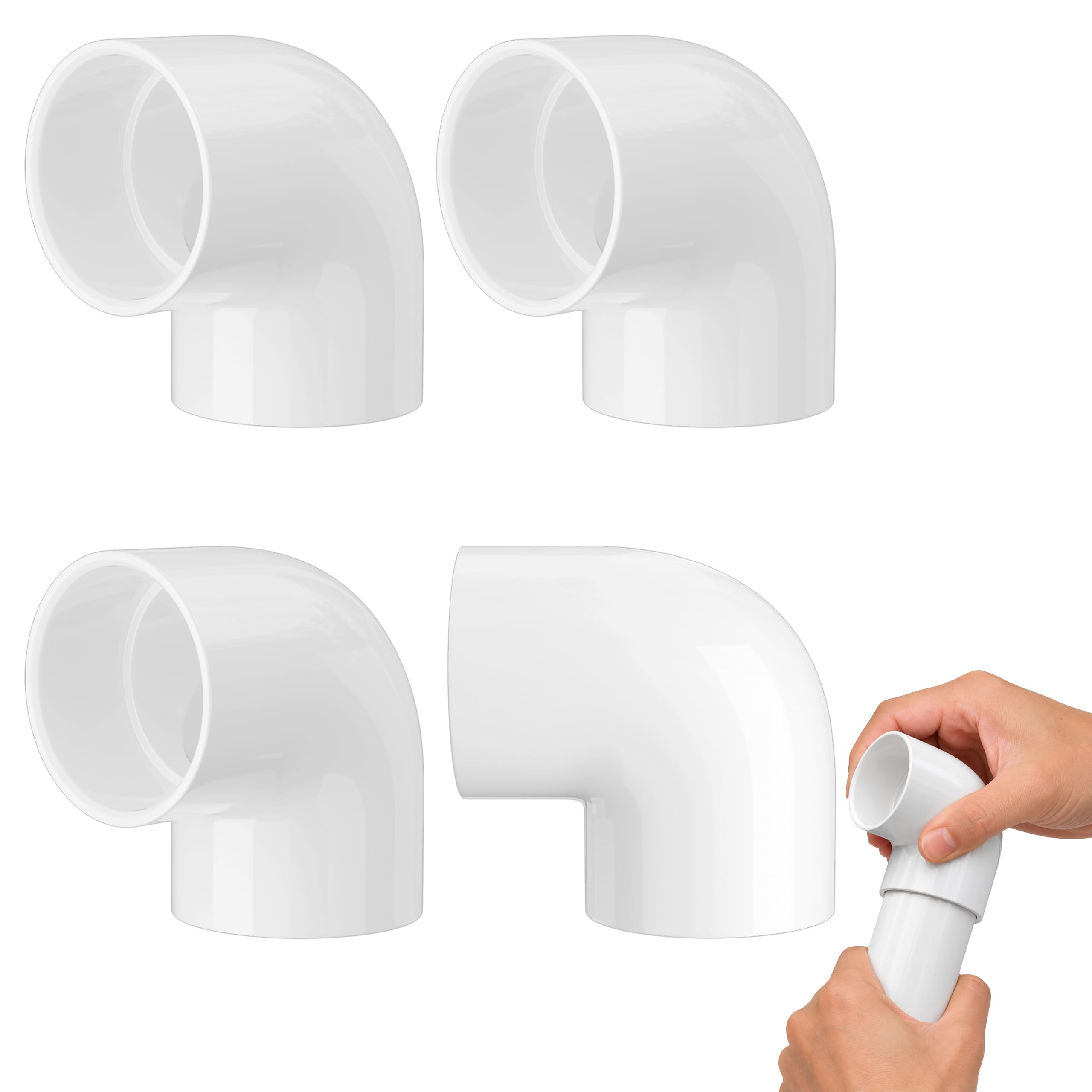
5. 4 Pcs 2 Inch PVC 90 Degree Elbow Fittings, Socket x Socket
Four SCH40 elbows aimed squarely at sprinkler layouts and garden plumbing.
The listing is unusually direct about sizing, and that is its best feature. These fit standard 2 inch SCH 40 PVC pipe with a 2.375 inch outside diameter, and the seller asks you to measure your pipe OD before ordering to avoid a loose fit. That single instruction heads off the most common mistake with socket elbows. You get four pieces of white Schedule 40 PVC in the pack.
The intended applications are laid out plainly: garden irrigation, sprinkler systems, greenhouse frames, storage racks, pet enclosures, and DIY furniture. Smooth socket openings make it easy to insert and align pipe, and the socket x socket design keeps corner joints square while you cement them. Installation is primer and solvent cement with no threading required. The material is a durable white PVC chosen for impact resistance and stable corner support.
Where this beats the four-pack at the top of the list is in the detail — the OD is spelled out plainly, which is exactly what a first-timer needs. Where it gives ground is breadth of track record; the other pack has far more buyers behind it. Both are Schedule 40 socket fittings meant for the same kind of work, so choose on which listing makes the sizing clearer for your pipe.
The standout detail: the 2.375″ outside diameter is printed right in the listing, so you can measure your pipe and know before you buy.
The trade-off: these are build-and-irrigation fittings, so do not press them into a hot or high-pressure line.
Best matched to: sprinkler and irrigation layouts where you need four corners and clean sizing.
Look past it if: you need a fitting rated for hot water or heavy pressure service.
6. SUPPLY GIANT CNOM0200 2″ 90 Degree Malleable Iron Elbow Fitting
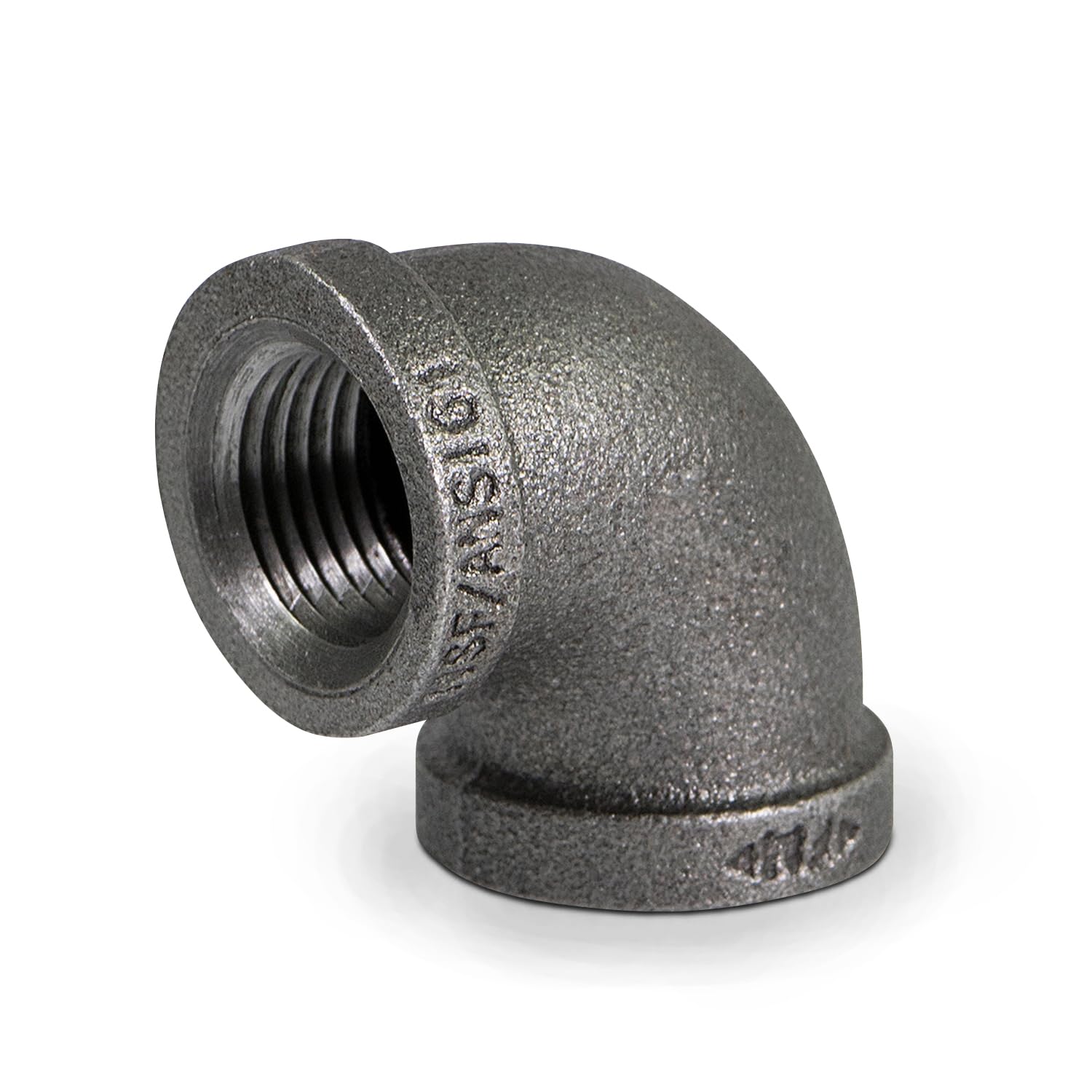
The odd one out in the best way: black iron with threads, built for pressure lines you may need to open again.
Everything else in this roundup is plastic and cements together. This one is malleable iron with female threads on both ends, so it screws onto male pipe and can be unscrewed later. It carries a 150 lb. application rating, which is the pressure class it is built for. If you are repairing a gas or water line with threaded pipe, this is the category of fitting you actually need — a PVC socket elbow will not thread onto it.
The black malleable iron construction is made for high-pressure service, and every fitting is pressure tested at the factory. It is approved by UL/ulc and FM and complies with applicable standards, which are the certifications to look for on a fitting that will carry pressurized media. The black finish is standard for this class of iron fitting.
It has the smallest review sample in this group, so treat it as a specialist for threaded pressure lines rather than a volume seller. It is sold as a single piece — one fitting, not a pack — so count your corners. What it buys you is permanence and re-serviceability that glued plastic cannot offer.
Why a threaded iron elbow earns its keep
- Female threads on both ends let you unscrew and re-service the joint later
- Rated for 150 lb. applications with factory pressure testing on every unit
- Approved by UL/ulc and FM and compliant with applicable standards
- Malleable iron handles high-pressure service that plastic cannot
Before you order
- One fitting per order, so a four-corner job needs four purchases
- Threaded iron only mates with threaded pipe, not socket PVC
For the pressure-line repair: this is the fitting when your pipe is threaded and the joint may need to come apart again.
Wrong tool if: you are working in white PVC — an iron elbow will not cement to plastic pipe.
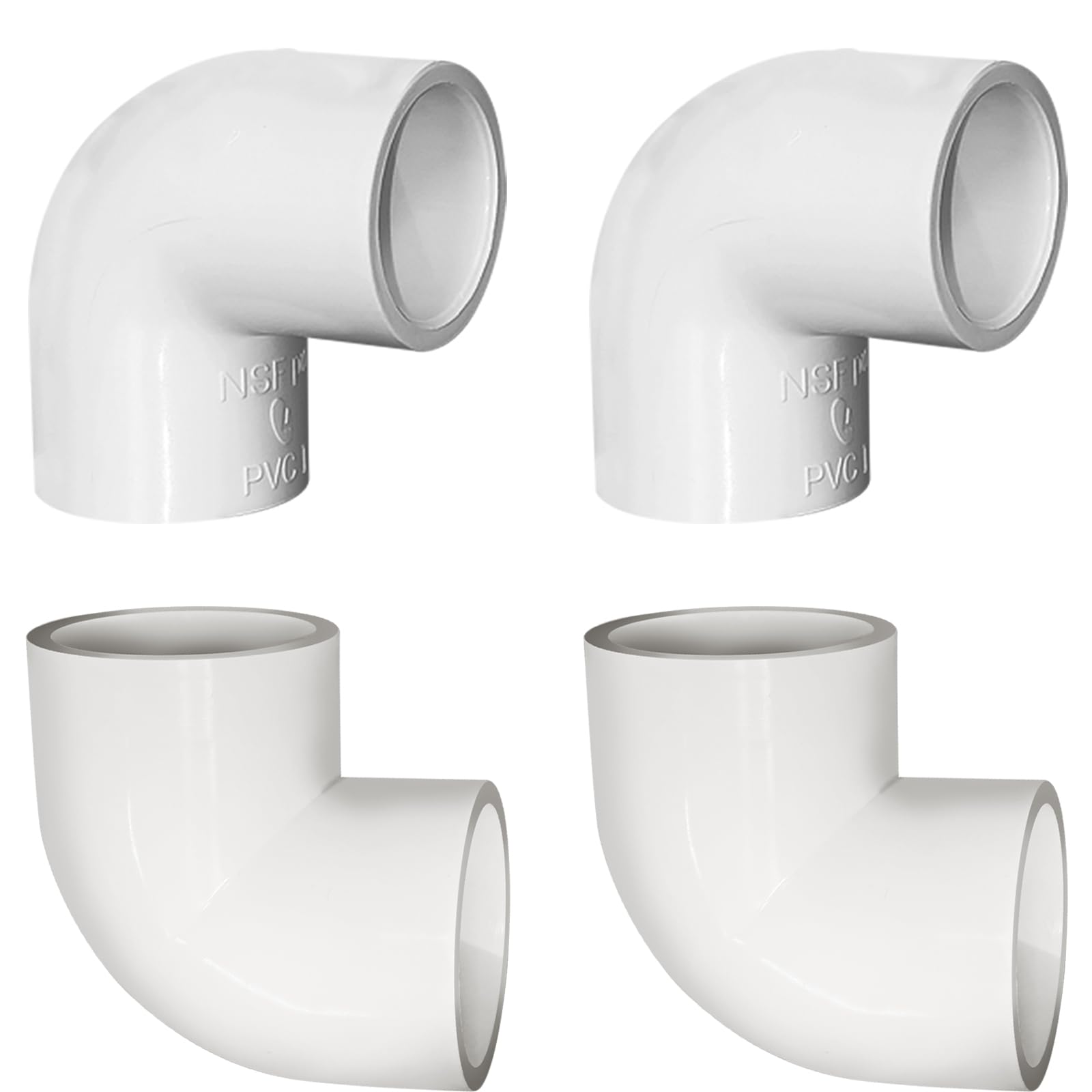
7. 2″ PVC 90 Degree Elbow, 2 Way Right Angle, 4Pcs (YTFSA)
Four elbows that name their pressure and temperature limits up front, which is rarer than it should be.
Two numbers make this listing easy to trust: a maximum operating pressure of 330 psi and a maximum temperature of 140° F (60° C). Those are the ceilings, and knowing them before you build beats guessing. You get four white socket elbows that fit 2″ inside diameter pipe with a 2.36″ outside diameter. That OD figure is worth measuring against your own pipe — it sits slightly under the 2.375″ claimed by some rivals here, and a socket that is off will not seat properly.
The extra-deep sleeve is the design detail that matters most in use. It lets the pipe slide further into the joint before the cement sets, which gives you a more secure hold on a corner. Installation is primer and solvent cement with no other tools required. The PVC is chosen for impact resistance and for standing up to frost and corrosion, and the fittings meet ASTM D2466 and D1784 and comply with NSF requirements.
Read the application list carefully: greenhouses, tent connections, cat enclosures, shelves, pool products, chairs, desks, raised beds, and garden supports. It is a long list, and it is a fair one for a furniture-grade Schedule 40 elbow. The listing is also explicit that these are for building and construction rather than irrigation. That is a useful line in the sand — if your plan is a sprinkler layout, buy a fitting the seller actually recommends for water service.
What stands out: a stated 330 psi pressure ceiling and a 140° F temperature limit, plus a deep sleeve that seats pipe further into the joint.
The line to respect: the maker says building and construction, not irrigation — so keep them out of sprinkler runs.
Suits you if: you are building furniture, enclosures, or garden structures and want the pressure and temperature limits stated plainly.
Choose differently if: the elbows are headed into a sprinkler or irrigation line.
8. 4PCS 2” PVC 90 Degree Elbow Corner Connector (Boltigen)

A high-gloss white four-pack for outdoor builds you want to keep looking clean.
The high-gloss white surface is the first thing to notice, and the maker says it resists yellowing outdoors. These are white PVC with a high-gloss surface that the maker says resists yellowing over time — a small thing until the frame is sitting in your yard and you would rather it stayed white. You get four pieces, and they fit 2″ inside diameter pipe with a 2.375″ outside diameter, so they match the standard 2-inch PVC most DIYers already have.
Fit is what carries this pick: the 2.375″ OD matches standard 2-inch PVC, and the deep sleeve seats pipe further before the cement sets. It is also the same 2.375″ OD figure the pbugac set uses, so if that size matches your pipe, both of these will seat properly. The body is PVC chosen to take shocks without cracking or breaking, with a stable chemical makeup that resists frost and corrosion. The extra-deep sleeve pushes the pipe further into the joint for a more secure hold before the cement sets.
Two applications get called out that the plastic-only crowd should note: pool products and outdoor structures. The listing states a maximum operating pressure of 330 psi and a maximum temperature of 140° F (60° C), and warns that these are for building and construction, not irrigation. There is also a stated warranty, so a bad unit has a route to resolution. Where this beats the pbugac set below is in the finish and the yellowing claim; where it gives ground is the higher outlay for the same four pieces.
The reason to pick this four-pack: a high-gloss finish built to stay white, plus deep sleeves and a stated warranty.
What you accept: a higher outlay than the other four-piece sets for the same core fitting.
The right buy for: pool builds and outdoor frames where the white finish is on show.
Think twice if: you just want the cheapest four corners and never look at them.
9. 5 Pack 2 inch PVC Elbow Pipe Fittings Schedule 40 (TALEGEN)

Five fittings in one bag, for the build where you know four corners will not be enough.
Buy more than you need and stop mid-build reorders. This pack hands you five white Schedule 40 elbows — one more than any other multi-pack here — for the same kind of corner-and-edge work. They fit 2″ inside diameter pipe with a 2.374″ outside diameter and have sockets on both ends for joining two male pipes. Five is a useful number on a greenhouse or a stepped shelf design, where a rectangular frame plus one extra corner is exactly the count you need.
The application list is broad and honest: indoor and outdoor structures, garden supports, storage frames, irrigation, underground sprinkler systems, pool products, and cold water lines. The material is high-impact PVC built to resist frost and corrosion, and it meets ASTM D2466 and D1784 and complies with NSF requirements. Installation is primer and solvent cement only. The listing spells out that the pipe slides into both socket openings, so this is the cement-together style, not a threaded fitting.
Review coverage on this one is thin compared with the top pick, so you are buying largely on stated spec rather than a long trail of owner experience. What the spec does give you is a full five-piece set with standards compliance and a wide application list. If your plan includes a pool or a cold water line, that counts. For a plain shelf frame, four pieces often finish the job and the fifth will sit in the drawer.
What you get: five SCH40 socket elbows, ASTM D2466 and D1784 compliance, and a stated clear span of applications from sprinklers to shelves.
The honest note: the review history here is shorter than the top pick’s, so lean on the spec and the standards rather than a crowd of owners behind it.
The pick for: a bigger structure where four fittings will not stretch and you would rather not reorder.
Only for: cold water, irrigation, and outdoor builds — not a pressure line that needs a heavier wall.
Understanding the Specs
Outside diameter versus nominal size
The “2 inch” on the box is nominal, a plumbing label rather than a measurement you can use with a tape. The number that actually decides whether a socket elbow fits is the outside diameter, and the listings here quote it as 2.36″, 2.374″, or 2.375″. Measure your pipe across its outer face before ordering. A socket that is slightly too small will not go on, and one too large leaves a loose joint even after the cement cures.
Schedule 40 versus Schedule 80
Schedule is about wall thickness. Schedule 40 is the standard furniture-and-irrigation grade you see in most DIY builds, and it does the job for shelf frames, greenhouses, and garden supports. Schedule 80 has a heavier wall for tougher service and its own standards — D2467 rather than D2466 — so keep Schedule 80 pipe with Schedule 80 fittings. A heavier wall means more pressure tolerance, but for a light indoor frame it mostly adds bulk.
Socket, barbed, and threaded ends
The connector type decides how the fitting joins your pipe. A socket end is a smooth bore that cements onto plain pipe permanently. A barbed end pushes inside flexible pipe and grips when a hose clamp is tightened. Threaded ends have female threads that screw onto male pipe and can be unscrewed later. None of the three interchange on the same joint, so this is the first thing to confirm before you buy.
Pressure and temperature limits
PVC fittings here state a maximum temperature of 140 degrees F (60° C) when a limit is listed, and the furniture-grade elbows state a maximum operating pressure of 330 psi. Those are ceilings, not targets. They tell you when a fitting is out of its depth — for example if a line runs hot or is pressurized above its stated rating. Read the limit on the listing you buy rather than assuming all plastic elbows in this size share a single rating.
FAQ
Will a 2 inch PVC elbow fit my existing 2 inch PVC pipe?
Can I use a socket elbow on a pressurized water line?
What is the difference between a socket elbow and a threaded elbow?
Do I need primer and cement, or does the fitting come with adhesive?
Can I use a 2 inch PVC elbow for irrigation and a sprinkler system?
What is the maximum temperature a PVC 90 degree elbow can handle?
How many elbows do I need for a rectangular shelf frame?
Will a Schedule 40 fitting work with Schedule 80 pipe?
Can I reuse a cemented PVC elbow after cutting it out?
Are these 2 inch elbows safe for potable drinking water lines?
Final Thoughts: The Verdict
The winner for most builds is the 4Pack 2″ 90 Degree Elbow PVC Pipe Fittings — four white Schedule 40 socket elbows that cover a full frame, fit 2″ inside diameter pipe with a stated 2.374″ outside diameter, and meet ASTM D2466 and D1784. Four corners, one pack, standard 2-inch PVC — no sizing guesswork. If your pipe is flexible PE tubing and you would rather use a clamp than cement, go for the Spears 1406 barbed elbow. And if the job is on a threaded pressure line, the SUPPLY GIANT malleable iron elbow is the one to reach for. Before you order any of them, get the outside diameter of your pipe with a tape — that measurement prevents most of the returns in this category.
How We Picked
We do not accept paid placement. Every pick is matched to a real buyer and a real use-case; we do not hands-on test units.
Sources & Methodology
Specifications: manufacturer listings and product documentation. Review insights: verified customer reviews, as of November 2026. Pricing: not shown on this page (it changes often); check the current price via the retailer link.
As an Amazon Associate, Gadgets Feed earns from qualifying purchases. This does not affect which products we feature.