
Our readers keep the lights on and my morning glass full of iced black tea. As an Amazon Associate, I earn from qualifying purchases.
Specs are compiled from manufacturer listings and verified buyer reviews and can change over time — please confirm the key details on the product page before buying.
If you want a dash cam that keeps watching after the engine is off — without threading a hardwire kit through your fuse box — a battery operated dash cam is the answer. The catch most buyers discover too late is that “battery powered” means different things across this category: some units carry a battery cell for parking-mode standby only, while continuous driving footage still needs the included power cable. The picks below sort that out clearly, so you know exactly what runs off the battery and what plugs in.
I’m Min — the founder and writer behind Gadgets Feed. This guide is built by comparing the manufacturers’ published specifications and the patterns across verified customer reviews, so you get each pick’s real strengths and trade-offs instead of marketing spin.
You will see which models ship with a memory card included, how each one handles night footage, and where the honest limits sit. Your right pick depends on what you need: four-way coverage, a true 4K plate shot, or a parking guard that survives up to two weeks without a wire. Use this list to judge the best battery operated dash cam for your own car.
Our Picks at a Glance
How To Choose The Best Battery Operated Dash Cam
Most dash cams are wired to the car’s power, so the battery here is not the main engine — it is the backup that keeps the camera alert while you are parked. Get that expectation straight first, and the rest of the shopping list falls into place fast.
Battery means parking protection, not endless driving footage
A built-in lithium battery lets the cam sit in a low-power standby while the car is off. When something bumps the car, it wakes and records a short clip. On units like the Baseus VD1 Pro, that protection is quoted at up to 14 days without a hardwire kit. Continuous recording while you drive still needs the included power cable plugged in.
So the question to ask is not “how many hours of driving video does the battery hold.” It is “how long will this cam guard my parked car, and does it come with a way to recharge that battery.” Solar charging, as on the Baseus, is the difference between plugging in and letting the sun top it up.
Resolution, field of view, and what your plate shot needs
Resolution is the detail in the frame — 4K UHD gives you the most pixels to read a plate at distance, 1296P sits below that, and 1080P is the common rear-camera tier. Wider field of view in degrees shows more road but bends the edges. A 360° four-channel setup like the Icesky shows front, rear, left and right at once, while a 140° single-lens cam puts all its pixels into one clean view.
Memory card, night vision, and the wiring caveat
Every pick here either ships with a card or lists its max supported size, and that ceiling decides how far back your footage goes before loop recording overwrites the oldest file. Night vision comes in flavors: IR lights (infrared LEDs that light up the dark) on side or cabin cameras, and STARVIS sensors (Sony’s low-light imaging chips) for color detail after dark. Ask whether the 24-hour parking mode needs a separate hardwire kit — several of these do, and it is not in the box.
Quick Comparison
| Model | Best For | Max Resolution | Field of View | Max Card Support | Amazon |
|---|---|---|---|---|---|
| Icesky 4K 4-Channel★ Best Overall | Full 360° coverage | 4K front / 1080P rear, left, right | 360 degrees | 512 GB | Amazon |
| Pelsee S1 ProPremium Pick | Dual true 4K front and rear | 4K front + 4K rear @30fps | 170 degrees | 1 TB | Amazon |
| Baseus VD1 Pro | Solar battery parking guard | 4K front + 1080P rear | 140 degrees front | 512 GB | Amazon |
| 70mai M310 Plus | Single-lens 4K clarity | 4K UHD front | 140 degrees | 256 GB | Amazon |
| SUVCON 3-Channel | Budget triple-camera kit | 1296P front | 170 degrees | 32 GB | Amazon |
| Garmin Dash Cam Live | LTE live view monitoring | 1440p | 140 degrees | — | Amazon |
In‑Depth Reviews
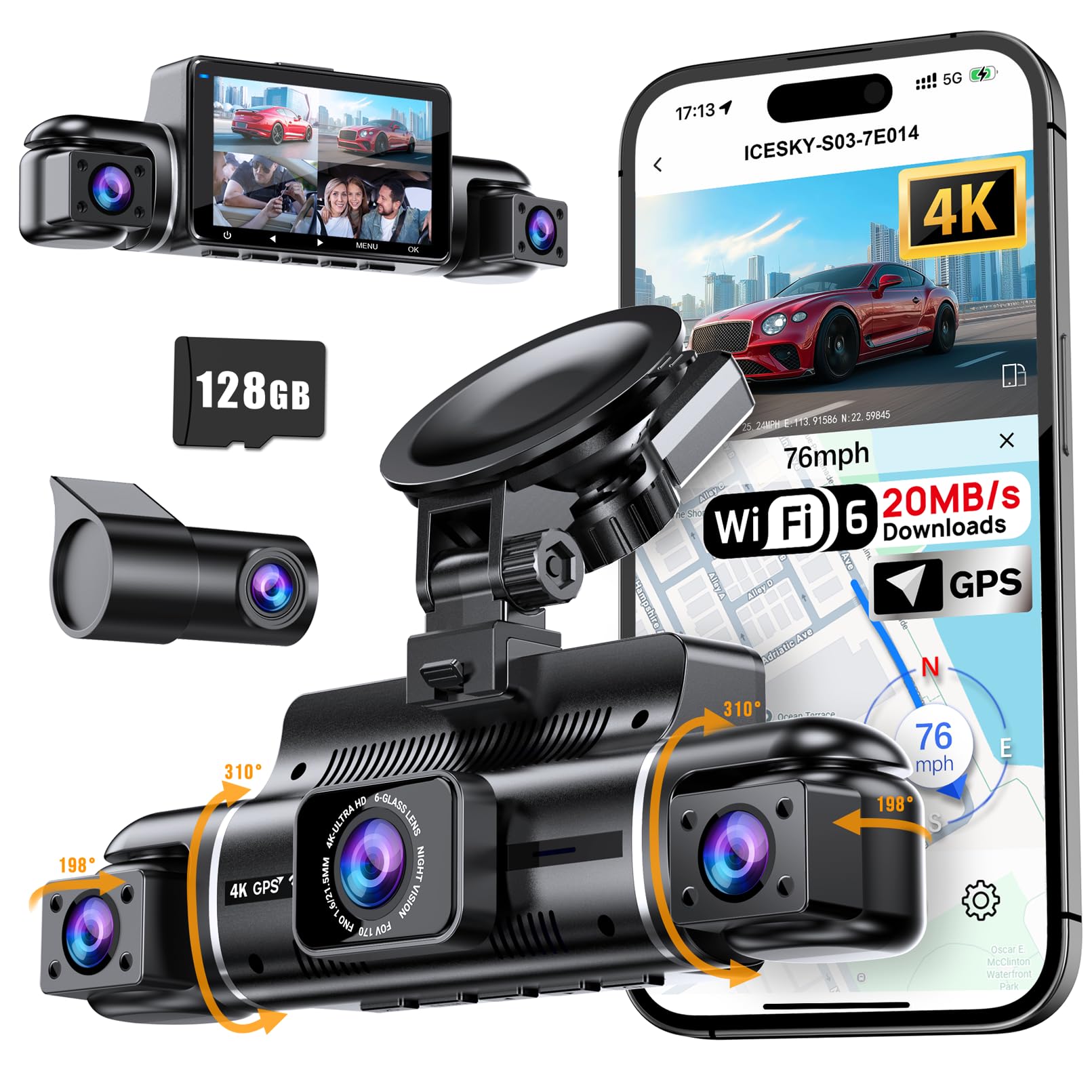
1. Icesky 4K Dash Cam Front and Rear Left Right with GPS, 20MB/s WiFi 6
Our pick — 4.5+★ from 250+ verified ratings; the strongest balance of quality and price.
Four cameras, one screen, and no blind spot left uncovered — the full-perimeter pick.
This is the one that records in every direction at once. The Icesky S03 captures 4K from the front lens and 1080P from the rear, inside, left, and right cameras at the same time — a full 360° field of view. That is the widest view in this whole list by a wide margin. For a plain sense of the gap: the 70mai M310 Plus below covers 140°, while this Icesky covers 360°.
Two cameras get you accused-of-nothing confidence. Four get you the whole picture — the car that swung out of the side street, the scooter that clipped your mirror, the parking-lot knock from the left. The built-in 3-inch screen shows multiple views together, so you are not guessing which angle caught the moment. Recording starts clean from the start because a 128GB microSD card comes in the kit. That is 128GB versus the 32GB card you get from the SUVCON triple-camera pick, and the Icesky supports up to a 512GB U3 card if you want a longer history.
Getting files off the camera is where a lot of dash cams stumble. The 5.8GHz WiFi 6 here moves downloads at up to 20MB/s over the app, so you can preview and share clips without pulling the card. GPS stamps speed, route, location, and time onto every clip, which is the kind of evidence an insurance adjuster actually wants. And 8 IR lights (infrared lamps that see in the dark) guard the left and right lenses after dark. That is 8 versus the 4 IR LEDs on the SUVCON cabin camera. You can switch the side infrared on independently, so you do not wash out the other views.
The case for the four-way view
- 360° coverage from four simultaneous cameras — front, rear, left, right
- 128GB card included, expandable to 512GB for a longer recording history
- 5.8GHz WiFi 6 app downloads at up to 20MB/s, no card removal needed
- 8 side IR lights for low-light side-view recording, independently controllable
- Built-in GPS records speed, route, location, and time
What to know before you mount it
- The 24-hour parking mode needs a hardwire kit, and it is not included — sold separately
- Four channels means four lenses to aim and four cables to route on install day
- Side views fall to 1080P while the front records 4K, so detail is uneven around the car
Buy this if: you want every angle covered and you would rather buy a card-included kit than piece it together.
Budget the extra: the parking-mode hardwire kit, since the 24-hour guard does not run without it.
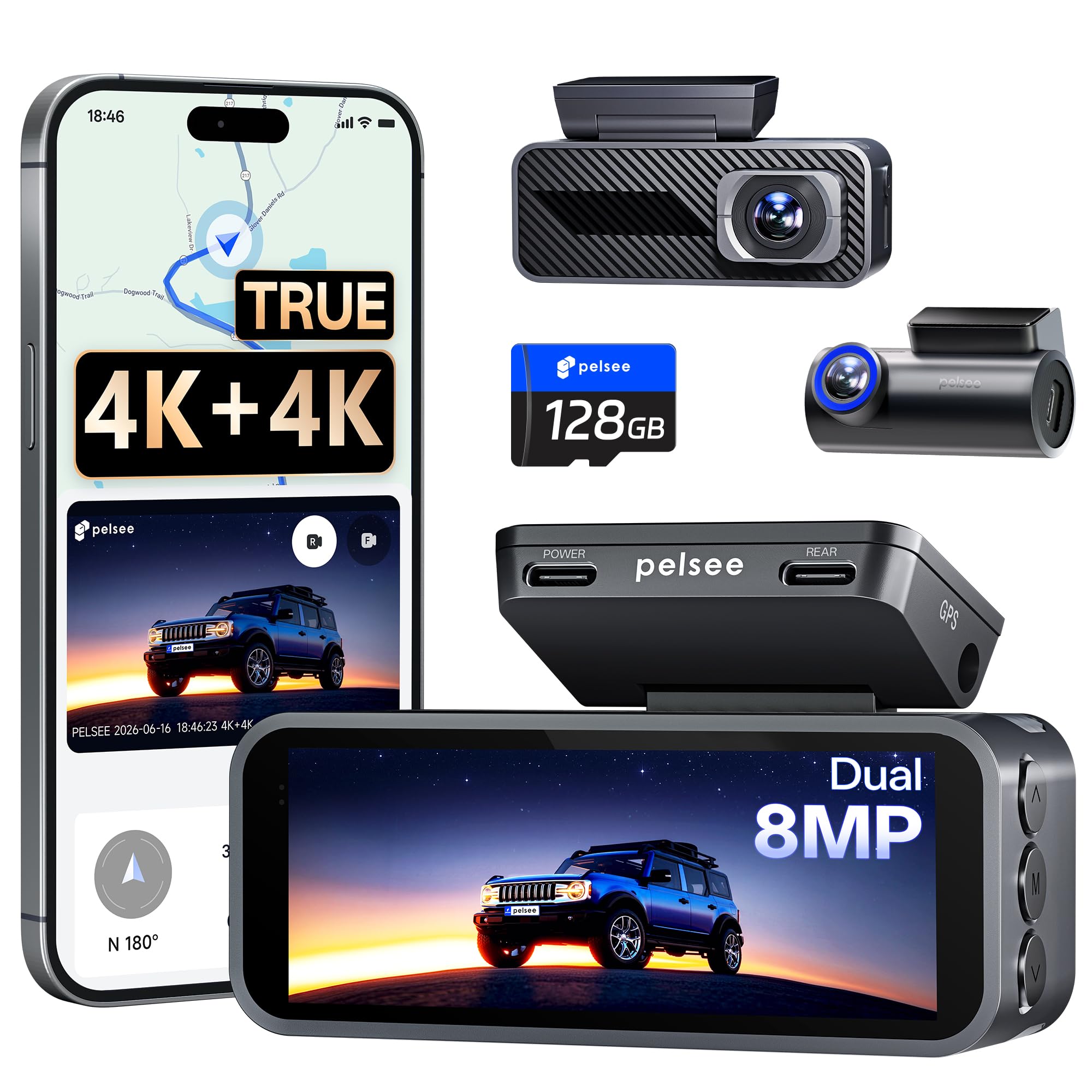
2. Pelsee S1 Pro Native Dual 4K Dash Cam Front and Rear, 128GB Card Included
True 4K out the front, true 4K out the back — no upscaling tricks on either lens.
Most dual-camera cams give you 4K up front and a softer rear view. The S1 Pro puts an 8MP sensor on both cameras, so the rear footage is native 4K too — 3840x2160P at 30fps from each lens. That matters when a tailgater hits you from behind and the only plate in the frame is on the rear camera.
The front lens opens to 170°, which is the same width as the budget SUVCON’s front camera but backed by a much sharper image. HDR (high dynamic range, which evens out blown highlights and deep shadows) keeps headlights from blowing out a plate in a tunnel. The F1.4 aperture lens and a color night-vision sensor are built to hold color in a dim garage instead of falling back to grainy black-and-white.
Storage is where this one really separates itself. It ships with a 128GB card and stretches to 1TB of supported storage — the largest ceiling on this list. Against the SUVCON’s 32GB cap, that is a far longer recording history before loop recording starts overwriting. Dual-band WiFi 6 covers 2.4GHz and 5.8GHz at up to 30MB/s, faster than the Icesky’s 20MB/s. Voice control keeps your hands on the wheel for locking footage or snapping a photo, and the 3.39″ IPS screen plays clips back on the spot. Our one fair caution: this is a newer model with a smaller track record than the long-listed picks, so the parking-mode hardwire kit (sold separately) is worth planning for.
The honest read: Dual native 4K plus a 1TB storage ceiling is the most future-proof combination here. The design is compact and installs with 3M adhesive and included DIY accessories.
One thing to plan: the 24-hour parking surveillance needs that separate hardwire kit, so factor it into your setup.
Best fit: rear-end-collision-prone commuters and rideshare drivers who need a sharp plate shot from both ends of the car.
Look elsewhere if: you want a long, long-established review trail over a newer but more capable unit.
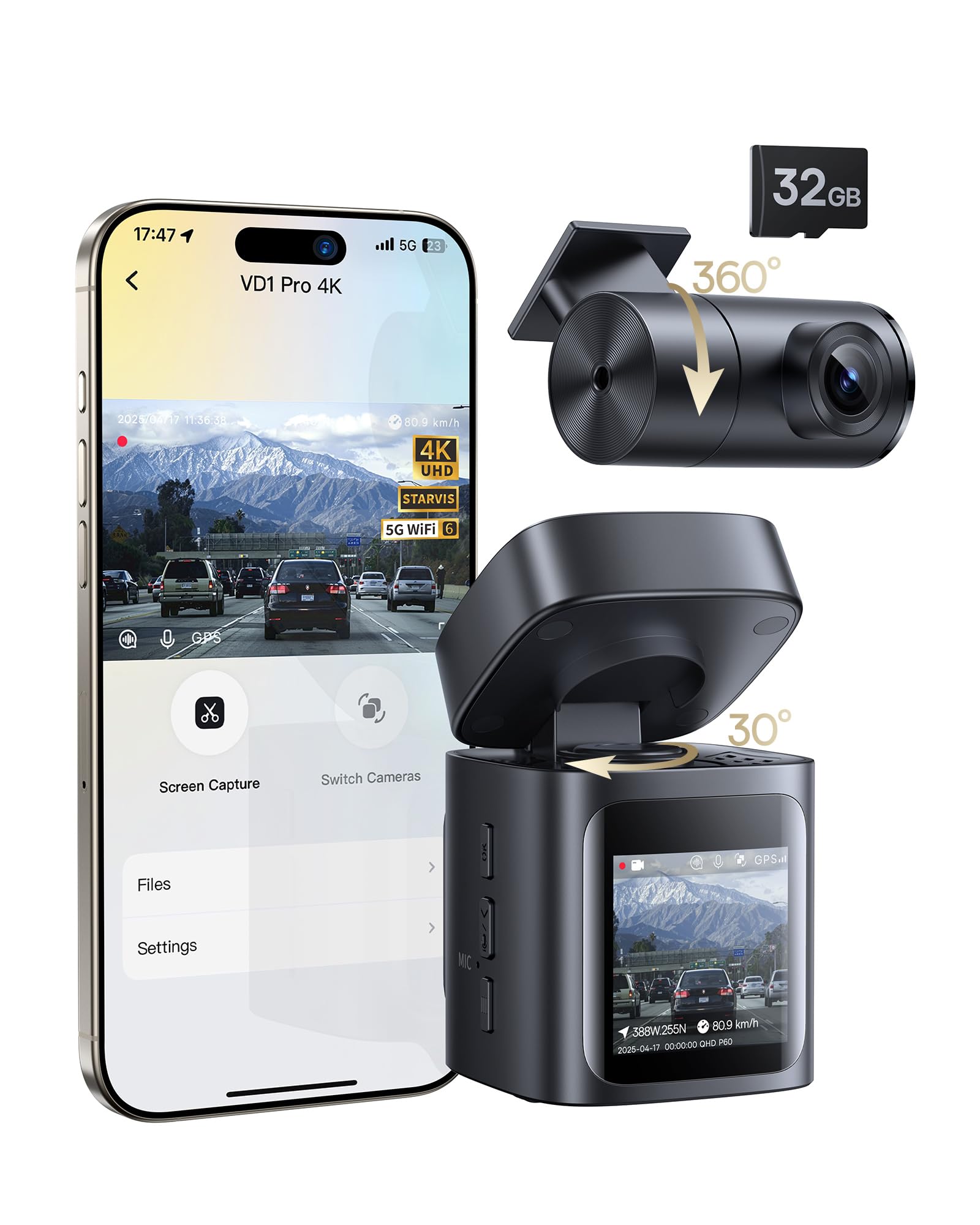
3. Baseus VD1 Pro Solar Dash Cam Front and Rear, 4K+1080P
The only pick that recharges from the sun — a parked-car guard with no wire in sight.
Here is the battery story done right. The Baseus Solar Sync System and its built-in lithium battery keep parking protection alive for up to 14 days without a hardwire kit. When the car is off, it drops into low-power standby and wakes to record a 30-second clip the moment it senses a collision. That is the whole point of a battery operated dash cam, and this one delivers it without a fuse tap.
Be clear on the split, because the brand is honest about it: solar and battery power cover parking protection and event-triggered recording only. Continuous footage while driving needs the included power cable connected, and the rear camera needs its wired link too. So it is not a cordless cam for the road — it is a cordless guard for the parking lot.
The front lens shoots 4K UHD HDR (ultra-high-definition with high dynamic range, so bright and dark areas both stay readable) at 140°, with the rear at 1080P over 120°. Night capability rests on an IMX335 STARVIS sensor (a light-sensitive image chip built for low light), a 6-layer glass lens, and an f/1.6 aperture (a wide opening that lets in more light) to pull detail out of near-darkness. 5GHz WiFi 6 pushes downloads the maker says are up to 3× faster, and the Baseus App handles preview, GPS data, and updates. Voice control is in English for hands-free work. Owners consistently praise the 4K front footage and STARVIS low-light detail. The recurring gripe is the split-of-use caveat: some find the night view dimmer than expected, and app viewing only works with your phone near the car on its WiFi.
Why it earns a spot: 14 days of unwired parking protection is a capability no other pick on this list matches.
The trade-off: it is a parking guard first and a driving recorder second — the driving footage still needs the cable.
Reach for this if: street-parking or lot-parking anxiety is your main reason for buying, and you want the battery to do the heavy lifting.
Think twice if: you expected the battery to power continuous driving recording — plan on the included cable for that.
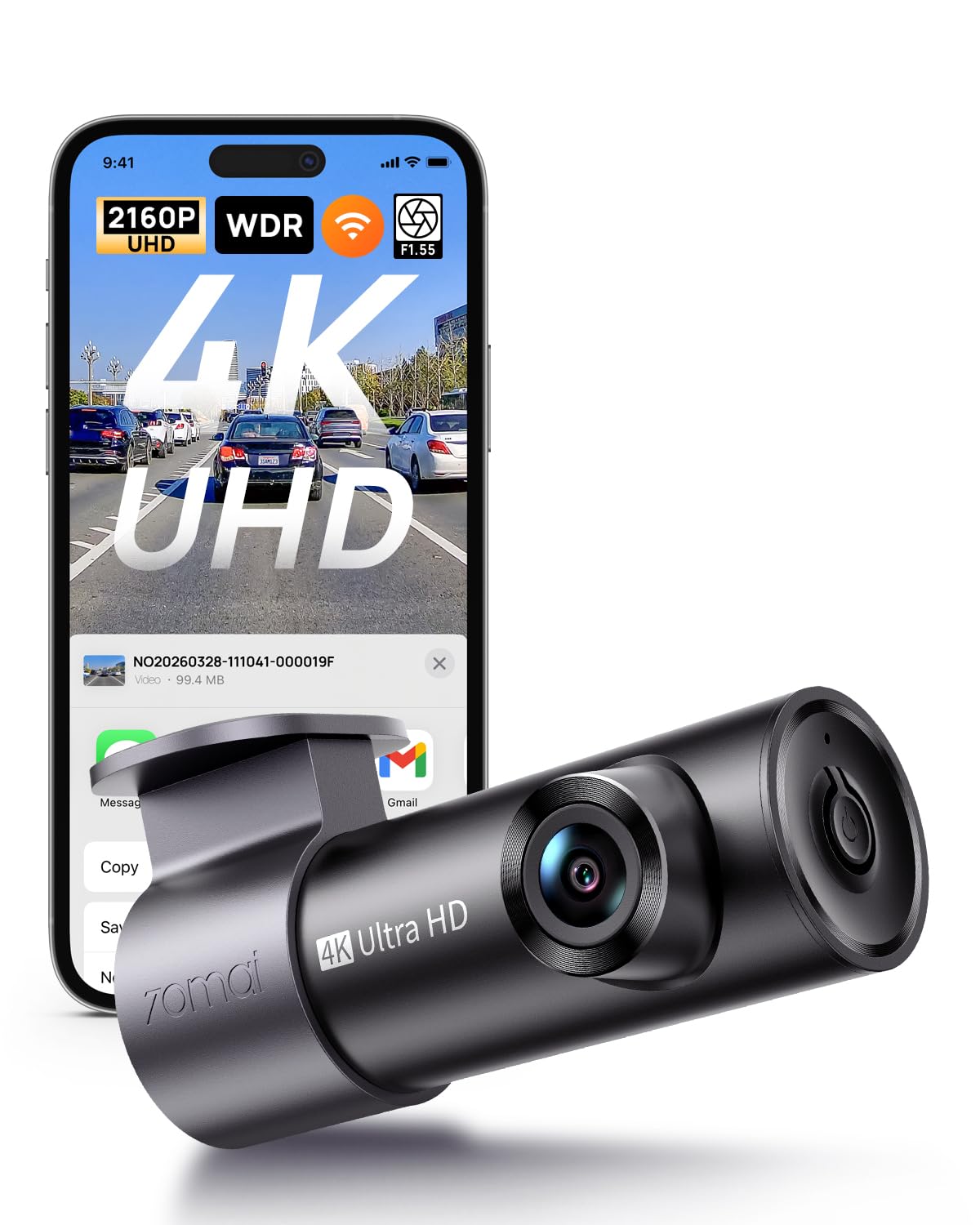
4. 70mai M310 Plus 4K Dash Cam Front with Night Vision, 140° Wide Angle
No rear camera, no extra cables — just one 4K lens pointed where it counts.
If your worry is the road ahead and nothing else, the M310 Plus puts every pixel into a single 4K UHD front lens at 140°. Plates, road signs, and street names all sharpen up. It is the simple, honest setup: one camera, one cable, no multi-view busywork.
Night work leans on an F1.55 large aperture (a wider lens opening that lets in more light) plus WDR and 3D noise reduction. Together they tame headlight glare and lift detail on unlit roads, in tunnels, and in rain. The pre-recording feature is the thoughtful part — when the G-sensor detects an impact, it locks up to 1–3 minutes of footage from before the collision. So the clip captures what led up to the hit, not just the moment of contact.
Parking mode brings time-lapse recording and low-voltage protection at 11.8V to keep your car battery from draining, though that mode needs the UP03 or UP06 hardwire kit, sold separately. App control and voice operation let you lock clips and grab photos without reaching for buttons. Owners praise the residue-free adhesive mount, which makes moving it between cars easy. The recurring gripe is app pairing: some find it finicky, and a few report random recording stops. It is worth formatting the card in-camera first and keeping the app updated.
Where it shines
- True 4K UHD front footage with a 140° view
- F1.55 aperture plus WDR for clearer night driving
- Pre-recording locks 1–3 minutes before an impact
- Residue-free install that moves easily between cars
Where it asks patience
- Parking mode needs the UP03 or UP06 hardwire kit, sold separately
- App connectivity and recording reliability draw mixed feedback
- No display and no rear camera — front-only by design
The right buyer: single-vehicle, front-focused drivers who want the cleanest one-lens 4K shot and a fast install.
Be ready to troubleshoot: keep the app current and format the card in-camera to sidestep pairing hiccups.
5. Dash Cam Front and Rear, 1296P Dash Camera for Cars, 3 Channel Car Camera
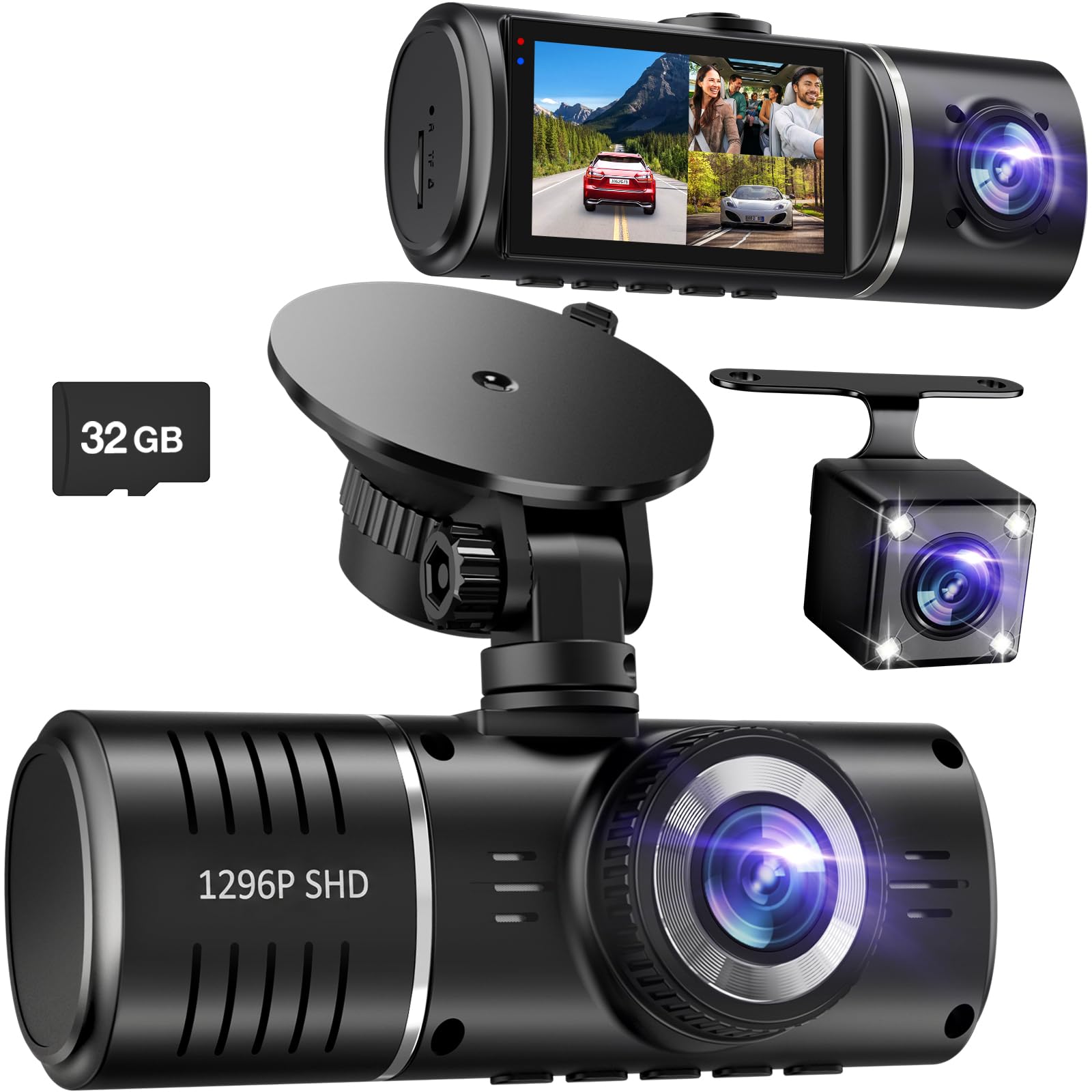
Three cameras for the price of a single-lens kit — the budget triple threat.
Want road, cabin, and rear coverage without spending much? This SUVCON unit runs three cameras at once: a 170° wide-angle front, a 150° cabin cam, and a 150° waterproof rear cam. That 170° front view matches the Pelsee’s width, though the resolution tops out at 1296P rather than 4K. The IPS screen stays readable from any seat angle, which is a real convenience when you are checking a clip roadside.
Night work comes from 4 infrared LEDs on the cabin-facing camera plus HDR to balance harsh lighting. The G-sensor locks footage on sudden vibration, loop recording overwrites the oldest file so you never run dry, and a 32GB card is in the box. At 32GB max, though, this is the shortest recording history on the list — the Icesky’s 512GB ceiling and the Pelsee’s 1TB sit well above it.
Install is genuinely simple: mount it, plug in the 11.48ft charger cable, and go. Owners praise the plug-and-play setup: mount it, plug in the 11.48ft cable, and record. The honest caveat is long-term reliability: a slice of buyers report recording stopping over time. For a budget triple-cam, that is the trade to weigh: if you need bulletproof uptime above all, spend up; if you want three angles cheap, it fits.
What you get for the tier: front, cabin, and rear cameras, a 32GB card, and a plug-and-play install for first-timers.
The catch: 32GB fills fast and loop-recording reliability is the mixed part — check the card regularly.
Pick it for: a first dash cam or a second car, where three-angle coverage beats one sharp lens.
Skip the idea of it if: you need a long recording history or rock-solid uptime — the card cap and reliability tilt toward a step up.
6. Garmin Dash Cam Live, 24/7 Live View, Always-Connected Dash Cam

A dash cam with its own phone line — watch your car from anywhere with a signal.
This is the odd one out, and on purpose. The Garmin Dash Cam Live carries an always-on LTE connection so you can pull a live view and share saved video from the Garmin Drive app, wherever the car is. That requires an active LTE subscription — nothing here is free-to-air. It also enables location tracking, theft alerts, and a parking guard that pings you when something touches your parked car (some vehicles need the constant power cable, sold separately).
Picture quality is 1440p HD through a 140° lens with Garmin Clarity HDR, recording at 60 FPS, and footage auto-uploads to the secure online Vault for viewing and sharing. It shoots at a higher frame rate than the 30 FPS Pelsee and Icesky, which smooths fast-motion detail. Voice control in several languages saves clips and snaps stills hands-free. The 16GB microSD card comes pre-installed, so it works straight from the start.
Now the honest part, because a buyer deserves it: reviews here are genuinely split. The connected features are impressive in theory, but reliability and connectivity are the most-discussed pain points — some owners mention the cam failing when they need it or dropping its WiFi or LTE link. The live view draws the same doubts: customers note the LTE feed dropping when they check on the car. If a always-on connection is what you are paying for, weigh that mixed record carefully; if you mainly want reliable in-car recording, a wired pick up the list serves you better at lower cost.
what separates it: LTE live view (a cellular connection that streams video to your phone from anywhere), theft alerts, and the Vault for remote footage — features the other picks cannot touch.
The honest caution: connectivity and reliability are the most-reported concerns, so treat the subscription as a leap of faith until it proves steady for you.
Worth it if: remote live monitoring of a parked car matters more to you than in-car simplicity, and you accept the needed LTE subscription.
Pass if: you want set-and-forget recording without a monthly plan or connectivity risk — a wired unit is the safer bet.
Understanding the Specs
Battery standby versus continuous recording
On a battery operated dash cam, the battery keeps the camera alive while the car is parked — it wakes to record a short clip when the G-sensor senses a bump. The Baseus explains this split directly: up to 14 days of parking protection from its battery and solar panel, with continuous driving footage still needing the included power cable. Read every listing with that in mind, and “battery life” means how long the parking guard lasts, not how long you can drive cordless.
Resolution and field of view
Resolution is the pixel detail in the frame — 4K UHD holds the sharpest plate shot, 1440p and 1296P sit below it, and 1080P is common on rear and side lenses. Field of view is the spread of road in degrees: a 170° lens shows more width but bends the edges, while a 140° lens keeps the shot cleaner. A 360° four-channel setup trades per-camera detail for wrapping all the way around the car.
Night vision: IR lights and STARVIS
IR lights are infrared LEDs (invisible light that a camera can see) that brighten the dark for a lens — the Icesky runs 8 of them on its side cameras, the SUVCON runs 4 on its cabin camera. STARVIS is a low-light sensor line that holds color and detail after dark, which is what the Baseus leans on with a 6-layer glass lens and f/1.6 aperture. Neither makes black night into daylight; they reduce noise and glare so plates stay readable.
Memory card and loop recording
The card decides how far back your footage reaches. Loop recording overwrites the oldest open up clip once the card fills, so a bigger card means a longer history — from the SUVCON’s 32GB cap up to the Pelsee’s 1TB support. A G-sensor locks impact clips into a protected folder so they survive the overwrite. Several picks ship with a card included, which saves you a separate purchase.
FAQ
Does a battery operated dash cam record while the car is off?
Can I run the dash cam entirely on battery while driving?
Do I need a hardwire kit for 24-hour parking mode?
What is the difference between 4K and 1296P on a dash cam?
Will a 360° four-camera setup show all angles clearly?
How large a memory card can these dash cams take?
Is the Garmin LTE live view worth the subscription?
Do these dash cams come with a memory card in the box?
How does night vision work on a battery operated dash cam?
Can I move the dash cam between two cars?
Final Thoughts: The Verdict
The four-way coverage on the Icesky 4K is what makes it the pick to beat: front, rear, left, and right at once, a 128GB card in the box, and 8 side IR lights for night work — the widest view here. If your worry is a clean plate shot from both ends of the car, the dual native 4K Pelsee S1 Pro leads on rear detail and stretches storage to 1TB. And if parking protection without a wire is the whole reason you are shopping battery powered, reach for the Baseus VD1 Pro — up to 14 days of solar-backed guard is a capability nothing else on this list offers. One honest nudge: the Icesky’s strong owner track record is the safest place to start if you are unsure, but read the parking-mode note first so the hardwire kit does not catch you out.
How We Picked
We do not accept paid placement. Every pick is matched to a real buyer and a real use-case; we do not hands-on test units.
Sources & Methodology
Specifications: manufacturer listings and product documentation. Review insights: verified customer reviews, as of November 2026. Pricing: not shown on this page (it changes often); check the current price via the retailer link.
As an Amazon Associate, Gadgets Feed earns from qualifying purchases. This does not affect which products we feature.