
Our readers keep the lights on and my morning glass full of iced black tea. As an Amazon Associate, I earn from qualifying purchases.
Specs are compiled from manufacturer listings and verified buyer reviews and can change over time — please confirm the key details on the product page before buying.
Buying resin is the cheapest part of resin printing — and the one that decides whether your prints come out sharp or end up in the bin. The right bottle holds fine detail through wash-and-cure, keeps its colour, and stays low-odour enough for a spare room. This guide groups seven genuinely different resins by what they actually do well, so you can match the bottle to the job instead of guessing from the label.
I’m Min — the founder and writer behind Gadgets Feed. This guide is built by comparing the manufacturers’ published specifications and the patterns across verified customer reviews, so you get each pick’s real strengths and trade-offs instead of marketing spin.
Every resin here is a photopolymer (a liquid plastic that hardens under UV light), but they behave nothing alike under the same printer. Below you’ll find the strength resins, the water-washable one, the crisp craft option, and the flexible rubber type — plus the honest catch on each. This is your shortcut to the right bottle of 3d printer resin.
Our Picks at a Glance

How To Choose The Best 3D Printer Resin
Match the resin to the print, not to a price tier. A bottle built to hold a thread will disappoint you on a tabletop miniature, and the reverse is just as true. Nail these four specs and the rest is exposure tuning.
Match the resin type to the print
Standard resin is the everyday workhorse — it prints fast and holds detail, which is why it suits miniatures and display models. ABS-like resin swaps some of that for toughness, bending under stress instead of shattering, so it fits brackets, jigs and anything that gets handled. Flexible resin trades rigidity for bend, which is what you want for gaskets and grips.
Check wavelength and printer fit
Almost every LCD and DLP printer cures at 405nm, and most resins list a 365–405nm band, so compatibility is rarely the problem. The real variable is your exposure time per layer — a bottle that cures quicker can change your whole print schedule. Always run a small exposure test before committing a full plate.
Viscosity and room temperature
Thin resin flows back under the build plate faster, which means fewer failed layers on tall prints. Cold workshops thicken resin and cause more release-force problems, so keep your printer in a spot that stays warm if your resin feels syrupy. A low-viscosity bottle gives you more margin on a chilly day.
Quick Comparison
| Model | Best For | Type | Wavelength | Bottle Size | Amazon |
|---|---|---|---|---|---|
| ELEGOO ABS-Like 3.0+ Grey★ Best Overall | All-round default | ABS-Like | — | 2000g | Amazon |
| ANYCUBIC Water Washable 2.0 ClearEasiest Cleanup | Easy cleanup | Water-Washable | 365-405nm | 1kg | Amazon |
| SUNLU Upgraded Standard Grey | Beginners | Standard | 365-405nm | 2000g | Amazon |
| Siraya Tech Craft Ultra-Clear | crisp display pieces | Clear Craft | 405nm | 1kg | Amazon |
| ANYCUBIC ABS-Like Pro 2 Bundle | Tough structural parts | ABS-Like Pro | — | 2kg | Amazon |
| SuperFlex Shore 80A Clear | Bendy rubber-like parts | Flexible | — | 1000g | Amazon |
| Siraya Tech Build Sonic Grey | Threaded, dimensionally exact parts | Engineering | UV-Curing | 2kg | Amazon |
In‑Depth Reviews
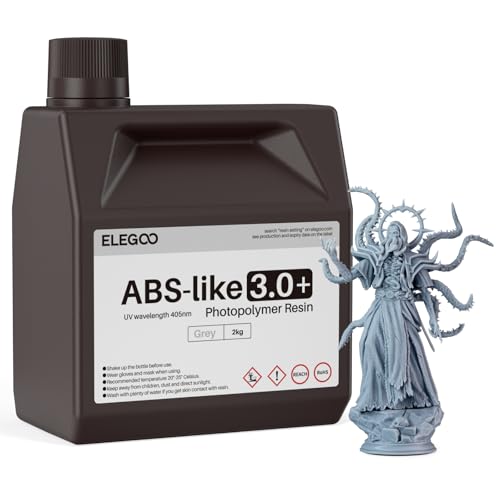
1. ELEGOO ABS-Like 3.0+ 3D Printer Resin Grey 2000g
Our pick — 4.5+★ from 550+ verified ratings; the strongest balance of quality and price.
The bottle that holds its shape in a hot car and takes a knock without spider-webbing.
A 2000g grey that stays rigid at temperatures up to 55°C (131°F) — that is the manufacturer’s heat-resistance figure, and it is the reason this one earns the top slot. It means a bracket left in a warm room or on a dashboard keeps its printed shape instead of sagging. The maker also claims printed parts can be tapped and drilled without cracking, which puts a lot of practical jobs within reach of a standard machine.
What wins people over is consistency. This is a resin where buyers report a wide exposure window for success — owners mention hitting good prints somewhere between 1.8s and 2.2s per layer, which is a forgiveness margin you feel on your first plate. The high-fluidity formula floods back under the build plate quickly, and that alone reduces the release-force failures that ruin tall prints. At 4.41 pounds, the two-kilo bottle is noticeably heavier to lift than the 2.61-pound ANYCUBIC water-washable, but it buys you double the material in one pour.
The catch is the curing speed. Fast curing is a plus for throughput and a trap for anyone who skips an exposure test — overcook it and fine detail softens at the edges. Odour is low enough for most indoor setups, though it is still a photopolymer and deserves ventilation. Durability feedback splits between buyers who find parts genuinely tough and those who still treat thin features gently, so size your walls with that in mind.
Where it wins
- Holds mechanical properties at up to 55°C, so parts survive warm rooms and gloveboxes.
- High-fluidity formula refills under the plate fast, cutting release-force failed layers.
- Low shrinkage keeps dimensions closer to what you modelled.
- Tapping and drilling without cracks opens up functional brackets and fixtures.
Where it asks for care
- Fast cure rewards a tuner and punishes sloppy exposure settings.
- The 4.41-pound two-kilo bottle is heavier to handle during a pour.
- Still needs ventilation — low odour is not no odour.
Buy it for: anyone who wants one grey bottle that prints miniatures and functional parts without changing settings twice.
Think twice if: you rely on eyeballing exposure — this resin cures quickly and rewards a quick test print.
2. ANYCUBIC Water Washable Resin 2.0, 405nm (Clear, 1kg)
Skip the alcohol entirely — this one rinses in a tub of water instead.
This bottle saves you the cleanup hassle: hydrophilic groups (water-loving molecules) in the formula let cured prints wash directly in water, so you never buy isopropyl alcohol for post-processing again. A viscosity of 150–250MPa·s at 25°C — that is a thin, fast-flowing liquid — means the resin rushes back into the gap under the build plate each layer, which is exactly what lifts your success rate on a tall print. At 2.61 pounds, it is also the lightest bottle here by a clear margin.
It handles a wide 365–405nm band, so it works on basically any LCD or DLP printer you already own. An upgraded formula resists the shrinkage that causes models to crack during the photo-curing stage, and the shelf life stretches to a year and a half if you store it properly. Give the bottle a full shake before use — the maker is specific about this, and skipping it gives you patchy colour in the print.
The honest trade-off is brittleness. Some buyers find parts tough enough for their needs, and others find thin features snap too easily under pressure. Wash the prints thoroughly before curing, because trapped water inside a hollow model is its own kind of trouble.
Cleanup economics: the water-wash route cuts a recurring consumable out of your workflow, which matters more than any single spec once you are printing weekly.
Shelf-life bonus: a year and a half of storage is generous for a resin you use in bursts.
Choose it if: you are tired of buying and storing alcohol and want a light bottle that pours easily.
Look elsewhere if: your prints are structural and need to absorb impact.
3. SUNLU Upgraded 2KG Standard 3D Printer Resin, 405nm (2000g Grey)

A newcomer-friendly grey in a bottle built to survive the delivery van.
For a first bottle, you want three things: predictable behaviour, easy cleaning and enough material that you are not reordering mid-project. This 2000g standard resin hits all three, and the leak-proof bottle design — a patented closure the maker is proud of — is the quiet detail that saves your shelf from a delivery-damaged disaster. The package arrives at 10.94 x 7.6 x 3.11 inches, which is a wider, flatter footprint than the 10.04 x 4.57 x 4.57-inch ELEGOO bottle, so it sits more stably on a low shelf.
Strong fluidity makes it forgiving on different printers and print speeds, which is why it is a sensible starting point if you have not dialled in your machine yet. Curing shrinkage is low, so the part coming off the plate matches the part you modelled. Post-processing is straightforward too: the surface cures hard and smooth, and it takes paint well if you are building hand-made pieces. Once printed, cleaning with isopropyl alcohol or ethanol gives you a smooth finish without scrubbing.
The mixed feedback worth knowing is on adhesion and durability — some users fight first-layer grip, and others find finished parts less forgiving than a dedicated ABS-like. It also tolerates weak acids and greases, so it is fine for most everyday jobs but not a substitute for a chemical-resistant engineering resin. Minimal odour during printing keeps it manageable in a garage or shed.
Why beginners like it
- Strong fluidity works across different printers and printing speeds.
- Leak-proof bottle design reduces the chance of a damaged delivery.
- Low shrinkage keeps the cured model close to the original size.
- Hard, smooth surface that takes paint easily after printing.
What to plan around
- Adhesion feedback is mixed, so level the plate and warm the room.
- Colour and durability opinions split — not a structural resin.
- Standard formula, not a high-heat or impact-tolerant one.
Good match: a first printer owner who wants two kilos of predictable grey and a bottle that survives shipping.
Less ideal: anyone printing parts that will be dropped, flexed or bolted under load.
4. Siraya Tech Craft Ultra-Clear 3D Printer Resin (1kg)

For the model that has to look like glass, not like a grey blob.
Clear resin is a different discipline, and this one is tuned for it. The formulation is built to resist yellowing over time, which is the failure mode that ruins a clear print months after you finished it. Its pigments settle more slowly than ordinary clear resins, which keeps the mix even across a long print, and it is aimed squarely at monochrome LCD and 8K-capable machines. The 405nm cure is fast, the shrinkage low, and the resulting surface smooth and glossy.
You will not get optical clarity straight off the printer. The maker is explicit that you need to clean, cure carefully and then apply a clear coating to restore transparency — exactly the same dance as any clear resin. Over-curing is the enemy here: push it and the yellowing you were promised protection from can start to appear. It is a 1kg bottle at 35.27 ounces, so plan your pours around a single big showpiece rather than a production run.
This resin splits opinion in a way that is worth understanding. The glow-in-the-dark effect draws the most discussion of any aspect of this resin, and the reactions divide — some love the luminous look, while others find the prints less clear than expected and note yellowing once sunlight gets at them. For display pieces and light-pipe models it is excellent. For load-bearing engineering parts, look elsewhere.
Post-processing is mandatory: coat the model after curing or the transparency never fully arrives — that is the price of clear resin, not a flaw in this one.
Showpiece logic: slower-settling pigment means a tall clear print stays evenly clear, which is exactly where cheap clear resins fail.
Suits you if: you print display pieces, lenses, light-pipe models or anything meant to be seen through.
skip it if: you want a one-bottle do-everything resin or you cannot apply a clear coat after curing.
5. ANYCUBIC ABS-Like Resin Pro 2 Bundle (Clear+Clear, 2kg)

The resin that bends before it breaks — 35 to 40 percent stretch at the breaking point.
Elongation at break is the number that matters on a toughness resin, and this formula reaches 35–40%. In plain terms, the material stretches that far before it fails, which is why brackets, jigs and structural parts survive a knock instead of shattering. ANYCUBIC states that is a 114% increase over its previous ABS-like resin, and the maker’s claim is that the finished model is considerably stronger. For anyone printing fixtures or prototype housings, that toughness is the whole reason to pick this bottle over a standard grey.
The bundle gives you two kilos of clear at 5.24 pounds total, and the light colour is a practical choice rather than a cosmetic one — lighter resin lets UV light penetrate further into the print, so thicker sections cure more evenly through the model. Low viscosity (a thin, runny liquid) keeps the flow fast, which shortens cure time and reduces the delamination (layer separation that shows up as flaky layers). Better backplane adhesion lowers the risk of a print peeling off the plate halfway through.
What you give up is the near-invisible detail a fine standard resin can pull off. This is a strength formula first, and the priority shows in the finish. The shrinkage is low and the detail is still sharp, but if your goal is a tournament-grade miniature, a dedicated detail resin will edge it. Low odour keeps a small workshop bearable during a long print run.
What it brings
- 35–40% elongation at break means parts flex instead of cracking.
- Clear colour lets UV penetrate, so thicker sections cure evenly.
- Low viscosity speeds cure and cuts delamination.
- Stronger backplane adhesion lowers mid-print failures.
What it costs you
- Strength takes priority over absolute fine detail.
- Not the cheapest per-kilo route to a grey workhorse.
- Clear resin still demands careful cleaning before cure.
Your bottle if: you print functional parts — enclosures, jigs, fixtures and prototyping hardware that gets handled.
Not your bottle if: your entire output is display miniatures where maximum detail is the goal.
6. SuperFlex 3D Printer Resin Shore 80A Flexible Rubber (1000g, Clear)

Prints a part you can squish, stretch and drop — and it comes back for more.
Shore 80A is a durometer (a hardness scale) reading that lands this resin in soft-rubber territory, close to a shoe sole or a stiff phone case. Combined with 100% elongation at break, that means a printed gasket, grip or bumper can stretch to double its length before tearing. The flexibility is what this resin is for, and it is what keeps people coming back to it for cushioning, damping and shock-absorption parts that rigid resins simply cannot make.
On a monochrome LCD printer it prints a 50µm layer (a 0.05mm slice, roughly the width of a human hair) in 1.7 seconds, which is quick enough that long flexible parts do not take all evening. The maker states its fast printing can raise output on a print farm by at least 40%, though that figure is a manufacturer claim about farm productivity rather than a guaranteed speed-up for a single hobby machine. Properly cleaned and fully post-cured prints are stated to pass ISO 10993-5 testing — that is a cytotoxicity standard (a lab test for cell toxicity), and it does not make the finished part safe for food or skin contact, so treat it as a materials benchmark.
This is the most demanding resin on the list to use well. Durability feedback divides between buyers who get long-lasting parts and those who find them short-lived in service, and value-for-money and ease-of-use both get mixed reactions. Flexible prints also need gentle support removal and careful post-curing, because overcuring stiffens a soft part. Budget a test print or two for exposure, and you get gaskets and grips no rigid resin can make.
The flex payoff: 100% elongation means a moulded gasket or foot bumper flexes instead of fracturing — the exact job standard resin does badly.
Plan for tuning: soft resins punish stock settings, so budget a test print or two before a big model.
Reach for this if: you need gaskets, grips, dampers or impact-absorbing parts with real give in them.
Look elsewhere if: you want a dial-in-and-forget resin for rigid display models.
7. Siraya Tech Build 3D Printer Low Shrink Resin, Sonic Grey, 2kg

Engineering resin that holds a real screw thread and still keeps its dimensions.
The standout here is tappability. This Sonic Grey is formulated to survive a screw being cut into a printed hole without cracking — a combination of hardness and just enough flexibility to resist the cutting stress while keeping the groove clean. If you have ever watched a thread strip out of a cheaper resin, this is the fix. Low warping and low shrinkage do the rest, keeping assemblies and moulds dimensionally honest for model and mould makers who need parts to fit first time.
Unusually for a tough resin, it also has an easy-to-print reputation. Good fluidity speeds the print and raises the success rate, and it is noted as very suitable for desktop miniatures as well as engineering parts. Add 8K compatibility and you can go from a small detail piece to an electronic enclosure on the same bottle. That range from miniatures to enclosures is why the 2kg bottle earns shelf space.
Know the two catches. Colour feedback is mixed — customers note it is not a solid black, so do not buy Sonic Grey expecting a deep finish. Adhesion also divides, and a few users fight the first layer. Durability, too, has a split voice: some find it suitably tough, others find it brittle in thin sections. At 2.2 pounds there is real material in the 2kg bottle, so neither catch should derail you as long as you level the plate carefully and treat slim walls gently.
The case for Build
- Tappable with screws while keeping threads intact.
- Low warping and shrinkage for dimensionally accurate assemblies.
- 8K-compatible, fast-printing and strong on miniature detail.
- 2kg bottle means fewer mid-project reorders.
The trade-offs
- Sonic Grey is not a solid black — check the colour before ordering.
- Adhesion is variable, so prep the plate carefully.
- Thin sections can still be brittle under load.
Pick it for: threaded holes, electronic housings and anything that must fit to a dimension.
Hold off if: you want a deep black finish or dead-simple first-layer reliability.
Understanding the Specs
Viscosity (MPa·s)
Viscosity is how thick the resin pours — a low number flows thin, a high number moves slow. Thin resin refills the gap under the build plate faster, which cuts failed layers on tall prints. The ANYCUBIC water-washable sits at 150–250MPa·s at 25°C, for example, which is thin enough to flow back quickly between exposures. Cold rooms thicken any resin, so a low-viscosity bottle gives you more margin in a shed.
Elongation at Break
This is the percentage a cured part can stretch before it snaps — the simplest way to judge toughness on paper. A flexible resin can reach the high end, which is what lets it act like rubber; a standard grey sits lower and holds detail instead. The ANYCUBIC ABS-Like Pro 2 lists 35–40%, a figure that tells you it bends well before it cracks. Compare it across bottles before you buy.
Shore Hardness (A Scale)
Shore hardness is a durometer reading for how soft or hard a cured material feels. The ‘A’ scale covers soft materials — a Shore 80A resin sits in soft-rubber territory, which is why it flexes like a shoe sole. Lower numbers mean softer, higher mean firmer, and anything on this scale is suited to parts that absorb shock, cushion or bend. Hard rigid resins are often listed on the ‘D’ scale instead, so do not compare the two directly.
Shrinkage and Warping
Resin shrinks a little as it cures, and uneven shrinkage is what warps a flat base or throws a fitted part out of tolerance. Low-shrinkage formulas keep dimensions closer to what your slicer planned, which matters when two printed parts must mate. The Siraya Tech Build is built specifically around low warping and low shrinkage so assemblies and moulds hold their fit.
FAQ
Can I use water-washable resin in any LCD printer?
Is ABS-like resin actually stronger than standard resin?
How long can I store resin before it goes off?
Why do my clear resin prints look cloudy instead of transparent?
Can I tap a screw thread into a printed part?
What does Shore 80A feel like in the hand?
Do I need to shake a resin bottle before pouring?
Is low-odour resin safe to use in a bedroom?
What wavelength do I need to look for?
Do flexible prints need different settings?
Final Thoughts: The Verdict
For most people, the 3d printer resin to load first is the ELEGOO ABS-Like 3.0+ Grey, because it covers miniatures and functional parts in one bottle while holding shape up to 55°C. If your weekly battle is cleanup, the ANYCUBIC Water Washable 2.0 rinses in water and pours thin. And when a part has to survive being dropped or bolted, the ANYCUBIC ABS-Like Pro 2 Bundle with its 35–40% elongation is the bottle that keeps bending instead of snapping.
How We Picked
We do not accept paid placement. Every pick is matched to a real buyer and a real use-case; we do not hands-on test units.
Sources & Methodology
Specifications: manufacturer listings and product documentation. Review insights: verified customer reviews, as of November 2026. Pricing: not shown on this page (it changes often); check the current price via the retailer link.
As an Amazon Associate, Gadgets Feed earns from qualifying purchases. This does not affect which products we feature.