
Nothing kills a morning faster than the last shower turning cold. A 70-gallon tankless water heater isn’t a luxury — it’s the only way a family with back-to-back showers, a dishwasher, and laundry can finish morning routines without anyone freezing mid-rinse. The difference between a 6 GPM unit and a 10 GPM unit is the difference between rationing hot water and never thinking about it again.
I’m Min — the co-founder and writer behind Gadgets Feed. I’ve spent months digging through BTU ratings, flow rates, heat exchanger materials, and warranty fine print to separate the units that deliver consistent hot water from the ones that struggle when the house is full.
This guide breaks down the best natural gas and propane tankless water heaters for whole-home use, covering everything from entry-level 5 GPM models to condensing behemoths pushing 11 GPM. You will find the best 70 gallon water heater alternative here — a tankless unit that delivers endless hot water without the tank.
How To Choose The Best Tankless Water Heater
Choosing a tankless water heater starts with matching flow rate and BTU to your home’s fixtures and climate. A 70-gallon tank heater replacement requires a tankless unit capable of delivering at least 6.5 to 7 GPM at a 70°F temperature rise — anything less and you’ll get warm water, not hot.
Flow Rate (GPM) and Fixture Count
GPM tells you how many fixtures can run simultaneously. A 5.1 GPM unit covers 2-3 fixtures. An 8.4 GPM unit handles 4-5. For a 3-bathroom home with a washer and dishwasher running, aim for 9 GPM or more. Undersizing here is the #1 mistake — the unit runs constantly and still can’t keep up.
BTU Input and Temperature Rise
BTU determines how fast the unit can raise cold incoming water to your set temperature. Higher BTU is critical in northern climates where groundwater drops to 40°F. A 160,000 BTU unit may only deliver 5 GPM at a 70°F rise, while a 199,000 BTU unit can push 7+ GPM in the same conditions. Check the manufacturer’s temperature rise chart.
Condensing vs Non-Condensing
Condensing units capture exhaust heat and achieve UEF ratings of 0.95 or higher — they’re more efficient but require a drain line and specific venting (PVC). Non-condensing units are simpler, cheaper, and can vent through stainless steel, but waste more heat. For indoor installations, condensing units often pay back the premium within 2-3 winters.
Venting and Installation Constraints
Non-condensing units require Category III stainless steel venting. Condensing units vent through standard PVC. Outdoor units eliminate venting entirely — ideal for mild climates. Always confirm your gas line diameter (3/4″ minimum for high-BTU units) and available electrical (120V AC). Many premium units require a licensed professional for warranty compliance.
Quick Comparison
On smaller screens, swipe sideways to see the full table.
| Model | Category | Best For | Key Spec | Amazon |
|---|---|---|---|---|
| Rinnai RXP199iN | Condensing | Whole home + recirculation | 11.1 GPM, 0.98 UEF | Amazon |
| Rinnai RU199iN | Condensing | Large households, 7 fixtures | 11 GPM, Circ-Logic | Amazon |
| Rinnai CX199iN | Condensing | Commercial-grade, 97% eff. | 11.1 GPM, Smart Sense | Amazon |
| Rheem Prestige 9.5 GPM | Condensing | Leak detection, error codes | 9.5 GPM, 0.93+ UEF | Amazon |
| Rheem RTGH-84 | Non-Condensing | 8.4 GPM, 157K BTU | 8.4 GPM, 15yr HX | Amazon |
| MIZUDO 199K BTU | Non-Condensing | 5-7 fixtures, WiFi app | 10.3 GPM, 199K BTU | Amazon |
| Noritz NR66-ODNG | Outdoor | Outdoor install, no venting | 6.6 GPM, 140K BTU | Amazon |
| Takagi T-H3J-DV-N | Condensing | Low NOx, radiant floor | 6.6 GPM, condensing | Amazon |
| Westinghouse 7.9 GPM | Non-Condensing | WiFi control, 3-5 fixtures | 7.9 GPM, 180K BTU | Amazon |
| Rheem RTG-70DVLN-3 | Non-Condensing | 2-3 bath, back-to-back showers | 7.0 GPM, 160K BTU | Amazon |
| Westinghouse Outdoor 8.1 GPM | Outdoor | Outdoor, remote control | 8.1 GPM, 180K BTU | Amazon |
| Westinghouse 5.1 GPM | Entry-Level | Entry level, 2-4 fixtures | 5.1 GPM, 120K BTU | Amazon |
In‑Depth Reviews
1. NEW Rinnai RXP199iN

The Rinnai RXP199iN represents the pinnacle of residential tankless design — a condensing unit that achieves a 0.98 UEF while delivering up to 11.1 GPM and 199,000 BTU. Its Smart Sense system auto-detects natural gas or propane, eliminating conversion kits. The built-in recirculation pump with Smart-Circ technology learns household usage patterns, reducing wait time for hot water at the farthest tap.
Installation is versatile: the RXP199iN works indoors or outdoors with the RX-OVC vent cap. The integrated pump means no external recirculation loop is required, simplifying retrofit in existing homes. It handles up to 7 fixtures simultaneously — three showers, a dishwasher, washing machine, and kitchen sink running at once without any temperature drop.
Owners consistently report near-silent operation and dramatic energy savings. One five-adult household replaced a 50-gallon tank and noted hot water reached a bathroom 70 feet away faster than the old tank could deliver at closer range. The 15-year heat exchanger warranty reflects Rinnai’s confidence in the primary heat exchanger.
Why it’s great
- Built-in recirculation pump with usage learning
- 0.98 UEF — among the highest efficiency ratings available
- Indoor/outdoor installation flexibility
Good to know
- Controlr module for WiFi sold separately
- Recirculation pump cycles audibly in economy mode
2. Rinnai RU199iN

The RU199iN is the non-recirculation sibling to the RXP — same 11 GPM flow rate and 199,000 BTU input, but with Circ-Logic that pairs with an external recirculation pump rather than an integrated one. This keeps the footprint smaller and the upfront cost lower while still supporting scheduled or on-demand recirculation. The ENERGY STAR qualification with a 0.105 UEF label is a metric anomaly — the unit’s actual thermal efficiency is competitive with other high-end condensing models.
Owners praise the stable temperature output even with multiple fixtures running. One user reported that after six months in a new build, the RU199iN delivered lower natural gas bills than expected. The 15-year heat exchanger warranty provides peace of mind for long-term ownership. The unit weighs 74 pounds, reflecting the robust heat exchanger and internal components.
The primary trade-off involves the WiFi Controlr module — it is sold separately, so smart home integration costs extra. Professional installation is strongly recommended, and some Amazon installation services declined tankless units, requiring a local plumber. Once properly installed, the unit runs quietly and maintains set temperature without fluctuation.
Why it’s great
- Stable temperature across 7 simultaneous fixtures
- Circ-Logic ready for external recirculation
- Proven long-term reliability (15-year heat exchanger warranty)
Good to know
- WiFi module not included
- Requires 1-inch gas line for full capacity
3. Rinnai CX199iN

Rinnai’s CX199iN is a commercial-tier condensing unit that crosses into residential territory. With a 97% thermal efficiency rating, it edges out many residential-only models by converting nearly every BTU into usable heat. The Smart Sense gas system auto-switches between natural gas and propane, and the Versa Vent allows indoor or outdoor installation with the RX-OVC vent cap for outdoor setups.
The optional recirculation conversion kit adds flexibility for homes that want instant hot water without buying a separate pump. Users upgrading from older tank heaters report dramatic savings: one household saved 360 kWh in the first month compared to hybrid heat pump units that had failed repeatedly. The unit handles an 8-person household with ease.
At 27.2 kilograms (60 pounds), it is lighter than many 9 GPM units, likely due to the condensing design’s compact heat exchanger. The Bluetooth-based Smart Connect via the Rinnai Central App allows easy setup and troubleshooting from a smartphone. Professional installation remains recommended for warranty purposes.
Why it’s great
- 97% thermal efficiency — best-in-class
- Auto-switches between natural gas and propane
- Bluetooth Smart Connect for app management
Good to know
- Recirculation kit sold separately
- Outdoor install requires RX-OVC vent cap
4. Rheem Prestige 9.5 GPM

The Rheem Prestige 9.5 GPM condensing unit packs smart diagnostics that most competitors lack — water and gas leak detection triggers automatic shutdown and displays an error code. This is a genuine safety feature for indoor installations where a slow gas or water leak could go unnoticed. The 9.5 GPM flow rate covers a 3-bathroom home with a washer and dishwasher running simultaneously without noticeable pressure drops.
Owners replaced cheap eBay units and older tank heaters, reporting that the Rheem delivers hot water within 20-30 seconds even with 50-foot supply lines. The 74-pound unit runs silently, and one user placed it in a garage wall shared with a bedroom without noise complaints. The high efficiency rating translates to real bill savings.
The main drawback reported is packaging — the unit arrives in a cardboard box with minimal internal bracing, and some units arrived with dents. The customer service experience varies significantly based on whether the issue falls under the 1-year labor or 15-year heat exchanger warranty. The condensation line can freeze in single-digit weather if not properly insulated or drained.
Why it’s great
- Water and gas leak detection with auto shutdown
- Condensing design with high efficiency
- Quiet enough for shared-wall installations
Good to know
- Packaging insufficient for safe shipping
- Condensation line must be protected from freezing
5. Rheem RTGH-84
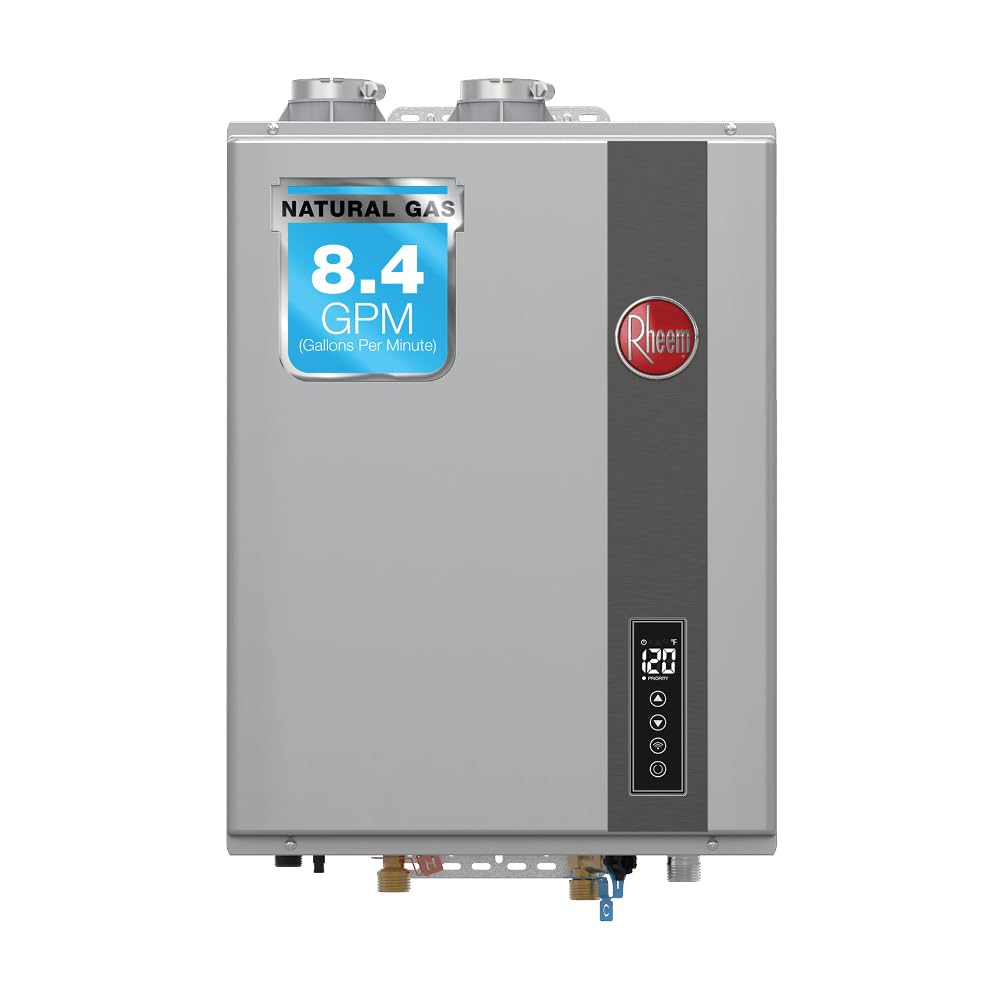
The Rheem RTGH-84 delivers a solid 8.4 GPM from 157,000 BTU, making it a strong mid-range option for homes with 3-4 fixtures. It is classified as super high efficiency and includes electric ignition with temperature settings ranging from 100°F to 140°F. The default 120°F setting works well for most households and helps prevent scalding.
A notable warranty package supports this unit: 15 years on the heat exchanger, 5 years on parts, and 1 year on labor. One owner reported the unit still going strong after 5-6 years of seasonal use with winterization and re-fire each spring. The 59.9-pound weight makes it manageable for wall mounting.
The installation complexity is higher than expected — the venting requirements (Category III stainless steel for this non-condensing unit) and the number of included parts can overwhelm a DIY installer. The 17.7-inch width requires more wall space than compact competitors. Once set up correctly, the temperature remains stable and the unit operates silently.
Why it’s great
- 15-year heat exchanger warranty
- Proven reliability over 6+ years of use
- Silent operation even in garage installations
Good to know
- Requires Category III stainless steel venting
- Installation requires many separate parts
6. MIZUDO 199K BTU
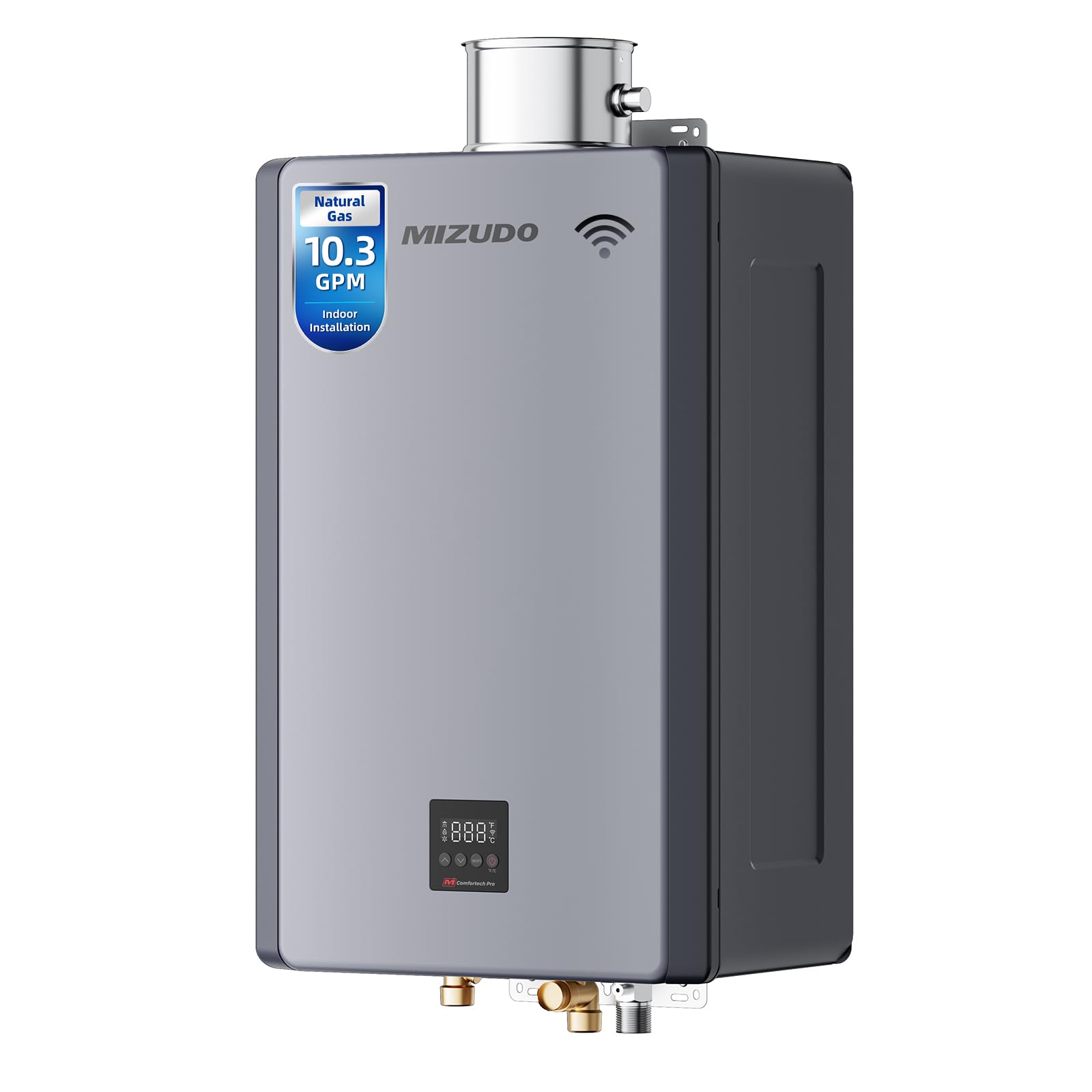
MIZUDO enters the tankless market with a 199,000 BTU unit that pushes 10.3 GPM — matching the flow rates of premium brands at a mid-range entry point. The 16+ safety mechanisms including freeze protection down to -13°F, anti-dry firing, and exhaust blockage monitoring make this a well-protected unit for colder climates. The phosphorous-deoxidized copper heat exchanger resists corrosion better than standard copper.
The 6-stage gas modulation maintains ±1°F temperature stability, and users confirm the unit delivers consistent hot water with very fast response times (35-40 seconds to an upstairs shower). The dedicated WiFi app allows temperature adjustments, scheduling, and maintenance alerts. The sealed direct vent system draws 100% external air for combustion — preserving indoor air quality.
The compact dimensions (24.8 x 15.9 x 10.4 inches) fit tight spaces, and the 55.5-pound weight is manageable. The 2-year full unit warranty plus 5-year heat exchanger coverage is shorter than Rheem or Rinnai, but the price-to-performance ratio remains strong. One user noted the gas fitting is not standard 1/2-inch MIP, which may require an adapter.
Why it’s great
- 10.3 GPM at 199,000 BTU — premium flow at mid-range price
- 16+ safety features including -13°F freeze protection
- Smart WiFi app with scheduling and alerts
Good to know
- Gas fitting is non-standard size
- Warranty shorter than industry leaders
7. Noritz NR66-ODNG

Noritz built the NR66-ODNG specifically for outdoor installation, eliminating the need for any venting or enclosure. At 6.6 GPM and 140,000 BTU, it is suited for 2-3 bathroom homes in moderate climates where outdoor piping won’t freeze. The 0.81 UEF is lower than condensing units, but the lack of venting material and labor offsets the efficiency difference.
Users in 3-bedroom, 2-bathroom households with five members report the unit keeps up with all demands. One installer used heat tape and insulation to keep the unit running in -7°F conditions with a windbreak. The compact 36-pound weight and simple 3/4-inch NPT connections make installation straightforward for a qualified plumber.
The warranty package is generous: 12 years on the heat exchanger, 5 years on parts, and 1 year on labor. The outdoor-only limitation means this unit is not an option for indoor or garage installations. The long lag time for hot water to reach distant taps is the most common complaint — the unit works fine but takes longer than a tank heater to push hot water through long supply lines.
Why it’s great
- No venting required — install outdoors
- Lightweight at 36 pounds
- 12-year heat exchanger warranty
Good to know
- Outdoor installation only — no indoor model
- 0.81 UEF is lower than condensing competitors
8. Takagi T-H3J-DV-N

Takagi’s T-H3J-DV-N is a condensing unit that satisfies the 2012 SCAQMD Rule 1146.2 for ultra-low NOx emissions, making it one of the cleaner-burning options for environmentally conscious buyers. With a 6.6 GPM flow rate and 100°C heat output rating, it is optimized for smaller homes or as a dedicated unit for specific applications like radiant floor heating.
The unit’s longevity is well-documented — one owner reported the previous Takagi model lasted 15 years without any issues. The 58-pound unit features computerized safety controls and no pilot light, eliminating a common failure point. Several users recommend installing flex lines for gas and water to protect against earthquake damage.
The primary consideration is that Takagi does not guarantee the unit for radiant floor heating use, and one user experienced repeated gas valve failures every 9 months when used exclusively for that purpose. Proper gas line sizing is critical — one installer upgraded from 1/2-inch to 1-inch supply for adequate flow. The water takes longer to reach temperature than a tank heater, which is standard for all tankless units.
Why it’s great
- Ultra-low NOx emissions — environmentally friendly
- Proven 15-year lifespan in real-world conditions
- Computerized safety features with no pilot light
Good to know
- Not recommended for radiant floor heating
- Requires minimum 3/4-inch gas line, 1-inch preferred
9. Westinghouse 7.9 GPM
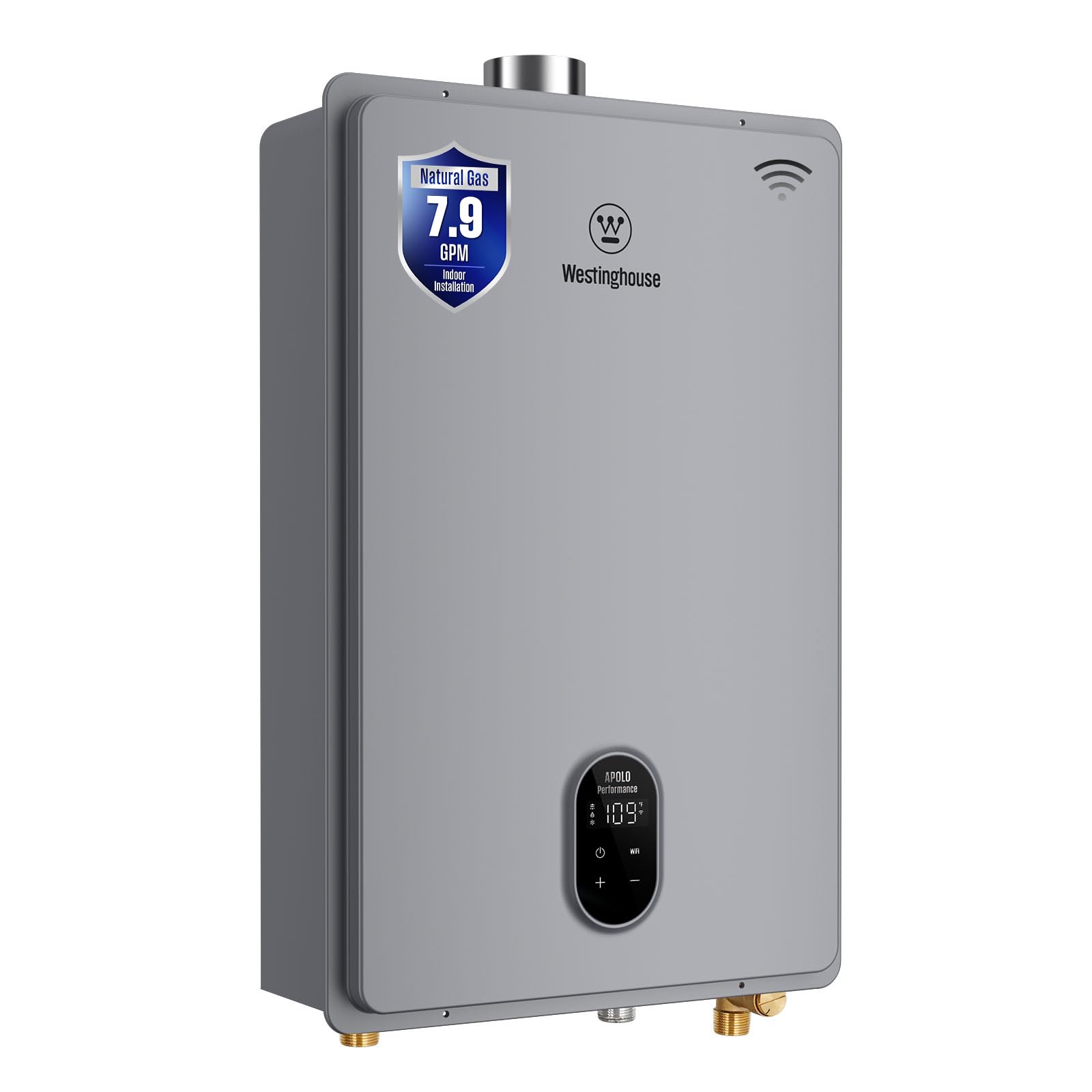
The Westinghouse 7.9 GPM unit delivers 180,000 BTU of heating power through a non-condensing design, supporting 3-5 fixtures simultaneously. The stand-out feature is the full WiFi app control — temperature adjustments, system monitoring, and daily water usage reports are available from a smartphone. The ±1°F temperature stability is maintained by self-modulating technology that adjusts gas and water flow in real-time.
Users consistently describe the installation as straightforward with clear step-by-step instructions. The CSA certification and freeze protection make it suitable for indoor installations in colder climates. The compact dimensions (17.1 x 26.2 inches) fit standard utility spaces, and the alloy steel construction feels solid.
The non-condensing design means the unit vents through Category III stainless steel piping, which adds to installation cost if not already in place. Some users report a 1-2 minute delay for hot water to reach distant fixtures — typical for tankless units at this BTU level. The 150 PSI maximum pressure rating matches standard residential plumbing.
Why it’s great
- Full WiFi app with usage reports and remote control
- ±1°F temperature stability with self-modulating technology
- Easy installation with clear instructions
Good to know
- Requires Category III stainless steel venting
- Noticeable delay for hot water to reach distant fixtures
10. Rheem RTG-70DVLN-3
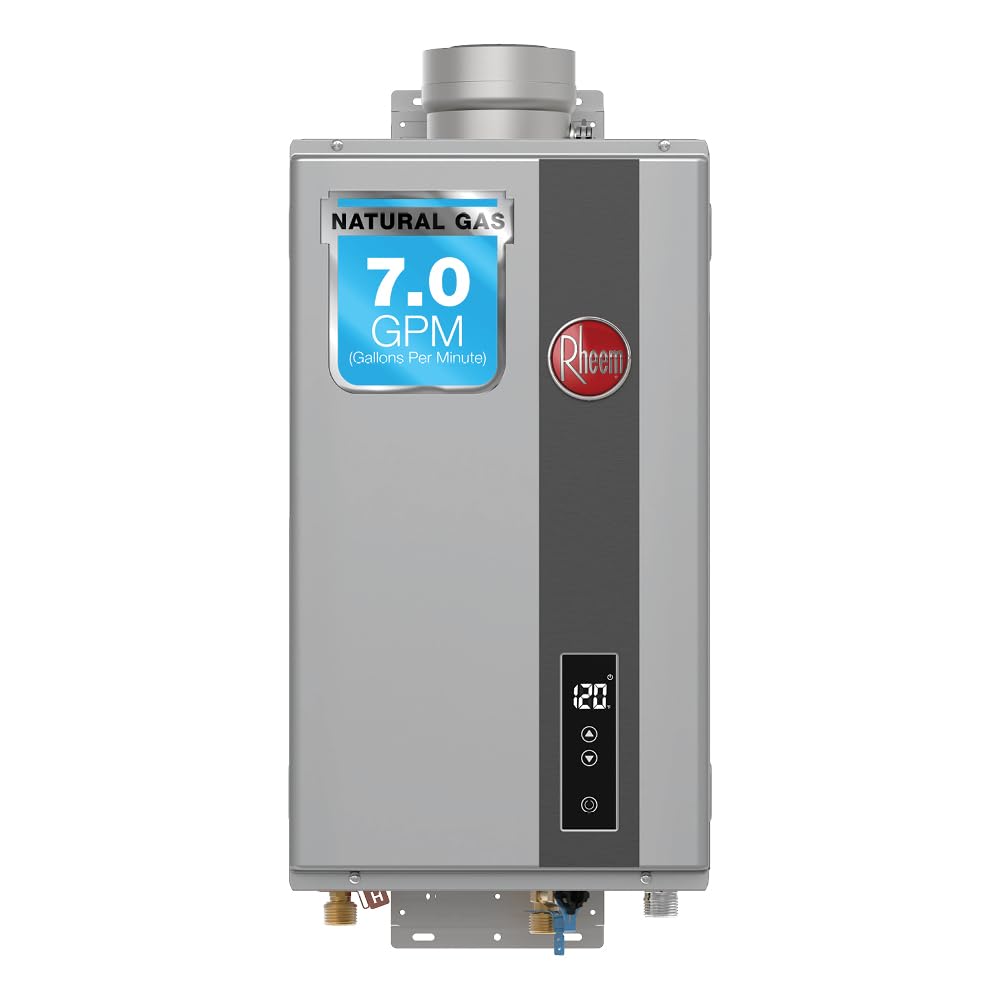
The Rheem RTG-70DVLN-3 hits the sweet spot for 2-3 bathroom homes with its 7.0 GPM flow rate and 160,000 BTU input. The Hot-Start programming is a standout feature that prevents cold water bursts between back-to-back showers — a common annoyance in non-condensing tankless units where the burner needs a moment to re-engage after a brief shut-off.
Owners in a family of four report the unit ended cold showers completely. The altitude adjustment feature allows tuning for high-elevation installations without losing performance. The compact metal cabinet weighs 46.5 pounds and fits smaller wall spaces. The warranty package includes 15 years on the heat exchanger, 5 years on parts, and 1 year on labor.
The unit requires special Category III stainless steel venting, which is not included and must be sourced separately. One user noted a long wait time for hot water — up to 30 seconds depending on the distance from the heater to the tap. The 10.27-inch depth is deeper than some competitors, requiring adequate clearance from the wall.
Why it’s great
- Hot-Start programming prevents cold water bursts
- Altitude adjustment for high-elevation homes
- 15-year heat exchanger warranty
Good to know
- Requires special Category III venting pipe
- 30-second delay for hot water at distant taps
11. Westinghouse Outdoor 8.1 GPM
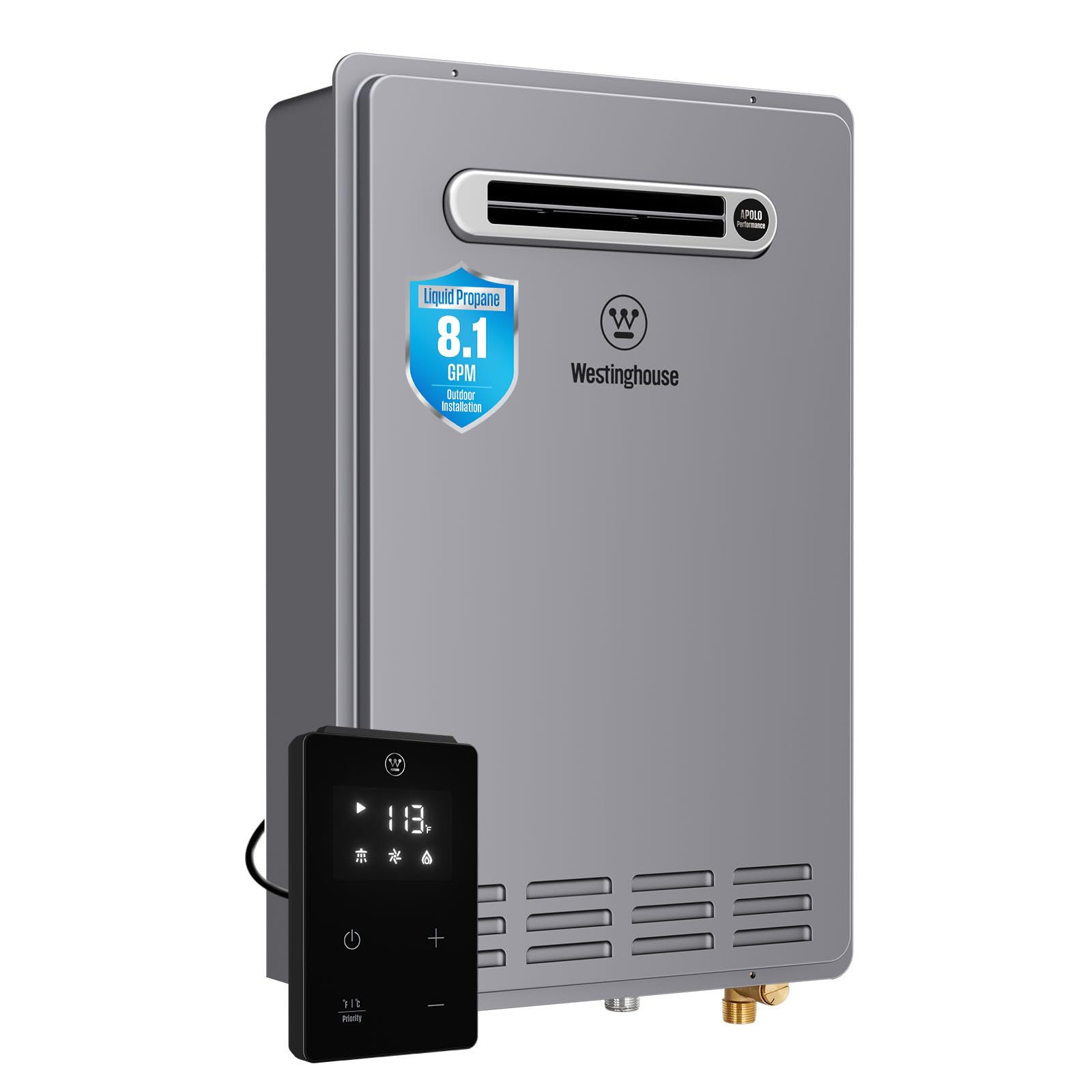
The Westinghouse outdoor propane tankless water heater delivers 8.1 GPM at 180,000 BTU for homes that need an outdoor installation to save indoor space. The included indoor remote control panel mounts on a wall inside the house, allowing temperature adjustments without going outside. The LED display shows water temperature and operating status clearly.
The outdoor-rated construction includes freeze protection and a variable-speed combustion fan designed for changing weather conditions. The 8.1 GPM flow rate supports 3-5 fixtures simultaneously, making it suitable for mid-size homes. The CSA certification confirms safety compliance for outdoor gas appliances.
Outdoor propane tankless units require protection from direct weather exposure even with freeze protection — the unit drains below 5°F if not in use. The remote control panel requires wiring to the unit, which adds a step to installation. Some users note that propane operation produces slightly lower BTU output than natural gas equivalents at the same flow rate.
Why it’s great
- Outdoor installation frees indoor space
- Included indoor remote control panel
- 8.1 GPM supports 3-5 fixtures
Good to know
- Must drain system below 5°F
- Remote panel requires wiring during installation
12. Westinghouse 5.1 GPM
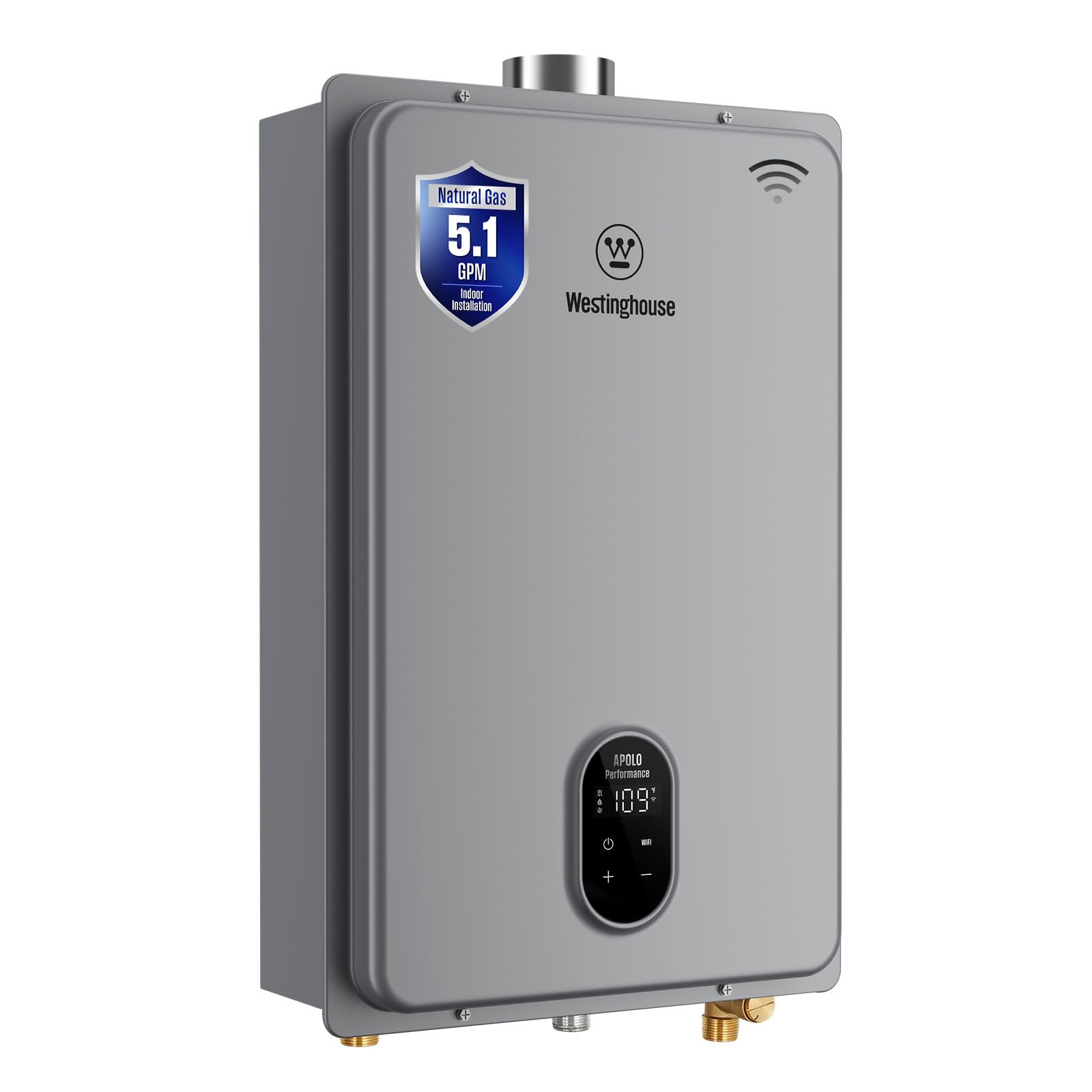
The Westinghouse 5.1 GPM unit is the most affordable entry point into whole-home tankless water heating. At 120,000 BTU, it handles 2-4 fixtures — enough for a 1-2 bathroom home with a kitchen sink and dishwasher. The WiFi app control and ±1°F temperature stability are features typically found on more expensive units. The non-condensing design keeps initial costs low.
Users praise the extremely easy installation process and the instant hot water delivery. One owner set the temperature at 116°F and reported no longer needing to mix hot and cold water — the output temperature is consistent enough for a comfortable shower without adjustment. The remote control capability adds convenience that budget units rarely include.
The 5.1 GPM flow rate limits simultaneous usage — running a shower and dishwasher at the same time may cause temperature drop in colder climates. The non-condensing design means it vents through Category III stainless steel, adding cost if not already installed. For larger families, the 7.0 GPM or higher models are better investments.
Why it’s great
- Most affordable whole-home tankless option
- WiFi app control and precise temperature stability
- Easy DIY installation
Good to know
- 5.1 GPM limits simultaneous fixture usage
- Requires Category III venting
FAQ
Can a tankless water heater replace a 70-gallon tank heater?
How is the flow rate of tankless water heaters measured?
Do tankless water heaters need special venting for indoor installations?
What maintenance does a tankless water heater need annually?
Final Thoughts: The Verdict
For most users, the best 70 gallon water heater alternative is the Rinnai RXP199iN because the built-in recirculation pump, 0.98 UEF efficiency, and 11.1 GPM flow rate deliver endless hot water with minimal wait time and energy waste. If you want the same Rinnai reliability without integrated recirculation, grab the Rinnai RU199iN. And for homeowners prioritizing budget without sacrificing WiFi controls and solid 7.9 GPM performance, nothing beats the Westinghouse 7.9 GPM.