
Our readers keep the lights on and my morning glass full of iced black tea. As an Amazon Associate, I earn from qualifying purchases.
Specs are compiled from manufacturer listings and verified buyer reviews and can change over time — please confirm the key details on the product page before buying.
The hardest part of buying an at-home treadmill isn’t picking a brand — it’s figuring out which machine actually fits your room, your stride, and the way you really walk or run. A belt that’s too short makes every step feel cramped. A deck that never inclines keeps your workout flat. And a machine that weighs too much never gets moved out of the way.
I’m Min — the founder and writer behind Gadgets Feed. This guide is built by comparing the manufacturers’ published specifications and the patterns across verified customer reviews, so you get each pick’s real strengths and trade-offs instead of marketing spin.
Below you’ll find eleven machines grouped by what they’re genuinely good at, from slim under-desk walkers to full commercial-style runners. Every pick lists its real deck size, motor, incline range, and weight so you can match one to your space before you buy. This breakdown of the at home treadmill market focuses on deck length, motor power, and fold-flat storage above all else.
Our Picks at a Glance


How To Choose The Best At Home Treadmill
Start with the floor space you can actually give up, then work backward to the machine. A treadmill that fits your room but not your stride will sit unused, and one that fits your stride but blocks your hallway gets folded away and forgotten.
Match the deck length to your stride
Deck length is the measurement from the front of the belt to the back, and it decides whether your foot lands safely at speed. Walking decks around 41 inches suit slow desk-side steps. Jogging and running want 55 inches or more so your heel doesn’t crowd the front roller. Belt width matters too — a 16.5-inch belt feels tight for wide stances, while a 20-inch belt gives your arms and hips room to swing.
Decide if you need auto incline at all
Auto incline raises the front of the deck on its own so you can simulate hills without touching a dial. Percentages range from 0–10% on simpler machines to 18% and 20% on higher-end models. If you mainly walk while working, a flat or lightly inclined belt is fine. If you want hill-style cardio at home, the incline range and the number of preset levels become a real buying factor.
Look at motor horsepower and how loud it runs
Horsepower (HP) is the motor’s rated output, and it tells you how comfortably the belt carries a heavier walker or a fast runner. Budget-friendly walkers often run around 2.5 HP. Mid-range runners step up to 3.0–3.5 HP. Brushless motors tend to run cooler and quieter than brushed designs, which matters if the treadmill sits near a TV or a shared wall.
Check the fold and the step-up height
A treadmill’s folded height decides whether it slides under a bed, stands in a closet, or just eats floor space. Step-up height is how high the deck sits off the ground — a low 6.5-inch step is easier to mount than a tall commercial deck. If you live in a small apartment, these two numbers matter as much as the motor.
Quick Comparison
| Model | Best For | Deck Length | Max Incline | Motor | Amazon |
|---|---|---|---|---|---|
| Walking Pad Treadmill 12% Auto Incline★ Best Overall | Desk-side walking with hill work | 41 inches | 12% | 2.5 HP | Amazon |
| WELLFIT Foldable TreadmillMost Family-Friendly | Family use with adjustable handrails | 44 inches | 10% | 3.5 HP | Amazon |
| NordicTrack T Series T5Best for Coached Workouts | Coached runner workouts | 55 inches | 10% | 2.6 HP | Amazon |
| MERACH 18% Auto Incline | Steep hill training at home | 47 inches | 18% | 3.5 HP | Amazon |
| ProForm Carbon | iFIT-guided walking and jogging | 55 inches | 10% | — | Amazon |
| Niceday TM2 | Heavy walkers wanting auto incline | — | 18% | 3.0 HP | Amazon |
| Sunny Health & Fitness Auto Incline | Tool-free setup in small rooms | 53.1 inches | 15% | 2.5 HP | Amazon |
| THERUN 20% Auto Incline | Tall runners and fast intervals | — | 20% | 3.5 HP | Amazon |
| Horizon Fitness Treadmill | Long-strided runners | 60 inches | 15% | 3.5 CHP | Amazon |
| NordicTrack Commercial 1750 | Screen-led home training | 60 inches | 12% | — | Amazon |
| 3G Cardio Pro Runner X | Serious runners in tight rooms | 58 inches | 15% | 3.0 HP | Amazon |
In‑Depth Reviews
1. Walking Pad Treadmill 12% Auto Incline, Under Desk Treadmill
Our pick — 4.5+★ from 850+ verified ratings; the strongest balance of quality and price.
A slim under-desk walker that still climbs to 12% — and arrives ready to step on.
Most walkers this compact give you a flat belt and nothing else. This one packs a 0–12% auto incline across 9 levels into a deck only 41 inches long and 16.5 inches wide, so a rainy morning still gives you a hill workout in the corner of a room.
The frame is rated for 450 lbs of user weight, which is the highest capacity on this list. It runs on a 2.5 HP motor and the steel frame keeps the whole thing at 44 pounds — light enough to tip up and lean against a wall when the room needs to be a room again. Owners consistently single out walking comfort above everything else; the double-deck structure, 4 silicone absorbers, and 5-layer anti-slip belt are why long sessions don’t leave your feet aching.
The 12% incline is the piece that turns a desk-side stroll into actual training, simulating hiking without leaving the house. On the tech side there’s a FitYo app that syncs workouts to Apple Health and Google Fit, plus 100+ coach-led courses with no subscription, so you’re not paying a monthly fee on a budget-tier machine. The RGB display cycles through 6 colors and tracks speed, calories, time, distance, and incline level at a glance.
What earns its place up top
- 12% auto incline across 9 levels — real hill work without a full-size deck.
- 450 lbs capacity, the highest load rating here, on a 44-pound frame.
- Arrives assembled and folds upright into a closet.
Where it concedes ground
- 41-inch deck is for walking, not running — sprinters want 55 inches or more.
- 2.5 HP motor sits below the 3.5 HP runners-of-the-family machines.
Best for: apartment walkers who want incline training in a footprint that disappears.
Think twice if: you plan to run — the 41-inch belt leaves little room for a longer stride.
2. WELLFIT Foldable Treadmill with Auto Incline, 400 LBS, Adjustable Height
Handrails that adjust through five heights so a teenager and a grandparent can share one deck.
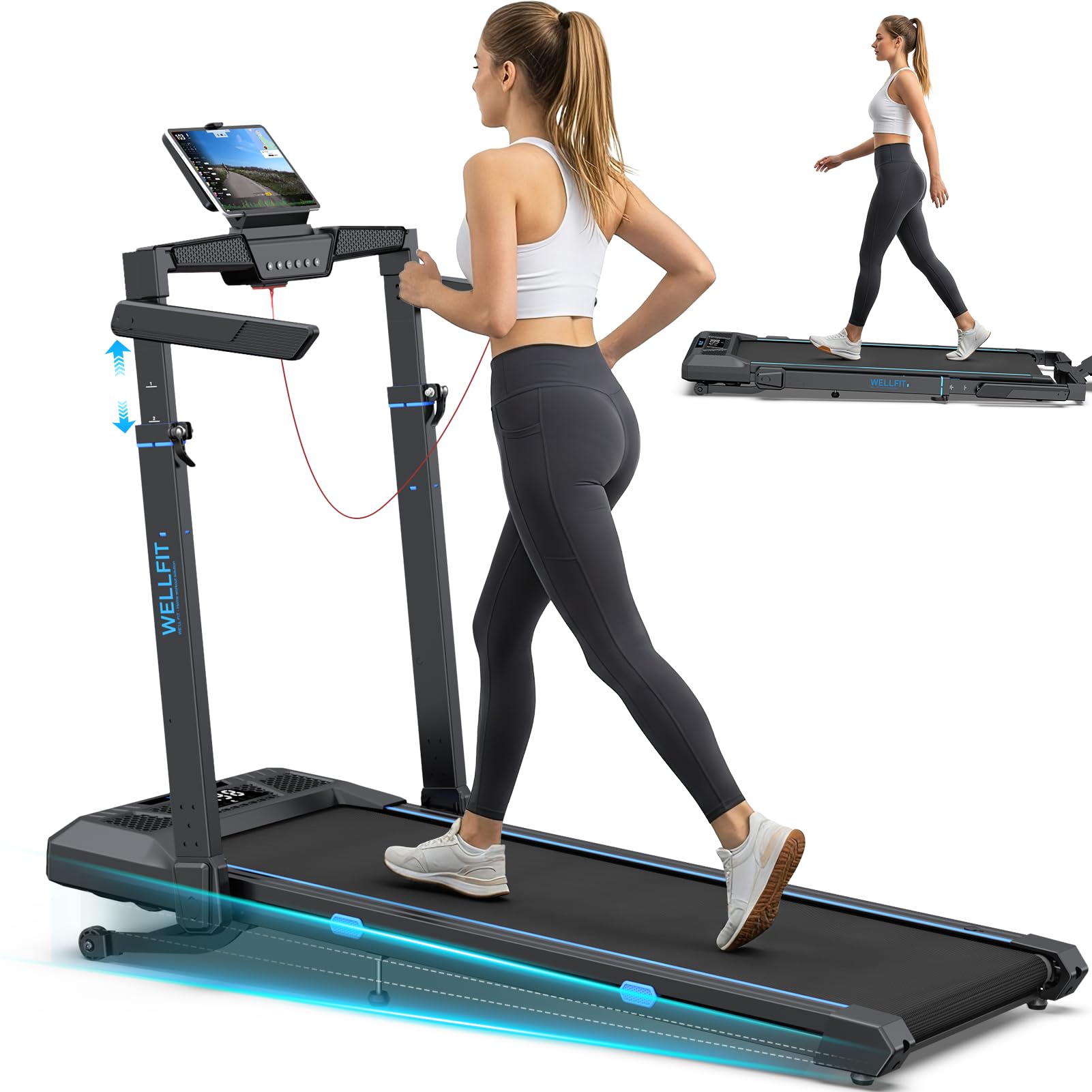
Shared households are where most home treadmills fail — one person’s comfortable grip is another person’s shoulder strain. The WELLFIT solves that with handrails that lock at five heights from 30.5″ to 41″, so teens, adults, and seniors can all stand tall instead of hunching over the console.
Under the belt sits a 3.5 HP motor rated to 400 lbs and measured under 45 dB — quiet enough that a work call on the other side of the room stays uninterrupted. The 44″ × 17″ running area carries a 7-layer anti-slip belt over 8 silicone shock absorbers, and the speed range of 0.6–8.6 MPH covers walking, working, running, and climbing. At 80.5 pounds it is noticeably heavier than the 44-pound Walking Pad, which is the price of that sturdier handrail structure.
Incline tops out at 10%, a step down from the MERACH’s 18%, but for family walking that range is honest hill variety. Folded, it stands just 5.7 inches tall — shallow enough to slide under a sofa, a bed, or a desk — and the smooth-rolling wheels mean you’re not dragging it. A built-in phone and tablet holder keeps a show running while you walk.
What owners settle into: performance is the trait buyers mention most, and next is how fast it’s ready to use — it comes ready from the start, so you can take your first walk the same day it arrives.
The trade-off to weigh: the 10% incline is modest next to steeper machines, and 80.5 pounds means it’s a two-hand move when you relocate it.
Reach for this if: more than one person in the house will use it and handrail height matters.
Look elsewhere if: you’re chasing aggressive hill training — 10% won’t get you there.
3. NordicTrack T Series Treadmills for Home | T5, T6.5s, T7, T10, T16
The deck that quietly outsizes its price class — 55 inches of running room paired with iFIT coaching.
NordicTrack’s T Series puts a 55-inch-long, 18-inch-wide deck under your feet, matching the ProForm Carbon on length and beating the Walking Pad’s 41-inch belt by a wide margin. That extra length is what lets a beginning jogger find a natural landing spot instead of shortening their stride to stay on the belt.
The T5 runs 0–10 MPH with a 0–10% incline, driven by a 2.6 HP motor. KeyFlex cushioning absorbs some of the joint impact on each stride, and the 5-inch LCD shows your stats if you’d rather not pair a device. Pair iFIT and the machine auto-adjusts speed and incline to follow the trainer’s terrain — there are 10,000+ workouts in the library, though an iFIT Train membership is required for that side of things.
ActivePulse reads a Bluetooth heart-rate monitor (sold separately) and steers speed and incline to keep you in the right zone. Workouts sync to Strava, Garmin, and Apple, and Google Maps routes let you run a real-world course with terrain simulation. What most owners come back to is straight quality — the build is what carries this machine’s reputation. The honest caveat is assembly: some buyers breeze through it and others find it a chore, so budget an evening if you’re not handy.
Pick this if: you want a long deck and coach-led sessions without jumping to premium tiers.
Don’t pick it if: you refuse to pay a membership — the smart-adjust features need iFIT Train.
4. MERACH Treadmill with 15/18% Auto Incline
Built around the steepest incline most home walkers will ever need, with a brushless motor to match.
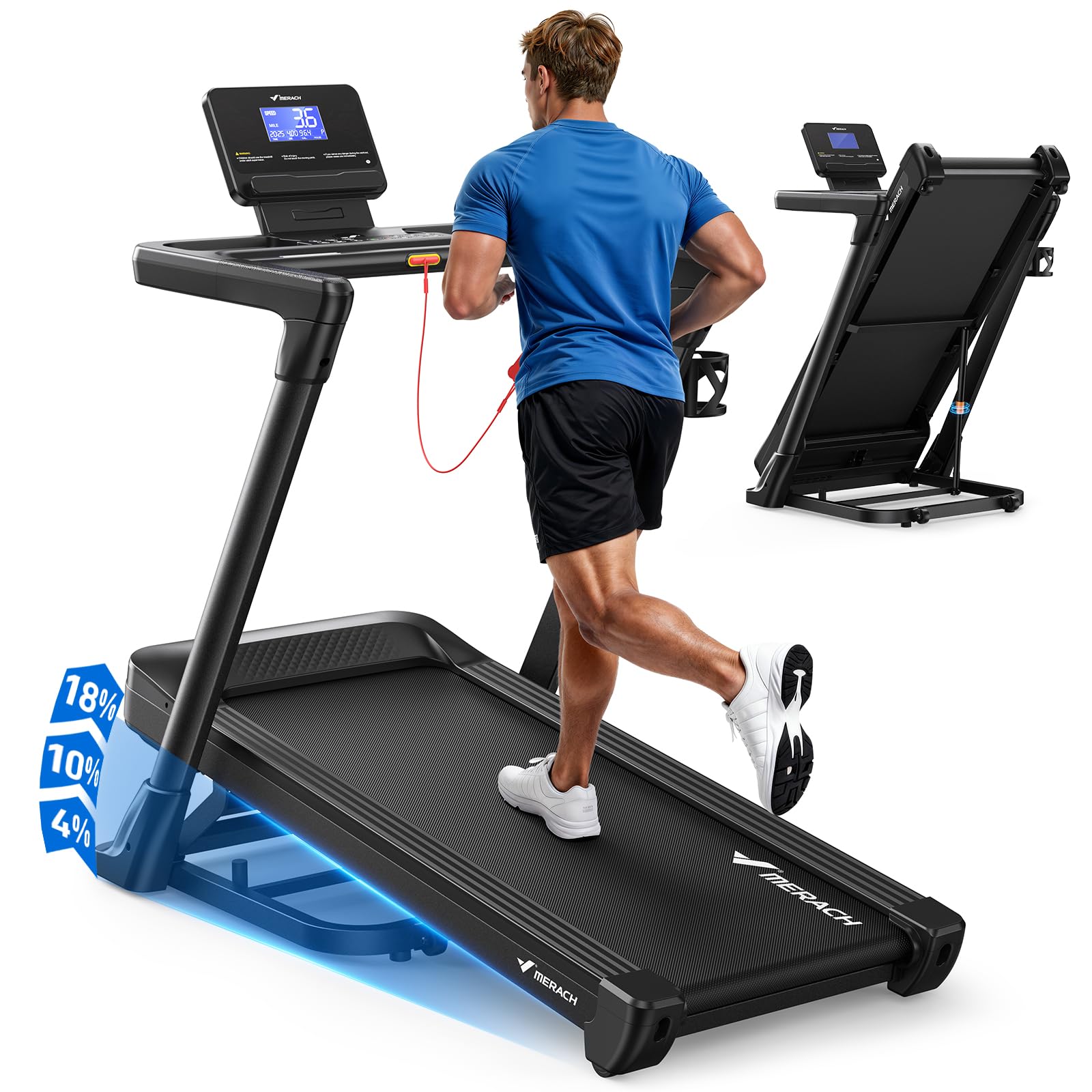
If flat walking bores you, the incline is the whole reason to buy this machine. It climbs to 18% automatically — eight points steeper than the WELLFIT’s 10% — which simulates real hill climbing rather than a gentle ramp. The maker claims that incline burns 2x more calories than flat walking, and the free MERACH app adds real-scenery training.
Underneath sits a 3.5 HP brushless motor, the same headline power as the Walking Pad’s 2.5 HP plus a full extra horsepower, running below 45 dB so the living-room TV stays audible. The frame weighs 122 lbs because of 2.0mm core steel built to commercial-grade standards, and it holds 350 lbs without the deck shuddering at speed. Top speed is 8.7 mph — quick enough for a solid jog, short of the 10 mph runners.
Workout data lands on an LED display showing speed, time, distance, calories, incline, and heart rate, adjustable by remote or app so you never bend mid-stride. A hydraulic folding system sets it up or stores it in about 30 seconds. What buyers tend to highlight is build quality first and easy assembly second — many find it arrives largely put together. The 47-inch belt is on the short side for fast running, and the 350-lb ceiling sits below the 450-lb Walking Pad.
The value read: you’re paying mid-range money for near-commercial incline range and a brushed-motor-free drive.
Where it stops: 8.7 mph and a 47-inch deck suit joggers, not sprinters.
Suits you if: hill intervals and walking incline are your priority.
skip it if: you need 10+ mph speeds or a deck longer than 47 inches.
5. ProForm Carbon Treadmill

A 55-inch deck with ProShox cushioning that makes daily walking easy on the knees.
Comfort is where the Carbon earns its keep. ProShox cushioning soaks up the impact of each footfall, and combined with a 55-inch by 18-inch deck it gives you the same running length as the NordicTrack T5 for a bit more money. It runs 0–10 MPH and 0–10% incline, so the numbers on the console match that NordicTrack closely.
The folding frame does one thing well: it rolls away and lands slowly on a hydraulic foot bar rather than dropping. A 5-inch LCD handles stats, or you hand control to iFIT trainers and let the machine auto-adjust pace and terrain — a Train membership is required for those features. It all runs on a 1000-watt power draw. Buyers most often praise the overall quality and reliability, and assembly is described as a roughly 90-minute job, so plan a free afternoon.
ActivePulse and SmartAdjust bring the same heart-rate-zone steering and history-based adjustment you’d expect from the higher NordicTrack tier, and workouts sync to Strava, Garmin, and Apple Health. The catch is the smart side needs that iFIT membership. As a walking and jogging machine, the cushioning and the folding are the reasons to pick it over the cheaper walkers on this list.
What you’re buying it for
- 55-inch deck with ProShox cushioning for softer daily strides.
- Hydraulic fold that lowers under its own control.
- iFIT sync to Strava, Garmin, and Apple Health.
What you give up
- Smart features need an iFIT Train membership.
- 10% incline leaves hill chasers wanting the 18% MERACH.
Right for: daily walkers who want cushioning and a long deck.
Wrong for: anyone who wants steep graded training — cap it at 10%.
6. Niceday TM2 Running Treadmill with 18% Auto Incline
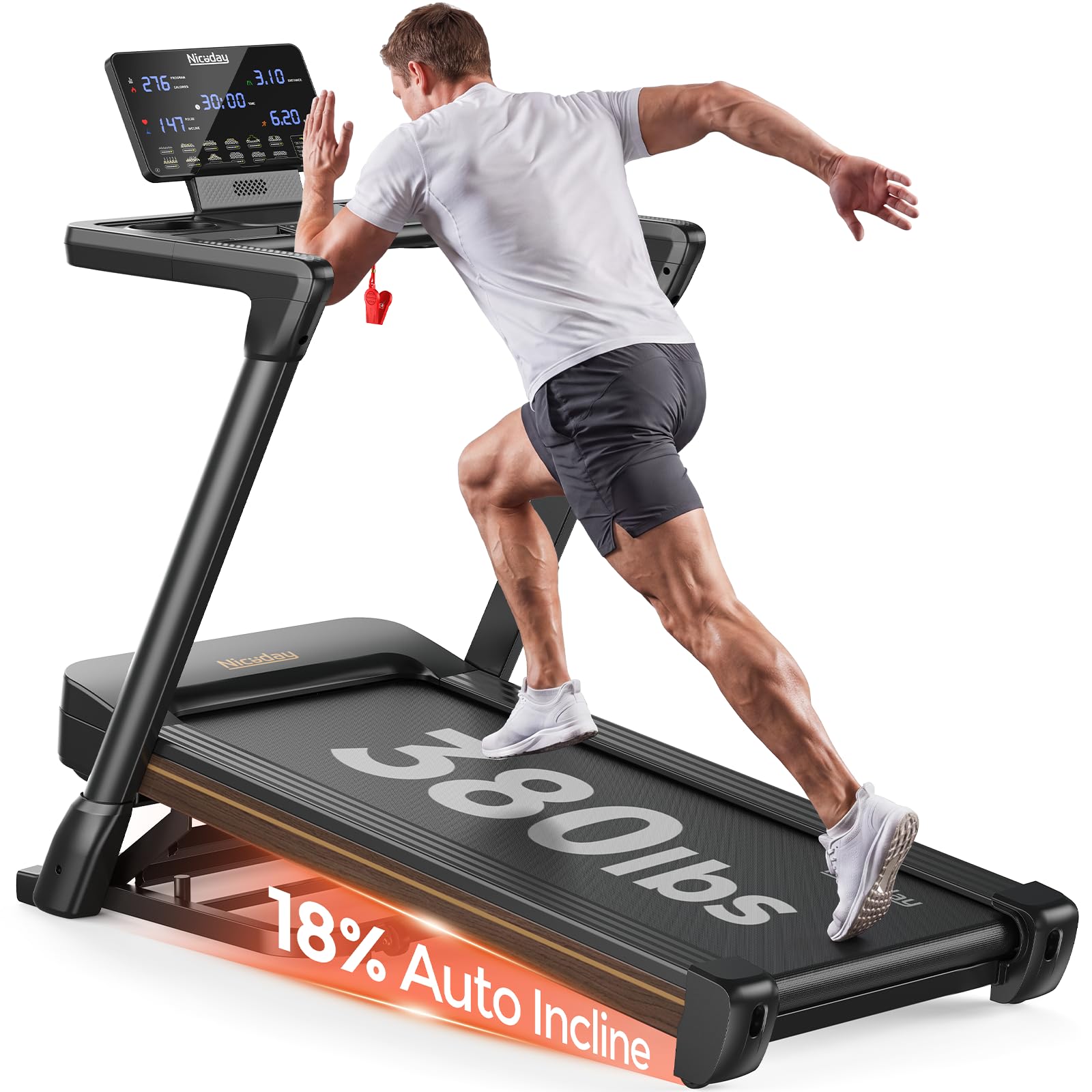
A 380-pound-rated steel frame with 42 mm rollers that stays steady through every incline change.
The TM2 leads with structure. Its reinforced steel frame and 42 mm heavy-duty rollers carry up to 380 lbs, and the unified Z-frame shock-absorbing construction keeps the running platform solid whether you’re walking or running. It climbs to 18% automatically and runs 0.6–8.7 MPH, backed by 12 preset programs to vary the intensity.
Power comes from a 3.0 HP brushless motor that holds steady from slow walking to faster running, runs quieter, and needs less upkeep than brushed designs. The 14.8-inch display is among the largest screens on this list outside the NordicTrack Commercial’s 16-inch touchscreen, so your speed and mileage are easy to read. Bluetooth connects to platforms like Kinomap, and the gas-assisted folding system lets you tip it vertical and reclaim the floor.
It’s a heavy unit at 122.4 pounds, which is what a frame rated for this much weight usually weighs. The 18% incline matches the MERACH’s steepest range, so hill training here is genuine. If you want a stable deck under a heavier walker or a vigorous jogger, this is one of the few mid-tier machines built around that load rating rather than an afterthought.
The spec that sells it: 380 lbs on a steel frame with 42 mm rollers is a durability signal more than a badge.
The catch: at 122.4 pounds, moving it to a new spot is a deliberate job, not a shove.
Worth it for: heavier users who want incline and stability over portability.
Not for: anyone who expects to tuck it away one-handed.
7. Sunny Health & Fitness Fully Assembled Auto Incline Treadmill
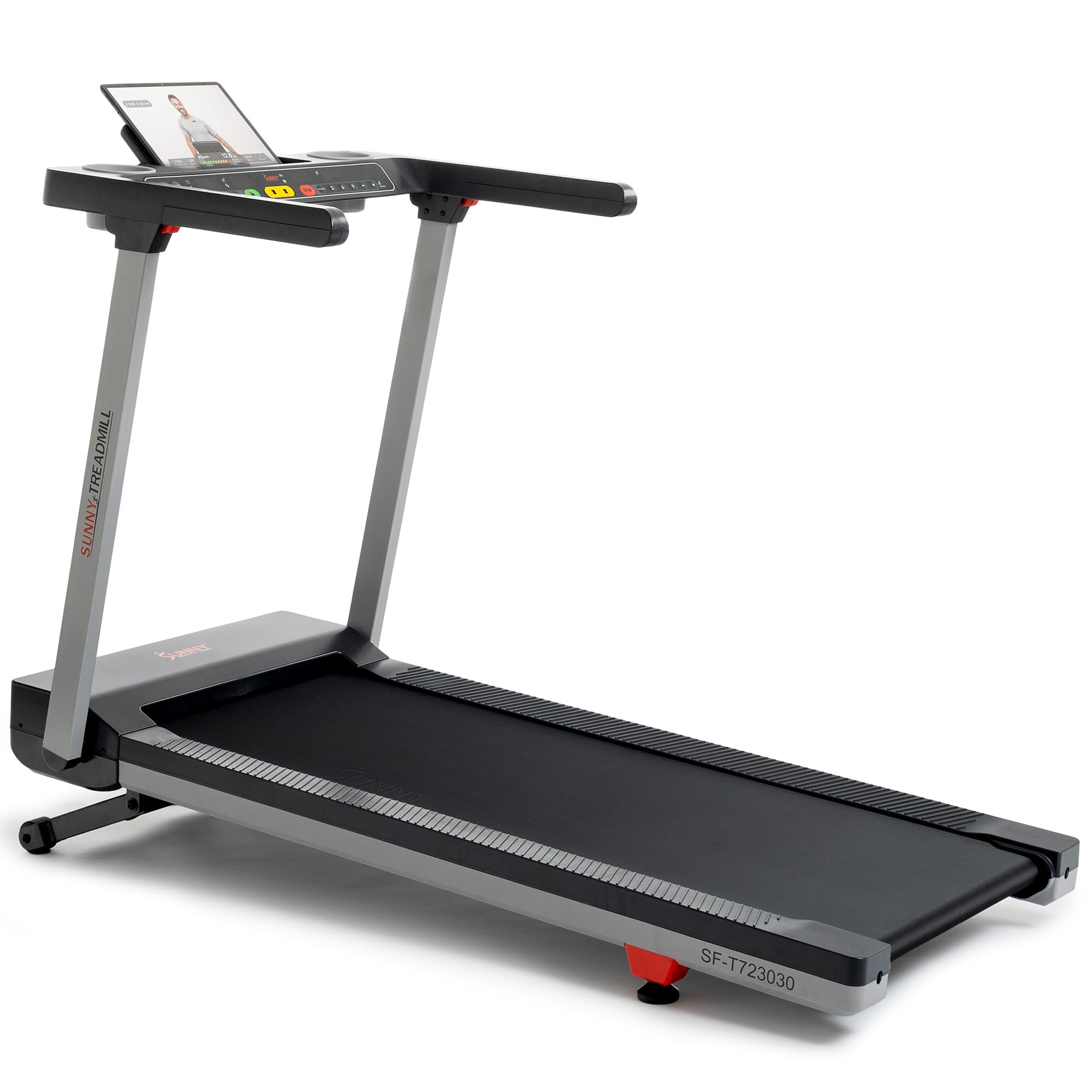
No tools, no ninety-minute build — raise the handlebar, lock it, and walk.
Assembly is the hidden cost of a home treadmill, and this Sunny skips it entirely. The unit arrives fully assembled: lift the handlebar, lock it, and you’re walking. That’s a real advantage over machines that ask for an evening of bolt-tightening, and it pairs with a 20.1-inch wide by 53.1-inch long running surface that gives you genuine freedom of stride.
A 2.5 HP brushless motor handles up to 10 MPH over a frame rated to 300 lbs, with heat dissipation designed to keep the motor cooler during long sessions. Incline reaches 15% across 15 levels, with quick speed and incline buttons so you don’t lose your rhythm mid-interval. There are 24 pre-set workout programs, 3 countdown modes, and 3 user modes to progress through.
The LED display tracks speed, time, distance, calories, incline, steps, and heart rate, and built-in pulse sensors give you a live reading without a strap. Two cup holders, a device holder, and a USB charging port round out the convenience. Most buyers point to value and the tool-free setup as the wins. One honest note: noise is mixed — some units run quietly, others develop a squeak, and the size reads compact to some and narrow to others.
Go for it if: you want zero-assembly setup and a wide 20-inch belt.
Reconsider if: you need over 300 lbs of capacity or a guaranteed silent deck.
8. THERUN 20% Auto Incline Treadmill, 12MPH with APP, 3.5HP Foldable
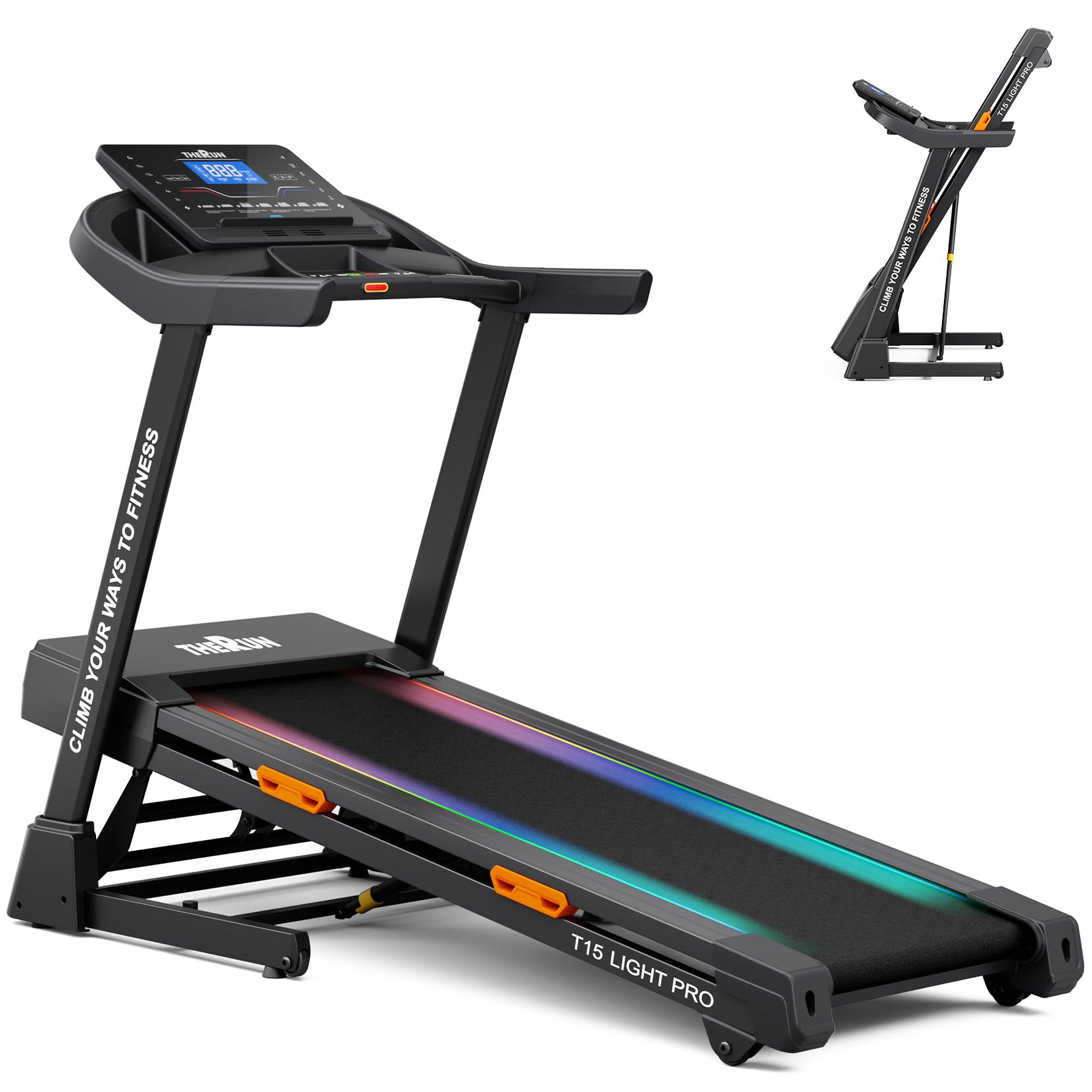
The steepest incline here at 20%, and the only deck explicitly sized for runners up to 6’3″.
Two numbers define this machine. The first is the 20% auto incline — the steepest on this list, two points past the MERACH and Niceday’s 18%. The second is a 55-inch by 20-inch running belt that the maker says comfortably fits runners up to 6’3″, which is rare among foldable home treadmills that usually stop at 18-inch widths.
A 3.5 HP motor drives up to 12 MPH, the second-fastest top speed here behind the Horizon’s 12 mph, and dual-layer shock absorption keeps the ride stable at speed. It holds users up to 300 lbs. The console is unusually loaded: a clear LCD, a built-in cooling fan, wireless charging, Bluetooth speakers, and cup holders. Side LED lights shift color with your pace — green from 0.5–4 MPH, blue from 4.1–7.5 MPH, red above 7.5 MPH.
Connectivity spans Zwift, FitShow, and Kinomap for guided training, and the maker claims that 20% incline engages 30% more muscles than 15% incline models. Buyers most talk about how quiet it runs and how much it delivers for the money — speeds get called out as genuinely quick. It’s a 157.6-pound machine, so the fold helps but this isn’t a lightweight to shuffle around casually.
The case for the THERUN
- 20% incline, the steepest on this list, for real hill sessions.
- 55″ × 20″ belt sized for taller runners up to 6’3″.
- Console with fan, wireless charging, and Bluetooth speakers.
What to plan around
- 157.6 pounds makes it a heavy unit to reposition.
- 300-lb capacity is lower than several lighter machines here.
Made for: tall runners who want a wide, steep deck and a loaded console.
Not ideal for: heavier users — the 300-lb ceiling is the limiter here.
9. Horizon Fitness Treadmill

A 22-inch-wide, 60-inch-long XL deck for full-stride runners who hate feeling boxed in.
Horizon goes bigger than almost anything else here: a 22-inch by 60-inch XL running surface with 3-zone Variable Response Cushioning that flexes and supports through every phase of a stride. That’s 5 inches longer and 4 inches wider than the 55-inch T Series deck, and it’s rated for 350 lbs of user weight.
QuickDial controls let you change speed and incline without breaking your stride, backed by a 0.5–12 mph range and 0–15% incline — numbers aimed squarely at interval work. The RapidSync 3.5 CHP drive system is the marketing name for the motor, and combined with a 500 lb thrust incline motor it’s meant to move between settings quickly. Program keys cover 5K, Calorie, Distance, Fat Burn, Hill Climb, Manual, and Max Heart Rate.
There’s no membership required to use the basics, and app connectivity, Bluetooth speakers, a USB rapid-charge port, a fan, and a water bottle holder round out the daily-use side. One-step FeatherLight hydraulic folding handles storage. What buyers most often call out is gym-quality performance and a sturdy build. Reliability is the mixed part — some report years of solid running while others describe a unit that stopped working, so buy knowing that mixed history exists.
The strong point: the 60-inch deck and QuickDial controls suit runners who change pace often.
The honest caveat: reliability feedback is split, and that’s worth weighing on a premium-tier purchase.
Tailored to: runners with long strides who want a wide, cushioned deck and no required membership.
Look past it if: split reliability feedback on a big-ticket machine makes you uneasy.
10. NordicTrack Commercial Series Treadmill | 1250, 1750, 2450, LE

A pivoting 16-inch touchscreen and the only deck here that tilts below flat into a decline.
The big differentiator on this Commercial series is the incline range: -3% decline up to 12% incline. That decline headroom is unusual, and it brings hill-and-terrain patterns into a home gym in a way the fixed 0% starting point of most machines can’t. A 16-inch pivoting touchscreen can turn for off-treadmill classes like yoga and strength, and it streams shows with an iFIT Pro membership.
Speed runs up to 12 MPH over a 60-inch by 22-inch deck, with RunFlex cushioning soaking up shock through walking, jogging, and sprinting. Build quality is where the machine does its best work — it’s described as commercial-grade equipment that runs quietly even at higher speeds, and assembly is straightforward. The fold-and-roll frame with assisted foot-bar lowering keeps it manageable in a small space.
SmartAdjust and ActivePulse handle real-time speed and incline changes for heart-rate-zone training, and workouts sync to Strava, Garmin Connect, and Apple Health. The membership math is the thing to plan: iFIT Pro is what open up the auto-adjust features and streaming. The 16-inch screen gets mixed reactions — impressive to some, close to useless to others, so it’s worth deciding whether a big screen matters to your routine before you commit at this tier.
Choose this if: you want a big pivoting screen and decline-terrain training.
Weigh the membership: the smart features require iFIT Pro, so factor that into the decision.
11. 3G Cardio Pro Runner X Treadmill

Commercial-grade running hardware packed into a frame that folds flat with a low 6.5-inch step-up.
The Pro Runner X solves a contradiction: most folding treadmills can’t handle sustained high-speed running. This one pairs a 20.5-inch by 58-inch running belt with heavy-duty Ortho Flex suspension that limits the initial foot-strike vibration, and it’s built to run hard without shaking apart. The low 6.5-inch step-up height makes mounting easier than climbing onto a tall commercial deck.
A 3.0 HP motor pushes 216 lbs of machine up to 12 mph, accelerating from 0 to 12 mph in 18 seconds — quick enough for interval and H.I.I.T. work. It holds up to 350 lbs. Incline runs 0–15%, with one-touch speed from 0.5 to 12 MPH, heart-rate control, and the ability to build your own workouts. There’s no membership required, so all the music and tablet use you want comes free of a monthly fee.
You get backup from an Arizona-based company: a lifetime frame warranty, 5-year parts, and 1-year in-home labor. Buyers most often praise performance and sturdiness, and they credit durability over months of use. Belt stability is the mixed area — several buyers report the belt slipping — so check the tension at setup. At 216 pounds it’s the heaviest machine on this list, and the fold is what keeps that weight from taking over your room.
Where it wins: 20.5″ × 58″ belt, 0–12 mph in 18 seconds, and a frame, parts, and labor warranty package that runs long.
Where to watch: the deck’s belt stability draws a mixed response, so verify tension early.
Ideal for: serious runners who want no-membership speed, incline, and a long warranty.
Pass on it if: 216 pounds is more machine than your floor and space can carry.
Understanding the Specs
Deck Length and Belt Width
Deck length runs from 41 inches on compact under-desk walkers up to 60 inches on full runner machines. The shorter decks suit slow walking; anything 55 inches or more gives a jogger room to land naturally. Belt width follows the same pattern — 16.5 inches is tight, 20 inches or more is roomy. Match the deck to how fast you’ll actually move, not to the top speed on the box.
Auto Incline Percentage
Incline raises the front of the deck to simulate a hill. The range here goes from 10% on simpler models up to 20% on the THERUN. More incline means more muscle engagement and calorie burn, but it also narrows the machine’s audience — a 10% machine is plenty for a daily walker, while hill intervals reward the steeper 18% and 20% decks.
Motor Horsepower
Horsepower (HP) is the motor’s rated output, and it dictates how comfortably the belt handles a heavier user or a fast run. A 2.5 HP motor suits walking and light jogging. A 3.0–3.5 HP motor carries heavier loads and faster speeds without strain. Brushless motors run cooler and quieter than brushed ones, which matters in a shared room.
Folding, Step-Up, and Weight
Folded height decides whether the machine slides under a bed or stands in a closet — some fold to 5.7 inches. Step-up height is how high the deck sits; a low 6.5-inch step is easier on the knees than a tall commercial platform. Weight matters too: a 44-pound walker is a one-hand move, while a 216-pound runner needs wheels and care.
FAQ
How much floor space does a home treadmill really need?
Is a 41-inch deck long enough to jog on?
What incline percentage do I actually need?
Are treadmills with a 300 lb capacity safe for heavier users?
Do I need a subscription to use an iFIT treadmill?
How quiet is a home treadmill in an apartment?
Can a folding treadmill handle real running speeds?
What is the difference between brushed and brushless treadmill motors?
How long does assembly take on a home treadmill?
How much does moving a treadmill around matter day to day?
Final Thoughts: The Verdict
For most people setting up an at home treadmill, the winner is the Walking Pad Treadmill 12% Auto Incline. It earns that spot with the highest rating of any pick here at 4.5+ stars, a 12% auto incline on a 41-inch deck, support for up to 450 lbs, and a 44-pound body that folds upright into a closet — a mix none of the larger machines match for daily desk-side walking. If you want a long 55-inch deck and coach-led workouts without the premium tier, reach for the NordicTrack T Series T5. And if hill training at the steepest grade matters most, the THERUN leads with a 20% incline and a belt sized for tall runners.
The smartest way to decide is to measure your floor space, decide whether you’ll walk or run, and pick the deck that fits that answer.
How We Picked
We do not accept paid placement. Every pick is matched to a real buyer and a real use-case; we do not hands-on test units.
Sources & Methodology
Specifications: manufacturer listings and product documentation. Review insights: verified customer reviews, as of November 2026. Pricing: not shown on this page (it changes often); check the current price via the retailer link.
As an Amazon Associate, Gadgets Feed earns from qualifying purchases. This does not affect which products we feature.