
Our readers keep the lights on and my morning glass full of iced black tea. As an Amazon Associate, I earn from qualifying purchases.
Specs are compiled from manufacturer listings and verified buyer reviews and can change over time — please confirm the key details on the product page before buying.
Pick the wrong bike and it sits in the garage within a month. A frame that fights your posture, gearing that skips on the hill by your house, or tires that buzz on pavement will do exactly that. Every pick below is a real men’s bike in a real category — cruiser, hybrid, mountain, road — so your choice depends on where you ride, not marketing language.
I’m Min — the founder and writer behind Gadgets Feed. This guide is built by comparing the manufacturers’ published specifications and the patterns across verified customer reviews, so you get each pick’s real strengths and trade-offs instead of marketing spin.
These picks run from a comfortable single-speed cruiser to a full carbon racer, each with the spec that matters most called out in plain numbers. Choosing among the bikes for men here depends on matching your terrain, your leg length, and your storage space to the right frame.
Our Picks at a Glance
How To Choose The Best Bikes For Men
The wrong bike is not a bad bike — it is a bike built for a different ride than yours. A 21-speed mountain bike with knobby tires will feel slow and buzzy on a smooth canal path. A single-speed cruiser will wreck your knees on a steep hill. So before you compare any two models, you need to answer three plain questions: where will you actually ride, how tall are you, and how much do you want to carry.
Match the frame and gearing to your terrain
Flat roads, bike paths and neighborhood cruises need almost nothing in the way of gears — a single-speed drivetrain (one fixed gear ratio, no shifters) keeps the bike simple and cheap to maintain. Hills, longer commutes and mixed surfaces reward a multi-speed derailleur system. A 21-speed setup gives you a low, easy gear for climbing and a tall one for the flats, while a 7-speed is plenty for gentle rolling ground. Road bikes go further still with 14-speed and 18-speed drivetrains.
Get the fit right before anything else
A bike that is too tall leaves you perched with your toes scrabbling for the ground at every stoplight. Manufacturers publish rider-height ranges for exactly this reason, and you should treat them as hard limits rather than suggestions. The sixthreezero cruiser fits riders from 5 to 6 feet tall. The HILAND road bike splits into three frame sizes — S for 5’3″–5’6″, M for 5’6″–6′, and L for 6’–6’4″. Check the range for the exact model, not the brand in general.
Frame material: steel, aluminum or carbon
Steel frames soak up road buzz and feel solid under a heavier rider, which is why the cruiser here supports up to 300 lbs. Aluminum is lighter and will not rust, and it is the material on most mid-range bikes in this list. Carbon fiber is the lightest of the three and the most expensive — the SAVADECK road frames come in at 8.9kg and 9.6kg for a whole bike. Buy carbon only if you know you will ride often enough to feel the difference.
Brakes, wheels and the things you will actually feel
Coaster brakes (you press back on the pedal to stop) are simple and strong for flat-ground cruising. Linear pull and caliper brakes squeeze against the wheel rim and stop well in dry weather. Disc brakes grip a metal rotor at the wheel hub and keep working when the rim is wet, which is why they show up on the trail and commuter picks here. Wheel size is the other daily factor: bigger 700C wheels roll over potholes and carry speed, while wider 26-inch tires cushion the ride.
Quick Comparison
| Model | Best For | Frame Material | Speeds | Wheel Size | Amazon |
|---|---|---|---|---|---|
| sixthreezero Around The Block★ Best Overall | Comfort cruising and commuting | Alloy Steel | Single-speed | 26-inch | Amazon |
| WEIZE 27.5-inch Mountain BikeBest Value | Trail riding on a tighter budget | Aluminum | 21-speed | 27.5-inch | Amazon |
| AVASTA AV300 Mountain BikeBest for Trails | Trail and hills with disc brakes | Aluminum | 21-speed | 24/26/27.5-inch | Amazon |
| VIRIBUS Hybrid 700C | City commuting with lights | Aluminum | 7-speed | 700C (28-inch) | Amazon |
| Mongoose Flatrock | Off-path trail exploring | Aluminum | 7-speed | 26-inch | Amazon |
| HILAND 700C Road Bike | Road speed and daily commuting | Aluminum | 14-speed | 700C | Amazon |
| Schwinn Wayfarer Hybrid | Retro style with cargo space | Alloy Steel | 7-speed | 700C | Amazon |
| Schwinn Suburban Comfort | Taller riders wanting comfort | Aluminum | 7-speed | 26-inch | Amazon |
| Tommaso Forcella | First serious road bike | Aluminum | 24-speed | 700C | Amazon |
| SAVADECK Carbon Road Bike | Lightest road build for beginners | Carbon Fiber | 18-speed | 700C | Amazon |
| SAVADECK Carbon Disc Road Bike | Carbon frame plus disc stopping | Carbon Fiber | 18-speed | 700C | Amazon |
In‑Depth Reviews
1. sixthreezero Around The Block Men’s Beach Cruiser Bike
Our pick — 4.0+★ from 950+ verified ratings; the strongest balance of quality and price.
The upright cruiser that gets you riding again without a single shifter to think about.
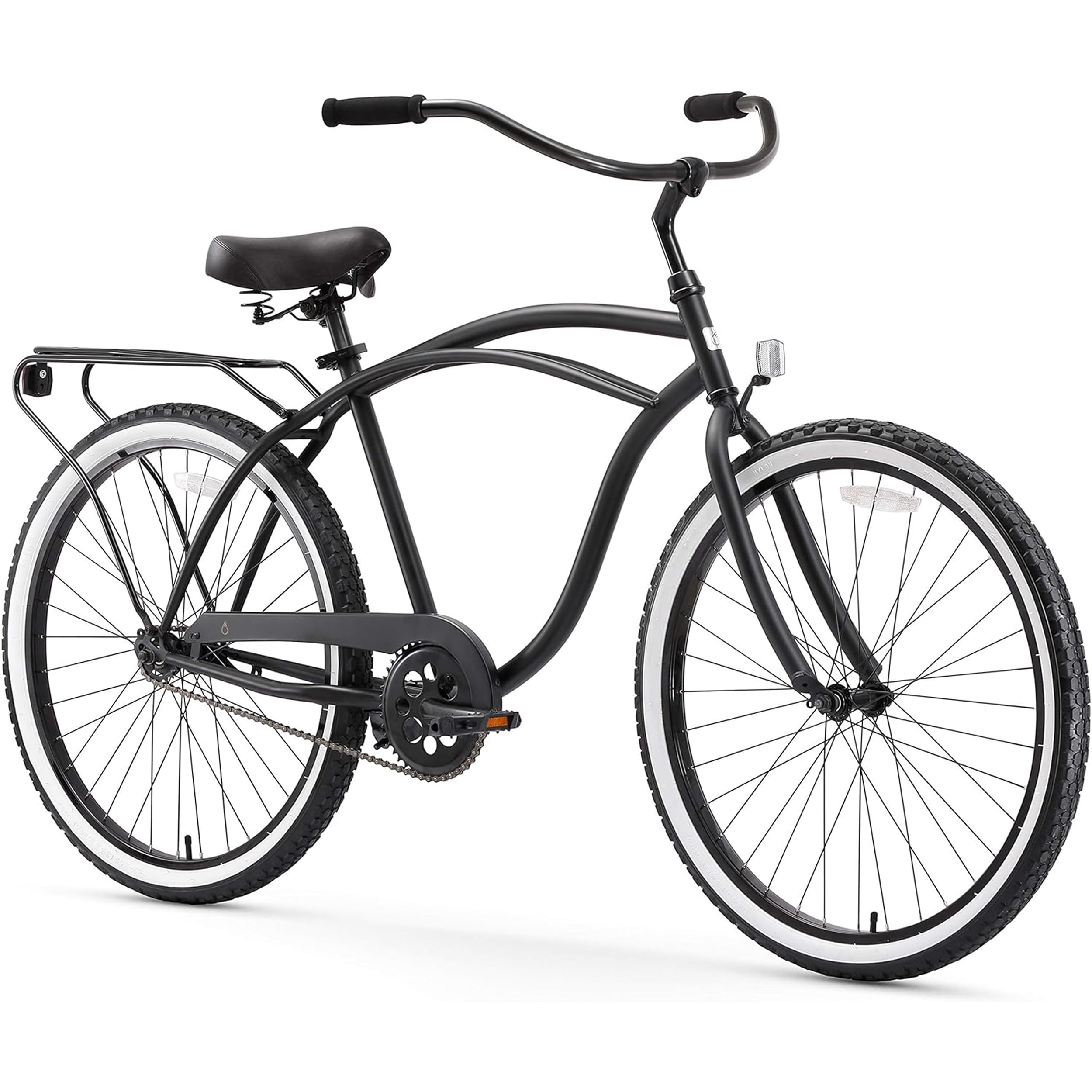
If your riding is flat pavement, a park loop and a coffee run, this is the one that keeps you on the saddle. The foot-forward geometry (pedals set ahead of the seat instead of straight below it) lets your legs extend naturally through each stroke, so your knees stop complaining on longer cruises. The 19-inch steel frame carries riders up to 300 lbs and fits anyone from 5 to 6 feet tall.
What wins people over is the build itself — the frame and finish draw more praise than anything else on this bike. Assembly lands close behind: the box ships with all the tools you need and the process is straightforward enough that a first-timer gets it rolling in an evening. The matte black finish with matching seat and grips is the detail owners mention most after the frame itself.
One shifter-free drivetrain and a rear coaster brake mean near-zero maintenance — you back-pedal to stop and there are no cables to tune. The 26 x 2-inch whitewall tires give a cushioned feel on pavement, and the included rear rack takes a basket or panniers (sold separately) for groceries. The honest catch: it is a 40-pound bike built for level ground, and the single gear makes a genuinely steep hill hard work. A few owners have had rear wheel spokes give out, so treat curbs and potholes with a little respect.
What riders rave about
- Upright, foot-forward posture keeps long cruises comfortable
- 300 lb weight limit and a 19-inch frame for solid, planted riding
- Rear rack included for a basket or panniers
- Comes with the tools needed to assemble
Where it asks for care
- Single-speed gearing is flat-terrain only — hills get heavy
- 40 pounds makes it a chore to carry up stairs
- Rear wheel spokes are the weak point worth watching
Made for: flat-ground commuting, boardwalk cruising and anyone who wants zero gear thinking.
Think again if: your route includes real climbs or you need to haul the bike up flights of stairs.
2. WEIZE 26 27.5 inch Mountain Bike Trail MTB Bicycle
Twenty-one gears and disc brakes on an aluminum frame, at the friendliest price in this trail group.
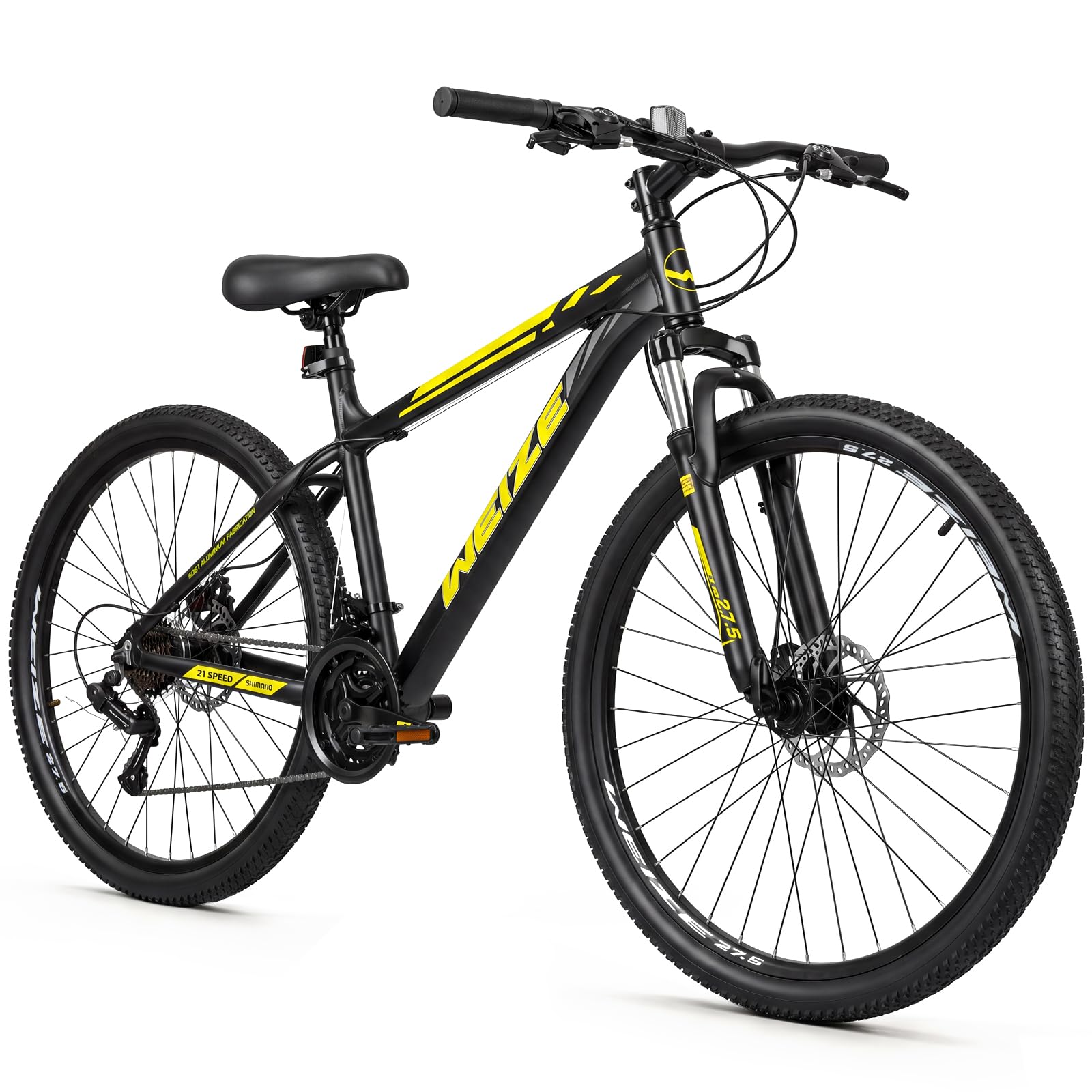
This is the entry price for real trail kit. You get a lightweight aluminum frame and 27.5-inch wheels — a size that keeps the bike agile in tight turns while still rolling over roots and rocks. The 21-speed twist shifters pair with front and rear derailleurs, so the low gears pull you up a climb and the tall ones let you push speed on the flats.
The 21-speed WEIZE against the 7-speed VIRIBUS hybrid above — 21 speeds versus 7 — is the difference between grinding up a hill and spinning up it. Front and rear mechanical disc brakes squeeze a rotor at the wheel hub, so you get controlled stopping on gravel, slopes and snow-covered roads, though the maker notes braking depends on surface and tire grip.
The front suspension fork soaks up trail chatter and the comfort saddle keeps a long ride from turning into a sit-bone protest. Assembly is quick: it arrives 85% pre-assembled with instructions and a video, though not every tool is in the box. The catch is durability — derailleur and front-wheel failures show up often enough in owner feedback that you should expect to check the shifting and spoke tension after the first few rides. Buy it as a value trail starter, not a lifetime trail bike.
Best read on the value: for a first mountain bike that climbs and stops properly, the gearing and disc brakes here give you real trail capability without a premium outlay.
The honest note: mixed durability feedback on the derailleur and front wheel means a post-assembly check is worth your time.
Your pick if: you want maximum trail capability for the least spend and don’t mind a tune-up after assembly.
Look past it if: you expect years of untouched trail abuse — the drivetrain is the compromise.
3. AVASTA AV300 24 26 27.5 Inch Mountain Bike
Pick your wheel size, then let the suspension fork and 21 speeds handle whatever the trail throws back.
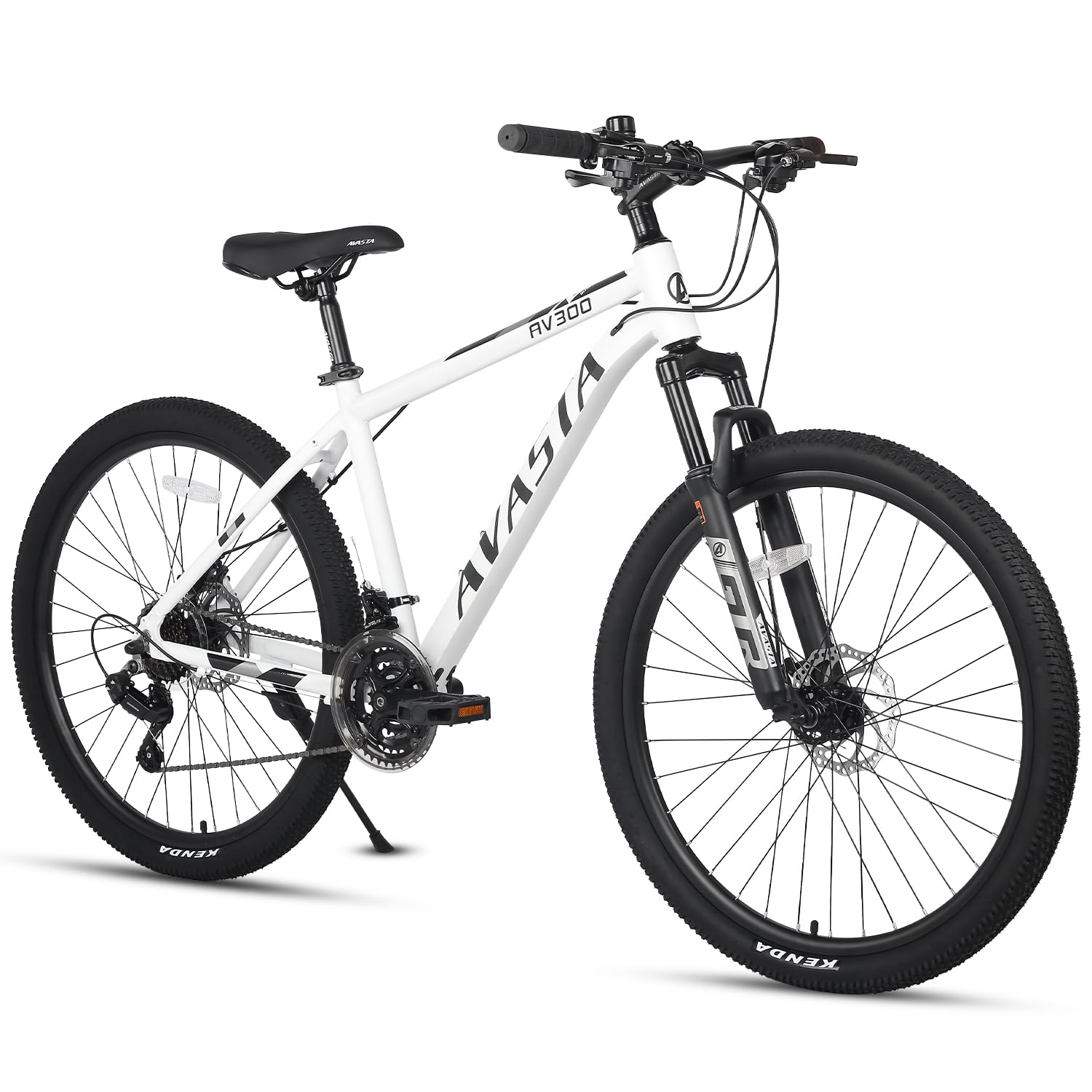
Most mountain bikes lock you into one wheel size. This one lets you choose from 24-inch, 26-inch or 27.5-inch all-terrain tires, each 1.95 inches wide with quick-release axles — so a shorter rider can drop to the smaller wheel and still get a balanced stance. The aluminum alloy frame and rims keep it light enough to muscle up a switchback, and the premium suspension fork absorbs the bumps that would otherwise reach your wrists.
A 21-speed derailleur with trigger shifters gives precise gear changes, and the dual disc brakes pull you down hard when the descent gets steep. Owners consistently come back to the build quality and the value — disc brakes at this tier are the thing that surprises people most. The cable routing tucked inside the frame also draws looks for how clean it keeps the whole bike, and it rides as good as it looks.
Setup is 75% pre-assembled, with an installation video on the product page for the rest. The trade-off: performance, durability and adjustability feedback sits in mixed territory, so expect to fine-tune shifting and brakes in the first week rather than from the start. Include the bell, kickstand, reflectors and tool kit and you have a complete trail package.
Why trail riders like it
- Three wheel sizes in one model — 24, 26 or 27.5-inch
- Dual disc brakes for controlled stopping on descents
- Internal cable routing keeps the frame clean and snag-free
- Bell, kickstand, reflectors and tool kit all included
Plan for this
- 75% pre-assembled means a real setup session before your first ride
- Mixed durability feedback calls for a post-ride check of bolts and shifting
Suits you best: trail riders who want a wheel size matched to their height and disc brakes on a budget.
Different route if: you want a bike that needs zero adjustment after assembly.
4. VIRIBUS Hybrid Bikes, 28 inch Road Bike 7 Speed

The commuter that ships with its own lights and brakes that work when the road is wet.
Riding to work means riding in weather you did not plan for, and this bike is built around that. Front and rear lights rated IPX4 (protected against splashing water from any direction) mean you are visible on a drizzly morning without hunting for a separate set. The corrosion-resistant aluminum frame carries up to 330 lbs, which is the highest weight limit in this whole group.
The 700C wheels — 28-inch, the taller road-bike size — roll over potholes and carry speed with less pedaling effort, which is exactly what you want on a longer city route. A 7-speed rear derailleur with a thumb shifter gives smooth changes for gentle hills and overpasses, and the dual disc brakes use aluminum alloy pads for solid stopping power in any weather.
Owners praise the overall bike quality and the easy assembly — over 85% of it is done before the box arrives. Where opinions split is durability and value: some find the frame solid, others think it feels built to a price. Adjustability is the recurring complaint, so budget time to dial in the seat and bars. It is a capable commuter, not a bike you ride hard for a decade.
The commuter case: built-in IPX4 lighting, 330 lbs of capacity and disc brakes make this a genuinely practical city bike.
What to weigh: mixed feedback on long-term durability means it rewards careful ownership over hard use.
Great for: daily commuters who want lights included and a tall 700C wheel for the road.
Less ideal if: you are chasing premium build quality — this is a practical city bike, not a showcase frame.
5. Mongoose Flatrock Hardtail Mountain Bike

A 26-inch hardtail that rolls over rough ground and fits riders from 5’4″ to 6’2″.
The Flatrock is a hardtail — meaning it has a suspension fork up front but no rear shock — which keeps the bike lighter and simpler than a full-suspension trail machine. Its 26-inch wheels roll over difficult terrain, and the stated fit range of 5’4″ to 6’2″ covers most men without a tape measure scramble. The aluminum mountain frame is light enough to push uphill without gasping.
The 7-speed drivetrain uses twist shifters for smooth gear changes, and linear pull brakes — which squeeze the wheel rim — provide reliable stopping on rough ground. Knobby mountain tires give traction off the path, and the suspension fork absorbs bumps and uneven ground for a controlled ride. Size it against the WEIZE above and the two are close: the Mongoose runs 26-inch wheels against the WEIZE’s 27.5-inch, a modest step up in roll-over ability for the WEIZE.
The Flatrock’s looks are its strongest selling point, and it handles light trail duty fine. But quality and value sit in mixed territory, and gear adjustment is the most talked-about frustration, with durability following close behind. Treat it as a bike for fire roads, gravel paths and neighborhood exploring, and plan on a shakedown of the shifting before you trust it on a real trail.
What lands well
- Fits riders 5’4″ to 6’2″ — a wide, clearly stated height band
- Knobby tires and a suspension fork handle uneven ground
- Appearance is the standout quality owners talk about most
What to keep an eye on
- Gear adjustment comes up repeatedly — expect to tune the shifting
- Mixed durability feedback means off-path use should stay light
- 7 speeds limit you on genuinely steep climbs
Worth it for: casual trail exploring, gravel paths and a rider who likes the look of a proper mountain bike.
skip it if: you plan serious technical descents — the drivetrain is the weak link.
6. HILAND 700C Road Bike, Aluminum Racing Bike

Fourteen speeds, 700C tires and three frame sizes — a road bike sized to actually fit you.
Fit is the first thing most road bikes get wrong, and this one solves it up front. The HILAND comes in three frame sizes: S (49cm) for riders 5’3″–5’6″, M (53cm) for 5’6″–6′, and L (57cm) for 6’–6’4″. Pick your height band, and the rest of the bike follows — a lightweight aluminum frame that is stiff enough to push speed on a commute and comfortable enough for a sport ride.
From there, 14 speeds give you a varied range for gravel, city streets and hills. The 700C tires reduce rolling resistance — less effort per pedal stroke — so distance comes more easily, and the large diameter rolls over potholes instead of slamming into them.
The dual caliper brakes shed weight versus disc brakes and stay aerodynamic, delivering stable stopping in all conditions. Owners rank build quality first and value for money second. Assembly is 85% done, with the free installation tools in the box. Two things to weigh: durability and performance feedback is mixed, and the drop-bar shifter asks for a riding style more committed than a cruiser — great for a road rider, awkward for a casual one.
Size it, then buy it: three published frame sizes from 49cm to 57cm make this the easiest road bike here to fit properly.
Know the posture: drop bars and a 14-speed road drivetrain reward riders who want speed, not a relaxed upright cruise.
Built for: riders 5’3″ to 6’4″ who want a fast, sized road bike for commuting and fitness.
Steer clear if: you want an upright, easy-going ride — the drop bars fight that posture.
7. Schwinn Wayfarer Hybrid Bike, 700c

The vintage-styled 7-speed that puts the bars back where your shoulders want them.
Here is a hybrid that solves the lower-back problem instead of ignoring it. The swept-back handlebar pulls your upper body upright, so a longer ride stops feeling like a plank hold. That upright posture is the point of the Wayfarer, and it suits riders from 5’5″ to 5’9″ on 700c wheels — a stable, easy-rolling ride for neighborhood laps or park loops.
The 7-speed twist shifter handles hills at a relaxed pace, and front and rear linear pull brakes give responsive speed control. The retro steel frame is the bike’s second-most-praised trait, behind overall quality. Chrome fenders on both wheels save you from splashes, and the rear cargo rack carries a bag or essentials on a longer outing.
The Schwinn badge and Madison, WI design roots carry weight with brand-loyal buyers. But this is a bike where assembly feedback splits down the middle — some sail through it, others find it difficult — and value opinions divide the same way. Durability is the aspect more owners push back on, so the lighter-weight rider who keeps to pavement will be happier than a heavy daily commuter.
The comfort argument: swept-back bars and a 700c wheel make this an easygoing, back-friendly ride for riders 5’5″ to 5’9″.
Set your expectation: mixed durability feedback means keep it on pavement and treat the fenders and rack as the everyday wins they are.
Picker’s choice: commuters and campus riders who want retro looks, fenders and a rack without learning to wrench.
Second thoughts if: you need a heavy-duty frame for daily abuse — this one is a fair-weather friend.
8. Schwinn Suburban Adult Comfort Bike

Big-volume tires, a cushioned seat and a fit range that reaches taller riders.
Where the Wayfarer targets the 5’5″–5’9″ band, the Suburban stretches to 5’5″–6’3″ — so a taller rider gets a proper stance instead of a cramped one. The aluminum step-over comfort frame keeps you upright, the large-volume tires give a cushy ride over rough pavement, and the 26-inch wheels suit neighborhood riding where agility beats outright speed.
Seven speeds with a twist shifter (a grip you rotate to change gears) give you manageable gearing for hills around town, and linear pull brakes (rim brakes that squeeze the wheel) provide reliable stopping power. The large cushioned seat and ergonomic grips are where the comfort case gets made, and buyers report the value is what they praise most — you get retro fenders front and rear plus a bike that will not make you dread the ride home.
Now the trade-off to hear clearly: assembly opinions are split, and the braking system draws negative feedback, with warped rims and wobbling wheels showing up repeatedly. The overall quality rating sits in mixed territory rather than outright praise. It can still be a comfortable, characterful city bike — just buy it expecting to check wheel trueness and brakes after assembly, not to trust them blindly.
The case for the Suburban
- Fit range up to 6’3″ suits taller men
- Large cushion seat and ergonomic grips prioritize comfort
- Retro fenders front and rear come standard
- Owners rate the value highest of anything about it
Check before you ride
- Warped rims and wobbling wheels show up in owner feedback
- Mixed reports on assembly difficulty
- 7 speeds only — plenty for town, little for real hills
Pitches well to: taller riders who want a comfortable, retro-looking town bike with fenders.
Reconsider only if: you are not willing to check the wheels and brakes yourself after assembly.
9. Tommaso Forcella Sport Bike Performance Aluminum Road Bike

Twenty-four speeds, a carbon fork and a drivetrain that says this is a real road bike.
Count the gears and the intent becomes obvious. The Forcella runs a Shimano Claris 24-speed (3×8) drivetrain — three chainrings up front and eight at the back — which gives you a low bail-out gear for climbs and a tall one for sprinting on the flat. That is 24 speeds against 18 on the SAVADECK carbon road models, a gearing edge on rolling terrain. The aluminum frame is stiff and durable, and a carbon fork knocks out road buzz before it reaches your hands.
Its 700x25c tires are the narrow road width — fast on pavement, less forgiving on rough ground — and rim brakes keep it light and aerodynamic. This is a performance-first build for fitness riders and commuters who care about speed. Owners credit the build quality for how well it rides, report trouble-free assembly, and praise the matte black finish.
The note to hold onto: wheel durability is the mixed area, with rear spokes losing tension often enough to watch. Value feedback is mixed too, so shop it for the drivetrain and fork rather than as a bargain. For a first serious road bike, the 24-speed gearing is the reason to pick this over the 14-speed HILAND above — more gears, more control on any pitch.
Why riders choose it: 24 Shimano Claris speeds plus a carbon fork is genuine road-bike hardware, not a hybrid dressed up in thin tires.
Keep an eye on: rear spokes are the known pain point — a quick truing check protects the wheelset.
For: fitness riders and commuters stepping up to a proper road bike with a big gear range.
Not for: anyone who wants to ride rough ground or hates checking spoke tension.
10. SAVADECK Carbon Road Bike for Beginners

A whole road bike under 9kg, where carbon makes the climbs feel shorter.
Start with the number that matters most here: 8.9kg (19.6lb). That is the complete bike weight, with a T800 carbon fiber frame, fork and seat tube. Carbon is the reason — the maker states it is 5 times harder than aluminum alloy at the same volume while staying light, and you feel it the moment a hill tilts upward. Lighter bike, easier acceleration, less of your effort wasted carrying the frame.
It comes 90% assembled — you attach the handlebar, front wheel, seat post and pedals, with most riders finishing in about 15 minutes on basic tools. The Shimano SORA 18-speed groupset (2×9) gives smooth, precise shifts for new riders, and the wind-tunnel-designed aero frame with full internal cable routing cuts drag. The 700x25C Continental Ultra Sport II tires are chosen for grip and puncture resistance, and free platform pedals are in the box.
Owners rate build quality highest, call the bike very light, and single out the pearl white paint for compliments. Assembly is straightforward. What to weigh: it is an 18-speed drivetrain against the Tommaso’s 24, so you lose some low-gear range if you plan to climb seriously. For tackling hills on a beginner budget, though, the carbon frame makes this the most climbing-friendly bike in the road group.
The weight argument: 8.9kg of T800 carbon on a bike that assembles in about 15 minutes is a genuinely light first road bike.
Compromise to accept: 18 speeds is fewer than the Tommaso’s 24, so the easiest climbing gears sit a step higher.
Match made for: a new road rider who wants the lightest possible build and quick setup.
Wrong turn if: you need maximum gear range for steep climbing — the 24-speed Tommaso covers more.
11. SAVADECK Carbon Disc Road Bike

Carbon everywhere plus disc braking, for the rider who wants control on wet roads.
This is the only carbon disc road bike here, and the combination changes what you can do. Toray T800 carbon fiber runs through the frame, fork, rims and seat post, keeping the complete bike at 9.6kg (21.1lb). The disc brakes are the real advantage — bilateral pulling with balanced power and a linear feel gives high stopping power and easy maintenance, so a wet descent does not turn into a gamble.
Shimano SORA R3000 18-speed gearing, with matching shift levers and front and rear derailleurs, handles the shifting smoothly. Full internal cable routing runs the lines inside the frame — the maker says it reduces wind-tunnel resistance, and visually it keeps the bike tidy. The tapered head tube stiffens the front end for more precise handling. Continental 700x25C tires suit a range of road surfaces, and pedals come with the bike.
Compare it with the non-disc carbon SAVADECK above and the trade is weight for weather: the disc version is 9.6kg against 8.9kg, but you gain serious stopping power in the rain. Owners rate the bike quality highest, and one line says it all — it matches the quality of bicycles priced several times higher, though we cannot verify the comparison. Setup feedback is mixed, so plan a careful first evening. It arrives nearly completely pre-assembled.
Why the disc build earns a place
- Carbon frame, fork, rims and seat post at 9.6kg (21.1lb)
- Disc brakes with balanced power for wet-road confidence
- Fully internal cables keep it clean and reduce drag
- Shimano SORA R3000 18-speed shifting
Trade-offs to know
- At 9.6kg it outweighs the rim-brake carbon SAVADECK’s 8.9kg
- Setup feedback is mixed — budget real time for the build
- 18 speeds, so fewer low climbing gears than a 24-speed
Best suited to: riders who want carbon speed but refuse to compromise on braking in wet weather.
Pause if: the lowest climbing gear is your priority — the 9.6kg disc build and 18 speeds trade some of that for control.
Understanding the Specs
Frame material: steel, aluminum or carbon
Steel frames are heavier but soak up road vibration and handle heavier riders — the sixthreezero steel frame carries up to 300 lbs. Aluminum is lighter and rust-resistant, which is why it appears on the mountain, hybrid and road picks here. Carbon fiber is the lightest of the three: the SAVADECK bikes weigh in at 8.9kg and 9.6kg complete. Pick aluminum for an all-rounder, carbon if you ride enough to feel the weight on every climb.
Speeds and gearing
Gear count tells you how many ratios you can pick from. A single-speed has one, which is fine on flat ground but hard work on hills. A 7-speed handles gentle rolling terrain. A 21-speed with front and rear derailleurs gives a low climbing gear and a tall sprinting gear. Road bikes go to 14 and 18 and 24 speeds. More gears means more control on changing pitch — and a little more maintenance.
Wheel size and tire width
Larger wheels roll over obstacles and carry speed with less pedaling, which is why 700C wheels show up on road and hybrid bikes. Smaller 26-inch and 27.5-inch wheels make a bike more agile, and wider tires cushion the ride. The 2-inch cruiser tires are the plushest here; the 700x25C road tires are the fastest and least forgiving. Match the wheel to your surface, not to a spec sheet.
Brake styles explained
A coaster brake stops when you pedal backward — simple, no cables. Linear pull and caliper brakes pressagainst the wheel rim and work well in dry weather. Disc brakes grip a metal rotor at the hub and keep stopping power when wet. For flat cruising, a coaster brake is enough. For trails and wet commutes, disc brakes are the safer bet. The SAVADECK disc road bike is the pick if wet-road control matters to you.
FAQ
How do I know which frame size fits my height?
Is a single-speed cruiser good for hills?
What does 85% pre-assembled actually mean?
Are disc brakes better than rim brakes for a city commuter?
Can I ride a mountain bike on paved roads?
How much weight can these bikes carry?
What is the difference between 700C and 26-inch wheels?
Is carbon fiber worth it for a beginner road bike?
Do these bikes come with pedals and tools?
How long do these bikes last?
Final Thoughts: The Verdict
For most men buying a bike to actually ride — flat paths, neighborhood loops and a relaxed posture — the sixthreezero Around The Block is the one to start with. The single-speed drivetrain, 300 lb weight limit, upright geometry and included rear rack make it a low-maintenance, comfortable cruiser. If your route has hills and you want trail capability, the WEIZE 27.5-inch mountain bike gives you 21 speeds and disc brakes for the least spend. And if speed is the goal, the HILAND 700C road bike in three frame sizes is sized to fit you properly.
Two buys worth calling out for riders who know what they want: the SAVADECK carbon road bike at 8.9kg is the lightest way into road cycling, and the SAVADECK carbon disc is the pick if wet-road braking matters more than the last few grams. With a solid rating and a large owner base behind it, the cruiser is the safest bet for a first buy — read a few of its reviews and you will see why it keeps ending up in garages that get used.
How We Picked
We do not accept paid placement. Every pick is matched to a real buyer and a real use-case; we do not hands-on test units.
Sources & Methodology
Specifications: manufacturer listings and product documentation. Review insights: verified customer reviews, as of November 2026. Pricing: not shown on this page (it changes often); check the current price via the retailer link.
As an Amazon Associate, Gadgets Feed earns from qualifying purchases. This does not affect which products we feature.