
Our readers keep the lights on and my morning glass full of iced black tea. As an Amazon Associate, I earn from qualifying purchases.
Specs are compiled from manufacturer listings and verified buyer reviews and can change over time — please confirm the key details on the product page before buying.
Three things decide whether an abrasive chop saw blade works for you: the arbor hole (the center hole that slides onto your saw’s spindle) has to match your saw, the disc has to fit under the guard at 14 inches (or 10 inches on a smaller machine), and the wheel has to survive cutting steel without shattering. Get those right and the cheapest box on this list will out-cut an expensive wheel that doesn’t fit. Get them wrong and you’ll be driving back to the shop mid-project.
I’m Min — the founder and writer behind Gadgets Feed. This guide is built by comparing the manufacturers’ published specifications and the patterns across verified customer reviews, so you get each pick’s real strengths and trade-offs instead of marketing spin.
Most people blame the saw when a cut wanders; the real culprit is usually a wheel that’s too thick for the motor or an arbor that never sat flush. So the choices below are sorted by what actually decides your cut. This is where a genuinely useful shortlist of abrasive chop saw blades saves you from guessing at the arbor.
Our Picks at a Glance


How To Choose The Best Abrasive Chop Saw Blades
An abrasive chop saw blade is a consumable (a part that wears out and gets replaced), not a tool you buy once. It wears down with every cut, so the real question isn’t “which one is best” — it’s “which box gives me the most clean cuts for the money before I have to buy again.” That reframes the whole decision, and it’s why a ten-pack of mid-priced wheels often beats a single premium disc.
Start with the arbor, not the brand
The arbor is the centre hole in the disc that slides onto your saw’s spindle. Get this wrong and nothing else matters. Most full-size chop saws take a 1-inch arbor, which is the standard on nearly every 14-inch wheel here. Smaller 10-inch saws commonly run a 5/8-inch arbor, so check your machine’s spindle before you order a box of ten. A wheel with the wrong hole will either not seat or will wobble, and a wobbling abrasive wheel is a safety problem, not just a bad cut.
Match the max RPM to your saw
Every abrasive wheel carries a max RPM figure — the fastest the disc is rated to spin. Your saw’s no-load speed must be at or below that number. Mercer’s 14-inch wheel, for example, is rated to 4,400 max RPM. Running a slower-rated wheel on a faster saw stresses the fiberglass reinforcement, and that’s the failure you don’t want. Check both numbers before the first cut.
Decide how thick you want the cut
Thickness is measured in fractions of an inch, and it drives two things: how much material the wheel removes and how hard your motor has to work. A 3/32-inch wheel is the common middle ground — thin enough to cut fast and leave a smaller burr, thick enough to hold up. A 1/8-inch wheel is beefier and lasts through rougher work like rebar, but it takes a wider bite. On a low-horsepower saw, the thinner wheel is usually the smarter call.
Quick Comparison
| Model | Best For | Diameter | Thickness | Arbor | Amazon |
|---|---|---|---|---|---|
| DEWALT DW8001B4★ Best Overall | All-round metal cutting | 14 inches | 0.8 inches | — | Amazon |
| IVY Classic 40088-5Best for Small Saws | Smaller 10-inch saws | 10 inches | 0.09 inches | 5/8 inch | Amazon |
| Sidco Supply 14-InchBest for Clean Cuts | Clean, low-burr cuts | 14 inches | 2.5 millimeters | 1 inch | Amazon |
| Makita B-57598-5 | Heavy-gauge pipe and angle iron | 14 inches | 0.09 inches | 1 inch | Amazon |
| FOXBC 14-Inch 10-Pack | Thin-kerf fast cutting | 14 inches | 7/64 inches | 1 inch | Amazon |
| Benchmark Abrasives 14-Inch | Wide saw compatibility | 14 inches | 0.09 inches | 1 inch | Amazon |
| Mercer Industries 602020 | General-purpose ferrous cutting | 14 inches | 0.09 inches | 1 inch | Amazon |
| BHA 14-Inch 10-Pack | Rebar and mixed material | 14 inches | 0.13 inches | 1 inch | Amazon |
| United Abrasives-SAIT 24051 | Low-horsepower saws | 14 inches | 3/32 inch | 1 inch | Amazon |
In‑Depth Reviews
1. DEWALT Cutting Wheel for Chop Saw, Metal Cutting, 14-Inch (DW8001B4), 4 count
Our pick — 4.5+★ from 350+ verified ratings; the strongest balance of quality and price.
A 4-count box of 14-inch aluminum oxide discs that cuts 1 5/8-inch fence pipe without shattering.
The thing that puts this one on top is the fiberglass. DEWALT builds in 2 full sheets of fiberglass — that’s the mesh layer that stops an abrasive wheel from flying apart mid-cut. Combined with a high grain concentration of aluminum oxide (the hard mineral that does the actual grinding), you get a wheel that cuts fast and keeps its shape instead of hollowing out after a few passes. It’s a 4-count box of 14-inch discs, matching the size most full-size chop saws take.
Reviewers consistently report fast cuts through steel and no shattering under load. As buyers report: “Customers find these cutting wheels perform well, with one mentioning they cut through 1 5/8 inch fence pipes like butter.” That’s a real-world data point: 1 5/8-inch fence pipe is no small cut, and it’s the sort of thing this wheel handles without bogging.
The grit rating here is 40, a medium-coarse grade built for aggressive material removal. Compared to the Benchmark Abrasives wheel with a 60 grit, this one is the coarser, more aggressive cutter — the 40 means it bites harder and clears metal quickly, while a finer wheel leaves a smoother edge. The trade-off is simple honesty: a fast, coarse 40-grit wheel runs through material, so you’re buying speed over finesse. For cutting pipe and angle iron to length, that’s the right trade.
What earns it the top spot
- 2 full sheets of fiberglass reinforcement — the safety-conscious build that resists shattering
- High grain concentration for aggressive cutting with smoother wheel running
- 4-count box at a mid-range tier, so you’ve got spares before the first one wears down
- Aluminum oxide grain rated for long life on metal, aluminum, and steel
Where it asks you to adapt
- A 40 grit is a coarse cutter — if you need a fine, polished edge, a 60-grit wheel serves you better
- The 0.8-inch listed thickness is a bulky profile; confirm your guard clearance before the first spin
- Only 4 discs per box, so a production shop will reorder sooner than a 10-pack owner
Reach for this if: you’re cutting pipe, angle iron, and general metal on a full-size 14-inch chop saw and want a wheel that won’t shatter.
Look elsewhere if: your machine takes a 5/8-inch arbor — this 14-inch disc is built for the larger spindle.
2. IVY Classic 40088-5 Swift Cut 10-Inch x 3/32-Inch x 5/8-Inch Arbor, Metal Cut-Off Blade for Chop Saws, 5-Pack
The 10-inch answer for smaller saws — and the only 5/8-inch arbor on this list.
If your chop saw is the smaller 10-inch type, this is the pick that actually fits. The arbor here is 5/8 inch, and the disc is 10 inches across, so it drops onto a small-spindle machine that a 14-inch wheel won’t. The 3/32-inch width keeps the cut narrow, and IVY rates it to a max RPM of 6,100 — a higher ceiling than the larger wheels because a smaller disc spins faster and safely. It’s a 5-pack of resin-bonded aluminum oxide discs for steel, angle iron, and sheet metal.
One thing to take seriously: the maker is explicit that these are not for high-speed saws, and the max RPM of 6,100 is the number to check against your machine before the first cut. Ignore that warning and you’re running a 10-inch disc past its rated speed. The blade is double-reinforced with fiberglass mesh and the arbor gets a metal reinforcement for extra strength, so the build is aimed at surviving a shop floor rather than a one-off afternoon. Note its 0.09-inch thickness sits alongside the DEWALT’s much bulkier 0.8-inch listed profile — a much thinner cut for the smaller saw.
Arbor fit is the whole reason this one earns a spot at the top of the value group. Five discs, one honestly narrow kerf, and a size that smaller machines demand. If you’ve been fighting a 14-inch wheel that wobbles on a 10-inch saw, this ends that problem outright.
Best for the small saw: the 10-inch diameter and 5/8-inch arbor make it a direct fit for machines the larger wheels can’t serve.
The clearance check: it’s not rated for high-speed saws, so match the 6,100 max RPM to your machine’s speed before you spin it.
Suits: anyone running a 10-inch chop saw who needs a wheel that seats properly on a 5/8-inch spindle.
Not suited to: full-size 14-inch machines — the smaller diameter simply won’t reach the work.
3. 14 Inch Cut Off Wheel – Precision Smooth Cutting – Abrasive Chop Saw Blades – Aluminum Oxide – Metal Cutting Wheel
A finer 60-grit disc that trades raw speed for a smoother edge and less cleanup.
Here’s a wheel built for the finish, not just the cut. The grit here is 60 — a medium grade that removes metal more gently than a coarse wheel — and the maker pitches it squarely at clean edges with minimal burrs. That matters when the cut has to be weld-ready: a rough, jagged edge means grinding time before you can join two pieces. The disc is 14 inches with a 1-inch arbor and 2.5-millimeter thickness, and it’s a 5-pack of aluminum oxide grain with double fiberglass mesh and a resin bonding formula.
Compare it to the DEWALT at the top: this one’s 60 grit against the DEWALT’s 40. The higher number means a finer abrasive that shaves rather than hogs, so the cut is cleaner but slower through the same material. That’s the honest trade. The thinner 2.5-millimeter profile also keeps resistance low, so the saw isn’t fighting the wheel on every pass. Built for ferrous metals, steel, stainless, pipe, iron, and copper.
A quick reality check on the smaller review base: this one hasn’t been out as long as the top picks, so it’s a newer entrant still building its track record. The specs and the build are sound — the double mesh and resin bond are legitimate durability features — but if you want a wheel with a long history behind it, the DEWALT or Makita hold that edge. If a clean, low-burr cut is the priority, this earns its slot.
Go with it when: you’re cutting pieces that need to join cleanly and you’ll trade a little speed for a smoother edge.
Think twice if: you want a long-established track record — this wheel is newer to the market than the top picks.
4. Makita B-57598-5 14″ x 1″ x 3/32″ Abrasive Cut-Off Wheel, 5/Pk

The heavy-gauge specialist that chews through pipe and angle iron with less vibration.
Makita designed this one for the thick stuff. It’s rated for cutting heavier gauge metal such as pipe or angle iron, and the special bond is aimed at improving both cutting speed and wheel life. The double reinforcement cuts down on burr and vibration — that shimmy you feel through the handle on a thin wheel. It’s a 5-pack of 14-inch discs with a 1-inch arbor and 3/32-inch width, built from brown fused aluminum at a 60 grit.
Where this really earns its keep is longevity on tough stock. The maker claims up to 2 times the life of a 7/64-inch thick abrasive wheel, and up to 20 percent faster cutting than that same 7/64-inch reference. Those are the manufacturer’s own figures, so treat them as such — but the direction is right: a 3/32-inch wheel cuts faster and lasts longer than a thicker 7/64-inch disc on heavy metal. The double reinforcement and special bond show up in the cut: less vibration and faster progress through thick steel.
The fair caveat: the reviews are split on durability and on value — some owners find them excellent, others feel they wear quicker than expected for the money. If you’re cutting heavy pipe all day, the fast-cutting bond is worth it; if you’re doing occasional light work, a ten-pack of budget wheels stretches further. On a Makita cut-off saw specifically, these are the natural pairing.
Why it punches above its tier
- Built for heavier gauge metal — pipe and angle iron are its home ground
- Double reinforcement for less burr and less vibration through the cut
- Special bond aimed at faster cutting and longer wheel life
- Maker’s figures put it at up to 2x the life of a 7/64-inch wheel
Keep in mind
- Durability and value draw a mixed read — heavy users are split on how fast it wears
- A 5-pack, so a busy shop will reorder sooner than a 10-pack owner
- The speed and life gains are compared against a thicker 7/64-inch wheel, not against every disc on the market
The right call for: heavy-gauge pipe and angle iron on a full-size chop saw, especially a Makita machine.
Less compelling for: light, occasional cutting where a larger budget box stretches your money further.
5. FOXBC 14 Inch Metal Cut-Off Wheel Abrasive Chop Saw Blades – 10 Pack
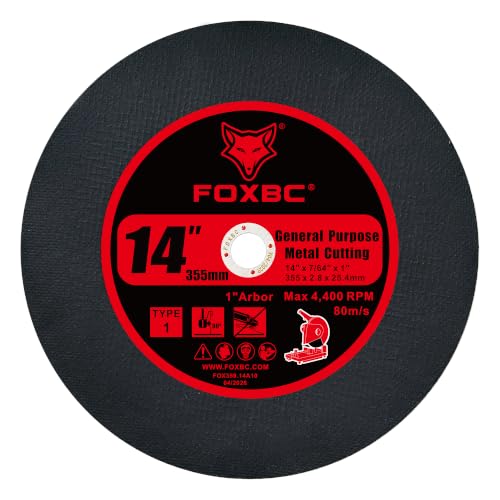
A thin-kerf ten-pack that lets your saw’s motor do less work per cut.
Thin is the whole idea here. These are 14 x 7/64 x 1-inch Type 1 flat discs (14 inches across, 7/64 inch thick, 1-inch arbor hole), and the thin-kerf design (a narrow cutting edge) is built to draw less power and less resistance — so your saw works closer to its full potential instead of straining through thick stock. Less resistance also means less burr (the rough metal lip left on a cut edge), which is the difference between a clean cut and a grinding session afterward. It’s a 10-pack of aluminum oxide blend discs with 2 sheets of fiberglass for breakage resistance, rated to ANSI B7.1 (the safety standard for abrasive wheels).
The 7/64-inch thickness puts it between the standard 3/32 and the beefier 1/8 wheels. That’s a genuinely useful middle ground: thin enough to cut fast and cool, thick enough not to fold on a hard pass. The 60 grit is a fine grade, so the finish is on the smoother side. For steel, stainless, cast iron, and sheet metal, this is a well-rounded everyday disc.
The honest note is the shallow track record — this is a newer ten-pack still building its ownership base, so you’re leaning more on the spec sheet than on a long history of use. The 7/64-inch kerf, 60 grit, and 2 sheets of fiberglass are solid on paper, and ten discs at this tier is strong value. If you want a fast, low-burr cutter and don’t need a long track record, this ten-pack delivers.
The thin-kerf win: 7/64-inch width means less resistance, cooler cuts, and a saw that isn’t straining on every pass.
The honest catch: a newer entrant with a shorter track record, so you’re trusting the specs more than a long history of owner experience.
Pick this if: you want a fast, low-resistance cut and a full ten-pack of thin-kerf discs to keep you stocked.
Hold off if: proven long-term owner history matters more to you than a well-specced new entrant.
6. Benchmark Abrasives Aluminum Oxide Type 1, 14 Inch Chop Saw Blade, 10 Pack

Ten discs that claim to fit virtually every 14-inch chop saw you’ll ever bolt them to.
The compatibility list is what stands out. Benchmark says these fit DEWALT, Milwaukee, Makita, Bosch, Metabo, Ryobi, Black & Decker, Kobalt, Craftsman, Skil, Porter Cable, Ridgid, and virtually any other 14-inch electric chop saw. That breadth is why this one suits a shared shop where machines come and go. The discs are 14 x 3/32 x 1-inch, Type 1 flat, 60 grit, with reinforced fiberglass mesh and precision balancing for low vibration — a 10-pack aimed at everything from iron and steel to drywall studs.
This is a wheel with more raw count on its side than the IVY Classic 5-pack — ten discs against five. Where it splits is cutting performance: the reviews here are genuinely mixed, with good reports on clean cuts and long life sitting alongside reports of durability issues. That split is about matching the wheel to your material, not a defect. The quality and the value both draw solid marks; it’s the cutting longevity that owners can’t agree on. On light gauge and general fabrication, most people are satisfied; push it hard through heavy stock and the experience varies.
Set expectations accordingly: this is a commodity ten-pack that does everyday fabrication well, not a premium wheel for punishing all-day production work. If your cuts are general — studs, tube, pipe, the occasional bracket — the breadth of compatibility and the ten-pack value make it an easy pick.
Good fit for: a mixed shop with several 14-inch saws where broad compatibility and a full ten-pack matter.
Look past it if: you’re running heavy production cuts where consistent per-wheel longevity is make-or-break.
7. Mercer Industries 602020-14″ x 3/32″ x 1″ Chop Saw Cut-Off Wheels for Metal (10 pack)

A workhorse general-purpose ten-pack with a clearly stated safety ceiling.
Here’s the number that matters most on this one: max RPM 4,400. That’s the safest thing on the whole spec sheet, because it’s stated plain and simple — check it against your saw’s speed and you’re covered. These are 14-inch, 3/32-inch thick, 1-inch arbor wheels designed for a chop saw on ferrous metals, in a 10-pack of aluminum oxide grain with double reinforcement for safety. The 3/32-inch thickness is pitched as a sturdy, long-lasting profile — thick enough to hold up, thin enough to cut quickly.
This is a general-purpose wheel in the truest sense. It’s not chasing a record on grit or kerf; it’s meant to sit on your shelf and handle whatever ferrous metal you throw at it. The double reinforcement speaks to breaking resistance, and the aluminum oxide grain is built for quick cutting. Ten discs in the box means you’re stocked for a while, which is the value play with consumables like these.
The catch most buyers will notice is that this is a step behind the top picks on measured ownership history — it’s a dependable everyday wheel rather than a standout one. For everyday ferrous metal work, that’s enough. If you want a stocked box of general-purpose discs at a sensible tier, Mercer delivers without drama.
Safety you can check: a clearly stated 4,400 max RPM makes it easy to confirm your saw stays within the wheel’s rating.
Where it settles: a dependable general-purpose wheel rather than an elite performer — the right buy when you want stock, not a record-holder.
Great for: the shop that wants a stocked, safely-rated general-purpose box for everyday ferrous metal work.
Skip if: you’re chasing the fastest or finest cut — this is built for dependable everyday use.
8. BHA 14 x 1/8 x 1 Chop Saw Cut Off Wheels for Metal and Rebar – 10 Pack

The thick, extra-coarse wheel built to chew through rebar and structural steel.
At 1/8 inch thick, this is the beefiest disc on the list — and that’s the point. Where a thin-kerf wheel trades durability for speed, this one trades speed for muscle. The grit is 30, an extra-coarse grade that bites hard into tough stock, and the target applications are rebar, angle iron, tube, and structural steel. It’s a 10-pack of 14 x 1/8 x 1-inch discs made from aluminum oxide, compatible with a stationary 14-inch chop saw. Note the maker’s warning: not for wood or masonry.
Line it up against the thin 7/64-inch FOXBC wheel and the split is clear. This 1/8-inch BHA removes more material per pass and shoulders through rebar that would slow a thinner disc, while the thin-kerf wheel cuts faster and cooler on lighter stock. Neither is “better” in a vacuum — one is built for grunt, the other for speed. If your work is rebar and heavy structural steel, this is the wheel your job calls for. It also handles fiberglass, plastic, iron, steel, and stainless.
Keep in mind the weight: the box lists at 15.1 pounds, so it’s a substantial box to store and move around. And a coarser 30-grit wheel leaves a rougher edge by design — that’s the cost of the extra cutting power. For demolition-grade and rebar work, that’s a fair trade; for finish work, choose a finer grit.
Built for grunt: the 1/8-inch thickness and extra-coarse 30 grit shoulder through rebar and heavy structural steel that slows thinner wheels.
The honest trade: a coarser wheel leaves a rougher edge, and the 15.1-pound box is a heftier thing to store — fine if you’re cutting demolition-grade stock.
Choose this for: rebar, angle iron, and structural steel where cutting muscle matters more than a finished edge.
Not the one for: finish work or light sheet metal, where a thinner, finer wheel suits better.
9. United Abrasives-SAIT 24051 Type 1 14-Inch x 3/32-Inch x 1-Inch Fast Cutting Chop Saw Blade, 10-Pack

Formulated for low-horsepower saws that need an easy-cutting wheel to keep up.
This is the specialist at the top of the price ladder, and its whole reason for existing is the underpowered saw. It’s specially formulated for use on low-horsepower chop saw machines, so it cuts fast with minimal pressure — your saw isn’t straining to push a stubborn disc through steel. The dimensions are 14 x 3/32 x 1 inch, Type 1 flat, in a 10-pack, with a 36 grit that’s finer than the coarse 30 of the BHA but coarser than the 60-grit wheels. It’s aimed at angle iron, channel iron, heavy rebar, and structural metal.
The 36 grit is a smart middle choice for fast cutting — fine enough to leave a reasonable edge, coarse enough to clear material quickly. That combination, plus the low-pressure formulation, is what makes this the premium option for someone running a tired or small-motor saw. If your machine bogs down with a beefier wheel, this removes that problem at the source.
What to weigh: this is the highest tier on the list, so it’s a real commitment per box, and its track record is the thinnest here — a premium wheel with fewer owners behind it than the mainstream picks. The people who run it on low-HP (low-horsepower) saws get exactly the fast, low-pressure cutting it was built for. If your motor is the weak link, this answers that need directly.
Worth it for: low-horsepower saws that struggle to push a heavy wheel through steel, and for fast cutting with minimal pressure.
Weigh the cost if: you run a full-power saw — the low-HP formulation is a specialist strength, not a universal one.
Understanding the Specs
Arbor size
The arbor is the centre hole in the disc that fits over your saw’s spindle. A 1-inch arbor is the standard on full-size 14-inch chop saws; smaller 10-inch machines often run a 5/8-inch arbor. If the hole doesn’t match, the wheel won’t seat properly, and an abrasive disc that wobbles is a safety risk, not just a sloppy cut. Always match arbor first.
Diameter
Diameter is the width of the disc across its face. A 14-inch wheel is the common size for full-size chop saws and reaches through thick pipe and structural steel. A 10-inch wheel is for smaller machines. The diameter has to match your saw’s capacity — a larger disc won’t clear a smaller guard, and a smaller disc won’t reach the work on a big saw.
Thickness and kerf
Thickness is how wide the cut is. A 3/32-inch wheel is the everyday middle ground — fast and clean. A 1/8-inch wheel is beefier and built for rough work like rebar but leaves a wider cut. A thinner 7/64-inch wheel draws less power and cuts cooler. On a low-power saw, go thinner to keep the motor from straining.
Grit and max RPM
Grit is the coarseness of the abrasive — a lower number like 30 is extra-coarse and bites hard, while a 60 is a finer grade that leaves a smoother edge. Max RPM is the fastest the wheel is rated to spin; your saw’s speed must stay at or below it. Check both: grit for the finish you want, max RPM for safety on your machine.
FAQ
How do I know which arbor size my chop saw needs?
Can I use a 14-inch blade on a 10-inch chop saw?
What does the max RPM number on the wheel mean?
Is a thicker chop saw blade stronger?
How long does an abrasive chop saw blade last?
Can I cut stainless steel and rebar with the same wheel?
What grit chop saw blade leaves the cleanest cut?
Why do my cuts leave a big burr?
Are fiberglass-reinforced wheels safer?
Do I need a different wheel for a low-horsepower saw?
Final Thoughts: The Verdict
For most people working a full-size 14-inch chop saw, the DEWALT DW8001B4 is the one to grab — the 2 sheets of fiberglass and high aluminum-oxide grain give you a wheel that cuts aggressively and resists shattering, and its 4.5+ star standing backs that up. If your machine is the smaller 10-inch type, the IVY Classic 5-pack is the proper fit with its 5/8-inch arbor (the center hole that mounts on the saw). And for rebar and heavy structural steel, the thicker, extra-coarse BHA 10-pack is the one to reach for.
Buy for the arbor and the job, not the label. Match the hole to your spindle, keep your saw’s speed under the wheel’s max RPM (revolutions per minute, the wheel’s top safe spin speed), and pick grit and thickness based on if you want speed or finish — then a stocked multi-pack keeps you cutting without a mid-project run to the shop.
How We Picked
We do not accept paid placement. Every pick is matched to a real buyer and a real use-case; we do not hands-on test units.
Sources & Methodology
Specifications: manufacturer listings and product documentation. Review insights: verified customer reviews, as of November 2026. Pricing: not shown on this page (it changes often); check the current price via the retailer link.
As an Amazon Associate, Gadgets Feed earns from qualifying purchases. This does not affect which products we feature.