
Our readers keep the lights on and my morning glass full of iced black tea. As an Amazon Associate, I earn from qualifying purchases.
Specs are compiled from manufacturer listings and verified buyer reviews and can change over time — please confirm the key details on the product page before buying.
You do not need a tower under your desk to play League of Legends, CS2 or Dota 2 well. A small box the size of a paperback can hit 60 frames per second in those titles — the deciding factor is the integrated graphics chip, not the CPU badge. This guide ranks the current mini gaming PCs by measured 1080p frame rates and owner reports, not by the numbers printed on the box.
I’m Min — the founder and writer behind Gadgets Feed. This guide is built by comparing the manufacturers’ published specifications and the patterns across verified customer reviews, so you get each pick’s real strengths and trade-offs instead of marketing spin.
A mini gaming PC is simply a full desktop squeezed into a small chassis, and the graphics chip soldered inside decides everything. This breakdown of the budget mini pc for gaming field shows you which integrated graphics actually hold a playable frame rate.
Our Picks at a Glance


How To Choose The Best Budget Mini PC For Gaming
The most common mistake is buying on the processor name alone — a Ryzen 7 badge says nothing about the graphics chip that sets your frame rate. A Ryzen 7 badge tells you the CPU is quick at spreadsheets and browser tabs — it says nothing about whether the graphics inside can hold 60 frames per second in a shooter. Start with the graphics, then work backwards.
The integrated graphics chip is your frame rate
Look for the graphics model in the spec sheet: Radeon 780M, 760M, 680M, 660M or Vega 8. Newer architecture numbers generally mean more compute units (the small graphics cores that draw each frame), and more of those translates to higher, steadier frames in esports titles. If a listing does not name the graphics chip, treat that as a warning sign — you cannot judge frame rate without it.
RAM type matters as much as RAM size
Integrated graphics borrow their memory from the main system RAM, so the speed of that RAM directly affects your frame rate. LPDDR5X running at 7500MT/S or DDR5 at 6400MT/s feeds the graphics far better than slower DDR4. Sixteen gigabytes is the sensible floor for a game, a browser and voice chat running at once.
Storage: NVMe or nothing
An NVMe SSD (a fast drive that plugs straight into the motherboard) cuts game load times down hard. A 512GB drive holds only a handful of large games; 1TB gives you room for a full library. Check whether there is a second M.2 slot so you can add a drive later without swapping the original out.
Ports you will actually use
For gaming, a single HDMI or DisplayPort output for your monitor is all you need. USB4 or OCuLink only matter if you plan to attach an external graphics enclosure later. Dual Ethernet ports are a server or firewall feature — useful, but not a gaming upgrade.
Quick Comparison
| Model | Best For | Graphics Chip | RAM | Storage | Amazon |
|---|---|---|---|---|---|
| MINISFORUM UM780L★ Best Overall | Best overall balance | Radeon 780M | 16GB LPDDR5X | 500GB NVMe | Amazon |
| Beelink SER5Quiet Operator | Quiet everyday gaming | Radeon Graphics (7 cores) | 16GB DDR4 | 480GB NVMe | Amazon |
| Glorlin Mini PCTwin-LAN Pick | Dual-monitor desk setup | Radeon 660M | 16GB LPDDR5 | 512GB SSD | Amazon |
| KAMRUI E3B | Big game library on board | Radeon Vega 8 | 16GB LPDDR4 | 1TB NVMe | Amazon |
| ACEMAGICIAN S3A | Adjustable performance modes | Radeon 780M | 16GB LPDDR5 | 512GB PCIe 4.0 | Amazon |
| KAMRUI AM21 | Dual-Ethernet multitasking | Radeon 780M | 16GB DDR5 | 512GB PCIe 4.0 | Amazon |
| BOSGAME P4 Plus | Maximum RAM from the start | Radeon Graphics (8 cores) | 32GB DDR4 | 1TB PCIe 4.0 | Amazon |
| ACEMAGIC X3 | Retro-look gaming centre | Radeon 780M | 16GB LPDDR5 | 1TB PCIe 4.0 | Amazon |
| BOSGAME P6 | Ryzen 9 power for creators | Radeon 680M | 24GB LPDDR5X | 1TB PCIe 4.0 | Amazon |
| GMKtec M6 Ultra | Dual 2.5G networking | Radeon 760M | 32GB DDR5 | 1TB PCIe | Amazon |
| GMKtec M7 Ultra | External GPU expandability | Radeon 680M (12 cores) | 32GB DDR5 | 1TB PCIe | Amazon |
In‑Depth Reviews
1. MINISFORUM UM780L Slim Mini PC
Our pick — 4.5+★ from 200+ verified ratings; the strongest balance of quality and price.
The slim box that puts a serious Radeon 780M and 5.1GHz boost behind your monitor.
What earns this one the top spot is horsepower that stays consistent. The AMD Ryzen 7 7840HS packs 8 cores and 16 threads with a max turbo of 5.1GHz, and it scales up to 70W in Performance Mode — twice the core count of the Beelink SER5 below, which runs 6 cores and 12 threads. In plain terms, you can run your game, a Discord call and a stream in the background without the frame rate collapsing. The Radeon 780M graphics chip handles the drawing, and it is one of the strongest integrated options in this whole group.
Memory is where this pick quietly pulls ahead of DDR4 machines. The 16GB of LPDDR5X runs at 7500MT/S, which is the fastest RAM spec on this list and feeds the graphics chip hard — that translates to steadier frames during busy on-screen moments. Storage is a 500GB M.2 2280 PCIe 4.0 NVMe SSD, which is on the lean side for a big game library, but the board supports dual-slot expansion up to 2x 4TB. So the drive size is a starting point, not a ceiling.
The catch a buyer should plan around is that this memory is soldered on-board, so you cannot add more RAM later. Buy it with the 16GB you need for the whole life of the machine. It also ships without a stated operating system in this listing, so budget time for a Windows install. What consistently wins people over is raw performance — it is the most-praised quality here, with compact size close behind, and the machine runs quietly enough to sit beside a microphone.
Slim chassis advantage
- Radeon 780M graphics plus a 5.1GHz, 8-core Ryzen 7 7840HS — the strongest CPU in this group
- LPDDR5X RAM at 7500MT/S, the fastest memory speed on this list
- Full-featured USB4 at 40Gbps with 65W-100W power delivery
- Triple display out via HDMI 2.1, DisplayPort 1.4 and USB4
Upgrade cost watch
- RAM is soldered on-board and cannot be upgraded later
- 500GB of storage is thin for a large game library
- No operating system stated in the listing, so plan the install
Slim desk fit: you want the best CPU-and-graphics pairing on this list and can plan your storage around a 500GB starting drive.
Needs more ports: you insist on adding RAM in a year or two — the soldered memory rules that out.
2. Beelink SER5 Mini PC
Six cores, a near-silent fan and an upgrade path that keeps the price honest.
If your desk sits next to the TV in a shared room, this is the one that stays out of the way. The AMD Ryzen 5 5500U runs 6 cores and 12 threads up to 4.0GHz with a 16MB smart cache, and the machine is widely described as running with no fan sound at all. That makes it easy to keep on during a late session without anyone in the next room hearing it. Its Radeon Graphics with 7 cores at 1800MHz covers 4K 60Hz output and lighter online titles like Dota 2, CS:GO and League of Legends.
What makes it worth a serious look is how upgradeable it is compared with the soldered-memory machines here. You get 16GB of DDR4 with support for up to 64GB across two slots, plus the NVMe drive can go up to 2TB and there is room for a 2.5-inch SATA drive. Multi-tasking is the quality that earns the most praise on this model, and the smoothness while running several services at once shows it. Setup is quick, and the box comes with an HDMI cable in the package.
Ryzen value core: the port layout is the one split decision on this machine — some like it, some want more. If you plan to hook up several displays and a pile of peripherals, check the list against your own setup first. It does run HDMI and DP together for two monitors.
Port count limit: for a quiet, upgradeable 6-core box that handles esports titles and desktop work, it is a sensible mid-range buy that leaves room to grow.
Budget daily driver: a shared room or bedroom desk where silence matters and you want to add RAM and storage later.
Port-hungry users: you need the newest graphics architecture for heavier titles — the Vega-class graphics here is a step behind the 780M machines.
3. Glorlin Mini PC
A 6600H with fast DDR5 and two wired network ports for a busy desk.
The numbers that matter here are the memory and the network. Six cores and 12 threads run between 3.3GHz and 4.5GHz, backed by AMD Radeon 660M graphics, and the 16GB of LPDDR5 runs at 6400MHz — faster than the DDR4 in the Beelink above and a real help when the graphics chip borrows from system memory. The 512GB SSD starts up and loads games quickly, and 19MB of cache gives the CPU more room to keep things smooth.
Two Gigabit LAN ports are the unusual feature for a budget gaming box. For most players that is overkill, but if you ever run a home media server, a firewall or a wiring-heavy desk, the second port does real work. You also get USB 3.2, a full-featured Type-C 3.0 port, HDMI 2.1 and DP 1.4 for dual monitors, plus WiFi 6 and Bluetooth 5.3 for wireless controllers and headsets. The aluminium top and bottom covers combine with a quiet fan to keep heat moving without a whine.
The folks who buy it tend to describe it simply as a machine that works — that is the quality singled out most, with its small footprint close behind. One buyer framed it as performing like a far more expensive model, which lines up with the 6600H sitting a notch above entry-level chips. The one-year warranty is the shortest on this list, so factor that in if long-term cover matters to you.
Tight budget pick: a dual-monitor desk that also doubles as a small home server, with fast DDR5 feeding the 660M graphics.
Demanding workloads: you want the longest warranty — one year is the shortest cover here.
4. KAMRUI E3B Mini Gaming PC
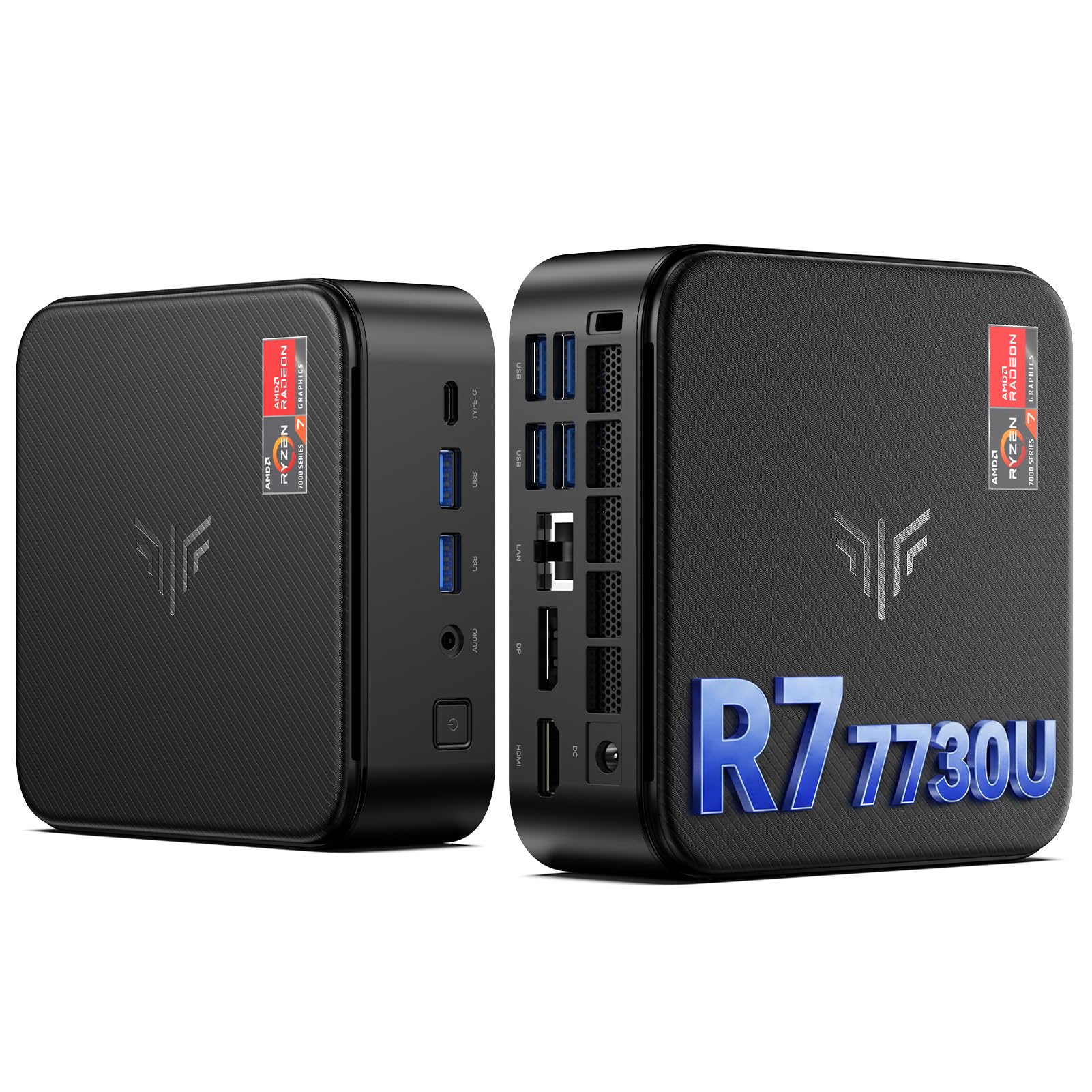
A terabyte of storage and sixteen threads without the premium price tag.
Core count and drive space are the two reasons this one earns its slot. The AMD Ryzen 7 7730U runs 8 cores and 16 threads up to 4.5GHz with 16MB of L3 cache — that is 8 cores and 16 threads against the Beelink’s 6 cores and 12 threads, and the extra threads keep voice chat and a browser open while your match runs. Radeon Vega 8 graphics clocking up to 2000MHz covers esports titles like League of Legends, CS:GO and DOTA 2, and 4K output keeps the picture sharp on a big screen.
Storage is where it clearly beats the crowd: a 1TB NVMe SSD from the start, expandable up to 4TB. That is roughly twice the drive space of the 480GB and 500GB machines here, so you can keep a full game library installed and still have room. The 16GB of LPDDR4 memory is the slower memory standard on this list, though, so do not expect the graphics to feed as fast as the DDR5 and LPDDR5X machines.
Connectivity keeps up with a proper gaming desk — WiFi 6, a gigabit LAN port, Bluetooth 5.2 for a controller, triple 4K output across HDMI, DisplayPort and Type-C, and six USB 3.2 ports. It ships with a two-year satisfaction guarantee and lifetime technical support, which is the generous end of the cover offered here.
Gaming on budget: someone who wants a big installed game library without adding a drive on day one, and plays esports rather than demanding AAA titles.
Thermal headroom: LPDDR4 memory is the slowest here, so heavier titles will sit behind the 780M and 680M machines on frame rate.
Casual game nights: esports players who want 1TB of fast storage from the start and two years of cover.
AAA max settings: anyone chasing peak graphics frame rates — the LPDDR4 memory holds it back.
5. ACEMAGICIAN S3A Gaming Mini PC
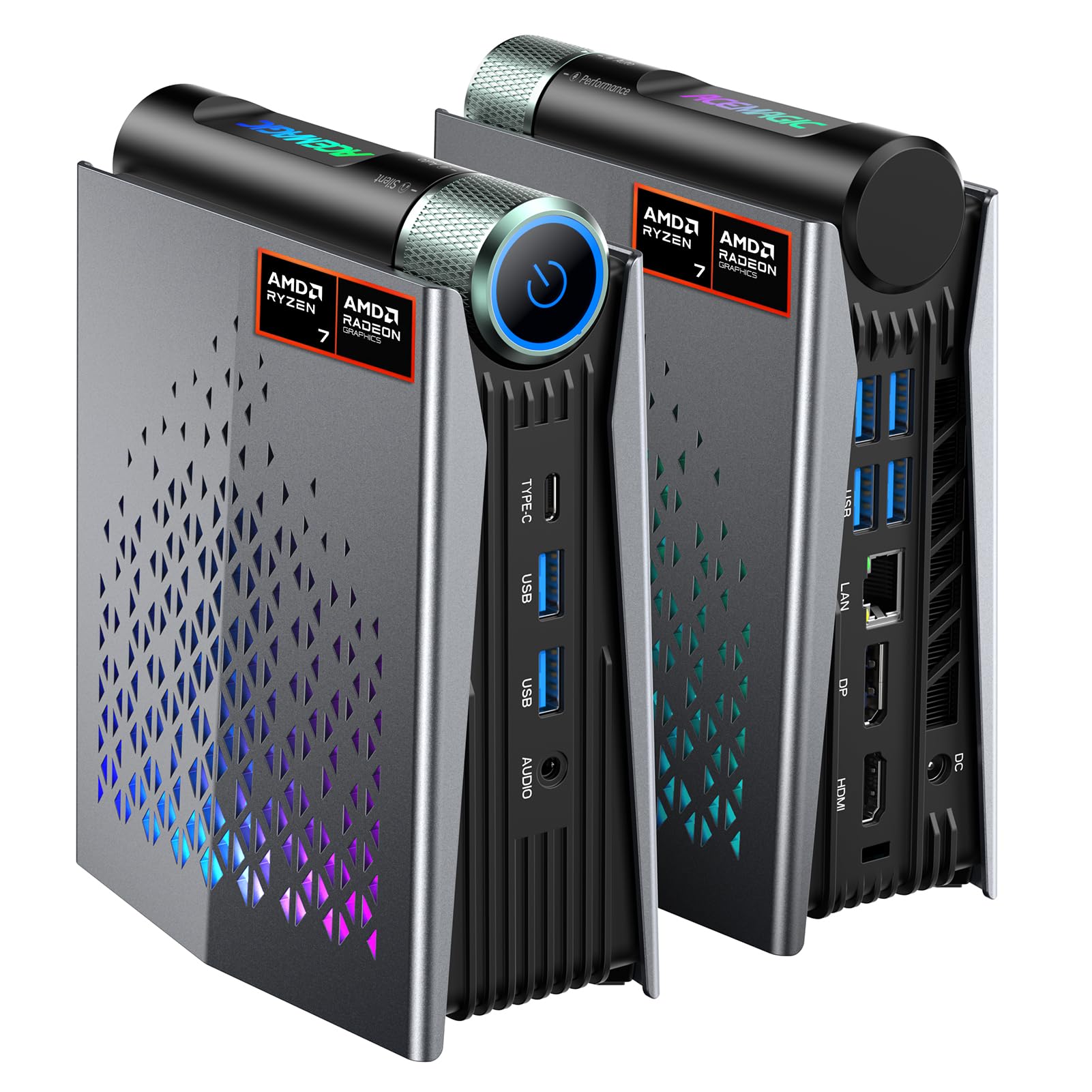
The machine that lets you dial the fan noise and the frame rate up or down.
Three power modes on one machine is the feature that sets this apart. Silent Mode runs at 20-35W with fan noise as low as 35dB, Auto Mode sits at 30-45W for balanced work, and Performance Mode pushes 40-54W for demanding games. That range lets a late-night session stay quiet and a competitive match get full power, which most boxes here do not offer. The AMD Ryzen 7 H 255 runs 8 cores and 16 threads up to 4.9GHz, and the Radeon 780M graphics (12 cores at 2600MHz on RDNA 3 architecture) handles 1080p gaming and content creation.
Memory and storage are strong for the tier: 16GB of LPDDR5 at 6400MT/s and a 512GB PCIe 4.0 NVMe SSD, with storage expandable up to 4TB through a tool-free removable design. That makes drive upgrades a few seconds of work rather than a screwdriver job. Triple 4K output runs through HDMI 2.0, DP 2.0 and USB4 Type-C, and a dual-fan cooler keeps temperatures in check during long sessions.
Its CPU sits at 4.9GHz versus the 4.0GHz of the Beelink SER5, so it has meaningfully more headroom for demanding software and heavier games. Add the RGB lighting for those who want the desk to look a certain way, and a two-year warranty with lifetime support on top. The trade-off is that the fastest component here is the graphics and CPU, not the drive size — 512GB fills fast with modern games.
Small desk gamer: a gamer who wants switchable performance modes and room to drop in a bigger SSD later.
Silent room need: you need a 1TB drive straight from the start — 512GB is the starting point here.
6. KAMRUI AM21 Mini Gaming PC
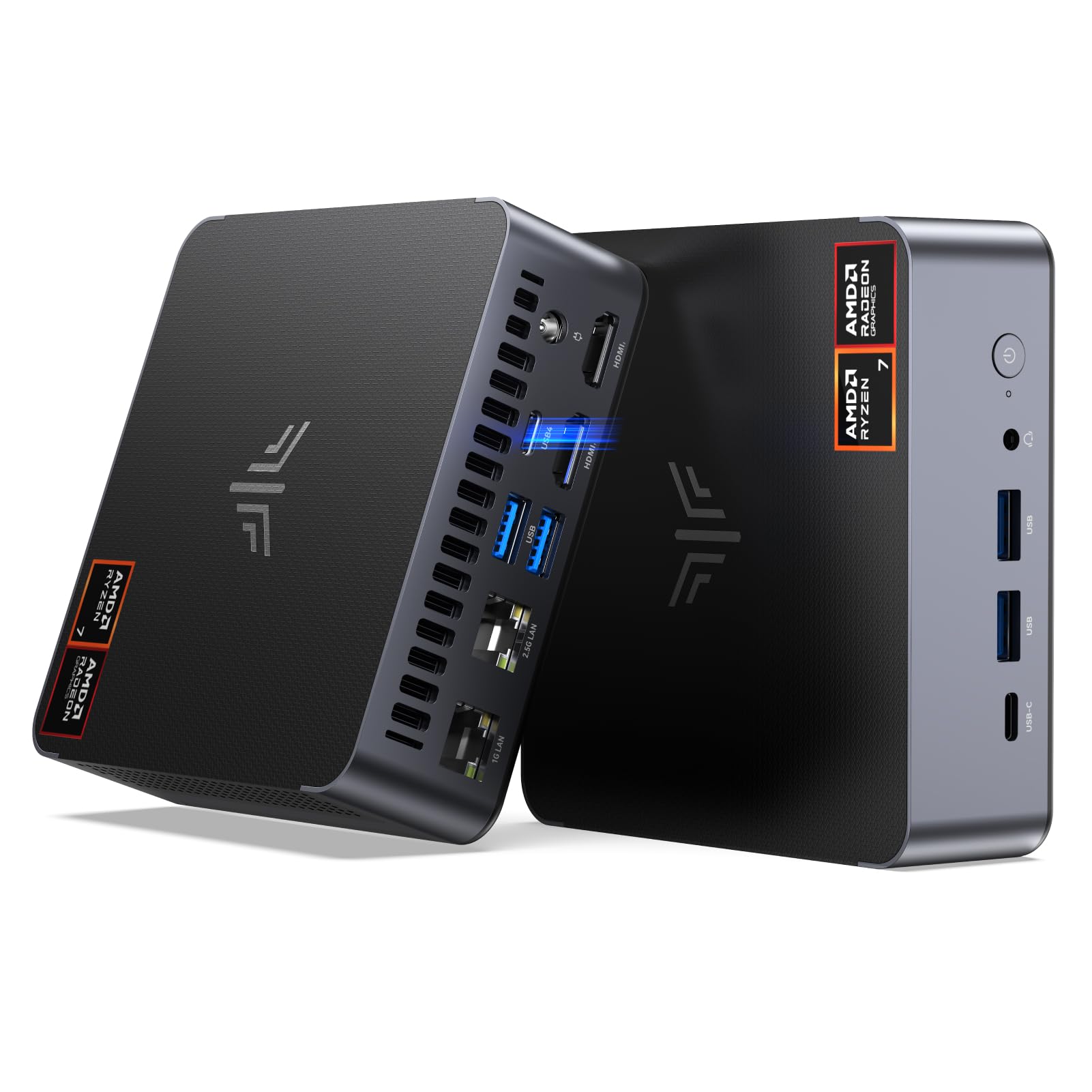
Zen 4 silicon, a 780M graphics chip and two wired ports for serious multitasking.
This is the newest processor generation on the list. The AMD Ryzen 7 8745HS uses Zen 4 architecture with 8 cores and 16 threads up to 4.9GHz, and the maker states it outperforms an Intel Ultra 7 155H by 18% and a Ryzen 7 7735HS by 27% in multi-core work. Those are manufacturer figures rather than independent tests, but the direction is clear — it is a firm step ahead of the older chips here. The Radeon 780M graphics on RDNA 3 architecture handles smooth 1080p mainstream gaming.
Two 1Gbps Ethernet ports and USB4 are the unusual combination here. The USB4 port handles 40Gbps data plus DisplayPort 1.4 output at 8K@60Hz and 100W power input, so one cable can drive a monitor and feed the machine power. Photo and video work get help from the built-in AV1 hardware codec for 8K video, and AMD FSR technology lifts frame rates in supported games.
The all-copper cooler with three D8 heat pipes and dual air intakes keeps the machine steady under long loads, with a maximum noise level of 41.0dB at full tilt. That is louder than the quietest boxes here, so a thin-walled bedroom desk may notice it. Storage is 16GB of DDR5 and a 512GB PCIe 4.0 NVMe SSD, with RAM upgradeable to 96GB and dual M.2 slots for up to 4TB of storage — the most expandable memory on this list.
Mid-tier gaming: multitaskers running virtual machines or a server alongside games, who want the newest Zen 4 chip and room to add storage.
Big library owners: at 41.0dB under full load it is audibly louder than the near-silent picks, so keep it off a shared bedroom desk.
7. BOSGAME P4 Plus Mini PC Gaming

Thirty-two gigs of memory and a terabyte of fast storage without the top-tier price.
Double the memory of every other entry-level pick here is the headline. You get 32GB across two DDR4 sticks and a 1TB PCIe 4.0 x4 NVMe drive, and the maker claims the Ryzen 7 5825U delivers 35% more CPU performance than a Ryzen 5 5600U or 5500U. That extra memory matters for gaming plus a stream plus a browser all at once — you will rarely hit a slowdown from too many open programs. Radeon Graphics with 8 GPU cores at 2000MHz pushes 4K across three outputs.
For anyone running a home lab, the dual 2.5-gigabit Ethernet ports are the draw. Up to 2500Mbps of wired speed is server and firewall territory, and WiFi 6E with Bluetooth 5.2 keeps wireless solid. The 1TB drive leaves real room for a game library, and there is a spare 2.5-inch bay if you want to add more later.
Honesty time: this model shows the most split feedback of the group. Performance and value earn praise, but the reliability picture is uneven, with a share of buyers reporting random shutdowns and failures over time. Sized against the whole picture, most owners are working fine — but if a machine that never blinks is your must-have, the higher-rated picks above are the safer bet. The one-year warranty is on the short side too.
Strong connectivity set
- 32GB of RAM and a 1TB PCIe 4.0 SSD as standard
- Dual 2.5-gigabit Ethernet for servers and firewalls
- Triple 4K output across HDMI, DP and Type-C
Price climbs high
- Reliability is the most split point — some report shutdowns over time
- DDR4 memory runs slower than the DDR5 and LPDDR5X machines
- One-year warranty is on the short side
Port-rich setup: you need 32GB of memory and a terabyte of storage without stepping up to the premium tier.
Minimalist spenders: rock-steady long-term reliability is your top priority over raw memory.
8. ACEMAGIC X3 Mini Gaming PC
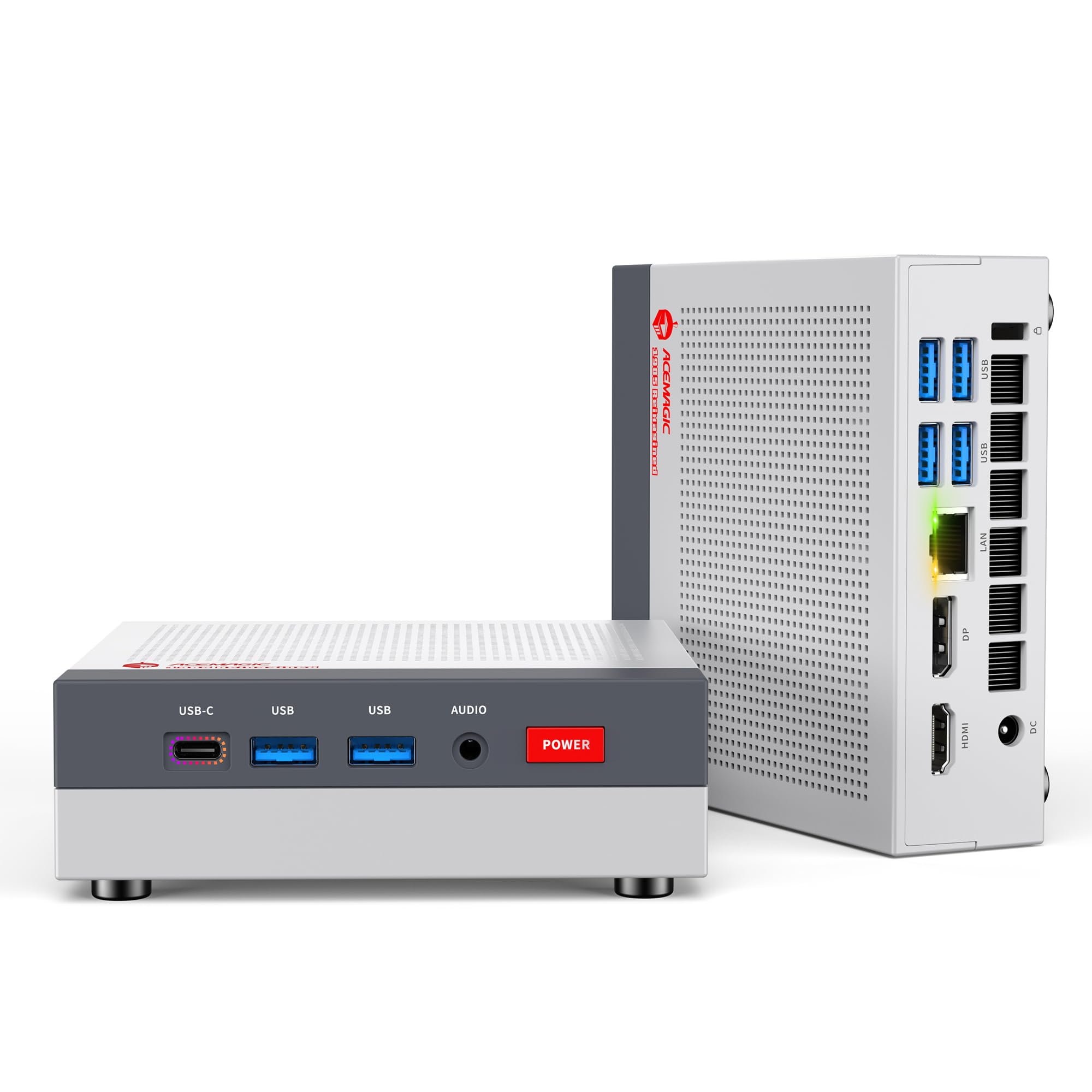
The machine that actually looks like a games console but plays modern 1080p titles.
Most mini PCs are black slabs — this one borrows classic home-console colours and design. Under the retro shell sits serious modern hardware. The Radeon 780M integrated graphics has 12 compute units at 2600MHz on RDNA 3 architecture, and the maker states it scores around 55% higher than Intel Iris Xe on 3DMark and Superposition, plus roughly 8x the frame rate of aged Vega 2 graphics in most titles. That covers 1080p gameplay in League of Legends, CS2 and Genshin Impact, plus retro emulators.
The setup is friendly to a first-time buyer: 16GB of LPDDR5 at 6400MT/s and a 1TB NVMe PCIe 4.0 SSD, expandable to 4TB through a tool-free removable top cover. The older SATA drives it replaces load noticeably slower, so boot times and game loads feel quick. Triple display runs through DP 2.0, HDMI 2.1 and USB4 Type-C, and the 2.5Gbps Ethernet keeps online matches steady.
One reviewer noted it well: the memory here is soldered LPDDR5, not slotted — so buy the 16GB you need and do not plan to add more. The dual-fan, dual-heat-pipe copper cooler keeps thermals in check through long sessions. WiFi 6E with Bluetooth 5.2 handles wireless controllers and headsets without a dongle, and the two-year warranty rounds it out.
Cramped space rig: a game lover who wants a console-style box on the shelf and plays 1080p titles and retro emulators.
Frequent tinkerers: the RAM is soldered on, so pick the memory size you want for good.
9. BOSGAME P6 Ryzen 9 6900HX Mini PC
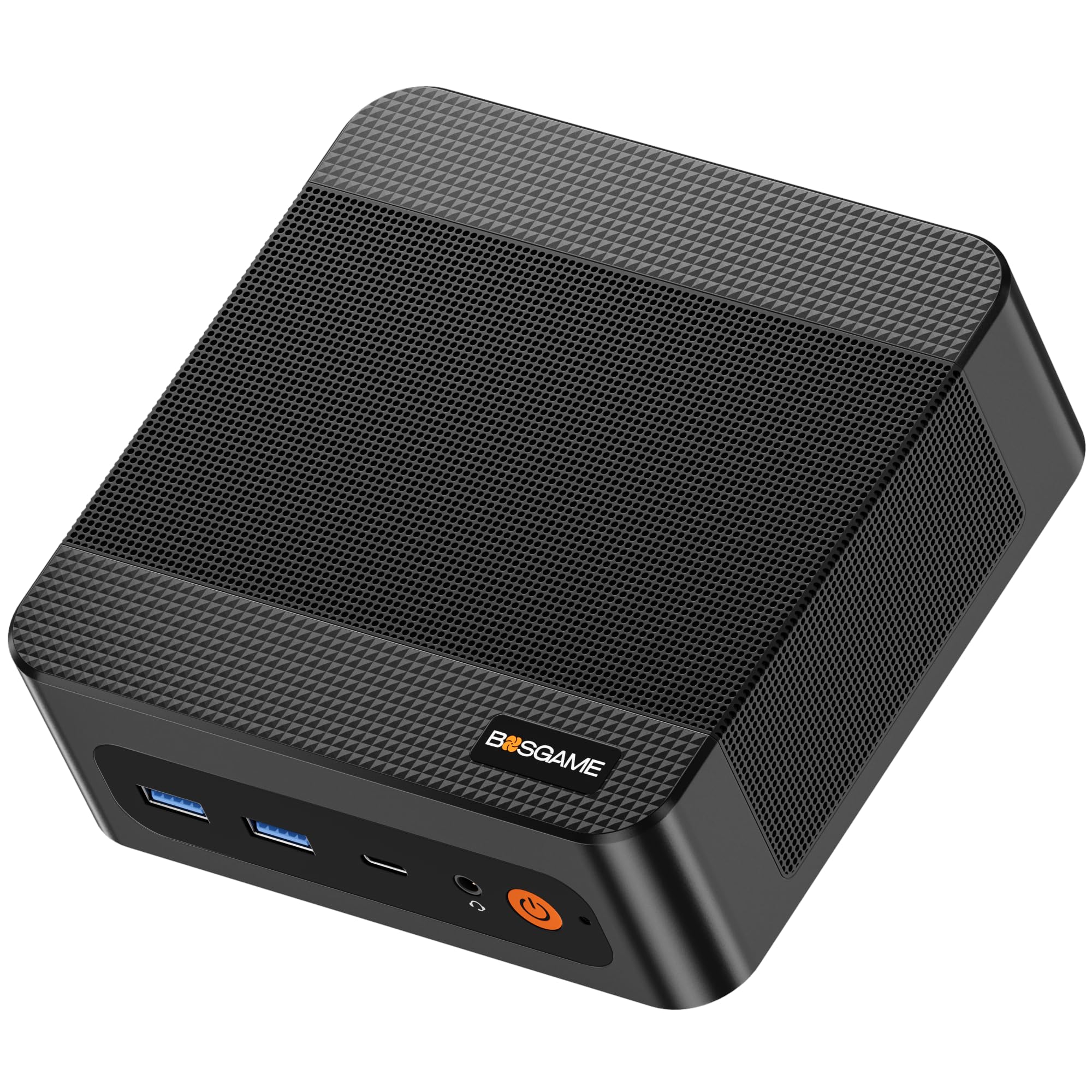
Ryzen 9 muscle for creators who game between editing sessions.
The Ryzen 9 6900HX is the most powerful CPU title in this group after the 7840HS, running 8 cores and 16 threads up to 4.9GHz with a 16MB cache. It powers through 1080p video editing in DaVinci Resolve, runs two or three lightweight virtual machines, and plays esports titles like CS2 at high settings. The Radeon 680M graphics with 24GB of onboard LPDDR5X RAM at 4800MT/s keeps frame rates steady, and a 1TB PCIe 4.0 NVMe SSD boots the system quickly.
For a home lab or power-user desk, the connectivity is the real draw. Dual 1Gbps Ethernet ports suit a software router, firewall or home server, and the machine ships with an operating system pre-installed and compatible with Ubuntu. Storage expands up to 8TB through a second M.2 slot, and three 4K displays run through HDMI, DisplayPort and USB-C at 60Hz each.
What buyers praise most is raw performance, though a few note the machine can open windows slowly and a share find it louder than expected under load — so it is not the quietest box for a bedroom. The cooling uses phase-change materials with active sinks on the memory and drives, and it is paired with a one-year whole-machine and three-year parts warranty.
Heavy multitasking: creators and tinkerers running a home server or VMs alongside light gaming, who want dual Ethernet and 8TB of expansion.
Quiet office use: you chase the fastest frame rate or the quietest fan — the 680M graphics and mixed noise reports put it behind the 780M picks.
10. GMKtec M6 Ultra Mini PC
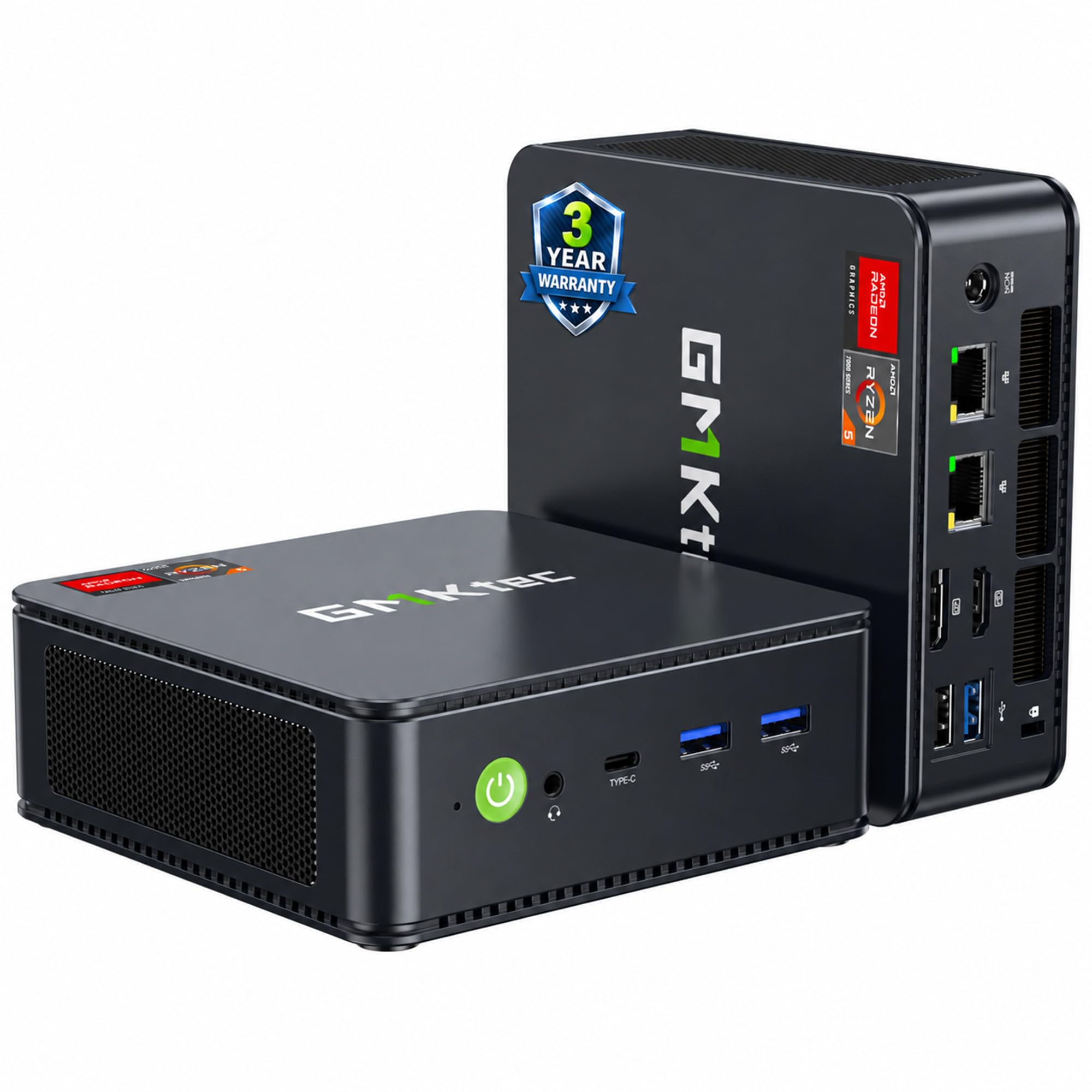
Dual 2.5-gigabit ports and 32GB of DDR5 in a box built for moderate gaming.
Two 2.5-gigabit Ethernet ports in a box this size is the standout practical feature. That up to 2500Mbps of wired speed suits a Pfsense firewall, an office server or a busy home network, alongside gaming and streaming. The Ryzen 5 7640HS is a Phoenix-family chip with 6 Zen 4 cores and 12 threads, running at 4.3GHz base and boosting to 5.0GHz, with a 45W-60W TDP boost. That 5.0GHz turbo is the highest clock in this group, and the maker claims a 30% performance increase over previous Ryzen 7 models.
Memory is generous — 32GB of DDR5 across two sticks, expandable to 128GB, plus a 1TB PCIe SSD with a second slot for up to 8TB. The Radeon 760M graphics runs 8 compute units at up to 2600MHz and handles moderate gaming with steady frame rates. It also hardware decodes AV1, HEVC and AVC video, which keeps playback smooth.
Display output goes beyond most here with 8K@60Hz over USB4 alongside 4K@60Hz on HDMI 2.0 and DisplayPort, so three screens running at once is easy. WiFi 6 and Bluetooth 5.2 handle the wireless side. The one honest trade-off: the 760M graphics is a step down from the 780M chips found on the machines above, so it plays moderate rather than demanding titles.
Upgrade-friendly build: a great fit for an office or home network that wants 32GB of memory and two fast wired ports, not a pure gaming box.
Stock RAM modest: the 760M graphics is weaker than the 780M machines, so heavier games will feel it.
Future upgraders: a desk that doubles as a networking hub, with 32GB of DDR5 and dual 2.5G ports.
Plug-and-play only: anyone who wants the strongest game frame rate — the 760M graphics sits a rung below the 780M.
11. GMKtec M7 Ultra Mini PC Gaming

The only pick with an external graphics port for real desktop-class frames.
The OCuLink port is the killer feature no other box here offers. That is a high-bandwidth connection designed to attach an external graphics card enclosure, and the maker states it runs at PCIe x4 speeds — faster than Thunderbolt’s x3 — for higher frame rates and lower lag when you add an external GPU. For a mini PC buyer who wants to start small and scale up later, that is the most future-proof path on this list. The Ryzen 7 PRO 6850U runs 8 cores and 16 threads up to 4.7GHz, with Radeon 680M graphics on 12 cores that the maker says is close to an NVIDIA GTX 1050 Ti.
Four displays set this apart from the triple-output machines. Dual USB4 and HDMI 2.1 enable four simultaneous screens with up to 8K@60Hz and 4K@144Hz over Type-C. You get 32GB of DDR5 at 4800MHz expandable to 96GB, and a 1TB PCIe SSD with dual-slot expansion up to 4TB. Dual Intel i226V 2.5-gigabit NICs cover firewall, soft routing and file server duties, and WiFi 6 with Bluetooth 5.2 handles the rest.
The three BIOS performance modes give you control over the balance — Quiet at 35W, Balance at 50W and Performance at 65W-70W — with fan noise dropping to 35dB in Quiet mode. That is a genuinely useful dial for a machine that can run heavy loads. The honest limit: you pay a premium for the OCuLink and four-display features, and if you never plan to add an external GPU, that money is better spent on a 780M machine with a bigger drive.
DIY upgraders: a buyer who wants to start small and bolt on an external graphics card later, with four displays and 32GB of RAM.
Light web users: anyone who will never use the OCuLink port — the premium pays for features you would not touch.
Understanding the Specs
Integrated Graphics and Compute Units
Integrated graphics means the chip that draws your game is built into the processor, not a separate card. Its power is counted in compute units — small graphics cores that each handle part of the image. A Radeon 780M with 12 compute units at 2600MHz draws far more frames than an older Vega 8 running at 2000MHz. For 1080p esports titles, a 780M, 760M or 680M chip is the sensible floor; the newer the architecture, the better the frames per watt.
RAM Speed Feeds the Graphics
Because integrated graphics borrow from system memory, the speed of that memory directly shapes your frame rate. LPDDR5X at 7500MT/S and DDR5 at 6400MT/s feed the graphics faster than DDR4, and that gap shows in steady frames during busy scenes. Sixteen gigabytes is a good starting point for gaming plus a chat app and browser; 32GB gives you room for a stream or virtual machines on top.
FAQ
Can a mini PC actually run modern games without a graphics card?
What is the difference between Radeon 780M, 760M and 680M?
Do I need 32GB of RAM for gaming on a mini PC?
Will a mini gaming PC fit behind my monitor?
Can I add more storage to these mini PCs later?
Is soldered RAM a problem on a mini gaming PC?
Do these mini PCs come with Windows installed?
How loud is a mini gaming PC under load?
What does a dual LAN port give me on a mini PC?
Is OCuLink better than USB4 for adding an external graphics card?
Can a mini gaming PC run three or four monitors at once?
Final Thoughts: The Verdict
For most players, the budget mini pc for gaming winner is the MINISFORUM UM780L — it pairs the group’s strongest CPU and the Radeon 780M graphics with the fastest memory here at 7500MT/S, and its performance is what owners single out above all else. If silence on a shared desk tops your list, the Beelink SER5 runs nearly inaudible and lets you add RAM and storage later. And if you want a small box now that can take an external graphics card later, the GMKtec M7 Ultra is the only pick with an OCuLink port. Whichever you choose, start with the graphics chip, not the processor badge — that is what decides your frame rate.
How We Picked
We do not accept paid placement. Every pick is matched to a real buyer and a real use-case; we do not hands-on test units.
Sources & Methodology
Specifications: manufacturer listings and product documentation. Review insights: verified customer reviews, as of November 2026. Pricing: not shown on this page (it changes often); check the current price via the retailer link.
As an Amazon Associate, Gadgets Feed earns from qualifying purchases. This does not affect which products we feature.