
Our readers keep the lights on and my morning glass full of iced black tea. As an Amazon Associate, I earn from qualifying purchases.
Specs are compiled from manufacturer listings and verified buyer reviews and can change over time — please confirm the key details on the product page before buying.
You want one sleeping bag that handles a frosty spring morning and a sub-zero night without buying three separate bags. That is exactly what an all-season bag is meant to do, and the picks below earn it by combining a real temperature rating with insulation that packs down small enough to carry. The biggest decision is fill: down gives you warmth with less bulk, while synthetic fibers shrug off damp better and cost less. Get that one call right and the rest falls into place quickly.
I’m Min — the founder and writer behind Gadgets Feed. This guide is built by comparing the manufacturers’ published specifications and the patterns across verified customer reviews, so you get each pick’s real strengths and trade-offs instead of marketing spin.
Cold nights are unforgiving, so the wrong bag turns a great campsite into a long, shivering wait for sunrise. Below you’ll find the best all-season sleeping bag picks grouped by how and where you actually sleep.
Our Picks at a Glance


How To Choose The Best All-Season Sleeping Bag
The quickest way to get this right is to decide where you sleep first, then match the bag to it. A bag that lives in a truck bed can weigh 20 pounds and nobody cares. A bag that rides on your back for eight miles needs to weigh a fraction of that, and the temperature rating you sacrifice for it is the trade you make.
Read the temperature rating as a range, not a promise
A rating like 0°F is a lower limit tested on a pad with a specific set of layers, not a guarantee you’ll be warm in a t-shirt. The ZOOOBELIVES listing breaks this out clearly with a comfort number, a lower number, and an extreme number because the same bag performs very differently across them. Buy for the comfort figure if you sleep cold, and treat the extreme figure as survival, not comfort.
Match the insulation to your weather
Down packs down small and delivers warmth per ounce that synthetics struggle to match, which is why a 35oz down fill can sit in a bag that weighs under four pounds. The catch is moisture: down loses loft when it gets soaked. Synthetic fills like the polyester in the Coleman North Rim keep more of their warmth when damp and cost less, though they bulk up more for the same rating.
Shape decides how warm you actually sleep
A mummy cut hugs your body and leaves less dead air to heat, so it wins on warmth-to-weight. A rectangular bag gives you room to roll over and stretch your legs, and the ALPS Redwood leans all the way into that with a 38-inch width. If you thrash in your sleep, that legroom is worth more than a few ounces of fill.
Quick Comparison
| Model | Best For | Temperature Rating | Weight | Shape | Amazon |
|---|---|---|---|---|---|
| ALPS OutdoorZ Redwood -25★ Best Overall | Base camp comfort in deep cold | -25°F | 13 lb | Oversized rectangle | Amazon |
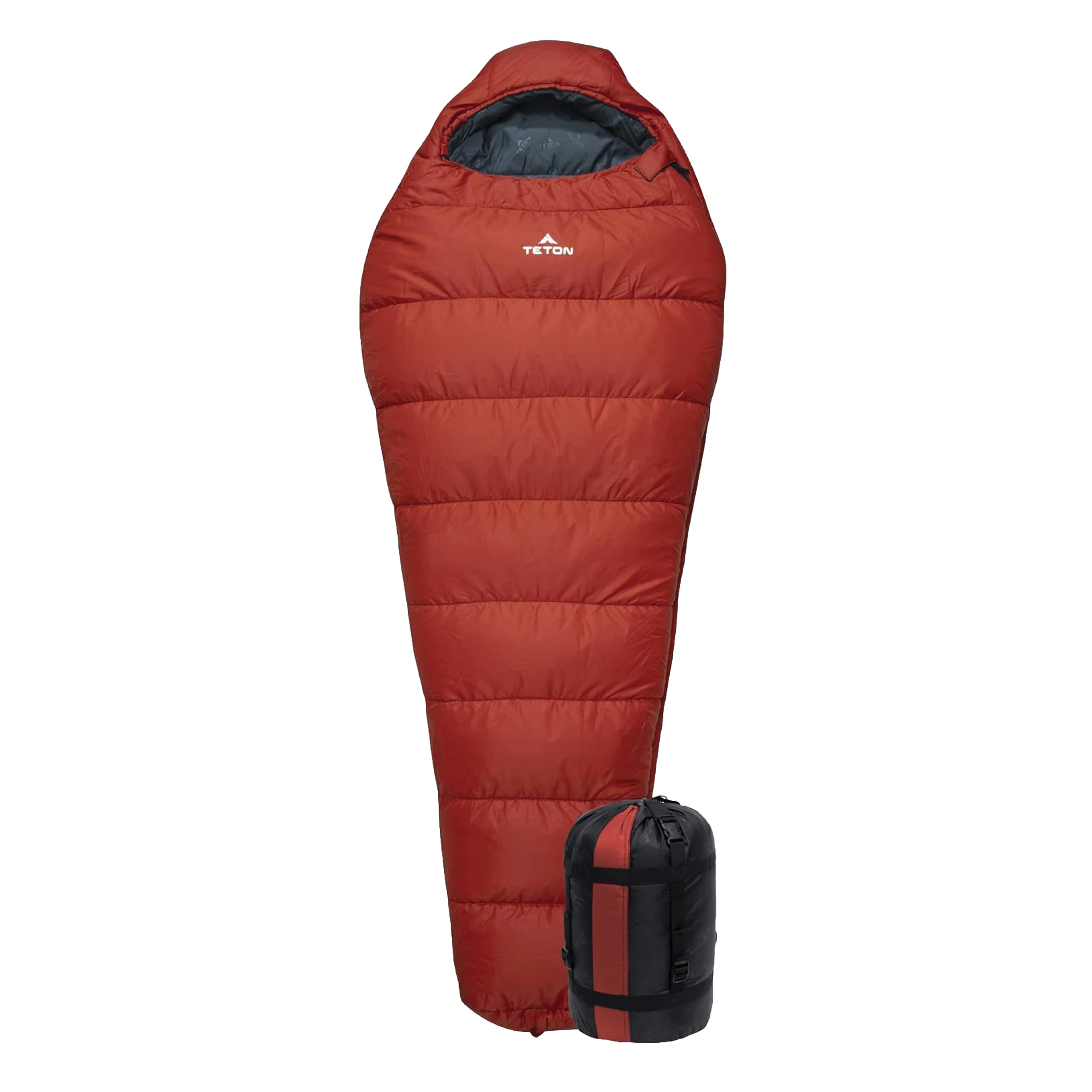
| Teton LEEF Mummy BagBackpacking Pick | Backpacking on a budget | 0°F / 20°F / 30°F options | 3.5 lb | Mummy | Amazon |
| Coleman North Rim 0°FBig & Tall Fit | Big and tall campers | 0°F | — | Mummy, big and tall | Amazon |
| ZOOOBELIVES 10 Degree Down | Down warmth without premium pricing | Comfort 32°F / Lower 10°F / Extreme 0°F | 1.75 kg | Roomy mummy | Amazon |
| Guide Gear Canvas -30 | Hunters in wet winter cold | -30°F | 12.7 lb | Rectangle with hood | Amazon |
| TETON Sports Outfitter -35F | Long-term base camp durability | -35°F | 20 lb | Rectangle | Amazon |
| The North Face Dolomite One 15F | Changing climates on one trip | 15°F paired / 30°F mid / 50°F top | 4 lb | Rectangular | Amazon |
| Snugpak Softie Elite 5 WGTE | Sleeping cold in a small pack | 5°F comfort / -4°F low | 5.2 lb | Mummy with expandable baffle | Amazon |
| US Military 4-PC Modular Sleep System | Any season, any weather, one system | Modular (warm, intermediate, bivy) | — | Modular mummy plus bivy cover | Amazon |
In‑Depth Reviews
1. ALPS OutdoorZ Redwood -25
Our pick — 4.5+★ from 900+ verified ratings; the strongest balance of quality and price.
A -25°F cotton-canvas rectangle that keeps car campers warm through a deep-winter night.
If your tent never moves more than twenty feet from the truck, this is the bag to beat. It carries a -25°F rating — a temperature measured in the kind of cold that makes your breath hang in the air inside the tent — and it does it inside a 38-inch-wide rectangle. That width is the number that matters: you can roll from your side to your back without dragging the bag with you.
The outer is cotton canvas and the liner is 100% cotton flannel, so it feels like a heavy duvet rather than a crinkly camping sack. TechLoft Silver insulation uses multi-hole micro-denier fibers with a siliconized finish, which in plain terms means the fill traps warm air in millions of tiny pockets instead of flattening into a pad. A two-layer offset construction staggers the layers so there’s no straight-through seam for cold to sneak past. Three webbing straps with quick-release buckles roll and cinch the whole thing for storage.
Here is the honest math. At 13 pounds it weighs a hair under four times the 3.5-pound Teton LEEF mummy bag, so carrying it any real distance is out. The reviewer trail agrees on that split: this is a car-camping bag, not a backpacking one. The width cuts both ways too — 38 inches of room to sprawl, yet a bag that doesn’t crush down into a small stuff sack. Neither is a defect; it’s simply the shape of the job it was built for. The value story is what wins people over, backed by a 4.5+ star average across 900+ ratings.
What earns its place
- -25°F rating that suits genuine deep-winter nights
- 38-inch width gives side sleepers and thrashers real room
- Canvas shell and flannel liner feel built for years of use
- Two-layer offset build fights cold spots at the seams
Where it stops making sense
- 13 pounds is strictly truck-to-tent territory
- Rolls large rather than packing compact
- Overkill for mild shoulder-season nights
Built for: car campers, hunters, and anyone sleeping near the vehicle in serious cold who wants room to sprawl.
Wrong tool if: you plan to carry your bag on your back — the 13-pound weight answers that quickly.
2. Teton LEEF Lightweight Mummy Sleeping Bag
A 3.5-pound polyester mummy bag that packs small enough for backpacking and comes in 0°F, 20°F, and 30°F ratings.
Weight is where this bag wins. At 3.5 pounds it takes almost nothing out of your pack, and a compression sack is included so you can squeeze it down further. Pair that against the 13-pound ALPS Redwood and you can see the whole design philosophy: the LEEF is built to travel, not to sprawl. It comes in 0 Degree, 20 Degree, and 30 Degree ratings across three sizes, so you can pick how much cold protection to carry.
The mummy shape is roomier than the classic tube. A ripstop polyester shell with microfiber fill gives you warmth without the bulk, and the boxy foot end leaves room for your toes instead of clamping them. Anyone who has woken up with numb feet knows why that matters. Quality is what the owner feedback circles on most, with warmth a close second — two things that tell you the insulation and stitching are holding up.
The one trade to think through: compact size gets mixed reviews, meaning the compression sack does its job but doesn’t perform miracles. If you’re counting every liter in a 40-liter pack, pack it once at home first. That said, the bag is a straightforward value play for a first backpacking setup, and the 4.5+ star average means most buyers come away satisfied.
Where it shines: the 3.5-pound carry and roomy mummy foot box suit hikers covering real miles, and the rating options let you tune warmth to your season.
The one catch: it packs smaller than a canvas bag but not small enough to vanish — budget pack space accordingly.
Reach for this if: you’re new to backpacking and want a cold-weather-capable bag without blowing the budget or the weight allowance.
Look elsewhere if: you need an expedition-grade build for sustained sub-freezing alpine trips.
3. Coleman North Rim 0°F
An 82 x 32-inch mummy cut sized for campers up to 6 ft. 2 in who need extra length at the foot.
Coleman designed this one for campers up to 6 ft. 2 in, and the dimensions back it up: 82 x 32 inches of mummy bag. If you’ve ever slept in a standard mummy and felt like a wrapped sausage, that extra length is the feature you’ll notice first. The 0°F rating means it handles a genuinely cold night, and the adjustable hood lets you dial in the balance between trapping heat and letting your face breathe.
Warmth is the headline here. The Thermolock draft tube runs along the zipper to stop your body heat escaping through the seam, and the Coletherm hollow polyester insulation is built to hold heat with less weight than a solid-fill bag. The no-snag zipper is a small thing that becomes a big one at 2 a.m. in the dark. It’s also machine washable, which matters more than people expect for a bag used on muddy ground, and it carries a 5-year limited warranty.
The mixed signals are worth knowing. Fit gets mixed reviews — some campers up to that 6 ft. 2 in mark find it perfect, while a few taller or broader sleepers find it tight. Portability splits the same way: fine for camp, not for backpacking. And zipper durability is the recurring gripe, so treat the zip gently and don’t force it when the fabric is bunched. Those are fit and care notes rather than reasons to skip it, especially with a 4.0+ star average behind the design.
Fits best: tall campers who need real length and a 0°F bag for cold-weather camping with a roof nearby.
Think twice if: you sit well past 6 ft. 2 in — measure yourself against that ceiling before ordering.
4. ZOOOBELIVES 10 Degree Down Sleeping Bag

35 ounces of 550+ fill power down that packs to roughly 10″ x 7″ x 15″ in the included compression sack.
Down is the insulation that makes all-season sleeping bags worth carrying. This bag packs 35oz of 550+ fill power down — fill power being a measure of how much loft each ounce of down creates, so a higher number traps more warm air per gram. That’s why this bag weighs 1.75 kg while still packing to roughly 10″ x 7″ x 15″ with the compression straps cinched. Layer it under the ALPS Redwood in spirit and you’ll see the difference: the same category, but one bag designed to travel and one to sit.
The temperature guide is unusually honest for a listing: Comfort 32°F, Lower 10°F, Extreme 0°F. Read the comfort number as the temperature where you’ll be genuinely cozy, and the lower and extreme figures as the limits. An insulated pad and a warm base layer are what let it reach those colder numbers. The 20D ripstop nylon shell handles real use, the YKK anti-snag zipper slides cleanly, and a draft collar plus insulated draft tube seal the gaps around your neck and along the zip. Left and right zipper options even let two bags zip into a double for couples.
Size is the honest caveat. Some sleepers find the 83 x 31 inch bag roomy, while others find it snug around the feet — a real issue for big-footed sleepers or anyone who sleeps like a starfish. The anatomic 3D foot box helps, but it’s still a mummy. Quality is the aspect owners praise most, and warmth follows close behind, which lines up with the 4.0+ star average.
Why down fans pick it
- 35oz of 550+ fill power down for genuine cold-weather warmth
- Packs to about 10″ x 7″ x 15″ with straps to cinch tighter
- Draft collar and insulated draft tube seal the neck and zip
- Left and right zip options let two bags join into a double
Where it gets tight
- Foot area feels snug to some sleepers with larger feet
- Down needs to stay dry — no room for a soaking
- Comfort rating of 32°F means deep winter needs layers
balance: campers who want real down warmth and a small pack size without paying premium-tier prices.
Skip the gamble if: your shoe size runs large — try it over your own sleeping pad before a cold trip.
5. Guide Gear Canvas Sleeping Bag -30

A 39 x 90-inch cotton duck canvas rectangle with a drawstring hood and flannel plaid lining for late-season hunting camps.
Hunting season in late November is the use case this bag was built around. The -30°F rating covers the kind of cold that settles into a blind before dawn, and 9 lbs of fiberfill insulation holds that warmth. The 8 oz. cotton duck canvas shell is the tougher cousin of standard cotton — a tightly woven fabric that shrugs off brush, tent floors, and the back of a truck. The brushed-cotton flannel plaid lining makes the inside feel like a bed rather than a sack.
Size is the standout feature. At 39″w. x 90″l this is a rectangle with room to move, and the listing points out that generous dimension as its core pitch. The attached hood with a drawstring seals around your head, and the 2-way zipper lets you vent from either end. Sleeping-bag straps are included, so you can roll it and carry it over your shoulder rather than fight with it in your arms.
Warmth is what owners praise most, followed by overall quality. The real consideration is bulk: at 12.7 pounds it’s in the same neighborhood as the ALPS Redwood, and the size feedback splits between “very large” and “bulky” because the same dimension produces both reactions. It’s a car-camping and base-camp bag, full stop. Consider it if you hunt or winter camp out of a vehicle and want a canvas build that lasts.
The strong suit: a 90-inch canvas rectangle with a flannel lining and a hooded, draft-blocking top that suits late-season hunting camps.
What to plan around: 12.7 pounds and a large rolled footprint mean this bag does not travel on your back.
Best matched to: hunters and cold-weather car campers who want a big, durable canvas bag that sleeps like a bed at base camp.
Not your bag if: you’re packing light or hiking in — the size and bulk work against you there.
6. TETON Sports Outfitter -35F
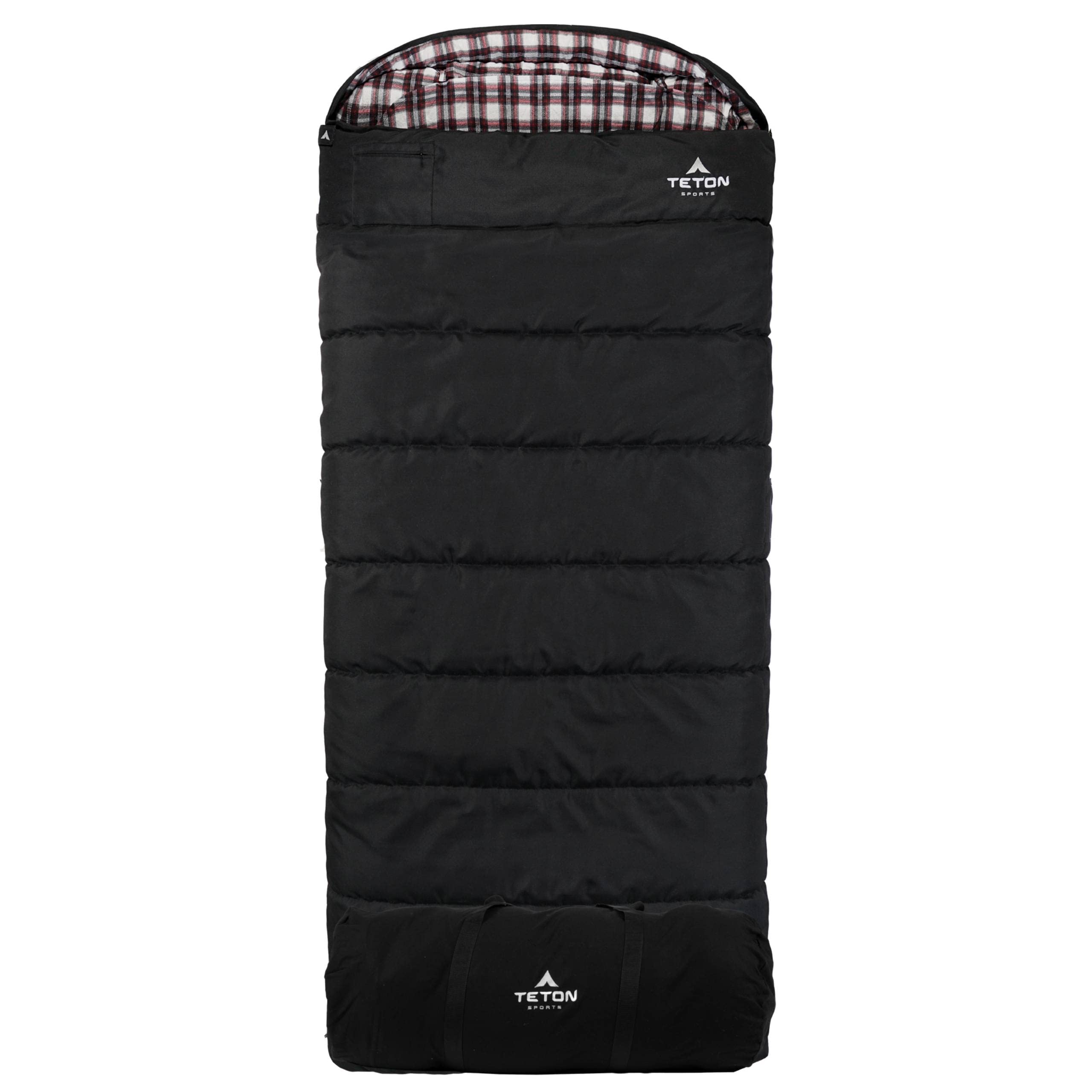
A 20-pound water-resistant canvas rectangle rated to -35°F, with hang loops for lofted storage between trips.
This is the extreme end of the all-season category, rated to -35°F. The construction is where the money went: SuperLoft Elite single-channel hollow fiber fill, double-layer construction, and draft tubes working together to trap warmth. A water-resistant canvas shell and soft cotton flannel liner round out a bag that reads more like outdoor furniture than camping gear. Hang loops let you store it lofted so the insulation keeps its bounce between trips.
The dimensions tell the honest story. At 92″L x 39″W this bag is longer and wider than the ZOOOBELIVES down bag (83 in L x 31 in W), and at 20 pounds it’s more than five times the weight of the 3.5-pound Teton LEEF. Those numbers aren’t flaws — they’re the price of a bag built to survive years of rigorous use. Fluff it before you sleep and put a pad underneath, as the listing suggests, and the warmth comes through.
What to expect from ownership: warmth is the trait campers return to most, and durability follows behind it. The counterpoints are weight and length — several owners describe the 20 pounds as heavy, and one noted it ran about 4 inches short for their height. That’s a tall-sleeper caveat worth checking against your own measurements, not a knock on the build. The 4.5+ star average reflects a bag that delivers what it promises for the right buyer.
Made for: hunters, outfitters, and long-term base campers who want one bag that outlasts repeated winters.
Elsewhere better: anyone who moves camp daily or measures over the bag’s 92-inch length in their sleep position.
7. The North Face Dolomite One 15F

A 3-in-1 system that zips a 50°F top layer and a 30°F mid layer into a 15°F bag.
Imagine a bag that adapts instead of forcing you to guess. The Dolomite One is a 3-in-1 system: a 50°F (10°C) top layer and a 30°F (-1°C) mid layer, which zip together into a 15°F (-9°C) bag for cold nights. That’s three bags in one, and it solves the real problem of an all-season bag — the fact that “all-season” often means “one season, plus a compromise.” Here you pick the layer that matches tonight.
The insulation is 30% recycled polyester cut-staple fill with a warmth-to-weight ratio that keeps the whole system at 4 pounds. The polyester taffeta outer shell has a Durable Water-Repellent (DWR) finish — a coating that makes light rain bead up instead of soaking in — which handles mist and condensation. Inside, a soft fleece lining and a rectangular 77″L x 33″W shape give you leg room, and the zippers open from the bottom for extra ventilation. An internal phone and watch pocket keeps devices close and off the floor of the tent.
One honest wrinkle: the zipper system gets mixed feedback and some find it confusing at first. With three layers and multiple zippers, that’s understandable — practice zipping the layers together at home before you’re doing it by headlamp. Size is what people like most, followed by warmth, and the 4.5+ star average backs a system that earns its keep on changing-weather trips.
Clever part: pairing the 50°F top with the 30°F mid layer makes a 15°F bag, so you pack one item for three climates.
Practice first: the multi-layer zipper setup reads confusing to some owners until they’ve zipped it a couple of times in daylight.
Ideal for: campers whose trips cross warm valleys and cold ridges, and anyone who wants one bag to cover different seasons.
Reconsider if: you want a simple zip-in-and-go bag — the layered system asks for a little patience.
8. Snugpak Softie Elite 5 WGTE

A 5.2-pound mummy bag with an expandable side baffle that adds room and venting control on demand.
The temperature spec sets up its whole story: rated to -15 °C (5 °F) for comfort and -20 °C (-4 °F) as a low. That puts it in genuine cold-weather territory, and at 5.2 pounds it’s still carryable on a real backpacking trip. It’s the balance point between the 3.5-pound Teton LEEF and the 12-pound canvas bags — you trade some weight for warmth you can trust.
what separates it is the expandable side baffle, part of an Expander Panel System. A baffle is a sewn panel that holds insulation in place; here, a deployable side panel adds room and temperature control when you need either. Thoughtful details: two-way YKK side zips (a zip you can open from either end) with an insulated baffle, anti-snag webbing, an adjustable hood, an internal valuables pocket, and a reinforced foot built to be worn with boots. A Paratex Micro outer and Paratex Light lining, with Softie plus Reflectatherm insulation, round out a bag built for breathability and durability as much as warmth.
Material is what owners praise most, warmth second — which tracks for a bag with premium fabrics and a heat-retaining hood and baffle setup. Size is where opinions split, which is the nature of a mummy fit; the expandable panel helps, but try it against your shoulders if you’re broad. A compression stuff sack, internal liner loops, and hanging foot tabs make packing and drying easier. The 4.5+ star average puts it among the more trusted cold-weather mummy bags here.
Points that carry weight
- -15 °C (5 °F) comfort rating with a -20 °C (-4 °F) low
- Expandable side baffle adds room and venting control
- Insulated baffle, adjustable hood, and reinforced boot-ready foot
- 5.2 pounds is manageable on a backpacking trip
Where the fit asks questions
- Mummy cut may feel tight across the shoulders for some
- A heavier carry than ultralight bags, though warmer
- Left or right zip matters — order the side you need
Suits you if: you want a real cold-weather mummy bag you can carry on your back and adjust through the night.
Look elsewhere if: you’re broad-shouldered and hate any restriction — a rectangular bag is the safer fit.
9. US Military 4-PC Modular Sleep System
Four pieces, one system, and a waterproof shell that turns any patch of ground into a dry bed.
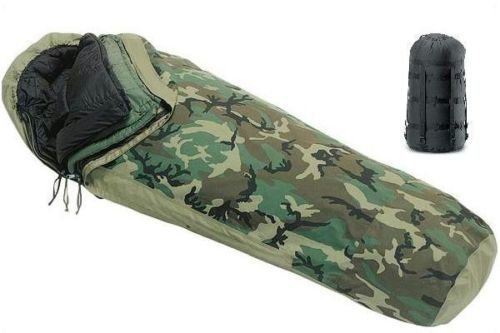
This is the most configurable option on the list. You get a warm-weather sleeping bag, an intermediate cold-weather sleeping bag, a Gore-Tex bivy cover, and a stuff sack. Layered together they handle arctic conditions; used separately or in pairs, they cover the rest of the year. That modular approach is the purest expression of “all-season” — instead of one rating, you choose the combination that matches the night.
The bivy cover is the piece that changes the rules. A bivy is a lightweight waterproof shell you slide your sleeping bag inside, and here the Gore-Tex cover keeps you dry in heavy rain while still letting moisture escape. All three bag pieces stow into the included stuff sack, so the whole kit travels as one bundle. It’s a single-person system made from nylon and polyester with a down fill and a drawstring closure.
What buyers value most is the fit-to-value relationship: for a full four-piece system, it’s a lot of protection per dollar. Durability is the next thing people point to — these pieces hold up without rips or tears — and buyers report the system arrives in brand new, unused condition. The honest trade is weight, which draws mixed reactions: packing all the pieces means a heavier load than a single lightweight bag. Size splits similar views, so it’s worth deciding whether you’ll carry the whole kit or leave pieces at base.
Pick this for: backpackers and campers who face unpredictable weather and want a dry, layered system that adapts on the spot.
Know the trade: carrying all four pieces is heavier than a single bag — leave the extra layers behind when the forecast is mild.
Understanding the Specs
Temperature Ratings and What They Mean
A sleeping bag rating like 0°F or -25°F describes a lower limit under specific test conditions, usually on a pad with layers and a closed hood. The ZOOOBELIVES listing does the buyer a favor by splitting it into three numbers — comfort, lower, and extreme — because a bag that keeps you cozy at 32°F will be uncomfortable at 0°F. Buy to the comfort figure if you sleep cold, and treat the extreme number as a survival boundary rather than a promise of a good night’s sleep.
Down Fill Power vs Synthetic Insulation
Down fill power measures how much loft an ounce of down produces, so a higher number traps more warm air per gram of weight. That’s why 35oz of 550+ fill power down can sit in a bag that weighs 1.75 kg and still pack to about 10″ x 7″ x 15″. Synthetic fills earn their place differently: they keep more warmth when damp and cost less, which is why the Coleman North Rim and Guide Gear bags use polyester and fiberfill. Choose down for packability and warmth-to-weight; choose synthetic for damp climates and lower cost.
Shape: Mummy vs Rectangle
A mummy bag tapers toward the feet, so there’s less dead air inside to heat and the whole thing packs smaller. A rectangular bag gives you room to roll and stretch — the ALPS Redwood’s 38-inch width is the clearest example here. Mummy bags win on warmth-to-weight, rectangles win on comfort for restless sleepers. Neither is better; they suit different sleepers and different trips.
Weight and Packed Size
Weight is the number most backpackers check first, and here it ranges from 3.5 pounds on the Teton LEEF to 20 pounds on the TETON Outfitter. A heavy bag belongs near the car, a light one belongs on your back. Packed size matters just as much for a mummy-style bag — a compression sack helps, but the fill and the rating set a floor you can’t compress below.
FAQ
What does an all-season sleeping bag temperature rating actually guarantee?
Is down or synthetic better for an all-season bag in wet weather?
Can two all-season sleeping bags zip together for couples?
How much does a backpackable all-season sleeping bag weigh?
Do I need a sleeping pad under an all-season sleeping bag?
How do I clean and store a canvas or down sleeping bag?
What is a bivy cover and do I need one?
What does fill power mean on a down sleeping bag?
Can I use a rectangular all-season bag for backpacking?
Will a mummy bag feel too tight if I sleep on my side?
Final Thoughts: The Verdict
For most people, the strongest all-round pick is the ALPS OutdoorZ Redwood -25 — a -25°F rating (a comfort limit for cold nights) in a 38-inch-wide rectangle, which is why it sits at the top with a 4.5+ star average. If you carry your bag on your back, though, the Teton LEEF wins on weight at 3.5 pounds, and the ZOOOBELIVES 10 Degree Down is the one to grab when you want genuine down warmth that packs down small. Match your bag to how you actually sleep and travel, and the cold stops being the thing you worry about.
How We Picked
We do not accept paid placement. Every pick is matched to a real buyer and a real use-case; we do not hands-on test units.
Sources & Methodology
Specifications: manufacturer listings and product documentation. Review insights: verified customer reviews, as of November 2026. Pricing: not shown on this page (it changes often); check the current price via the retailer link.
As an Amazon Associate, Gadgets Feed earns from qualifying purchases. This does not affect which products we feature.