
Our readers keep the lights on and my morning glass full of iced black tea. As an Amazon Associate, I earn from qualifying purchases.
Specs are compiled from manufacturer listings and verified buyer reviews and can change over time — please confirm the key details on the product page before buying.
All three picks are mid-calf merino socks with a loose, non-binding top instead of the tight elastic band on ordinary socks. For most people, the 6-pair thermal pack is the safest all-round buy.
I’m Min — the founder and writer behind Gadgets Feed. This guide is built by comparing the manufacturers’ published specifications and the patterns across verified customer reviews, so you get each pick’s real strengths and trade-offs instead of marketing spin.
Below, I break down how cuff tension, merino percentage, and sock height each affect a sensitive foot, then rank three mid-calf options by what they do well. Every pick here is a genuine merino mid-calf sock with a loose top, which is the short version of what makes the 3/4 merino wool socks for diabetics list below worth reading before you buy.
Our Picks at a Glance
How To Choose The Best 3/4 Merino Wool Socks For Diabetics
A diabetic sock is not just a warm sock. Three things have to line up at once: a cuff that does not squeeze, a fabric that manages moisture, and a height that covers the calf without digging in. Miss any one of the three and the sock stays in the drawer.
Start with the cuff, not the wool
The top of the sock is where most of the trouble lives. A non-binding top (a loose cuff with no tight elastic ring) is designed to sit against the leg without pressing a groove into the skin. Check the cuff first: even 96% merino cannot make up for a top that grips too hard. Search the listing for “non-binding” or “loose fit”; a standard crew sock with a strong elastic band is the wrong choice.
Then look at how much merino is actually in it
Merino wool (a fine wool that wicks moisture and stays soft against skin) is the reason these socks breathe instead of turning clammy. But the percentage swings a long way between products. A blend with 20% merino mixed with cotton, polyester and spandex behaves very differently from a sock that is 96% merino. Higher merino gives better temperature regulation and less itch; lower merino gives more stretch and a lower price per pair.
Height and seam are the quiet deciders
Mid-calf, sometimes called 3/4 or crew length, covers the calf and sits above the ankle bone without climbing to the knee. That height puts the cuff above the narrow ankle bone, where pressure hurts most. A smooth flat toe seam is the other detail worth hunting for, since a raised ridge rubbing across the toes is the classic reason a sock gets pulled off halfway through the day.
Quick Comparison
| Model | Best For | Merino Content | Pack Size | Height | Amazon |
|---|---|---|---|---|---|
| 6 Pairs Thermal Merino Wool Diabetic Socks★ Best Overall | Everyday winter wear on a budget | 20% Merino Wool | 6 Pairs | Crew | Amazon |
| Merino Wool Diabetic Socks for Men & Women Thick Warm Loose Fit | Staying up without binding | Wool/bamboo blend | — | Mid-calf | Amazon |
| J.B. Field’s 96% Merino Wool Weekender | Maximum merino for cold hikes | 96% Merino Wool | 3 Pairs | Crew / Mid-calf | Amazon |
In‑Depth Reviews
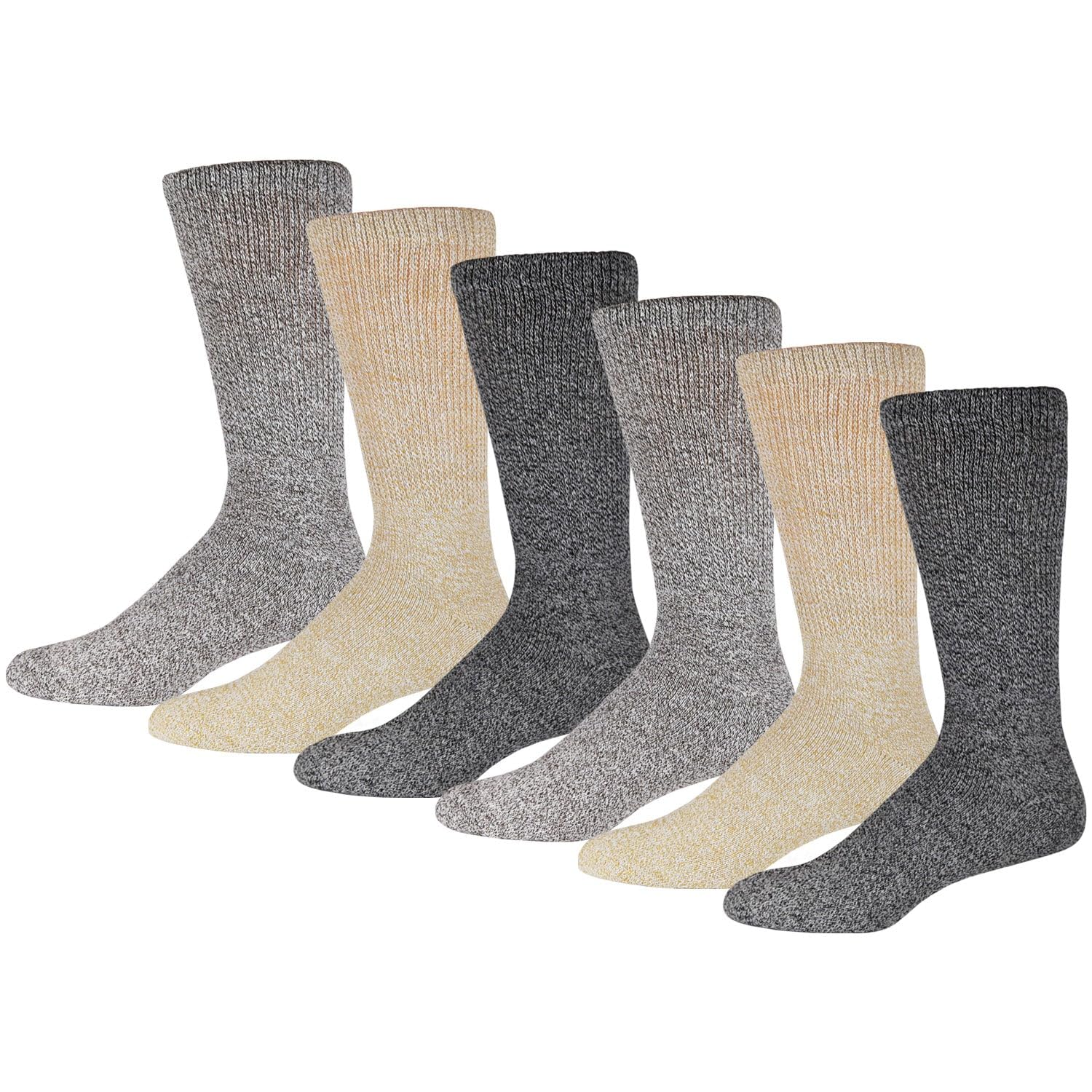
1. 6 Pairs of Thermal Merino Wool Warm Diabetic Socks, Assorted
Our pick — 4.5+★ from 300+ verified ratings; the strongest balance of quality and price.
Six pairs, one loose cuff, and enough stretch to clear a swollen ankle without a fight.
The number that decides this one is six. You get six pairs in a single pack, three times the count of the J.B. Field’s set, which means you can rotate through a week without hand-washing or running out mid-cycle. That matters when a swollen foot means one pair ends up damp and you need a dry backup the next morning.
The fabric is a 20% Merino Wool blend, padded out with 35% cotton, 35% polyester, 5% acrylic and 5% spandex. That is far lower merino than the 96% J.B. Field’s, so treat it as a warm everyday sock rather than a pure-wool one. What it does well is stretch: the spandex and loose knit let the sock slip on easily over swollen ankles and feet, and the smooth flat toe seam is built so it does not rub across the toes.
What wins people over is comfort, with warmth close behind — this is a sock people describe as soft and easy to leave on all day. The honest catch is the fit itself, which splits opinion: some wearers find the cuff relaxing nicely off the ankle, while others find the sock simply too big. The listed sizing runs sock size 10-13 for US men’s 9-11.5 and women’s 8-10.5, so check where you sit on that chart before committing to six pairs.
Where It Pulls Ahead
- Six pairs per pack against three in the premium set, so you always have a dry spare
- 20% Merino Wool blend with spandex for real stretch over a swollen ankle
- Flat toe seam designed not to rub sensitive toes
- Comfort is the trait this one is best known for, with warmth right behind it
What To Weigh First
- Only 20% merino, so it is a warm blend rather than a near-all-wool sock
- Fit is the divided point — some find the loose cut just right, others find it generous
- The non-binding top is not universally loved; a few prefer a touch more hold
Go for this if: you want a full week of warm mid-calf socks from one purchase and a cuff that slips over a swollen ankle.
Think twice if: you specifically want a high merino percentage — this is a 20% blend, and the J.B. Field’s is the pure-wool route.
2. Merino Wool Diabetic Socks for Men & Women Thick Warm Loose Fit
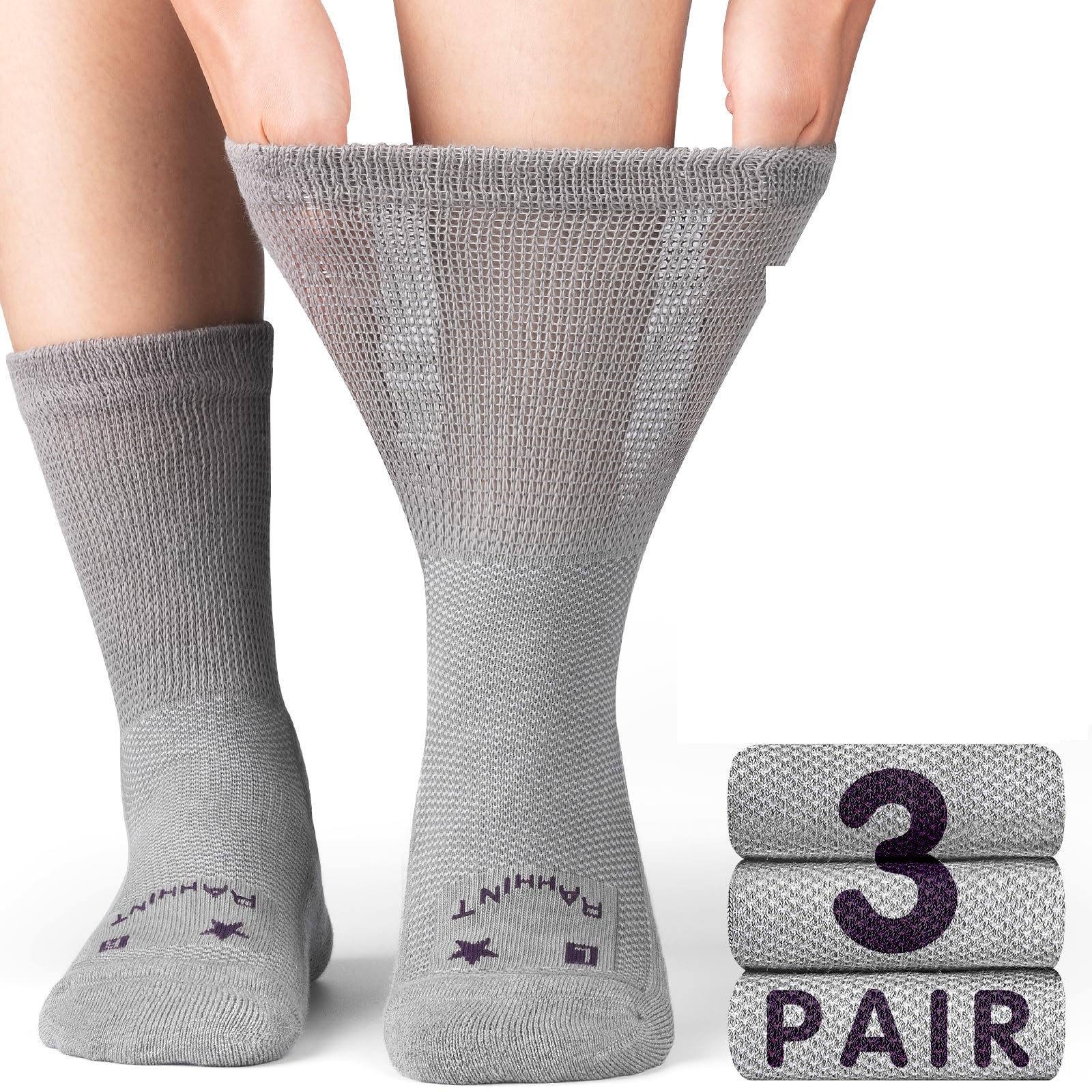
The tricky balance done right: a sock that stays up on the calf without clamping down on it.
Most loose-cuff socks solve one problem and create another — they stop squeezing, then slowly slide down the calf by lunchtime. This pair is built around holding its position while staying non-binding, and that combination is the whole reason it belongs on this list. It is a thick, warm, wide-fit sock that reads as substantial the moment you pull it on.
The material is a wool and bamboo blend, and the bamboo is doing quiet work here. Bamboo fibre is smooth and pulls moisture away, which is why these are described as keeping feet warm and dry rather than damp and cold. The interior gets the same attention: the lining through the toe and stress areas is smooth, so the parts of the foot that take the most pressure are not sitting against a rough seam.
Appearance is what people notice first, and it is not a backhanded compliment — these are good-looking socks you would not hide under a trouser leg. Comfort follows close behind, with staying-in-place rounding out the top traits. The one real variable is fit: some wearers find them snug rather than loose, so if your feet run wide, size with care. Everyone else gets stretchy, warm, dry feet and a cuff that behaves.
The case for it: a mid-calf diabetic sock whose non-binding top actually holds its place, with a smooth toe lining for sensitive feet.
Where it asks something of you: the fit leans snug for a loose-fit sock, so wider feet should check sizing before ordering.
3. J.B. Field’s 96% Merino Wool Weekender Casual Socks, 3 Pairs

Ninety-six percent merino — the closest thing here to wearing pure wool on your feet.
If wool content is the thing you care about most, this is the clear leader. It is 96% Merino Wool against the 20% in the thermal six-pack, a 4.8x gap in wool content, with just 4% Nylon Lycra added for strength and stretch. That ratio is why warmth is the trait this sock is known for above all else, with softness a close second even after repeated washing.
The cuff is deliberately loose, and the maker names it a non-binding top that does not restrict circulation — which is exactly what earns a hiking sock a place on a diabetic-friendly list. Nylon and ribbing are placed to keep the sock in position without clamping, and a thin toe seam cuts the rubbing that makes sensitive toes complain. It is crew length, so it lands mid-calf, and it is genuinely cushioned rather than a thin dress sock.
Here is the trade-off, and it is a real one. At 96% merino you are paying for wool, and value for money divides buyers — some see a fair deal for the wool content, others find the three-pair pack hard to justify. The fit also splits: some pull it on and find it comfortable, others find it looser than expected. Care is straightforward but specific: machine wash warm, inside out, no bleach, tumble dry low, no iron and no dry clean.
Why the wool matters: merino wicks moisture and holds heat, so a high percentage keeps feet dry and warm on a cold hike without bulk. This one also stays soft after washing, which is not a given at this wool level.
The honest limit: three pairs for premium money is a wool-first purchase, not a value-pack one. If you want quantity and a lower cost per pair, the six-pair thermal set is the more practical buy.
Pick this one when: wool purity is the priority and you want a cushioned mid-calf sock for cold days outdoors.
Leave it if: you need a week’s worth of socks from one order or prefer a snugger, stretchier fit.
Understanding the Specs
Merino Wool Percentage
This tells you how much of the sock is actual merino wool (a fine wool that moves moisture away and regulates temperature) versus cotton, polyester or spandex. A 96% merino sock behaves very differently from a 20% blend — the higher figure means more natural warmth and softness, the lower figure usually means more stretch and a friendlier price per pair. Neither is wrong; they suit different buyers.
Non-Binding Top
The non-binding top is the loose cuff at the top of the sock, built without the tight elastic ring that normal socks use. It is designed to sit against the calf without pressing a groove into the skin, which is the feature that makes a sock diabetic-friendly. Check for it by name, because a sock can be warm and soft and still fail here if the cuff grips.
Mid-Calf / 3/4 Height
Mid-calf, also called crew or 3/4 length, stops partway up the calf. It covers the ankle and lower leg without reaching the knee, which keeps the cuff away from the narrowest, most pressure-sensitive part of the ankle. Ankle socks leave the calf exposed; knee-highs add extra fabric and tension higher up the leg.
Seam And Cushioning
A flat or thin toe seam is a smooth join at the toe instead of a raised ridge, so nothing rubs across the toes during the day. Cushioning is the thickness underfoot and through the sock — more of it means softer landings and better warmth, less of it means a closer, thinner fit. For sensitive feet, the seam is usually the more important of the two.
FAQ
What makes a sock “diabetic” rather than just a warm sock?
Is 20% merino enough or should I go higher?
Will a loose cuff slide down my calf during the day?
What height should I pick for swollen ankles?
Do merino wool socks itch?
How do I wash merino diabetic socks without ruining them?
How many pairs do I need for a week?
Can I wear these socks for hiking and cold weather outdoors?
What shoe size do the six-pair thermal socks fit?
Is a wool and bamboo blend better than pure merino?
Final Thoughts: The Verdict
For most people, the best buy here is the 6 Pairs of Thermal Merino Wool Warm Diabetic Socks. One order gives you six warm, stretchy, non-binding mid-calf pairs (socks that reach the middle of your calf and don’t squeeze). That covers a full week with a spare to hand. If a sock that stays up without binding matters most to you, reach for the Merino Wool Diabetic Socks for Men & Women. It has a smooth toe lining (no seam rubbing your toes) and a cuff that holds its place. For cold-weather hiking or the most wool, the J.B. Field’s 96% Merino Wool Weekender has the highest merino share of the three at 96%. Pick by the cuff first, the wool percentage second, and the pack size third — that order settles almost every decision.
How We Picked
We do not accept paid placement. Every pick is matched to a real buyer and a real use-case; we do not hands-on test units.
Sources & Methodology
Specifications: manufacturer listings and product documentation. Review insights: verified customer reviews, as of November 2026. Pricing: not shown on this page (it changes often); check the current price via the retailer link.
As an Amazon Associate, Gadgets Feed earns from qualifying purchases. This does not affect which products we feature.