
Our readers keep the lights on and my morning glass full of iced black tea. As an Amazon Associate, I earn from qualifying purchases.
Specs are compiled from manufacturer listings and verified buyer reviews and can change over time — please confirm the key details on the product page before buying.
You want a pad that makes your ankle work harder without rolling under you mid-lunge. That is the whole job. A balance pad is a slab of squishy foam you stand, kneel, or sit on so your joints have to correct themselves constantly, and the right one feels firm underfoot, grips a hard floor, and stays put when you sweat. The wrong one slides, tears, or sinks until it stops being a challenge at all.
I’m Min — the founder and writer behind Gadgets Feed. This guide is built by comparing the manufacturers’ published specifications and the patterns across verified customer reviews, so you get each pick’s real strengths and trade-offs instead of marketing spin.
Below you will find nine pads sorted by what they genuinely do well, from a crowd favorite that has been standing up to daily home rehab for years to oversized slabs built for tall frames. Every pick is judged on the same handful of things: how thick the foam is, how much surface you get, how much it weighs to carry, and how it behaves once your hands or feet get damp. Read on for the balance pads for physical therapy that hold their shape and their grip session after session.
Our Picks at a Glance


How To Choose The Best Balance Pads For Physical Therapy
The single biggest mistake is buying the softest, thickest pad you can find. Too much give and your ankle stops being challenged, so the exercise turns into standing on a pillow. You want foam that compresses a little under your weight and pushes back — firm enough to stay stable, soft enough to be unstable.
Thickness and what it changes
Two inches is the common middle ground. It is enough cushioning to kneel on for floor work and enough height for your ankle to correct against while standing. Thicker foam — 2.3, 2.4, 2.5 inches — gives more travel underfoot, which some people find easier on the joints and others find too wobbly at first. If you have never stood on a pad before, start with the 2-inch range.
The surface is the safety feature
A textured top is not decoration. Bare feet on smooth foam get slick the moment you sweat, and a pad that skates across a hardwood floor is a fall waiting to happen. Look for wording about a textured or non-slip surface, and check whether the material is described as sweat-proof. TPE, short for thermoplastic elastomer, is the foam most of these pads use because it grips and wipes clean.
Footprint versus your frame
A pad around 15.5 by 12.75 inches fits most adults standing with feet shoulder-width apart. If you are tall, wear a large shoe, or want to stand on it at a desk for long stretches, the extra-large sizes around 19 by 15 inches give your feet somewhere to go without hanging over the edge. Petite users and children often do better on the smaller footprint.
Weight and where the pad lives
These pads run from roughly 10.5 ounces to 0.7 kg, so none of them is a burden. The lighter ones toss into a gym bag or carry-on without thought. The heavier, denser slabs feel more planted on the floor but are the ones you leave in one spot. Decide whether the pad travels with you or lives beside the sofa.
Know the limit listed for your pad
Several pads here publish a maximum weight recommendation, commonly 300 pounds or 136 kg. That is the number to respect for standing work, and it is worth checking before you buy if you plan to use the pad as a seat cushion or under a chair. Foam that is overloaded stops rebounding and starts to flatten permanently.
Quick Comparison
| Model | Best For | Dimensions (L x W x H) | Weight | Material | Amazon |
|---|---|---|---|---|---|
| ProsourceFit Exercise Balance Pad★ Best Overall | Most people, first pad | 15.5″ x 12.75″ x 2.25″ | 12 ounces | TPE | Amazon |
| Yoblink Foam Balance PadBest for Travel | Travel and small spaces | 15.75″ x 13″ x 2″ | 10.5 ounces | TPE | Amazon |
| Hshbxd Professional Balance PadTwo-Size Choice | Two-size flexibility | 15.7″ x 13″ x 2″ | 0.31 kg | TPE | Amazon |
| Fragraim Balance Pad | Long warranty coverage | 15.7″ x 13″ x 2″ | 10.56 ounces | TPE | Amazon |
| NexFit High-Density Balance Pad | Dense, planted feel | 15.5″ x 12.75″ x 2.25″ | 0.58 kg | Foam | Amazon |
| Vive Oval Balance Pad | Thick oval platform | 16″ x 12″ x 2.5″ | — | TPE | Amazon |
| THERABAND Stability Trainer Pad | Guided intermediate work | 16.35″ x 10.25″ x 2.3″ | — | Foam | Amazon |
| ANVICTOX XL Balance Pad | Tall adults, big feet | 19.8″ x 15.7″ x 2.4″ | 570 g | TPE | Amazon |
| Therapist’s Choice X-Large Balance Pad | Large surface, closed-cell foam | 19″ x 15″ x 2.3″ | 0.7 kg | Closed Cell Foam | Amazon |
In‑Depth Reviews
1. ProsourceFit Exercise Balance Pad, Non-Slip Cushioned Foam Mat & Knee Pad
Our pick — 4.5+★ from 17,000+ verified ratings; the strongest balance of quality and price.
The 2.25-inch TPE pad that suits ankle drills, kneeling, and desk standing in one buy.
There is a reason this is the pad most people picture when they hear the phrase. It measures 15.5 by 12.75 by 2.25 inches, which is roomy enough for a normal stance and low enough that you can still do lunges and planks on top of it. The foam is TPE — a rubbery plastic that resists sweat — so the surface stays grippy through a hot session and wipes down afterward. At 12 ounces it straps to a bag without complaint.
What wins people over is the sheer consistency of the thing: the firmness feels dialed in rather than either rock-hard or mushy, and the top texture keeps your feet from creeping. It carries a 340 kg maximum weight recommendation, which is the highest figure in this lineup by a wide margin, so you are not worrying about the foam bottoming out during standing work. People use it for balance drills, for kneeling during floor exercises, and as a cushion under a desk or in the garden. The 4.5+ stars across 17,000+ owners tells you the pattern holds.
One honest note: at 2.25 inches thick it gives a little more travel than the 2-inch pads, so if you have never balanced on foam before, expect a wobbly first few sessions. That is the point — it just takes getting used to. And because it is the pad everyone reaches for, it tends to live in one spot rather than travel.
Where this pad earns its place
- Sweat-proof TPE surface holds grip through damp workouts and cleans up with a wipe
- 340 kg weight limit removes any worry about the foam crushing under standing work
- 2.25-inch thickness and 15.5 by 12.75-inch footprint suit lunges, planks, and kneeling
- Doubles as a seat cushion, gardening knee pad, or footrest at a standing desk
What to keep in mind
- More give than a 2-inch pad, so the first sessions feel notably unstable
- You will want it in one place; it is not the pack-and-carry option in this list
Reach for this if: you want a single pad to cover ankle work, kneeling, and desk standing without second-guessing the foam.
Think twice if: you are brand new to balance training and want the firmest, least wobbly surface to start on.
2. Yoblink Foam Balance Pad, 2 Inch Thick High Resilience
A 15.75 by 13 inch TPE pad at 10.5 ounces, the lightest full-size option here.
The number that decides this one is 10.5 ounces. That is the lightest pad here, and it is lighter than the ProsourceFit’s 12 ounces, so if the pad has to ride in a suitcase or a gym bag every week, this is the one you stop noticing. You still get a full 15.75 by 13 inches of surface at 2 inches thick, which suits most people standing with feet apart.
The manufacturer describes a textured slip-resistance surface meant to hold even when things get damp, and the TPE body is listed as sweat-proof. Rinse it and let it dry after use and it stays usable. Beyond standing work it works as a seat cushion, a gardening knee pad, or a foot pad at a desk, which covers a lot of the small daily uses people actually want from a pad this size.
Here is the catch worth naming: this is a newer listing with a small review base compared to the older pads in this lineup, so you are buying somewhat on the spec sheet rather than a long track record. The specs are solid and the surface is described the way you want it described. Just go in knowing you are an early adopter rather than joining a crowd.
Editorial read: at 15.75 by 13 by 2 inches and 10.5 ounces, this pad scores on portability first and surface area second — a sensible trade for anyone whose therapy happens in more than one building.
Suits you if: the pad needs to move between home, gym, and office and you want full-size surface without the carry weight.
Look elsewhere if: you would rather buy into a long review history before committing.
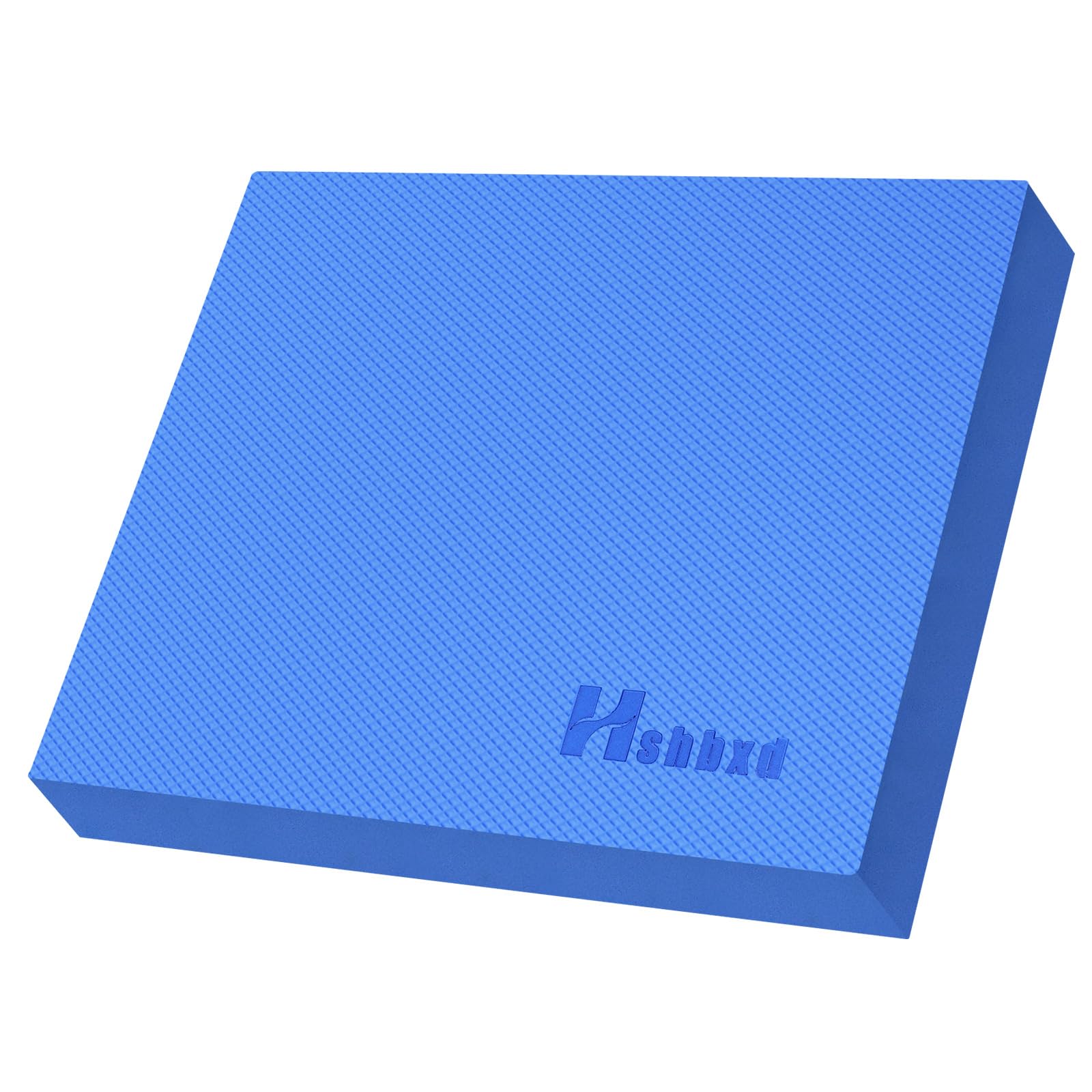
3. Hshbxd Professional Balance Pad for Physical Therapy and Stability Training
The only listing here in two footprints, 15.7 by 13 inches or 18.8 by 15 inches, both 2 inches thick.
Most pads here come in exactly one size. This one ships in your choice of 15.7 by 13 by 2 inches or 18.8 by 15 by 2 inches, both in TPE foam with a listed 300-pound maximum weight recommendation. If you are tall, have wide feet, or plan to stand on the pad at a desk for long stretches, the larger option is the reason to pick this listing over a single-size pad.
The balance exercises are what this pad gets used for most — lunges, planks, squats, sit-ups — and the manufacturer pitches it for rebuilding ankle and foot strength as well as core work. It also folds into the same secondary uses as everything else in this category: meditation cushion, gardening knee pad, footrest. The textured top is described as preventing slipping, and the TPE is called sweat-resistant and waterproof, which is the wording that matters for wiping it down between sessions.
The trade-off is a short track record: the review base is modest and barely a year of buying history sits behind it. It is also, at 0.31 kg, one of the lightest pads in this lineup — noticeably easier to carry than the denser NexFit at 0.58 kg — but that lighter build is also why it does not feel quite as planted underfoot.
Worth choosing when: you need the larger footprint and want the same foam in a smaller size for someone else in the house.
Not your pick if: you want a heavy, dense pad that barely moves when you step on it.
4. Fragraim Balance Pad, Non-Slip Foam Mat, 15.7 x 13 x 2 Inch

The 15.7 by 13 inch TPE pad backed by a 60-day return and an 18-month replacement window.
Foam tears. That is the reality of standing on the same slab every day, and it is why the standout detail here is the coverage: 60 days to return it and an 18-month replacement window, which is the longest stated protection in this lineup.
The hardware underneath is familiar and sound. It measures 15.7 by 13 by 2 inches of TPE foam at 10.56 ounces, with a textured sweat-proof top described as holding grip through sweaty sessions. The manufacturer lists it for rehab, physical therapy, and physio work as well as the usual standing, kneeling, and desk-cushion jobs. Hand wash only, so it lives with a quick rinse rather than a dishwasher.
What you should know before buying: size and thickness are the contested points here. Some people find the footprint perfect, others want it an inch bigger, and comfort splits the same way. The foam is on the softer side of the category, which suits kneeling and seated work but gives more underfoot movement than the dense slabs. If you are a large-frame user, consider the 19-inch pads instead.
Buyer pattern: most people are content with the firmness and the grip, and the grip on a damp floor is the thing that stops the pad from being a hazard.
Worth knowing: hand wash only and a softer foam means this is a pad you look after rather than toss around.
Fits best for: a months-long home rehab routine where the replacement window is the deciding factor.
Consider the bigger pads if: you are tall or wide-footed and find a 15.7-inch width cramped.
5. NexFit High-Density Balance Pad

At 0.58 kg, roughly double the 0.31 kg Hshbxd pad, this dense foam stays planted on the floor.
Weight is the giveaway with this one. At 0.58 kg it is the densest pad in this lineup — that is 0.58 kg against the Hshbxd pad’s 0.31 kg, so roughly double the mass in the same size class. The footprint mirrors the ProsourceFit at 15.5 by 12.75 by 2.25 inches, which means nothing about the standing area is compromised; the extra weight sits in the foam itself. Dense foam does not bottom out, and it does not slide when your foot loads it.
The manufacturer leans hard on that density story: an unstable surface to engage the core, feet and ankles, and a high-density TPE body described as non-toxic and sweat-proof with a non-slip top for sweaty sessions. It carries a 300-pound maximum weight recommendation and an extra-large size option for more standing room. Planks, lunges, squats, seated use, meditation, and desk work all appear on the intended-use list.
The obvious catch: 0.58 kg is a lot of pad to carry. This is the one that stays by the sofa or under the desk rather than the one that goes in your bag. And if you are brand new to balance training, dense foam is a firmer, less forgiving start than a softer pad.
Why the weight is the point
- 0.58 kg of high-density foam stays planted on the floor instead of skittering
- Sweat-proof, non-slip top described for high-intensity sessions
- 300-pound weight limit covers seated and standing use comfortably
- Available in an extra-large option for more standing surface
The honest counterweight
- Heaviest pad here at 0.58 kg — a poor choice if the pad needs to travel
- Dense foam is a firmer starting point for absolute beginners
Good match for: a fixed home spot where you want the pad to feel bolted to the floor.
Wrong call for: a pad that has to travel between locations.
6. Vive Oval Balance Pad
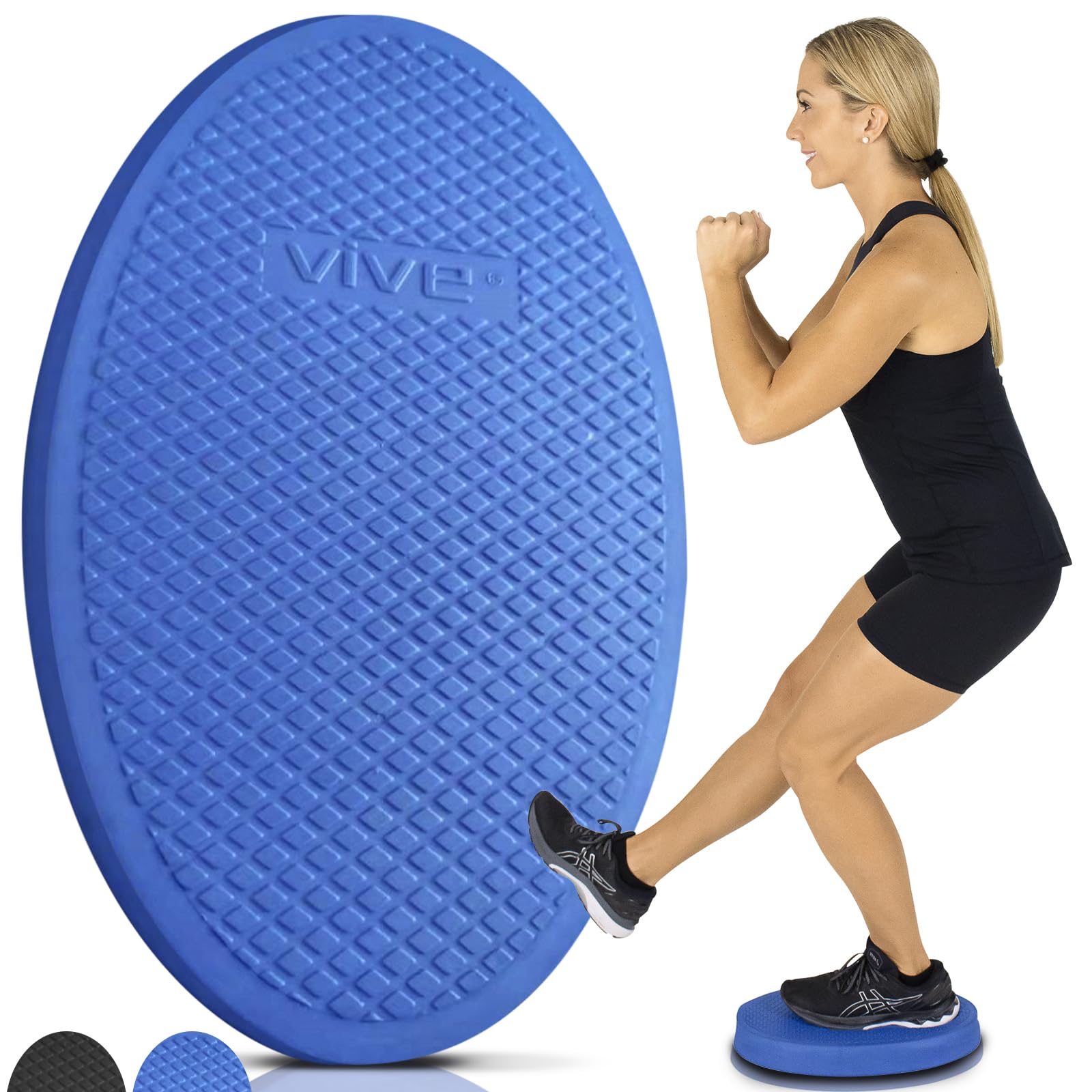
A 16 by 12 inch oval at 2.5 inches thick, the tallest foam here, with no corners to brace against.
It is 2.5 inches thick, which is the tallest foam here, and the shape is an oval measuring 16 by 12 inches rather than a rectangle. That combination changes the feel: you get more travel under your foot and no hard corners to brace against, so your ankle is doing more correcting. The manufacturer calls it a soft stability trainer and lists it for physical therapy and rehab alongside Pilates, yoga, and core work.
The TPE body is described as grippy and the whole thing carries a 300-pound maximum weight recommendation. It cleans easily and moves from floor to chair without fuss. The difficulty is the recurring theme in feedback — it is more challenging than it looks, which is exactly what you want from a therapy tool and exactly what will surprise you on day one.
Durability is the split point. Most owners have had a solid run with it, but a subset report the foam coming apart with heavy use, which is fair warning to keep your feet off the very edge of the oval. If you are a beginner or unsteady on your feet, this is not the pad to learn on.
Where it stands out: 2.5 inches of soft foam in an oval footprint adds difficulty without adding bulk, so it packs into a corner beside a chair.
Handle with care: keep weight centered on the oval rather than on the rim, and the foam holds its shape longer.
Built for: someone who has already stood on a 2-inch pad and wants the next step up in difficulty.
Not recommended as: a first balance pad for a user with steadiness concerns.
7. THERABAND Stability Trainer Pad
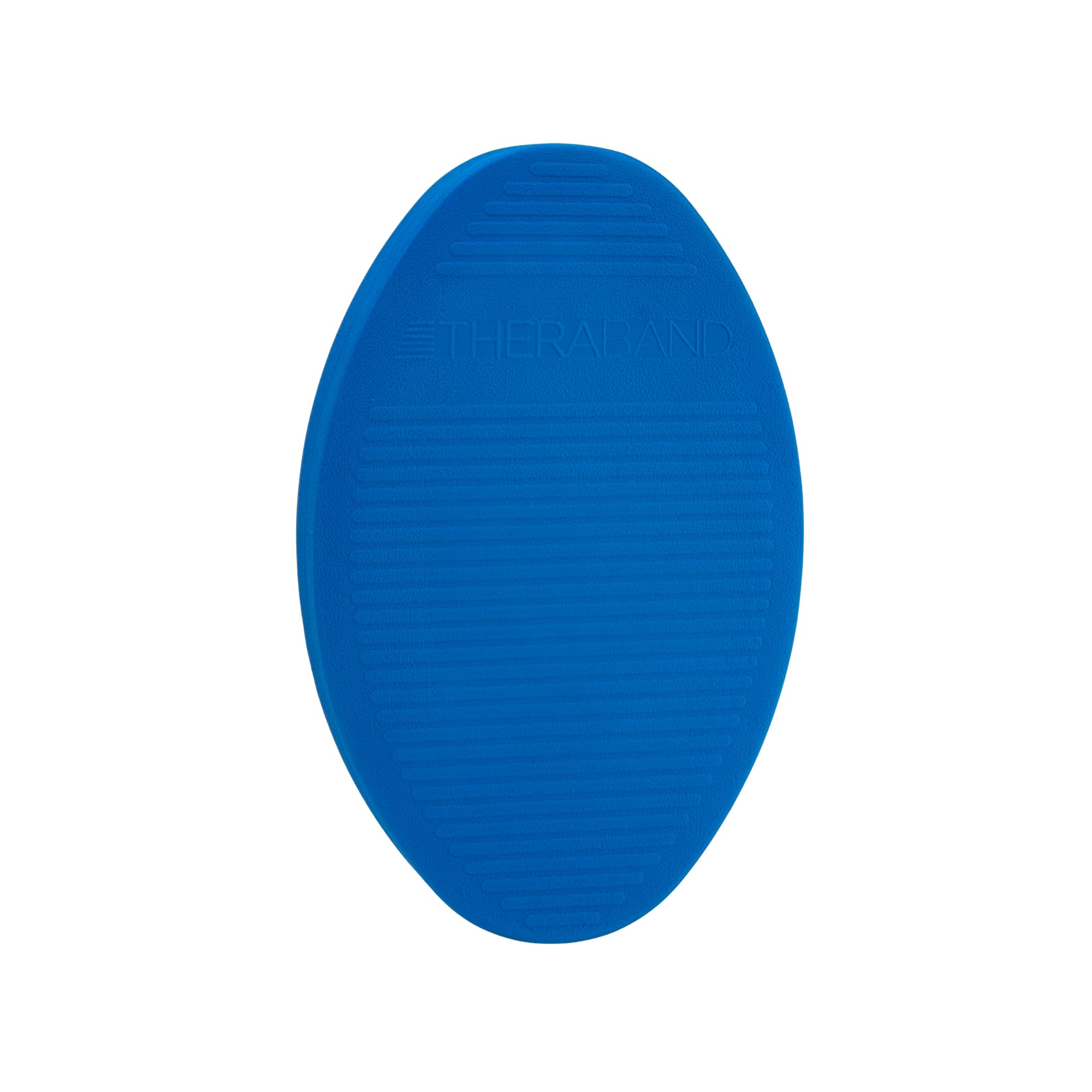
Blue marks THERABAND’s intermediate level, a softer surface than a firm beginner pad.
The soft blue foam here is not an arbitrary color. THERABAND uses a color-coded system where this blue marks the intermediate level, a softer surface that allows a bit more movement than a firm beginner pad. That is genuinely useful if you are working through a plan and want to know when to move up. The pad measures 16.35 by 10.25 by 2.3 inches and supports up to 300 lbs.
It arrives with a full-body balance training guide, which is the detail that separates it from the bare foam slabs — you are not guessing at exercises. The non-slip textured surface handles standing, seated, and kneeling work, and the water-resistant material wipes clean and is positioned as a lighter alternative to a wobble cushion or balance disc. Foot and ankle rehabilitation is where it earns its keep most often.
There is a fit question worth flagging. The footprint is the narrowest here at 10.25 inches wide, so wide stances and large feet will overhang. It also has a noted difficulty curve — soft foam at the intermediate level is a real step up from a flat floor, and that is by design.
Choose this for: a structured rehab progression where the color coding and included guide replace guesswork.
Measure first: the 10.25-inch width is the tightest footprint here and will not suit wide stances.
8. ANVICTOX XL Balance Pad

At 19.8 by 15.7 by 2.4 inches, this is the biggest pad here, with 102 sq in more surface than the L version.
At 19.8 by 15.7 by 2.4 inches, this is the biggest pad here, and the manufacturer is direct about who it is for: taller adults, wider stances, and rehabilitation work where the extra support area makes you feel steadier. The listing also spells out that the XL offers 102 sq in more surface area than the L version, which runs 15.8 by 13.2 by 2 inches. That is a real difference if your feet hang off a standard pad.
The TPE foam is described for resilience, wear resistance, and weather resistance, and it weighs 570 g. Stability is the recurring theme in owner feedback — the pad does not slip on floors even during standing work, and people find it firm enough to feel stable and slightly squishy at the same time. It carries a one-year warranty with round-the-clock email support.
The edge caveat is written into the instructions themselves: keep your feet off the border of the pad. Weight right on the rim is what causes wobble and what eventually damages the foam. Keep to the center and this pad holds up well; treat the edge as a landing zone and durability suffers.
Pick this if: you are tall, wear a big shoe, or simply want your whole foot planted without overhang.
One instruction to follow: stay off the rim — the maker’s own guidance, and the fix for the tear reports.
Fits you when: standard 15-inch pads feel cramped and you want the largest stable platform in this group.
skip it if: you have a small living space — this pad takes up more floor than anything else here.
9. Therapist’s Choice X-Large Balance Pad
The oversized slab with the densest body and a name that leans on therapeutic use.
Closed-cell foam is the technical detail worth understanding here. The cells in the foam are sealed, which keeps water out and makes the pad wipeable, and it is listed as latex-free. At 19 by 15 by 2.3 inches and 0.7 kg, it is the heaviest pad in this lineup and the second largest, so it is a station rather than a travel accessory.
The manufacturer lists its uses around core work, balance, and coordination, and specifically notes standing at a desk or using it as a seated cushion for low-back and pelvis support. The destabilizing surface is described as automatically activating back and abdominal muscles, and it is pitched for recovery work in therapy settings as well as at home. Standing on one leg for a short daily session is the simple routine it is built around.
The trade-off is firmness. Some people find this pad too firm for comfort, which matters most if you plan to kneel or sit on it as much as stand. It is forgiving storage-wise for its size and easy to wipe. But if you want a soft sink-in feel, the 2.5-inch oval is the softer option.
Makes sense for: a big footprint with sealed, wipeable foam and a firm surface for standing balance work.
Reconsider if: you want a plush, sink-in pad for long kneeling sessions.
Understanding the Specs
TPE Foam and Why It Keeps Appearing
TPE stands for thermoplastic elastomer — a material that behaves like rubber but can be molded like plastic. In a balance pad it gives you a springy, grippy surface that resists sweat and wipes clean, which is why most pads here use it. Plain foam can go slick once it gets damp, and slick foam under bare feet is a fall risk. If the listing mentions sweat-proof or non-slip alongside TPE, that is the combination you are looking for.
Closed-Cell Foam and Cleanability
Closed-cell means the foam’s air pockets are sealed rather than open and connected. The practical result is that water and sweat sit on the surface instead of soaking in, so a quick wipe handles it. It also tends to hold its shape better under repeated loading. That is why the Therapist’s Choice pad lists closed-cell foam as a headline feature — it is a durability and hygiene detail more than a comfort one.
Thickness From 2 to 2.5 Inches
Thickness controls how much the pad travels under your foot and how much it corrects for you. A 2-inch pad sits at the low end and is easier to stand on. Somewhere around 2.25 to 2.4 inches is the middle ground for most adults. At 2.5 inches the foam is at its most challenging, which suits someone already comfortable on a thinner pad. Thicker is not better — it is harder.
The Maximum Weight Recommendation
Several pads list a figure like 300 lbs or 136 kg, and these are not decorative. That is the load the foam is designed to carry without permanently flattening. Standing use is well within it for most buyers, but if you plan to use the pad as a seat cushion or under a chair, respect the number. Overloaded foam stops springing back, and once it collapses it stops challenging your balance at all.
FAQ
How thick should a balance pad be for ankle physical therapy?
Can a balance pad slide on hardwood or tile floors?
What is TPE foam and is it better than standard foam?
How much weight can these balance pads hold?
Is an extra-large balance pad better for tall people?
Can I use a balance pad as a knee pad or seat cushion?
How do I clean a foam balance pad?
Will a balance pad tear with daily use?
What is the difference between a balance pad and a wobble cushion?
Final Thoughts: The Verdict
For most people the winner is the ProsourceFit Exercise Balance Pad, and the reasoning is plain: 15.5 by 12.75 by 2.25 inches of sweat-proof TPE, a 340 kg weight recommendation, 12 ounces to carry, and a crowd favorite reputation that has held up across years of home use. It is the pad you buy once and stop thinking about.
If the pad has to travel, take the Yoblink at 10.5 ounces. If your frame is bigger than the standard footprint, the ANVICTOX XL gives you 19.8 by 15.7 inches of standing surface. And if you want a structured progression with a color code and a guide to follow, the THERABAND Stability Trainer Pad is the sensible pick.
One honest nudge before you decide: write down whether this pad stays in one room or rides in a bag, and whether your feet fit a 15-inch width. Those two answers eliminate most of this list on the spot, and they matter far more than the label on the foam.
How We Picked
We do not accept paid placement. Every pick is matched to a real buyer and a real use-case; we do not hands-on test units.
Sources & Methodology
Specifications: manufacturer listings and product documentation. Review insights: verified customer reviews, as of November 2026. Pricing: not shown on this page (it changes often); check the current price via the retailer link.
As an Amazon Associate, Gadgets Feed earns from qualifying purchases. This does not affect which products we feature.