
Our readers keep the lights on and my morning glass full of iced black tea. As an Amazon Associate, I earn from qualifying purchases.
Specs are compiled from manufacturer listings and verified buyer reviews and can change over time — please confirm the key details on the product page before buying.
Most people who buy a big camera stop carrying it within a month, and the phone wins by default. The trick to a camera you actually use every day is matching the body and lens to where you shoot — a bag, a pocket, a commute, a kitchen table — rather than chasing the biggest sensor on the shelf. Below are nine cameras that each solve the everyday problem in a different way, from a 51-point DSLR that still handles low light to a compact that genuinely lives in a jacket pocket. The top pick is the Nikon D7500, a 4.5+ star body across 700+ ratings that pairs a 20.9MP sensor with a versatile 18-140mm zoom.
I’m Min — the founder and writer behind Gadgets Feed. This guide is built by comparing the manufacturers’ published specifications and the patterns across verified customer reviews, so you get each pick’s real strengths and trade-offs instead of marketing spin.
Each camera here wins on a different everyday strength, so the right one depends on how you shoot rather than how much you spend. Read on for the honest breakdown of the camera for everyday use shortlist.
Our Picks at a Glance


How To Choose The Best Camera For Everyday Use
An everyday camera is a compromise machine, and the job is picking the compromises you can live with. A body that fits in a pocket wins on carry but loses on lens choice. A full-frame sensor wins on low light but adds weight and cost to every lens you buy afterwards. Work out which of those hurts you less before you read a single spec sheet.
Sensor size before megapixels
The sensor is the chip inside that collects light, and its physical size decides how clean your photos look indoors and at dusk. A 20.9MP or 24.1MP APS-C sensor (a mid-size chip, smaller than full-frame but far bigger than a phone) gathers far more light than a phone’s tiny chip, so evening shots keep their detail. A full-frame sensor is larger again, which is why the Sony Alpha 7 IV’s 33MP full-frame chip and the Nikon Z6 III’s full-frame body are the low-light specialists here. Megapixel count alone tells you how big you can print, not how good the photo looks in a dim room.
Autofocus points and how they track
Autofocus points are the spots on the frame the camera can lock focus onto, and more of them usually means more freedom to place your subject off-centre. Phase detection is the faster method — it judges distance directly, so it locks onto moving kids and pets quickly. Contrast detection hunts back and forth for the sharpest edge, which is fine for still subjects but slower on action. The Sony ZV-E10 carries 425 autofocus points, while the Panasonic point-and-shoot carries 39 with contrast detection. That gap shows up the moment your subject starts walking toward you.
Lens reach decides your whole day
A kit lens sets the boundaries of what the camera can shoot without you buying anything else. A zoom that starts around 18mm captures a whole room or a street scene, and one that reaches 140mm pulls a face or a detail close without you stepping forward. The Nikon D7500’s 18-140mm lens covers that whole span in one tube, which is why it suits a day out with no bag of extras. A fixed 40mm lens, like the Ricoh GR IIIx, is the opposite bet: one honest field of view, no zooming, and a body small enough to forget you are carrying it.
Quick Comparison
| Model | Best For | Sensor / Resolution | Autofocus Points | Kit Lens Reach | Amazon |
|---|---|---|---|---|---|
| Nikon D7500★ Best Overall | All-round everyday shooting | 20.9MP APS-C | 51 | 18-140mm | Amazon |
| Panasonic Point and Shoot 4KLongest Reach | Travel and long-zoom reach | 4K video / 8MP photo from 4K | 39 | 20-1200mm equivalent | Amazon |
| Canon EOS R100Smart First Step | First mirrorless on a budget | 24.1MP APS-C | 143 | 18-45mm | Amazon |
| Sony ZV-E10 | Video and streaming | 24.2MP APS-C | 425 | 16-50mm | Amazon |
| Canon EOS RP | Entry into full-frame | Full-frame, 14 Bit | — | 24-105mm | Amazon |
| FUJIFILM X-T30 III | Straight-out-of-camera colour | APS-C, 14 Bit | 425 | 13-33mm | Amazon |
| RICOH GR IIIx HDF | True pocket carry | 24MP APS-C | 150 | 40mm fixed | Amazon |
| Nikon Z6 III | Hybrid stills and 6K video | Full-frame, 10 Bit | 299 | Body only | Amazon |
| Sony Alpha 7 IV | Full-frame everyday powerhouse | 33MP full-frame | 693 | Body only | Amazon |
In‑Depth Reviews
1. Nikon D7500 20.9MP DSLR Camera with AF-S DX NIKKOR 18-140mm Lens
Our pick — 4.5+★ from 700+ verified ratings; the strongest balance of quality and price.
One body, one lens, and a 51-point autofocus grid that keeps up with a toddler.
The reason the D7500 tops this list is not a single headline number — it is that one purchase covers a whole day. The kit bundles an 18-140mm zoom, which starts wide enough for a street scene and reaches far enough to pull a face close without stepping in. That range means you leave the house with one tube on the camera and nothing else, which is exactly the habit an everyday shooter needs to build.
Under the hood sits a 20.9MP APS-C sensor (a mid-size chip) with 14-bit depth. Bit depth is how many shades of colour the sensor records per channel, and 14-bit files hold far more gradation than 8-bit ones, so skies and skin tones keep their smoothness when you edit. Owners consistently point to low-light picture quality as the reason they stay loyal, and the image processing and metering here mirror Nikon’s higher-tier D500 body. A 3.2-inch 922K-dot tilting touchscreen lets you frame from waist height on a crowded street, and the 8 fps burst catches a kid mid-run.
Quality is what wins people over more than anything else on this camera — it is by far the most-discussed strength in owner feedback, with picture quality right behind it. The recurring gripe is setup: the menu system takes some dialling in before it feels quick, so budget an evening with the manual.
What makes it the daily driver
- 18-140mm kit zoom covers wide scenes and tight portraits in one lens
- 14-bit files keep colour smooth when you push them in editing
- 51 autofocus points, 15 of them cross-type, hold a moving subject
- 3.2-inch 922K-dot tilting touchscreen for odd angles
- 8 fps burst for action without a second body
Where it asks for patience
- Menu setup is fiddly before it becomes fast
- DSLR body and mirror make it bigger than a mirrorless compact
- Speed settings need learning before the burst shines
Reach for this if: you want one camera and one lens that covers family, travel and low light without a bag of extras.
Think twice if: pocket carry is non-negotiable — a DSLR with a zoom mounted is a shoulder-bag camera, not a jacket one.
2. Panasonic Point and Shoot Digital Camera 4K
A 20-1200mm equivalent zoom in a body that never needs a second lens.
If your everyday shooting happens at a distance — a kid’s match, a bird on a fence, a landmark across a valley — this is the pick. The lens spans 20mm to 1200mm in 35mm-equivalent terms, so you go from wide landscape to a tight crop of a face without changing anything. No interchangeable-lens camera in this list gets close to that reach from a single kit purchase.
The stabiliser matters as much as the zoom. POWER O.I.S. (optical image stabilisation, which physically counteracts your hand shake) is tuned to work at the long end, where any tremor gets magnified. Panasonic also builds in Post Focus, which lets you tap the spot you want sharp after the shot is taken, and 4K Photo, which pulls an 8-megapixel still out of a 4K clip. The 2,360K-dot 0.74x viewfinder stays readable in bright sun, which is where point-and-shoots usually fall apart.
Zoom reach is the strength owners talk about most, with overall quality close behind and versatility mentioned often. The honest catch is image clarity at the very top of that zoom — feedback splits between crisp results and softer ones as you push past the middle of the range. Reliability draws more negative commentary than anything else here, so treat the body with care and pack it properly for hiking. Ease of use splits too: the Auto modes are simple, but the full feature set has a learning curve.
The trade-off in plain terms: a 39-point contrast-detect autofocus system is slower to lock than the 425-point phase-detect setup on the Sony ZV-E10, so fast-moving subjects at close range are harder work.
Where it belongs: a travel and hiking camera where reach beats pocketability every time.
Your match if: you shoot wildlife, sport or travel architecture and want one sealed body instead of a bag of lenses.
Walk past if: you mostly shoot dim indoor scenes at close range — this one is built for distance and daylight.
3. Canon EOS R100 Mirrorless Camera RF-S18-45mm Lens Kit
The smallest, lightest body in Canon’s R-series — and the cheapest way in.
Buyers who want a real camera but hate the idea of a heavy bag should start here. This is the smallest and lightest body in Canon’s EOS R mirrorless line, and the 24.1MP APS-C sensor (a mid-size chip) with natural bokeh means portrait backgrounds blur the way phone shots cannot. The DIGIC 8 processor handles the 4K video, and the RF mount means the lens you buy today still fits a bigger body later.
Autofocus is where the R100 punches above its tier. Dual Pixel CMOS AF (Canon’s phase-detect system that judges distance directly) covers up to 143 zones, with human face and eye detection plus animal and vehicle tracking. That is more than three times the 39 points on the Panasonic point-and-shoot, and the difference shows when a face moves through the frame. Continuous shooting tops out at 6.5 frames per second in One-Shot AF, and video reaches 4K at 24 fps or Full HD at 60 fps with HD at up to 120 fps for slow motion.
Compact size, light weight and beginner-friendliness are the themes that keep coming back — this is a camera that gets carried because it is not a chore. Quality leads the praise, image quality follows, and value for money rounds it out. Two honest limits: some units have stopped working for their owners, so buy from a seller with a clean return route, and battery life comes up short for heavy shooters — pack a spare if a full day is the plan. The 18-45mm lens is a genuine wide-to-normal zoom with optical stabilisation, but do not expect reach.
The real-world read: a 24.1MP sensor and 143 autofocus zones in a body this light is the value story of this list; the short kit lens is the price of that light frame.
Pick it for: a first mirrorless camera you will genuinely carry, with room to grow into RF lenses later.
Not the one if: you need zoom reach or all-day battery from a single charge.
4. Sony ZV-E10 APS-C Mirrorless Camera with 16-50mm Lens
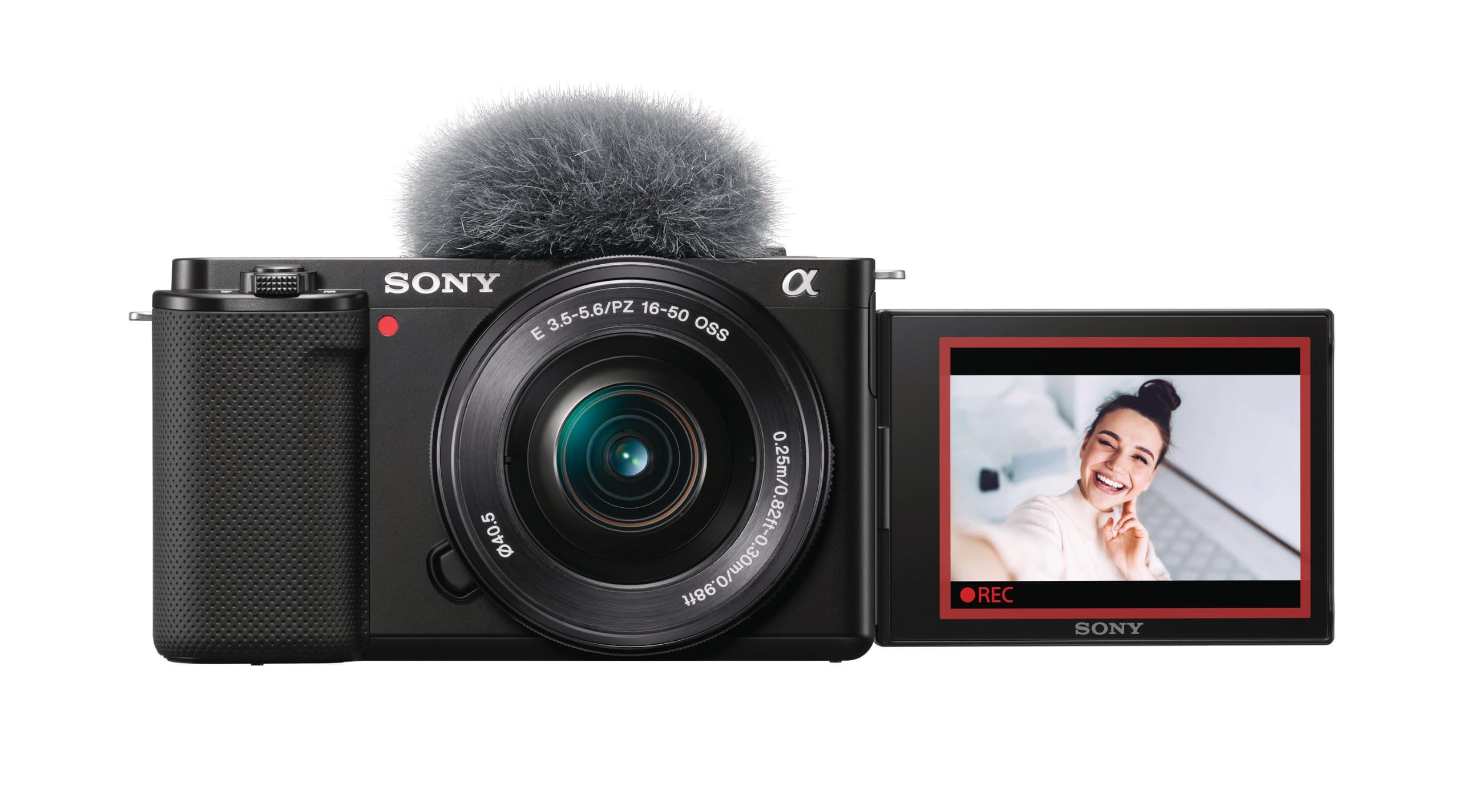
Built for the desk-to-street creator who needs one USB cable and no extra gear.
Say you shoot talking-head videos, product clips and the odd vlog, and you want the camera to do the technical thinking. The ZV-E10 is aimed straight at you. A 24.2MP APS-C Exmor CMOS sensor pairs with Sony’s BIONZ X processor, and the 4K is oversampled from 6K with full pixel readout and no pixel binning — meaning the camera reads every pixel instead of skipping some, so 4K footage keeps fine detail instead of softening.
The 425-point autofocus array is the standout number, and it is the one to weigh against the Panasonic point-and-shoot’s 39 points. That is a ten-fold gap, and it matters for tracking a face that turns away mid-sentence. A Product Showcase Setting flips focus from your face to an object you hold up, the Background Defocus button toggles the blurred-background look on and off, and live streaming runs off a single USB cable with no extra hardware or software.
Camera quality is the strength that carries the most weight in owner feedback, with image quality and value next. Autofocus splits opinion — it works beautifully for some and has stopped working for others, so test it thoroughly inside the return window. The 16-50mm power zoom is the widest kit lens on this list at the short end, which suits tight rooms and handheld self-filming, but it gives up reach compared with the Nikon’s 18-140mm.
Why creators gravitate to it
- 4K oversampled from 6K with no pixel binning for detailed footage
- 425 autofocus points across hybrid phase and contrast detection
- Single-cable USB live streaming, no capture card needed
- Background Defocus button switches the blurred look instantly
The honest asterisks
- Autofocus reliability is uneven across units — test early
- 16-50mm kit lens gives up long-range reach
- Hotshoe flash only, no built-in flash for dim rooms
Built for you if: video, streaming and quick content clips are your everyday use rather than stills-first shooting.
Better elsewhere if: you need reliable all-day stills autofocus and a longer zoom in one purchase.
5. Canon EOS RP Mirrorless Camera RF24-105mm Lens Kit

The least painful route into a full-frame sensor, bundled with a genuinely useful zoom.
Anyone who has priced full-frame lenses knows the kit is often where the value hides. Here the bundle is a 24-105mm RF zoom with optical stabilisation rated at up to 5 stops of shake correction — five stops means you can hold a shot roughly five shutter-speed steps slower before blur sets in, which is the difference between a sharp evening street scene and a smear. The 24mm wide end takes in a whole room; 105mm pulls a portrait tight.
The 14-bit depth is a real advantage over the 8-bit Panasonic point-and-shoot — 14-bit files capture far more tonal steps, so highlights and shadows recover far more gracefully in editing. Macro ability is generous too, with a maximum magnification of 0.5x and a minimum focus distance of 0.43 ft using Center Focus Macro. There is no built-in flash, so low-light interiors need the stabiliser and a steady hand. The 4K UHD video records at 2160p, and Canon’s EOS Utility Webcam Beta software or a clean HDMI output turns the body into a high-quality webcam.
Overall quality and image quality dominate owner sentiment, with value for money close behind and performance praised as well. The specific appeal is catching full-frame colour and depth without paying the top-tier price for it. Autofocus and battery life both draw mixed feedback — the AF is competent rather than cutting-edge, and a spare battery is sensible for a long day out.
Where the money goes: a 14-bit full-frame file and a stabilised 24-105mm zoom in one bundle, which is why this reads as the sensible full-frame step up.
Worth it for: shooters ready for full-frame colour and depth who want a versatile stabilised zoom included.
Hold off if: you shoot fast action — the autofocus here is steady, not speedy, and there is no built-in flash.
6. FUJIFILM X-T30 III Mirrorless Camera with XC13-33mm Lens Kit
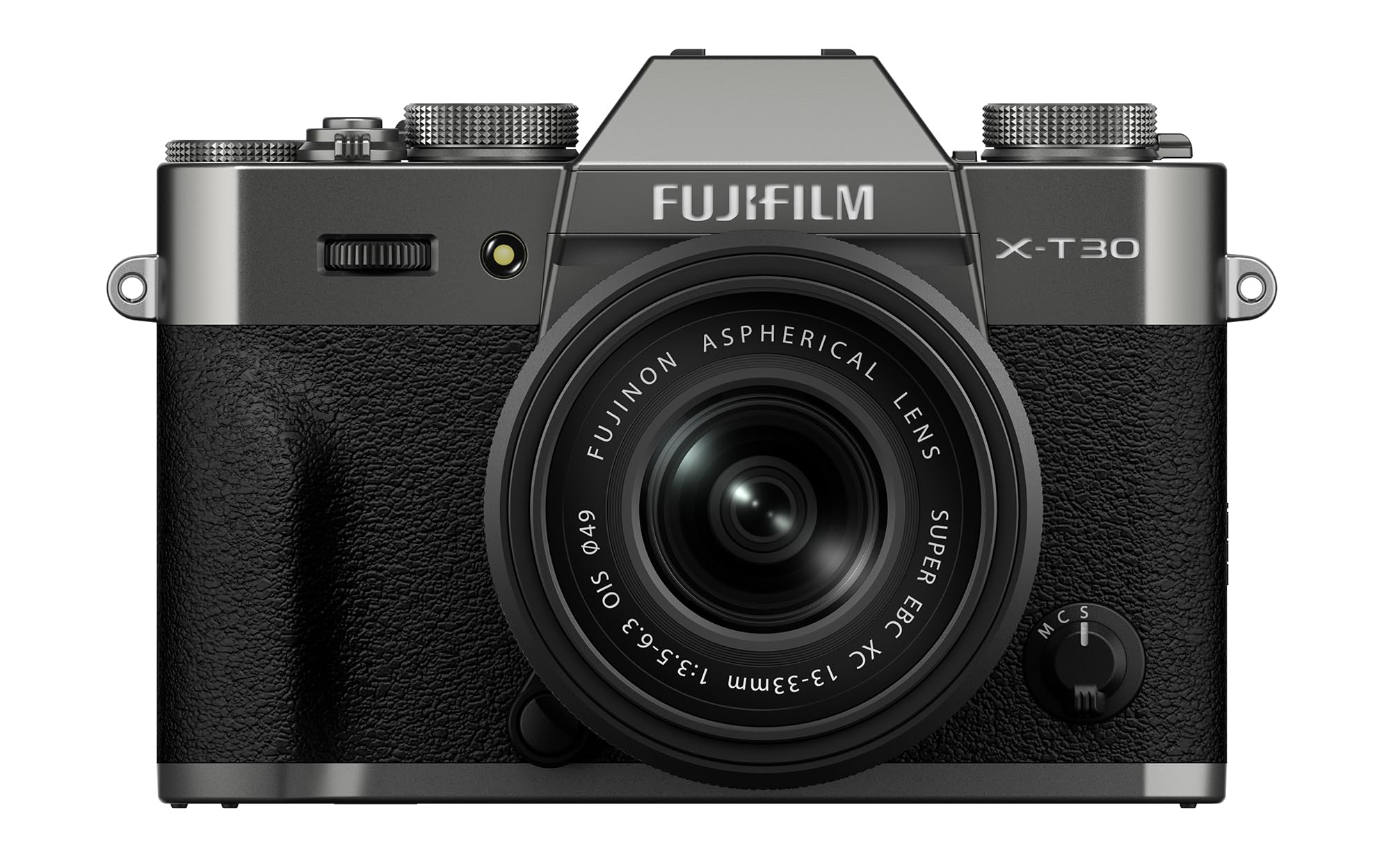
Twenty film looks baked in, so the photo is finished before it leaves the camera.
Most people who shoot every day do not want to sit at a computer afterwards. Fujifilm’s answer is 20 built-in Film Simulations — preset colour and contrast treatments that mimic classic film stocks — applied in camera, so the JPEG is ready to share. Owners describe results that look professional without heavy editing, and the gorgeous colour is a recurring theme. That is the whole pitch of this body in one line.
The rest of the hardware backs it up. AI-powered subject detection autofocus uses 425 points, matching the Sony ZV-E10’s count and more than ten times the Panasonic’s 39. Continuous shooting reaches 20 frames per second, which is the fastest burst in this list, and 14-bit depth keeps the colour files editable. A remarkably compact body with a timeless design houses it all, and the FUJINON XC13-33mm F3.5-6.3 OIS kit lens adds optical stabilisation.
An Auto mode is there for the days you just want the shot, and beginner-friendly operation is widely appreciated. Ease of use is the one split subject — the dials reward learning but can feel busy at first. Compact size and appearance earn steady praise, and the value read is strong. What you give up is reach: the 13-33mm kit lens is the shortest zoom here, so distant subjects need cropping or a second lens.
Choose this when: you want shareable colour straight out of the camera and a body small enough to take everywhere.
Look elsewhere when: you need long zoom range or a dial-light, point-and-shoot-simple layout.
7. RICOH GR IIIx HDF Premium Digital Compact Camera

A pocket body with a 24MP APS-C chip and a 40mm lens that just sees the shot.
The GR IIIx is for the person who wants a serious sensor in a camera that disappears into a jacket pocket. A 24.2MP APS-C format sensor sits inside a body small enough to forget you are carrying it, and the 40mm-equivalent f/2.8 lens fixes one honest field of view — close to how your eye frames a scene. No zooming, no lens decisions. You see it, you shoot it.
The headline feature is the built-in HDF, or Highlight Diffusion Filter — a filter that softens bright highlights for a gentler, more atmospheric look with a sense of depth. Flick the Fn button and it turns on or off instantly, and the letters HDF are printed on the back so you can find the control by touch. The lens is a newly developed 7-elements-in-5-groups design at 26.1mm (about 40mm in 35mm terms), built for high resolution and contrast.
Fifteen autofocus points run on contrast detection, which is fine for street and still subjects but a step behind the phase-detect arrays on the larger bodies here. There is no flash, so the f/2.8 aperture and the HDF filter carry you through low light. A dark silver shutter-release button marks this HDF version apart from the standard model. Wi-Fi lets you pull shots to a phone as you walk.
The honest trade: you are paying for the 24MP APS-C sensor inside a truly pocketable frame — and accepting a fixed 40mm lens and contrast-detect autofocus to get it.
Made for the walk-everywhere shooter: street, café, candid daily frames where one lens and a pocket body feel right.
The wrong tool for: sport, wildlife or anything that needs zoom and fast tracking.
8. Nikon Z6 III Full-Frame Mirrorless Stills/Video Camera

A full-frame body that records 6K/60p RAW in-camera and lights up its viewfinder at 4000 nits.
This is the pick for someone who shoots stills and video in the same session and refuses to carry two cameras. The Z6 III records 6K/60p internal N-RAW video, oversampled 4K UHD, and 4K/120p with Full HD at 240p for slow motion. Line-in audio and professional monitoring tools are built in, so a serious video day needs fewer accessories clipped to the cage.
The viewfinder is the second headline spec. An electronic viewfinder (EVF) is the little screen you look through instead of an optical mirror, and this one peaks at 4000 nits of brightness — enough to see clearly in very bright conditions — with 5760k-dot resolution and a 120 fps refresh rate that keeps fast motion looking natural. It covers a colour gamut equivalent to DCI-P3 for more accurate tone reproduction.
Autofocus detection reaches down to -10EV (a low-light sensitivity figure, so it can find focus in near-darkness), with multi-subject recognition aided by Deep Learning and detection of human faces as small as roughly 3% of the frame. The ISO range runs 100-64000, extendable to Hi 1.7, equivalent to ISO 204800. In owner feedback, quality and speed draw strong praise and autofocus is well regarded. Reliability and battery life are the two mixed notes — pack spares and treat the EVF glitch reports as a reason to test early.
Where it outruns the rest
- 6K/60p internal N-RAW plus 4K/120p slow motion in one body
- 4000-nit, 5760k-dot EVF readable in harsh daylight
- 299-point hybrid autofocus rated down to -10EV
- ISO 100-64000, extendable to the Hi 1.7 setting
What to plan around
- Body-only — you still need to buy a lens
- Battery life is a weak spot for long shoots
- Reliability draws mixed notes, including EVF reports
The right call when: video and stills share your work and in-camera 6K RAW saves you a recorder.
Overkill when: you rarely shoot video — most of this camera’s strength lives in the recording specs.
9. Sony Alpha 7 IV Full-frame Mirrorless Interchangeable Lens Camera

693 autofocus points and a 33MP full-frame sensor that quietly handles almost everything.
For anyone who wants one full-frame camera to do portraits, travel and video without excuses, this is the most complete answer on the list — and the crowd favourite, holding 4.5+ stars across 700+ owners. A 33MP full-frame Exmor R back-illuminated sensor (a chip designed to gather light from behind the circuitry) pairs with the BIONZ XR processor, and the output handles cropping and big prints with room to spare.
Its 693 autofocus points are the most numerous here — compare that with the 425 on the Sony ZV-E10 and Fujifilm X-T30 III, or the 150 on the Ricoh — and the mixture of contrast and phase detection keeps a moving subject locked with less fuss. Video is strong too: up to 4K 60p 10-bit 4:2:2 with full pixel readout in all recording formats, plus 7K oversampled full-frame 4K 30p with no pixel binning. The S-Cinetone colour profile gives pleasing skin tones straight out of the camera.
Quality and image quality are the strengths that carry this camera’s reputation, with accurate autofocus noted again and again and the improved menu system a welcome change from Sony’s older layouts. There is no built-in flash, and this is a body-only purchase — you will be choosing and buying an E-mount lens before you shoot anything.
The verdict in one line: the 33MP full-frame sensor and 693-point autofocus make this the most capable everyday body here, provided you are ready to invest in lenses.
Best for the serious everyday shooter: someone who wants one full-frame body to cover stills, portraits and 4K video for years.
Not the shortcut: if you want everything in one purchase — this is body only, so a lens is a separate decision.
Understanding the Specs
Sensor Size And Megapixels
The sensor is the chip that collects the light, and its physical size matters more than the megapixel number on the box. A 20.9MP APS-C sensor like the Nikon D7500’s is larger than a phone chip, so evening shots keep their detail. A full-frame sensor is larger again, which is why the full-frame bodies here hold up in dim rooms. Megapixels only tell you how far you can crop or how large you can print — a higher count rarely makes a photo look better by itself.
Autofocus Points And Speed
Autofocus points are the spots on the frame the camera can lock onto. More points generally means more freedom to place your subject off-centre and still get a lock. Phase detection judges distance directly and locks faster on moving subjects, while contrast detection hunts for the sharpest edge and suits still scenes. The Sony ZV-E10 and Fujifilm X-T30 III carry 425 points on phase detection; the Panasonic point-and-shoot carries 39 on contrast detection, which is why it is slower on action.
Bit Depth And Editing Room
Bit depth counts the shades of colour a file records per channel. A 14-bit file, like the ones from the Nikon D7500, Canon EOS RP, Sony ZV-E10, Fujifilm X-T30 III and Sony Alpha 7 IV, holds far more gradation than an 8-bit file — so bright skies and deep shadows recover more gracefully when you edit. The Panasonic point-and-shoot and Ricoh GR IIIx record 8-bit files. For everyday sharing, that is no problem; for heavy editing, the extra depth is worth having.
Viewfinder And Screen Brightness
The electronic viewfinder is the little screen you look through instead of an optical mirror, and its dot count and brightness decide whether you can see your composition outdoors. A 5760k-dot, 4000-nit EVF, like the Nikon Z6 III’s, stays clear in bright sun. The Panasonic point-and-shoot’s 2,360K-dot 0.74x viewfinder does similar work at a smaller scale. A tilting touchscreen, like the 3.2-inch 922K-dot panel on the Nikon D7500, lets you frame from waist height or over a crowd.
FAQ
Is an APS-C sensor good enough for everyday photos?
Do I need interchangeable lenses for everyday use?
What does 4K oversampled from 6K actually mean?
How many autofocus points do I actually need?
Will a full-frame camera be too heavy for daily carry?
What is the difference between phase detection and contrast detection autofocus?
Do I need to buy a lens separately with body-only cameras?
How much zoom range do I need for travel?
Are these cameras good for video as well as stills?
What does bit depth mean for everyday photo editing?
Which everyday camera handles low light best?
Final Thoughts: The Verdict
The everyday camera that suits the most people is the Nikon D7500, because one purchase covers a whole day — an 18-140mm zoom for wide scenes and tight portraits, 14-bit files that edit cleanly, and a 51-point autofocus grid that tracks a moving subject. It is the least fussy way to stop leaving the camera at home. If colour straight out of the camera is what you crave, the FUJIFILM X-T30 III bakes 20 film looks into every shot. And if you want a full-frame body that handles stills and 4K video without compromise, the Sony Alpha 7 IV is the most complete answer on this list, at 4.5+ stars across 700+ owners. Whichever you pick, check the return window and shoot with it for a week — the right everyday camera is the one you actually reach for.
How We Picked
We do not accept paid placement. Every pick is matched to a real buyer and a real use-case; we do not hands-on test units.
Sources & Methodology
Specifications: manufacturer listings and product documentation. Review insights: verified customer reviews, as of November 2026. Pricing: not shown on this page (it changes often); check the current price via the retailer link.
As an Amazon Associate, Gadgets Feed earns from qualifying purchases. This does not affect which products we feature.