
Our readers keep the lights on and my morning glass full of iced black tea. As an Amazon Associate, I earn from qualifying purchases.
Specs are compiled from manufacturer listings and verified buyer reviews and can change over time — please confirm the key details on the product page before buying.
Your 309L rod is the one that lets you join stainless to mild steel without the weld cracking later — so buy the rod whose diameter and length actually match the joint in front of you. A 3/32″ rod on 1/8″ plate runs a stable arc; the same rod on 20-gauge sheet burns through. Oversize the rod and you fight spatter and porosity all afternoon.
I’m Min — the founder and writer behind Gadgets Feed. This guide is built by comparing the manufacturers’ published specifications and the patterns across verified customer reviews, so you get each pick’s real strengths and trade-offs instead of marketing spin.
The 309L grade (a stainless filler made for joining mismatched steels) matters most when you are welding a stainless part onto a carbon-steel frame. Below you will find the diameters, lengths and package weights that separate a smooth job from a frustrating one, and the smartest pick among the 309l welding rod options.
Our Picks at a Glance


How To Choose The Best 309L Welding Rod
The first decision is not brand — it is process. A TIG rod goes into a tungsten torch under shielding gas, and a stick electrode runs off a stinger with its flux coating doing the gas work. Buying the wrong one means the rod never touches your machine correctly.
Match the rod to your welding process
TIG rods here are bare wire with no flux coating, so you feed them by hand into the arc. You need a bottle of shielding gas — usually 100% Argon — for that to work at all. Stick electrodes carry their own flux coating and run without a gas bottle, which suits outdoor work and windy shop bays where gas blows away.
Pick the diameter that fits your metal thickness
Thin sheet wants a small rod. A 1/16″ or 3/32″ rod lets you keep the amperage low and avoid burning through. Thicker plate and heavy buildup call for 1/8″, which carries more current and lays down metal faster. One supplier lists diameters from 0.045″ up to 1/8″, so you can scale the rod to the job rather than forcing one size to do everything.
Read the length and weight together
A 36-inch TIG rod gives you more usable filler per piece than a 12-inch stick electrode. Weight tells you the other half of the story: a 1-pound tube of TIG rod is a light starter order, while a 5.3-pound box of electrodes is a working quantity. Match the package to how much welding you actually plan to do this season.
Quick Comparison
| Model | Best For | Diameter | Length | Package Weight | Amazon |
|---|---|---|---|---|---|
| ER309L – TIG Stainless Steel Welding Rod – 36” x 3/32” (1 Lb)★ Best Overall | All-round TIG work on mixed steels | 3/32″ | 36 inches | 16 ounces | Amazon |
| 1-Lb ER309L Stainless Steel 309 TIG Welding Rod 3/32″x36″Top Performer | Consistent-diameter TIG filler | 3/32″ | 36 inches | 1 pound | Amazon |
| E309L-16 Stainless Steel Welding Electrode 14″ x 1/8″ (2 LB) | All-position stick welding | 1/8″ | 14 inches | 2 pounds | Amazon |
| Forney 48520 Tig Filler Metal, ER309L Stainless Steel, 1/16-Inch-by-36-Inch | Thin-gauge and heat-treated joints | 1/16″ | 36 inches | 1 pound | Amazon |
| Blue Demon E309L-16 3/32″ x 12″ x 5LB Arc Electrode | Bulk stick welding | 3/32″ | 12 inches | 5.3 pounds | Amazon |
In‑Depth Reviews
1. ER309L – TIG Stainless Steel Welding Rod – 36” x 3/32” (1 Lb)
Our pick — 4.5+★ from 100+ verified ratings; the strongest balance of quality and price.
The 36-inch rod that reaches into a deep joint without your glove scraping the plate.
Start with the length, because it is what you feel first. Each rod runs 36 inches, which gives you a long run of filler before you have to stop and swap pieces. That matters on a full-length seam where stopping mid-pass leaves a visible restart.
The 3/32″ diameter is the middle child of rod sizes, and that is exactly why it earns this spot. It is small enough to control the puddle on thin stainless, yet sturdy enough to lay a proper bead when you join a stainless fitting onto a carbon-steel bracket. The manufacturer lists this rod for 22-25% chromium and 12-13% nickel stainless grades like 309, 309L, 304L, 308L, 310, 316L, 321 and 347, plus martensitic grades 410, 420 and 431. In plain terms, it covers the mixed-metal jobs most home and shop welders actually face.
Run it on DCEN (electrode negative, the TIG polarity) with 100% Argon, or an Argon/Helium mix when you want deeper penetration. For the tungsten, the maker suggests 2% Thoriated, 2% Ceriated, or 2% or 1.5% Lanthanated. Frame this as the one rod here that gives you a full 36-inch reach from a shop that also sells 0.045″, 1/16″ and 1/8″ if you need to scale up later. It is the only pick here sold in four pack sizes, from 1 Lb to 10 Lb.
Where it pulls ahead
- 36 inches of filler per rod — the longest TIG rod in this lineup, alongside the Forney and WeldingCity.
- 3/32″ sits in the balance for stainless-to-mild-steel joints.
- Sold in 1 Lb, 2 Lb, 5 Lb and 10 Lb packs, so you can reorder bigger once you know you like it.
The honest catch
- The main product photo is a reference image, not an exact count — you have to check picture #2 to see roughly how many rods sit in a pound.
- A 1-pound tube is a small first order if you have a long project planned.
Built for: the welder joining stainless to carbon steel who wants one rod size that handles most of it.
Go bigger if: you already know you will burn through more than a pound — the same rod is sold up to 10 Lb.
2. 1-Lb ER309L Stainless Steel 309 TIG Welding Rod 3/32″x36″
A rod that arrives cut to spec, stamped, and marked with its full chemistry — no guessing what you got.
What you are buying here is documentation as much as wire. The maker lists the rod against AWS A5.9 / ASME SFA A5.9 with a typical composition of C=0.025, Cr=24.5, Ni=13, Si=0.38, Mo=0.35, Mn=1.88, Cu=0.35, P=0.02 and S=0.01, with iron making up the rest. That low carbon figure is the whole reason the 309L grade exists — it is the “L” in the name.
Each rod runs 36 inches with a single end stamped, and it is available in 0.045″, 1/16″, 3/32″ and 1/8″ diameters. Feed it into a TIG torch under a shielding gas, usually 100% Argon, and it will join dissimilar alloys like mild steel to stainless, or lay a direct overlay on mild steel for corrosion work. It also gets called on for “18-8” base metals when the corrosion conditions are harsh. The maker notes it holds strength and toughness across a wide temperature range.
Buyers keep returning to the consistent 3/32″ diameter — rods that feed evenly rather than snagging or wandering in the arc. Value gets its own nod too. A U.S.-based welding and hardware supplier stands behind it with technical support if a question comes up mid-project.
Read the chemistry: a stated chromium of 24.5 and nickel of 13 tells you this sits squarely in the 309L family, not a relabelled 308. That is worth knowing when an unfamiliar supplier quotes you a low number on “309L” wire.
Same reach, lighter bite: a 1-pound tube weighs just 1 pound against the Blue Demon box’s 5.3 pounds — a difference you feel on the shelf, though it also means fewer rods in hand.
Pick it when: you want filler you can trace back to a published spec sheet, size by size.
Hold off if: you need electrode-style flux coating — this is bare TIG wire and needs a gas bottle.
3. E309L-16 – Stainless Steel Welding Electrode – 14″ x 1/8″ (2 LB)

No gas bottle, no tungsten — just clamp it in the stinger and weld wherever the joint sits.
This is the odd one out in the lineup, and deliberately so. It is a stick electrode, not a TIG rod, which means it carries its own flux coating and runs without a shielding gas bottle. For anyone working outdoors or in a draughty bay where Argon blows away, that alone is the deciding factor.
The 1/8″ diameter is the thickest here — 1/8″ against the Blue Demon’s 3/32″ and the Forney’s 1/16″. That extra metal lets you run hotter and lay down more on heavier sections. The manufacturer rates it for all-position work, so you can run it flat, vertical or overhead without switching rods.
You can join almost any stainless you own with this rod. It welds 22-25% chromium and 12-13% nickel stainless like 309 and 309L to each other. It also joins austenitic grades (the common 300-series stainless) like 304L, 308L, 310, 316L, 321 and 347. It works on martensitic grades 410, 420 and 431, on ferritic grades such as 430, 442 and 446, and on mild and carbon steels. Each electrode is 14 inches, shorter than a 36-inch TIG rod, so you will swap more often. The upside: the stubbier rods are easier to control in tight geometry. The 2-pound pack sits between the 1-pound tubes and the Blue Demon’s 5.3-pound box.
The trade-off to plan for: flux-coated electrodes leave slag you have to chip and brush off each pass — a step TIG work skips entirely. Budget that cleanup time into a repair job.
The right call for: field repairs and outdoor welds where hauling a gas cylinder is impractical.
Think twice if: your machine is TIG-only — this electrode needs a stick-capable power source.
4. Forney 48520 Tig Filler Metal, ER309L Stainless Steel, 1/16-Inch-by-36-Inch, 1-Pound
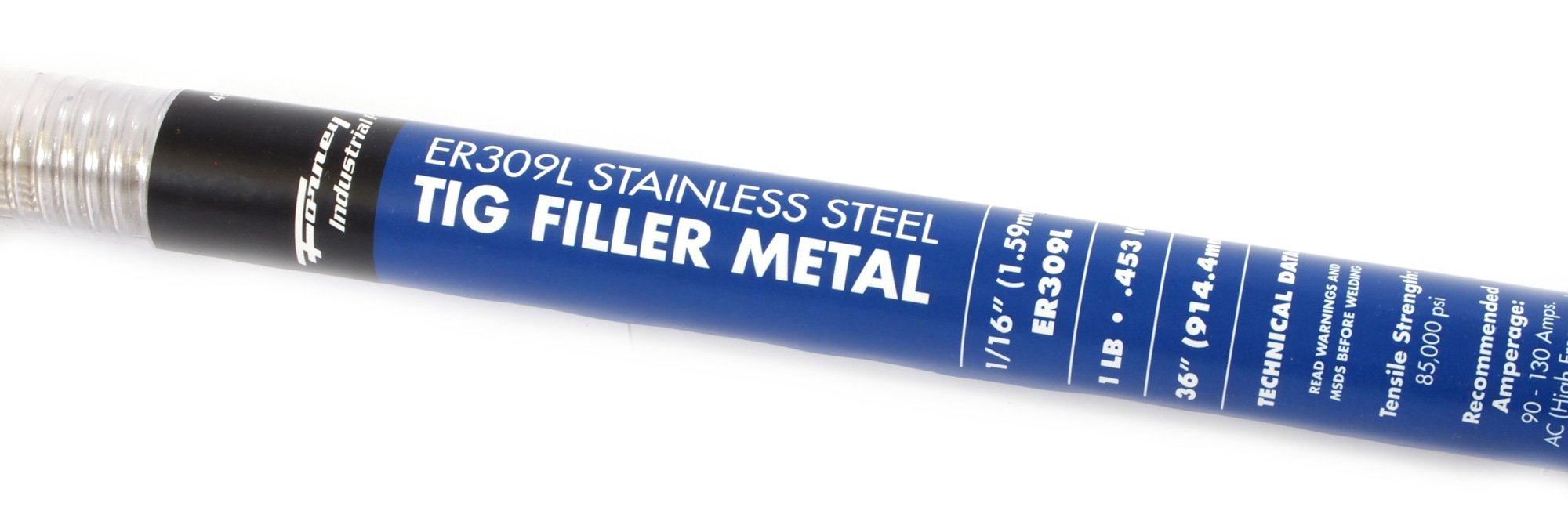
The smallest-diameter rod here, built for thin stainless and joints headed into heat treatment.
Forney’s headline number is the one serious weld inspectors care about: 85,000 PSI tensile strength. That is the load the finished weld is rated to carry, and it tells you this rod is meant for joints that have to hold real stress. The maximum shear strength is listed at 51,000 PSI alongside it.
The carbon content is under 0.03-percent, which is the low-carbon spec that gives 309L its corrosion resistance. The maker points this rod at dissimilar joints that will undergo heat treatment — the case where a standard filler would lose its properties once the part goes through a furnace cycle.
At 1/16″, the diameter is the finest in this lineup, versus the 1/8″ of the TGB electrode. That makes it the one to reach for on thin sheet where a fatter rod would burn through. The 36-inch length matches the other TIG options; the Blue Demon electrode runs 12 inches. Run it at 90-130 DCEP — direct current, electrode positive — as the manufacturer specifies. That is a different polarity from the DCEN the SÜA and WeldingCity rods call for, so check your machine setting before you strike an arc.
Reasons it earns a slot
- 85,000 PSI tensile strength gives you a rated figure to work from.
- 1/16″ diameter suits thin-gauge stainless that a 1/8″ rod would cook.
- Carbon under 0.03-percent for corrosion resistance on heat-treated parts.
Know before you order
- Only one diameter and one length — you cannot scale the same rod up for thick plate.
- The 90-130 DCEP polarity is the opposite of most TIG setups, so it is easy to run wrong if you do not check.
Best fit: a welder on thin stainless or a part that will be heat-treated after welding.
Look elsewhere if: you need a rod for heavy sections — 1/16″ is the wrong tool for thick plate.
5. Blue Demon E309L-16 X 3/32″ X 12″ X 5LB Plastic Stainless Steel Arc Welding Electrode

Five pounds of stick electrode in one box — the volume buy for a shop that welds stainless every week.
If you go through electrodes rather than use them occasionally, this is the quantity that makes sense. The box runs 5.3 pounds against the 1-pound tubes of TIG rod here — that weight is the whole point of the pick. You are not buying a sample; you are stocking the shelf.
The rod is a 3/32″ stick electrode, 12 inches long, so it fits a standard stinger and runs flat, vertical or overhead. As an E309L-16, it carries flux coating and needs no gas bottle. That puts it in direct contrast with the 36-inch bare TIG rods from SÜA, WeldingCity and Forney, which all need Argon — this one does not.
Where it wins is straightforward: welding performance carries the most weight with people who run it, and the value gets its own echo. As owners put it, it “works nicely at 30amps DCEP for sheet metal” — a low-amperage setting that keeps thin sheet from warping. Ease of use is more of a split verdict, though: some find it straightforward, others less so, which is worth knowing if you are new to stick work.
What the buyer is really paying for: shelf stock. One 5.3-pound box outlasts a 1-pound tube on a job that keeps you at the bench across weekends.
Reach for this if: you weld stainless often enough that running out mid-project is a real risk.
skip it if: you are only fixing one small sheet-metal job — 5.3 pounds is more than a single repair needs.
Understanding the Specs
Rod Diameter
The diameter of the filler — 0.045″, 1/16″, 3/32″ or 1/8″ — sets the amperage you run and the metal thickness you can weld. A smaller rod like 1/16″ keeps the heat low so thin sheet does not warp. A bigger 1/8″ rod carries more current and builds up heavier sections faster. Match the rod diameter to the plate thickness first, then set your amperage to suit it.
Rod Length
A 36-inch TIG rod gives you a long run before you have to stop and reposition, which keeps a seam continuous. A 12-inch or 14-inch stick electrode is shorter and needs more swaps, but those shorter rods are easier to control in tight corners. Length also decides how far your hand can reach into a deep joint without the glove dragging.
The 309L Grade
The “L” stands for low carbon — under 0.03-percent on the Forney rod, and C=0.025 on the WeldingCity rod. That low carbon is what gives 309L its corrosion resistance. The grade is designed to join dissimilar steels: stainless to mild or carbon steel, and the full range of 304L, 308L, 310, 316L, 321 and 347 austenitic grades to each other. It also covers martensitic grades like 410, 420 and 431 and ferritic grades such as 430, 442 and 446.
TIG Rod vs Stick Electrode
A TIG rod is bare wire fed by hand into a tungsten arc under a shielding gas, usually 100% Argon. A stick electrode carries its own flux coating, so it runs with no bottle and is the pick for outdoor work. TIG gives cleaner, slag-free welds; stick is tougher and portable. A TIG-only machine cannot run the stick electrodes here, and a stick-only machine cannot run the bare rods.
FAQ
What is the difference between 309L and 308L welding rod?
Can I weld stainless steel to mild steel with a 309L rod?
Do I need shielding gas to run a 309L TIG rod?
What diameter 309L rod should I use for thin sheet metal?
How many rods come in a one pound package?
Is E309L-16 the same as 309L stick electrode?
What polarity and amperage does a 309L TIG rod need?
Can 309L welding rod handle high heat applications?
Does a 309L stick electrode leave slag I have to clean off?
Final Thoughts: The Verdict
For most jobs, buy the SÜA ER309L TIG Rod. Its 3/32″ diameter and 36-inch length handle the mixed stainless-to-carbon joints most people actually face. You can reorder it from a 1 Lb tube up to a 10 Lb pack. Want filler with a fully published chemistry — chromium 24.5 and nickel 13? Then pick the WeldingCity 1-Lb ER309L. For outdoor repairs where a gas bottle is a hassle, reach for the TGB E309L-16 electrode — no Argon required.
How We Picked
We do not accept paid placement. Every pick is matched to a real buyer and a real use-case; we do not hands-on test units.
Sources & Methodology
Specifications: manufacturer listings and product documentation. Review insights: verified customer reviews, as of November 2026. Pricing: not shown on this page (it changes often); check the current price via the retailer link.
As an Amazon Associate, Gadgets Feed earns from qualifying purchases. This does not affect which products we feature.