
Our readers keep the lights on and my morning glass full of iced black tea. As an Amazon Associate, I earn from qualifying purchases.
Specs are compiled from manufacturer listings and verified buyer reviews and can change over time — please confirm the key details on the product page before buying.
Most home networks are held back by something quieter than a slow router: the cable in the wall. If your internet plan promises a multi-gig connection and your PC still crawls, the wire between your router and your machine is the first thing to question. The picks below are all rated for 10 gigabit speeds — ten billion bits per second — so the cable stops being the bottleneck. Every one of these is a genuine 10-gigabit-rated cable (Cat6a, Cat7, or Cat8 class), not a Cat5e or Cat6 cord that only claims gigabit. The question is which length, jacket, and shielding suits your run.
I’m Min — the founder and writer behind Gadgets Feed. This guide is built by comparing the manufacturers’ published specifications and the patterns across verified customer reviews, so you get each pick’s real strengths and trade-offs instead of marketing spin.
A cable that runs 100 feet through a hallway needs different shielding and gauge than a short patch cord inside a rack. This breakdown of the 10 gigabit ethernet cable options matches the wire to your actual layout.
Our Picks at a Glance


How To Choose The Best 10 Gigabit Ethernet Cable
Speed ratings on a cable box are not the whole picture. What actually determines whether a 10-gigabit cable performs in your home or office is how it handles electrical noise, how it fits the physical run, and whether it physically reaches your equipment. Here is what to weigh before you buy.
The category rating is the floor, not the ceiling
A Cat6a, Cat7, or Cat8 cable is rated for 10 gigabit speeds. A Cat5e or Cat6 cable is typically built and tested for gigabit speeds, though some manufacturers tune their Cat6 cable to higher bandwidth. The three digits after “Cat” tell you how much bandwidth the cable is designed to carry — higher bandwidth (measured in megahertz) gives more headroom for 10G equipment to run reliably over longer runs. Check the datasheet figure, not just the category label printed on the jacket.
Shielding protects your signal in noisy spaces
Electrical noise from power lines, appliances, and crowded network racks can degrade a signal. Shielded cables wrap their twisted pairs in foil or braid to block that interference. If your cable will run near electrical wiring or through a server rack with dozens of other cables, a shielded construction is the safer choice. An unshielded cable is usually fine for a clean straight run in a quiet room.
Gauge, flatness, and length decide where it will actually fit
Wire gauge is the thickness of the copper inside, measured on the AWG (American Wire Gauge) scale, where a lower number means thicker wire. Thicker conductors tend to run more stable data over distance, while thinner cables are more flexible and easier to bend around corners or fit through conduit. Flat-profile cables slip under carpets and along baseboards without a bulge. And a run that is too short is useless — measure your actual path before you commit.
Quick Comparison
| Model | Best For | Category | Data Rate | Bandwidth / Length | Amazon |
|---|---|---|---|---|---|
| CableGeeker Cat 6 Flat Ethernet Cable 10ft 5Pack★ Best Overall | Budget multi-room runs | Cat 6 | 10 Gbps | 550 MHz / 10 ft | Amazon |
| VOIETOLT Cat 8 Ethernet Cable 20 FT FlatTop Performer | High-noise gaming runs | Cat 8 | 40 Gbps | 2000 MHz / 20 ft | Amazon |
| UGREEN Cat 7 Ethernet Cable 15FTCrowd Favorite | All-purpose home wiring | Cat 7 | 10 Gbps | 600 MHz / 15 ft | Amazon |
| StarTech Cat6a Snagless Ethernet Cable (C6ASPAT10BK) | Standards-grade installs | Cat 6a | 10 Gbps | 500 MHz / 10 ft | Amazon |
| DbillionDa Cat 8 Ethernet Cable 15FT | Outdoor and long indoor pulls | Cat 8 | 40 Gbps | 2000 MHz / 15 ft | Amazon |
| TuokaJu Cat6A Shielded 10ft (5 Pack) | Rack and server-room runs | Cat 6a | 10 Gbps | 550 MHz / 10 ft | Amazon |
| Jadaol Cat6/Cat6A 100FT Flat | Long wall-to-room routing | Cat 6 | 10 Gbps | 250 MHz / 100 ft | Amazon |
| 10Gsupxsel Cat8 Flat 100 FT Indoor/Outdoor | Long outdoor and Starlink runs | Cat 8 | 40 Gbps | 2000 MHz / 100 ft | Amazon |
| Rapink Cat6a Patch Cables 10ft (10 Pack) | Patch-panel density | Cat 6a | 10 Gbps | 550 MHz / 10 ft | Amazon |
In‑Depth Reviews
1. CableGeeker Cat 6 Flat Ethernet Cable 10ft 5Pack, 10Gbps, Black
Our pick — 4.5+★ from 950+ verified ratings; the strongest balance of quality and price.
Five flat cords that wire a whole room without turning your floor into a snake pit
Five 10-foot flat cords in one pack is the practical answer to a house full of devices. Each one is rated for 10 gigabits per second with 550 MHz of bandwidth — that bandwidth figure (measured in megahertz) is how much signal range the cable is built to carry cleanly. In daily use it means a console, a desktop, and a router can all sit on real wired connections instead of sharing WiFi. The flat jacket is the feature that wins people over: it slides under a carpet, behind a baseboard, or around a door frame without leaving a lump.
The copper is 100% bare copper, not the copper-coated aluminum some budget cords use, and each end gets gold-plated RJ45 contacts (the metal pins inside the plug that carry the signal). Molded strain-relief boots protect the joint where the cord meets the plug, so a yank on the cable does not snap the connector. Each cord is network-tested before it ships, so a bad termination is less likely to show up at your desk. Owners mostly report the connections just work, with the flat, low-profile jacket a close second in the feedback.
The catch is category: this is a Cat 6 cable, rated here at 10 Gbps and 550 MHz, but it is built lighter than a shielded Cat6a for a noisy rack. If you are pulling through a ceiling next to mains wiring, step up to a shielded pick. For desk-to-router and console-to-switch runs in a normal home, the thinness is a feature, not a compromise — as owners put it, it is about the thinnest cord on the market for hiding under carpet or behind furniture.
ten gigabit five pack
- Five 10 ft cords cover a whole desktop or living-room setup in one buy
- Flat jacket slips under carpets and behind baseboards with no bulge
- 100% bare copper with gold-plated RJ45 contacts for a clean signal
- Rated 10 Gbps at 550 MHz — plenty for gigabit-plus home internet
flat cable fragility
- Cat 6 class: unshielded, so a noisy rack or a run beside power lines is not its job
- 10 ft is short for a room-to-room pull — measure before you count on it
bundle buyers: you want a handful of tidy, flat 10-gigabit cords to wire several devices at once without a big spend.
heavy shielding need: your run crosses a rack or hugs electrical conduit — you want shielding this one does not have.
2. VOIETOLT Cat 8 Ethernet Cable 20 FT Flat, 40Gbps 2000MHz Braided
The braided, four-layer-shielded cord built for a gaming corner full of electrical noise
This cord carries 40 gigabits per second at 2000 MHz — four times the data rate and four times the bandwidth of the Cat 6 pack above, which sits at 10 Gbps and 550 MHz. That extra headroom is measured in raw capacity, and it matters most when your network runs 10G equipment and you want margin to spare. The 20-foot length gives you a generous run from a modem to a router or a router to a desk without an extension.
Your signal stays clean because of the shielding: four pairs of aluminum-foil-shielded twisted copper under a nylon braid, with gold-plated RJ45 connectors (the standard square network plug). The foil layers block electrical noise from a power strip or a bank of monitors, so the signal arrives intact. The flat braided jacket bends around corners and passes under doorways without tangling. It ships with two dust covers plus fixing clips (the clips ship with lengths of 15 feet and above) to pin the cord neatly along a wall.
Buyers report the build quality draws the most praise, with plenty of word about it working cleanly between a modem and a router and handling an Xbox Series X without complaint. Flexibility splits opinion: some find it pliable, others find the braided jacket stiffer than a plain cord. If you need to coil it tight into a small conduit, factor that in.
future proofing: a gaming setup or home office near power cables, where the foil shielding and braided jacket earn their keep.
tight corners: you plan to stuff it into a narrow conduit — the braided jacket is not the softest cord in the list.
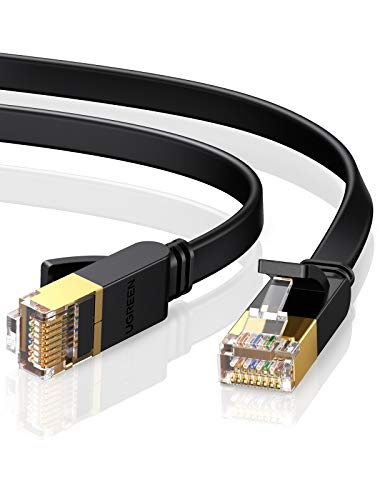
3. UGREEN Cat 7 Ethernet Cable 15FT, 10Gbps 600MHz
The everyday 15-footer backed by a mountain of owner experience
Fifteen feet is the length most people actually need to get from a router to a desk, and this Cat 7 cord delivers 10 Gbps at 600 MHz. That 600 MHz bandwidth beats the StarTech Cat6a’s 500 MHz and trails only the Cat 8 picks. The construction is four shielded twisted pairs of copper with gold-plated connectors — the shielding blocks crosstalk and noise better than a bare Cat 6 cord, which is the whole reason to reach for Cat 7 here.
Build quality is what buyers praise most, by a wide margin over everything else. The flat, thin jacket routes cleanly under a door, through a window frame, or beneath a carpet, so indoor wiring pulls easily. It is backward compatible with Cat6e, Cat6, Cat5e, and Cat5 gear, so it slots into an older network without a second thought. Owners mention the jump from WiFi to this cable — one reported going from about 600 Mbps over 5GHz WiFi to over 900 Mbps on the wire, a real-world change that justifies the switch.
The honest note is connectivity: while most runs are near flawless, a minority hit connection trouble. That is the trade-off with a big-selling cable — a few units behave differently. If a cord misbehaves, the connection is a connector or termination issue, not a speed limit. For the vast majority it plugs in and stays solid.
balanced cat seven
- 10 Gbps at 600 MHz — more bandwidth than the Cat6a pick and a length that fits most rooms
- Shielded twisted pairs reduce noise and crosstalk versus unshielded Cat 6
- Flat jacket routes under doors, around windows, and beneath carpet
- Backward compatible with Cat6e, Cat6, Cat5e, and Cat5 devices
pricier than cat six
- A small share of runs report connectivity trouble — check the terminations if yours does
- Indoor wiring only; not built for burial or constant outdoor exposure
midrange upgrades: anyone who wants one reliable 15-foot 10-gig cord for a desk or console and values a long track record.
budget builds: it is indoor-only, so an outdoor run should look at the Cat 8 weatherproof options instead.
4. StarTech 10ft Cat6a Snagless Ethernet Cable, Black (C6ASPAT10BK)

The cable you buy when a spec sheet and a lifetime warranty matter more than a flat profile
Pick this one if you want a standards-minded install. It is a Cat6a cord rated for 10 GbE (10 Gigabit Ethernet, about ten times the speed of older 1 Gigabit gear), individually tested to comply with ANSI/TIA-568-B.2-10 Category 6 requirements and ETL Verified to meet ANSI/TIA-568.2-D. Those certifications mean an independent lab checked the cable against a published spec, not just the maker’s own word. The structure is 4-pair shielded twisted pair (STP, copper pairs wrapped in shielding) with 26 AWG copper (the wire thickness). Shielding on the joints minimizes near-end crosstalk (NEXT, signal leaking between pairs) and guards against electromagnetic and radio-frequency interference. That 26 AWG gauge is thicker than the 31 AWG on the Cat 6 flat pick — 26 vs 31 — a solid conductor build for a permanent desktop run.
Power-over-Ethernet (PoE, sending power and data down one cable) support is a real differentiator: 26 AWG stranded copper conductors and UL-rated wiring support up to 100W for PoE devices like VoIP phones and security cameras. It is compliant with IEEE 802.3bt and DTE power, which keeps the cable from heating up. The snagless connector makes it easy to install and to pull out of a tight conduit without snagging the clip. Gold-plated connectors (50-micron) keep the signal clean and resist rust and corrosion, and a lifetime warranty backs the whole thing.
The trade-off is character: this is a stiffer, more structured cable than a flat pull, and at 10 feet it is a short run. Durability and length both draw a mixed verdict from buyers — it is built for a rack and a fixed setup, not for tucking under carpet. If you need a flexible length to hide, look at the flat options; if you want a cable that meets a named standard and can carry power, this is the reasoned choice.
snagless boot design: independently verified standards compliance, 100W PoE support, and a lifetime warranty — this is an install-grade cord, not a spare.
patch panel work: a patch panel, a PoE camera, or any install where you want a tested, warrantied cable carrying data and power.
bulk purchases: you need to route a soft, flat cord around rooms — this one is built to sit fixed in a rack.
5. DbillionDa Cat 8 Ethernet Cable, 15FT 40Gbps 2000MHz

The one cable on the list rated to survive direct burial and full sun
Most cables stop at the wall. This Cat 8 cord is built to go outside. A waterproof, anti-corrosion PVC jacket allows safe direct burial and reliable outdoor or indoor use, and the UV-resistant outer layer is made to take direct sunlight, extreme cold, humidity, and hot weather without aging fast. Inside it is 26 AWG OFC (oxygen-free copper) across four shielded foiled twisted pairs, rated 40 Gbps at 2000 MHz — the same top-end ceiling as the VOIETOLT, so it matches the highest-speed cable in this group. Thick 26 AWG conductors are the reason it runs stable over a high-load network.
Buyers bring up speed and durability most, with compatibility a steady third. The double shielding cuts EMI/RFI interference so a long run to a garage, shed, or backyard access point stays clean. It works with switches, IP cameras, routers, consoles from PS3 through PS5 and Xbox, modems, patch panels, and servers, and it is backward compatible with Cat7, Cat6, Cat5e, and Cat5 gear. An 18-month support window comes with it.
Here is the honest split: connectivity, length, and signal quality all draw a mixed read. Some long runs report strong connections and better signal strength; others run into disconnections or weaker reception over the course of a day. A 15-foot outdoor-rated cable is doing more work than a thin indoor cord, so a burial run still benefits from a clean connector and a protected path. Match it to the environment it is built for and it holds up.
gaming rigs: a run that leaves the house — to a shed, a camera, or an outdoor access point where weather is a factor.
long conduit runs: your run stays indoors and short — the weatherproof jacket is overkill for a desk.
6. TuokaJu Cat6A Shielded 10Gbps 10 ft (5 Pack), Slim F/UTP

Five slim, shielded Cat6a cords that fit where full-size cables jam shut
Five cords at 10 Gbps and 550 MHz makes this a rack or home-office pack. The differentiator is the slimming: the 28 AWG construction lets it be described as 40% thinner than standard Cat6a cable, and just 4.5mm in diameter. The jacket is also described as 50% more bendable than standard Cat6a, so it turns tight corners and fits behind a wall or under a carpet in a crowded setup. In a server rack or a cable-management tray, that thinner profile means more airflow and less fighting with neighbors.
Shielding here is F/UTP — an overall foil shield around unshielded twisted pairs, which prevents electromagnetic interference (EMI) in noisy environments like an industrial space or one running past electrical wire. It also supports PoE/PoE++ over 28 AWG pure bare copper, so it can feed security cameras, VoIP phones, and access points. The snagless connectors protect the ports and release cleanly in a crowded cable bundle.
Owners praise functionality first and quality close behind: it works with WiFi 6 systems, holds full 10Gbps, and the thinness keeps drawing positive mention. The honest limit: 10 feet is a rack length, not a room run, and the 0.4 kg weight across the five cords reflects a slim conductor. If you need long runs, this pack is not the one; if you are tidying a rack, it is.
slim shielded five pack: a shielded, PoE-capable Cat6a that fits five connections into the space a full-size cord would eat alone.
crowded racks: server racks, data-center trays, and home offices where thick cables simply will not fit.
outdoor installs: anyone wiring two rooms together — 10 feet runs out fast.
7. Jadaol Cat6/Cat6A Ethernet Cable 100FT Flat, White

A hundred feet of flat white cable that disappears along the wall
When the run is the problem, the length is the feature. This is 100 feet of Cat 6 flat cable at 10 Gbps, supported to 250 MHz and rated for 10GBASE-T, the standard for 10-gigabit Ethernet over twisted pair. The 30 AWG bare-copper construction with gold-plated RJ45 connectors keeps noise low, and the flat shape lets it lie flush along walls, follow edges and corners, and slide under carpet without a visible rise. The white jacket blends into a wall the way a black cord never will.
Mounting clips are in the box, which turns a loose hundred feet into a tidy route along a baseboard. It is compatible with routers, switches, hubs, NAS drives, printers, my gaming consoles from PS5 and Xbox down to Switch, streaming devices, and VoIP phones. Owners buy it for routing: quality and functionality dominate the feedback, and the flat profile and easy concealment are recurring wins. Across that many buyers, it holds up as a long, clean run.
Worth naming: 30 AWG is thinner copper than the 26 AWG on the StarTech, so this is a routing cable first and a heavy rack cable second. A 250 MHz rated run over 100 feet is long, so keep it away from power lines where you can. It is indoor-rated, so a buried outdoor run belongs with the weatherproof picks instead.
hundred foot flat run
- 100 feet of flat cable reaches across a home or office
- Mounting clips included to pin the route along a wall or baseboard
- White jacket hides against light walls
- 30 AWG bare copper with gold-plated RJ45 for a clean 10GBase-T signal
white shows dirt
- Indoor-only — not rated for burial or weather
- Thinner 30 AWG copper is a routing build, not a rack backbone
wall fishing: your router and your desk sit at opposite ends of the house and you want a cord that disappears.
high traffic floors: you need shielding or a short rack run — this is a long indoor pull made to hide.
8. 10Gsupxsel Cat8 Flat Ethernet Cable 100 FT Indoor & Outdoor, 40Gbps

A hundred feet of shielded Cat 8 that stays ultra-thin while carrying 40 Gbps
This is the fastest long-run option here: a 100-foot Cat 8 cable rated 40 Gbps at 2000 MHz, with four pairs of shielded foil twisted-pair wire for EMI/RFI protection. The flat jacket is only 2.7mm thick, so a hundred feet can slip under carpets and doors, along baseboards, and behind furniture without leaving a visible ridge. The narrow RJ45 plug molds let you seat several cables side by side in a crowded router or switch without the plugs fighting each other.
It is built for the awkward jobs that a short indoor cord cannot do: a Starlink install, a camera run, a garage or shed connection. Customers note it working with Starlink and the Nintendo Switch 2, with solid speeds and no lag spikes, and the value-for-money read is strong. Durability and easy installation come up positively too. It is the rare cord that is fast, long, flat, and tolerant of being routed through an RV window or along an exterior wall.
The one split is physical: flatness and flexibility draw mixed views, with some finding it super flexible and others finding it stiff. A thick-protected Cat 8 jacket at 100 feet will feel stiffer than a thin indoor cord. For a buried or outdoor run that stiffness is a fair trade for the shielding. For a tight indoor coil, plan the route carefully.
yard to house: you need one long, fast, flat cable to reach an outdoor or far-corner device without drilling a big hole.
sharp bends: flexibility is debated — a patient, gentle route around tight corners serves it better than a hard bend.
9. Rapink Cat6a Patch Cables 10ft (10 Pack) Slim

Ten razor-thin Cat6a patch cords that turn a jammed rack into a clean one
Ten connectors is the point here. This is a 10-pack of Cat6a patch cables rated 10 Gbps at 550 MHz, built for the dense end of a network — patch panels, switches, and server racks. The cable is about half the diameter of a typical patch cable, which means three of them fit where a standard cable would go alone. In a 48-port panel, that adds up fast, and it saves the cost and time of expanding or replacing a cable pathway.
All 8P8C contacts (the eight pins in the RJ45 plug) are gold-plated 30 AWG pure copper, and that combination supports the full 550 MHz 10G connection. The cables are exceptionally thin and very flexible, which makes them easy to route in high-density environments and easy to stash in a laptop bag for a travel patch. They come in a common blue so a clean, same-length, same-color install looks deliberate.
Buyers bring up quality and the thin profile most. They don’t tangle around a patch panel, and they work at 10GBe speeds with PoE+. Durability is the honest caveat: a cable this thin is a patch-cord build, not a tug-of-war cord, so treat the pull gently. For rack-to-switch patching where neatness and density rule, that is a fair trade.
rack fillouts: a 10-pack of patching between a panel and a switch, where thin cords and tidy bundles matter.
room to room: a single long run or anything that gets yanked hard — thin is the feature and the limit.
Understanding the Specs
Category (Cat6a, Cat7, Cat8)
The “Cat” number is the cable’s performance class. A higher class is designed to carry more bandwidth and hold a 10-gigabit signal over a longer run with more margin. Cat6a is the common 10G baseline for patch panels; Cat7 and Cat8 push bandwidth higher (600 MHz and 2000 MHz in this list) and usually add more shielding. A true 10-gigabit cable will name Cat6a, Cat7, or Cat8 and a data rate of 10 Gbps or more — not Cat5e or plain Cat6 that only claims gigabit.
Bandwidth in MHz
Bandwidth, measured in megahertz (MHz), is how much signal range the cable is built to carry without losing integrity. In this guide the cables range from 250 MHz to 2000 MHz. More bandwidth gives 10G equipment more headroom and more tolerance for a longer or noisier run. It is not the same as data rate — the data rate (Gbps, gigabits per second) is how fast bits move, and bandwidth is the clean path those bits travel on.
Shielding and Twisted Pairs
Shielded cables wrap their twisted pairs in foil or braid to block electromagnetic and radio-frequency interference. UTP (unshielded twisted pair) is fine for a clean indoor run. STP, F/UTP, and SFTP add shields that matter near power lines, in industrial spaces, and in crowded racks. Shielding is the single biggest reason to step up a category when your cable shares a path with electrical noise.
Gauge (AWG) and Flat Profile
Gauge is copper thickness on the AWG scale — a lower number means thicker wire. Here the cables run from 26 AWG to 31 AWG. Thicker 26 AWG copper tends to hold a stable signal over a long or high-load run; thinner 28–30 AWG is more flexible and easier to fit in tight spaces. A flat jacket bends and tucks under carpets and along walls, which is why flat cords are the favorite for hiding a run.
FAQ
Will a Cat6a cable work with my existing router and switch?
Is Cat8 overkill for a home network?
Do I need a shielded cable or is unshielded fine?
How long can a 10 Gigabit Ethernet cable run?
What does PoE support mean on an Ethernet cable?
Can I bury a Cat8 cable outdoors?
Why is my cable slower than the rated speed?
What is the difference between 10 Gbps and 2000 MHz on a cable spec?
Should I buy a single long cable or a multi-pack?
Final Thoughts: The Verdict
For most buyers, the 10 gigabit ethernet cable that earns the top spot is the CableGeeker Cat 6 Flat 5-Pack. Five flat 10-gig cords at 550 MHz let you wire several devices in one purchase without a messy floor — the crowd-loved pick at 4.5+ stars across 900+ ratings. If you want matching Cat 8 speed and a braided, shielded jacket, reach for the VOIETOLT Cat 8 20 FT. And for a run that leaves the house, the 10Gsupxsel Cat8 100 FT is the one built to go outdoors. Measure your path, match the category to your equipment, and the cable stops being the bottleneck.
How We Picked
We do not accept paid placement. Every pick is matched to a real buyer and a real use-case; we do not hands-on test units.
Sources & Methodology
Specifications: manufacturer listings and product documentation. Review insights: verified customer reviews, as of November 2026. Pricing: not shown on this page (it changes often); check the current price via the retailer link.
As an Amazon Associate, Gadgets Feed earns from qualifying purchases. This does not affect which products we feature.