
Our readers keep the lights on and my morning glass full of iced black tea. As an Amazon Associate, I earn from qualifying purchases.
Specs are compiled from manufacturer listings and verified buyer reviews and can change over time — please confirm the key details on the product page before buying.
You do not need the biggest vise on the shelf — you need the one whose jaw opening, throat depth, and clamping force match the work you actually clamp. A vise that is too small slips on pipe and stalls on thick stock. One that is oversized eats your bench and your budget. This guide covers nine bench vises that each earn their place for a different job: small home repairs, daily garage work, pipe and tube, and full shop duty.
I’m Min — the founder and writer behind Gadgets Feed. This guide is built by comparing the manufacturers’ published specifications and the patterns across verified customer reviews, so you get each pick’s real strengths and trade-offs instead of marketing spin.
The list below sorts each vise by what it clamps best, what its swivel base really gives you, and where the honest limits sit.
Want a straight answer before you read on? This guide to the best bench vises pairs each pick with the exact jobs it handles and the one spot where it falls short.
Our Picks at a Glance


How To Choose The Best Bench Vises
The quickest way to buy wrong is to shop by jaw width alone. A 6-inch vise with a shallow throat will not hold a deep part. A vise with a narrow opening will not clamp a wide block. Start with the parts you clamp most, then match the numbers on the spec sheet to them.
Match the opening to your widest part, not your average one
Jaw width is how wide the jaw faces themselves are. Jaw opening is how far apart they travel. A 6-inch jaw width with a 5-inch opening means the widest part you can hold is roughly 5 inches — the jaw faces are wider than the gap. Decide the thickest thing you will realistically clamp, then buy opening above that figure. For pipe, look for dedicated pipe jaws or a multi-jaw design, which grips round stock far better than flat serrated faces alone.
Throat depth decides whether deep parts sit flat
Throat depth is the distance from the top of the jaw down to the slide bar — how deep a piece can hang below the jaw faces. A shallow throat means a deep part rides high and the jaws grip only its top edge. Clamping a tall board or a deep bracket? Go deeper. The numbers here range from around 2 inches up past 3 inches, which is a real difference when the work hangs down.
Swivel: useful, but know its trade-off
A swivel base rotates the whole vise so you can work from a comfortable angle without unbolting it. It is genuinely handy for assembly and grinding. The honest catch is that a swivel adds a moving joint, and cheap swivel bases can develop play over time. Price the swivel as a feature that needs good lockdowns — two lock nuts rather than one — to stay firm.
Quick Comparison
| Model | Best For | Jaw Width | Clamping Force | Swivel | Amazon |
|---|---|---|---|---|---|
| Yost Vises BV-4★ Best Overall | Small workshops and hobbies | 4″ | 3,380 lbs | 120-degree | Amazon |
| Forward 0806Best Value | All-purpose home and garage | 6″ | — | 120-degree | Amazon |
| VEVOR 6.5″ Bench ViseMost Versatile Jaws | Pipe, tube, and mixed materials | 6.57″ | 4,496 lbs | 360-degree | Amazon |
| PONY 5 Inch | Pipe and forming work | 5″ | 5,512 lbs | 360-degree | Amazon |
| PONY 6 Inch 8800 | Heavy clamping in tight space | 6″ | 8,800 lbs | 360-degree | Amazon |
| IRWIN Heavy-Duty 6″ | Home shop heavy use | 6″ | — | Swivel base | Amazon |
| Wilton 746 Mechanics | Mechanical and automotive work | 6″ | — | 360-degree | Amazon |
| Wilton 550P Multi-Purpose | Light trades and maintenance | 5-1/2″ | — | 360° head + base | Amazon |
| Yost ADI-6 | Shop-grade heavy duty | 6″ | — | 360-degree geared | Amazon |
In‑Depth Reviews
1. Yost Vises Tool 4-Inch Workshop Duty Bench Vise, Model BV-4
Our pick — 4.5+★ from 450+ verified ratings; the strongest balance of quality and price.
The compact workhorse that clamps like a bigger vise without eating your whole bench.
For a home workshop or a hobby bench, the Yost BV-4 makes the most sense of anything here. Its 3,380 lbs of clamping force is plenty to hold a bike brake lever, a knife blank, or a small bracket steady. The 4-inch jaw width with a 3-inch opening handles most everyday parts, and the 2.1-inch throat depth keeps shallow work sitting flat. The whole thing is cast iron rated at 30,000 PSI tensile strength.
What wins people over is how solidly the thing behaves for its size. Owners praise its functionality above all: it clamps light woodwork, small metal jobs, and general repairs without fuss. The versatility count runs second, which lines up with a vise this size being able to handle light woodwork, small metal jobs, and general repair all at once. The serrated microgroove jaws grip without slipping, and the 120-degree swivel base with two lockdowns lets you swing the work to a comfortable angle.
The honest limit is scale. Some owners find it smaller than they pictured — that 3-inch opening will not swallow a wide block or a thick pipe section. If your work is consistently larger, step up to a 6-inch model below. But if your clamping is small to medium, this is the one that earns its keep. It is a simple, well-made 4-inch vise at the entry level of the mid-range — exactly what a home bench needs.
The grip and the price
- 3,380 lbs of clamping force from a compact body
- 120-degree swivel base with twin lockdowns
- Cast iron at 30,000 PSI tensile strength
Where it stops short
- 3-inch opening rules out wide or thick stock
- Mounting hardware is not included
Best for: a hobby bench or small home shop where parts are compact and the bench has limited room.
Skip if: you routinely clamp parts wider than its 3-inch jaw opening.
2. Forward 0806 6 Inch Bench Vise Workbench Vise with Anvil and Swivel Base
A 6-inch bench vise with a real anvil on top, built for the whole garage.
Step up in size from the Yost above and you get the Forward 0806, which delivers a 6-inch jaw width, a 5-inch jaw opening, and 2.7 inches of throat depth. The anvil is 3.5 by 3.5 inches polished steel — useful for flattening a bracket or shaping sheet metal alongside the clamping jaw. The body is cast iron at 30,000 PSI tensile strength with a blue powder coat, and the whole thing weighs around 29.7 pounds.
Buyers report a vise that moves well and holds firmly. The quality assessment is the strongest theme — tight-moving jaws that clamp without slop is the recurring note. Value for money follows close behind, which makes sense given how much clamping size this brings at an accessible mid-range level. The 120-degree swivel base with dual lock-down nuts and three mounting holes rounds out a vise that behaves like a serious tool.
The one recurring note is size expectation again — some buyers find 6 inches visually smaller than they imagined on a big bench. That is a perception point, not a mechanical fault. If your parts run large and you want a single vise for woodworking, assembly, and maintenance, this is the versatile middle ground.
What it brings to the bench: a full 6-inch jaw that opens to 5 inches and a built-in anvil in one unit — a genuine do-everything vise for home and garage.
Keep in mind: the swivel base is a 120-degree design, not a full 360-degree turn, so you rotate within a wider arc rather than all the way round.
Reach for this if you want one mid-range vise to cover woodwork, assembly, and general repairs.
Consider something else if you need a full 360-degree swing for awkward angles.
3. VEVOR Bench Vise 6.5″ Jaw Width Multipurpose 360-Degree Swivel Locking Base
The vise that swaps between flat stock and round pipe without a second tool.
If you clamp pipe and tube as often as flat stock, the VEVOR is the one to look at. Its 6.57-inch jaw width opens 6.5 inches forward and 9.3 inches in reverse, and it holds pipe from 0.6 to 2.8 inches in diameter. That pipe range is the feature that separates it from the flat-jaw vises here — sharpening, grinding, cutting, and tapping round stock all become easy. The throat depth of 3.5 inches (the distance from the jaw top to the slide) is the deepest in this guide, so long parts sit low and stable.
At 27 pounds it has real mass for absorbing hammer blows and heavy cuts. The body is ductile iron at 60,000 PSI tensile strength — stronger than the cast iron on several picks above — and it creates up to 4,496 lbs of clamping force. The 360-degree locking base, magnetic jaw pads, and supplied nuts and bolts mean it mounts and works without extra fittings.
The trade-off worth knowing is the clamping setup itself. Some owners mention the magnets in the soft jaws can work loose, so check them when you fit the pads. Otherwise this is a strong all-rounder with a jaw design that handles more shapes than most. Its reputation rests on quality — buyers describe it as a heavy-duty tool that keeps performing.
Big on range
- 6.5″ forward and 9.3″ reverse jaw opening
- Pipe jaws grip 0.6″–2.8″ round stock
- Ductile iron at 60,000 PSI with 4,496 lbs clamping force
Details to check
- Magnets in the soft jaw pads can come loose
- Heavier than compact picks at 27 pounds
The right tool if your work mixes pipe, tube, and flat parts and you want one vise to cover all three.
Look at a fixed-jaw design instead if you only ever clamp flat stock and prefer fewer moving parts.
4. PONY 5 Inch Heavy Duty Bench Vise with 360-Degree Swivel Base and Head

Two axes of rotation and a permanent pipe jaw — built for awkward angles.
Most vises here swivel the base. The PONY 5-inch swivels the base and the head, turning 360 degrees in both directions, versus the Yost BV-4’s 120-degree base. If you have ever wrestled a long pipe around a bench to reach a comfortable cutting angle, that two-axis turn is the feature that earns this pick. The permanent pipe jaws and large forming horn add to the range, and the anvil surface measures 3-5/32 inches long by 2-9/16 inches wide.
Clamping force lands at 5,512 lbs, and owners describe the grip as genuinely strong — the kind of force you feel when you tighten down and the part stops moving. Heavy cold-formed steel channel beams cover the screw for protection, and the ductile cast iron base handles the load. Durability is the reputation here, with build quality driving the consensus. Owners also flag the value, which makes sense given the pipe jaws, forming horn, and dual-axis swivel packed into one unit.
The honest note is ease of use. Some owners find the setup a little fiddly when they first dial in the swivel and lock it down. Give it a few sessions and the twin lock nuts become second nature. For pipe, tube, and forming work, it is the most flexible option in its class.
The standout: 360 degrees on both the base and the head means you never have to unclamp a long pipe to reach a new angle.
The catch: the extra swivel points mean more to adjust at setup — a small learning curve before it feels natural.
Choose this for pipe, tube, and forming jobs where you need work at many angles.
skip it if you want a rigid, set-and-use vise with no swivel to fiddle with.
5. PONY 6 Inch Heavy Duty Bench Vise, 8800LBS Clamping Force Pro Workshop Vise

The clamp-down champion — 8,800 lbs of force in a vise that still fits a corner.
When the part absolutely cannot move, this is the pick. Its 8,800 lbs clamping capacity (the force it can hold without slipping) is the highest in this guide — well above the Yost BV-4’s 3,380 lbs and the VEVOR’s 4,496 lbs. For demanding metalworking or woodworking jobs where a slipping part means a spoiled cut, that force matters. The 6-inch jaw width and matching 6-inch opening handle large stock, and the replaceable pipe jaws grip round objects while a built-in anvil handles shaping and hammering.
Build details make the difference over time. A fully enclosed rear keeps dust and debris out of the body, and an upgraded round slide bar keeps operation smooth. The replaceable U-shaped steel piece adds life to the wear points. The body is ductile iron rated at 60,000 PSI tensile strength, with a corrosion-resistant finish for shop use. Owners consistently praise the construction and the value it delivers, alongside its compact footprint and easy installation — it is the kind of vise that slots into a corner and stays out of the way.
The honest limit sits in the locking mechanism. Some customers note that the jaws do not align cleanly when the vise is pulled fully tight, so check alignment on arrival and break it in gently. Otherwise the strong build and high force make it a serious mid-range contender.
Built to clamp hard
- 8,800 lbs of clamping force — the top figure here
- Fully enclosed rear keeps debris out of the body
- Includes pipe jaws and a built-in anvil
Worth noting
- Jaw alignment can shift when tightened fully
- Tensile rating is lower than the 130,000 PSI Yost ADI-6
Grab this when maximum clamping force on large parts is your top priority.
Pass if you prefer a vise with a simpler, single-piece jaw that never needs alignment checks.
6. IRWIN Bench Vise, Heavy-Duty, 6-Inch (226306ZR)
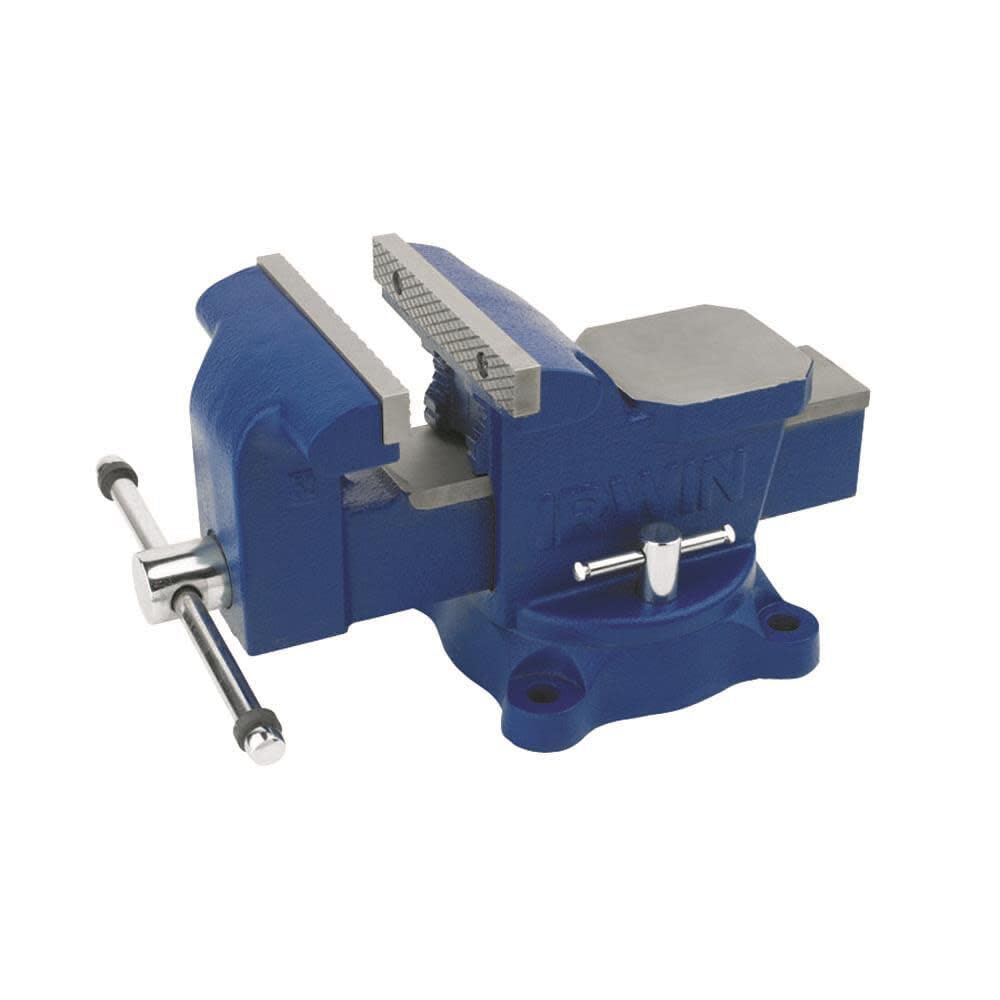
A workshop vise that keeps its slide locked in during the heaviest work.
Heavy use is where the IRWIN earns its keep. A captured safety jaw keeps the slide from dropping out when you really lean on the handle — a small feature that matters once a part is jammed in hard. It weaves in aggressive steel jaws that hold clamped material firmly, plus incorporated anvil and pipe jaws for a sturdy grip on both flat and round stock. The swivel base moves into position quickly and easily, and the 30.6-pound weight supplies a stable base so the vise does not wander under load.
Reviewers point out a vise that lasts a long time and works well as a table vise, which fits its home-use role. Durability is the theme buyers return to, and the value read is strong too — a heavy-duty 6-inch vise that suits a busy home garage. The cast iron body and limited lifetime warranty back the build.
The honest note is that ease of use does not fare as well as the durability. Some owners find the unit takes more effort to work than expected, and a few would have preferred a larger size. Neither undermines the vise for typical home tasks, but if you want feather-light operation, this one is more of a deliberate, sturdy tool than a quick-and-easy one.
Why it holds up: the captured safety jaw and aggressive steel jaws keep the slide and the part locked tight through heavy use.
The honest trade-off: it is a sturdier tool than a slick one — operation takes a little more effort than lighter picks.
Best matched to a home workshop that clamps hard and often and wants a slide that will not drop out.
Think twice if you want light-effort operation or a larger-than-6-inch jaw.
7. Wilton Mechanics Bench Vise, 6″ Jaw Width, 5-3/4″ Jaw Opening, 4-1/8″ Throat (Model 746)

A deep-throated mechanics vise that swallows tall parts other 6-inch vises cannot.
The number that sets the Wilton 746 apart is throat depth — 4-1/8 inches, versus the Yost BV-4’s 2.1 inches, and the deepest in this guide. That depth means a tall component like a strut or a thick bracket sits down inside the jaws instead of teetering on top. Combined with a 5-3/4-inch jaw opening and 6-inch jaw width, it handles the bulky parts a mechanic actually faces. The durable 30,000 PSI gray cast iron body (a measure of tensile strength) and ductile iron swivel base rotate 360 degrees with double lockdowns for firm positioning.
Running down the spec sheet, the vise covers the mechanical essentials well: replaceable hardened steel top and pipe jaws, a large anvil work surface, a fully enclosed spindle and nut (the screw that opens and closes the jaws), and a powder coat finish that resists scratches. Shoppers say it is robustly built and heavy, with solid value and a good look on the bench. The hammered finish gets noted more than once for its appearance.
The honest caveat is finish consistency — some owners describe the fit and finish as cruder than expected, with misaligned jaws in some units. Check the jaw faces on arrival and return anything that does not mate cleanly. Get a good unit and this is the deep-throated mechanics vise that keeps its place for years.
The mechanics’ pick
- 4-1/8″ throat depth — the deepest here — holds tall parts low
- 5-3/4″ jaw opening on a 6″ jaw width
- Fully enclosed spindle keeps grit out of the screw
Inspect on arrival
- Finish and jaw alignment can vary between units
- Heavier and bulkier than compact picks
Built for mechanical and automotive work where deep, bulky parts need a long throat.
Not your fit if you want a light vise for small hobby parts or prefer a fully polished finish.
8. Wilton Multi-Purpose 5-1/2″ Bench & Pipe Vise, 360° Rotating Head & Base

Three kinds of jaws, a head that indexes to 30-degree steps, and a 40-pound frame behind it.
Where the PONY above gives you a head that turns, the Wilton 550P gives you a head that both turns and indexes in 30-degree steps — so you can set a common angle, repeat it, and stop fiddling. That head and the swiveling base each move a full 360 degrees, letting you hold work at nearly any angle without re-clamping. The jaws pack in three functions: 5-1/2-inch bench jaws with a 5-inch opening and 2-3/4-inch throat (the depth behind the jaws), replaceable steel pipe jaws that grip pipe and round stock from 5/8 to 2-1/4 inches in diameter, and a V-jaw that holds round stock vertically for drilling or cutting.
The materials explain the 40-pound weight. The body and movable jaw are 30,000 PSI gray cast iron, the base is 60,000 PSI ductile iron, and the replaceable jaw inserts are hardened steel with a serrated grip. A large built-in anvil covers forming and shaping. Owners describe it as a beast, and its quality reputation is the strongest of any vise here — buyers call it versatile, smooth for general-purpose workholding, and worth the premium asking price. A Lifetime Warranty backs the castings.
The honest limit is the “heavy-duty” claim itself. Not everyone finds it heavy-duty enough for the heaviest trades, and it is explicitly not a press — never hand-tighten the lockdowns with a pipe or hammer the handle. It is built for light tradesman, utility, maintenance, and general shop use. Match it to that scope and it delivers.
What stands out: bench jaws, pipe jaws, and a V-jaw in one tool — the widest workholding range in this guide.
The honest scope: it is a light-trades and maintenance vise, not a press; the heaviest industrial jobs are beyond its design.
Reach for this if you do mixed utility and maintenance work and want repeatable angles plus three jaw types.
Look elsewhere if your shop runs the heaviest class of work or you need a vise to double as a press.
9. Yost Vises ADI-6 Heavy Duty Vise, 130,000 PSI Austempered Ductile Iron

The material upgrade: 130,000 PSI ductile iron that shrugs off a beating.
The headline on the Yost ADI-6 is its material. Austempered ductile iron (a heat-treated iron that resists cracking) at 130,000 PSI tensile strength is a big jump over the 30,000 PSI cast iron you see on several picks here, and it is the toughest-rated body in this guide. That toughness pays off where a vise takes repeated shock — heavy hammering, stubborn parts, and years of use. The 6-inch jaw width, 42-pound weight, and 130,000 PSI ADI construction put it firmly in shop-grade territory.
The swivel base uses interlocking gear teeth rather than a plain friction ring, so it locks into a position and stays there when you swing the vice around. Two lockdowns and three mounting holes anchor it to the bench. The replaceable hardened steel serrated machinist and pipe jaws are zinc plated for corrosion resistance, and the full anvil surface handles forming work. Owners describe it as a beast with excellent build quality, and they agree on the clamping force and jaw alignment — the jaws mate up cleanly and open more than 5 inches.
For all the strength, it is still a vise that demands care in use. It is not a press, and over-tightening against a fragile part will damage the part before the vise. The 42-pound mass also means a sturdy bench is part of the deal — mount it well and this is the vise that will outlast most of the shop around it.
The upgrade you feel
- 130,000 PSI austempered ductile iron — the toughest body here
- Interlocking geared 360-degree swivel stays put
- Zinc-plated replaceable serrated machinist and pipe jaws
Plan for it
- 42 pounds calls for a sturdy bench and through-bolted mounting
- Not built to be used as a press
You want this if you run a real shop, hammer and clamp hard, and want the toughest body on the list.
Look at a lighter pick if you are mounting on a light bench or only work small parts.
Understanding the Specs
Clamping Force (in pounds)
Clamping force is how hard the jaws can squeeze, measured in pounds. It is not the same as how big the jaws are — a compact vise can clamp harder than a large one. High force matters when a part must not slip mid-cut, like drilling metal or driving a stubborn bolt. A vise rated in the thousands of pounds holds most home jobs with room to spare, and the highest figures here suit heavy shop work. Force alone will not make a vise useful, though; generous jaw opening and throat depth decide what you can actually fit inside it.
Jaw Opening vs. Jaw Width
Jaw width is the width of the steel faces that clamp the part. Jaw opening is how far those faces travel apart. They are usually close but not identical — a 6-inch jaw width often opens around 5 to 6.5 inches. Shop by opening, because that is the real size limit on the parts you can hold. Add throat depth to the picture too: it is how deep a part can sag below the jaw faces, and a deeper throat holds tall or bulky work properly instead of pinching only its top edge.
FAQ
What is the difference between jaw width and jaw opening on a bench vise?
Can a bench vise hold round pipe, or do I need pipe jaws?
What does clamping force in pounds actually mean?
Is a swivel base worth it on a bench vise?
What should I mount the vise on, and how?
Cast iron vs ductile iron — which is better for a vise?
Can I use a bench vise as an anvil or a press?
Does jaw quality matter over the long run?
How do I know my bench vise is mounted tight enough?
Final Thoughts: The Verdict
The winner for most home benches is the Yost Vises BV-4, because it delivers 3,380 lbs of clamping force and a 120-degree swivel in a compact cast iron body that suits a home workshop. If you want more jaw to work with and an anvil for forming, the Forward 0806 opens to 5 inches and covers all-purpose garage duty. For pipe and tube, the VEVOR 6.5″ grips round stock from 0.6 to 2.8 inches and reaches 4,496 lbs of force. And if you need the toughest body on the list for a real shop, the Yost ADI-6 and its 130,000 PSI ductile iron is the one to reach for.
How We Picked
We do not accept paid placement. Every pick is matched to a real buyer and a real use-case; we do not hands-on test units.
Sources & Methodology
Specifications: manufacturer listings and product documentation. Review insights: verified customer reviews, as of November 2026. Pricing: not shown on this page (it changes often); check the current price via the retailer link.
As an Amazon Associate, Gadgets Feed earns from qualifying purchases. This does not affect which products we feature.