
Our readers keep the lights on and my morning glass full of iced black tea. As an Amazon Associate, I earn from qualifying purchases.
Specs are compiled from manufacturer listings and verified buyer reviews and can change over time — please confirm the key details on the product page before buying.
Only one card in this lineup actually holds 2 TB, and that is the SanDisk 2TB Extreme PRO SD UHS-II. It is the only pick here that truly meets the capacity on the box. The other two cards are Extreme PRO models sold under related listings, so your real job is telling a true 2 TB card apart from a 512 GB or 128 GB sibling before you spend premium money. Three things decide whether your camera clears its buffer or stalls mid-burst: capacity (how much footage fits), speed class (the minimum sustained write speed the card guarantees), and sustained write speed (how fast it keeps writing during a long burst).
I’m Min — the founder and writer behind Gadgets Feed. This guide is built by comparing the manufacturers’ published specifications and the patterns across verified customer reviews, so you get each pick’s real strengths and trade-offs instead of marketing spin.
A card can look identical in photos and still be a different capacity or speed tier, so check the model number against the label. The safest way to judge a 2 tb sd card is by matching its speed class and write rating to how you actually shoot.
Our Picks at a Glance

How To Choose The Best 2 TB SD Card
Most people buy an SD card by the biggest number on the front. That is the wrong instinct here. On a 2 TB card the number that decides whether your footage survives a long shoot day is the write speed, because the card has to swallow data as fast as the camera hands it over.
Start with your camera’s speed class, not the capacity
The video speed class is the small letter-plus-number badge — V30, V60, V90 — and it guarantees a minimum sustained write rate for recording. A card carrying V90 is built for the heaviest footage, while V30 is aimed at 4K UHD capture. If your camera records 8K video, dropping to a lower class risks the recording stopping partway through.
Check the bus before you pay for speed you cannot use
UHS-II cards use a second row of contact pins for faster transfers, but they only deliver that speed in a camera or card reader built for UHS-II. Put a UHS-II card in a UHS-I slot and it falls back to the slower mode. Match the card to the slot your body and reader actually have.
Decide how much capacity you really need
A full 2 TB card lets you shoot an entire event day without swapping media mid-coverage. If you shoot smaller projects and offload nightly, a smaller card at a higher speed tier can be the smarter spend. Capacity and speed trade off against price, so pick the combination your workflow actually needs.
Quick Comparison
| Model | Best For | Capacity | Video Speed Class | Max Read / Write | Amazon |
|---|---|---|---|---|---|
| SanDisk 512GB Extreme PRO SD UHS-I★ Best Overall | 4K UHD work with fast offloads | 512 GB | V30 | 250 MB/s read / 170 MB/s write | Amazon |
| SanDisk 2TB Extreme PRO SD UHS-II | Full-day 8K and heavy burst shooting | 2048 GB | V90 | 310 MB/s read / 305 MB/s write | Amazon |
| SanDisk 128GB Extreme PRO SD UHS-II | 6K capture on a tight media budget | 128 GB | V60 | 300 MB/s read / 250 MB/s shot | Amazon |
In‑Depth Reviews
1. SanDisk 512GB Extreme PRO SD UHS-I Card, Up to 250MB/s Read and 170MB/s Write
Our pick — 4.5+★ from 1,500+ verified ratings; the strongest balance of quality and price.
The 4K workhorse owners trust — if 512 GB of room is enough for your shoot day.
More owners back this card than any other here: it carries a 4.5+ star rating across 1,500+ owners, the deepest review base in this lineup. It delivers up to 250 MB/s read and 170 MB/s write, so 4K UHD clips and high-resolution stills transfer quickly to your computer. Its U3 and V30 speed class ratings (guaranteed minimum write speeds for video) are aimed squarely at high-resolution stills and 4K UHD video.
Here is the honest catch: this listing is the 512 GB model, not a 2 TB card. It holds 512 GB against the 2 TB pick’s 2048 GB, which means more frequent offloads on long days. Read speed also trails, at 250 MB/s versus 310 MB/s on the 2 TB card. For a lot of shooters that trade is fine, because the card is reliable where it counts: owners lean on it for Sony bodies and quick transfers to a MacBook Pro.
Owners consistently praise its dependability, and reviews repeatedly note it handles 4K recording without lag. Durability reports are mixed: some owners call it tough as nails, others have had one break, so keep it in its case. SanDisk’s Memory Zone desktop app also makes backing up and organizing clips straightforward whether you use an SD slot or a reader.
The read on capacity: this is a 512 GB card wearing an Extreme PRO badge — before you hit buy, confirm the model you want matches the capacity you need.
Best if you shoot 4K UHD and want the most proven card here: the deep review history is real comfort on a shoot.
Look elsewhere for your 2 TB need: the 512 GB ceiling is the limiting factor.
2. SanDisk 2TB Extreme PRO SD Memory Card, Up to 310MB/s Read, UHS-II
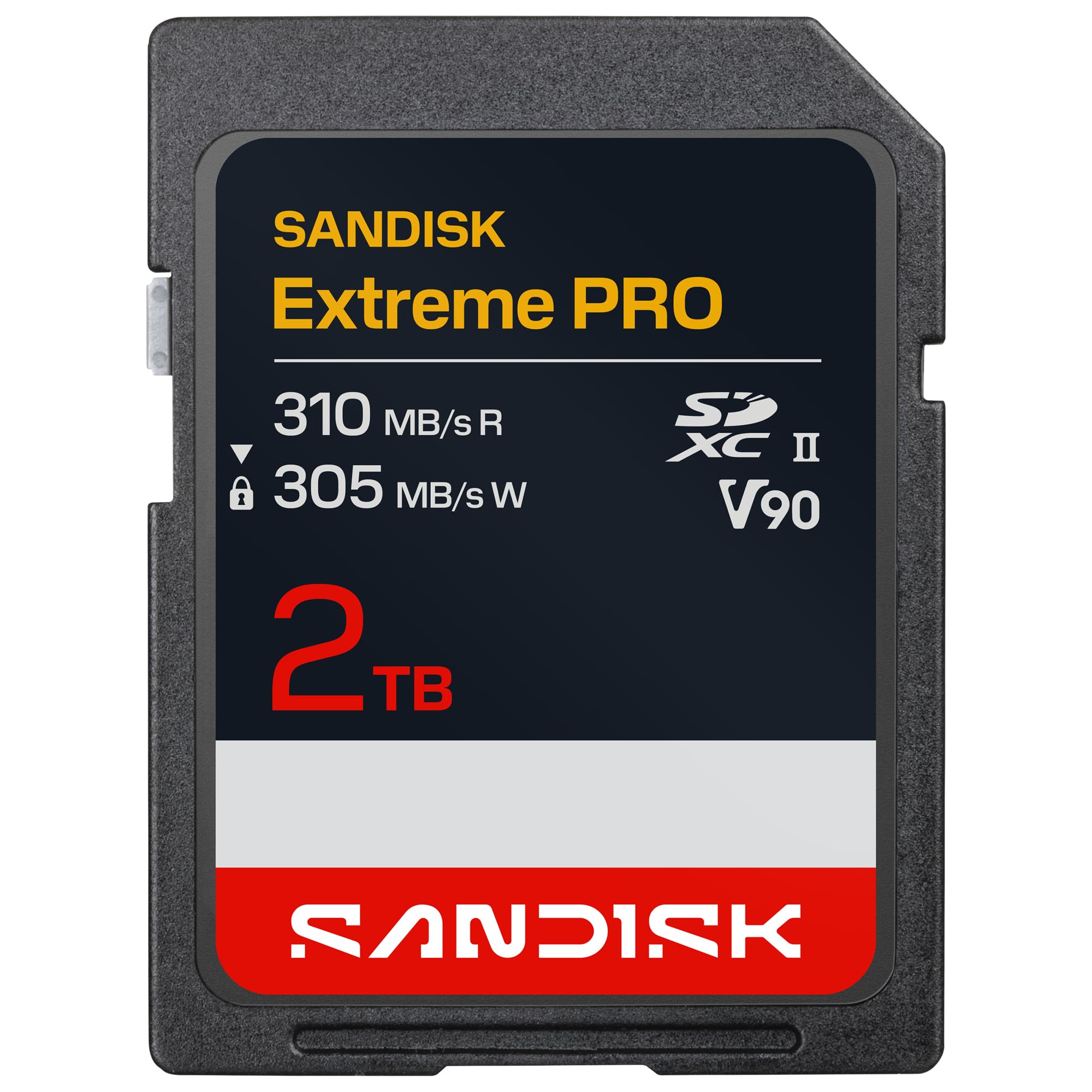
The only card here that truly carries 2 TB on the label — and it writes at nearly the speed it reads.
This is the pick for the shooter who fills a card in a single day and cannot afford to stop. It holds a genuine 2048 GB, so you get the full 2 TB the keyword promises rather than a fraction of it. Write speed tops out at 305 MB/s, which is what keeps a camera’s buffer from filling during a long burst of stills or a run of 8K clips.
Set it beside the 128 GB UHS-II in this guide and the capacity gap is the whole story: 2048 GB against 128 GB. It also outruns the 512GB UHS-I card on every speed measure — 310 MB/s read versus 250 MB/s, and 305 MB/s write versus 170 MB/s. That faster write means long bursts keep flowing instead of stalling. On video class (the V rating that guarantees a minimum write speed for video) it sits at V90 against the 512GB card’s V30, so it is built for the heaviest recording tier.
For a card that lives in a camera bag, the IP68 seal and drop testing are the durability features that matter. It carries an IP68 rating (a sealed rating that means dust cannot get in and it survives being submerged), and it is drop-tested as well. SanDisk also bundles RescuePRO Deluxe software for restoring lost files, which is the kind of safety net that matters on a card holding a full day’s work.
Where this card pulls ahead
- True 2048 GB capacity
- V90 video speed class, the top tier for demanding 8K capture
- 305 MB/s write keeps a camera buffer clearing fast
- IP68 dust and water rating plus drop testing for bag life
What to weigh first
- You pay a premium for the true 2 TB tier
- UHS-II speed only arrives if your camera body and reader support it
- Fewer owners have logged experience with this exact card than with the 512 GB sibling
Reach for this if: you shoot 8K, cover long events, and want one card that lasts the whole day without a swap.
Think twice if: your body only runs UHS-I — the faster bus goes unused unless the slot supports it.
3. SANDISK 128GB Extreme PRO SD Memory Card, Up to 300MB/s Read Speeds, UHS-II

Small capacity, serious speed tier — built for 6K cinema on prosumer rigs.
The 128 GB Extreme PRO is a different animal from the 2 TB card: it drops capacity hard but keeps a high speed tier aimed at MIL, dual-slot MIL-FF, and cinema bodies. It records 6K video thanks to a V60 (video speed class 60) rating, which guarantees a sustained write rate for that footage tier, plus standard-to-slow-motion in 4K UHD and Full HD. Transfer speeds reach 300 MB/s so offloads to a laptop stay quick.
Compared with the 512GB UHS-I card, this one sits a class higher on video, at V60 against V30, and reads faster at 300 MB/s versus 250 MB/s. Against the 2 TB pick it trails on video class — V60 versus V90 — and holds just 128 GB against 2048 GB of storage. Buy it when your priority is the fastest sustained recording your budget allows and you offload at the end of each session.
The trade-off to plan around is capacity. With 128 GB, a heavy 6K shoot day will fill the card faster than you expect, so carry a second card or offload often. The listed features rate it drop-proof, temperature-proof, water-proof, wearout-proof, and X-ray-proof. Shot speeds reach up to 250 MB/s to help continuous burst mode and time-lapse hold their rhythm.
Speed where it counts: V60 and a 300 MB/s read give you fast 6K capture and quick transfers — the limit is room, not pace.
One thing to plan: 128 GB fills fast under 6K, so budget for a second card in the bag.
Choose it if: you shoot 6K on a prosumer body and want top-tier speed without paying for 2 TB.
Pass if: you need capacity to last a whole shoot without swapping media.
Understanding the Specs
Video Speed Class (V30, V60, V90)
The V-number is a promise of a minimum sustained write rate for video, not a peak burst figure. A V30 card is built for 4K UHD capture, V60 steps up to 6K footage, and V90 sits at the top for the heaviest recording. If your camera records beyond what your class guarantees, the recording can stop early — so match the class to your footage tier, not to the biggest read speed on the box.
UHS-I vs UHS-II
UHS-II cards add a second row of contact pins that allow faster transfers, but the speed only arrives if your camera slot and card reader support the same bus. Put a UHS-II card in a UHS-I-only device and it runs at the slower mode. Check both the body and the reader before paying extra for UHS-II speed.
FAQ
Is the card called a 2 TB SD card really 2 TB?
Will a V90 card work in a camera that only needs V30?
Do I need UHS-II for 8K video?
What does IP68 mean on an SD card?
How much 4K video fits on a large card?
Is a 512 GB card enough instead of a 2 TB card?
What is RescuePRO Deluxe software for?
Will these cards work with a MacBook Pro card reader?
Final Thoughts: The Verdict
For most people who genuinely need the capacity the keyword names, the 2 tb sd card to buy is the SanDisk 2TB Extreme PRO SD UHS-II — it is the only pick here that truly holds 2048 GB, backed by a V90 class and 305 MB/s write for 8K work. If your shoots are 4K and you want the most proven card in the lineup, the 512GB Extreme PRO UHS-I delivers reliability with a deep track record. And when you shoot 6K on a prosumer body and just want maximum speed per card, the 128GB Extreme PRO UHS-II is the lean, fast choice. One honest nudge: if you are spending for 2 TB, verify the model number matches the capacity first — the top pick earns its place because it actually is the 2 TB card.
How We Picked
We do not accept paid placement. Every pick is matched to a real buyer and a real use-case; we do not hands-on test units.
Sources & Methodology
Specifications: manufacturer listings and product documentation. Review insights: verified customer reviews, as of November 2026. Pricing: not shown on this page (it changes often); check the current price via the retailer link.
As an Amazon Associate, Gadgets Feed earns from qualifying purchases. This does not affect which products we feature.