
Our readers keep the lights on and my morning glass full of iced black tea. As an Amazon Associate, I earn from qualifying purchases.
Specs are compiled from manufacturer listings and verified buyer reviews and can change over time — please confirm the key details on the product page before buying.
Dolby Atmos only sounds like overhead rain and passing helicopters when the receiver behind it has real Atmos decoding and enough channels to drive height speakers. Streaming apps, room calibration, and HDMI inputs matter, but only after the channel count is settled. All eleven receivers here decode Atmos onboard, so the choice is channel count, wattage, and calibration depth.
I’m Min — the founder and writer behind Gadgets Feed. This guide is built by comparing the manufacturers’ published specifications and the patterns across verified customer reviews, so you get each pick’s real strengths and trade-offs instead of marketing spin.
Below you will find the channel counts, wattage ratings, and HDMI layouts that decide how a room actually fills with sound, plus the setup quirks owners run into. Use this list to match an Atmos receiver to your room size, your speaker count, and your tolerance for calibration menus.
Our Picks at a Glance

How To Choose The Best Audio Receiver Dolby Atmos
Look up at your ceiling first. If you will not hang speakers there, you need a receiver with height virtualization (processing that fakes overhead sound from ordinary floor-level speakers). If you will mount a pair up there, you need enough amplified channels to feed them without giving up your surround pair. Most comparisons between two Atmos receivers come down to whether you will mount height speakers.
Channels decide your ceiling, not your budget
A 7.2-channel receiver (seven amplified speakers plus two subwoofer outputs) typically runs a 5.1.2 layout — five ear-level speakers and two height speakers — or a 7.1 floor layout with no height at all. A 9.2-channel model opens up 5.1.4 or 7.1.2, which is where Atmos starts sounding genuinely three-dimensional. Pick the channel count by counting the ear-level and height speakers you own or plan to mount.
Wattage numbers are not written the same way
Two receivers can both claim big watt figures and mean completely different things. Some publish a two-channel rating measured across the full 20 Hz–20 kHz range with low distortion, which is the stricter figure. Others publish a one-channel rating at a single 1 kHz tone with higher distortion, which reads louder on a box. Compare ratings measured the same way, and remember that high-efficiency speakers need far fewer watts than the box suggests.
Room correction is the quiet upgrade
A calibration system uses a supplied microphone to measure how your room bounces sound and then corrects the signal. Audyssey, YPAO, and Dirac Live all do this job with different levels of control. In a room with hard floors and a low ceiling, calibration usually changes what you hear more than stepping up in wattage does. Look for the version name, because base and advanced tiers within the same brand behave differently.
HDMI inputs and the 8K question
Count your sources: console, streaming stick, cable box, Blu-ray player, and maybe a PC. Then check how many of those inputs handle 8K and 4K/120, because on several receivers only some ports carry the full-speed HDMI 2.1 feature set. If you run a modern console at high frame rates, an input that drops to older HDMI speeds will cost you the mode you bought the console for.
Quick Comparison
| Model | Best For | Channels | Power Rating | HDMI In / Out | Amazon |
|---|---|---|---|---|---|
| Denon AVR-X1700H★ Best Overall | Balanced first Atmos system | 7.2 | 80W per channel | 6 / 1 | Amazon |
| Pioneer VSX935Budget Champion | Budget-friendly Atmos entry | 7.2 | 80W per channel (2ch driven) | — | Amazon |
| Denon AVR-S770HBest 8K Value | 8K TV owners on a mid budget | 7.2 | 75W x 7 | — | Amazon |
| Yamaha RX-V6A | Multi-room MusicCast homes | 7.2 | — | 7 / 1 | Amazon |
| JBL MA710 | High power per channel | 7.2 | 110W x 7 | 6 / 1 | Amazon |
| Onkyo TX-RZ30 | 9-channel Dirac Live rooms | 9.2 | 100W per channel | — | Amazon |
| Sony STR-AN1000 | 360 Spatial Sound Mapping | 7.2 | 165W (6 ohms, 1 kHz, 1ch) | 6 / 2 | Amazon |
| Marantz Cinema 60 | Musical two-channel listening | 7.2 | 100W per channel | 6 / — | Amazon |
| Sony STR-AZ1000ES | Custom install and IP control | 7.2 | 100W + 100W (8 ohms, 1 kHz, 2ch) | 6 / 2 | Amazon |
| Yamaha RX-A4A AVENTAGE | Surround:AI auto tuning | 7.2 | — | 7 / 3 | Amazon |
| Denon AVR-X4800H | Large rooms and 9.4 layouts | 9.4 | 125W x 9 | 7 / 3 | Amazon |
In‑Depth Reviews
1. Denon AVR-X1700H 7.2 Channel AV Receiver
Our pick — 4.0+★ from 700+ verified ratings; the strongest balance of quality and price.
Seven channels, 80 watts each, and a setup routine simple enough to finish before the popcorn.
This pick earns the top slot on one number: 80 watts into each of seven channels, paired with Dolby Atmos Height Virtualization (processing that builds the impression of overhead sound even when you never mount a ceiling speaker). So you get real Atmos decoding without committing to drywall work. Six HDMI inputs feed it and one output sends the picture to your TV. Three of those inputs are dedicated 8K ports running 8K/60Hz and 4K/120Hz pass-through (8K and 4K are resolution labels; the numbers after the slash are refresh rates in frames per second), so a new console or player runs at full speed. Denon also upscales to 8K on all six inputs, so older gear gets a lift too.
Owners describe the theater effect that comes from the surround and height channels working together. Setup stays friendly: the on-screen Quick Setup Guide walks you through speaker EQ (equalizing, or tuning each speaker’s tone) with color-coded back-panel connections. You can control it by app, remote, touch, or voice through Alexa, Google Assistant, or Siri. Multi-room streaming goes further than most buyers expect, since you can play a movie in one zone while someone else streams Spotify, Pandora, or Amazon Music HD over Wi-Fi, AirPlay 2 (Apple’s wireless streaming standard), or Bluetooth in another. There is also a phono input, so a turntable plugs in without a separate preamp box.
The catch is reliability — a small share of units reportedly quit inside the first week, which is worth knowing before you wire everything in. Test it thoroughly during the return window. Denon’s on-screen guide is genuinely helpful, but a first-timer still needs an afternoon for speaker placement and EQ. Compare it with the Pioneer below: this Denon gives you a documented 6 HDMI in / 1 out and a phono stage, while the Pioneer’s spec sheet does not list its port count at all. The crowd favorite here sits at 4.0+ stars across 700+ ratings, and the depth of that feedback is why it holds the crown.
What earns it the top slot
- 80W across seven channels with Atmos Height Virtualization so overhead sound works without ceiling speakers
- Three dedicated 8K inputs and 8K upscaling on all six, covering a new TV and an old console in one box
- Zone 2 streaming lets one room watch while another plays Spotify or Tidal over AirPlay 2 or Bluetooth
- Phono input and a color-coded back panel keep a turntable and a novice installer both happy
Where it asks for patience
- A minority of units stop working early, so run a full test during the return window
- Speaker calibration and EQ still take a real afternoon the first time through
- Seven channels caps you at a 5.1.2 height layout — no room for four overhead speakers
Made for: a first serious Atmos build in a living room where ceiling speakers are not happening.
Think twice if: you already own four height speakers and need a 9-channel amplifier to drive them.
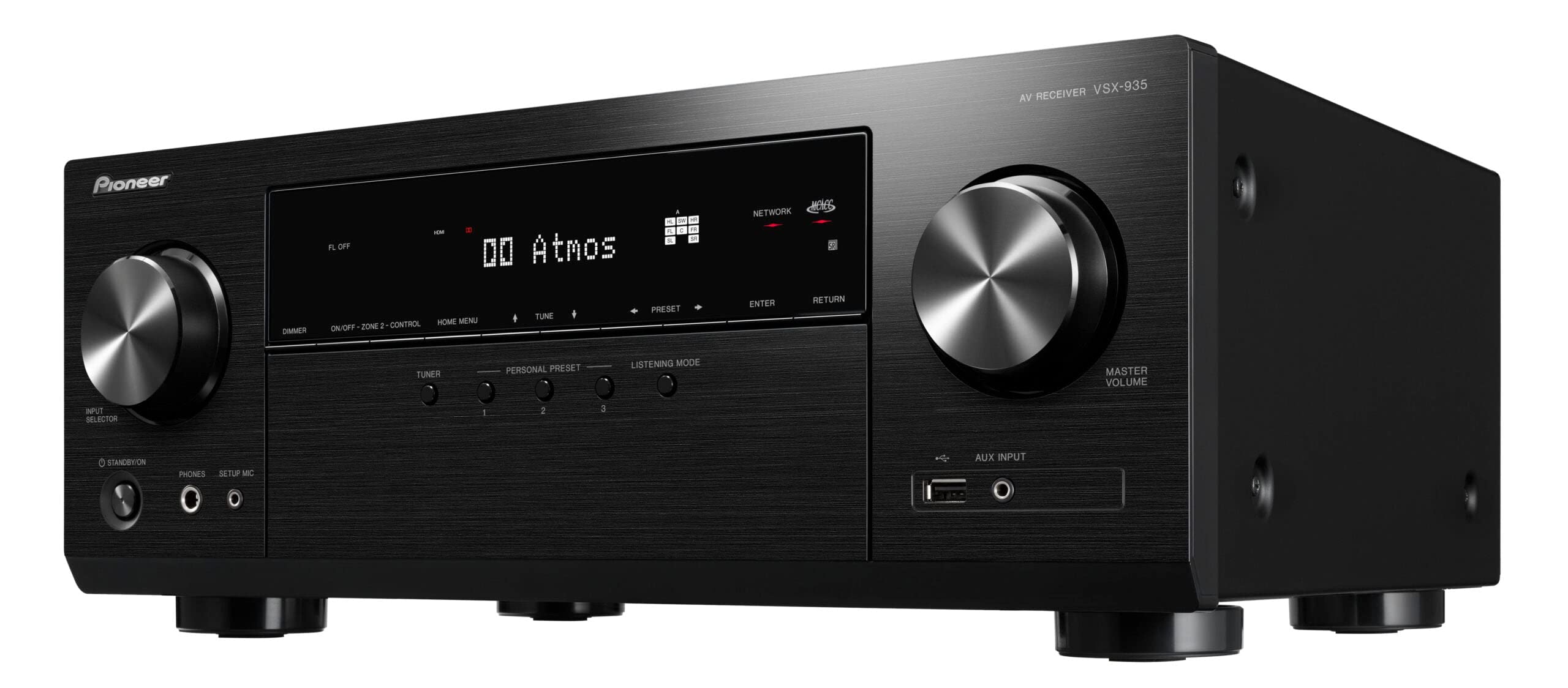
2. Pioneer VSX935 7.2 Channel Network AV Receiver
Two power figures on one spec sheet, and knowing which one you are buying is the whole game.
Pioneer publishes both numbers honestly, which makes this the easiest receiver in the group to read. You get 170 watts per channel measured at 6 ohms, 1 kHz, 10 percent distortion, one channel driven — a peak-style figure. The stricter number is 80 watts per channel at 8 ohms, across the full 20 Hz to 20 kHz range, at 0.08 percent distortion, two channels driven. The second figure is the one that predicts how it behaves with real speakers. Atmos arrives with a Dolby Surround Upmixer for older content and a Height Virtualizer that generates overhead effects without ceiling speakers, plus DTS:X and DTS Neural:X for discs mixed in that format.
Setup is the single most-praised thing about this receiver, with the control layout close behind, and the companion iPhone control app does more than people expect going in. Footprint matters too: it measures 14.56 inches deep, 17.13 inches wide, and 6.81 inches tall. The Yamaha RX-V6A lists 6.25-inch depth, 17.3-inch width, and 14.9-inch height. That is a 2.3x difference in the published depth figures, so measure your cabinet before assuming either shape fits.
Honest caveat: the verdict here is split. Some owners find the rear and side surround channels underwhelming, and value, video quality, and Bluetooth all draw mixed reactions rather than cheers. Nothing is broken — it is a case of expectations. If you want a clean, easy-to-operate Atmos box for a modest room and you keep your speaker upgrade plans simple, this is a sensible entry. If you expect a dramatic surround bubble on day one, you may end up fiddling.
The published-wattage read: both the 170W peak-style and 80W strict-rating figures are on the sheet, which is more transparency than most listings offer.
The fit note: mixed feedback on surround-channel impact means this suits buyers who value an uncomplicated setup over maximum rear-channel drama.
Right call for: a modest first Atmos room where easy setup and a low entry point beat raw output.
Pass on it if: you are chasing a chest-thumping rear-channel effect and plan to push inefficient speakers hard.
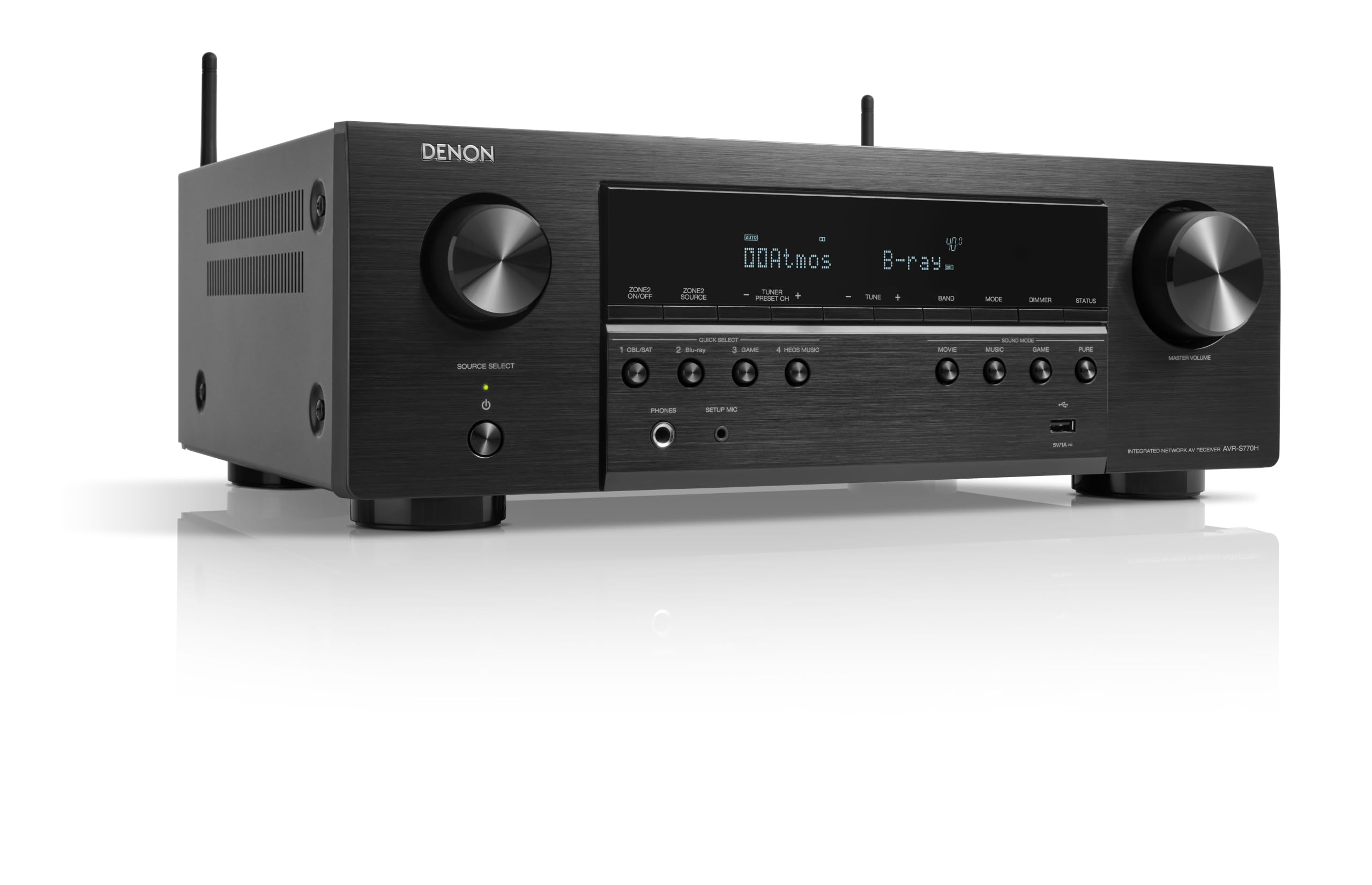
3. Denon AVR-S770H 7.2 Ch Home Theater Receiver
The gaming-focused Denon: VRR, ALLM and QFT on board for a console that needs every frame.
75 watts across seven channels is the headline, but the reason to pick this over the Pioneer above is the video feature list. It passes 8K/60Hz and 4K/120 through, supports HDR10+, HLG, HDR, Dolby Vision and Dynamic HDR, and adds VRR, ALLM and QFT — the trio that keeps a fast-paced game smooth and cuts controller-to-screen lag. Dolby Height Virtualization and DTS Virtual:X build overhead sound in a 7.1, 5.1, or even 2.1 setup without height speakers, while a full 7.2 or 5.2.2 arrangement works with real Dolby Atmos and DTS:X speakers installed.
Denon’s own bigger sibling, the X1700H above, is listed at 80W per channel x 7 against this model’s 75W x 7 — a modest gap on paper. The JBL MA710 further down the list runs 110W x 7, well ahead of both. Where this S770H wins is streaming reach: built-in HEOS (Denon’s multi-room music system) spreads music to other rooms over Wi-Fi or Bluetooth with Pandora, Spotify, and TIDAL, and voice control works with Alexa and other major voice agents for volume, track, and input changes.
Setup and adjustability split opinion, and a share of owners had trouble getting it to work the way they wanted — so budget time for the first configuration rather than expecting plug-and-play. The list of inputs and the sound it produces are what carry it, and that combination is what most buyers are after. One calibration microphone and stand come in the box, which saves a separate purchase.
Reasons it lands
- VRR, ALLM and QFT support keeps console gaming smooth and responsive
- 8K/60 and 4K/120 passthrough with Dolby Vision, HDR10+ and Dynamic HDR
- Height Virtualization fakes overhead channels when speakers are not an option
- HEOS multi-room streaming with Spotify, TIDAL and Pandora over Wi-Fi
Where it gets fiddly
- Getting it fully configured is a mixed experience across owners
- 75W per channel sits below the JBL MA710’s 110W x 7
- No phono input listed, so a turntable needs its own preamp
The honest fit: a gamer with an 8K TV and a 5.1.2 speaker plan who wants Atmos and HEOS in one box.
Look elsewhere if: you want plug-in simplicity on the first afternoon or you spin vinyl.
4. YAMAHA RX-V6A 7.2-Channel AV Receiver with MusicCast

Seven HDMI inputs, three of them 8K, and a streaming platform built for a whole house.
Port count is the argument here. This Yamaha gives you seven HDMI inputs and one output with HDCP 2.3 and eARC, three of which carry 8K and 4K/120, against the Denon AVR-X1700H’s six inputs. Dolby Atmos and DTS:X both decode onboard, with Height Virtualization available when you would rather not mount ceiling speakers, and Dolby Vision, Hybrid-Log Gamma and BT.2020 handled on the video side.
Sound quality is what keeps drawing praise, with the feature set right behind it. MusicCast (Yamaha’s multi-room audio system) is the long-game feature: it turns the receiver into one zone of a whole-home audio system, and it works alongside AirPlay 2, Spotify Connect, Wi-Fi, Bluetooth, and voice control through Alexa, Google Assistant, or Siri via AirPlay 2. Pandora, Napster, SiriusXM, TIDAL, Deezer, Qobuz, and Amazon Music HD are all named as supported services. YPAO R.S.C. with multipoint measurement (Yamaha’s automatic room-tuning system, which samples several seating spots) handles the room calibration.
Watch the Bluetooth. Connectivity draws the most negative commentary of any aspect on this receiver, with constant dropouts reported, so plan to use Wi-Fi or AirPlay 2 for streaming and leave Bluetooth as a fallback. Setup splits down the middle — some find it straightforward, others find the menus a slog — and reliability and value both draw divided views rather than unanimous cheer. The 6.25-inch depth, 17.3-inch width, and 14.9-inch height put it in a different cabinet shape from the Pioneer’s published 14.56 by 17.13 by 6.81 inches, so check whether you are measuring depth or height before you order.
Why it belongs here: seven HDMI inputs with three at 8K is the most generous port layout in this mid-range group, and MusicCast makes it a whole-home hub rather than a single-room box.
Set your expectations: stream over Wi-Fi, not Bluetooth — that is the weakest link in an otherwise well-loved receiver.
Built for: a cabinet full of sources and a home that wants music in more than one room.
Not the one: if Bluetooth streaming is your main listening method, since dropouts are the recurring complaint.
5. JBL MA710 7.2 Channel 8K AV Receiver

110 watts into all seven channels — the power figure that separates it from the Denon crowd.
This is the muscle pick of the mid-range group. The MA710 runs 110 watts x 7, against the Denon AVR-S770H’s 75W x 7 and the X1700H’s 80W per channel. For a room with inefficient speakers or a big open-plan space that swallows bass, that headroom is the difference between a soundtrack that swells and one that sounds strained. Dolby Atmos and DTS:X both decode, with support up to 7.1 or 5.1.2 speaker layouts, and 8K video passes through six HDMI inputs and one output with eARC.
Wireless is generous for the tier: Bluetooth plus network streaming with Apple AirPlay 2 and Google Chromecast built in, so an iPhone or an Android phone both cast without a dongle. There is a moving magnet phono input for a turntable, which means vinyl plugs straight in — the same convenience the X1700H offers and the S770H does not list. It also sits lower in a cabinet at 4.3 inches tall, 13.7 inches deep, and 17 inches wide, with a listed weight of 6.3 kg, so it slides into tighter shelving than the taller boxes here.
Be realistic about the track record: this receiver is newer to market and has far less owner history behind it than the Denons and Yamahas around it, so you are buying on specification and early word rather than a long tested record. The 7.2-channel ceiling also means 5.1.2 is your maximum Atmos layout (five ear-level speakers, one subwoofer, two height channels) — no four-speaker overhead array here. If you want maximum watts per channel at a mid-range point and you like AirPlay 2 plus Chromecast in the same box, the spec sheet is compelling.
Strongest for: a large room with power-hungry speakers and a phone-casting habit — 110W x 7 with AirPlay 2 and Chromecast does that job.
Slow down if: you want a long established owner record before committing, since this model has the thinnest review history here.
6. Onkyo TX-RZ30 9.2-Channel AV Receiver

Nine channels and a Dirac Live license in the box — the calibration upgrade most receivers charge extra for.
Nine amplified channels changes what you can build. The TX-RZ30 runs 100 watts per channel across 9.2, which means a 5.1.4 layout with four overhead speakers or a 7.1.2 arrangement — both out of reach for the seven-channel receivers above. Its amplifier section is specified from 5 Hz to 100 kHz, a very wide bandwidth rating that speaks to how it handles deep bass and high treble. Two independent subwoofer outputs let you run a pair of subs without a splitter, and Dolby Atmos and DTS:X both decode.
The feature that tips this one is Dirac Live Room Correction, with the Full Bandwidth license included from the start and an optional upgrade path for Single or Multi Bass Control. Dirac is the calibration system enthusiasts seek out, and getting the full-bandwidth version bundled rather than sold separately is a real value argument. Add IMAX Enhanced certification, THX certification, and a Klipsch tune Mode that applies crossover values tuned for specific Reference Premiere speakers, and you have a receiver aimed at people who care how the room measures.
Setup is the honest trade-off — some owners take to it quickly while others find it far from user-friendly, and the depth of the calibration tools is exactly why. It weighs 29.3 pounds, so plan for a solid shelf. Sonos owners get a bonus: a Sonos Port connection distributes sound through an existing Sonos wireless network. Stereo music performance draws particular praise, with several describing it as close to dedicated hi-fi gear — high marks for a home theater box.
Why the extra channels pay off
- 9.2 channels at 100W each opens 5.1.4 or 7.1.2 Atmos layouts
- Dirac Live Full Bandwidth license included, not sold as an add-on
- Two independent subwoofer outputs for a dual-sub setup without a splitter
- Klipsch tune Mode applies tuned crossover values for Reference Premiere speakers
The honest cost of depth
- Dirac calibration is not beginner-simple; expect a learning curve
- 29.3 pounds needs a sturdy shelf and a second pair of hands
- IMAX Enhanced and THX matter only if your content and speakers support them
Suits you if: you want four overhead speakers and a measured, calibrated room rather than a guessed one.
skip it if: you want to unbox, run one auto-setup screen, and never open a calibration menu again.
7. Sony STR-AN1000 7.2ch Home Theater 8K A/V Receiver

Sony’s answer to awkward speaker placement: phantom speakers mapped into the room by calibration.
Two Sony technologies do the work here. Digital Cinema Auto Calibration IX measures your room, and 360 Spatial Sound Mapping uses that data to create the impression of additional speakers where none exist. In a living room where the sofa sits off-center and the left speaker is jammed against a bookshelf, that is a practical fix rather than a gimmick. The amplification is rated at 165 watts at 6 ohms, 1 kHz, single channel at 0.9 percent distortion, and Dolby Atmos and DTS:X both decode for object-based soundtracks.
Video coverage is thorough: 8K and 4K/120 over HDMI 2.1 with six inputs and two outputs, plus Dolby Vision, HDR10, Hybrid Log Gamma, and IMAX Enhanced. Two outputs is a real convenience for a projector-plus-TV room — the Yamaha RX-V6A offers one. Zone 2 and Zone 3 let you route audio to two extra spaces independently, and the graphical setup interface steps through each stage on screen rather than in a paper manual. Streaming covers Bluetooth, Wi-Fi, Chromecast built-in, Spotify Connect, and Apple AirPlay, with Google Assistant voice control and Works With Sonos integration over a Sonos Port.
The wrinkle is compatibility. Chromecast functionality draws specific complaints about connection trouble, and a share of owners ran into eARC handshake problems in particular setups. Sound quality and setup ease are what most people talk about positively, and the upscaling job on 4K HDR content gets noticed. If you feed it an 8K TV and a console at 4K/120, the spec sheet delivers — just confirm your TV’s eARC behavior early, while returns are still easy.
The spatial trick: 360 Spatial Sound Mapping and Digital Cinema Auto Calibration IX combine to place sound where your speakers are not, which is the reason to choose this model over a plain seven-channel box.
Test it early: Chromecast and eARC compatibility are the two recurring friction points, so verify both in your own room within the first week.
Pick this for: an awkward room where speaker placement is fixed and two display outputs would help.
Think again if: Chromecast is your main streaming route, since that is where the complaints land.
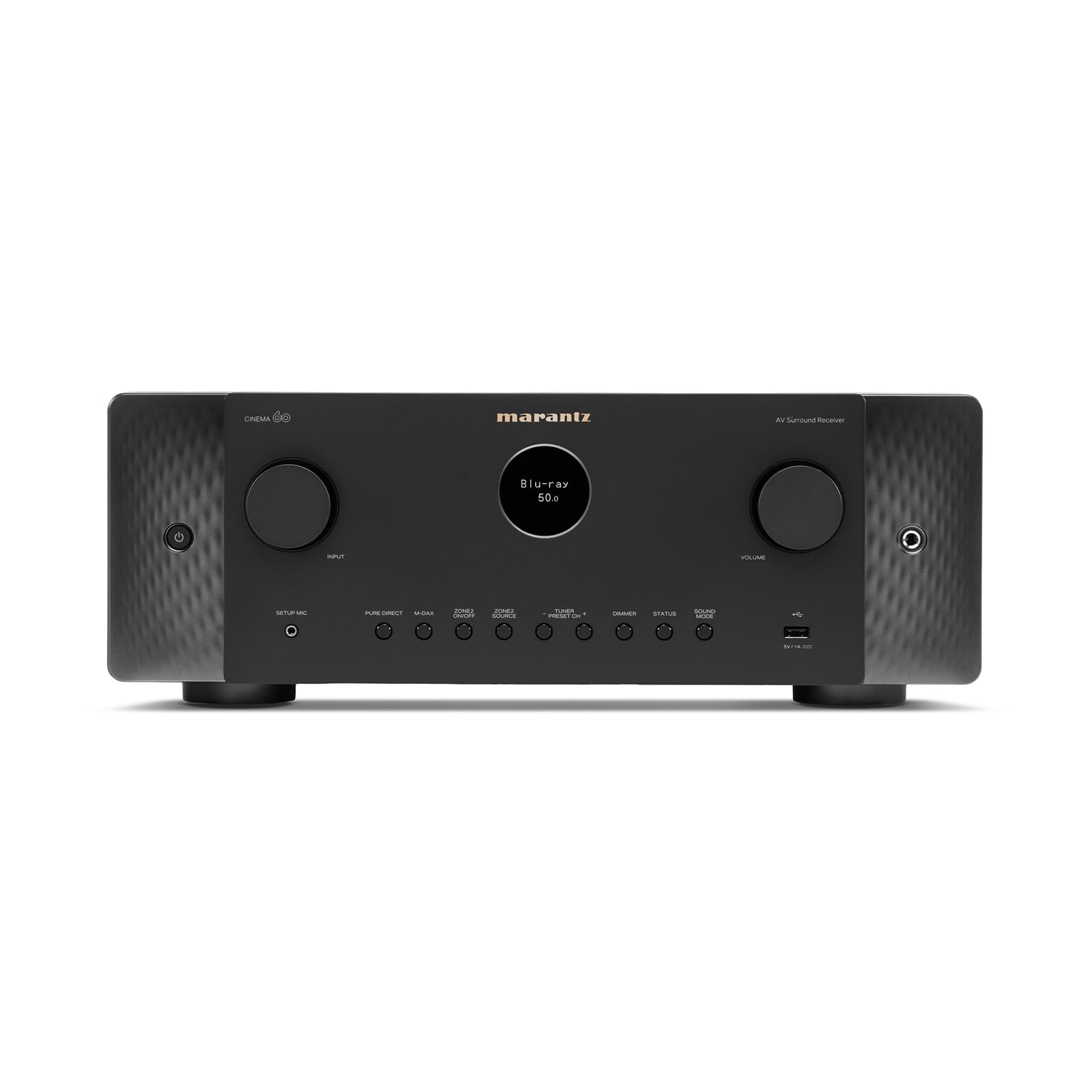
8. Marantz Cinema 60 Premium 7.2 Channel AV Receiver
Hand-tuned in Japan and built to sound warm on music, not just loud on explosions.
Most receivers in this group are sold on channel counts and codecs. This one is sold on a listening character: it is hand-tuned at Marantz’s Shirakawa facility in Japan and pitched at what the brand calls its most musical sound. Seven channels at 100 watts each drive Dolby Atmos and DTS:X into a three-dimensional field, and Audyssey MultEQ XT measures your specific room and tailors output to it. If your system spends as much time on albums as on films, that tuning bias is the reason to pay attention.
Inputs are flexible for mixed households: six HDMI inputs, three of them 8K-compatible, plus analog, digital, and phono connections. HEOS streaming covers Spotify, TIDAL, and Amazon Music HD over Wi-Fi. The pairing of a phono stage with a music-first tuning makes this a genuine two-channel option wearing a home theater badge — the Denon AVR-S770H, by contrast, does not list a phono input at all.
What is worth flagging is the track record. Owner history on this model is thin next to the Denon and Yamaha boxes here, and reliability draws a split response — plenty of units work exactly as promised, while some buyers could not get it behaving the way they wanted. There is also the physical side: it is listed at 17.32 inches deep, 21.65 inches wide, and 11.81 inches tall, considerably larger than the other receivers here, so measure before you commit shelf space. None of that undercuts the sound, which is what carries it.
The case for the Marantz sound
- Hand-tuned at the Shirakawa facility in Japan for a warmer musical character
- 100W x 7 with Dolby Atmos and DTS:X decoding
- Audyssey MultEQ XT tailors output to the specific room
- Phono, analog, and digital inputs plus three 8K-capable HDMI ports
What to weigh first
- Limited owner history compared with the Denon and Yamaha picks
- Split reliability feedback, so test thoroughly on arrival
- Larger footprint than most competitors here demands cabinet space
Best matched to: a listener who plays more music than movies and wants a phono stage plus Atmos in one chassis.
Hesitate if: your cabinet is tight or you want a long, well-documented owner record before spending.
9. Sony STR-AZ1000ES Premium ES 7.2 CH 8K A/V Receiver

The installer’s Sony: front-panel display, IP control, and a chassis built to sit in a rack.
Where the STR-AN1000 above aims at living rooms, this ES model aims at racks. It carries smooth IP control integration (network control) with the leading control systems, which matters if your receiver lives in a closet and answers to a wall panel or a remote programmed by an installer. Amplification is rated at 100W + 100W into 8 ohms, 1 kHz, two channels at 0.9 percent distortion (8 ohms is the speaker load; 1 kHz is the test tone; 0.9 percent is how much the signal is distorted). Dolby Atmos and DTS:X both decode, and Digital Cinema Auto Calibration IX and 360 Spatial Sound Mapping map the room the same way the consumer Sony does.
Video covers 8K and 4K/120 over HDMI 2.1 with six inputs and two outputs, plus Dolby Vision, HDR10, Hybrid Log Gamma, and IMAX Enhanced. Streaming is broad — Bluetooth, Wi-Fi, Chromecast built-in, Spotify Connect, Apple AirPlay — with Google Assistant voice control and Works With Sonos over a Sonos Port. Setup can run through the built-in graphical interface or the front-panel display, a genuinely useful second option when the unit sits facing away from you.
Build quality is the aspect that most consistently satisfies, with sound quality close behind. What buyers should know before deciding is that compatibility is a live issue: eARC handshakes with certain TV and cable-box combinations have caused headaches, and ease of use and value both draw divided opinions at this level. That is the tension — this is a premium-priced receiver whose core strength is build and integration, not a friendly first-time experience.
The integration argument: IP control with leading control systems plus a front-panel display makes this the pick for a rack-mounted build where nobody sees the receiver.
Where to be careful: verify eARC behavior with your exact TV and set-top box before you finalize the install.
For the rack: a custom-install system with a control panel, a projector, and a second display output to feed.
Not the shortcut: if you want simple first-day operation and rock-solid HDMI handshakes from the start.
10. Yamaha RX-A4A AVENTAGE 7.2-Channel AV Receiver

Surround:AI reshapes the effects in real time, scene by scene, without you touching a menu.
Yamaha’s AVENTAGE line sits at the top of its range, and this model earns the placement partly on processing. Surround:AI automatically tune sound and effects in real time as a scene changes — a quiet dialogue moment and a battle sequence get treated differently without input from you. Dolby Atmos and DTS:X decode alongside Auro-3D, which most receivers in this group do not offer. All seven HDMI inputs support 8K60 and 4K/120 at 40 Gbps, with three outputs, HDCP 2.3, eARC, and ALLM plus VRR for gaming.
Calibration runs deep with YPAO R.S.C. using 3D, multipoint measurement, precision EQ, and a low frequency mode. Video formats cover Dolby Vision, HDR10+, HLG, and BT.2020. Streaming is broad — Wi-Fi, Bluetooth, AirPlay 2, Spotify Connect, MusicCast, plus Spotify, Apple Music over AirPlay 2, Amazon Music HD, SiriusXM, TIDAL, Pandora, Deezer, and Qobuz, and it is Roon Tested. Voice control works with Alexa, Siri via AirPlay 2, and Google Assistant, a phono input is present, and it pairs with a Sonos Port for Sonos households. The unit weighs 18.6 kg.
One recurring friction point: the front display is small enough that reading it from the couch is genuinely hard, and a small display on a receiver this capable is a shame. Reliability and value both draw divided reactions at this price, and configuration divides buyers into easy and complicated camps. Features and build quality get the consistent praise. Against the Yamaha RX-V6A further up, its 7-in/3-out HDMI layout beats the V6A’s 7-in/1-out — two extra outputs for a TV, a projector, and a second room.
Why you would choose it: Auro-3D, Surround:AI, and three HDMI outputs are a combination no other receiver here offers.
The one catch: the front display is small enough to be hard to read from across the room, so lean on the app instead.
11. Denon AVR-X4800H 9.4 Ch Home Theater AV Receiver

Nine channels at 125 watts and four subwoofer outputs — the big-room build with nothing left out.
The top of this list earns its place on sheer capability. It runs 125 watts into each of nine channels, which against the Onkyo TX-RZ30’s 100W per channel and the Denon AVR-S770H’s 75W x 7 puts it in a different weight class for a large, open room. Ten HDMI ports — seven inputs and three outputs — with 8K and 4K/120 support mean almost nothing has to be unplugged to make room for something else. Add 8K/60Hz passthrough and smooth motion handling, and it is built to sit at the heart of a serious system rather than beside it.
The audio side goes further than Atmos alone: Dolby Atmos, DTS:X Pro, IMAX Enhanced, and Auro 3D all decode, with Dolby Height Virtualization and DTS Virtual:X generating overhead sound in a 7.1, 5.1, or 2.1 setup when no height speakers are installed. Four RCA or XLR subwoofer outputs (two common cable connector types) let you run a serious bass array without splitting signal. A phono input, analog and digital inputs, and built-in HEOS over Wi-Fi handle stereo and multi-room duty, with Pandora, Spotify, and TIDAL named as supported services. HDCP 2.3 (copy protection for HDMI) and eARC (the audio return channel that sends TV sound back to the receiver) cover the modern TV handshake.
Clarity and power at volume are what consistently impress here, and the feature spread, setup process, and user interface all get fair treatment rather than complaints, though the interface itself draws a divided reaction. What you give up is simplicity and footprint: at 14.9 inches deep, 17.1 inches wide, and 6.6 inches tall, this is a substantial box, and nine channels of this grade reward equally substantial speakers. A 9.4 layout (nine channels plus four subwoofers) is also more amplifier than most rooms can use.
What the top tier buys you
- 125W x 9 with Dolby Atmos, DTS:X Pro, IMAX Enhanced, and Auro 3D decoding
- 10 HDMI ports (7 in / 3 out) with 8K and 4K/120 passthrough
- Four RCA/XLR subwoofer outputs for a multi-sub bass array
- Built-in HEOS, phono input, and Dolby Height Virtualization for speaker-light setups
Where the ceiling is yours
- Nine channels of amplification is more than most rooms can put to work
- The user interface draws a divided reaction
- Substantial chassis and weight need a real shelf and real speakers to match
The deep end: a dedicated theater room with a 9-channel speaker array, dual subs, and a rack to hold it all.
Overkill if: your room tops out at a 5.1.2 layout, where the seven-channel picks above deliver for far less complexity.
Understanding the Specs
Channels and speaker layouts
Channel count (the 7.2 or 9.2 in a model name) tells you how many speakers the receiver can amplify and how many subwoofer outputs it carries. A 7.2 receiver typically builds a 5.1.2 Atmos layout — five ear-level speakers plus two height speakers — while a 9.2 box can reach 5.1.4 or 7.1.2. Height speakers are the ones that actually place sound above you; the virtualization alternatives fake that effect from floor-level speakers and tend to be less precise. Count your speakers first, then pick the channel count that feeds them.
Wattage ratings, read carefully
A watt figure means nothing until you know how it was measured. A rating taken across the full 20 Hz–20 kHz range with two channels driven and low distortion is the conservative, useful number. A rating taken at a single 1 kHz tone with one channel driven at higher distortion flatters the figure. Both styles appear on these spec sheets — the Pioneer VSX935 publishes 170W and 80W for exactly this reason. Match the number to your speakers’ efficiency and room size rather than chasing the largest digit.
Room calibration systems
Calibration uses a supplied microphone to measure your room, then adjusts the signal to suit it. Audyssey MultEQ XT, YPAO R.S.C., Dirac Live, and Sony’s Digital Cinema Auto Calibration IX all do this with different depth and different menus. Dirac Live tends to offer the most granular control and the steepest learning curve; bundled full-bandwidth licenses are note because that tier is often an add-on. In rooms with hard surfaces, calibration is usually the single biggest audible improvement available.
HDMI versions and gaming features
An HDMI 2.1 port with 8K60 and 4K/120 support is what a modern console and an 8K TV want. VRR (variable refresh rate) keeps frame pacing smooth, ALLM (auto low latency mode) switches the display into game mode without menu-diving, and QFT (quick frame transport) reduces lag. Check how many of a receiver’s inputs carry the full-speed feature set, not just whether the model claims HDMI 2.1 — several boxes here split fast and slow ports across the same panel.
FAQ
Do I need height speakers to hear Dolby Atmos on these receivers?
Is a 9-channel receiver worth it over a 7-channel one?
What is the difference between 80W and 170W on a receiver spec sheet?
Will these receivers pass 4K/120 from a game console?
Can I connect a turntable directly to these receivers?
What does Dirac Live add over a standard auto-calibration system?
How many HDMI inputs do I realistically need?
Do these receivers work with a Sonos system?
Can one receiver send a movie to one room and music to another?
Why do some people say Atmos receivers quit working early?
Final Thoughts: The Verdict
Your audio receiver dolby atmos decision depends on how many speakers you will actually hang. For a straightforward first build — seven channels, real Atmos decoding, height virtualization as a fallback, and an on-screen setup routine that does not fight you — the Denon AVR-X1700H is the pick that best balances capability against complication. It also holds 4.0+ stars across 700+ ratings, which strengthens the case.
If you want four overhead speakers and a properly measured room, the Onkyo TX-RZ30 is the one to reach for — the Dirac Live Full Bandwidth license bundled in the box is a genuine reason to spend up. For a big room with inefficient speakers and a phone-casting habit, the JBL MA710 brings 110 watts into all seven channels with AirPlay 2 and Chromecast on board. And if nine channels and a 10-port HDMI panel are what your theater room has been waiting for, the Denon AVR-X4800H closes the list at the top of the range. Buy the channel count your ceiling speakers can use, then run the calibration mic before judging the overhead effect.
How We Picked
We do not accept paid placement. Every pick is matched to a real buyer and a real use-case; we do not hands-on test units.
Sources & Methodology
Specifications: manufacturer listings and product documentation. Review insights: verified customer reviews, as of November 2026. Pricing: not shown on this page (it changes often); check the current price via the retailer link.
As an Amazon Associate, Gadgets Feed earns from qualifying purchases. This does not affect which products we feature.