
Our readers keep the lights on and my morning glass full of iced black tea. As an Amazon Associate, I earn from qualifying purchases.
Specs are compiled from manufacturer listings and verified buyer reviews and can change over time — please confirm the key details on the product page before buying.
Your catcher’s kit is the heaviest load on the team, and the wrong bag turns every walk from the parking lot into a wrestling match. What you need is a bag that swallows a chest protector, shin guards, helmet and four bats, then rolls over gravel instead of fighting you. This guide sorts the strongest catcher-specific options by what they actually do well, so you can pick the one that matches how you travel.
I’m Min — the founder and writer behind Gadgets Feed. This guide is built by comparing the manufacturers’ published specifications and the patterns across verified customer reviews, so you get each pick’s real strengths and trade-offs instead of marketing spin.
Below you’ll find rolling and duffle options sorted by real-world fit, from tournament haulers to compact backpack styles. Every pick here is judged on whether it truly holds a full catcher’s set, and our top pick is the Bownet Commander, a rolling hauler rated 4.5+ stars across 800+ reviews. If you want a bag that carries a full catcher’s set without tearing at the seams, this is the baseball catchers gear bag shortlist worth your time.
Our Picks at a Glance


How To Choose The Best Baseball Catchers Gear Bag
A catcher’s bag is not a generic duffle with a logo slapped on. It has to swallow a chest protector, a pair of shin guards, a helmet and a mask, and still leave room for cleats and a water bottle. Get the wrong one and you’ll be cramming gear into a sack that bursts a zipper by midseason. Here is what separates a bag built for catchers from a bag that just looks like one.
Wheels and handle: the part you’ll notice every single day
A loaded catcher’s bag gets heavy fast, so the rolling hardware carries the real workload. Rubber-treaded wheels roll over grass, gravel and dirt without snagging, while bare plastic wheels chatter and tip on uneven ground. A telescoping pull handle lets you roll the bag behind you at full height instead of dragging it at an awkward angle. If you haul gear across a tournament complex all weekend, this is the first spec to check.
Helmet protection and dedicated compartments
Your helmet and mask are the most fragile and most expensive pieces in the bag. A molded or semi-hard helmet case keeps the cage from getting crushed under shin guards. Look for a catcher-specific shin guard pocket too, because shin guards are long and awkward and will not sit flat in a general-purpose main compartment. Separate shoe storage keeps dugout dirt and smell away from your clean uniform.
Capacity in liters: how much gear space you actually get
Capacity is measured in liters, and a catcher’s full set plus backup gear tends to run large. A 130-liter duffle holds a full catcher’s set with room to spare, while a 56-liter backpack roller packs the same set snugly and rewards careful packing. Match the number to how you play: travel ball and tournament weekends want the bigger space, while a youth player who carries one set can get by with less.
Fence hooks, ventilation and the little things
Fence hooks let you hang the bag on chain-link instead of setting it in the mud, which keeps your gear clean and within reach. Ventilated cleat compartments let wet shoes air out instead of festering in a sealed pocket. Bat sleeves hold your bats upright and separate so the barrels don’t bang together. These small features are what you notice after the first rainy tournament.
Quick Comparison
| Model | Best For | Capacity | Compartments | Wheels | Amazon |
|---|---|---|---|---|---|
| Bownet Commander Rolling Catcher’s Gear Bag★ Best Overall | Best Overall | — | 14 pockets | Big Trax all-terrain | Amazon |
| 130L Heavy Duty Large Duffle Equipment BagMax Capacity | Maximum capacity | 130 liters | 7 | None | Amazon |
| Large Rolling Baseball Catchers Gear Bag with WheelsRolling Bargain | Budget rolling | 86 liters | 5 | 2 sliding rollers | Amazon |
| Rolling Baseball Backpack with Off-road Wheels | Backpack carry | 56 liters | 4 | Steel bearing off-road | Amazon |
| Boombah Rolling Catcher’s Superpack | Compact wheeled | 4 bats | 2 | Heavy duty | Amazon |
| Easton Catcher’s Wheeled Bag Series | Organization | — | Multiple | Rugged inline | Amazon |
| Rawlings YADI 2.0 Wheeled Catcher’s Bag | Bat capacity | 6 bats | Multiple | Wheeled | Amazon |
| PowerNet Optimus Catcher’s Bag | Organization | 8 compartments | 8 | Telescopic | Amazon |
| PowerNet All Gear Transporter | Coach + catcher | 4 nets | 20+ pockets | All-terrain | Amazon |
In‑Depth Reviews
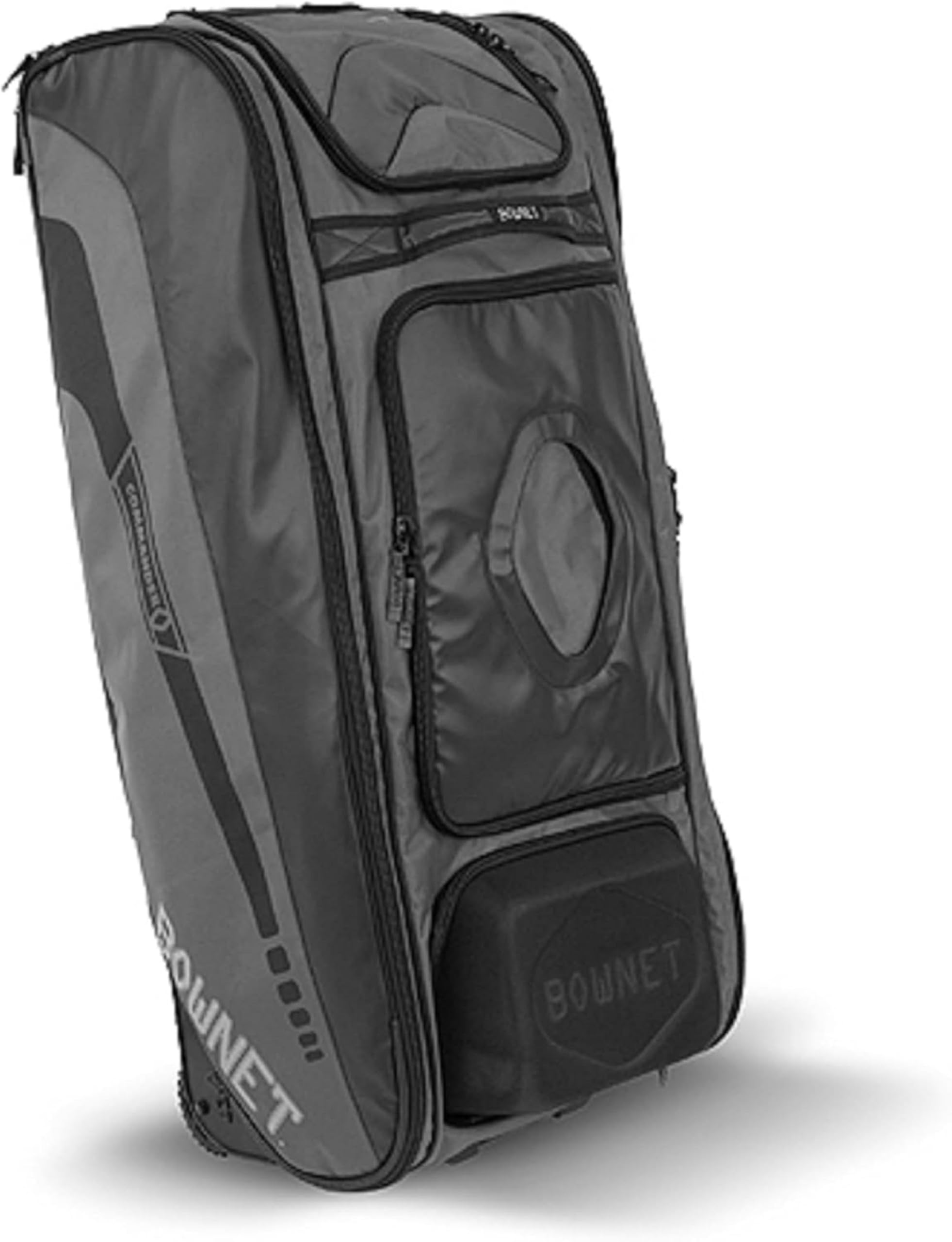
1. Bownet Commander Rolling Catcher’s Gear Bag with Wheels
Our pick — 4.5+★ from 850+ verified ratings; the strongest balance of quality and price.
The all-terrain hauler that keeps a fully loaded catcher’s kit rolling instead of dragging.
The Commander’s defining trait is its Big Trax wheels — rubber-treaded rollers built to cross grass, gravel, dirt and pavement without tipping. On a tournament weekend you’re moving between fields all day, and those wheels are the difference between a smooth roll across grass and gravel and a daily drag. A telescoping pull handle runs up to full height so you wheel it behind you, and top and side lift handles make loading it into the car easy even when it’s packed.
You get a place for every piece of catcher’s gear with the 14-pocket layout built specifically for catchers. A molded semi-hard helmet case shields your cage (your face mask), a catcher-specific shin guard pocket holds your leg guards, and a side panel carries 3 full-size bats. Ventilated cleat storage lets your shoes air out, and a removable internal shelf pulls out to make one big open space. The weather-resistant fabric and reinforced zippers are aimed at players who use their gear hard, and bottom feet keep the bag off dirty dugout floors. It measures 38 by 17 inches in length and width, deliberately larger than the compact 11.8-inch-wide rolling bag further down this list — more room for a full set, but a bigger footprint in a crowded car.
The honest trade-off is durability at the edges: most buyers report the Commander holds up well, though a minority report edge wear after about a year. Zipper quality is the recurring gripe, so treat the zips with some care and don’t overstuff a pocket to the bursting point. What wins people over is capacity — the 14-pocket layout swallows a chest protector, shin guards, helmet and bats with room left over — plus a dedicated compartment for a second helmet that keeps a backup shell separate. If you carry a full catcher’s set for travel ball, this is the one to beat. skip it if you mostly walk to a local field and want something lighter to sling over your shoulder.
Where it earns the crown
- Big Trax rubber-treaded wheels roll over grass and gravel without tipping
- Molded semi-hard helmet case protects the cage from shin guards crushing it
- 14 pockets including a catcher-specific shin guard pocket and ventilated cleat storage
- Removable internal shelf flips between organized and one big open space
The honest trade-off
- Zippers are the weak point — care needed when the bag is fully packed
- 38 by 17 inches is a large footprint to fit into a full car
Right for you if: you play travel ball or tournament weekends and haul a full catcher’s kit across grass and gravel.
Think twice if: you want a light bag to carry on your back for a short walk to a local field.
2. 130L Heavy Duty Large Duffle Equipment Bag
If “fits everything” is your buying criterion, this 130-liter duffle ends the search.
Capacity is the whole point here: a 130-liter main compartment measuring 35 by 16 by 15 inches. The tear-resistant polyester and a cut-resistant bottom fabric protect the bag from sharp objects on the ground, and the maker rates the duffle to support up to 80 pounds of catcher’s gear.
Organization runs to 7 compartments. The main space takes your clothes, helmet, catcher’s gloves and protective gear; four smaller pockets handle phone and personal items; and independent side pockets swallow a water bottle, an umbrella or shoes. Three ventilation holes on the back keep odors from building up on sweaty gear, and an adjustable detachable shoulder strap measuring 49.21 inches offers a carry option when a duffle suits you better than a roll. Velcro stickers and a business-card holder let you mark it as yours in a pile of team bags.
Bear in mind this is a duffle, not a wheeled bag, so the 80-pound-rated build still lands on your shoulder when it’s fully loaded. It’s the right call if you want the most raw gear space for the money and don’t mind doing the lifting yourself. pass on it if rolling transport is a must — this one relies on padded handles and a shoulder strap, not wheels.
The case for it: 130 liters in a tear-resistant, water-resistant shell is the most gear room here for the least money, and the cut-resistant base protects it on rough ground.
The follow-up question: it has no wheels, so you carry all that capacity on shoulder straps — comfortable for short trips, less so for long tournament walks.
Reach for this if: your priority is total gear capacity and a shoulder strap you can hand off to a teammate.
Look elsewhere if: you need wheels to roll a heavy kit across a complex all day.
3. Large Rolling Baseball Catchers Gear Bag with Wheels
Rolling wheels and a long, slim shape — but the stitching is where you’ll want to look closely.
This one is built around a long, tall silhouette: 38.97 inches of length, which is nearly 4 inches longer than the 130-liter duffle above. The main space takes knee pads and gloves, the top compartment stores a helmet, and the back carries four bats. A separate shoe compartment at the bottom keeps cleats away from clean gear, and two fence hooks at the top let you hang the bag on the net instead of setting it in the dirt. At 86 liters it is 44 liters smaller than the 130-liter duffle — less raw space, but shaped to slot behind you on a run bag.
What people like most is simply how much softball equipment it holds and how easily the wheels roll across the road and grass. Handle options are thoughtful too: side and top carry handles for lifting, plus sliding rollers for the long walk in. An anti-friction fabric patch at the bottom of the back cuts down on dragging wear.
The catch is durability. Quality and sturdiness come in for genuine pushback — stitching that doesn’t hold up and fabric wearing through within a season are the recurring complaints. This is a bag that rewards sensible loading rather than cramming. If you want a rolling option for a youth player or a backup set that won’t see daily abuse, it earns its place. it’s not for you if you need a bag to survive back-to-back tournament seasons.
What works well
- Rolling wheels make transport easy on road and grass
- Separate shoe compartment keeps cleats apart from clean gear
- Two fence hooks lift the bag off the ground at the park
- Top compartment holds a helmet while four bat sleeves carry bats
Where it falls short
- Stitching and fabric durability are the common gripes — don’t overload it
- 86 liters is noticeably tighter than the big duffles above
Suits you when: you want a rolling catcher’s bag for a youth player or a spare set at a lower entry point.
Skip it when: you need a bag to hold up to a full season of hard, daily tournament use.
4. Rolling Baseball Backpack with Off-road Wheels
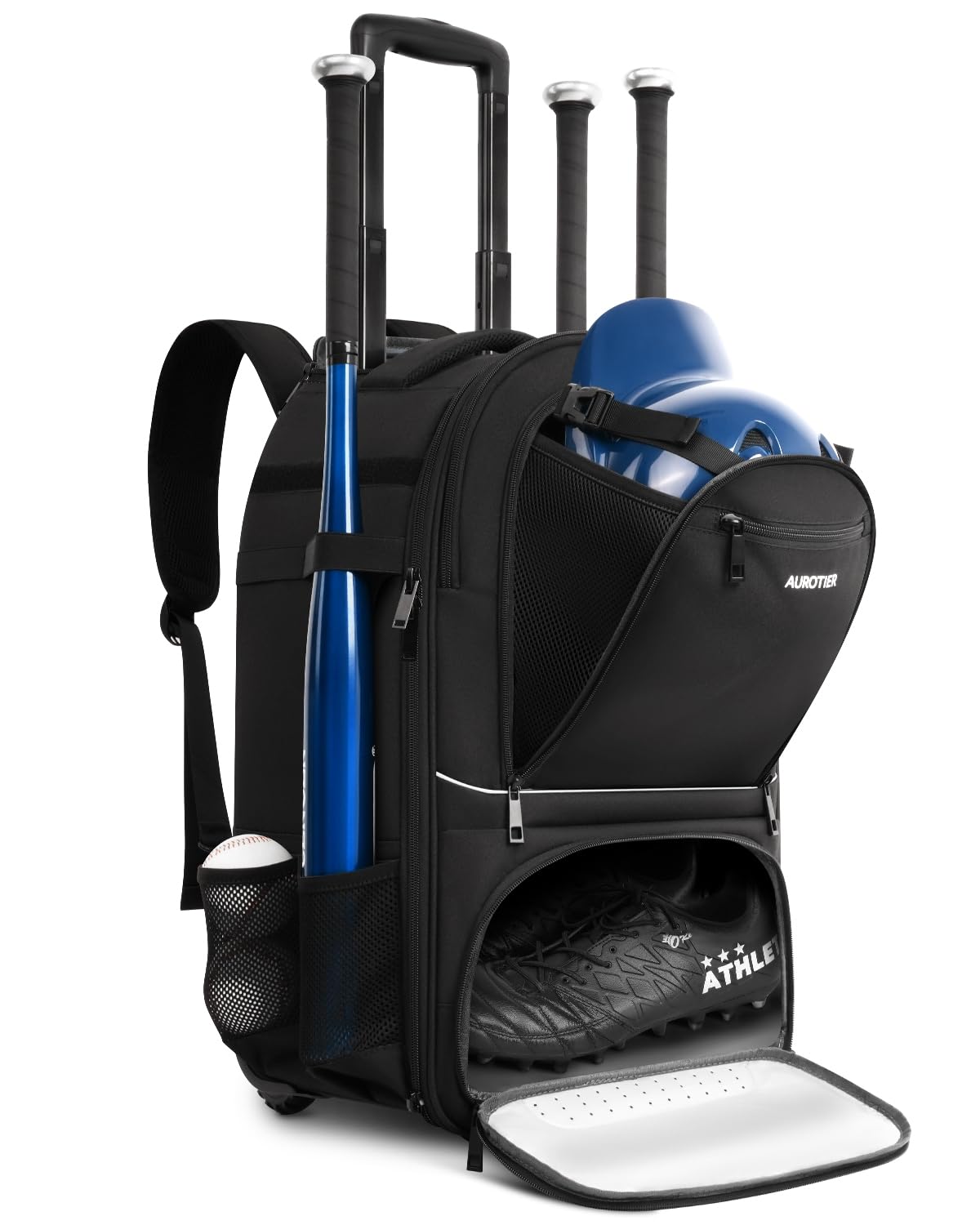
A backpack that also rolls — the switchable carry style for catchers who walk and wheel.
The headline feature is flexibility: steel bearing off-road wheels with a large ground clearance to clear grass and sand, plus thick-padded shoulder straps for when you want it on your back. The PVC back panel gives rigidity so the bag doesn’t sag, and the waterproof bottom material wipes clean. A hidden telescoping handle lets you switch between rolling and carrying in seconds, which matters when a grassy field has you lifting and rolling rather than dragging.
Inside, a dedicated helmet compartment keeps the shell protected, while the spacious main compartment takes helmets, masks, throat guards, chest protectors, gloves, wrist guards, leg guards, clothes and towels. Four elastic mesh pockets hold up to 4 bats and water bottles, and the breathable shoe compartment keeps cleats away from the rest. A dry/wet separation compartment can hold clean clothes or frozen drinks, and reflective stripes on the shoulder straps make you visible in low light.
Capacity is 56 liters — the smallest full-rolling option reviewed here, so it packs a catcher’s set snugly rather than loosely. Treat the compartment space as the limit and this becomes an excellent all-rounder. It’s the pick for the catcher who rotates between shoulder carrying and rolling depending on the field. If you routinely carry backup gear on top of a full set, the bigger duffles are safer. If one set and smart packing is your normal day, this is a comfortable, well-built choice.
What stands out: build quality and the good-value feel are what most please people, and the off-road wheels roll smoothly across complex ground while a hidden fence hook lifts the bag off the dirt.
What you should know: 56 liters is tight for a full adult catcher’s set plus extras, so this rewards organized packing over cramming.
Best fit: the multi-mode catcher who wants to carry on the shoulder and roll on the field without switching bags.
Not the one for: hauling a full set plus a second bag of backup gear every outing.
5. Boombah Rolling Catcher’s Superpack
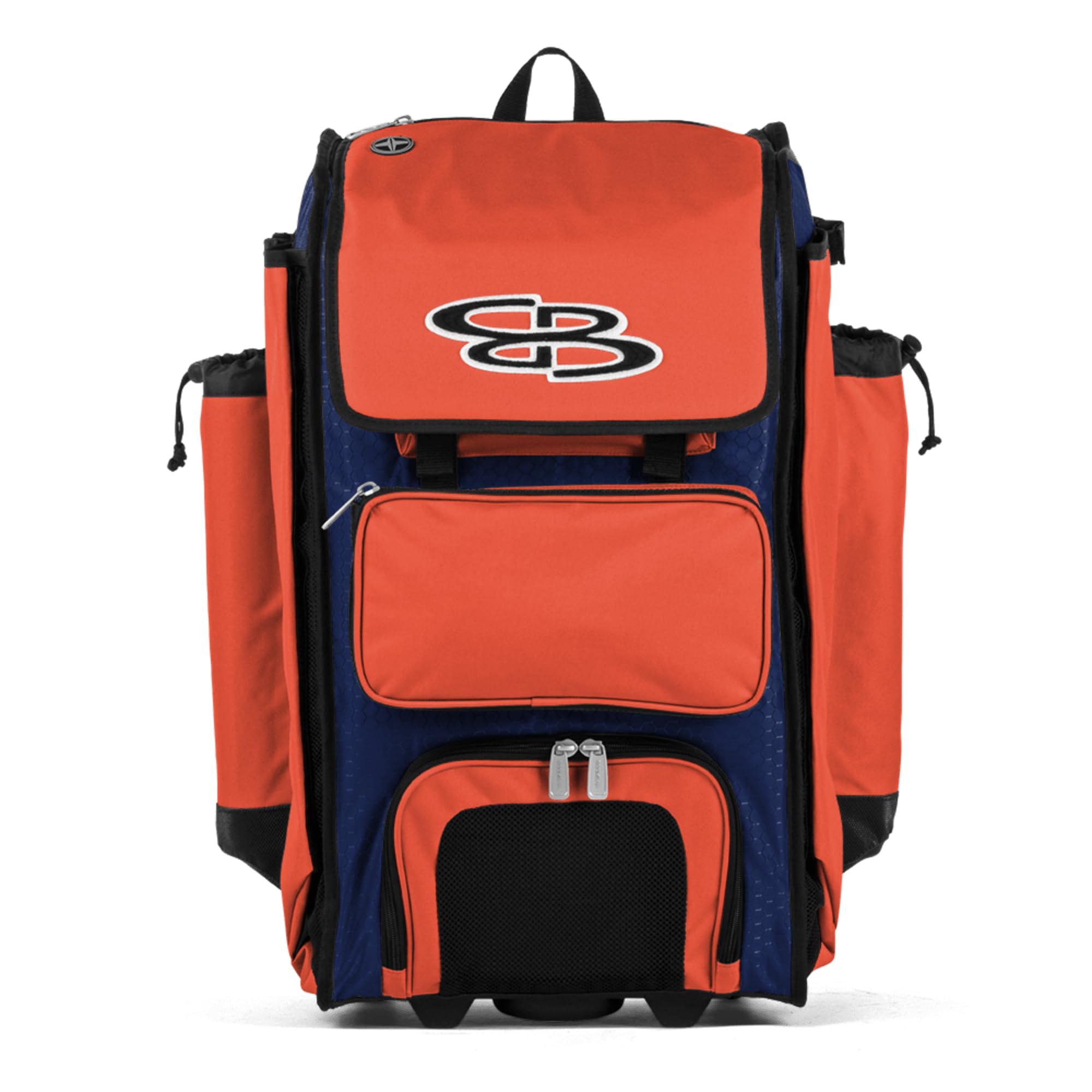
A tight, purpose-built wheeled bag that hangs on the fence and holds four bats.
Boombah keeps this one compact at 23.5 by 13.5 by 9.5 inches and 7.5 pounds, with a telescopic handle that stops in two positions. Heavy-duty wheels carry the bag, side compartments take a pair of bats each, and reinforced J-hooks hang it on the chain-link so your gear stays out of the mud. The separate shoe compartment keeps cleats away from clean gear. It’s the rolling version specifically, not the backpack, so treat it as a wheel-only hauler.
Polyester construction keeps the weight reasonable, and the two-position handle helps smaller players find a pull height that isn’t awkward. For a catcher who wants a tidy rolling bag that hangs neatly on the fence and doesn’t sprawl across the dugout floor, the compact footprint is a plus.
The tight dimensions are also the limit — this is a compact wheeled bag, not a tournament hauler that also holds spare uniforms and extra gear. If you pack exactly one catcher’s set and a few bats, the Superpack fits the job cleanly. If you’re hauling a full travel-ball mountain of gear, you’ll want more space.
Go with this: you want a tidy rolling catcher’s bag with a fence hook and a compact footprint.
Pass on this: your travel-ball kit expands beyond a single set and a few bats.
6. Easton Catcher’s Wheeled Bag Series

Rigid base, two shelves, and sleeves aimed straight at your shin guards.
Easton builds this around a rigid base and back with a telescopic handle and rugged inline wheels, so it rolls with a stiff, stable shell instead of a floppy one. The catcher-specific detail is a pair of expandable side sleeves built for leg guards — those long shin guards get a home of their own rather than being crammed into the main compartment.
Organization runs deep: three mesh-vented compartments for breathability, two detachable internal shelves, two fully-lined bat sleeves with integrated fence hooks, and an internal mesh pocket with hook-and-loop for batting gloves. A felt-lined personal pocket protects a phone, and external straps with quick-release buckles hold gloves or helmets. A small removable bag keeps personal items together at the bottom of the main space.
The size feedback is split — some find it spacious, others say it isn’t large enough for everything they’d like to carry. For catchers who like every piece of gear in its slot, the Easton’s rigid frame and leg guard sleeves make it a thoughtful pick.
Why it works: the rigid base and back keep the bag standing and rolling straight, and the expandable side sleeves give shin guards a dedicated home alongside the two detachable shelves.
One thing to weigh: size is the point of contention — great for organized packers, tighter for anyone who wants maximum open space.
Solid choice for: catchers who want every piece of gear in a labeled slot and a bag that stands up on its own.
Consider another if: you want one wide open compartment instead of shelves and sleeves.
7. Rawlings YADI 2.0 Wheeled Catcher’s Bag

Six bats, two gloves, one XL compartment — a bat-first bag with a catcher’s heart.
Rawlings built this bag around storage so you can carry a full catcher’s set plus extras. Internal bat storage fits up to six bats, a dedicated two-glove compartment keeps your gloves safe and ready, and an XL main compartment takes an adult-sized catcher’s set. Two large mesh pockets give easy access, and five top and side pockets handle small gear. The layout suits a player with a lot of small gear to keep track of.
Dimensions come in at 37 inches long by 14 wide by 14 high, and the polyester shell keeps the bag reasonably light. The extra-large capacity that holds multiple bats and extras is what buyers appreciate most, and the bag runs larger than expected with compartments for everything. If you carry a bat bag’s worth of gear plus a catcher’s set, the space is there.
The honest caveat is durability and stability: construction and rolling stability come in for mixed feedback, and pockets have been known to rip out under heavy loads. Load it sensibly and it holds up; over-stuff the pockets and you invite trouble. This is a bat-forward pick for catchers who also play the field and want their bats inside the same bag.
Why it makes the list
- Internal storage fits up to six bats — the most dedicated bat space on this list
- Two-glove compartment keeps gloves separate and ready
- XL main compartment takes an adult-sized catcher’s set
What to keep in mind
- Construction and rolling stability get mixed notes — don’t overload the pockets
- Pockets can pull away under heavy loads, so distribute weight evenly
Choose it for: a catcher who also wants a full six-bat bag and two-glove storage in the same carry.
Do not choose it: if you want the most stable roller and plan to stuff every pocket to the limit.
8. PowerNet Optimus Catcher’s Bag
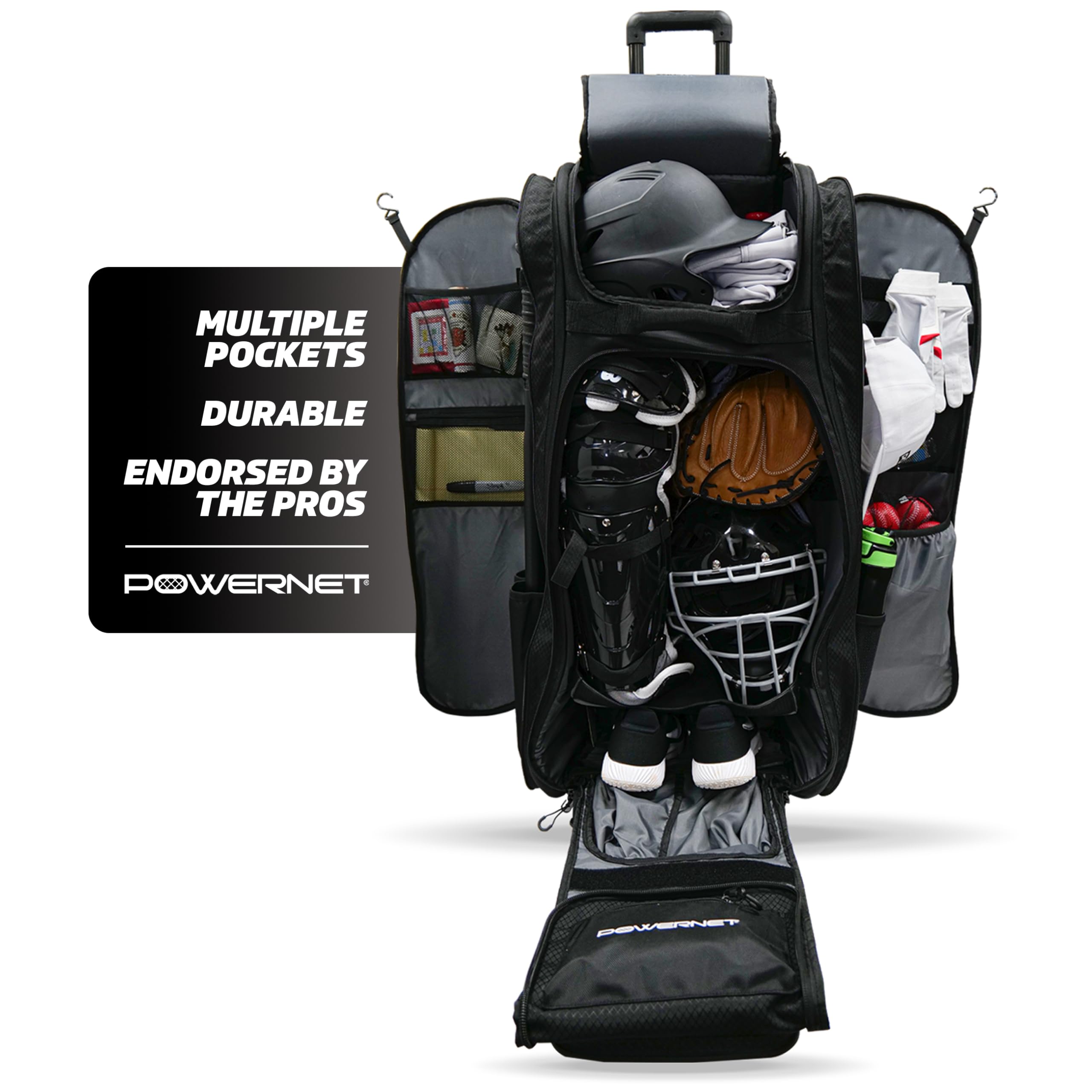
Eight compartments, five fence hooks, and a felt-lined pocket for your phone.
The Optimus leans hard into organization. A large main pocket holds your catcher’s glove, gear, balls and helmet, backed by 2 internal mesh pockets, 3 accessory hangers, adjustable shelves and two water bottle holders. That is 8 compartments working together so nothing ends up loose in the bottom of the bag. Felt-lined pockets protect a phone, fabric strips hold batting gloves, and the ventilated cleat compartment lets wet shoes air out while you travel.
The standout practical touch is five hidden hanging hooks inside the bag — enough to hang it on any chain-link fence and keep your gear off the ground with easy access during games and practice. Support rails on the back prevent tearing at the stress points, and the heavy-duty fabric is reinforced where a bag tends to fail first. It’s built for players 12 years and older and holds up on its own when fully loaded.
What lets it down for some is long-term durability and value — a portion of buyers find it doesn’t hold up as well as they hoped, and some consider it pricey for what it is. It responds best to being packed within its limits rather than overloaded. The organization and sturdiness are the stars; treat those as the reason to buy and keep the load reasonable.
The winning detail: five hidden hooks and eight compartments mean the bag hangs at eye level and every accessory has a home — it even stands up on its own when fully loaded.
Worth knowing: durability and value draw mixed views, so this is a bag to pack sensibly rather than cram to the brim.
Ideal for: a detail-driven catcher who wants a fence-hanging bag with a slot for everything.
Think again if: you want maximum open space and don’t care about organizing every pocket.
9. PowerNet All Gear Transporter

The one bag that replaces the wagon — nets, helmets and catcher’s gear in one roll.
The All Gear Transporter’s large main compartment fits up to four 7×7-style net carry bags (mesh bags about 7 by 7 inches), or a mix of coaching equipment including shin guards and catcher’s gear. A removable divider opens the whole thing into one big space. Over 20 pockets and hooks store everything from a clipboard to a first aid kit, and it holds 3 full-size bats plus practice balls. This is the pick for a coach or a catcher who hauls team equipment, not just their own set.
Mobility is handled by a hidden telescoping pull handle and large all-terrain wheels that roll over asphalt, dirt and grass, with grab handles along the top, bottom, front and back to load it into a car easily. Hanging hooks keep the flaps open so your equipment stays at a glance, and the molded plastic bottom plus heavy-duty fabric resist wear, with support rails preventing tearing at the back.
It’s a volume hauler first. If you want one bag for nets, coaching gear and a catcher’s set all at once, it does the job. If you only ever carry your own gear, the size is more than you need.
Worth buying for: coaches and catchers who haul nets, helmets and team gear together and want wheels instead of a wagon.
Probably overkill if: you only need to carry a single catcher’s set of your own.
Understanding the Specs
Capacity in liters vs. bat count
Capacity is measured in liters for the main space, and bats are often counted separately because they live in dedicated sleeves. A bag rated at 130 liters gives you the most raw room for a full catcher’s set and backup gear. A bag rated to hold four or six bats tells you how many bats the sleeves or internal storage will take. Read both numbers, because a bag can be huge and still only hold a handful of bats, or compact and hold more bats than you own.
Wheel type: tires vs. inline rollers
Wheels are named differently across brands — “Big Trax,” “off-road wheels,” “inline wheels,” “sliding rollers.” Rubber-treaded wheels roll over grass, gravel and dirt without snagging, while smaller rollers work best on pavement and smooth floors. A steel bearing wheel set handles rough ground and a heavy load better than a bare plastic wheel. Match the wheel type to the surfaces you cross most and the weight you carry.
Helmet cases and shin guard sleeves
A molded or semi-hard helmet case shields the cage from shin guards and other gear pressing against it. Separately, expandable side sleeves built for leg guards give shin guards a dedicated slot instead of a place in the main compartment. Both features matter because a cracked mask or a scratched cage is an expensive fix. Look for them by name when you shop.
Fence hooks and ventilation
Fence hooks let you hang the bag on chain-link so it stays off wet dugout floors and your gear is within reach. Some bags tuck hooks inside for hidden storage; others mount them on the top. Ventilation is usually a mesh-vented compartment or a set of vent holes that lets cleats and sweaty gear air out, which keeps odor from building up over a season. Both are small features that make a big difference in daily use.
FAQ
Will a rolling catcher’s gear bag fit in the trunk of a sedan?
How much gear can a 130-liter catcher’s bag actually hold?
Do wheeled catcher’s bags roll well on grass and gravel?
What’s the difference between a molded helmet case and a separate helmet compartment?
How do fence hooks work on a baseball gear bag?
Is a backpack roller better than a standard rolling bag for a catcher?
How long should a catcher’s gear bag last?
Can a catcher’s gear bag also carry bats and a glove?
What is the difference between liters and pocket counts on these bags?
Do I need a wheeled bag or a duffle for youth travel ball?
Final Thoughts: The Verdict
For most catchers, the baseball catchers gear bag winner is the Bownet Commander because it pairs all-terrain Big Trax wheels with a catcher-specific 14-pocket layout and a molded helmet case, so a full kit rolls instead of hauls. If you want the most raw gear space and don’t mind a shoulder carry, the 130L Heavy Duty duffle holds two full sets. And for a catcher who also plays the field and wants six bats in the same bag, the Rawlings YADI 2.0 is the one to reach for.
How We Picked
We do not accept paid placement. Every pick is matched to a real buyer and a real use-case; we do not hands-on test units.
Sources & Methodology
Specifications: manufacturer listings and product documentation. Review insights: verified customer reviews, as of November 2026. Pricing: not shown on this page (it changes often); check the current price via the retailer link.
As an Amazon Associate, Gadgets Feed earns from qualifying purchases. This does not affect which products we feature.