
Our readers keep the lights on and my morning glass full of iced black tea. As an Amazon Associate, I earn from qualifying purchases.
Specs are compiled from manufacturer listings and verified buyer reviews and can change over time — please confirm the key details on the product page before buying.
You want a big-screen picture you can carry from the bedroom to the backyard, and brightness decides everything. A projector that claims 4K but can barely light up a dark wall will disappoint you on night two. The picks below all put a true 4K image in a compact body, and each one solves a different problem — the brightest for a room with lamps on, the smallest to actually fit in a bag, the one with the best color. Start with the Nebula Cosmos 4K SE if you want the most complete package.
I’m Min — the founder and writer behind Gadgets Feed. This guide is built by comparing the manufacturers’ published specifications and the patterns across verified customer reviews, so you get each pick’s real strengths and trade-offs instead of marketing spin.
One honest note before you scroll: this list uses flexible, human-like matching for true 4K resolution, so not every pick is the exact number you searched — the nearest same-type compact 4K model serves the same purpose. Here is the breakdown of the 4k pocket projector category, sorted by what each unit does best.
Our Picks at a Glance

How To Choose The Best 4K Pocket Projector
The single question that decides your purchase is how much light the projector can throw. Every other spec — resolution, contrast, speakers — is secondary if the picture washes out the moment a lamp is on. Work through the four checks below in order and you will land on the right unit.
Brightness Is The Real Buying Decision
ANSI lumens is the standard measure of visible light output — the higher the number, the more the picture survives ambient light. The Nebula Cosmos 4K SE lists 1,800 ANSI lumens versus the Epson Lifestudio Pop Plus at 700 lumens. If you plan to watch with lamps on, that 1,100-lumen gap decides the purchase. If you only ever watch in a fully dark room, a lower-lumen unit still looks excellent.
True 4K Versus “4K Input”
A native 4K chip means the projector has the physical pixels to draw 3840 x 2160 detail — that is the spec you want. Plenty of cheaper units accept a 4K signal but display a lower resolution, which softens the image. Look for the word “native” or “true 4K” in the listing and check the resolution field reads 3840 x 2160 or higher.
Setup Sensors And Keystone
You will move a portable projector constantly, so auto-setup matters more than it does on a ceiling mount. Auto focus sharpens the image on power-up, while auto keystone corrects the trapezoid shape when you angle the unit. Every pick here includes both in some form — the difference is how reliably they lock in.
Light Source: Laser, LED Or Hybrid
A laser light source (a solid-state beam instead of a lamp bulb) tends to hold color and brightness steadier over time. Hybrid designs pair LED with laser. Laser units also eliminate the spinning color wheel that some DLP projectors use, which removes the faint rainbow edge a few people notice on fast-moving scenes.
Quick Comparison
| Model | Best For | Brightness | Resolution | Contrast | Amazon |
|---|---|---|---|---|---|
| Nebula Cosmos 4K SE★ Best Overall | Best overall balance | 1800 lm | 3840 x 2160 | 400:1 | Amazon |
| U1 PRO Native 4K UHDSharpest Detail | Best for dark-room detail | 1700 lm | 3840 x 2160 | 5000:1 | Amazon |
| Epson Lifestudio Pop Plus | Best compact footprint | 700 lm | 3840 x 2160 | — | Amazon |
| XGIMI Elfin Flip 4K | Best contrast | 1600 lm | 3840 x 2160 | 20000:1 | Amazon |
| JMGO N1S 4K Upgrade | Best color and adjustability | 1700 lm | 3840 x 2160 | 1000000:1 | Amazon |
| Hisense M2 Pro | Best for big-screen nights | 1300 lm | 3840 x 2160 | 5000:1 | Amazon |
In‑Depth Reviews
1. NEBULA Cosmos 4K SE Portable Projector
Our pick — 4.5+★ from 250+ verified ratings; the strongest balance of quality and price.
The all-rounder that holds its picture even with the living-room lamps on.
If you are setting this up in a room where you do not want to kill every light, start here. The Cosmos 4K SE is specified at 1,800 ANSI lumens — a measure of how much visible light it throws — and that is the top brightness figure on this list. It gets there through HybridBeam technology, which pairs an LED light source with a laser. What that means for you: the image stays punchy on a wall during a normal evening, not just in total darkness.
The image engine side is just as deliberate. It uses a 3840 x 2160 4K panel with Dolby Vision support — Dolby Vision is a frame-by-frame brightness and color adjustment that keeps highlights from blowing out. Its contrast ratio reads 400:1, which is the one number here you should not read as a ranking. The XGIMI Elfin Flip advertises a 20,000:1 contrast ratio, so on paper the Cosmos trails badly on that single spec. In practice, picture performance is the most-praised point in the reviews, and it holds up especially well after dark.
Setup is where the honest caveat lives. The IEA 4.0 intelligent system handles real-time autofocus, keystone correction, obstacle avoidance, screen fit and wall-color adaptation automatically. The autofocus and auto-keystone functions draw a split reaction — a mix of praise and frustration — so treat the first power-on as a moment to nudge it manually if the corners look off. Once it locks, Google TV with 4K Netflix is built in, so there is no streaming stick dangling from the back. Portability gets steady praise, and it is small enough to move between rooms without a second pair of hands.
What Earns Its Place
- 1,800 ANSI lumens — the brightest pick here, so you can watch with the lights low rather than off.
- 200″ max screen size turns a blank wall into a theater-size picture.
- Google TV with 4K Netflix runs inside the unit — no extra dongle needed.
- Built-in speakers are genuinely well-liked, so you can skip an immediate soundbar.
Where It Asks Patience
- Auto focus and auto keystone get a split reaction — expect to fine-tune by hand on the first setup.
- Its 400:1 contrast figure is far lower than the XGIMI Elfin Flip’s 20000:1 on paper.
Best fit for: anyone who wants one projector that does bright room, big screen and streaming without add-ons.
Think twice if: you watch only in a pitch-dark room and want the deepest blacks the spec sheet can offer.
2. U1 PRO Native 4K UHD Google TV Projector
Built for the buyer who cares about a lens that stays sharp year after year.
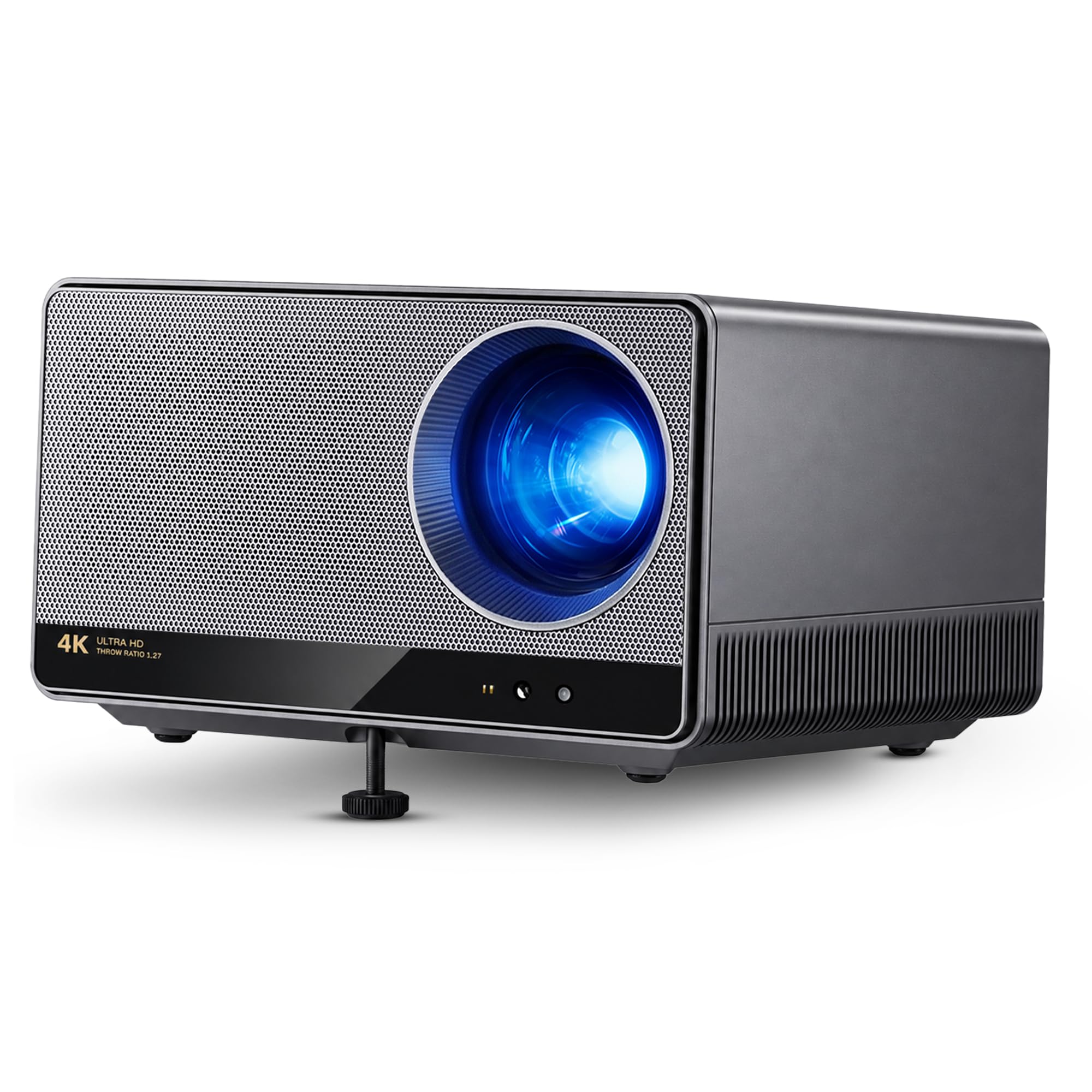
Here is a detail most listings bury: the U1 PRO uses an all-glass optical lens instead of a plastic one. Glass resists thermal expansion — the slight swelling that heat causes — so the focus does not drift as the unit warms up. Its optical engine is fully sealed to keep dust off the light path, which is the usual cause of faint blotches on older projectors. For long movie nights, that sealed glass lens is a real longevity advantage, not a marketing phrase.
On resolution it matches the Nebula Cosmos 4K SE: the U1 PRO is listed at 3840 x 2160 pixels, the same as the Cosmos. Brightness sits at 1,700 ANSI lumens — bright enough for a dim room, and close to the Cosmos. Its stated contrast is 5000:1, a big step above the Cosmos’s 400:1, so dark scenes carry more weight on this panel.
Sound is a stronger story than you might expect from a compact unit: dual 16W speakers with a bass-reflex port and an oversized 600cc sound cavity fill a room without a soundbar. Connectivity is generous too, with dual HDMI 2.1 ports, two USB ports, a 3.5mm jack, Bluetooth and wireless mirroring, plus a 60Hz refresh and low-latency mode for console gaming. The trade-off: it is a desktop form factor rather than a true throw-in-a-bag pocket unit, so plan to leave it on a shelf and move it only occasionally.
The glass-lens argument: a sealed glass lens resists focus drift and dust, which is exactly the wear that shortens a cheaper projector’s sharpness over years of use.
One number to weigh: at 1,700 ANSI lumens it trails the top pick’s 1,800, so a fully lit room is still its weak spot.
Reach for this if: you want the sharpest native 4K panel and a lens built to hold focus long-term.
Look elsewhere if: you need a projector that genuinely travels in a backpack weekend to weekend.
3. Epson Lifestudio Pop Plus 4K PRO-UHD Personal Lifestyle Projector
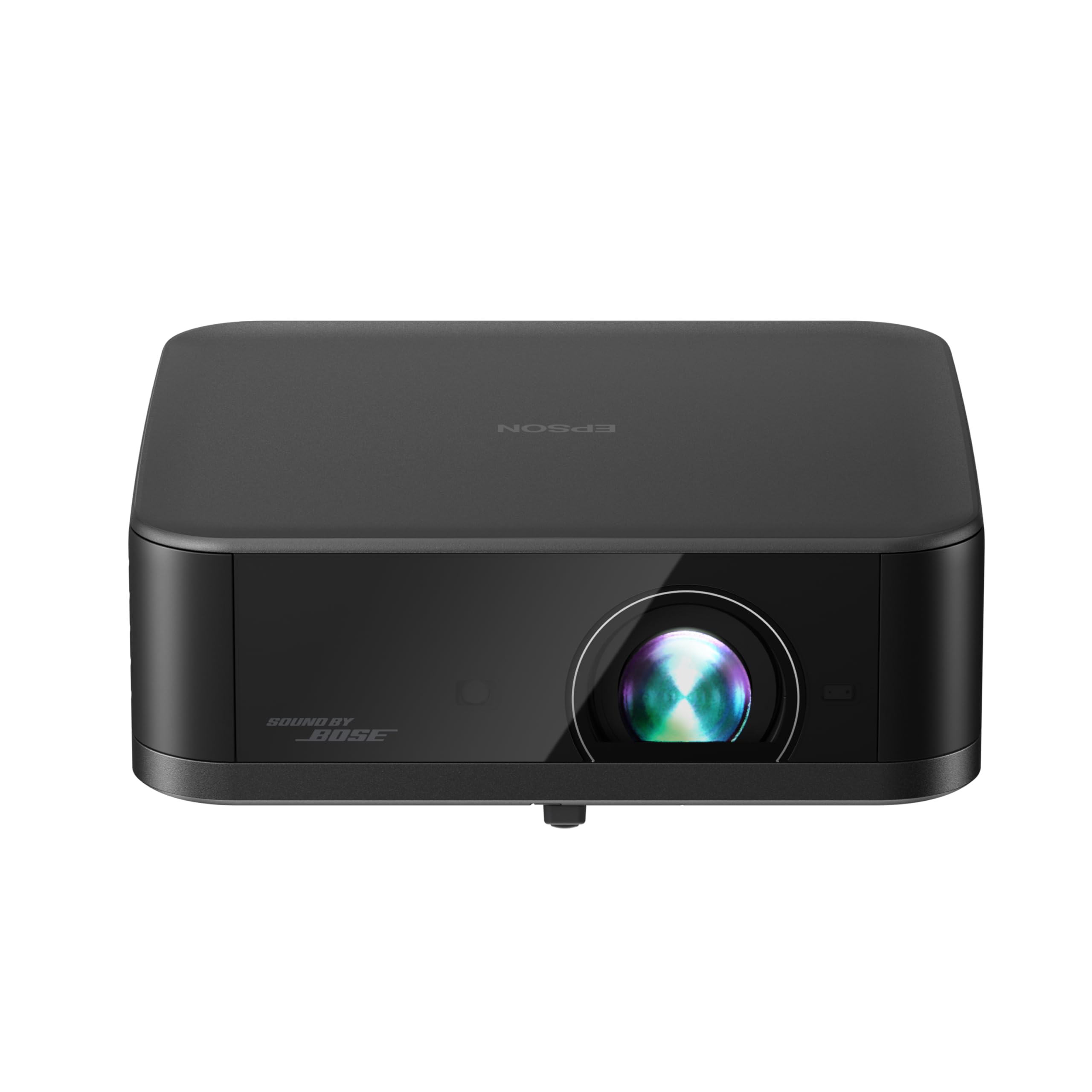
The one that actually disappears into a shelf, a bag, or a small bedroom corner.
Size is this projector’s whole reason to exist: it measures 7.5″ long, 7.8″ wide and 2.7″ tall — the most compact footprint on the list. To put that in context, the XGIMI Elfin Flip is 9.7″ long, 3.1″ wide and 10″ tall. If your plan is to tuck the unit on a narrow shelf or drop it in a carry-on, the Epson’s smaller frame is the deciding advantage.
Brightness is where you have to be realistic. It lists 700 lumens of both color and white brightness, IDMS and ISO rated. Against the Nebula Cosmos 4K SE’s 1800 ANSI lumens, this is a dark-room unit — bring it out for a nighttime movie, not a lit living room. What Epson does well is sound and setup: an integrated stereo system built by Bose handles the audio, and EpiqSense 2.0 auto-setup gets focus, color and alignment right in seconds. A whole range of streaming apps, including Netflix and Disney+, runs through built-in Google TV.
The honest trade-off is that thin, compact body — treat it gently and it will serve you well for years, but it is not the projector to lug on a camping trip in a shared gear bag. Its lower star score comes from a smaller pool of ratings, not from defects. For a bedroom or small apartment, its 7.5″ x 7.8″ x 2.7″ frame fits where the bigger units will not.
Its Case For A Small Room
- 7.5″ x 7.8″ x 2.7″ — the smallest frame here, so it tucks onto a narrow shelf.
- Bose-engineered stereo audio fills a bedroom without a soundbar.
- EpiqSense 2.0 handles focus, color and alignment in seconds.
- Built-in Google TV streams Netflix and Disney+ with no add-on stick.
What You Give Up
- 700 lumens versus the top pick’s 1800 — this is a dark-room projector.
- Its thinner, lighter body needs a gentle hand when packing.
Made for: a bedroom or tiny apartment where a small box on a shelf is the only option.
Not the one for: a bright room or a backyard afternoon — you will want more light output.
4. XGIMI Elfin Flip 4K Portable Projector
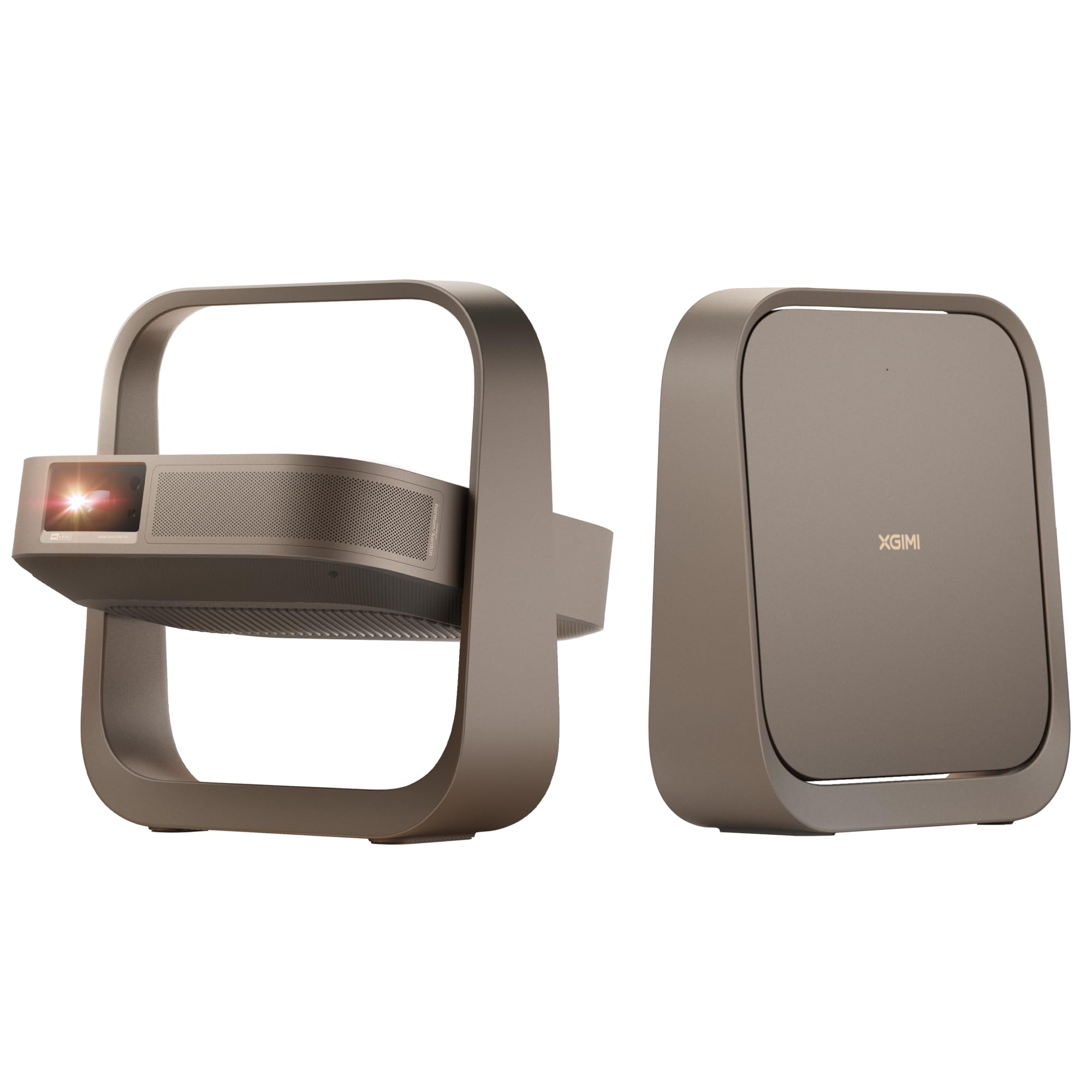
A book-sized box that treats dark scenes as seriously as bright ones.
The headline here is the contrast figure: 20,000:1. Contrast ratio is the difference between the brightest white and the darkest black the panel can produce — a higher number means shadows stay deep rather than turning gray. Compare that to the Nebula Cosmos at 400:1 and you can see the gap. In real terms, night scenes, space films and moody thrillers hold their richness on this DLP panel in a way the lower-contrast picks struggle to match.
It pairs that with 1,600 ANSI lumens of brightness, close to the top of the range but a step under the Cosmos’s 1800. Dual Harman Kardon speakers handle audio without an external bar, and Google TV is built in, opening up a huge library of movies and episodes from Netflix, YouTube and Prime Video with no dongle. Setup is quick, and the portable build is genuinely easy to relocate — it moves from room to room without fuss.
Where you have to be honest is brightness. The reviews flag it as a mixed point: it holds up beautifully in dim conditions, but a bright daytime room is not its stage. Owners settle into a nighttime ritual: lights down, 20,000:1 contrast doing the heavy lifting. Software quirks occasionally come up in the trade-off column, but the picture is what people come back to.
Why the contrast wins: at 20000:1, its darkest blacks run far deeper than the Nebula Cosmos’s 400:1, so night scenes stay rich instead of washing gray.
The brightness caveat: at 1,600 ANSI lumens it sits below the top pick’s 1800 — best enjoyed once the light drops.
The pick for: movie nights after dark where deep blacks matter more than sheer lamp power.
Skip this one if: you need to project in a sunlit room — the lower brightness is your limit.
5. JMGO N1S 4K Upgrade Triple Laser Projector
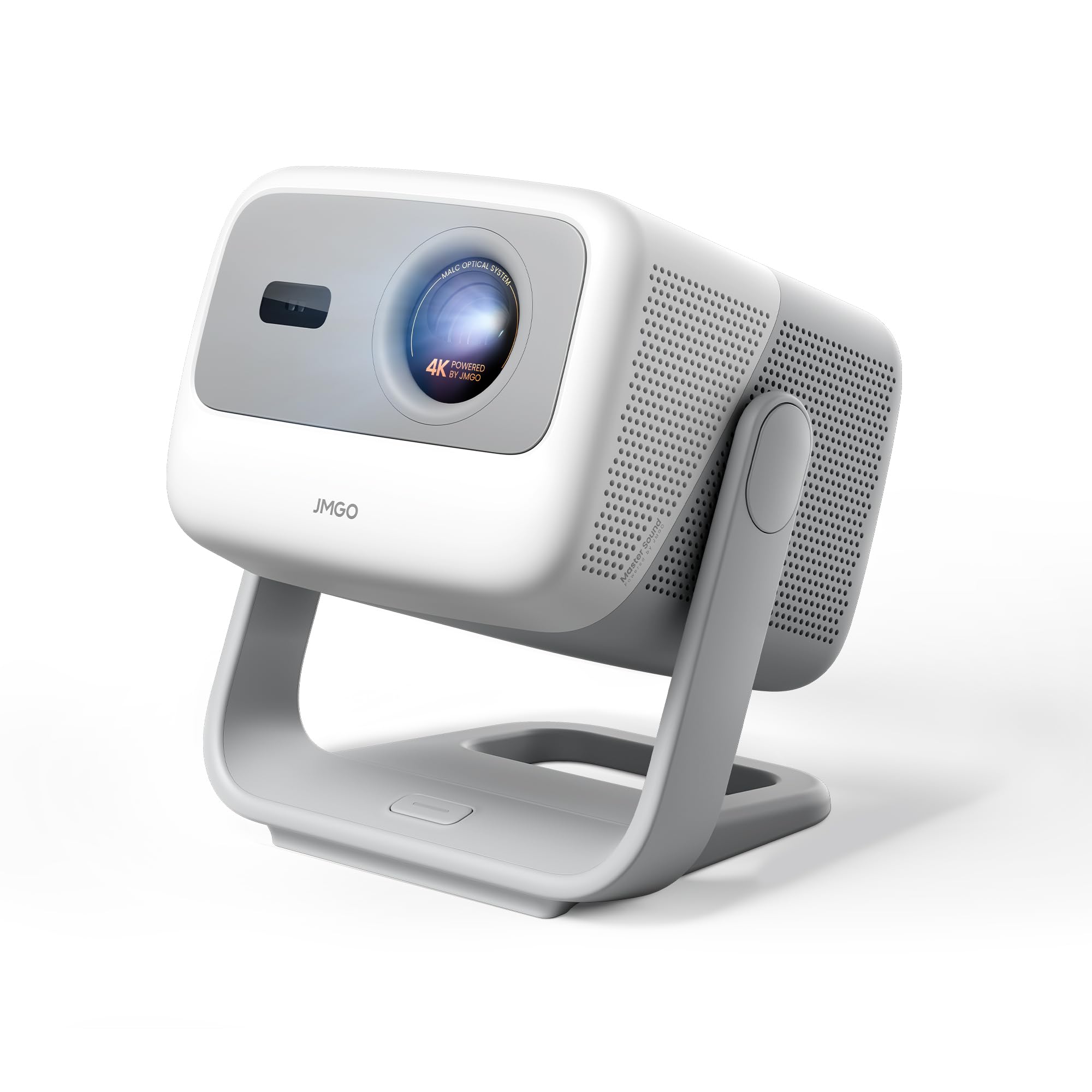
Pure RGB laser color and a 127-degree gimbal that aims at any wall or ceiling.
What wins people over on the N1S is the image, and the reason is the light engine. It uses MALC 3.0 pure RGB triple laser technology — three separate laser colors instead of a spinning color wheel — which removes the faint rainbow edge a few viewers catch on wheel-based DLP units. Its LSR speckle reduction sharpens clarity further. Color coverage is listed at 110% BT.2020 and 151% DCI-P3, the color space numbers you want high. Image quality is the most-praised point in the reviews, and the RGB triple laser explains why.
Brightness comes in at 1,700 ISO lumens with 1.07 billion colors, and the panel handles 4K HDR10 with a 200-inch max screen. The gimbal is the feature you will use every day: 127° of vertical rotation means you can point it at a wall, a ceiling, or a corner in one hand, no bracket needed. That adjustability is a regularly praised point. Auto focus and keystone correction keep the image crisp and squared, and Google TV with an officially licensed Netflix app runs inside.
Now the catch a buyer should know going in. It weighs 4.4 lbs with the EPP carry case, so it travels but it is not a shirt-pocket gadget. The maker also notes a color-tint possibility (a pinkish screen) and points to a troubleshooting guide and its support team to recalibrate color temperature — a quick check on first power-on saves you a return. For gaming, HDMI 2.1 with 17ms latency and MEMC smoothing are a genuine step up.
Why It Stands Out
- RGB triple laser with 110% BT.2020 and 151% DCI-P3 delivers vivid, accurate color.
- 127° gimbal makes aiming at a ceiling or wall a one-hand job.
- 4.4 lbs with carry case — portable without being cumbersome.
- HDMI 2.1 at 17ms latency suits console gaming.
Fine Print To Note
- The maker flags an occasional color tint — check calibration on first setup.
- At 1,700 ISO lumens, it is a dim-room performer rather than a daylight one.
Choose this when: color accuracy and quick re-aiming drive your setup more than raw lamp power.
Steer clear if: you want a featherweight pocket unit — 4.4 lbs is its travel weight.
6. Hisense M2 Pro Triple Laser Smart Portable Projector
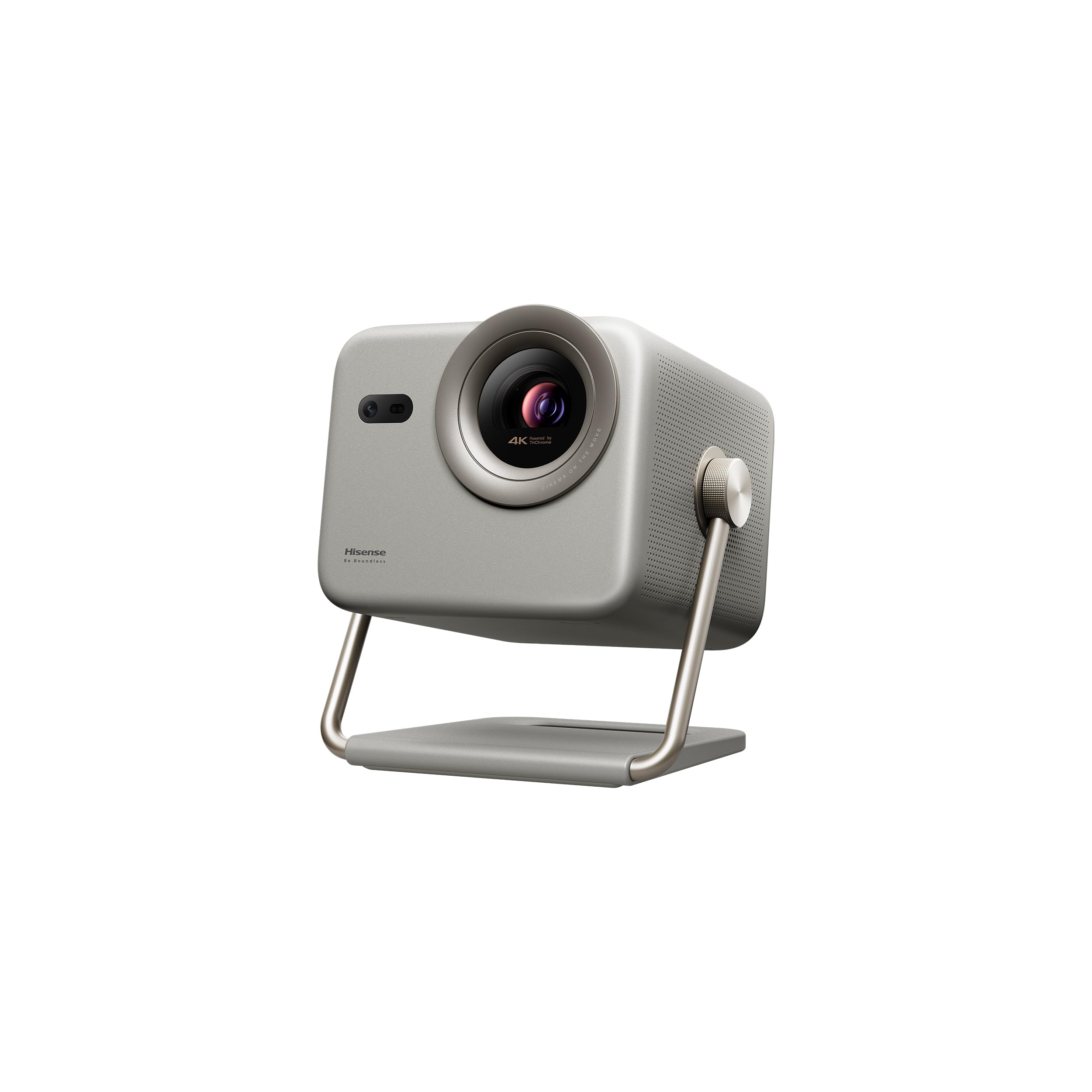
A triple-laser performer built to throw a cinematic 200-inch picture for a crowd.
Start with the light source, because it explains the price of entry. The M2 Pro runs an MCL38 triple-laser design and delivers Dolby Vision, which adjusts brightness, contrast and color frame by frame. Its brightness is listed at 1,300 ANSI lumens — a step under the Nebula Cosmos’s 1800, so it is a low-light performer rather than a daylight one. What it does well is scale: a 65″ to 200″ projection range with AI PQ enhancement that uses 2.07 million micro mirrors to keep the image sharp across that span.
The optical zoom is a quiet but useful advantage. With a 1.0-1.3:1 ratio, you can resize the picture without moving the unit and keep the image at 4K throughout — handy if your shelf depth is fixed. Active 3D support adds depth for movies and games (DLP-Link active shutter glasses required), and AI color enhancement analyzes each frame so skin tones stay natural. Set it up for a backyard night and the 200-inch picture carries the whole gathering.
Setup is where Hisense earns its keep: the Auto Magic Adjusting System (automatic alignment) handles the alignment work, and Vidaa smart OS (the built-in smart TV system) brings Netflix, YouTube and Disney+ with no external stick. Its rich gaming mode keeps motion smooth for fast games. The honest caveat is that triple-laser color and Dolby Vision (a high dynamic range format) are the reasons to pick it — if you do not value that color depth, the lower-contrast picks here will do the job for less.
The cinematic edge: Dolby Vision plus triple-laser color on a 200-inch screen is what makes this a genuine event-night machine.
The brightness reality: at 1,300 ANSI lumens it sits below the top pick’s 1800 — plan for a dim room or after sunset.
The right call for: someone hosting backyard movie nights who wants Dolby Vision color at big scale.
Less ideal if: your room is bright through the evening — you will want more lumens.
Understanding the Specs
ANSI Lumens
ANSI lumens is the standard measure of how much visible light a projector throws at the screen. Higher numbers survive more ambient light. In this list, the range runs from 700 lumens on the Epson up to 1,800 on the Nebula Cosmos — the gap decides whether you can watch with the lights low or only in full darkness. Treat this as the first spec you compare.
Contrast Ratio
Contrast ratio is the difference between the brightest white and the darkest black the panel can produce. A higher number, like the XGIMI Elfin Flip’s 20000:1, keeps shadows deep rather than gray. Lower figures like the Nebula Cosmos’s 400:1 still look good in the right room, but dark scenes carry less punch. Match this to how much dark content you watch.
Light Source Type
A laser light source uses a solid-state beam instead of a lamp bulb, and an LED source uses light-emitting diodes. Hybrid units pair the two. Laser designs, like the JMGO N1S’s pure RGB triple laser, avoid the color wheel entirely, which removes the faint rainbow edge some viewers catch on fast scenes. The type also affects how quickly colors stay consistent over long sessions.
Auto Focus And Keystone
Auto focus sharpens the image automatically when you power on. Auto keystone corrects the trapezoid shape that appears when you angle the projector off-center. On a portable unit you will move often, both save real setup time. Some units add obstacle avoidance and screen fit, which nudge the picture around a wall outlet or frame edge without your input.
FAQ
Is a true 4K pocket projector really better than a 1080p one that accepts 4K input?
How bright does a 4K pocket projector need to be to watch with the lights on?
Can I stream Netflix without plugging in a streaming stick?
What contrast ratio should I look for in a 4K pocket projector?
Do these projectors have built-in speakers or do I need a soundbar?
Will auto keystone and auto focus work reliably when I move the projector often?
Is a triple laser light source better than LED for color?
How far back does a 4K pocket projector need to sit for a 200-inch picture?
Can I use a 4K pocket projector for console gaming?
Do I need a dark room for a pocket 4K projector to look good?
Final Thoughts: The Verdict
For most setups, the 4k pocket projector winner is the Nebula Cosmos 4K SE because it throws the most light at 1,800 ANSI lumens while bundling Google TV and 4K Netflix without a stick. If you prize detail above all, the U1 PRO gives you a native 4K panel with an all-glass lens that holds focus. And for a genuine cinematic night at big scale, the Hisense M2 Pro brings Dolby Vision and triple-laser color to a 200-inch wall. One tasteful nudge before you decide: the Nebula’s 4.5+ star score across a healthy review base tells you it earns its keep for room-to-room use — if that is your plan, it is the pick to start with.
How We Picked
We do not accept paid placement. Every pick is matched to a real buyer and a real use-case; we do not hands-on test units.
Sources & Methodology
Specifications: manufacturer listings and product documentation. Review insights: verified customer reviews, as of November 2026. Pricing: not shown on this page (it changes often); check the current price via the retailer link.
As an Amazon Associate, Gadgets Feed earns from qualifying purchases. This does not affect which products we feature.