
Our readers keep the lights on and my morning glass full of iced black tea. As an Amazon Associate, I earn from qualifying purchases.
Specs are compiled from manufacturer listings and verified buyer reviews and can change over time — please confirm the key details on the product page before buying.
A six-foot trampoline looks simple to buy until you read the listings. Half are really toddler play pens with a “6 ft” label, and the other half leave a hard steel spring inches from a small foot. Here is the honest answer: for a proper backyard bounce for a young child, the BLUERISE 55-inch is the one worth buying, and the two SkyBound picks cover the family that wants more room or wants zero springs. One sizing note matters. This list uses flexible, human-like matching for the six-foot diameter rule, so not every pick measures exactly six feet across; the nearest same-type size does the same job. Everything below is stated plainly so you know exactly what you are assembling in your garden.
I’m Min — the founder and writer behind Gadgets Feed. This guide is built by comparing the manufacturers’ published specifications and the patterns across verified customer reviews, so you get each pick’s real strengths and trade-offs instead of marketing spin.
Below you will find the frame measurements, weight limits, spring or bungee choices and enclosure details that actually decide whether a trampoline is safe and fun for years. Every pick here is a genuine kids trampoline, and this breakdown of the 6 ft trampoline category shows you which frame, net and bounce style fits your yard best.
Our Picks at a Glance
How To Choose The Best 6 Ft Trampoline
The single most important thing to sort out first is what kind of trampoline you actually want, because the six-foot shelf holds two very different machines. One is a low indoor play center that a toddler steps onto. The other is a backyard jumper your child climbs into through a net door. Decide that before you look at any spec.
Measure the frame, not the marketing
A six-foot round frame gives a jumping surface small enough for a garden corner but wide enough for real bounce. The problem is that some listings call a 55-inch model a “6 ft” trampoline because it plays the same role. Check the actual L x W figure in inches, and be ready for a pick like the BLUERISE at 55″L x 55″W, which is a genuine toddler size rather than a full six-footer.
Springs or bungee cords
Springs give a lively, familiar bounce and cost less, but the gaps between them are where pinched toes happen. Bungee cords remove those gaps entirely, which is why springless designs appeal to parents of very young children. Springs also need a pad covering them; look for a stitched jump mat and protective pad that keeps feet off the metal, the way the BLUERISE listing describes.
Weight limit and frame material
Each trampoline lists a maximum weight recommendation, and that figure tells you how much bounce and structure you are really getting. The Baotree holds up to 110 pounds, while the springless SkyBound is rated for 220 pounds. Galvanized and alloy steel resist rust better than plain iron, which matters if the frame stays outside through a wet winter.
Enclosure net height and padding
The net is what stops a child mid-bounce, so its height and fittings are a safety decision, not a style one. Look for a net that surrounds the mat fully, foam tubes over the poles so a jump cannot land on bare metal, and a door that closes behind the child. Higher nets let kids jump harder without wobbling the poles.
Quick Comparison
| Model | Best For | Frame Size | Weight Limit | Spring Style | Amazon |
|---|---|---|---|---|---|
| BLUERISE 55″ 6-in-1★ Best Overall | Indoor toddler play and first jumps | 55 inches | — | 30 springs | Amazon |
| Baotree 6FT with Basketball HoopBest Value | Tight gardens and first trampolines | 6 feet | 110 pounds | Springs | Amazon |
| Vitaler Outdoor 6FT | Year-round backyard use | 6 feet | — | Steel springs | Amazon |
| SkyBound Outdoor 6ft | Parents who want certified safety | 6 feet | — | Springs | Amazon |
| SkyBound Springless 6ft | No-pinch play for bigger kids | 6 feet | 220 pounds | Bungee cords | Amazon |
In‑Depth Reviews
1. BLUERISE 55″ Indoor & Outdoor 6-in-1 Trampoline
Our pick — 4.0+★ from 1,500+ verified ratings; the strongest balance of quality and price.
A toddler play center that keeps its bounce low and its fun count high.
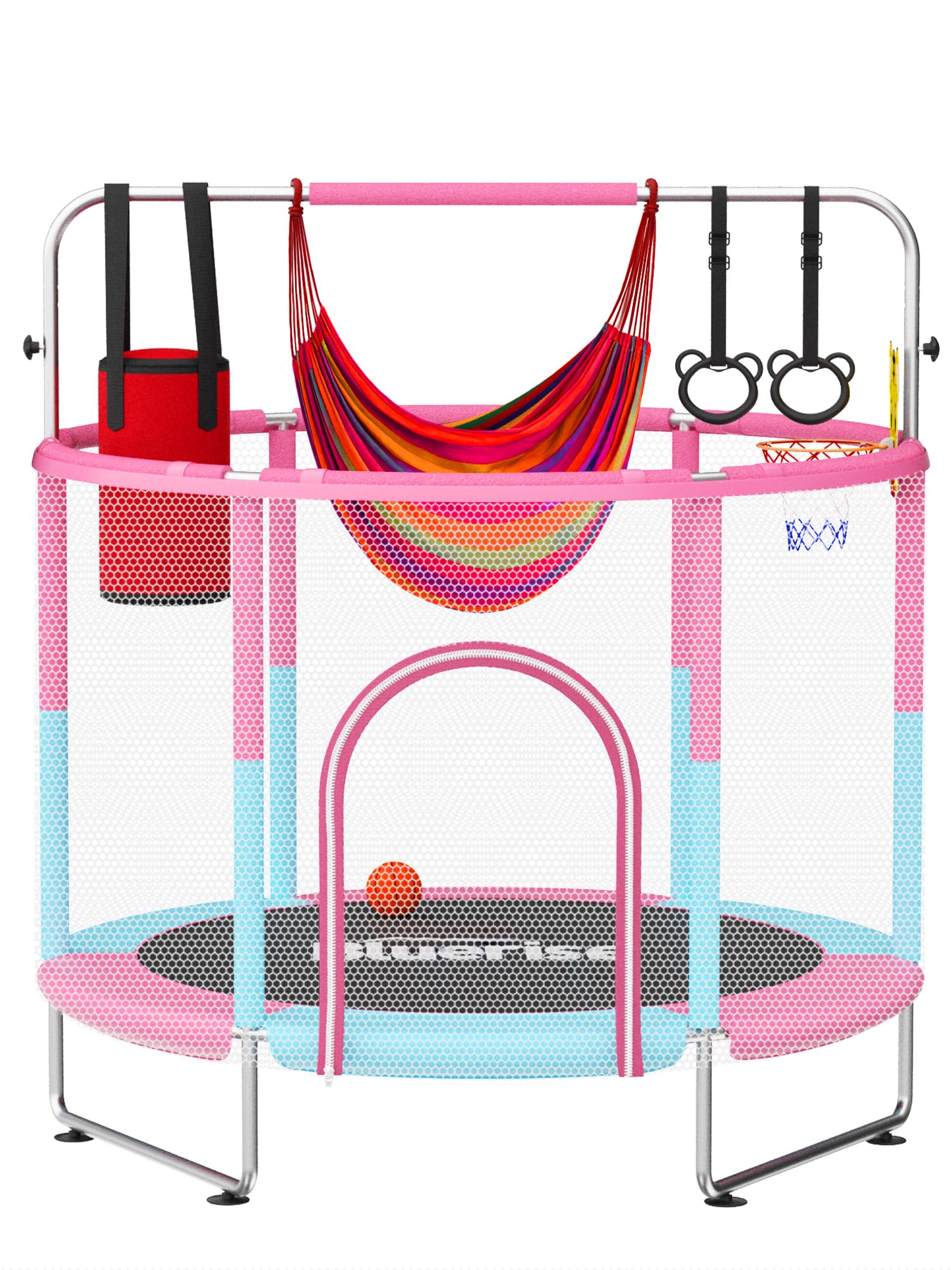
The standout number here is the 4.5FT, 55-inch frame, and it changes who this is for. That is a toddler-sized jumping surface, not a full backyard six-footer, so a very young child steps onto it without a long climb. It sits at 55″L x 55″W x 10″H, which is low enough to tuck into a playroom or a garden corner. Compare that to the Baotree at 72″L x 72″W x 58″H, and you are looking at two different jobs: one is a first jump, the other is a full enclosure tower.
What wins people over is the play value. The 6-in-1 layout adds a basketball hoop, swing, boxing sandbags, gym rings and an adjustable gym bar, and it even turns into a small playhouse and game tent. That is why parents treat it as a rainy-day activity rather than backyard gym equipment. The stitched jump mat and protective pad sit over the 30 springs so feet land on fabric, not metal, which matters most on a first trampoline. There is also a 6-month free parts replacement offer, useful because springs are the part most likely to need attention.
The catch is assembly and springs, and both show up as a split picture in owner feedback. Some setups go together easily, while other families say it takes two people, so plan for a helper rather than a solo ten-minute job. A few note springs breaking under heavier use, and one or two mention the frame feeling less planted outdoors. That is worth weighing if you have an energetic older child rather than a toddler. As owners put it, the fun side is not in doubt — it is the build patience you are signing up for.
What families get right away
- Six play modes from one frame, so it holds attention far longer than a plain jumper.
- Low 10-inch height is easy for a toddler to step onto indoors.
- Padded mat and spring cover keep little feet off the metal.
- ASTM F381-16 and ASTM F963-23 certification listed for confidence.
Where it needs patience
- Assembly feedback is split between easy and a two-person job.
- Springs are the part most likely to need a replacement.
- The 55-inch surface suits toddlers more than bigger kids.
Reach for this if: you have a toddler or preschooler and want a low, packed-with-play first trampoline for indoors or a small garden.
Think twice if: you want a full six-foot bounce surface for a child heading toward school age — the Baotree or Vitaler frames fit that better.
2. Baotree 6FT Trampoline with Safety Net, Hoop & Dart Board
The six-footer for a small patio, with a hoop and dart board thrown in.
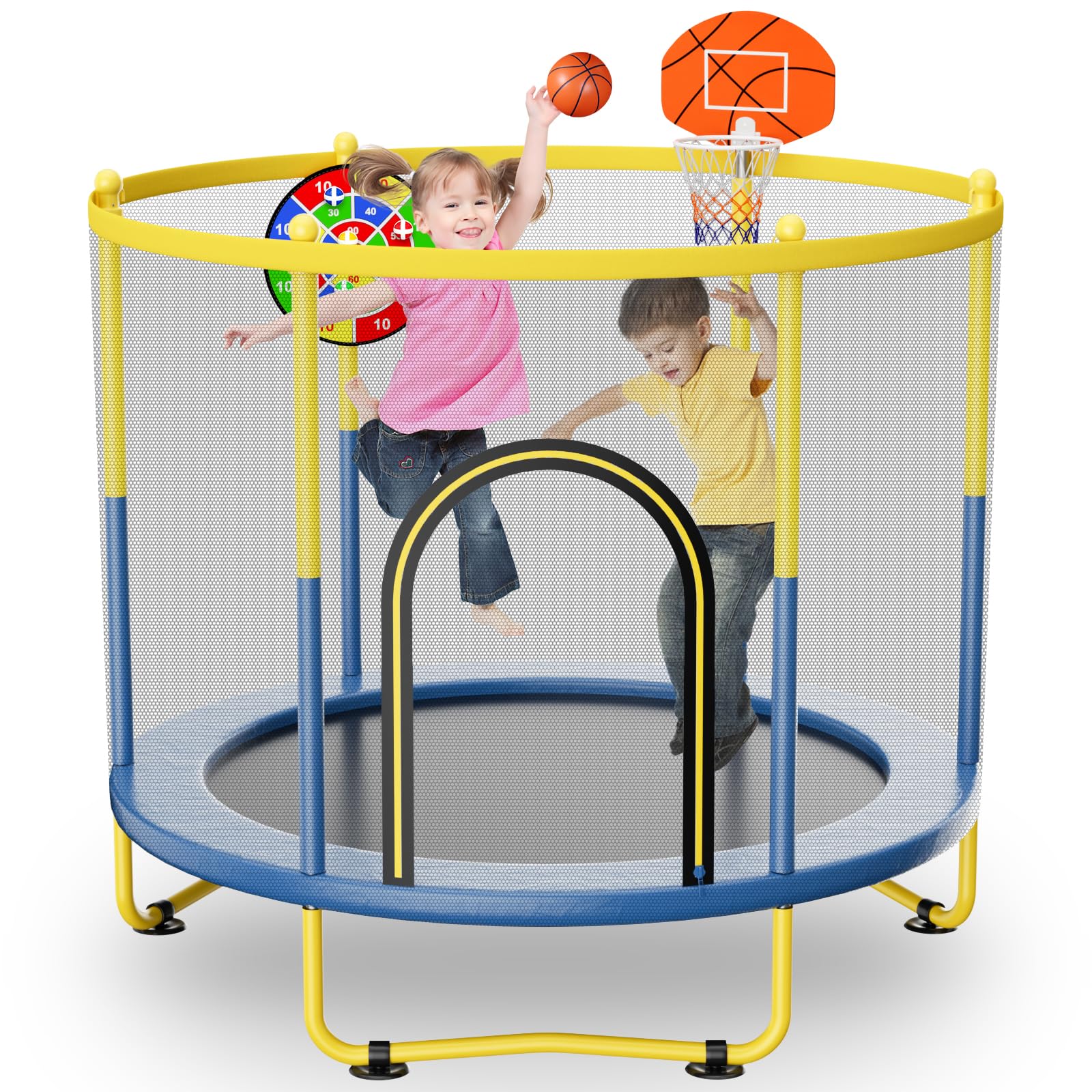
Here is a real six-foot frame that still fits a modest space. The Baotree measures 72″L x 72″W x 58″H, so it stands tall enough for a proper net but stays within a compact footprint. Its recommended weight limit is 110 pounds, which tells you plainly this is a young children’s trampoline rather than a teen-and-adult jumper. Bounce is spring-based under a waterproof mat, and the covering is a blue canvas over the springs.
Quality is the thing that keeps coming up in its favor — the alloy steel frame, the rust and corrosion resistance, and a mat built not to tear easily. The square insert structure and U-shaped legs with protective pads are described as absorbing shock and reducing noise, which helps if you want it on a patio or deck.
One honest wrinkle sits in the size. Some owners say the frame does not measure a full six feet as advertised, so measure your space and expect a compact jumper rather than a wide one. The blue canvas covering the springs is also the part a few note tearing over time, so check and reseat that cover now and then. The brand claims a ten-minute, tool-free setup with a manual and video, and an experienced DIY parent can get close to that; a first-timer should still set aside a relaxed afternoon.
The short answer: a well-built compact six-footer with extra play modes at a sensible price for a first trampoline.
Keep in mind: the 110-pound limit and reports that it is smaller than six feet mean it suits younger, lighter children.
3. Vitaler Outdoor 6FT Trampoline with Safety Net
Built to stay out through the wet months, not just the summer.
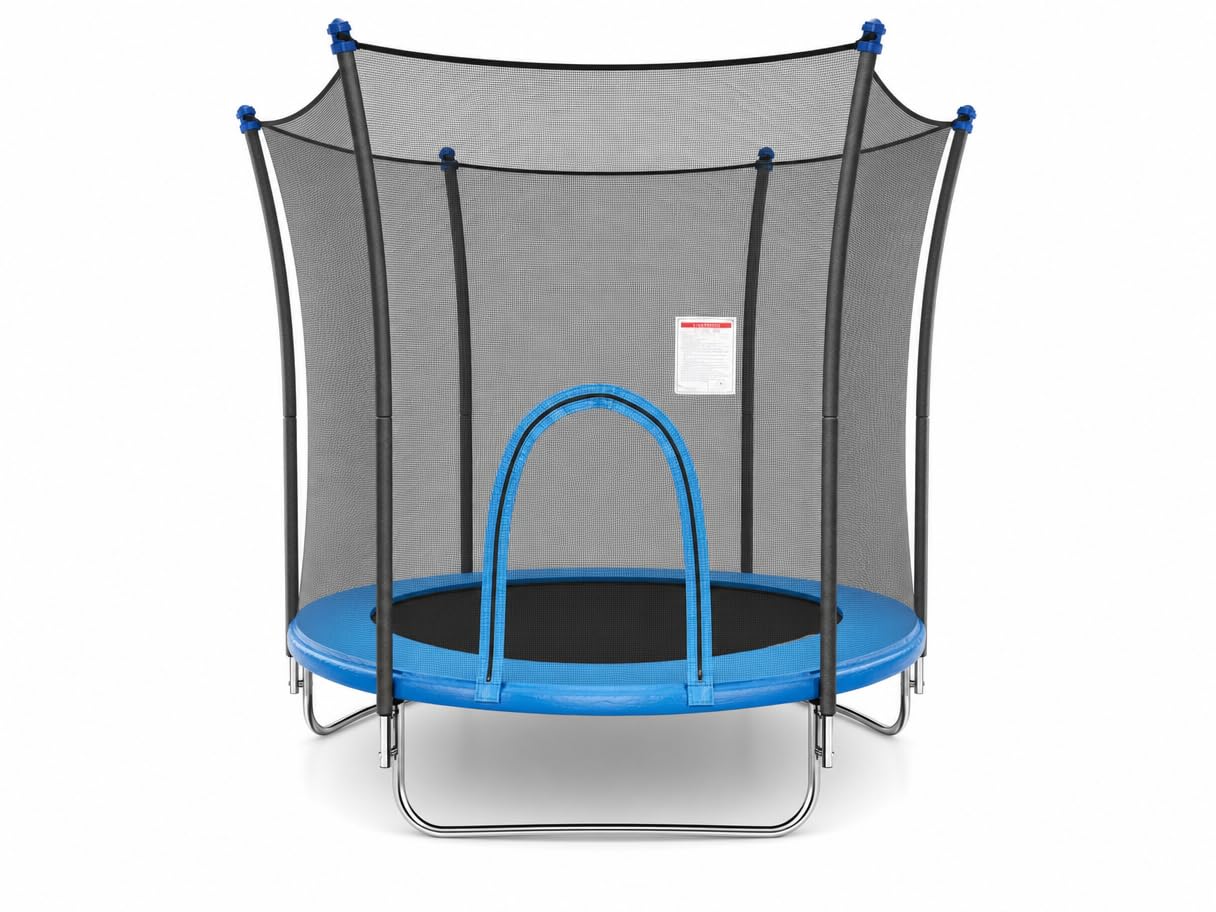
The Vitaler leads with the thing that actually shortens a trampoline’s life: rust. Its frame is galvanized steel with silver-gray powder-coated T-connectors, and the support legs are 2mm thick for stability. That is the build you want if the trampoline stays in the garden through autumn and winter. It carries CPSIA and ASTM F381-16 safety standards, with curved poles that keep the enclosure net a comfortable distance from a jumping child so they are not colliding with the frame.
The bounce comes from steel springs under a woven mesh jump pad, described as uniformly elastic without dead corners — worth explaining plainly: no flat spots where the mat sags. A foam pad covers the spring frame, which is the barrier between a bare spring and a landing foot. It also arrives with tools and instructions, plus a 1-year warranty and 24/7 support, so the after-sale side is covered if a part goes missing.
This one is newer to the market than the others, so owner history is thinner and you are leaning more on the spec sheet than on a long track record. It is also a designated outdoor trampoline, so if you need an indoor rainy-day jumper, the BLUERISE 6-in-1 above is the better fit. For a family that wants a galvanized frame, powder-coated connectors and a 1-year warranty, this is the sensible pick.
The build story: galvanized steel, powder-coated connectors and 2mm legs point to a frame made for year-round outdoor duty.
The real question: with a shorter review history, you are buying the specifications and the 1-year warranty rather than a proven long-term record.
Good fit for: a family leaving the trampoline outside permanently who want rust protection and a warranty to back it.
Less ideal for: anyone wanting an indoor play trampoline or a long established track record of owner feedback.
4. SkyBound 6ft Outdoor Trampoline, ASTM Approved
The safety-paperwork pick for parents who read the fine print.
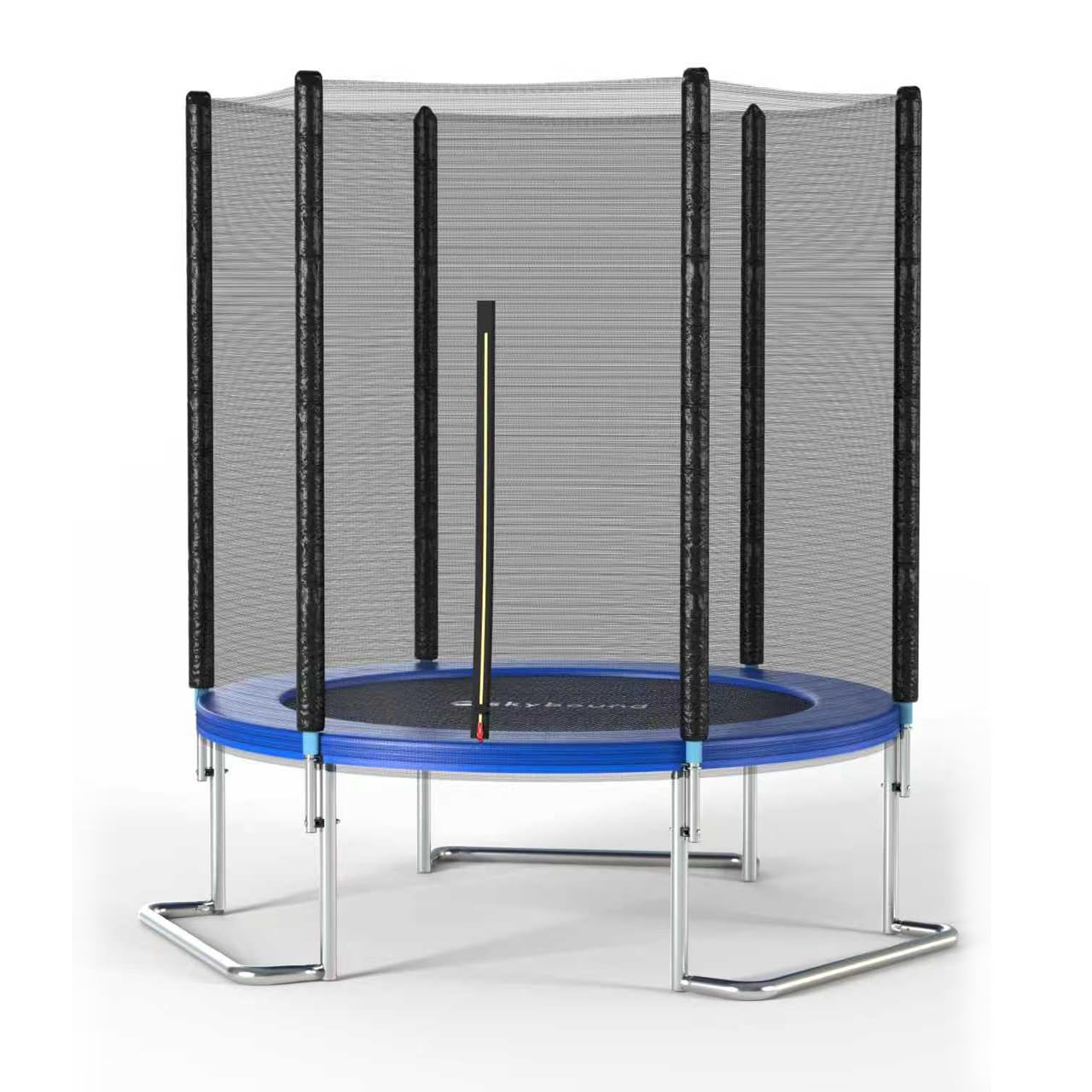
If the certifications are what you care about, this is the SkyBound that lists them. It carries ASTM F318-16 and F2225-15 plus CPC, and the brand also cites ISO 14001 and 9001, Intertek and BSCI approvals. That is a lot of letters, and what they mean in plain terms is that the frame and enclosure have been put through published safety tests. For a parent comparing six-footers on safety grounds, the ASTM F318-16 and F2225-15 listings are the headline.
The enclosure is where the outdoor thinking shows. The net is high-density and UV-resistant so sun does not chew through it, and the foam-padded poles carry 6 extra PE sleeves so the foam does not age and split. The frame is stainless steel and everything ships in an all-in-one package with instructions and US-based support, so you are not chasing missing parts mid-build. Owners most often land on two points: it is easy to assemble, and they are happy with the quality.
The trade-off is experience. This is a newer listing with a smaller pool of owner feedback than the Baotree or the springless SkyBound, so treat the design as promising rather than proven. It is a spring-based jumper, so unlike the springless SkyBound below, it keeps the bounce of traditional springs and the finger-and-toe care that comes with them. If ASTM F318-16 and F2225-15 certification are your first filter, this stays near the top of your shortlist.
What stands out: the fuller list of safety certifications and a UV-resistant, anti-aging enclosure aimed at multi-season outdoor use.
Fair warning: a lighter feedback history means less real-world evidence behind it than the more established picks here.
Pick this when: published safety standards and a long-lasting enclosure matter more to you than a proven back catalogue of owner reviews.
Otherwise: a spring jumper, so it needs the same toe-and-finger supervision as any framed model.
5. SkyBound 6ft Springless Trampoline with Bungee Cords

No springs, no pinch points, and a weight rating that handles bigger kids.
Two numbers define this one. The first is the absence of springs: patented bungee cords replace the metal coils, which removes the pinch gaps that can catch a toe, and that is the safety argument parents of young kids care about. The second is the 220-pound maximum weight recommendation, the highest on this list, so it carries school-age children and the occasional adult with ease. It sits at 72″L x 72″W x 20″H, a low, planted profile.
The build shows the same no-gap thinking elsewhere. The zipper system pulls the net tight against the mat so there is no seam for a foot to slip through, and the pad is high-strength polypropylene that is UV-resistant and water-permeable so rain drains instead of pooling. Fiberglass poles replace metal, which means no rust over the years, and the frame is stainless steel with a rust-resistant coating. There is also a 5-year warranty, the longest coverage in this lineup.
The honest trade-offs are assembly and bounce feel. Setting up bungee cords is trickier than threading springs, and owner feedback shows the assembly and instruction steps as the split points, so allow time and a second pair of hands. The bounce is confident but it is bungee rebound, not the livelier spring kick some kids expect. Durability gets a mixed read too, so inspect the cords each season and keep an eye on the pad. For a family prioritizing bungee cords over springs and a 220-pound weight ceiling, it earns the premium.
The pitch in one line: springless, no-gap and warranty-backed, for families who want bigger kids to bounce without pinch risk.
The caveat to weigh: bungee assembly is fiddlier than springs, and some report durability concerns worth a seasonal check.
Understanding the Specs
Spring vs bungee bounce
Coil springs store and release energy in a quick kick, giving the familiar lively bounce. Bungee cords stretch instead, which softens the rebound slightly but removes the open gaps between coils where a toe can get caught. If your child is small and still learning to land, bungee reduces that pinch risk; if you want maximum air, springs deliver more pop.
Maximum weight recommendation
Every trampoline lists a weight ceiling, and it is a guide to how much bounce and frame strength you are really buying. A lighter rating like 110 pounds signals a young-children’s trampoline; a higher one such as 220 pounds means it holds older kids and the occasional adult. Exceeding the limit strains the mat and springs, so match it to who will actually jump.
Frame material and rust
Iron and plain steel frames will rust if left outside through wet weather, which shortens their life. Galvanized steel, alloy steel and stainless steel resist corrosion far better, so look for those on any trampoline staying in the garden year-round. Powder-coated connectors add another layer against moisture getting into the joints.
Enclosure net and padding
The net is your child’s safety boundary, so its height and fittings matter. A full surround keeps a jumper from tumbling out, while foam tubes over the poles stop a hard landing on bare metal. A no-gap door or zipper system that pulls the net tight against the mat closes the seam a foot could slip through.
FAQ
Is a 6 ft trampoline big enough for two kids at once?
Are springs or bungee cords safer for young children?
Can a 6 ft trampoline stay outside in winter?
What does the maximum weight recommendation actually mean?
How long does assembly usually take?
Is a 55-inch trampoline the same as a 6 ft trampoline?
Do I need to anchor the trampoline to the ground?
What is the difference between the two SkyBound six-footers?
Can adults use a 6 ft trampoline?
How do I stop the enclosure net from wearing out?
Final Thoughts: The Verdict
For most families with a toddler or preschooler, the BLUERISE 55-inch 6-in-1 is the one worth buying. Its low 10-inch height, six play modes and padded mat turn a first trampoline into something that earns its space both indoors and out. If you want a true six-foot frame in a compact garden spot, the Baotree 6FT gives real six-foot width, a hoop and a dart board while staying under its 110-pound limit. And if toe-safe, no-pinch play for bigger kids is the priority, reach for the SkyBound Springless 6ft, with its bungee cords and 220-pound ceiling. Whichever you pick, measure your space and match the weight limit to who will jump.
How We Picked
We do not accept paid placement. Every pick is matched to a real buyer and a real use-case; we do not hands-on test units.
Sources & Methodology
Specifications: manufacturer listings and product documentation. Review insights: verified customer reviews, as of November 2026. Pricing: not shown on this page (it changes often); check the current price via the retailer link.
As an Amazon Associate, Gadgets Feed earns from qualifying purchases. This does not affect which products we feature.