
Our readers keep the lights on and my morning glass full of iced black tea. As an Amazon Associate, I earn from qualifying purchases.
Specs are compiled from manufacturer listings and verified buyer reviews and can change over time — please confirm the key details on the product page before buying.
Buying a 4 ohm loudspeaker is mostly about one thing: making sure your amplifier can actually feed it. A 4 ohm speaker draws more current from your receiver than an 8 ohm model does, so a cheap or weakly rated amp can run hot or shut down. Get the pairing right and the same amplifier drives the speaker louder with less strain. Get it wrong and you get clipping, heat, and a speaker that sounds strained long before it should. This guide sorts the real options by what they are honestly built to do — car doors, desktops, or a living-room floor.
I’m Min — the founder and writer behind Gadgets Feed. This guide is built by comparing the manufacturers’ published specifications and the patterns across verified customer reviews, so you get each pick’s real strengths and trade-offs instead of marketing spin.
You will see car midranges, passive bookshelf pairs, and full tower cabinets here, because 4 ohm gear spans all three jobs. The trick is matching the speaker’s impedance, RMS power handling, and sensitivity to the amplifier you already own or plan to buy. Every pick below is a genuine 4 ohm design, so your shortlist for 4 ohm loudspeakers starts with compatibility instead of guesswork.
Our Picks at a Glance

How To Choose The Best 4 Ohm Loudspeakers
The first decision is not brand or cabinet finish. It is what you are plugging the speaker into. A 4 ohm nominal impedance means the speaker presents a heavier electrical load than the 8 ohm models most budget receivers are built around. Many home theater receivers list a 4 ohm rating on the back panel, and many do not. Look for that rating before you fall in love with a cabinet.
Check your amplifier’s 4 ohm rating first
If your receiver or amp publishes a 4 ohm power figure, you are clear to shop freely. If it only lists 8 ohm numbers, running a 4 ohm pair at high volume can push it into protection mode. The Kanto YU Passive 4” is explicit about this: it wants an amplifier capable of supplying 70 W per channel into 4 ohms. That is the kind of published amplifier requirement worth checking on any passive speaker’s spec sheet.
RMS versus peak power — which number to trust
RMS is the continuous power a speaker can absorb hour after hour. Max or peak power is a short burst figure. Match your amplifier’s continuous output to the speaker’s RMS rating, not its peak. A 250 W RMS midrange paired with a 40 W amp will play, but it will never show what it can do. Conversely, overdriving a low-RMS bookshelf speaker with a big amp is how voice coils cook.
Sensitivity and bass extension in plain terms
Sensitivity, measured in dB, tells you how loud the speaker goes for a given watt. A 94.6 dB design is far easier to drive than an 85 dB one, so it needs less amplifier power for the same volume. Frequency response tells you how deep the bass reaches — a speaker starting at 40Hz digs lower than one starting at 48Hz. Check both figures before you buy, not the cabinet finish.
Quick Comparison
| Model | Best For | Power Handling | Impedance | Driver / Response | Amazon |
|---|---|---|---|---|---|
| DS18 PRO-X6.4BM 6.5″ Midrange Pair★ Best Overall | Car door midrange punch | 250W RMS / 500W Max | 4 Ohm | 6.5″ driver | Amazon |
| Saiyin 3-Way Passive BookshelfSmall-Room Pick | Small-room stereo and turntables | 5-50 Watts each | 4 Ohm | 5.25″ woofer / 48Hz-20kHz | Amazon |
| DS18 PRO-FR5NEO Full-Range | Loud, efficient car audio | 200W RMS / 400W Max | 4 Ohm | 5.25″ driver / 242Hz-13.6kHz | Amazon |
| Rockville RockTower 64C | Living-room tower sound | 125W RMS / 500W peak | 4 Ohm | 6.5″ woofer + 1″ tweeter | Amazon |
| Floor Standing Tower Pair, Dual 6.5″ | Home theater towers | 120W RMS | 4 Ohm | Dual 6.5″ woofers / 40Hz-21kHz | Amazon |
| Kanto YU Passive 4″ | Desktop and small-room detail | 70W per channel amp needed | 4 Ohm | 4″ Kevlar woofer + 1″ tweeter | Amazon |
In‑Depth Reviews
1. DS18 PRO-X6.4BM 6.5″ Midrange Speakers, 250W RMS, 4 Ohm, Pair
Our pick — 4.5+★ from 950+ verified ratings; the strongest balance of quality and price.
A pair of door midranges that turn vocals into the loudest thing in your truck.
The reason this takes the top spot is simple arithmetic. It handles 250W RMS at 4 ohms, so it will soak up the output of a real car amplifier without running out of headroom. That is the number that decides whether a midrange keeps up with your subwoofer or gets buried by it. If you have ever heard a car system where the bass pounds but the singer sounds thin, this is the fix.
What wins people over is the vocals and the mid-band clarity. The 6.5″ bullet dust cover protects the voice coil and shapes the upper midrange, so guitars and voices sit forward instead of smearing together. The 1.5″ high-temperature CCAW voice coil (copper-clad aluminium wire wound into a coil that carries the signal) is built to take heat, which is a real factor in a door panel baking in summer sun. The pair fits most door panels without custom fabrication, which is why so many buyers go straight to these for a stock stereo upgrade.
Here is the honest part, and it is worth reading before you buy. Some of these units fail early, with buyers reporting a speaker blowing within hours of play time. That is a quality-control tail, not the whole story — the long-run experience is overwhelmingly positive — but it exists. Pair them with a properly set gain and avoid pushing a small amp into clipping, since clipped signal is what kills voice coils. The other thing to know: this is a midrange, not a full-range driver, so bass is not its job. It is the muscle that makes your existing woofers sound better, not a replacement for them.
What earns them the crown
- 250W RMS at 4 ohms — real amplifier headroom, matched to a full car build.
- Clear, forward vocals and mids that cut through road noise.
- Fits most door panels without extra fabrication work.
- Bullet dust cover protects the voice coil in a hot car.
Where they can bite back
- Some units fail early, with a speaker reported blowing within four hours of play.
- Midrange only — no deep bass on its own.
- Needs a correctly set amp gain to survive hard use.
Buy this if: you are upgrading a car stereo and want loud, clear vocals that keep pace with a subwoofer.
Think twice if: you need a full-range speaker covering bass too — this one is the mid-band specialist.
2. Saiyin 3-Way Passive Bookshelf Speakers 5.25inch Woofer
Three separate drivers and a real 48Hz floor — this is the calm, detail-first desktop pair.
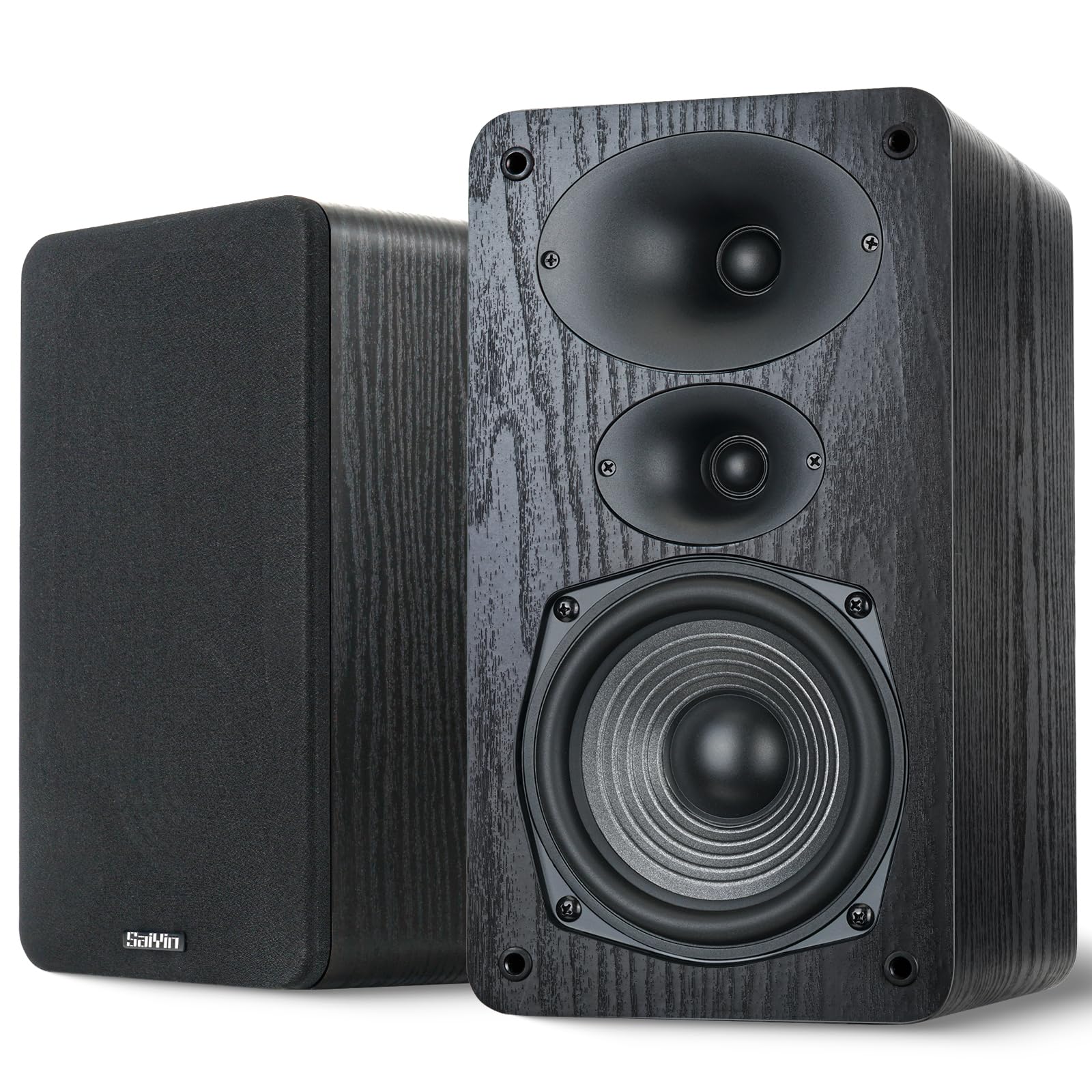
Picture a turntable or a stereo receiver rather than a party. These Saiyin speakers split the work across three drivers: a dedicated tweeter for highs, a 1″ elliptical midrange for vocals, and a 5.25″ paper cone woofer for bass. That separation is why frequencies do not smear together the way they do in a two-driver cabinet. The response runs 48Hz-20kHz, so the low end reaches genuinely deep for a bookshelf box — deep enough for jazz, acoustic, and classical where the upper bass carries the warmth.
Here is where it separates from the towers on this list. The midrange driver is shaped as an ellipse, which widens the sound presentation so you still hear vocals clearly when you are off to the side of the speakers. That matters in a small room where you rarely sit dead centre. A foam plug comes with each cabinet for the bass port: leave it in to tame the bass in a tight space, pull it out for a fuller sound in an open one. That plug lets one cabinet suit both a tight room and an open one.
Two things will catch a first-time buyer out. These are passive speakers — they have no amplifier inside and no Bluetooth. You need a receiver or amp plus speaker wire, which is not included. The upside is the efficiency side of the equation: because they need only 5-50 watts each, a modest receiver drives them easily. And a 3-year manufacturer’s warranty backs the cabinet. For a stereo setup in a bedroom or small study, the spec-to-money ratio is hard to argue with.
Best for careful listening: the three-driver layout and 48Hz extension suit jazz, vocals, and turntable setups rather than bass-heavy film nights.
What you supply: an amplifier, speaker wire, and a little patient placement — this pair delivers the rest.
Reach for this if: you have a spare receiver or amp and want a refined stereo pair in a small room.
Look elsewhere if: you have no amplifier and want plug-and-play Bluetooth speakers — these need power from elsewhere.
3. DS18 PRO-FR5NEO Loudspeaker- 5.25″, Full-Range, Silver Aluminum Bullet, 400W Max, 200W RMS, 4 Ohms, Neodymium Magnet
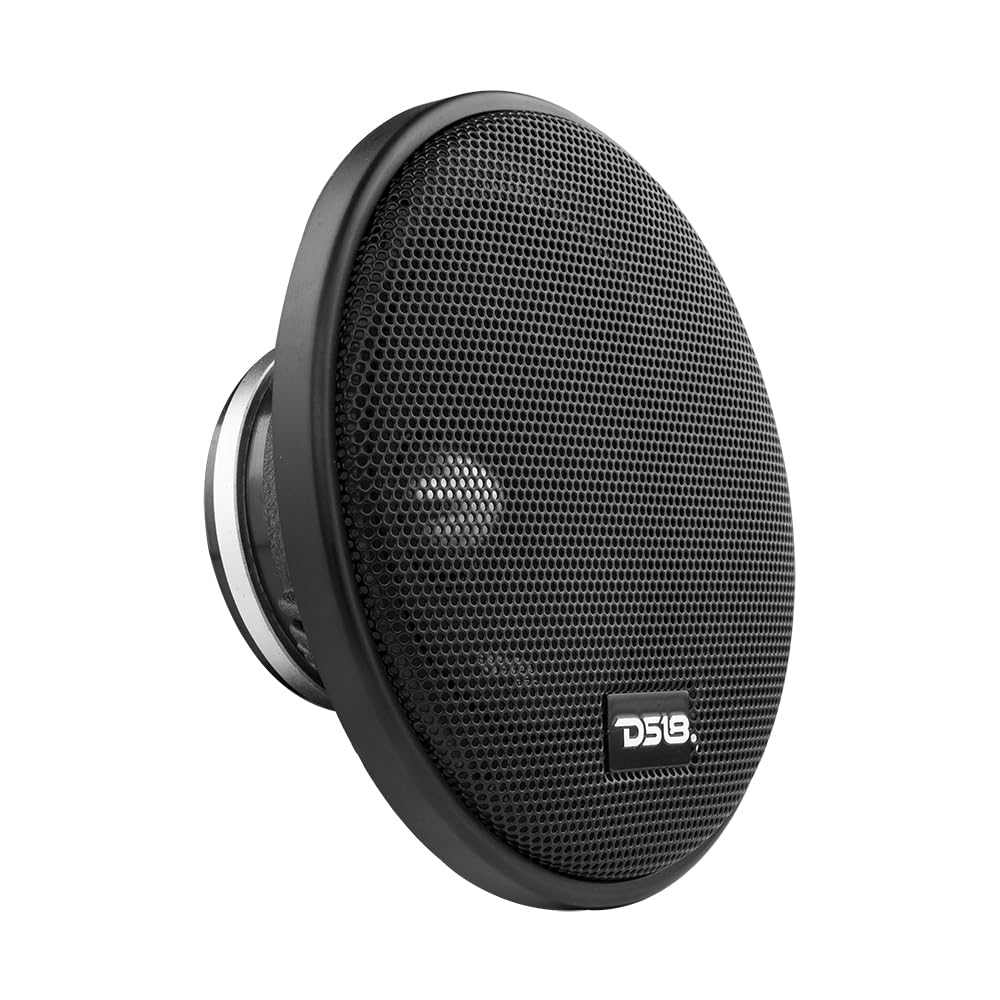
The one that gets loud on almost nothing — 94.6 dB of sensitivity in a compact neo magnet body.
Sensitivity is the underrated spec of car audio. This speaker rates 94.6 dB, meaning it produces far more volume per watt than a typical low-efficiency bookshelf. Compare it to the Saiyin pair at 85 dB and the gap is plain: same amplifier power, noticeably louder output from the DS18. That is the whole case for it — if your head unit or amp is modest, this driver squeezes every last watt into sound instead of heat.
Max power climbs to 400W, and against the DS18 midrange above that is a step up in burst headroom, but RMS sits at 200W — still serious continuous power. The 5.25″ size makes it an easy fit into door or rear-deck locations, and the mounting depth of 1.74 inches keeps it shallow enough for tighter cavities. The neodymium magnet is the reason the motor is compact for its output; a strong magnet in a small body is what lets this thing punch above its size.
There is a trade-off hiding in the numbers. The frequency response starts at 242Hz, so this driver covers midrange and up — it will not give you bass, and it is not meant to. It is a mid/upper-range specialist that needs a woofer or subwoofer beside it. If you want a clean drop-in upgrade for door speakers that keeps up with a sub, this is the efficient choice. If you want thump from one driver, keep looking.
Its whole point: 94.6 dB efficiency means more volume from the amp you already own.
Know the limit: 242Hz on the bottom end means it needs a woofer for bass — it handles the mids and highs.
Pick it for: car audio builds where the amp is small but the goal is loud, clear mids.
Skip it for: full-range duties — its 242Hz floor leaves bass to other drivers.
4. Rockville RockTower 64C Classic Home Audio Tower Speaker Passive 4 Ohm

A wood-finish floor tower that brings real weight to a stereo without asking for a small fortune.
This is the pick for a living room where the speakers are part of the furniture. The three-way design pairs 6.5″ woofers with a dedicated midrange and a 1″ silk dome tweeter, so highs stay crisp and bass stays punchy rather than boomy. Power handling runs 125W RMS with 500W peak, which leaves plenty of room for a stereo amp to drive them without strain. The MDF cabinet gives the sound something solid to push against, and the vented design helps the bass carry.
The detachable grille is a small thing that buyers actually notice. You can keep the classic, minimalist look or pull it off to show off the drivers. The gold-plated 5-way binding posts accept banana plugs, spade terminals, or bare wire, so almost any stereo amp or receiver connects without an adapter. And the 4 ohm impedance means these pull more power from the same amplifier than an 8 ohm tower would — which is the reason to buy 4 ohm speakers in the first place.
The caveat worth flagging: this is one tower per unit, not a pair. Confirm you are ordering enough for a full stereo setup before you commit. Also give a floor-standing cabinet some breathing room from the wall so the vented bass can do its work. Otherwise, the build and the finish read far above the tier this sits in.
The draw: a genuine 3-way tower with 6.5″ woofers and a silk dome tweeter, dressed in MDF and classic wood — living-room sound with floor-standing presence.
The check: order carefully, because this listing is for one cabinet, not a pair — you need two for stereo.
It suits: a home stereo where a floor tower earns its place as a visual as well as a sonic anchor.
Be sure of: the quantity you need — one cabinet per unit means a stereo setup needs two orders.
5. Floor Standing Tower Speakers Pair, Dual 6.5″ Woofers, 120W, Black
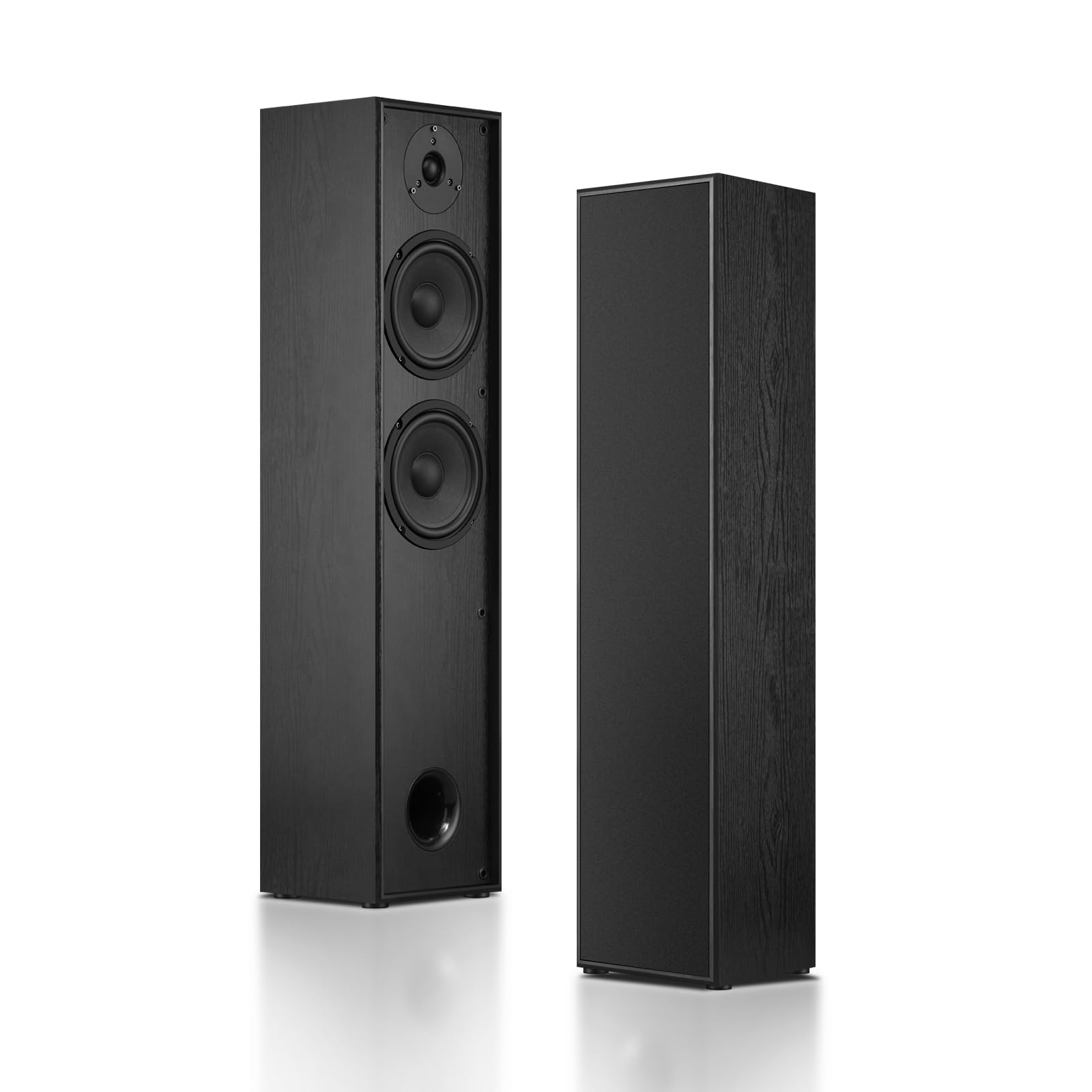
Two towers, four woofers, and a bass floor of 40Hz — cinema reach from a passive pair.
Bass extension is where this pair earns attention. The bottom of its range sits at 40Hz, which digs deeper than the Saiyin bookshelf’s 48Hz floor. Two 6.5″ woofers per tower do that work, backed by a 1″ silk dome tweeter for the top end, and the whole thing is crossed over at a stated 40Hz-21kHz ±3dB. The MDF cabinet is built to keep unwanted resonance out of the sound, so what you hear is closer to the recording.
Where this pair pulls ahead of the single RockTower above is bundled value on the theater side: you get a matched pair out of one box, both passive, both rated at 120W RMS. Set them behind a screen or flanking a TV and they will partner with most AV receivers and amplifiers. The cabinets are wood, the finish is black, and the two-way crossover keeps the mids and highs balanced across the whole spread.
The trade-off is amplifier dependency, as with every passive speaker here. No receiver, no sound — so budget for the amp if you do not already own one. The 4 ohm load also means you should confirm your receiver handles 4 ohms before you crank a film soundtrack. Do those two things and this pair gives you the deep end of the room for home theater money.
Why it fits a movie room
- Dual 6.5″ woofers per tower reach down to 40Hz for real cinema bass.
- A matched pair arrives in one box at 120W RMS — no doubling your order.
- MDF cabinets keep vibration and colouration out of the sound.
Before you commit
- Passive only — you must supply a receiver or amplifier.
- Confirm your amp is rated for the 4 ohm load at volume.
Made for: a home theater or hi-fi room that needs a pair of deep-reaching towers in one purchase.
Only if: you already have an AV receiver or amp happy to drive a 4 ohm load.
6. Kanto YU Passive 4″ Passive Bookshelf Speakers with 1″ Silk Dome Tweeter

A compact desktop pair with a Kevlar woofer and a spec sheet that is refreshingly straight with you.
Start with the number most listings hide. Kanto states plainly that the YU Passive 4” needs an amplifier capable of supplying 70 W per channel into 4 ohms. That is the honest kind of spec you want, because it tells you exactly what the speaker expects instead of leaving you to guess. The 4″ Kevlar woofer, a woven cone material chosen for stiffness, pairs with a tuned bass port for tight, controlled bass. The 1″ silk dome tweeter keeps highs smooth enough to listen to for hours without listener fatigue.
This is a desktop and small-room speaker, and it is built for that life. Solid MDF cabinets cut down vibration, self-adhesive rubber feet come in the box, and the minimal black or white vinyl finish blends into a room instead of shouting. Attach them to a compatible Kanto speaker stand and the cabinet coupling further takes resonance out of the equation. For a bedroom or desk setup, that is the exact spec list an owner wants to see.
The limit is the same as the rest of the passive family: bring your own amplifier. There is no Bluetooth and no internal power here, so a small amp or a compact receiver has to ride along. Do that and the 4″ driver still delivers realistic, uncoloured sound — the appeal is accuracy at low volume, not chest-thumping bass. It is the pick for a desk listener who wants accurate detail at low volume over raw output.
The details that sell it
- Clear 70 W per channel into 4 ohms amplifier requirement — no guesswork.
- Kevlar woofer and silk dome tweeter for tight bass and smooth highs.
- MDF cabinets plus rubber feet keep the cabinet resonance down.
The honest limits
- No amp inside — you must pair it with one.
- 4″ driver favours accurate detail over heavy bass.
Choose it when: you want a clean, accurate desktop or bedroom pair and already own a suitable amp.
Hold off if: you want bass-heavy output from a small speaker — this one trades thump for tonal honesty.
Understanding the Specs
Impedance (Ohms)
Impedance is the electrical load a speaker presents to your amplifier, measured in ohms. A 4 ohm speaker is a heavier load than an 8 ohm one, so it draws more current and can play louder from the same amp. The catch is that a weak amplifier may overheat or cut out driving a 4 ohm pair hard. Always check the receiver’s rated 4 ohm capability before you buy.
RMS Power Handling
RMS is the continuous power a speaker can safely take for long stretches, while max or peak figures describe brief bursts. Match your amplifier’s continuous output to the speaker’s RMS rating. An amp with far less power than the speaker’s RMS rating leaves performance on the table; one that overdrives a low-RMS speaker can damage the voice coil through clipped signal.
Sensitivity (dB)
Sensitivity tells you how loud a speaker plays for a given amount of power. A higher dB figure means the speaker needs less amplifier wattage to reach the same volume. The 94.6 dB DS18 full-range is a far easier load than the 85 dB Saiyin bookshelf, so it goes louder on a smaller amp — useful in a car where amplifier power is limited.
Frequency Response
This is the range of pitches a speaker can reproduce, written in hertz. The lower the starting figure, the deeper the bass — a response starting at 40Hz reaches lower than one starting at 48Hz. The upper figure covers the treble. Read it as a map of what the speaker can and cannot reproduce.
FAQ
Will a 4 ohm speaker work with an 8 ohm rated amplifier?
Do I need an amplifier for passive bookshelf speakers?
Is 250W RMS too much power for a door speaker?
What does sensitivity in dB actually mean for volume?
Can I mix a 4 ohm speaker with an 8 ohm speaker on one amplifier?
How much bass will a 5.25 inch driver produce?
Do tower speakers need a different amplifier than bookshelf speakers?
Is a 3-way speaker better than a 2-way for home listening?
What gauge speaker wire should I use for 4 ohm speakers?
Can I wall mount passive bookshelf speakers?
Final Thoughts: The Verdict
For most people, the 4 ohm loudspeakers winner is the DS18 PRO-X6.4BM 6.5″ Midrange Pair because its 250W RMS at 4 ohms gives real amplifier headroom and the loud, clear vocals most car upgrades are chasing. Buyers back it too: 4.5+ stars across 900+ ratings from car owners running it in their doors. If you are building a home theater room instead, the Floor Standing Tower Pair brings dual 6.5″ woofers and a 40Hz floor in one matched box. And for a calm desktop or bedroom setup, the Kanto YU Passive 4” delivers Kevlar-and-silk detail from a compact cabinet — just line up the 70 W per channel amp it asks for.
How We Picked
We do not accept paid placement. Every pick is matched to a real buyer and a real use-case; we do not hands-on test units.
Sources & Methodology
Specifications: manufacturer listings and product documentation. Review insights: verified customer reviews, as of November 2026. Pricing: not shown on this page (it changes often); check the current price via the retailer link.
As an Amazon Associate, Gadgets Feed earns from qualifying purchases. This does not affect which products we feature.