
Our readers keep the lights on and my morning glass full of iced black tea. As an Amazon Associate, I earn from qualifying purchases.
Specs are compiled from manufacturer listings and verified buyer reviews and can change over time — please confirm the key details on the product page before buying.
You want a belt sander that grinds a knife bevel flat and cool, not one that scorches the tip and throws the belt off track. The single most important thing to understand is speed: a slow-turning belt gives you control over where the steel goes, and a fast one removes metal so quickly that a beginner loses the grind line in seconds. This guide covers seven belt sanders that knife makers actually use, from a 1790 rpm low-speed machine built for edge work to a 2×72 heavyweight with a stepless variable frequency drive.
I’m Min — the founder and writer behind Gadgets Feed. This guide is built by comparing the manufacturers’ published specifications and the patterns across verified customer reviews, so you get each pick’s real strengths and trade-offs instead of marketing spin.
Some machines here are 1×30 benchtop units that fit on a small bench, while others are 2×72 grinders that need real floor space. Below you will find the honest differences in motor type, belt width, speed range, and work support — everything that decides whether a sander suits blade work or fights you. The right belt sander for knife making is the one that matches your speed, belt size, and bench space.
Our Picks at a Glance

How To Choose The Best Belt Sander For Knife Making
The wrong sander for blade work is almost always the wrong speed or the wrong belt width. Get speed and belt width right and the rest — motor type, work support, dust ports — falls into place. Here is what actually matters when you are shaping a bevel instead of sanding a tabletop.
Belt speed decides how much control you keep
A low-speed belt turns slowly enough that you can watch the grind line form instead of chasing it. The BUCKTOOL runs at 1790 rpm (revolutions per minute — how many times the drive wheel spins each minute), while the VEVOR spins up to 5000 rpm. Slower is friendlier to thin edges and heat-sensitive steel; faster eats metal fast when you are hogging off a blank. If you are new to bevels, a variable-speed machine lets you start slow and speed up once your hands are steady.
Belt width and length set your blade size and running cost
A 1-inch-wide belt is nimble for finger grooves and small blades. A 2-inch belt covers more steel per pass and suits longer kitchen knives and full-flat grinds. Belt length matters too, because a 1×30 belt costs less and is easy to find, while the 2×72 format is the standard in custom knifemaking shops. Longer belts also run cooler because there is more abrasive to spread the heat over.
Motor type and build decide how long it survives
An induction motor (a sealed motor with no brushes to wear out) tends to run quieter and smoother than a universal motor. The BUCKTOOL, the RIKON, and the Greteefor combo all use induction power. A reinforced steel frame holds alignment better under pressure, which matters when you press a blade hard into a platen. A detachable or tilting workbench helps you find an angle your wrists can hold for more than a minute.
Quick Comparison
| Model | Best For | Max Speed | Belt Size | Amperage | Amazon |
|---|---|---|---|---|---|
| VEVOR 30 x 1-Inch Variable Speed Belt Polisher★ Best Overall | Hobbyists and intermediate fabricators | 5000 rpm | 1 x 30 in | 5 A | Amazon |
| JLD Professional 2×72 Belt GrinderPremium Pick | Heavy-duty shaping and full-time makers | 3000 rpm | 2 x 72 in | 10 A | Amazon |
| RIKON 50-161VS Belt / Disc Sander | Shop stability and dialed-in control | 3400 rpm | 1 x 30 in + 6 in disc | 2 A | Amazon |
| Greteefor 6″ Bench Grinder & 1″x30″ Combo | Two tools on one bench | 3600 rpm | 1 x 30 in + 6 in wheel | 2.3 A | Amazon |
| BUCKTOOL 1×30″ Low Speed Sander | Beginner edge control | 1790 rpm | 1 x 30 in | 2.3 A | Amazon |
| KFMK 2″x42″ Belt Sander Combo | Sharpening with an angle guide | — | 2 x 42 in | — | Amazon |
| Jinlida JLD 30 x 1-Inch Belt Polisher | Budget multi-mode grinding | 5000 rpm | 1 x 30 in | 10 A | Amazon |
In‑Depth Reviews
1. VEVOR Belt Grinder Sander, 30 x 1-Inch Variable Speed Belt Polisher with VFD
Our pick — 4.0+★ from 350+ verified ratings; the strongest balance of quality and price.
A 550W motor with a VFD dial that lets you rough out a blank and then slow down for the finish pass.
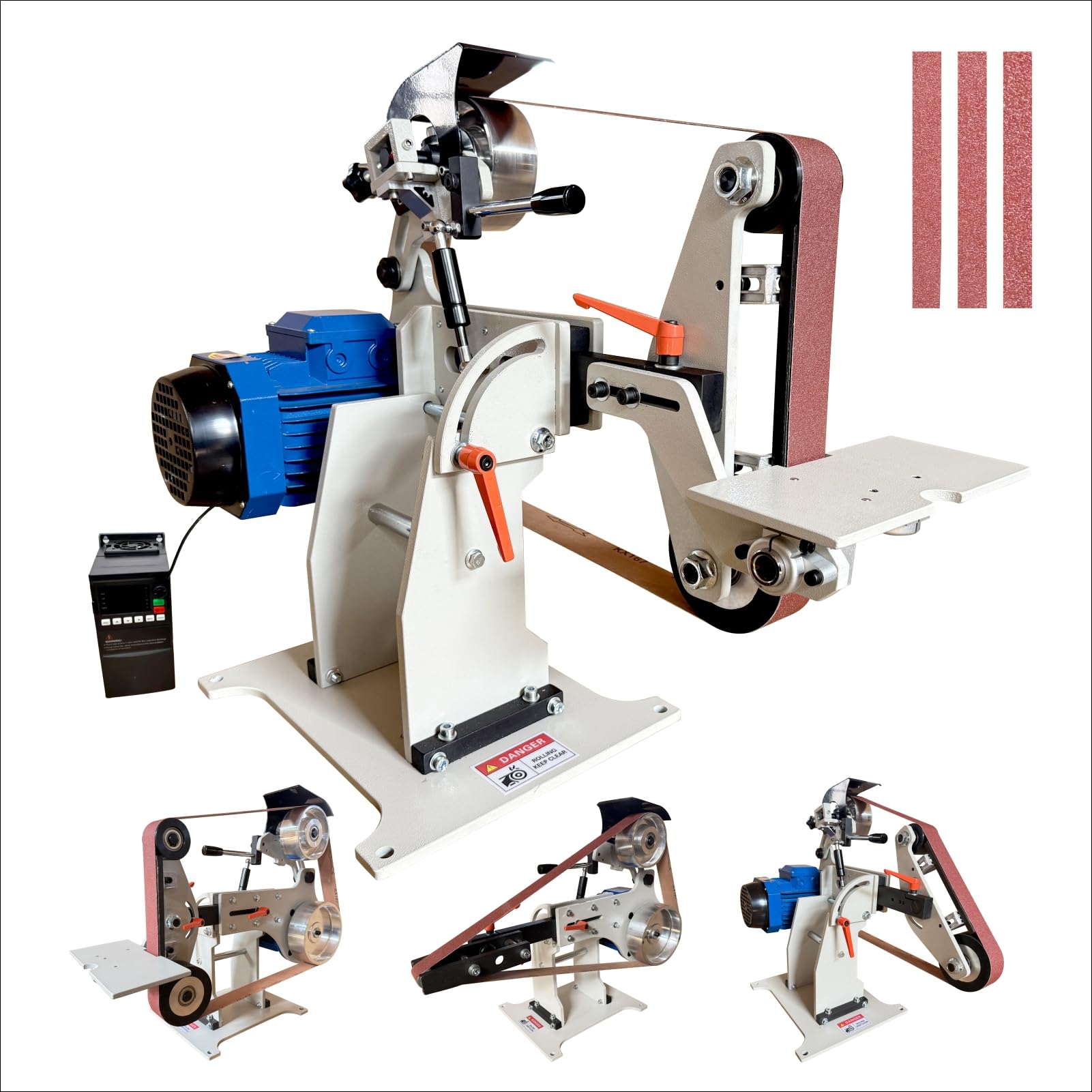
This is the machine that covers both ends of the job. The 550W pure copper motor pushes the belt to a maximum 5000 rpm, which is fast enough to hog a bevel into a bar of steel — and the VFD (variable frequency drive, a controller that changes motor speed without dropping its pulling power) lets you back it down for fine work. You get 2 grinding moulds, so flat grinding and circular grinding both happen on the same frame, and the detachable workbench lets you reposition the rest for whichever angle your hands prefer.
Owners describe it as well-built and genuinely versatile, and the aspect that gets the most nods is exactly that build quality. It is also one of the few 1×30 machines in this group that runs vertical or horizontal, so you can stand a blade upright for a plunge line or lay it flat for a scandi grind. At 17.4 pounds it is light enough to lift onto a shelf when the bench needs clearing — noticeably lighter than the 30.2-pound RIKON. Its 5 A draw is also more than double the RIKON’s 2 A, which tells you the motor is doing real work under load.
The honest catch is setup and belt tracking. Fitting the belts and dialing in tracking draws mixed feedback — some find assembly extremely easy, others find the directions thin. Adjustability is the single most-discussed topic and it lands mixed rather than glowing, so plan on some patience the first afternoon while you learn which knob moves what. Once the belt runs true, it stays useful. It is the pick most hobbyists and intermediate fabricators should start with.
Where this one earns its keep
- 550W motor reaching 5000 rpm handles rough shaping and finish passes on the same machine
- VFD speed control lets you slow the belt for heat-sensitive edges
- Two grinding modes — circular and flat — plus a detachable workbench
- Runs vertical or horizontal, so plunge lines and flat grinds both work
- 17.4 pounds is easy to move and store between projects
What to plan around
- Assembly directions are thin; some buyers find setup slow
- Belt tracking needs attention before the first real grind
- Adjustability is the most-discussed topic and reads mixed, not universally praised
Worth it for: the hobbyist or intermediate fabricator who wants one machine to shape, grind, and polish without buying three tools.
Think twice if: you want to unbox and grind in five minutes — the belt tracking setup asks for an evening of patience.
2. Jinlida JLD Professional Belt Grinder Sander, 2×72 Inch, 1500W
The 2×72 format every custom knifemaker recognizes, wrapped around a 1500W motor and a 2.2kW VFD.
Belt size is the whole story here. A 2-inch-wide, 72-inch-long belt gives you a long, cool-running abrasive and enough surface to grind a full-flat bevel without the belt wandering — and it is the size most knifemaking belts are sold in. The 1500W pure copper motor drives it, and Jinlida claims its transmission structure boosts grinding efficiency by 30% over standard models. Treat that figure as the maker’s own claim, not a tested number, but the motor size backs up the intent: this is built for metal removal in volume.
The speed control is the standout feature for edge work. A 2.2kW VFD gives stepless adjustment from 0-2800 rpm, so you can creep up on a thin edge without the belt jerking or stalling — the maker describes the regulation as smooth and jerk-free. Three belts come in the box in 60, 100, and 180 grit, which lets you go from deburring to refining without hunting for consumables. The one-piece powder-coated steel frame is there to keep vibration out of your grind lines during long sessions.
What buyers report is that it performs above what they expected and feels like money well spent — and at 4.5+ stars this is the highest-rated machine on the list. The reality check is the footprint and the power: it is a 30″ x 24″ x 18″ machine, and the box includes a power transformer that steps 110v up to 220v, so you need to set that up properly before the first run. It also runs at 10 A, so check what your bench circuit will comfortably carry.
The belt argument: if you are chasing a long, clean grind line on kitchen knives and hunters, the 2×72 belt is the format that gives it to you — nothing in the 1×30 group covers steel that fast per pass.
The bench argument: this is a floor-standing commitment, not a shelf sander.
Suits: makers who already know they will grind regularly and want the industry-standard belt size plus dial-controlled speed.
Look elsewhere if: you have a small bench, a limited circuit, or no appetite for wiring a step-up transformer.
3. RIKON 50-161VS 1 x 30-Inch Belt / 6-Inch Disc Variable Speed Sander

Two sanding surfaces, a 3/4 HP motor that dials from 2,000 to 3,400 rpm, and 30.2 pounds of stay-put.
Where the light 1×30 machines want to walk across the bench, this one plants. At 30.2 pounds it sits heavy, and the base has mounting holes so you can bolt it down and stop chasing it mid-grind. The 3/4 HP, 120V motor adjusts between 2,000 and 3,400 rpm, which translates to belt speed from 1,909 to 3,248 SFPM (surface feet per minute — how fast the abrasive actually passes the steel, which is the number that really controls heat and material removal). Slow it down and the belt stops scorching a fine edge.
Both work tables tilt from 0 to 45 degrees, and a miter gauge rides the disc-table slot for angled work. That tilting belt table is what lets you set a consistent grind angle and repeat it, rather than freehanding every pass. Separate dust ports for the belt and the disc mean you can hook both up to shop dust collection — a real quality-of-life detail in a small shop. Compare this to the VEVOR: the RIKON draws 2 A against the VEVOR’s 5 A, so it is the calmer machine, not the faster one.
The trade-off shows up in the most-discussed topics. Belt movement draws the only outright negative read in this sander’s feedback, and motor heat picks up mentions of its own, so give it air and check tracking before a long session. Stability and noise land mixed as well. It is not a machine that hides its weight or its motor — you work with both. Owners still rate the performance highly and call the adjustable speed the reason it stays in the shop.
Reach for this if: your bench is fixed, your shop has dust collection, and you want a dial that goes slow on thin stock.
Pass if: you need a portable sander or expect to haul it to a class — 30.2 pounds and a bolt-down base are not travel gear.
4. Greteefor 6″ Bench Grinder & 1″x30″ Belt Sander Combo
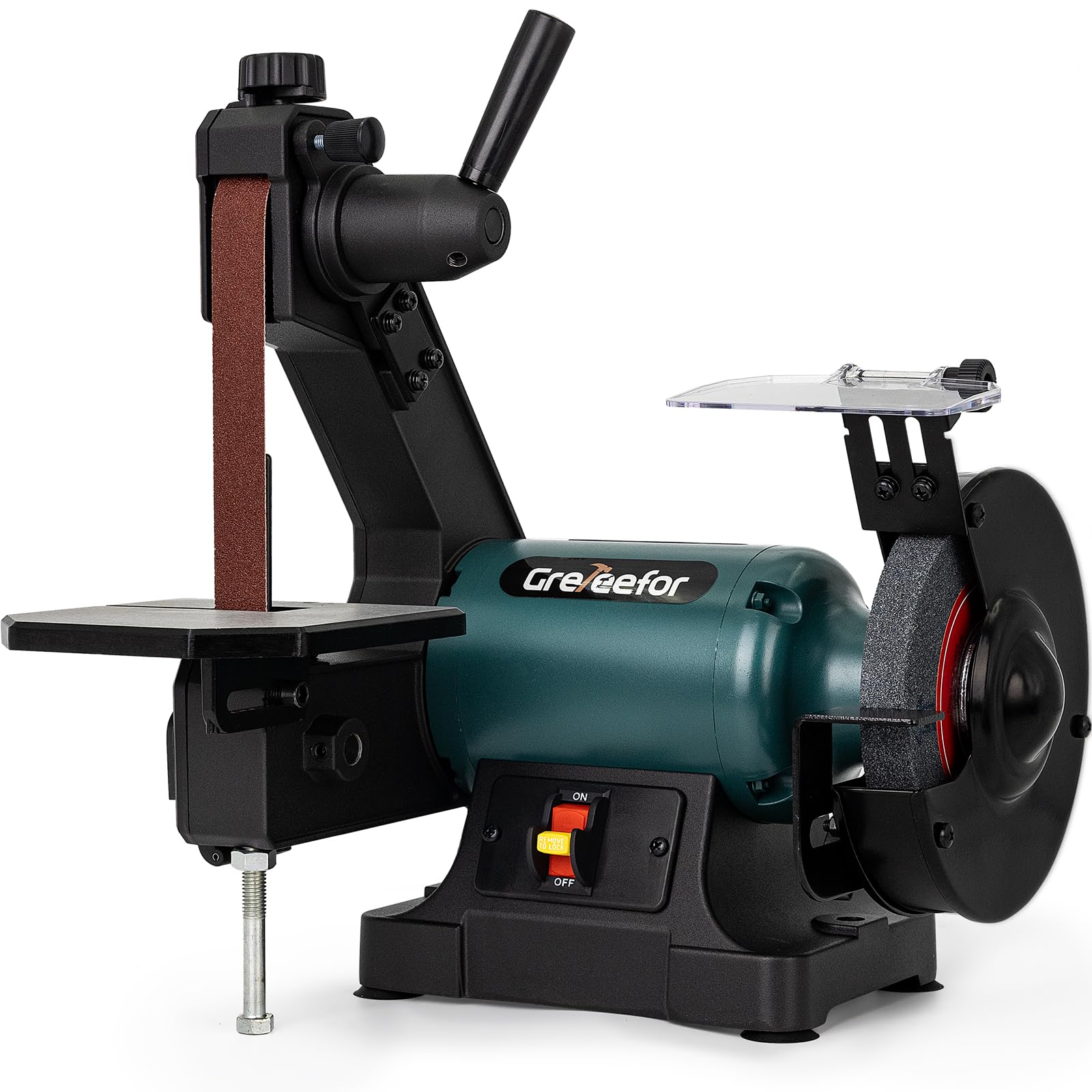
A grinder wheel for hogging and a belt for finishing, bolted to the same little steel base.
Knife work needs two different abrasives: a coarse wheel for knocking down a blank and a belt for shaping the bevel. This machine gives you both without buying twice. The 6-inch bench grinder carries a 60-grit wheel on a 1/2-inch arbor and spins at 3600 rpm, and the 1″ x 30″ belt side runs at 3400 FPM (feet per minute — the abrasive’s travel speed past the steel). A 2.3A induction motor runs both, which is why it stays smooth and quiet rather than screaming.
The convenience details are where a combo earns its bench space. Belt changes are quick-release with a tracking mechanism, the belt cover comes off in one step, and there is a built-in wrench holder so the tool you need is already on the machine. The grinding wheel gets toolless adjustable eye shields and an adjustable worktable, and the whole thing sits on a steel base with mounting holes to kill vibration. Three belts come included at 2×120 grit plus 1×100 grit — the finer of the two grits in this group’s comparison, since the KFMK ships a 120 and this combo’s wheel is a 60.
Feedback on this one is thin simply because it is new to the market, but what is there is warm: it reads as a good-value machine that does double duty.
Why it earns its footprint
- Grinder wheel and belt on one base — coarse shaping and belt finishing together
- 2.3A induction motor runs smooth and quiet across both surfaces
- Quick-release belt change, one-step cover removal, built-in wrench storage
- Mounting holes in the steel base hold it steady under pressure
Keep in mind
- 1-inch belt and 6-inch wheel limit wide bevel work
- Feedback pool is small because the model is new
Built for: the small-shop knife maker who wants a grinder and a belt sander without giving up two bench slots.
Skip if: you are shaping wide kitchen blades and need a 2-inch belt to do it.
5. BUCKTOOL 1×30″ Low Speed Belt Sander for Knife Sharpening
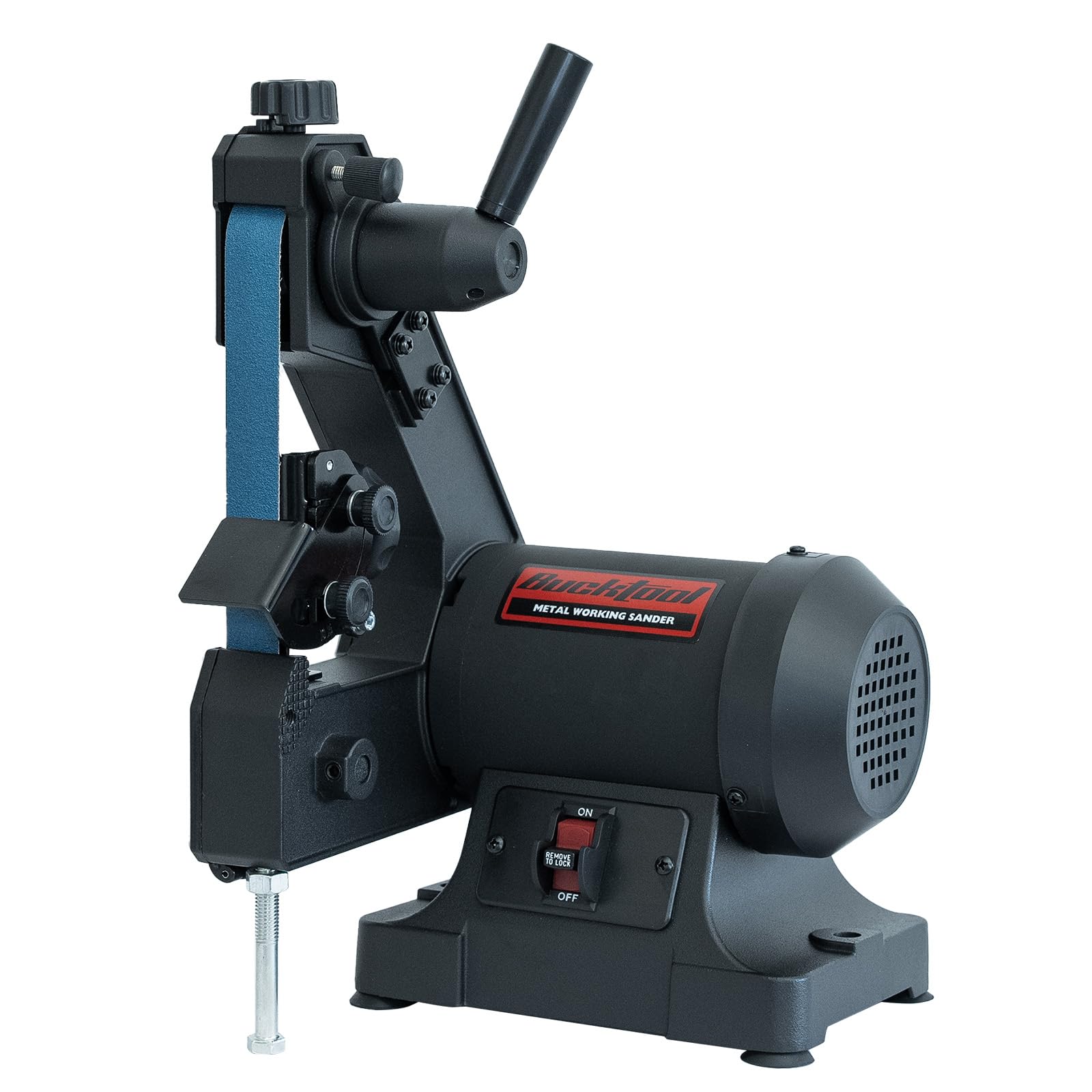
The slowest belt here — and that is the point, because slow means you can see the edge forming.
Here is the clearest speed contrast on the whole list. This sander turns at 1790 rpm, while the VEVOR reaches 5000 rpm. That is the difference between a belt that lets you feel the steel and one that removes metal before you notice you angled too steep. For someone learning to set a bevel on a scandi grind, the slow machine is the forgiving one. A 2.3A induction motor supplies the pull, and induction motors are valued for smooth torque and low vibration — the reasons a slow belt stays steady instead of chattering.
The angle guide is the feature that makes it a knife tool rather than a generic sander. It adjusts from 10 to 45 degrees, so you can lock a consistent sharpening angle for knives, chisels, and other edge tools instead of eyeballing it on every pass. A removable safety key cuts power so the machine cannot start by accident, and a two-year limited warranty backs the whole unit. Belt changes use one-button cover removal and quick-release replacement, with a tracking adjustment knob to keep the 1 x 30 belt running straight.
Buyers describe it as doing an excellent job on knives and cutting tools, and ease of use is the theme — belts swap in and out quickly. The scale is honest here: this is a newer model with a small feedback pool compared to the VEVOR, so you are judging a good early signal rather than a long track record. What you give up for the low speed is hogging power: at 1790 rpm it will take longer to grind a fresh blank into shape than the 5000 rpm machines.
Best fit on the bench: a first belt sander for someone whose main goal is a repeatable edge rather than speed of stock removal.
Where it slows down: grinding a blank from scratch is a patient afternoon, not a fast one.
Right call if: you are learning, you want a locked angle guide, and you value control over raw feed rate.
Wrong call if: you are production-shaping blanks and need the belt to eat steel fast.
6. KFMK 2″x42″ Belt Sander Combo for Knife Making with Angle Guide
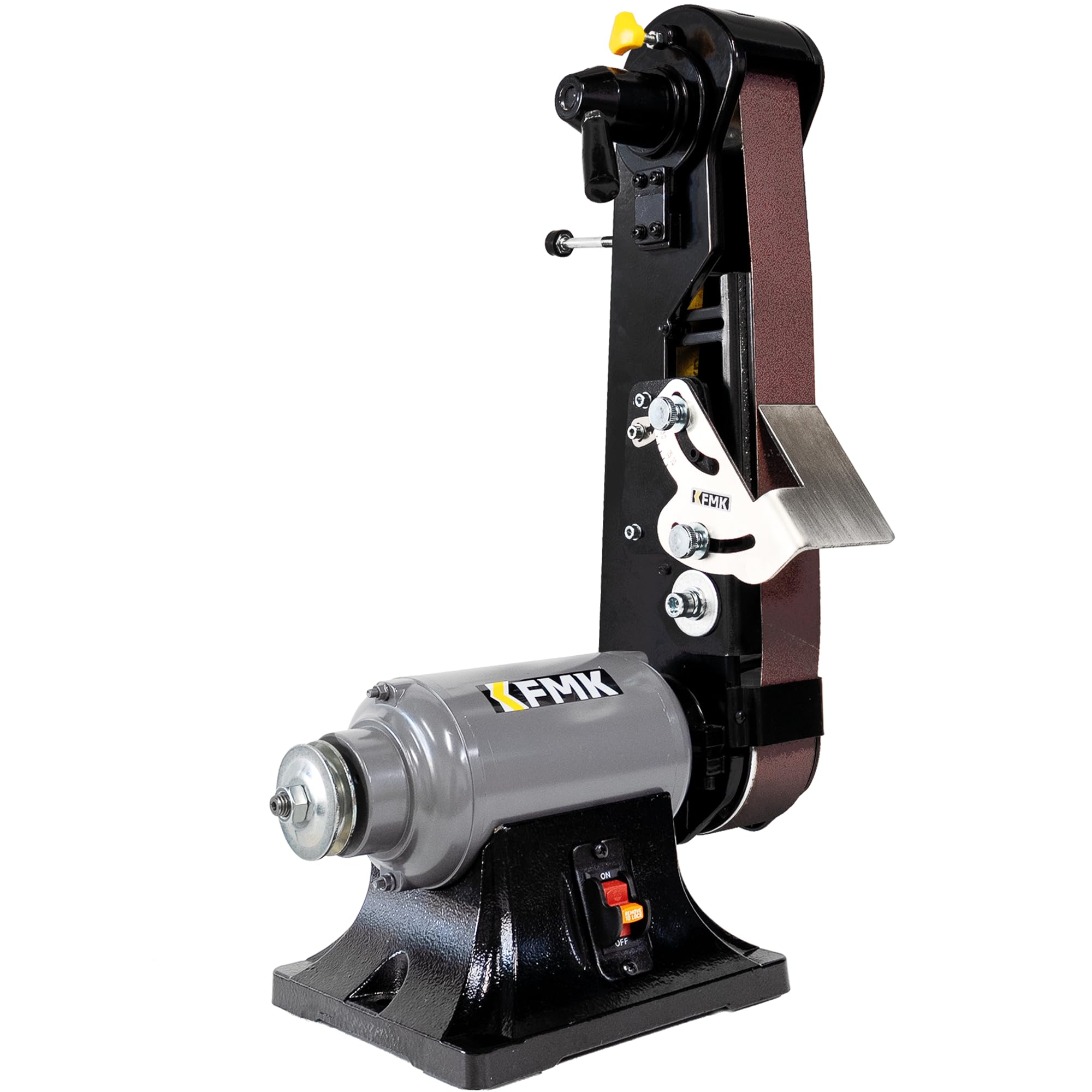
A 2-inch belt for wider bevels, with an angle guide in the box so sharpening stays repeatable.
If you want more belt under your blade than a 1-inch machine offers but you are not ready for a 2×72 shop grinder, a 2×42 sits right in the middle. The wider belt covers more edge per pass, and the KSAG-2 angle guide that ships with it gives you a fixed reference for holding a bevel angle across both sides of the blade. A 120-grit belt is included, which is a fine grit suited to sharpening and refining rather than heavy stock removal.
Owners say it handles sharpening on blades and chisels well, and functionality and quality come up most often — it does the job it was sold to do. Sharpening performance is a distinct strength in the feedback, with a perfect edge on just about anything being the kind of result people describe. Versatility with conditioning belts is another plus that shows up. Assembly is simple: a manual and a hex wrench are the only setup tools needed.
The caveats are worth knowing before you buy. Durability feedback is split, with some describing it as heavy-duty and others pointing to a wobbling stone — so check that everything is seated properly on arrival. Power draws mixed comments as well, so treat this as a sharpening and finishing machine rather than a blank-hogging workhorse. Noise is mentioned but not as a dealbreaker either way.
A good match for: the sharpener who wants a wider belt and a repeatable angle without stepping up to a full shop grinder.
Not for you if: you need to grind fresh blanks from bar stock — this one is built to refine an edge, not create one from nothing.
7. Jinlida JLD 30 x 1-Inch Variable Speed Belt Polisher with VFD
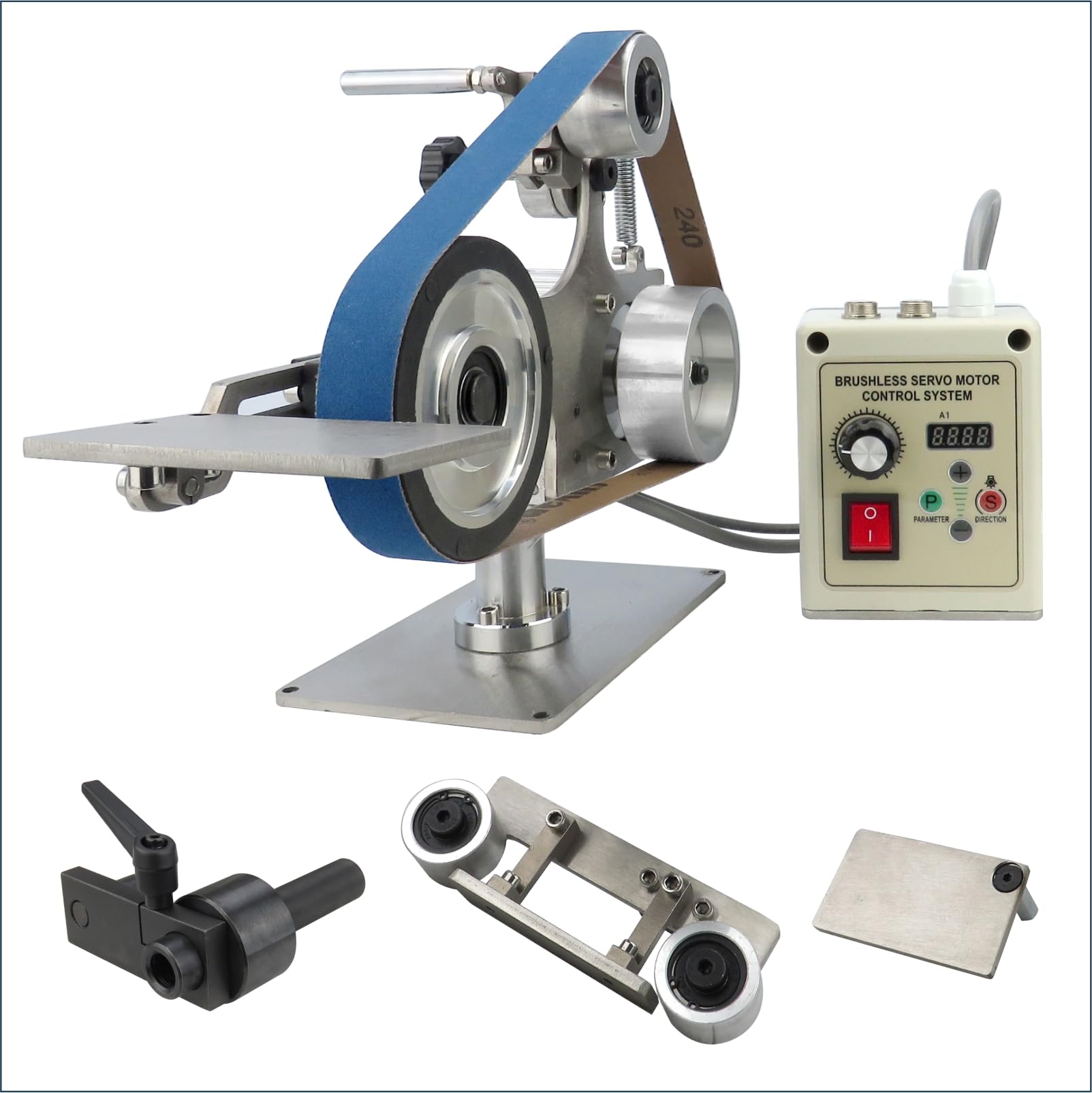
Three grinding modes and a VFD dial on a compact 1×30 frame that slides onto a small bench.
This is the entry point to variable speed, and it packs a surprising amount into 17.6 pounds. A 550W pure copper motor pushes the belt to 5000 rpm for rough work, and the VFD lets you switch down for fine passes. Crucially, you get three grinding modes — circular, flat, and arc — where the VEVOR offers two. Arc grinding is the one that matters for finger grooves and curved profiles, and it is rare on a machine in this tier.
The belt-speed number behind the VFD is 26m/min (metres per minute), which is slow enough for controlled fine grinding once you dial it down. A mid-to-high adjustment wheel on the belt is there to stop the abrasive from drifting sideways, which protects both the belt and the motor. Three belts come included at 100, 180, and 240 grit, and the frame runs vertically or horizontally with a reinforced steel body and a detachable workbench.
There is no customer feedback on this model yet, which is worth saying plainly — the Jinlida name is newer to Amazon listings and the rating pool is empty. That means you are buying on specs and build description rather than a track record. If a proven review history matters more to you than the three-mode grinding, the VEVOR is the safer bet. If you want the most modes for the least outlay and are comfortable being an early owner, this delivers the features.
The spec case
- Three grinding modes including arc — unusual at this tier
- VFD variable speed with a 5000 rpm ceiling
- 100, 180, and 240 grit belts included for the full grit run
- Vertical and horizontal use in a 17.6-pound frame
The honest side
- No customer feedback yet — no real-world track record to lean on
- Newer brand, so long-term durability is unproven
For: the budget-conscious beginner who wants variable speed and arc grinding and is fine being an early adopter.
Not for: anyone who needs a proven review history before spending — pick the VEVOR instead.
Understanding the Specs
Belt Speed: RPM vs SFPM
RPM (revolutions per minute) tells you how fast the drive wheel spins; SFPM (surface feet per minute) tells you how fast the abrasive actually passes your steel. Two machines at the same rpm can run different belt speeds if their wheels differ in size. For knife work, what matters is that you can slow the belt down enough to keep heat out of a thin edge — the RIKON’s 1,909 to 3,248 SFPM range is a good example of a belt that can go gentle. A belt running at a fixed high speed removes material faster but gives you less room to correct a bad angle.
Motor Type: Induction vs Universal
An induction motor has no brushes, so it tends to run quieter, smoother, and longer between services. A universal motor is smaller and cheaper for the same output but louder and more prone to brush wear. For a slow-speed knife sander, the induction design’s smooth torque is exactly what keeps a slow belt from stalling under pressure. A pure copper motor is a build detail that affects heat handling — it is worth checking whether the motor runs hot at the end of a long session and giving it airflow.
Belt Width and Length
A 1-inch belt is the smallest common size and handles finger grooves and small blades comfortably. A 2-inch belt covers more steel per pass and is the width most custom knife makers prefer for bevels. Length affects two things: how warm the abrasive gets and how much belts cost. A 1×30 belt is cheap and easy to source; a 2×72 runs longer and cooler but costs more per belt. Choose the biggest belt your budget and bench can carry, then plan for consumables.
VFD and Work Supports
A VFD (variable frequency drive) is a controller that changes motor speed electronically without losing pulling power, letting you go from coarse hogging to fine polishing with one dial. Work supports matter as much. A tilting worktable, a locking angle guide, and a miter gauge are what let you repeat an angle instead of eyeballing it. Belt tracking adjustment is the third piece: without it, the belt drifts sideways and the grind wanders. Check that a sander has all three before you buy for edge work.
FAQ
Is a low-speed or high-speed belt sander better for knife making?
What belt size should I choose for knife making?
Do I need a VFD on a knife-making belt sander?
Will a 1×30 belt sander handle a full kitchen knife bevel?
How do I stop a belt from tracking off the machine?
Does a belt sander need a lot of power for knife grinding?
Can I sharpen chisels and other edge tools on these sanders?
How much bench space does a 2×72 grinder take up?
What grit belts come with a knife-making belt sander?
Can I mount a belt sander so it stops moving during grinding?
Final Thoughts: The Verdict
For most knife makers starting out or working in a home shop, the belt sander for knife making winner is the VEVOR 30 x 1-Inch Variable Speed Belt Polisher because it pairs a 550W motor and a VFD dial with two grinding modes and vertical or horizontal use, so one machine does shaping and polishing. If you are building custom blades and have the bench for it, the JLD Professional 2×72 is the step up — the standard belt size, a stepless VFD, and the highest-rated machine on this list at 4.5+ stars. And if control is what you are missing, the BUCKTOOL 1×30 at 1790 rpm with its 10-to-45-degree guide is the patient teacher. Whichever you pick, buy more belts than you think you need — a 1×30 belt wears through grit faster than you expect.
How We Picked
We do not accept paid placement. Every pick is matched to a real buyer and a real use-case; we do not hands-on test units.
Sources & Methodology
Specifications: manufacturer listings and product documentation. Review insights: verified customer reviews, as of November 2026. Pricing: not shown on this page (it changes often); check the current price via the retailer link.
As an Amazon Associate, Gadgets Feed earns from qualifying purchases. This does not affect which products we feature.