
Our readers keep the lights on and my morning glass full of iced black tea. As an Amazon Associate, I earn from qualifying purchases.
Specs are compiled from manufacturer listings and verified buyer reviews and can change over time — please confirm the key details on the product page before buying.
If you want the short answer: buy for the surface you actually drive on, not for the top-speed number on the box. A car-park basher and a gravel-and-grass buggy need different motors, chassis and shocks, and most first-time buyers get this backwards. This guide walks through the real differences — motor type, chassis material, shock setup, battery count — so you pick the one that still works in a month.
I’m Min — the founder and writer behind Gadgets Feed. This guide is built by comparing the manufacturers’ published specifications and the patterns across verified customer reviews, so you get each pick’s real strengths and trade-offs instead of marketing spin.
Below you’ll find eight open-wheel off-road buggies sorted by what they genuinely do best, from micro racers for the living room to a brushless 1/8 monster. Each entry names the exact spec that decides whether it fits you, plus the honest trade-off nobody puts on the box — a practical read on the best rc buggy car for your terrain.
Our Picks at a Glance


How To Choose The Best RC Buggy Car
The single mistake that ruins a first buggy purchase is buying for speed. Top speed is the easiest number to print and the hardest to actually use — a buggy that does 50 km/h needs space, skill, and spare parts. Start instead with three questions: where will you drive it, who is driving it, and how long do you want to be out before the battery quits. Those answers narrow the field fast.
Match the scale to your driving space
Micro and small-scale buggies (1/24 and 1/18) run happily in a driveway or a living room and cost less to repair when you clip a table leg. Mid-scale buggies (1/16 and 1/12) need a park, a gravel lot, or a ball field to stretch out. A 1/8 buggy is a serious machine that wants open ground — it is heavy, fast, and it will find every curb within range.
Brushed or brushless — decide this before anything else
A brushed motor (the traditional type with physical carbon brushes inside) is cheaper, simpler, and slower. A brushless motor (no brushes touching the spinning part, so less friction and heat) delivers more speed and typically runs cooler, but it demands a bigger battery and more respect on the throttle. Brushless is the upgrade path; brushed is the learn-to-drive path.
Count the batteries, not the marketing
Run time is decided by capacity in mAh (milliamp-hours — how much energy the pack holds) and by how many packs come in the box. Two included packs means you swap and keep driving instead of waiting on a charger. Also check the chemistry: Li-Po packs deliver punch but need careful charging, while the charger type in the box decides how long you sit around between runs.
Look at shocks and chassis material for durability
Oil-filled shocks (metal tubes with hydraulic damping fluid inside) soak up landings from jumps; plain spring shocks bounce. An aluminum chassis resists bending where plastic flexes and eventually cracks. If your ground is gravel, grass, or rock, those two details matter more than another few km/h of top speed.
Quick Comparison
| Model | Best For | Scale | Top Speed | Drive / Power | Amazon |
|---|---|---|---|---|---|
| Losi Micro-B 2WD Buggy Silver RTR★ Best Overall | Indoor racing and first hobby buggy | 1/24 | 13 mph | 2WD brushed | Amazon |
| HAIBOXING 18872 1:18 Dune BuggyBudget Basher | Backyard bashing on a budget | 1/18 | 36 km/h | 4WD brushed | Amazon |
| RC Cars 1:16 All Terrains GreenBeginner Friendly | Beginners wanting two batteries | 1/16 | 50 km/h | 4WD brushed | Amazon |
| ARRMA Typhon GROM 4×4 RTR Red/White | Hobby-grade small-scale all-rounder | Small scale | — | 4WD brushed | Amazon |
| ZD Racing 1:12 Brushless Buggy | Adults chasing real speed | 1/12 | 42 mph | 4WD brushless | Amazon |
| GoolRC WLtoys 124019 1/12 Buggy | Cheap entry into 60 km/h | 1/12 | 60 km/h | 4WD brushed | Amazon |
| ARRMA Typhon GROM 223S BLX Silver | Brushless speed with stability control | Small scale | 50+ mph on 3S | 4WD brushless | Amazon |
| AMORIL RLAARLO DSK 1/8 Dragon Knight | Serious 6S bashing and jumping | 1/8 | 50 mph | 4WD brushless | Amazon |
In‑Depth Reviews
1. Losi Micro-B 2WD Buggy Silver RTR LOS00007T2
Our pick — 4.5+★ from 250+ verified ratings; the strongest balance of quality and price.
A palm-sized racer that borrows real race-car hardware and fits on a kitchen floor.
The number that sells this buggy is 20 minutes of racing from an hour of charging — a fast turnaround that keeps a lunch break or a rainy afternoon moving. It’s a 1/24 scale machine, meaning roughly one twenty-fourth the size of a full race buggy, so it runs in spaces a bigger car simply cannot. Top speed is 13 mph, which sounds modest until you watch it cross a living room in a couple of seconds.
Where the money actually goes is underneath: a TLR-inspired design (TLR is Team Losi Racing, the company’s competition arm) with an aluminum chassis and oil-filled shocks. Those oil-filled shocks are the difference between landing a jump and bouncing off it, and they’re rarely found at this scale. It ships ready-to-run with a Spektrum 7.4V 350mAh 2S LiPo battery, a charger, a 2-in-1 ESC and receiver, and a 65T brushed motor already installed — you unbox, charge, and drive.
Quality is what wins people over here, and the fun factor sits right behind it. It’s also the lightest thing on this list at 152 g, so a tumble off a curb is a pick-up-and-go moment rather than a repair session. The recurring gripes are honest ones: durability and handling draw mixed feedback, and a few units have quit within a week. Battery life splits opinion too, with charging complaints mixed in. Keep it on smooth indoor and driveway surfaces rather than gravel, and the aluminum chassis and oil-filled shocks hold up. At 4.5+ stars across 250+ ratings, it’s the strongest-reviewed buggy here.
What earns it first place
- Oil-filled shocks and an aluminum chassis at micro scale — real race hardware, not toy springs.
- 20 minutes of run time from a one-hour charge keeps sessions rolling.
- 152 g all-in, so it survives drops that would sideline heavier buggies.
- Complete ready-to-run kit: battery, charger, radio, and motor all in the box.
Where it asks patience
- Durability reports are mixed — it’s built for smooth ground, not gravel abuse.
- Charging complaints surface often enough to warrant using the supplied charger exactly as directed.
- 13 mph is indoor-and-driveway pace, not park-conquering speed.
Reach for this if: you want a genuine hobby-grade micro racer for indoors, a driveway, or a smooth court.
Look elsewhere if: your ground is rough grass and rocks — the HAIBOXING below is built for that.
2. HAIBOXING 18872 1:18 RC Car 4WD Off-Road Dune Buggy
Two batteries in the box and over 35 minutes of run time — the value play for a backyard.
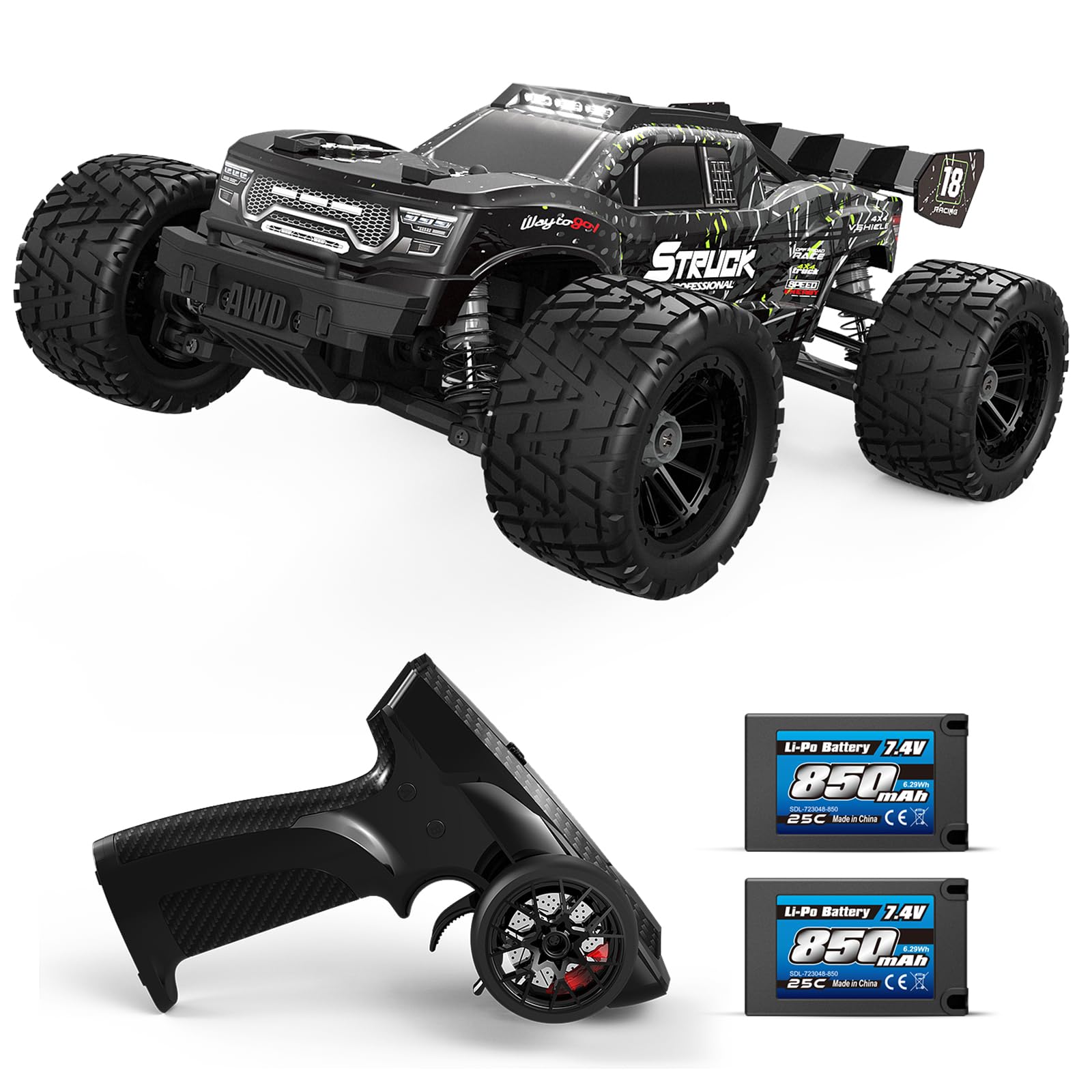
Thirty-five minutes of driving is the headline, and it comes from two 850mAh Li-Po packs rather than one big one. For contrast, the Losi Micro-B above runs 20 minutes per charge — the HAIBOXING stretches a session by a good margin because you swap packs instead of waiting. It’s a 1/18 four-wheel-drive dune buggy, so power goes to all four wheels and it tracks straighter through loose gravel and grass than a two-wheel-drive car would.
The hardware is aimed squarely at beginners who will hit things. There’s a 380 motor, a 3-wire 17g servo, independent suspension, adjustable shock absorbers, front and rear differentials, and metal drive shafts. The body uses PA material (a tough nylon-type plastic) with a reinforced structure and a collision-resistant frame. The 2.4GHz radio reaches over 280 feet, and the electronics are splash-proof with overheat protection and an anti-jam cut-off. One catch worth flagging: new and old controllers aren’t compatible, so don’t plan on pairing a spare radio from another unit.
Fun is what owners talk about most, with quality and speed close behind, and the durability read is genuinely positive — it takes abuse and keeps going. Performance and battery life both register as pluses rather than compromises. Build quality is the one mixed signal, so check the screws and shocks after a hard session. At 4.0+ stars across 150+ ratings, this is the sensible first buggy for a kid or an adult who wants to learn on grass.
Best value read: two 850mAh packs plus a splash-proof ESC and metal driveshafts is a lot of hardware for the entry tier — this is the buggy you hand a beginner without flinching.
Who should look on: if you want brushless speed or a car you can tune heavily, this is a starting point, not a destination.
Buy it for: backyard and ball-field bashing where the car will get bumped and you’d rather not babysit it.
Skip it for: long open runs where you want top-end pace — 36 km/h is quick, not fast.
3. RC Cars 1:16 Scale All Terrains Remote Control Car 50 km/h Green
Fifty kilometres an hour with two packs and a splash-proof IPX4 speed controller for wet-day runs.
This one leads on raw pace at the beginner tier: 50 km/h from a 390 motor — the HAIBOXING above tops out at 36 km/h. It’s a 1/16 four-wheel-drive buggy running a 35A ESC (electronic speed controller — the circuit that meters power to the motor) rated IPX4, meaning it shrugs off splashes but isn’t built for submersion. A 5-wire 17G servo handles steering with proportional throttle control, so you get fine input rather than on-off switches.
Run time comes from a 7.4V 1300mAh pack plus a second 1500mAh pack, each giving 20-30 minutes. That’s a lot of driving from one box. The manual is blunt about one thing: rest 5-10 minutes before swapping batteries so the motor can cool — ignore that and you risk overheating damage. Suspension is metal shocks on a sturdy chassis, and the rubber tires and head-up wheel are meant for mud, beach, grass, snow, sand dunes, and rock road.
What it does best is welcome a beginner — suitability for beginners is the strongest theme in the feedback, and plenty of buyers hand it to kids. Speed draws a mixed reaction, which fits a cheap brushed motor at this price tier. The electronics protections (charging protection, motor anti-lock, high-temperature cut-off) are the real story for a nervous first owner. At 4.0+ stars across 100+ ratings, it’s a solid starter rather than a hobbyist’s tool.
The honest trade-off: 50 km/h is genuinely quick for a brushed 1/16, and that pace plus a light chassis means curb hits cost you. Run it on open ground while you learn.
The smart pick if: you’re buying a first buggy for a teenager and want two batteries plus water resistance built in.
Think twice if: you want to tune and upgrade — this is a closed, simple package.
4. ARRMA Typhon GROM 4×4 RC Buggy RTR Red/White ARA2106T2

The small-scale buggy that drives like a scaled-down race car, with the parts to back it up.
What you’re paying for here is the drivetrain. An enclosed all-metal gear set, high-quality hex hardware throughout, and a four-wheel-drive system put this in hobby territory rather than toy territory. It’s noticeably bigger and heavier than the micro cars above — 2.6 pounds against the HAIBOXING’s 1.9 pounds — and that mass is why it settles onto dirt instead of skittering across it. Dimensions run 13.9 x 9.6 x 7.6 inches, so plan on a boot or a shelf rather than a drawer.
The suspension is independent with oil-filled coil-over shocks, which absorb landings and keep the tires planted through ruts. Electronics are fully waterproof: a Spektrum SLT 2-in-1 25A ESC and receiver plus an SX110 waterproof metal-geared servo, so a damp field or a puddle splash isn’t the end of the run. A clipless body system means you pop the shell off without fiddly pins when you need to get at the battery or motor.
Quality is the thing owners rave about, and fun and value follow — the consensus is that it drives like a mini 4WD race buggy. Battery life splits: some get good runs, others find it short. Durability feedback is mixed in the same way, so treat hard landings with a little respect. At 4.0+ stars across 250+ ratings, it’s the most-reviewed ARRMA here and the safest entry into the brand’s ecosystem.
The ecosystem payoff: it ships with a Spektrum 2S LiPo and Smart charger, and the metal-geared internals take upgrades without complaint — this is a buggy you grow with, not out of.
The catch: brushed power means it won’t match the brushless ZD Racing below on top end, and the heavier build needs a firmer surface than a micro racer.
Worth it for: anyone who wants a genuine hobby-grade small buggy with room to upgrade and waterproof confidence.
Not needed for: indoor-only drivers — the Losi micro suits a living room better.
5. ZD Racing 1:12 Brushless Buggy, 42 MPH 4WD
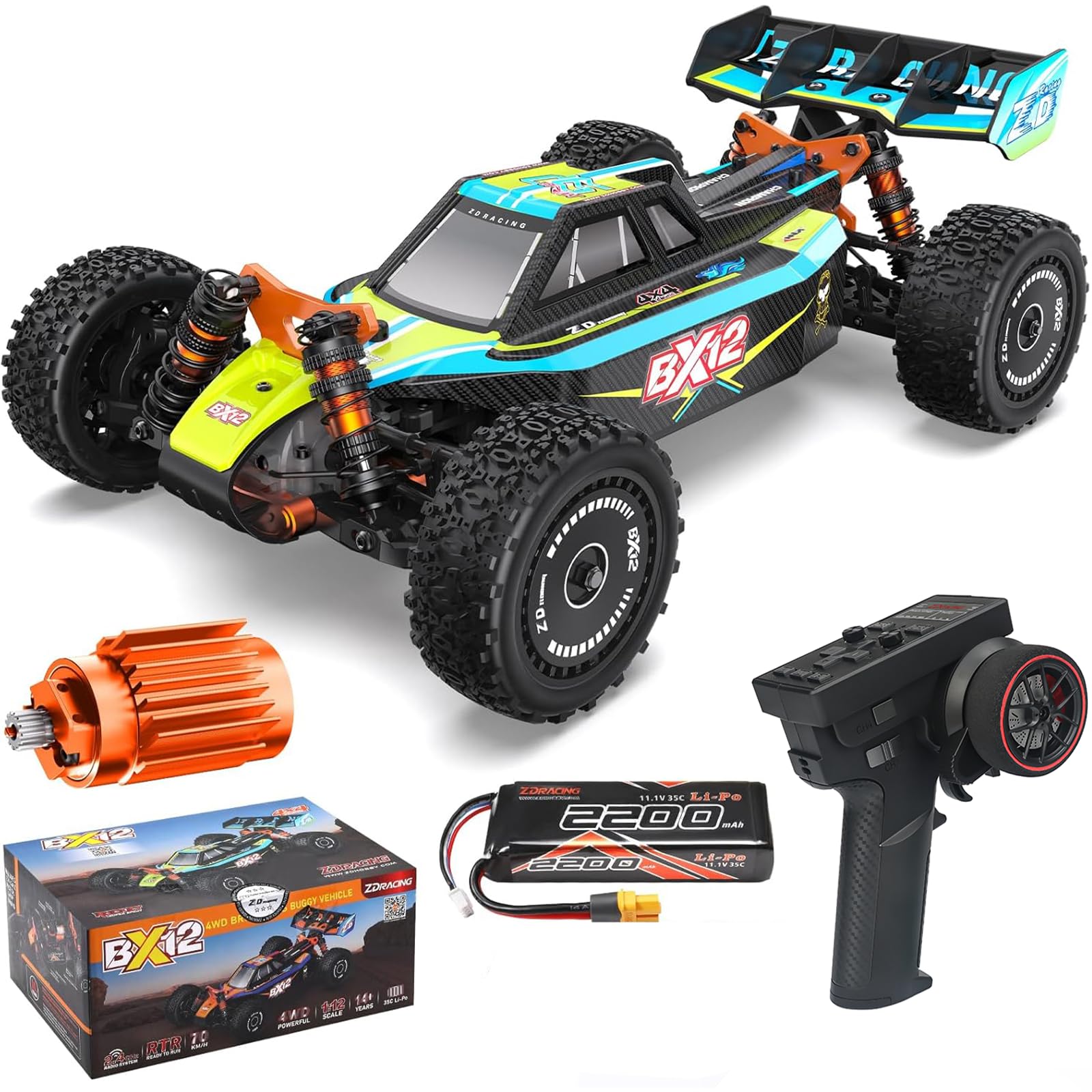
Real brushless power from a 3600KV motor and 3S pack — adult speed, adult respect required.
Forty-two mph from a 1/12 buggy is a different sport from the brushed cars above. It comes from a 2845 brushless motor rated 3600KV (KV measures RPM per volt, so higher means more spin and more speed) fed by a 3S 2200mAh Li-Po. The independent receiver and high-torque motor give smooth acceleration on mud, sand, grass, and rugged ground. Just know the radio needs four AA batteries that aren’t in the box.
Durability hardware is serious for the tier: a CNC-machined 59T steel differential, steel CVD components, 16x71mm oil-filled metal shocks, and a 2mm reinforced shell with a front anti-collision design. There’s a cooling system aimed at keeping motor temperatures down during long races. Electronics include overheating warnings, low-voltage cutoff, and over-current protection — the last one guards the battery from a dead-short mistake.
Owners find it extremely fast and well-built, with value for money a strong second theme and durability ahead of speed in mentions. Control and reliability are the mixed notes — some find it easy to maneuver, others hit steering issues. Worth knowing before you buy: the transmitter must be adjusted above 25 to start, and a full charge takes two hours. At 4.0+ stars across 90+ ratings, it’s a strong brushless step-up.
Setup quirk to know: the throttle adjustment has to be dialled past 25 before the car moves at all, which trips up first-timers who think the unit is faulty.
Fair warning from the maker: high speed plus a crash can break parts, and replacement is on you — buy a spare set of arms when you buy the car.
Choose this when: you’ve driven a brushed buggy and want genuine brushless pace without jumping straight to 6S money.
Hold off if: you’re buying for a younger kid — 42 mph demands an experienced hand.
6. GoolRC WLtoys 124019 1/12 Buggy with Aluminum Chassis

Sixty kilometres an hour and a 100-metre radio range on the cheapest 1/12 chassis here.
Speed per pound is the pitch: 60 km/h from a high-efficiency strong-magnet motor, with a 2.4GHz anti-jamming radio that lets several cars run the same track at once. Control distance is up to 100 metres, which is far more range than you’ll use in a park. The base is high-strength aluminum alloy with a zinc alloy gear set and an aluminum shock tower, so the structure resists wear better than an all-plastic frame.
Four hardware hydraulic shock absorbers let it adapt to beach, snow, grass, mountain road, and rock road. Two batteries come in the box along with a charging cable and cross socket wrench. It’s a 1/12 four-wheel-drive off-road buggy with drift capability on loose ground. Note the weight — 2.09 kg, which is a substantial car to carry to the park and a substantial car to hit a curb with.
The start-up experience is what buyers praise most, with speed and value right behind it. That’s the honest picture: it feels quick and it feels like a lot of car for the tier. The counterweight is real, though — durability is the most-cited concern, with suspension arms breaking and reports of the car failing within days. Battery life is the other weak spot, with short lifespans and long charge times mentioned. At 4.0+ stars across 400+ ratings, it’s the most-reviewed buggy on this list and a genuine first hobby-grade car — just budget for spares.
Why it still earns a spot
- Aluminum chassis, zinc gears, and an aluminum shock tower at the entry tier.
- 60 km/h top speed with a 100-metre radio range for open-ground runs.
- Two batteries included, so run time doubles before you need a charger.
What to plan around
- Suspension arms are the weak point — order spares with the car.
- Charge times are long enough to plan sessions around.
- 2.09 kg makes it a load to carry and unforgiving in a collision.
Good match for: a tinkerer who enjoys wrenching and wants 60 km/h without premium-tier spend.
Poor match for: a set-and-forget owner who wants zero maintenance.
7. ARRMA Typhon GROM 4X4 223S BLX Brushless Buggy RTR, Silver
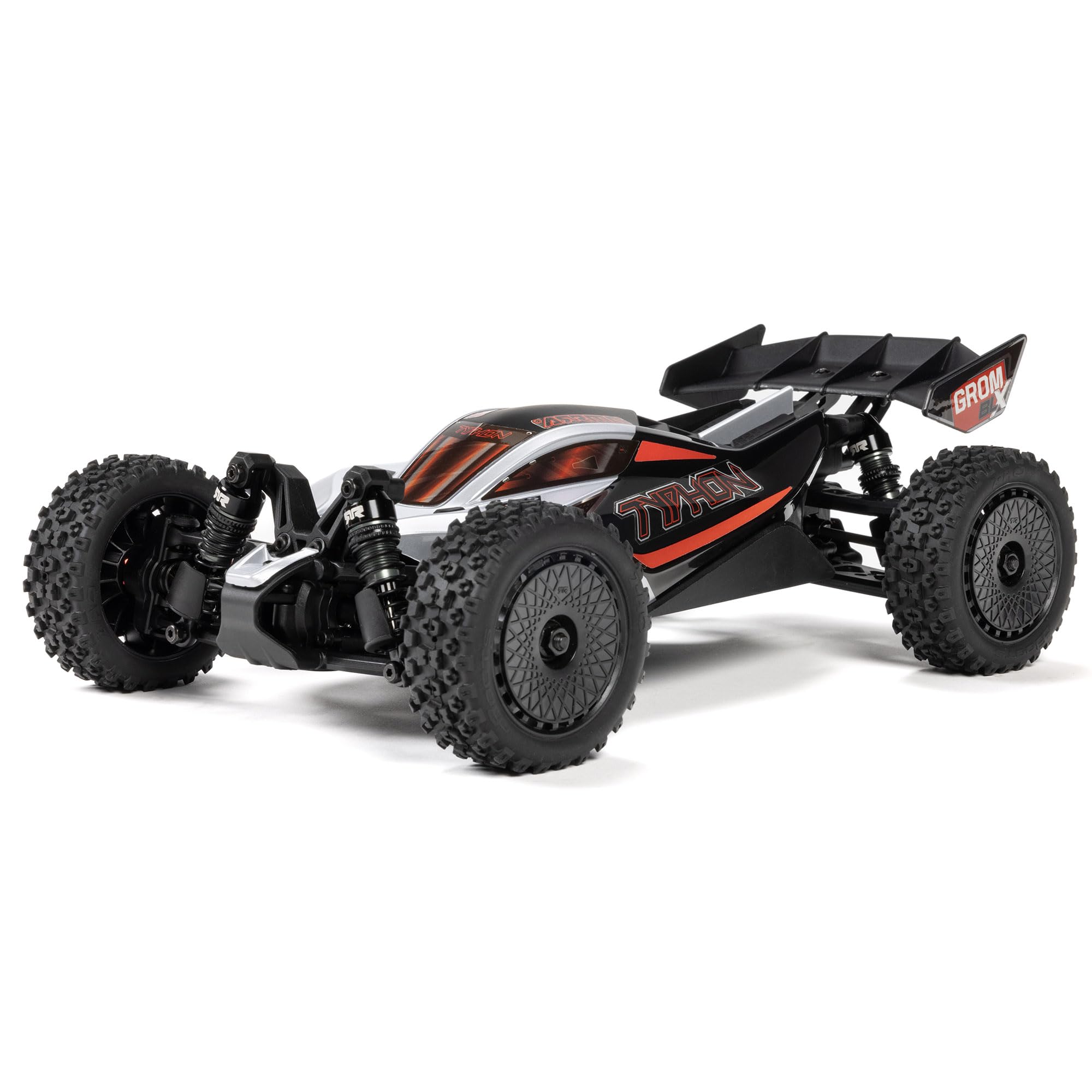
Fifty-plus miles an hour with a stability brain that keeps a beginner out of the weeds.
The feature that makes this buggy different from every other brushless car here is DSC — Dynamic Stability Control, a system that automatically corrects slides and spins. It has four selectable modes plus throttle limiting, so you can start slow and dial up. Compare that with the ZD Racing above, which gives you 42 mph and no electronic safety net at all. That’s a meaningful difference for anyone stepping up from a brushed toy.
The power system runs a 2838 4500Kv brushless motor through a Spektrum SLT 25A 2-in-1 ESC, ready for either a 2S or 3S Li-Po. On 3S it reaches 50+ mph. It ships with an SLT2 2-channel 2.4GHz transmitter, a Spektrum SX110 waterproof metal-geared servo, and AA transmitter batteries — but no drive battery and no charger, so factor that into your plan. A pre-installed set of option parts means you skip the usual upgrade step.
Owners describe it as excellent and genuinely fast, with happiness about the purchase running high. Twenty minutes of playtime per pack is the realistic expectation. Durability and steering each split opinion — some report solid performance, some hit issues with steering stopping. The small-scale size is the quiet advantage: it fits in spaces the 1/8 monster below can only dream of. At 4.5+ stars across 100+ ratings, it’s a strong brushless pick for people who want the electronics doing some of the work.
The standout spec: four DSC modes and throttle limiting in a ready-to-run buggy are the closest thing here to a learning curve built into the hardware.
The real cost: no battery and no charger in the box means the honest total is higher than the sticker suggests.
Made for: a driver with a little experience who wants 50+ mph safely, and owns or plans to buy a suitable charger.
Overkill for: a casual backyard driver — the brushed 4×4 above is plenty.
8. AMORIL RLAARLO DSK 1/8 Dragon Knight 6S Buggy RTR
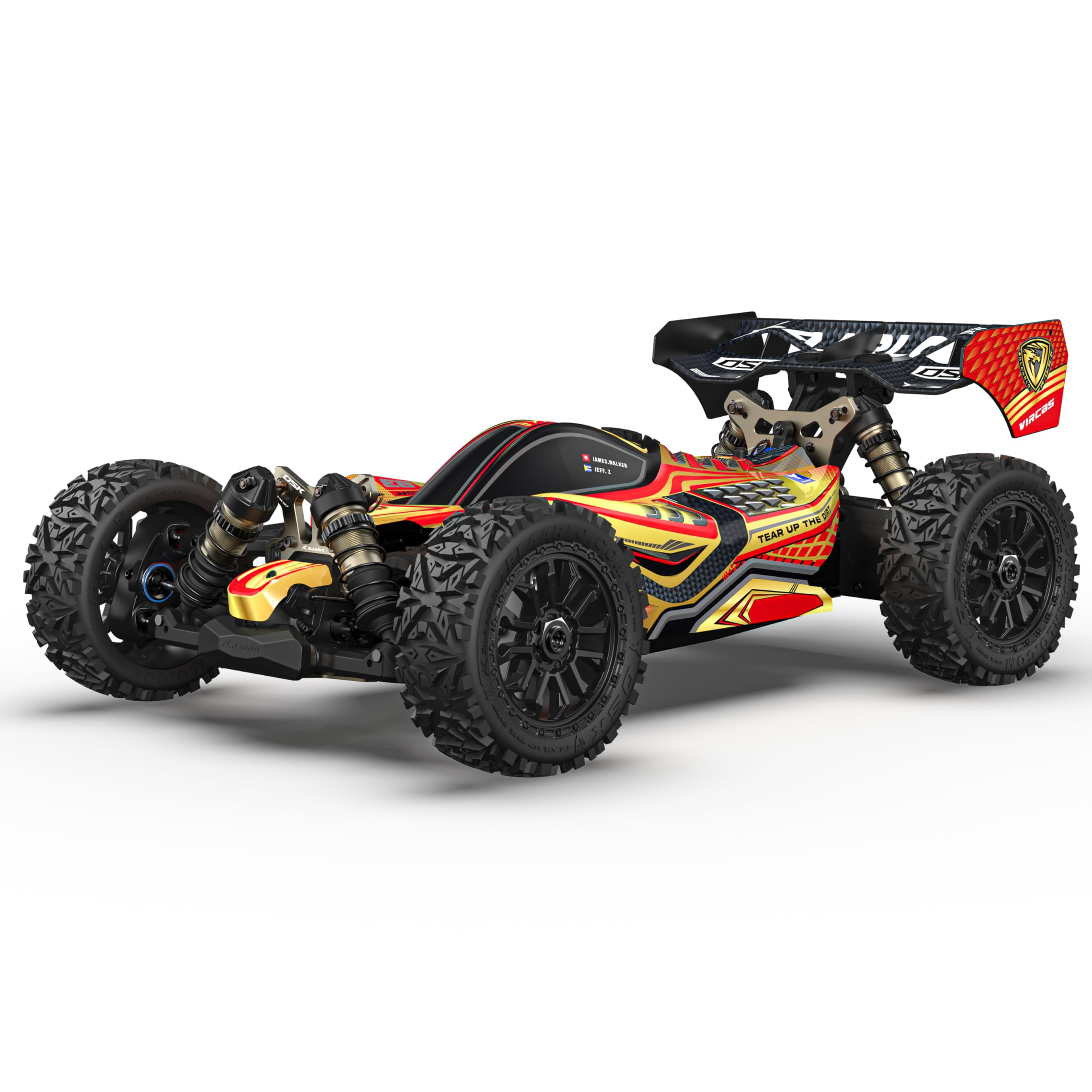
A 1/8 dragon built for 6S voltage and 3-4 foot jumps, with a chassis decision baked in.
This is the only 1/8 buggy in the group, and at 11 pounds it drives like it. Power comes from a 4274-2050KV brushless motor paired with a 180A ESC, delivering 50 mph and a top end the spec sheet lists above 80 km/h. The headline feature is a dual chassis design: you can move the motor to the rear or front without drilling, and choose pivot-ball or C-hub steering — one ready-to-run car, two setups, so you can tune weight distribution to the ground.
The structure underneath is 7075-T6 aluminum, 3mm thick and hard-anodized, with 5mm shock towers, reinforced arms, and three diffs. Quick-release gearboxes and a center diff mount make maintenance faster than pulling a whole chassis apart. It includes a 6-channel transmitter and a 45kg servo, and the ESC accepts both 4S and 6S Li-Po packs. There’s no battery and no charger in the box, and discharge rate is capped between 30C and 50C, with 60C the peak — go outside that and you risk overloading the electronics.
What buyers praise most is the hobby-grade quality, with speed and appearance close behind. Jumps of 3-4 feet get called out as handled well, and the build feels solid in hand. Durability and control draw mixed feedback, which is the nature of a 6S machine this heavy. The dimensions are 6.69 x 12.6 x 22.83 inches — a boot-filler, not a backpack car. At 4.5+ stars across 100+ ratings, it’s the serious tool in this lineup.
Why the dual chassis matters: rear-motor setup suits loose, bumpy ground where you want weight over the back; front-motor suits tighter tracks. You get both without buying a second buggy.
Read the manual first: battery C-rating and voltage are strict on this ESC — an out-of-range pack is the fastest way to an expensive failure.
Reserve it for: a bashing veteran with a 4S or 6S pack and charger already on the shelf, plus room to run something this big.
Wrong purchase if: you drive in a driveway — 11 pounds at 50 mph needs open ground.
Understanding the Specs
Brushed vs brushless motors
A brushed motor uses physical carbon brushes to switch the current as it spins, which is simple and cheap but generates friction and heat. A brushless motor swaps that for electronics, so it delivers more speed per size and runs cooler. In this lineup the brushed cars run at 13 mph to 50 km/h, while the brushless machines start at 42 mph and climb past 50. Brushless also demands a bigger battery — 3S and 6S Li-Po packs rather than small 2S units — so the total cost runs higher than the motor alone suggests.
Battery capacity, C-rating, and run time
Capacity in mAh is how much energy the pack holds, so a 1500mAh battery outlasts a 350mAh one in the same car. C-rating is how fast it can release that energy safely, and some ESCs on bigger buggies specify a strict window — the AMORIL asks for 30C to 50C with a 60C peak. Run time also depends on how many packs come in the box. Two-included models let you swap and keep driving instead of waiting on the charger, which is the practical difference between a 20-minute session and an hour of driving.
Scale and where you can drive
Scale is the car’s size relative to a full race buggy. A 1/24 micro runs indoors; a 1/16 or 1/18 wants a driveway or backyard; a 1/12 needs a park or ball field; a 1/8 needs genuine open ground. Smaller scale also means lighter weight and cheaper repairs when you hit something. Buy a 1/8 for a driveway and it sits unused; buy a 1/24 for a gravel lot and it jams on the first stone.
Shocks, chassis, and drive layout
Oil-filled shocks use hydraulic fluid inside a metal tube to absorb landings smoothly; plain springs just bounce. An aluminum chassis resists bending where plastic eventually cracks. Four-wheel drive sends power to all four corners for traction on gravel and grass, while two-wheel drive is lighter and simpler. If you plan on jumping, prioritize oil-filled shocks and a metal chassis over extra top speed.
FAQ
Will a 1/8 buggy fit in a normal backyard?
How long does an RC buggy battery actually last per charge?
Is brushless really better than brushed for a first buggy?
Can I run an RC buggy in wet grass or shallow puddles?
Why does my buggy not move when I pull the throttle?
Do I need to buy a battery and charger separately?
What C-rating battery does a 6S buggy need?
How far away can I drive an RC buggy?
Are RC buggies repairable when parts break?
What age is an RC buggy actually suitable for?
Final Thoughts: The Verdict
For most people, the best rc buggy car is the Losi Micro-B because it packs oil-filled shocks and an aluminum chassis into a 152 g micro racer that runs 20 minutes off a one-hour charge — genuine race hardware at a scale you can actually use indoors. If your ground is rougher and you want two batteries plus splash-proof electronics from the start, the HAIBOXING 18872 is the better first car. And if you want brushless pace with a stability system doing the babysitting, the ARRMA Typhon GROM 223S BLX is the one to reach for.
One honest nudge before you decide: the Losi holds the highest score of the group at 4.5+ stars, and the GoolRC has far more ratings behind it — but those ratings measure ratings, not how well a car suits your driveway. Match the scale to your space, match the motor to your experience, and count the batteries in the box. Get those three right and the buggy stays in use instead of on a shelf.
How We Picked
We do not accept paid placement. Every pick is matched to a real buyer and a real use-case; we do not hands-on test units.
Sources & Methodology
Specifications: manufacturer listings and product documentation. Review insights: verified customer reviews, as of November 2026. Pricing: not shown on this page (it changes often); check the current price via the retailer link.
As an Amazon Associate, Gadgets Feed earns from qualifying purchases. This does not affect which products we feature.