
Our readers keep the lights on and my morning glass full of iced black tea. As an Amazon Associate, I earn from qualifying purchases.
Specs are compiled from manufacturer listings and verified buyer reviews and can change over time — please confirm the key details on the product page before buying.
A stuck, weeping, or wrongly set valve on your tank is a cheap fix — the whole job depends on one number: the pressure it pops at. You need three things to get it right: the right thread size, the right pop-off rating (the pressure where the valve opens), and a valve that seats tight afterward. Below are the real options, sorted by which ones actually bolt on and hold.
I’m Min — the founder and writer behind Gadgets Feed. This guide is built by comparing the manufacturers’ published specifications and the patterns across verified customer reviews, so you get each pick’s real strengths and trade-offs instead of marketing spin.
The categories below run from American-made certified valves to budget multi-packs, so you can match your tank’s thread, pressure, and certification requirements before you order. Choosing the right air compressor pressure release valve starts with knowing your NPT thread size and your tank’s maximum psi.
Our Picks at a Glance


How To Choose The Best Air Compressor Pressure Release Valve
A pressure release valve — also called a pop-off or safety relief valve — is the part that vents air if your tank pressure climbs too high. Getting it wrong is not a small mistake. A valve that does not seat leaks air all day. A valve rated above your tank’s limit gives you no protection. Match three things and you are done: thread size, pop-off pressure, and the certification your application needs.
Thread size has to match your tank exactly
These valves use NPT threads (National Pipe Tapered — a tapered thread that seals as you tighten it). The four common sizes here are 1/8″, 1/4″, 3/8″, and 1/2″. A 1/4″ valve will not fit a 1/2″ port, and forcing it damages the thread on your tank. Check the port on your tank, not the old valve, because a previous owner may have used an adapter. If you are unsure, measure the outside of the threaded section — the sizes in this guide are stated verbatim in each product’s spec sheet.
Pop-off pressure: match it, do not exceed it
The pop-off pressure is the psi at which the valve opens. You want a valve rated at or below your tank’s maximum working pressure. The options here run from 70 PSI up to 250 PSI, so the spread is wide. Putting a 250 PSI valve on a tank rated lower means the valve never opens before the tank is overstressed. That defeats the whole purpose of the part.
What UV and NB stamps mean
The “UV” and “NB” stamps on some of these valves are certification marks — UV for the ASME pressure vessel code and NB for the National Board. They tell you the valve was made and tested to a recognized standard. For a home shop compressor they are nice to have. For an industrial or commercial tank, they are often required.
Seat material and leak-free seating
Several valves here use a silicone rubber soft seat (a flexible disc that presses against the opening when the valve is closed). That soft seat is what stops the valve weeping air after it pops. A metal-on-metal valve can leak slightly over time. If your old valve is leaking and you want a quiet tank, look for a soft seat in the description.
Quick Comparison
| Model | Best For | Inlet Size | Pop-Off Pressure | Material | Amazon |
|---|---|---|---|---|---|
| Milton S-1090-200★ Best Overall | Overall pick for 1/4″ tanks | 1/4″ MNPT | 200 psi | Brass | Amazon |
| Conrader 1/8″ NPT 150 PSIBest for Tight Ports | Small pancake and portable tanks | 1/8″ NPT | 150 psi | Brass | Amazon |
| Conrader 1/4″ ASME 250 PSI | Industrial and high-pressure tanks | 1/4″ NPT | 250 psi | Brass | Amazon |
| Conrader 3/8″ ASME 200 PSI | Larger-port tanks needing 200 psi | 3/8″ MNPT | 200 psi | Brass | Amazon |
| Conrader 1/2″ NPT 200 PSI | Big-port, high-flow tanks | 1/2″ NPT | 200 psi | Brass | Amazon |
| Bonuci 4-Pack 1/4″ 150 PSI | Spares and multi-tank setups | 1/4″ NPT | 150 psi | Brass | Amazon |
| Conrader 1/4″ ASME 70 PSI | Low-pressure and specialty tanks | 1/4″ NPT | 70 psi | Brass | Amazon |
In‑Depth Reviews
1. Milton S-1090-200 1/4″ MNPT ASME Safety Valve – 200 PSI Pop off Pressure
Our pick — 4.5+★ from 100+ verified ratings; the strongest balance of quality and price.
A 200 PSI brass pop-off from a name that has been machining air fittings since 1943.
If you have a 1/4″ port and a tank rated for 200 psi, this is the valve to start with. It threads in with 1/4″ male NPT threads (the tapered thread that seals as it tightens), and it pops at 200 PSI — the exact pressure printed on the valve. At 2.4 ounces it is light enough that the weight puts no strain on the tank port, and it is solid brass so it will not rust in a damp garage.
The number worth paying attention to is the flow capacity: 170 cubic feet per minute. That is the volume of air the valve can dump when it opens, and it is more than you will ever need on a home or prosumer compressor. A low-flow valve on a big tank can be slow to vent; this one is not. Milton also states the valve stays bubble tight up to 10% of pop-off pressure, which is the maker’s claim for how well it seats before it opens.
This valve earns its spot on the ASME stamp (ASME — the US standards body that sets pressure-vessel safety rules) and US manufacturing, which the 1/4″ valves in this list do not carry. It weighs 2.4 ounces, and the 4-pack of 1/4″ brass valves weighs 4.48 ounces for four pieces — so a single valve of each is a similar heft. It is made in the USA, and the maker is a long-standing supplier to automotive, industrial, hardware, agriculture, and heavy-duty fleet markets. If you want the part a shop would stock on the shelf, this is it.
Where It Earns Its Place
- 200 PSI pop-off matches the valve’s own rating exactly
- 170 cubic feet per minute flow vents a tank fast
- ASME-rated brass body with a US-made pedigree
- Bubble tight to 10% of pop-off pressure, per the maker
What To Know Before Ordering
- 1/4″ NPT only — check your port before buying
- 200 psi is the ceiling; do not fit it to a lower-rated tank
- Single valve, so no spare in the box
Strongest all-rounder: a 1/4″ port and a 200 psi tank are the only two boxes to tick.
Think twice: if your tank port is 1/8″, 3/8″, or 1/2″, this will not thread in.
2. (Ship from USA) 1/8″ NPT 150 PSI Air Compressor Safety Relief Pressure Valve
The small-port specialist for pancake compressors and portable tanks that need a 1/8″ fit.
Most valves on the shelf are 1/4″, so a 1/8″ NPT valve is a narrower find. This is the one you want when the port on your portable or pancake tank is that small size. It threads in with 1/8″ male NPT and pops at 150 PSI, which suits the lower working pressures those little tanks usually run.
What separates it from the pack is the accuracy claim: the relief pressure is set at 150 PSI and is accurate within plus or minus 3% of the set pressure. That is a tight band, and it means the valve opens where it says it will rather than somewhere near it. The body is solid brass with a silicone rubber soft seat, so it seals against leaks rather than weeping after it pops. It also carries the “UV” and “NB” stamps, which are the certification marks that confirm it was made and tested to a recognized standard.
Size is where this one stands apart from the rest of the list. Its dimensions are 1.75 x 0.75 x 0.75 inches, and the 1/2″ valve above measures 2.75 x 1 x 1 inches — so this is the compact choice when clearance around the port is tight. It also has a maximum operating temperature of 250 F, which covers the hot end of compressor duty.
Who should grab it: anyone with a 1/8″ tank port and a 150 psi working limit, especially on a small portable unit where space is tight.
The honest catch: the small thread size means it will not fit the 1/4″, 3/8″, or 1/2″ ports that most full-size compressors use, so measure first.
Pick it if: your port is 1/8″ and you want a certified valve with tight pressure accuracy.
Leave it if: you are fitting a standard 1/4″ shop compressor — this thread is too small.
3. 4 Pcs 1/4″ Male 150 Psi Npt Air Compressor Pressure Relief Valve Brass

Four 1/4″ brass valves in one box, so one lives on the shelf as a spare.
If you want to stop hunting down a valve every time one gives out, this four-pack solves that. You get four 1/4″ NPT threaded valves with thread seal locks included, which is enough for a main tank plus a few backups. That is the practical appeal: this is the first valve that actually has a spare in the box, unlike the single-valve options above.
The working numbers are 150 PSI, a flow of 178 cfm, and a temperature range of -65 degrees Fahrenheit to +250 degrees Fahrenheit. Brass also resists corrosion, so these hold up in a damp shop. One easy win is that the same valve can discharge air, water, or oil, so it works on air compressor drain setups too, not just tank safety.
What wins buyers over is the machining: reviewers report these valves seat and hold on the first install. Buyers use them to replace a pancake compressor pop-off, and the reviews back up the maker’s claim of clean machining on that straightforward swap. Each valve weighs 4.48 ounces for the four-piece set, putting individual heft close to the single 1/4″ valves on this list.
Why The Four-Pack Makes Sense
- Four valves so you always have a spare
- 178 cfm flow and a 150 PSI setting
- Handles -65 F to +250 F, air, water, or oil
The Practical Limits
- 150 psi ceiling — not for high-pressure tanks
- Sold only as a four-pack, not singles
Smart buy when: you run several tanks or just want a spare on the shelf.
Look elsewhere if: your tank runs above 150 psi or uses a non-1/4″ port.
4. New 3/8″ ASME Brass Safety relief Valve 200 PSI American made
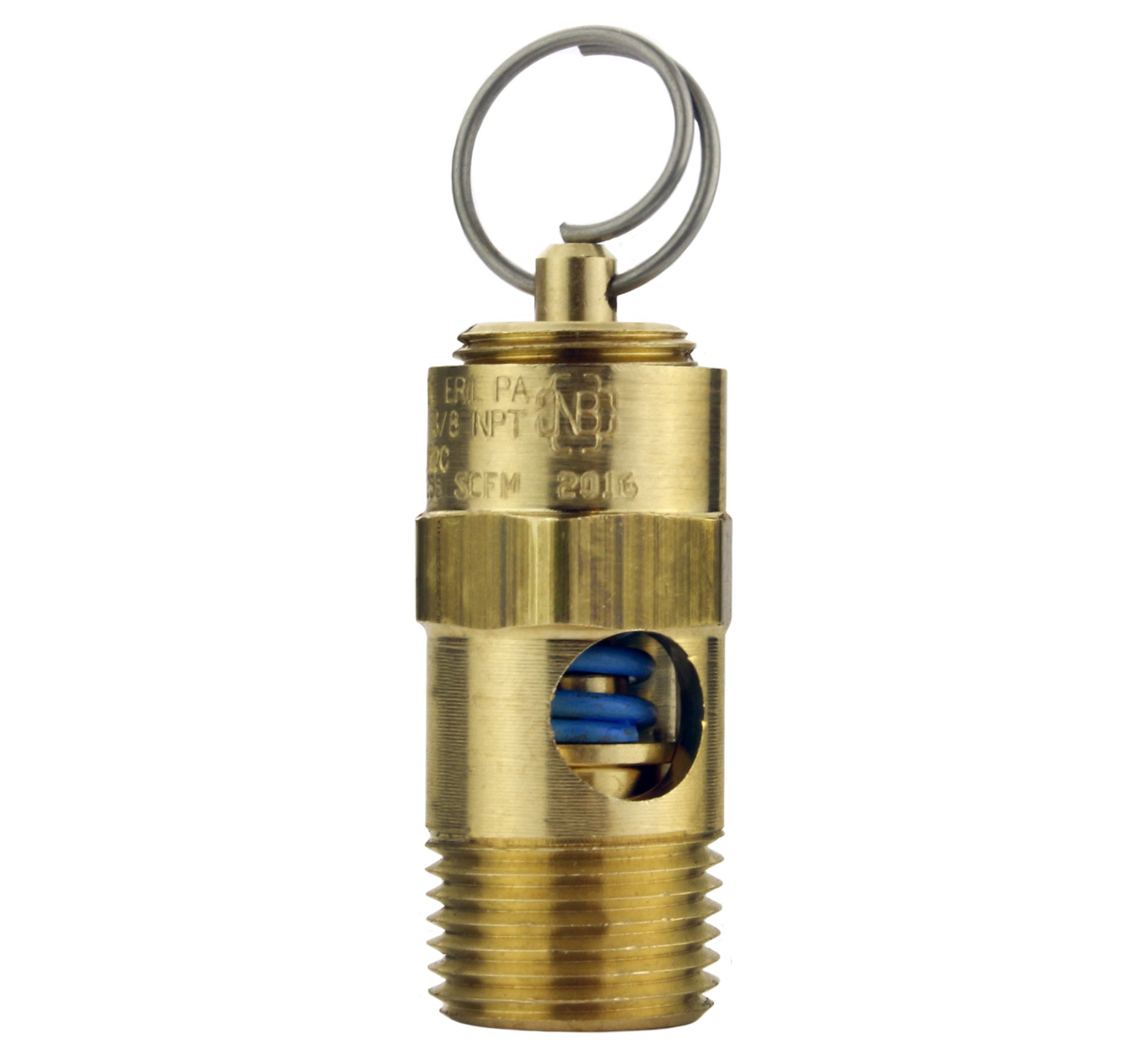
The wider-port pick when 1/4″ is too small but 1/2″ is overkill.
If your tank uses a 3/8″ port, you are in a middle size that fewer valves cover. This one fits it: 3/8″ male NPT, a thread measuring about 5/8″, and a pop-off set at 200 PSI. The total valve length is 1-3/4″, and it takes an 11/16″ wrench for installation — worth knowing before you reach for the toolkit.
The 200 PSI rating comes with 173 SCFM capacity, which is a big airflow number. That means when the valve opens, it vents fast rather than letting pressure hang. The relief pressure is accurate within plus or minus 3% of the set pressure, the same tight band the other certified valves here carry, so you can trust it opens where it says. The body is solid brass with a maximum temperature rating of 250F, and it is stamped UV/NB for the ASME and National Board certification.
Against the 1/4″ valves in this list, this one moves more air through a wider port — 173 SCFM here. That makes it the right call on a compressor where the port itself is 3/8″ and you do not want to step down with an adapter. It is manufactured in the USA with ASME compliance, which is the certification a commercial or industrial tank usually asks for.
The honest read: a certified, high-flow valve that fills a thread size many kits skip, and the 200 PSI rating is a working limit, not a suggestion.
The buying note: 3/8″ fits a narrower set of tanks, so confirm the port and wrench size before ordering.
Fits best: a 3/8″-port tank running up to 200 psi that needs certified venting.
Not for: 1/4″ or 1/2″ ports — this thread will not seat in either.
5. 1/4″ ASME Brass Safety Relief POP Off Valve, American Made (250 PSI)

A 1/4″ thread paired with a 250 PSI setting — the highest pop-off in this lineup.
Here is the valve for a 1/4″-port tank that runs to a higher pressure than the common 150 or 200 psi units allow. It is set at 250 PSI, which is the top of the range across this whole list. The 1/4″ NPT body is solid brass, it is US-made, and it carries the UV and NB certification stamps.
Compared with the 70 PSI valve near the bottom of this list, the numbers tell the story: this one pops at 250 psi versus 70 psi, so the two are built for very different tanks. The pressure accuracy is within plus or minus 3% of the set pressure, so it opens close to 250 rather than drifting. That accuracy matters at higher pressures, where a wide drift band is a bigger safety margin problem. The silicone rubber soft seat is there to prevent leaks after it blows, which is the part that keeps your tank quiet between uses.
At 1.75 x 0.75 x 0.75 inches it fits a tight port area without adding bulk, and at 2.4 ounces it threads in by hand before the final wrench turn. For industrial compressed-air work, this is the high-pressure end of the range, and the certification stamps back that up.
Standout Strengths
- 250 PSI pop-off, the highest in this list
- Plus or minus 3% accuracy on the set pressure
- Silicone soft seat stops leaks between pops
- UV and NB certified, US-made brass
Check Your Tank First
- Only suitable if your tank is rated for 250 psi
- 1/4″ NPT — no other port size will fit
The high-pressure answer: a 1/4″ port and a tank rated for 250 psi are the exact match.
Do not fit it: on a 150 or 200 psi tank, where the valve would never open in time to protect it.
6. New 1/4″ ASME Brass Safety relief Valve 70 PSI American made

A rare low-pressure valve for tanks that top out well under the usual 150 psi.
A 70 PSI pop-off is a specific tool, and that is exactly why some buyers need it. If your tank or system runs at a low ceiling — an older unit, a specialty setup, or a low-pressure application — a 150 or 200 psi valve would never vent in time to protect it. This valve is set at 70 PSI, which is the lowest setting in this roundup, and it uses the standard 1/4″ NPT thread so it fits common ports.
It is built to the same spec as the higher-pressure valves here: solid brass, US-made, UV and NB certified, accurate within plus or minus 3% of the set pressure, with a silicone rubber soft seat to prevent leaks. The 70 PSI setting is not a downgrade: it is the same brass body, UV/NB stamps, and 3% accuracy as the higher-pressure valves, tuned to a lower band. That silicone soft seat matters most at 70 PSI, where a weeping valve would drain a low-pressure tank fast.
The one thing to weigh is the fit. A 70 psi valve belongs only on a low-pressure system, and on a standard shop compressor it would pop constantly. It is a fit-specific valve: right for a low-pressure tank, wrong for a standard shop compressor. The valve is compact at 1.75 x 0.75 x 0.75 inches, matching the other 1/4″ valves here, so installation clearance is the same.
The fit to weigh: the low 70 PSI setting is the entire point, so it only makes sense on a tank that tops out below it.
What you still get: full ASME-grade brass, USB and NB certification aside — the same certified build and soft seat as the higher-pressure valves.
Reach for this if: your tank or system runs at a low pressure ceiling and needs a valve down at 70 psi.
skip it if: you own a standard higher-pressure compressor, where it would vent constantly.
7. New 1/2″ NPT 200 PSI Air Compressor Safety Relief Pressure Valve Tank Pop Off

The big-bore valve for large tanks that need to dump air in a hurry.
A 1/2″ port calls for a 1/2″ valve, and this is the largest thread size in this roundup. It is a high-CFM valve (CFM being the cubic feet per minute of air it can move when open) set at 200 PSI, which suits a large tank that needs to vent fast. The body is brass, it is US-made, and it carries the UV and NB certification stamps.
This is the biggest and heaviest valve of the group at 2.75 x 1 x 1 inches, next to the 1/8″ valve above at 1.75 x 0.75 x 0.75 inches — what you would expect for a 1/2″ fitting. It also has two ports, which is part of why it moves so much air. The pressure is accurate within plus or minus 3% of the set pressure, and the silicone rubber soft seat is there to keep it leak-free after it opens.
Where this one falls back is simply that 1/2″ is a big thread most home compressors do not use. The flip side of the large port is that it does not fit a 1/4″ or 3/8″ tank without stepping down, and every step-down is a potential leak point. So it belongs on the large industrial tanks it was built for. On a 1/2″-port tank, that bigger bore is what vents the volume fast.
Where It Shines
- 1/2″ NPT moves air through a big port
- High CFM for fast venting on large tanks
- UV and NB certified 200 PSI brass body
Where It Falls Short
- Too big for 1/4″ and 3/8″ home-compressor ports
- Stepping down to fit adds leak risk
Made for: a 1/2″-port tank where you want maximum airflow on venting.
Not for: a home compressor with a small port — retap or step down and you add leaks.
Understanding the Specs
Pop-Off Pressure (psi)
This is the heart of the whole part. The psi number is the pressure at which the valve opens and vents air. You match it to your tank’s maximum working pressure — never above it. The valves here run from 70 psi up to 250 psi, so the same-looking part can behave very differently depending on that setting. A valve set above your tank’s rating never opens before the tank is overstressed, so it protects nothing. The setting is printed on the valve and stated in the specs, so check it against your tank’s rating plate.
NPT Inlet Size
NPT stands for National Pipe Tapered — a thread that seals by wedging tighter as you turn it. The 1/8″, 1/4″, 3/8″, and 1/2″ sizes are not interchangeable. A 1/4″ valve in a 1/2″ port has a sloppy fit that leaks; a 1/2″ valve in a 1/4″ port simply will not start. Measure the port on the tank itself, then match it to the inlet size on the valve’s spec sheet. When you install, use thread tape or sealant on the threads, but never on the valve seat itself.
Flow Capacity (CFM / SCFM)
CFM and SCFM measure how much air the valve can move per minute when it opens. A higher number means the valve vents a tank faster — useful on a big tank where pressure can build quickly. The valves here quote different units (cfm vs SCFM), and the exact figures are in each product’s own description. For a small home compressor, almost any of these flow rates is plenty. On an industrial tank, the flow rate is a real performance spec worth checking.
Certification Stamps and Seat Material
UV and NB are certification marks from the ASME pressure vessel code and the National Board. They confirm the valve was made and tested to a recognized standard, and they are common on the US-made valves in this list. The seat material matters too: a silicone rubber soft seat presses against the opening to stop leaks after the valve closes, while a bare metal seat can weep. If a quiet, non-leaking tank is your goal, the soft seat is the detail to look for in the listing.
FAQ
Will a 1/4″ valve fit an 1/8″ port on my pancake compressor?
What pressure release valve do I need for my tank?
Do I need a valve with UV and NB stamps?
Why is my pressure relief valve leaking air?
Can I replace a 150 PSI valve with a 200 PSI valve?
What is the difference between a pop-off and a safety relief valve?
How tight should I install a pressure release valve?
What does high CFM mean on a pressure relief valve?
Can a pressure release valve be used for water or oil too?
How do I know my tank port is NPT and not another thread type?
Final Thoughts: The Verdict
For most buyers, the air compressor pressure release valve winner is the Milton S-1090-200, because it matches a 1/4″ port to a 200 PSI tank with a 170 cubic feet per minute flow and the US-made certification that shops want. If you need a 3/8″ port or a higher 250 PSI setting, grab the Conrader 3/8″ ASME or the 250 PSI 1/4″ valve. And for spare valves or several tanks, the Bonuci 4-pack is the one to reach for — four valves so a spare is always on the shelf.
How We Picked
We do not accept paid placement. Every pick is matched to a real buyer and a real use-case; we do not hands-on test units.
Sources & Methodology
Specifications: manufacturer listings and product documentation. Review insights: verified customer reviews, as of November 2026. Pricing: not shown on this page (it changes often); check the current price via the retailer link.
As an Amazon Associate, Gadgets Feed earns from qualifying purchases. This does not affect which products we feature.