
Our readers keep the lights on and my morning glass full of iced black tea. As an Amazon Associate, I earn from qualifying purchases.
Specs are compiled from manufacturer listings and verified buyer reviews and can change over time — please confirm the key details on the product page before buying.
If you want one speaker that fills a living room with real bass and never needs a charging cable hunt, pick a plug-in model with a proper woofer. The Harman Kardon Onyx Studio 9 is the strongest all-rounder here — 4.5+ stars across 600+ owners — because it combines a 13 cm dynamic driver with automatic room tuning and a built-in battery you can carry from the kitchen to the patio. Everything below is about matching one of these speakers to how you actually listen at home.
I’m Min — the founder and writer behind Gadgets Feed. This guide is built by comparing the manufacturers’ published specifications and the patterns across verified customer reviews, so you get each pick’s real strengths and trade-offs instead of marketing spin.
Some speakers here run on wall power and fill a big room, while others carry a battery so you can move them from the counter to the balcony. This guide sorts those differences one by one to help you choose the best at home Bluetooth speaker for your space.
Our Picks at a Glance


How To Choose The Best At Home Bluetooth Speaker
A shelf-bound speaker needs steady wall power and a bigger woofer; a portable one needs a battery. Start with where it will sit and how it gets power, then work down to the driver size and the connections you actually use.
Wall power or battery, pick the one that fits the room
A corded speaker draws steady power, so it can push a bigger woofer without worrying about runtime. The JBL Authentics 200 is built this way and requires corded power to operate, which suits a fixed spot on a console. A built-in battery like the 8 hours in the Harman Kardon Onyx Studio 9 lets you move the speaker into the garden for an evening. Decide between corded and battery power before you compare anything else.
Driver size and a real woofer decide the bass
Small full-range drivers handle vocals well but run out of low end. A dedicated woofer, like the 5.25 inch high excursion unit in Klipsch The Three Plus, moves more air so kick drums and basslines land with weight. If you mostly listen to spoken word or acoustic sets, a two-driver setup without a dedicated woofer is plenty. If you want the room to thump, check the woofer size in inches before anything else.
The connections you need beyond Bluetooth
Bluetooth is the default, but a wired input turns a music speaker into a TV or record player speaker. The Saiyin Powered Bluetooth Bookshelf Speakers add optical and coaxial inputs that carry 24 bit 192k digital audio for a lossless feed from a television. A turntable needs care though: the source must have a Bluetooth transmitter, or you connect through RCA. Check whether your turntable or TV has an RCA, optical, or Bluetooth output before you commit to one of these boxes.
Quick Comparison
| Model | Best For | Main Driver | Battery | Inputs | Amazon |
|---|---|---|---|---|---|
| Harman Kardon Onyx Studio 9★ Best Overall | All-round home pick | 13 cm dynamic | 8 hours | Bluetooth, USB | Amazon |
| DOSS SoundBox XLBass On A Budget | Big bass on a budget | 12W subwoofer + dual full-range | 10 hours | Bluetooth, AUX, TF card | Amazon |
| Edifier Retro WoodVintage Decor Pick | Vintage looks, small rooms | 48 mm dynamic | 9 hours | Bluetooth 5.0, AUX, USB-C, TF | Amazon |
| Saiyin Powered Bookshelf | TV and turntable duty | 4 inch woofer + 0.5 inch tweeter | — | Bluetooth 5.3, Optical, Coaxial, RCA | Amazon |
| JBL Authentics 200 | Smart home streaming | 5 inch woofer + 25 mm tweeters | — | Wi-Fi, Bluetooth, Ethernet, AUX | Amazon |
| Sonos Era 100 | Multi-room and stereo pairing | Dual tweeters + midwoofer | — | Wi-Fi, Bluetooth, Line-In | Amazon |
| Klipsch The One Plus | Compact luxury sound | 4.5 inch woofer + two 2.25 inch drivers | — | Bluetooth 5.3, USB-C | Amazon |
| Klipsch The Three Plus | Larger rooms and vinyl | 5.25 inch woofer + dual 2.25 inch drivers | — | Bluetooth 5.3, Optical, RCA, USB | Amazon |
| Marshall Stanmore III | Loud rock and iconic style | Dynamic drivers, stereo | — | Bluetooth, wired | Amazon |
In‑Depth Reviews
1. Harman Kardon Onyx Studio 9
Our pick — 4.5+★ from 600+ verified ratings; the strongest balance of quality and price.
A sculpture that tunes itself to the room, then unpacks its own battery for the patio.
The Onyx Studio 9 runs a 13 cm dynamic driver in a metal enclosure, and that driver size is why it can hold a low bassline without turning muddy. What makes it easy to live with is the self-tuning: every time you switch it on, it measures the space around it and adjusts, so a corner placement or a bookshelf does not wreck the balance. You get stereo output and a 2.1-style presentation from a single cabinet.
Sound quality is the thing people rave about here, and the value read follows right behind it — this is a lot of speaker for a mid-range outlay. Bluetooth pairing accepts two phones at once, so you and someone else can take turns with the playlist without unpairing anyone. Pair a second Onyx Studio 9 and the soundstage widens noticeably. A USB port on the back even tops up your phone while you stream.
Here is the honest catch: Bluetooth connection draws mixed notes, with occasional dropouts mentioned, and the 8-hour battery figure is a ceiling rather than a floor — some owners find it falls short of that. Against the 10 hours of the DOSS SoundBox XL below, runtime is the weaker number, though the two are not far apart. If you mostly listen plugged in near an outlet, neither point will bother you.
What earns it the top spot
- Automatic tuning adjusts the sound to wherever you set it down
- Two-device Bluetooth pairing so playlists can swap hands
- Built-in battery for moving room to room or out to the garden
- USB port charges your phone mid-stream
Where it asks for patience
- Bluetooth dropouts turn up in some owner reports
- Battery runtime sits at 8 hours, and some say it comes up short
Fits you if: you want one speaker that sounds considered in every room and can travel to the patio.
Think twice if: you need marathon battery life or a rock-solid always-on Bluetooth link at long range.
2. DOSS SoundBox XL 32W
A wallet-friendly box that pushes a 12W subwoofer and refuses to distort at full tilt.
Start with the number that sells it: 32W split between dual full-range drivers and a dedicated 12W subwoofer, plus dual passive radiators. Passive radiators are extra cones that move with the bass to deepen the low end without a vibrating cabinet. That combination is why the SoundBox XL delivers punchy bass without cabinet rattle. Dual DSP processing keeps the sound clean even when you crank the volume dial.
Two of these pair over TWS, which simply means wireless stereo pairing — one speaker becomes the left channel, the other the right. Vocals and instruments separate with a precision a single box cannot match. A 3.5 mm AUX input adds a zero-latency wired path, handy for a TV or console where Bluetooth lag is annoying.
The bass is what wins people over, and there are plenty of buyers behind that verdict. Reliability is the split note: most units run fine, but some stop working over time, and battery experience is divided. Treat it as a speaker for someone who wants a cheap, bass-heavy box and accepts a slice of risk. The wide Bluetooth range of 10 meters covers a normal room with room to spare.
What it nails: genuine subwoofer thump, a stereo pairing option, and a wired AUX path for lag-free movie nights.
The honest trade-off: long-term reliability is the question mark — this is the value pick, not the buy-once pick.
Choose this for: a bass-forward party box on a tight budget with two-speaker stereo ambitions.
Look elsewhere for: a speaker you plan to leave running daily for years.
3. Edifier Retro Wood
A wooden cabinet that looks like a flea-market find and hides modern DSP inside.
The Edifier leans on a 20W stereo setup inside an MDF wooden enclosure, which is thinner than plastic and warmer to the touch than metal. A touch panel controls playback instead of physical buttons.
Bluetooth 5.0 handles the wireless link with faster transmission and lower battery draw, and the 2500 mAh lithium-ion pack keeps playback going for up to 9 hours per charge. Beyond Bluetooth, you get AUX, a USB-C port, and a TF card slot, so an old MP3 collection still has a home. A 48 mm dynamic driver does the work across the frequencies, and Bluetooth range reaches 10 meters.
Owners point to the appearance and the sound in the same breath — the retro design is genuinely the draw here. The battery also earns warm words, though the “lasts forever” praise is enthusiasm rather than a spec, so plan around the 9-hour figure. It suits a desk, a bedside table, or a small den where looks count as much as decibels.
Its real draw: a 20W stereo speaker in a genuine wooden cabinet with four ways to feed it music.
The limit to know: a single 48 mm driver cannot reach the bass depth of the subwoofer models on this list.
Made for: a styled shelf or desk where the speaker is furniture as much as audio gear.
Not the pick if: you want deep bass or room-filling volume.
4. Saiyin Powered Bluetooth Bookshelf Speakers

A two-box stereo pair that doubles as your television and record player sound system.
These are two separate speaker boxes: one active with the amplifier built in, one passive, joined by speaker wire. Inside sits a 0.5 inch silk dome tweeter for the high end and a 4 inch woofer for the low end. A SUB OUT jack lets you add any powered subwoofer later, which is the upgrade path most one-piece speakers cannot offer.
The connection list is the reason to buy. Optical and coaxial inputs carry 24 bit 192k digital audio, so a TV sends a lossless signal straight in. Bluetooth 5.3 pairs with a phone, tablet, Mac, or PC without cable clutter. RCA lets a turntable share the same pair while the TV stays on optical — two sources, one speaker set. Just confirm your turntable has its own Bluetooth or RCA output, because one that only receives Bluetooth will not work here.
Sound quality is what buyers praise most, and ease of setup follows closely behind. The supplied remote handles volume, mute, and input switching, and it even works with a Fire TV stick. The remote itself draws mixed notes — a few units arrive with one that misbehaves. Volume is well liked, and the 150*170*240 mm cabinet fits a shelf or desk without crowding it.
Why the pair wins
- Optical and coaxial inputs for a clean feed from a TV
- SUB OUT jack opens a path to add a powered subwoofer
- Remote works with a Fire TV stick
- Bluetooth 5.3 keeps wireless pairing current
Before you plug in
- Your turntable must have a Bluetooth or RCA output, not just an input
- The remote is replaceable for life, but some arrive finicky
- No built-in battery, so it stays near an outlet
Pick this if: your TV sound is weak and you own records you want to hear through the same pair.
Pass if: you want a single box you can pick up and carry outside.
5. JBL Authentics 200

A plugged-in smart speaker with a 5 inch woofer and a retro grille that blends into the decor.
Stereo sound comes from 25 mm tweeters for detail and a 5 inch woofer paired with a 6 inch passive radiator for bass you feel. The passive radiator is the trick — it does the low-end grunt of a much larger box without the cabinet size. The catch on the design side: this speaker is not built for portable use and needs corded power, so choose its spot before you unbox it.
Wi-Fi is the real reason to pick this one over a Bluetooth-only box. It streams internet radio and podcasts in high definition, and it supports AirPlay, Chromecast built-in, Spotify Connect, and Alexa Multi-Room Music. Voice control works through Alexa or Google Assistant. Pair several Authentics speakers through the Google Home or Alexa app for a room-to-room setup.
Sound quality is what wins people over most here, and the aluminum frame and leather-like enclosure earn their own nods. The honest snag is connectivity: some owners hit pairing trouble and Bluetooth dropouts after the speaker sits idle. The self-tuning steps in at every power-on, so the sound settles to a new shelf or counter without manual fiddling. Think of the JBL One app as the control room for EQ and speaker management.
Why it’s worth a look: Wi-Fi streaming plus a 5 inch woofer and a 6 inch passive radiator in a heritage-styled cabinet.
The honest note: Bluetooth links can sleep on you, so stay on Wi-Fi for daily listening and you sidestep the main complaint.
Suits you if: you stream from Spotify or the radio and want a voice-controlled speaker sitting on a shelf.
Skip if: you need a battery to carry it outside.
6. Sonos Era 100
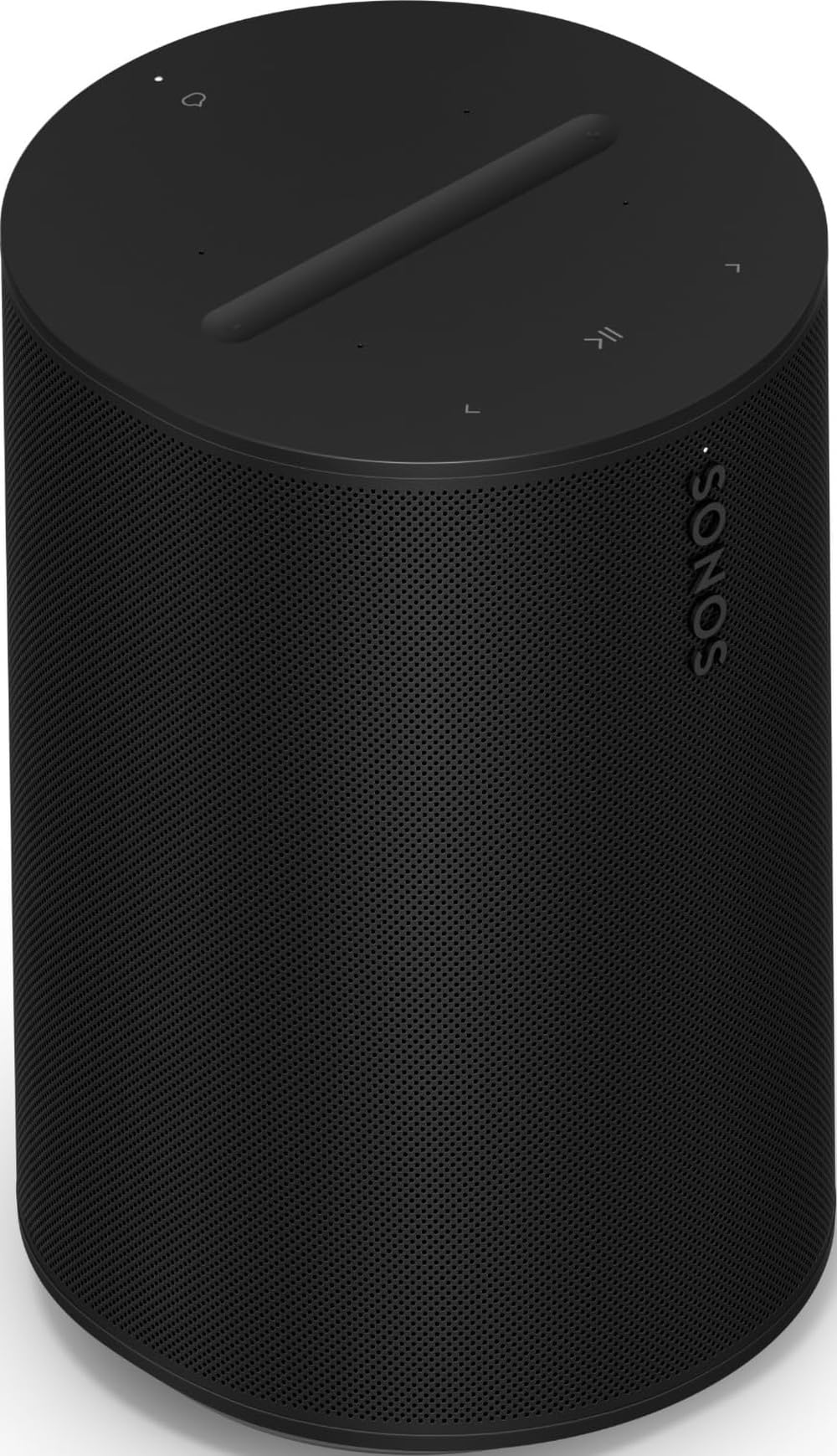
The bookshelf speaker that plays nicely with the rest of your Sonos house.
A 13.06 cm dynamic driver uses a next-gen dual-tweeter design to separate left and right detail, while a midwoofer extends the bass. The compact footprint fits a bookshelf, counter, desk, or nightstand without hogging space. Trueplay tuning runs from the Sonos app: it analyzes the acoustics of your specific room and adjusts the equalizer to fit, so a corner or a bare wall does not dull the sound.
Wi-Fi streaming pulls from all the major services, and Bluetooth connects with the press of a button. A turntable or other source can join through an auxiliary cable and the Sonos Line-In Adapter. Setup is quick — plug in power, connect your phone to Wi-Fi, open the Sonos app. If you already run Sonos speakers in other rooms, this one steps into that group without fuss.
Sound quality is the clear bright spot, with the room-filling presence noted again and again. Bluetooth, reliability, and setup each draw split reactions — some pair with ease, others run into connection trouble. As a stereo pair or part of a home theater arrangement, it earns its keep. A single speaker on a kitchen counter also works well for casual listening.
Where it shines: a compact box with dual tweeters and Trueplay tuning that adapts to the room, all wrapped in the Sonos ecosystem.
The real cost of admission: the best flexibility lives inside the app and multi-room group, so it pays off most if Sonos already runs in your house.
Best when: you want a discreet speaker on a shelf and plan to add more rooms or a turntable later.
Consider another pick if: you want one standalone speaker with no app.
7. Klipsch The One Plus

Two full-range drivers and a 4.5 inch woofer packed into a walnut box a foot wide.
The 2.1 stereo system is biamplified — meaning each driver gets its own amplifier channel — and the package is two 2.25 inch full-range drivers plus a 4.5 inch high excursion woofer. Exposed wood veneer and tactile knobs put it closer to furniture than gadget. Bluetooth 5.3 stretches the wireless range to 40 feet, well beyond the 33 feet of the Marshall Stanmore III, so you can leave your phone on the far sofa and skip a track without reaching for it.
The Klipsch Connect App handles EQ, saved presets, and firmware updates, so you can shape the sound to your taste. USB-C handles both playback and reverse charging, handy for a quick top-up of your phone. The footprint at 12 inches wide by 6.39 deep by 6 tall lets it sit on a console or an office shelf without eating the room.
Sound quality is what buyers praise most, and the easy setup sits second. A few owners flag Bluetooth dropouts and app quirks, so treat the app as a convenience rather than a must. This is the speaker for a smaller space where the accent is on the beautiful walnut and the balanced, polished sound — not the loudest bass on the block.
What buyers like
- Real wood veneer and knurled tactile knobs
- Bluetooth 5.3 with 40 feet of range
- Biamplified 2.1 system for clear, balanced sound
- USB-C playback and phone charging in one
What to weigh
- Dropouts and app glitches turn up in the odd report
- No battery, so it stays near a wall outlet
- Smaller woofer than The Three Plus below
Buy it for: a smaller room that wants a speaker looking like a mid-century piece of furniture.
Look at The Three Plus instead if: you want the bigger 5.25 inch woofer for a larger space.
8. Klipsch The Three Plus

The bigger sibling with a 5.25 inch woofer and a phono stage for your turntable.
This is The One Plus with more muscle: dual 2.25 inch full-range drivers plus a 5.25 inch high excursion woofer, biamplified so each driver has its own power channel. That extra cone size is why it shakes a larger room than its smaller sibling. Included Phono/RCA inputs make a turntable a direct plug-in, no separate preamp talk needed. Bluetooth 5.3 gives you 40 feet of wireless range, matching The One Plus.
Broadcast Mode links 10 plus Three Plus speakers into one multi-speaker setup — a whole-home system without extra hardware. The Klipsch Connect App covers EQ tuning, presets, and firmware. USB-C handles playback and reverse charging, and the real wood veneer with tactile knobs keeps the heritage look intact.
Sound quality earns the loudest praise, with the high-end sparkle and deep low-end both called out. Appearance and build quality draw their own nod, as does the Connect App’s adjustable frequencies. The mixed feedback sits on Bluetooth performance and value, so a stable connection near the router helps. For vinyl lovers, the phono inputs are the deciding feature — most speakers here need an adapter to do the same job.
The deciding feature: Phono/RCA inputs and a 5.25 inch woofer make this a true record player companion.
What to expect: Bluetooth is not its strongest suit, so a wired turntable or a stable Wi-Fi-free setup gets the best out of it.
Designed for: a record player owner who wants one beautiful box to handle the sound and the looks.
Better options exist if: you mostly stream wirelessly and want the most reliable Bluetooth link.
9. Marshall Stanmore III

A wall of rock-and-roll sound in a cabinet with an amp-style face and knobs on top.
The Stanmore III widens its soundstage versus its predecessor, and the stereo drivers push the Marshall signature tone across a whole room. Pair-and-play is the whole setup story: switch it on, pair, and the music starts. Where The Three Plus reaches 40 feet, the Marshall’s Bluetooth range is 33 feet — plenty for a lounge, shorter if you wander into the garden.
Under the grille there is a genuinely thoughtful build: a PVC-free construction with 70 percent recycled plastic and vegan materials, and the bass boost gives low-end weight on demand. Controls sit on top in a physical knob style rather than a touch panel. The app adds equalizer adjustments if you want to tune the tone to the room. A wired connection is available too, which helps when the wireless link is busy.
The sound quality gets the loudest praise here — high-end clarity and rich tones — and the looks earn their own nod. Volume has genuine headroom, and buyers rate it strongly on value. Reliability and build quality each pick up a small mixed note, but nothing that dims the overall picture. If you want your home speaker to make a statement on a shelf, this is that speaker.
The case for it: a stereo soundstage with real rock character, top-panel knobs, and 70 percent recycled plastic in the build.
A fair caveat: 33 feet of Bluetooth range is the shortest on this list, so keep the phone nearby for rock-solid streaming.
This is the one if: you want your speaker to look as loud as it plays and live permanently in one spot.
Not the pick for: someone who wants to carry the speaker out onto a patio.
Understanding the Specs
Woofer size and the passive radiator
The woofer is the driver built for low notes — the bigger it is, the more air it can move. A 4.5 inch woofer in Klipsch The One Plus gives tighter bass than a 48 mm driver, and a 5.25 inch woofer in The Three Plus pushes harder still. A passive radiator is a second cone with no motor that moves with the bass, letting a smaller cabinet produce deeper sound without rattling. Size and a radiator together decide how much weight the music carries.
Battery hours and what they really mean
A built-in battery turns a home speaker into a portable one. The Harman Kardon Onyx Studio 9 lists 8 hours, the Edifier Retro Wood runs up to 9 hours, and the DOSS SoundBox XL gives 10 hours. Those are ceiling figures at ordinary volume — owners regularly find real-world runs come up a little shorter. If the speaker mostly sits on a shelf, skip the battery entirely and choose a corded model with more room for acoustic hardware.
Bluetooth range and multi-speaker modes
Bluetooth range states the distance a phone can sit from the speaker — 10 meters is the common figure on the DOSS and Edifier, 33 feet on the Marshall Stanmore III, and 40 feet on both Klipsch models. Wall thickness matters more than raw range: a wall between phone and speaker eats several feet. Multi-speaker modes go by different names — TWS on the DOSS, Broadcast Mode on The Three Plus, Auracast on the Onyx Studio 9 — but all do the same job: linking boxes into one wider stereo or whole-home sound.
Inputs: AUX, optical, and phono explained
AUX is the 3.5 mm round jack found on older phones and TVs. Optical is the square fibre-optic port TVs use, and it carries digital audio without humming or interference. Phono inputs step the tiny signal from a record player’s needle up to a level the speaker can play — that is what Klipsch The Three Plus includes for vinyl. If you want one speaker for TV, phone, and records, the input list matters more than any single power figure.
FAQ
Will an at-home Bluetooth speaker work with my television?
Can I connect a record player to a Bluetooth speaker directly?
What does a passive radiator do on a home speaker?
How long will the battery actually last on these speakers?
Is a single speaker or a stereo pair better for a living room?
Does automatic room tuning really change the sound?
Which speaker is best for classical or acoustic music rather than rock?
Do I need a subwoofer with one of these speakers?
Can I use these speakers outdoors on a patio?
Final Thoughts: The Verdict
For most people, the at-home winner is the Harman Kardon Onyx Studio 9 because the 13 cm driver with automatic tuning handles a whole living room, and the built-in battery carries the same speaker to the patio. If you want a subwoofer-grade thump for the money, grab the DOSS SoundBox XL and enjoy its 12W subwoofer and 10 hours of playback. And for a speaker that lives under the television with a turntable wired into RCA, the Saiyin Powered Bluetooth Bookshelf Speakers are the ones to reach for. Match power source, driver size, and inputs to the room you plan to put it in — get those three right and the sound follows.
How We Picked
We do not accept paid placement. Every pick is matched to a real buyer and a real use-case; we do not hands-on test units.
Sources & Methodology
Specifications: manufacturer listings and product documentation. Review insights: verified customer reviews, as of November 2026. Pricing: not shown on this page (it changes often); check the current price via the retailer link.
As an Amazon Associate, Gadgets Feed earns from qualifying purchases. This does not affect which products we feature.