
Our readers keep the lights on and my morning glass full of iced black tea. As an Amazon Associate, I earn from qualifying purchases.
Specs are compiled from manufacturer listings and verified buyer reviews and can change over time — please confirm the key details on the product page before buying.
You want a gaming desktop that feels fast on day one and still holds its frame rate two years from now. The machine that gets you there is the CyberPowerPC Gamer Xtreme VR, a 4.5+ star crowd favorite across 290+ ratings. It pairs an Intel Core i5-12400F (a six-core processor) with a GeForce RTX 3050 that carries 8GB of its own video memory — the number that decides whether modern games stutter or stay smooth. Everything below is ranked around that same question: which prebuilt in this range gives you the most usable graphics muscle without a rebuild.
I’m Min — the founder and writer behind Gadgets Feed. This guide is built by comparing the manufacturers’ published specifications and the patterns across verified customer reviews, so you get each pick’s real strengths and trade-offs instead of marketing spin.
Most buyers fixate on the processor and ignore the graphics card’s video memory, which is the figure that actually decides whether a game loads at high settings or drops frames. Here is how to tell which is the better fit for your desk, explained in plain terms, in this breakdown of the best Gaming PC Under $1200.
Our Picks at a Glance


How To Choose The Best Gaming PC Under $1200
Most prebuilts in this range look identical in the marketing photos and wildly different in a game. The decisions that matter come down to three specs and one honest question about how you actually play. Start there, not with the case lighting.
Start with the graphics card’s video memory, not its badge
The graphics card (GPU) does the heavy lifting in every game. Its dedicated memory — called VRAM — is a fixed pool of ultra-fast storage the card uses to hold textures and lighting data. When a game needs more than that pool holds, it stutters or drops detail. At this budget you will see cards with 4GB, 6GB, and 8GB. The 8GB cards have more room to stay smooth in newer titles, and that is the single clearest line between the picks worth buying and the ones that frustrate you later.
Read the processor by cores and boost clock together
The CPU handles game logic, physics, and every background app you leave open. A six-core chip running at a 4.2GHz boost is enough for gaming plus Discord, a browser, and a capture app at once. A 2.5GHz base clock sounds slow but climbs much higher under load, so compare the boost figure, not the base one. More cores help with streaming and editing; raw boost speed helps with frame rates.
Storage and RAM decide how snappy it feels between matches
An NVMe SSD (a stick-shaped drive that plugs straight into the motherboard) cuts loading screens to seconds. 512GB fills up fast once modern games take up large chunks each. 1TB gives you real breathing room. On memory, 16GB DDR4 is the honest minimum for gaming today. 32GB buys headroom for streaming, editing, and dozens of browser tabs, and it is cheap insurance against future titles that ask for more.
Quick Comparison
| Model | Best For | Graphics Card | RAM | Storage | Amazon |
|---|---|---|---|---|---|
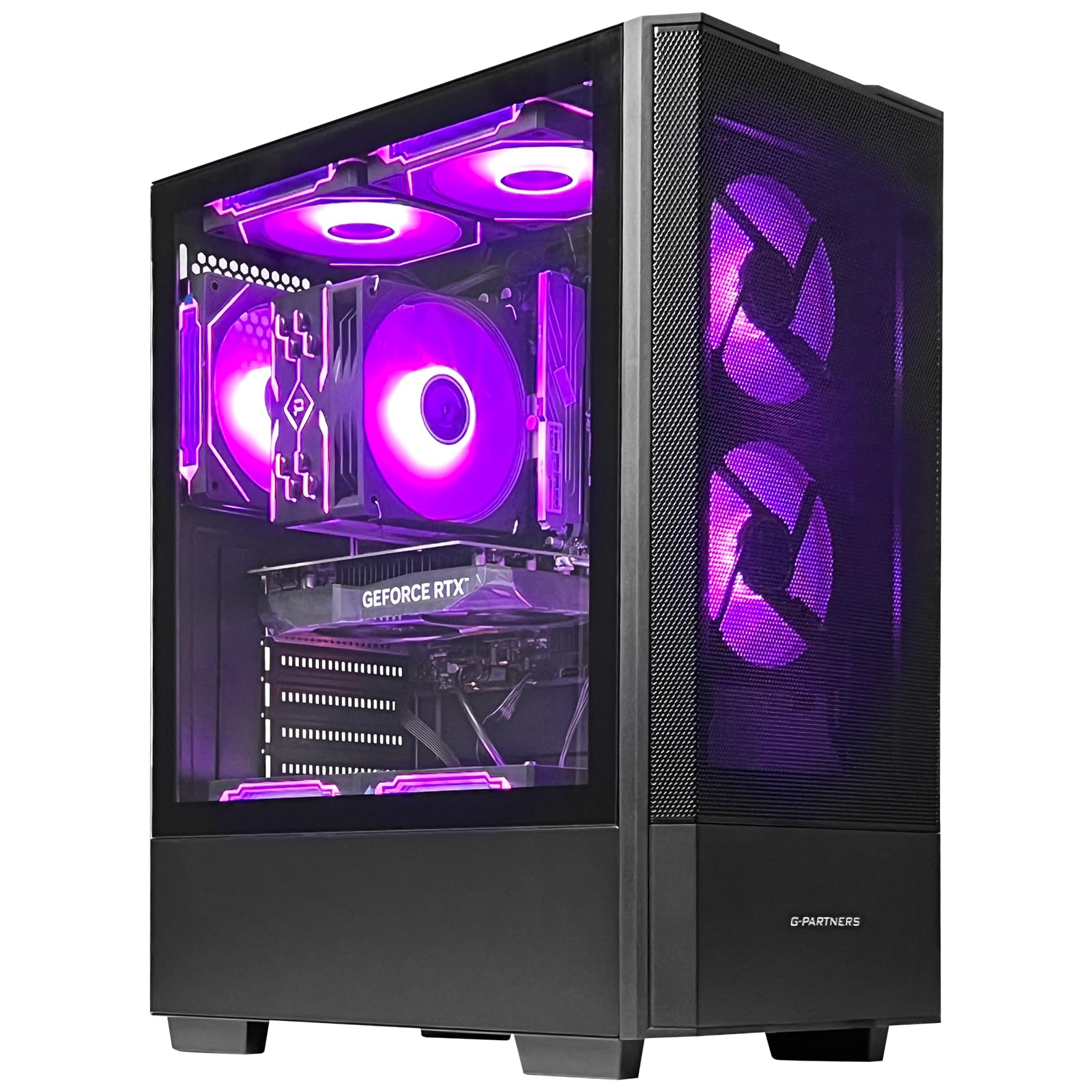
| CyberPowerPC Gamer Xtreme VR★ Best Overall | Smooth 1080p from the start | RTX 3050 8GB | 16GB DDR4 | 500GB NVMe | Amazon |
| Gamer Master Gaming Desktop PCMemory Monster | Streaming and multitasking | RTX 3050 6GB | 32GB | 1TB SSD | Amazon |
| Prebuilt Gaming Desktop PC (ZYNEEX)Balanced Buy | Balanced all-rounder | RTX 3050 6GB | 16GB DDR4 3200MHz | 1TB NVMe | Amazon |
| HP Victus 15L | Compact desk setup | GeForce GT dedicated 2GB | 32GB | 1TB SSD | Amazon |
| CyberPowerPC Ryzen 5 5500 / RX 6500 XT | Budget entry into PC gaming | RX 6500 XT 4GB | 8GB DDR4 | 500GB NVMe | Amazon |
| STGAubron Gaming PC Desktop | Lowest-cost tower | RTX 3050 6GB | 16GB DDR4 | 512GB SSD | Amazon |
| HP OMEN 40L | Big-room multitasking build | GTX 1660 SUPER 6GB | 32GB DDR4 | 1TB NVMe | Amazon |
| Gaming PC RTX 3060 Ti 8GB (Olialia) | 1440p and streaming | RTX 3060 Ti 8GB | 16GB DDR4 | 1TB PCIe SSD | Amazon |
| LXZ Gaming PC Desktop Tower | High-refresh esports play | RTX 5060 8GB GDDR7 | 16GB DDR4 3200 | 1TB NVMe | Amazon |
| Skytech Gaming PC (Ryzen 7 5700) | Popular big-volume pick | RTX 5060 8GB GDDR7 | 16GB DDR4 3200 | 1TB NVMe | Amazon |
| Gaming PC Ryzen 7 5700X (AEXPXO) | Best price-to-frame rate | RTX 5060 8GB GDDR7 | 16GB DDR4 3200MHz | 1TB NVMe | Amazon |
| Skytech Gaming PC (Intel i5 14400F) | DDR5 on a white build | RTX 5060 8GB GDDR7 | 16GB DDR5 6000 | 1TB NVMe | Amazon |
| msi Codex R2 | Quiet, tidy name-brand build | RTX 5060 8GB | 16GB DDR5 | 1TB SSD | Amazon |
In‑Depth Reviews
1. CYBERPOWERPC Gamer Xtreme VR Gaming PC
Our pick — 4.5+★ from 250+ verified ratings; the strongest balance of quality and price.
The quiet 1080p workhorse, with 8GB of VRAM on its RTX 3050 — double the 4GB on the RX 6500 XT build
The number that puts this machine on top is the 8GB on its GeForce RTX 3050. That is double the 4GB you get on the cheaper RX 6500 XT build further down, and it is the difference between a card that manages modern textures and one that has to cut detail. The Intel Core i5-12400F runs six cores at a 2.5GHz base clock, with plenty of headroom under load. Add 16GB of DDR4 memory and a 500GB PCIe NVMe SSD and you have a machine that boots in seconds and gets you into a match without a coffee break.
What wins people over here is how it behaves once the game is running. Owners describe high-end titles sitting at high graphics settings with steady frame rates, and the operation staying quiet while they do it. Setup is genuinely a ten-minute job — everything arrives pre-assembled, Windows 11 Home is already installed, and a keyboard plus a seven-colour RGB gaming mouse come in the box. The tempered glass side panel and custom RGB case lighting are there if you want a desk showpiece, or you can leave them subtle.
The honest catch is storage. 500GB sounds fine until you install two or three current big-budget games, and then you are juggling. Budget for a second drive down the road, or accept that you will uninstall to install. The RTX 3050 is a 1080p card too — it is not the chip you buy for high-refresh 1440p, and nobody should expect that from it.
Where it pulls ahead
- 8GB of VRAM on the RTX 3050 — more texture headroom than the 4GB RX 6500 XT build
- Arrives fully assembled with Windows 11 Home pre-installed and a keyboard and mouse included
- Runs cool and quiet under load, even through long sessions
- Six-core Intel Core i5-12400F with 802.11AC Wi-Fi and 6 USB 3.1 ports
What to plan around
- 500GB SSD fills quickly with modern titles
- 1080p-focused graphics card, not a 1440p high-refresh chip
Buy this one if: you want a plug-in-and-play 1080p desktop that stays quiet and arrives ready to game.
Think twice if: you already own a large game library — that 500GB drive will need a partner.
2. Gamer Master Gaming Desktop PC
32GB of RAM — four times the 8GB in the CyberPowerPC Ryzen 5 build — for streamers who never close a tab
Here is the gap that jumps off the page: this tower carries 32GB of RAM against the 8GB in the CyberPowerPC Ryzen 5 build — a 4.0x difference. That headroom is what lets you run a game, a streaming app, a voice chat, and a browser full of tabs without the whole thing grinding. The Intel Core i7 quad-core chip boosts to 3.9GHz, and the 1TB ultra-fast SSD covers both your game library and quick boots. Wi-Fi 6 and Bluetooth 5.2 handle the wireless side.
Only a handful of ratings exist so far, but the early read is that it behaves like a proper entry-level gaming system: responsive, quick to close apps, and priced fairly for what is inside. The RTX 3050 with 6GB GDDR6 (a type of fast video memory) handles 1080p comfortably, so everyday games stay smooth. The listing points to detailed 1440p Quad HD visuals with 60+ FPS (frames per second) in many titles, according to the maker. Assembly happens in the USA, and you get a keyboard and mouse with no bloatware (unwanted preinstalled software) loaded on.
Treat the 1440p language as a ceiling, not a promise — the 6GB card has less room than an 8GB model, so the newest, most demanding games will want settings dialled back. For a streaming-first desk, the 32GB and 1TB are the parts that actually earn their keep.
Space to breathe: 32GB of RAM and a 1TB SSD are the standout pair — this is the pick for anyone who multitasks hard while gaming.
The trade-off: a 6GB graphics card means newer titles at 1440p need settings dialled back, and the review base is still thin.
Reach for this if: streaming, editing, or a dozen browser tabs live alongside your games.
Look elsewhere if: you want the biggest possible VRAM pool for the newest titles — that lives on the RTX 3060 Ti pick.
3. Prebuilt Gaming Desktop PC (AMD Ryzen 5 5500, RTX 3050 6GB)
A six-core Ryzen 5 5500 boosting to 4.2GHz and a full 1TB of NVMe storage
Clock speed is where this one separates itself. Its AMD Ryzen 5 5500 boosts to 4.2GHz against the 2.5GHz base of the CyberPowerPC Gamer Xtreme VR — the same six cores, but a materially quicker ceiling. Pair that with a GeForce RTX 3050 carrying 6GB GDDR6, and you get smooth 1080p gaming with ray tracing (the lighting effect that makes reflections and shadows look real). The 16GB of DDR4 3200MHz memory and 1TB NVMe SSD mean quick loads and room for a proper library.
What people keep coming back to is the performance-to-hassle ratio. It handles demanding games and multi-tasking without complaint, and setup is genuinely plug-and-play — several buyers report Windows 11 installing itself cleanly on first boot. The ARGB air cooling with multiple fans stays quiet through long sessions, and the built-in Wi-Fi plus HDMI and DisplayPort outputs make monitor hookup simple.
The honest limit: this is a 1080p machine with a 6GB card, so it is not the build for someone chasing 1440p at high refresh. And the case lighting is a taste thing — if you wanted a stealth build, you will be turning it down.
Why it earns the spot: a 4.2GHz six-core processor, 1TB NVMe and 16GB of 3200MHz memory is a well-rounded package that does not force a compromise between speed and storage.
Worth knowing: 6GB of VRAM is the ceiling here — fine for 1080p, tight for the newest titles at higher detail.
The fitting buyer: someone who wants the fastest-clocking six-core chip in this tier plus a full terabyte of NVMe storage.
The mismatch: a 1440p high-refresh gamer — that needs the 8GB RTX 3060 Ti further up.
4. HP Victus 15L Gaming Desktop
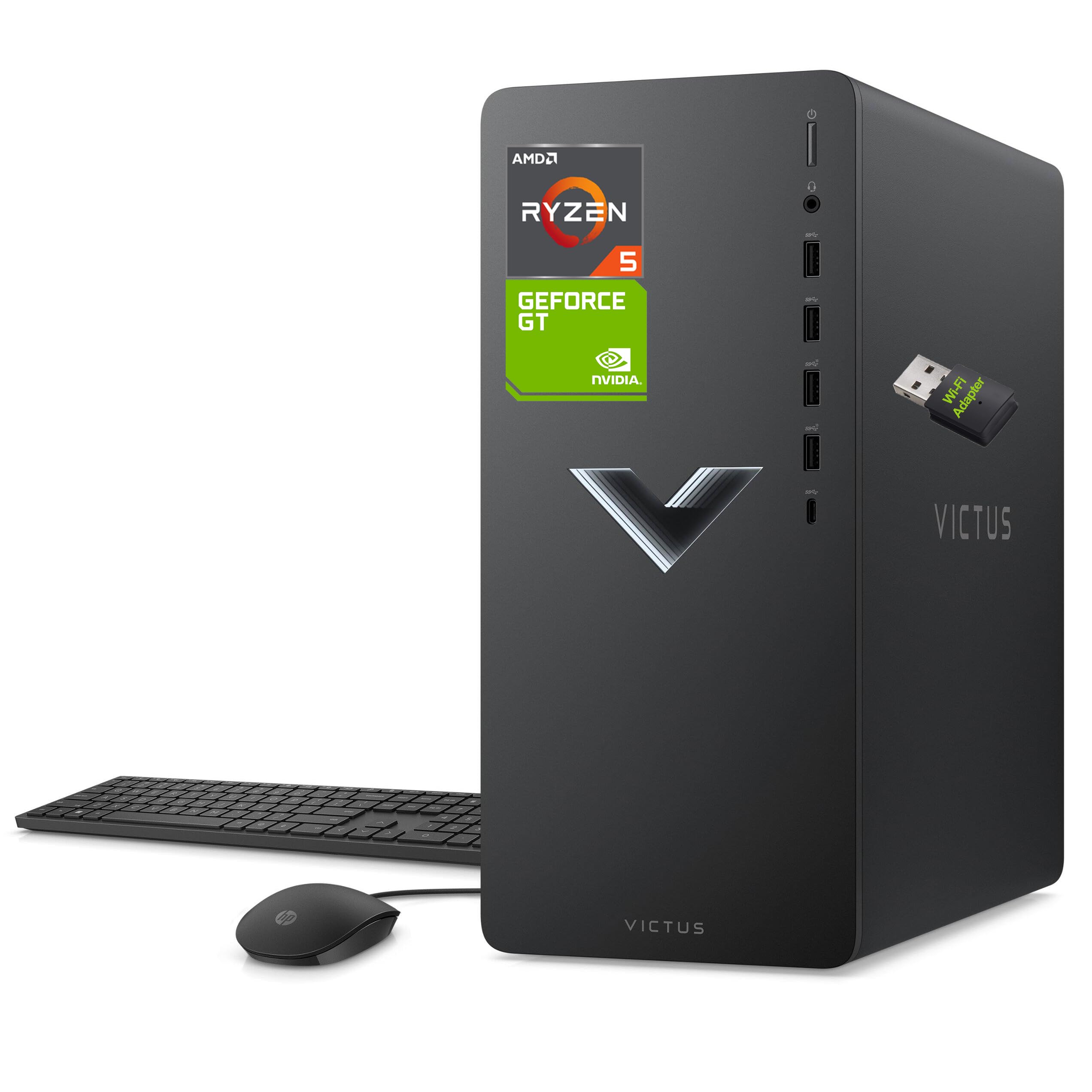
A 15-liter, 11.3-lb tower that fits under a desk and still packs 32GB of RAM and a 1TB SSD
Most full towers eat a lot of floor space. This one fits into a 15-liter chassis and weighs 11.3 lbs, so it slots under a desk or onto a dorm shelf without a fight. Inside, the AMD Ryzen 5 5500 runs six cores and twelve threads up to 4.2GHz, matched to 32GB of RAM and a 1TB PCIe SSD. That combination boots fast, moves files quickly, and keeps a lot of apps open at once.
What owners describe most is general capability rather than raw gaming muscle — it handles everyday computing, multitasking, and light gaming without lag. The description is upfront that the NVIDIA GeForce GT graphics is aimed at casual gaming, video playback, and everyday graphics work, with 2GB of card memory. It comes with Windows 11 Home, an English keyboard and mouse, a 350W power supply, and a bundled wireless USB WiFi adapter so you are connected from day one.
The real trade-off is the graphics card. Its 2GB of video memory is a small pool next to the 8GB on the RTX 3050 models here, so the newest titles at high settings will strain it. This is a desktop for someone who games lightly and values the small footprint and big memory.
What it nails
- 15-liter chassis and 11.3 lbs — fits where full towers will not
- 32GB RAM plus 1TB PCIe SSD for fast boots and heavy multitasking
- Six-core, twelve-thread Ryzen 5 5500 up to 4.2GHz
- Ready to use with Windows 11 Home, keyboard, mouse, and a bundled WiFi adapter
Where it asks patience
- 2GB of graphics memory limits it to casual and light gaming
- Not built for the newest demanding titles at high settings
Built for: small desks, dorm rooms, and shared spaces where a full tower simply will not fit.
Not for: anyone planning to run modern AAA games at high settings — the 2GB card is the wall.
5. CyberPowerPC Gaming PC (AMD Ryzen 5 5500, RX 6500 XT 4GB)
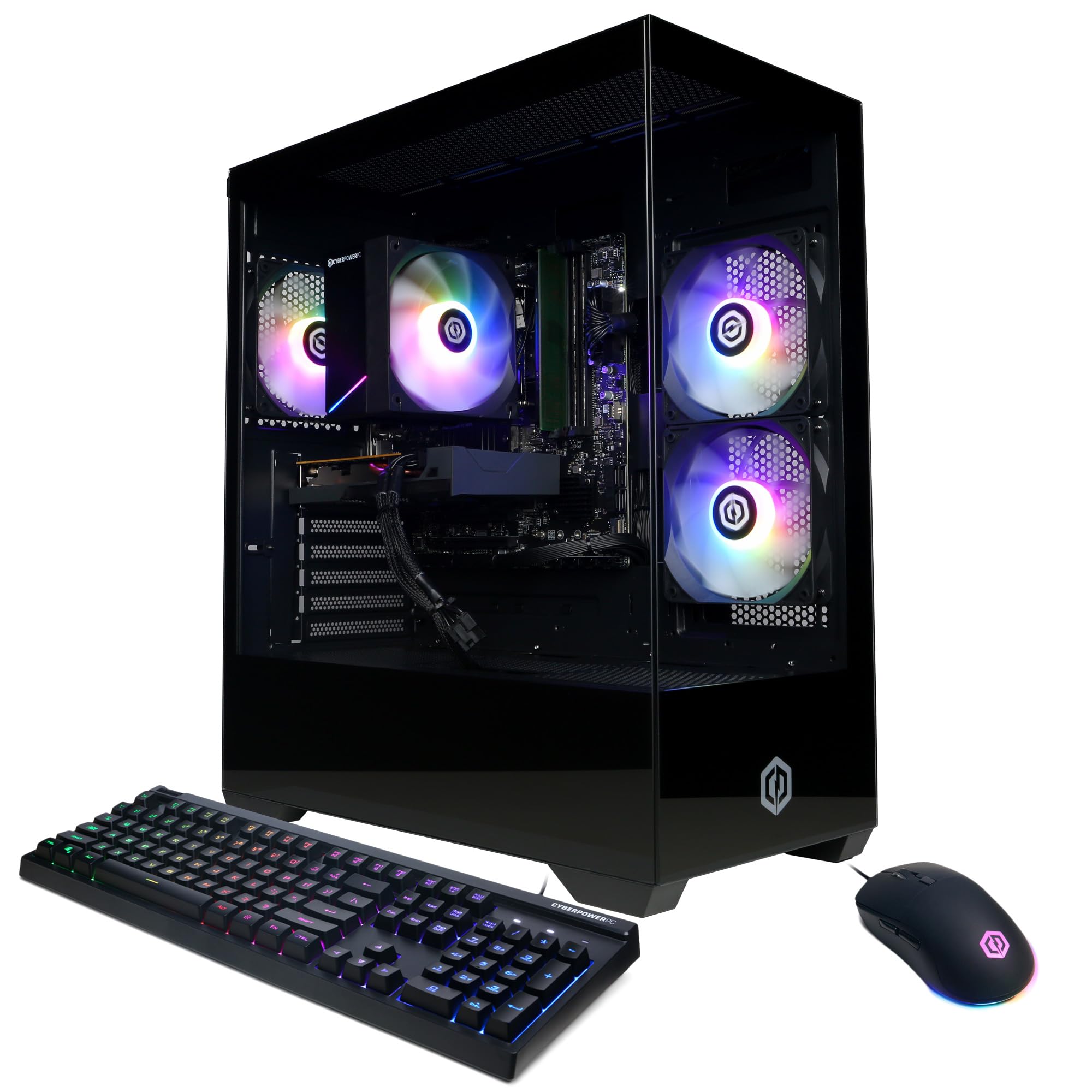
The cheapest way into a real gaming tower, with a 4GB RX 6500 XT — the smallest VRAM pool here
This is the entry point. Its AMD Radeon RX 6500 XT carries 4GB of GDDR6 memory — half the 8GB on the RTX 3050 in the Best Overall pick, and that gap is the whole story. The six-core Ryzen 5 5500 at 3.6GHz and the 500GB PCIe 4.0 NVMe SSD are perfectly respectable. But 8GB of DDR4 memory is the slimmest in this lineup, so you will feel it if you game with a lot of apps open.
What people value most is the reliability and the value — it does the fundamental job of running popular games smoothly enough without drama, and the Wi-Fi 5 and Bluetooth 5.0 connectivity cover the basics. The tempered side panel, custom RGB lighting, and included keyboard and mouse give it a complete look from the start.
The performance side is where expectations need calibrating: feedback on raw speed is split, and 4GB of memory is a real ceiling as games get heavier. If you mostly play older or lighter titles at 1080p, it delivers. If you want smoother room to grow, the 8GB RTX 3050 pick is the better spend.
Where the money went: a reliable six-core chip and a PCIe 4.0 NVMe drive at the lowest entry point — the fundamentals are sound.
Where it cuts: 4GB of VRAM and 8GB of system RAM are the tightest figures in this group, so heavy multitasking and newer games will feel the squeeze.
Go here for: a first gaming tower on a tight budget where 1080p and lighter or older titles are the plan.
Spend up if: you want more VRAM headroom — the 8GB RTX 3050 models above cost more but breathe easier.
6. STGAubron Gaming PC Desktop (Core i7 8th Gen, RTX 3050 6G)
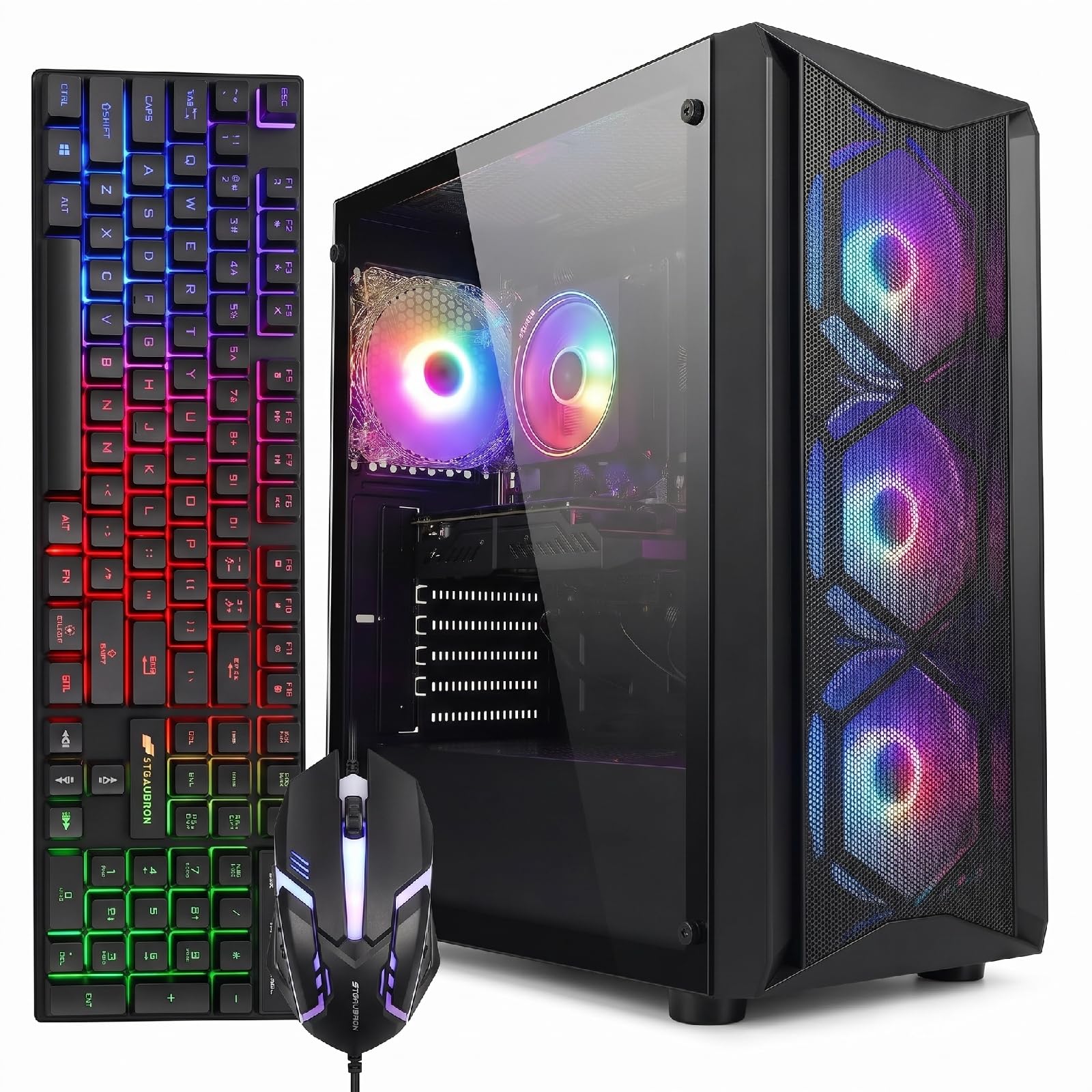
Four RGB fans plus Wi-Fi 6 and Bluetooth 5.2 — newer wireless than the cheaper CyberPowerPC build
For a budget tower, the connectivity here is unexpectedly generous: Wi-Fi 6 and Bluetooth 5.2 beat the Wi-Fi 5 and Bluetooth 5.0 on the cheaper CyberPowerPC build. The graphics card is a GeForce RTX 3050 with 6GB of GDDR6 memory, and the processor is an Intel Core i7 8th Gen that climbs to 4.1GHz. 16GB of DDR4 and a 512GB SSD round it out, with four RGB fans and an ARGB keyboard and mouse included.
Gamers report it handling mainstream and indie titles well, and the RGB lighting is a genuine draw for anyone building a desk setup. The listing points to a long list of popular games running at 60+ FPS, and the plug-and-play setup gets you going in minutes, with a 1-year parts and labor warranty plus lifetime tech support behind it.
Be realistic about the graphics memory and the chip generation: the 6GB card and an older-generation i7 mean this is a solid starter, not a long-term high-settings machine. Some buyers question whether it justifies its cost, which is fair — compare it against the 8GB RTX 3050 pick before you decide.
What stands out: Wi-Fi 6 and Bluetooth 5.2 on a budget tower, four RGB fans, and a 6GB RTX 3050 — more modern wireless than its price tier usually offers.
What to weigh: an 8th-gen processor and 6GB of VRAM put it behind the newer, bigger-VRAM picks for long-term headroom.
the balance: a first-time builder on a budget who wants RGB style and modern wireless without a big outlay.
The caution: generations-old silicon and 6GB of VRAM — buy this as a starter, not a keeper.
7. HP OMEN 40L Gaming Desktop PC
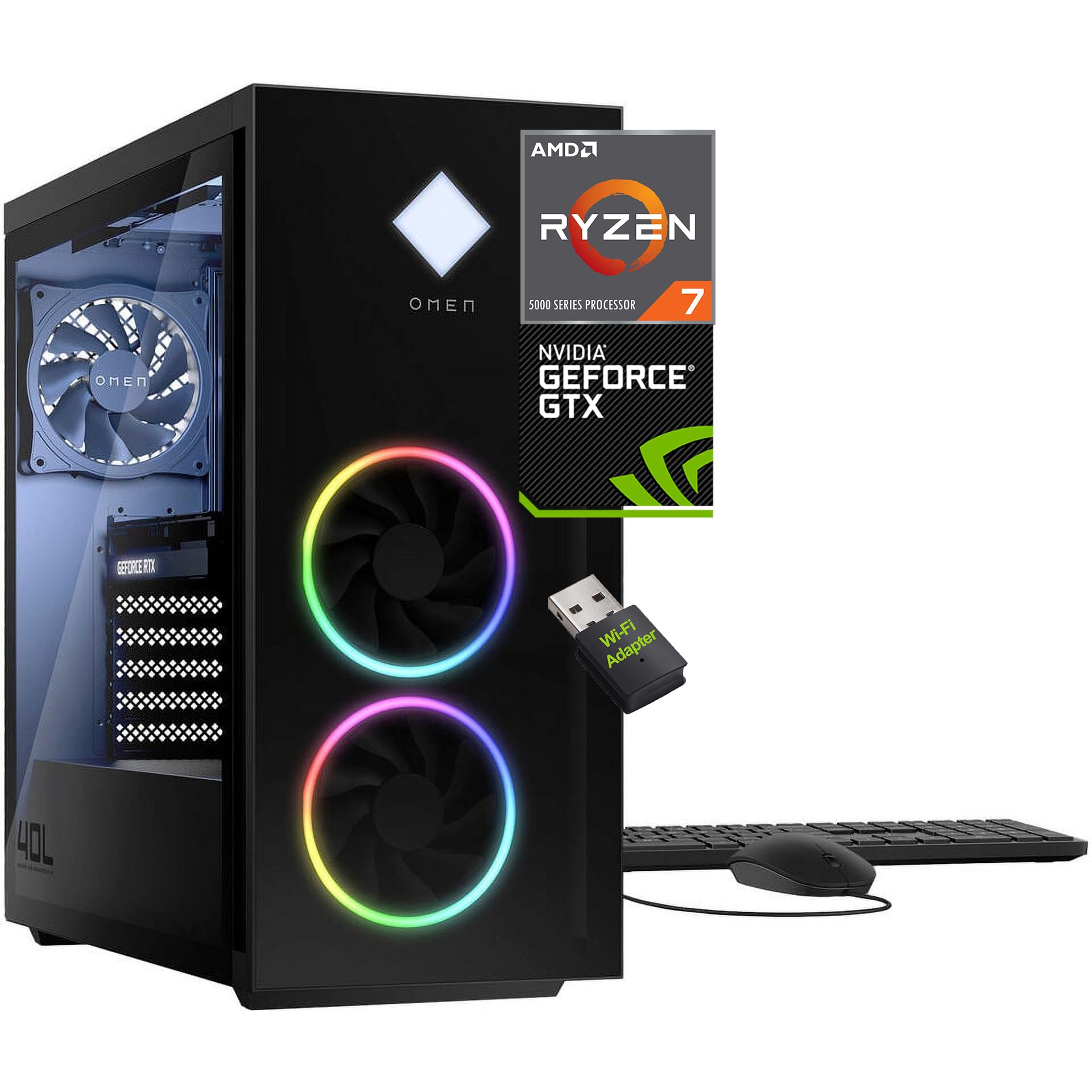
An 8-core Ryzen 7 5700X, 32GB of RAM, and a tool-less chassis for easy upgrades
This is the biggest processor in the lineup: an AMD Ryzen 7 5700X with 8 cores and 16 threads, up to 4.60GHz and 32MB of cache. That core count is what matters when you stream, record, and game at the same time — the machine has more workers to spread the job across. Add 32GB of DDR4 and a 1TB PCIe NVMe M.2 SSD and you get fast boots with room for a large library. The GTX 1660 SUPER with 6GB handles 1080p gameplay with DVI, HDMI, or DisplayPort outputs for multi-monitor setups.
What owners mention most is straightforward everyday capability — it handles basic tasks and non-gaming work without trouble. The tool-less chassis is a genuine plus: you can open it up and swap parts without tools. OMEN Light Studio lets you control the RGB across connected devices from one app, and the 600W power supply with DTS:X Ultra 5.1 audio rounds things out.
The gaming graphics card is the compromise. The GTX 1660 SUPER is an older-generation card, and the description leans toward casual rather than demanding gaming. Functionality feedback is mixed, with some buyers reporting smooth sailing and others hitting snags. This is a multitasking workhorse first and a gaming rig second.
Why pick it
- 8-core, 16-thread Ryzen 7 5700X up to 4.60GHz with 32MB cache — the most cores here
- 32GB DDR4 and a 1TB NVMe M.2 SSD
- Tool-less chassis for easy upgrades, plus OMEN Light Studio lighting control
- 600W power supply, DTS:X Ultra 5.1 audio, and a bundled WiFi adapter
Where it gives ground
- GTX 1660 SUPER is an older-generation card for the gaming side
- Feedback on overall functionality is split
Pair it with: streaming, editing, or a dozen heavy apps — the 8 cores and 32GB are the reason to buy.
Pass if: pure gaming is the goal — the RTX 3050 and 3060 Ti picks game better despite fewer cores.
8. Gaming PC, GeForce RTX 3060 Ti 8GB, Ryzen 5 5500

The strongest graphics card here — an 8GB RTX 3060 Ti — for players who want 1440p headroom
Graphics muscle is the headline. The GeForce RTX 3060 Ti with 8GB of GDDR6 memory is the most capable card on this list for sustained gaming, and its DLSS and ray-tracing features are aimed squarely at 1440p and high frame rates. Compare it to the 8GB RTX 3050 in the Best Overall pick: same memory amount, but a notably tougher card. The AMD Ryzen 5 5500 with six cores and Zen 3 architecture keeps up, paired with 16GB DDR4 and a 1TB PCIe SSD.
The cooling setup is more serious than the rest — seven ARGB fans alongside a 600W 80 PLUS Bronze power supply mean it holds steady through marathon sessions. Connectivity is broad: Gigabit Ethernet, USB 3.0, USB-C, HDMI and three DisplayPort outputs, PCIe Wi-Fi 6 with Bluetooth, and tempered glass front and side panels with customizable RGB. The 1-year warranty covers repairs done in the United States.
The trade-off is honest: the far-superior card sits behind only a six-core Ryzen 5, so heavy streaming may want the extra cores on the OMEN 40L. And this configuration is a niche listing with limited buying history to lean on — you are judging it on the spec sheet, which is genuinely strong.
The draw: an RTX 3060 Ti with 8GB GDDR6, seven ARGB fans, a 600W 80 PLUS Bronze supply, and full multi-monitor outputs make this the performance-first pick.
The compromise: six cores behind a top-tier card, and a limited track record — great for gaming, less so for hard streaming multitasking.
The clear match: gamers who prioritise the strongest graphics card over core count and want 1440p room.
The other side: dedicated streamers should weigh the 8-core OMEN 40L instead.
9. LXZ Gaming PC Desktop Tower (Ryzen 7 5700X, RTX 5060)
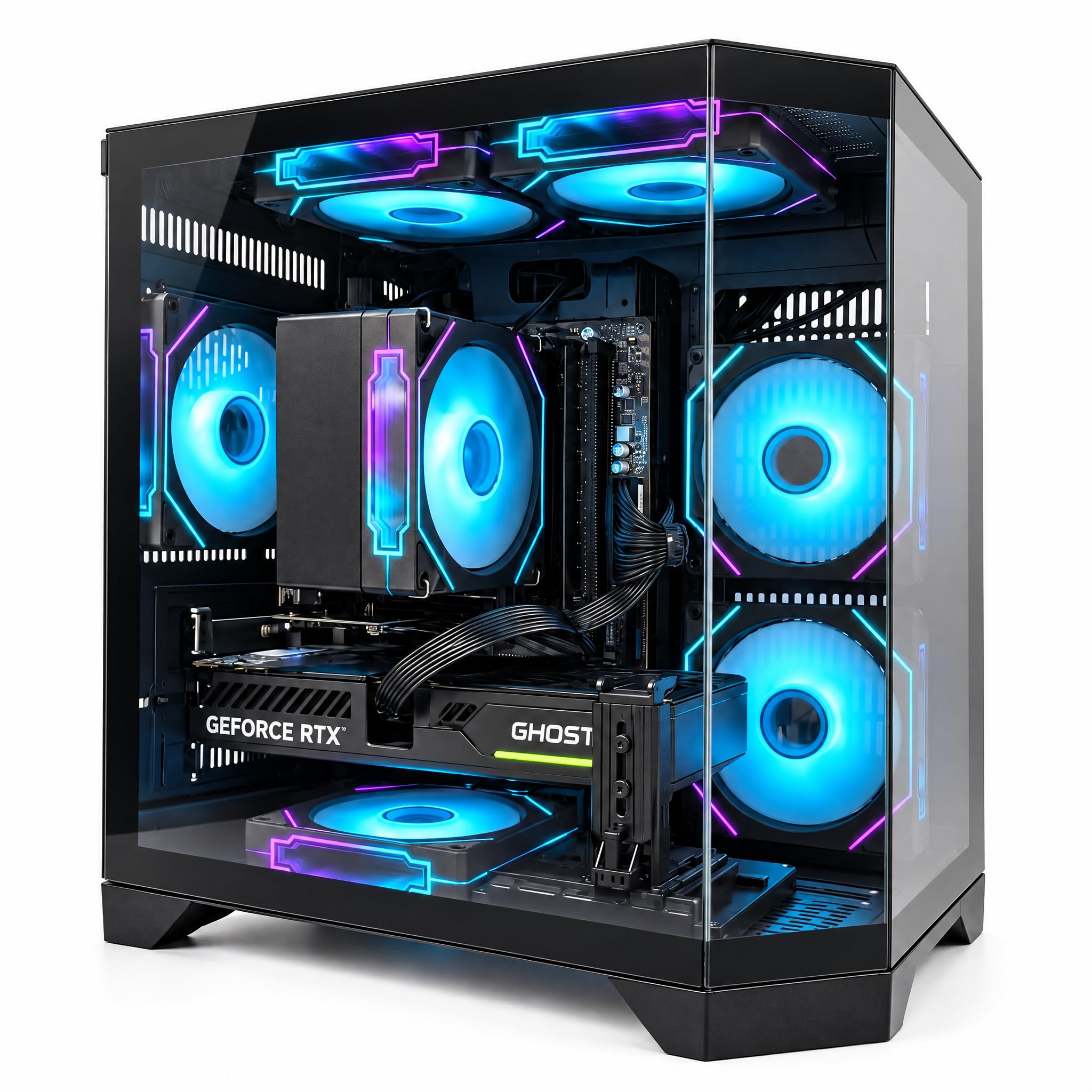
GDDR7 graphics memory and eight cores, tuned for high-refresh esports frames
The graphics card here uses GDDR7 memory — the newest and fastest type on this list — with 8GB in the RTX 5060. The listing targets high-refresh 1080p and solid 1440p play, quoting 60+ FPS in many AAA titles and 144+ FPS in popular esports titles at 1080p with tuned settings. Behind it, the Ryzen 7 5700X runs 8 cores and 16 threads up to 4.6GHz with 32MB of L3 cache, so it can keep a game, Discord, and OBS running together. Storage is a 1TB NVMe SSD with up to 3,000MB/s sequential read.
Six ARGB fans with multiple intake and exhaust positions keep airflow balanced through long sessions, and the 650W power supply with three DisplayPort and one HDMI output supports a multi-monitor setup without a hub. Wi-Fi 6 means you can place it away from the router, and it ships ready to play with no OS install needed.
The catch is track record: this is a lesser-known brand with limited buyer history, so you are leaning on the specification list rather than a deep well of feedback. The case is also very much a showpiece with that full tempered glass panel — if you wanted understated, this is not it.
Why it turns heads: GDDR7 RTX 5060 graphics, an 8-core 5700X at 4.6GHz, a 1TB 3,000MB/s NVMe drive, six ARGB fans, and a 650W supply — a genuinely modern spec sheet.
What to keep in mind: a thinner track record behind the brand, and the glass-and-lights look is not for everyone.
Reach for it when: esports and high-refresh 1080p are the goal and you want the newest GDDR7 graphics memory.
Hold off if: you only feel comfortable buying from a brand with a long review history.
10. Skytech Gaming PC Desktop (Ryzen 7 5700, RTX 5060)
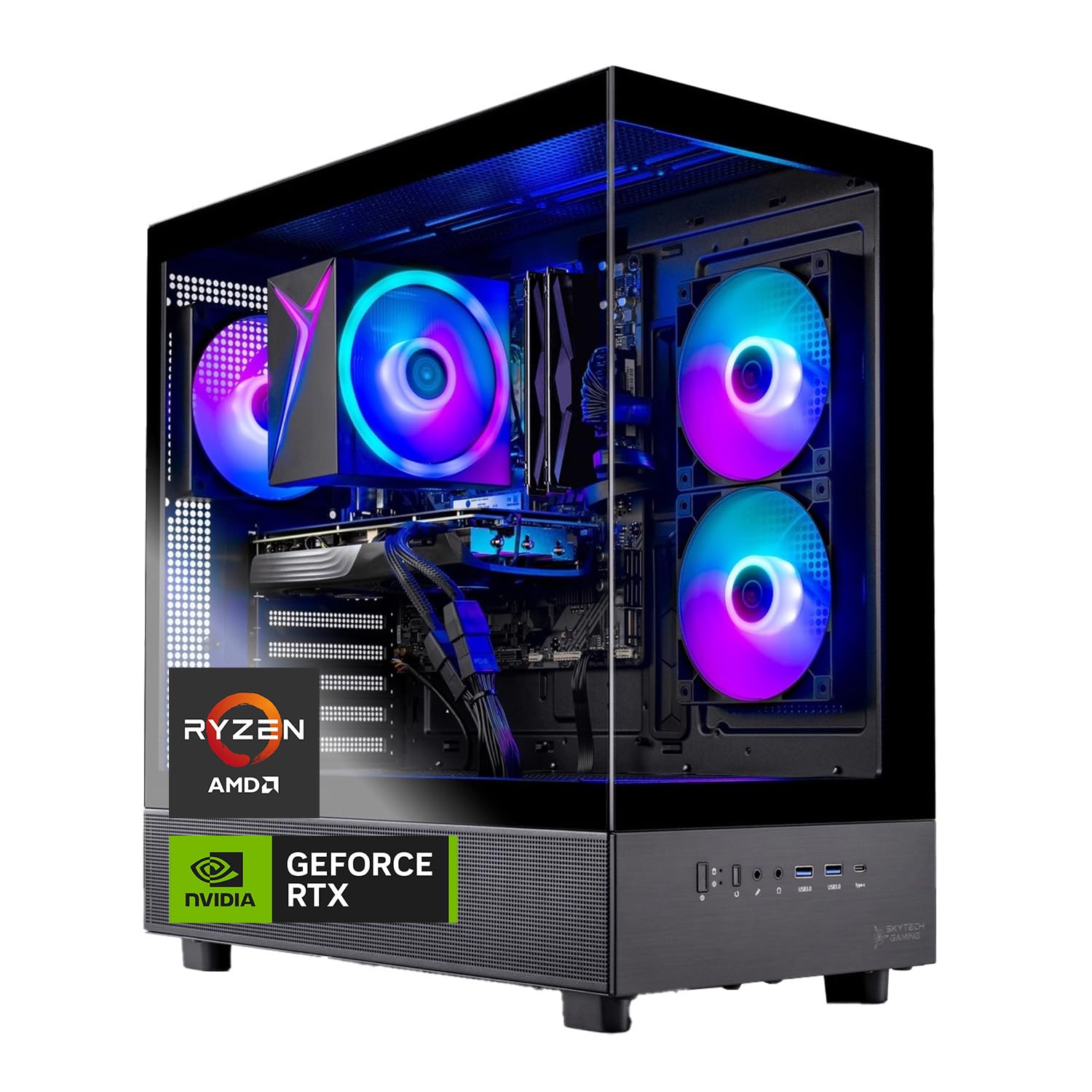
The best-known badge in this lineup, with GDDR7 graphics and a 4.6GHz eight-core chip
The AMD Ryzen 7 5700 runs 8 cores with a 4.6GHz turbo boost, matched to an NVIDIA GeForce RTX 5060 with 8GB of GDDR7 memory. The 1TB NVMe M.2 SSD is listed at up to 30x faster than a traditional hard drive, and 16GB of DDR4 3200 memory with a heat spreader rounds out the internals. A high-performance air cooler and ARGB fans in the tempered-glass Azure case handle heat, and it ships with a keyboard and mouse.
What draws people in is the overall experience — buyers describe the look as a genuine standout and the speed as quick, with the SSD shortening load times. Wi-Fi 5 covers wireless, and the graphics outputs include at least one HDMI and one DisplayPort, with USB 2.0, 3.0, and 3.2 Gen1 ports on board. It carries a 1-year parts and labor warranty and is assembled in the USA.
Be measured about the graphics brand: the listing notes the RTX 5060’s brand may vary. Performance feedback is mixed overall, with most buyers happy and a minority reporting trouble, so buy from a seller with a clear return path. For a well-known name and a modern card, it is a sensible, if not exceptional, pick.
The case for it
- 8-core Ryzen 7 5700 with a 4.6GHz turbo boost
- RTX 5060 with 8GB of GDDR7 memory and a 1TB NVMe M.2 SSD
- ARGB fans, a high-performance air cooler, and a tempered-glass Azure case
- Well-known brand with a 1-year parts and labor warranty
The fine print
- Graphics card brand may vary from unit to unit
- Performance feedback is split, so buy with a clear return option
Fits best: buyers who want a familiar name, a modern RTX 5060, and an attractive tempered-glass case.
Look past if: you want zero variance in parts — the graphics brand can differ between units.
11. Gaming PC AMD Ryzen 7 5700X, RTX 5060 8GB GDDR7
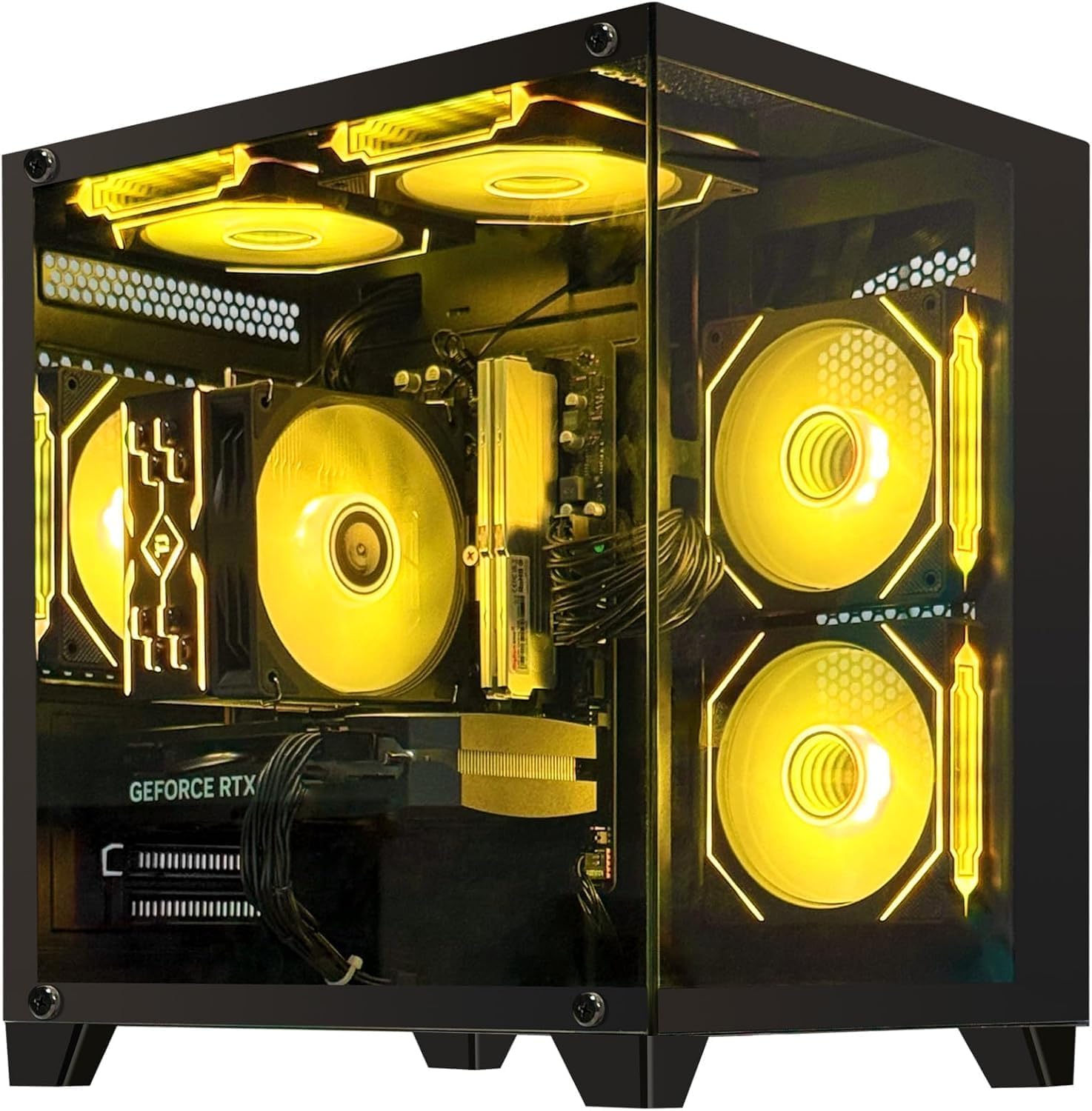
Eight cores, newer GDDR7 graphics, and a build that keeps its cool under pressure
Everything about this one is newer-generation: an 8-core AMD Ryzen 7 5700X up to 4.6GHz, an RTX 5060 with 8GB of GDDR7 memory featuring DLSS 4 and ray tracing, 16GB of DDR4 3200MHz, and a 1TB NVMe SSD. The cooling is a four-copper-pipe ARGB system with an extra ARGB fan, aimed at holding temperatures down during long gaming or rendering sessions. A 550W Bronze-certified supply keeps power delivery stable.
What owners highlight is performance-to-price — this is the pick for someone who wants modern graphics and a fast eight-core processor without overpaying. It handles AAA games, esports, streaming, and content creation with high frame rates, and the built-in Wi-Fi means no adapter needed. The 1-year warranty and free tech support round it out, and it arrives ready to use.
The catch is the power headroom: 550W is the smallest supply among the RTX 5060 builds here, so upgrades down the line get tighter faster. And the ARGB-heavy cooling is styling you may or may not want.
The value case: an 8-core 5700X, GDDR7 RTX 5060 with DLSS 4, 16GB of3200MHz, a 1TB NVMe SSD, and four-pipe ARGB cooling — modern parts at a sensible tier.
What to plan for: a 550W power supply leaves less headroom for future upgrades than the 650W options on this list.
Choose it for: the newest graphics memory plus an eight-core processor, without paying the very top of the range.
skip it if: you plan to add a bigger graphics card later — the 550W supply is the binding limit.
12. Skytech Gaming PC Desktop (Intel i5 14400F, RTX 5060)
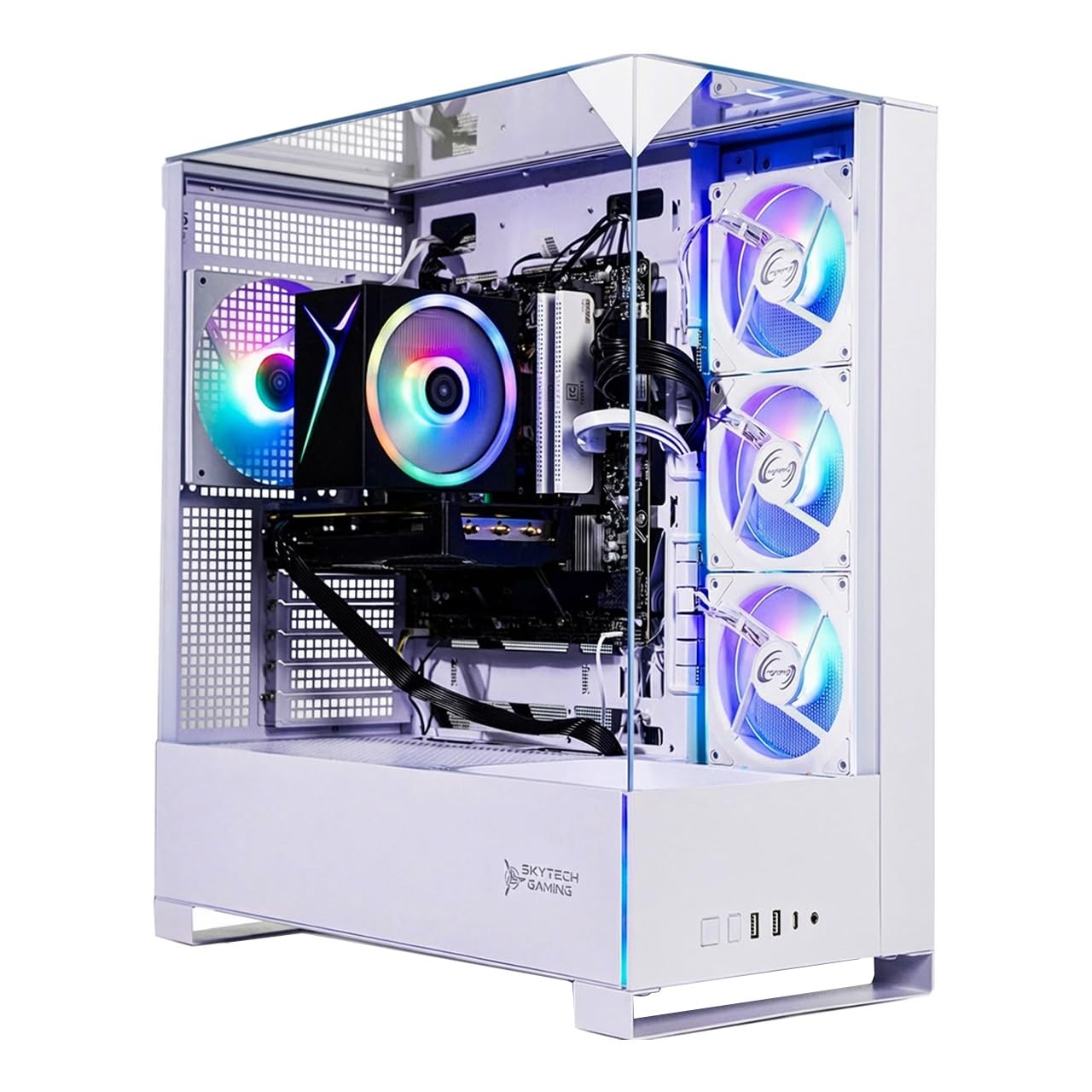
The only DDR5 machine in the lineup, dressed in a white tempered-glass case
Memory generation is the differentiator here. This build runs 16GB of DDR5 6000 with a heat spreader — the newer, faster memory standard — where nearly every other pick uses DDR4. The Intel Core i5 14400F pushes to a 4.7GHz turbo boost, the highest clock speed in the group, paired with a GeForce RTX 5060 carrying 8GB of GDDR7 graphics memory. A 1TB NVMe M.2 SSD and a high-performance air cooler with ARGB fans complete the package in a white Archangel 5 tempered-glass case.
For buyers who care about future-proofing, the DDR5 platform is the argument to make: it is the current memory generation, and the 4.7GHz turbo on the Intel chip is the fastest boost clock here. It runs popular titles at 1080p with the RTX 5060, ships with a keyboard and mouse, and carries a 1-year parts and labor warranty with assembly in the USA.
The trade-off is that it sits near the top of the range, and the RTX 5060’s brand may vary between units. If DDR5 and a white case are what you want, few builds here match it.
Why it stands apart: DDR5 6000 memory and a 4.7GHz turbo boost — the fastest-clocking processor and the only newer-generation memory on the list.
What to weigh: a thin review base and a variable graphics card brand mean you are trusting the specification.
It suits: buyers who want the newest memory standard and a white showpiece case to match a bright setup.
It does not suit: anyone who wants a deep, proven review history before committing.
13. msi Codex R2 Gaming Desktop (Intel i5-14400F, RTX 5060)
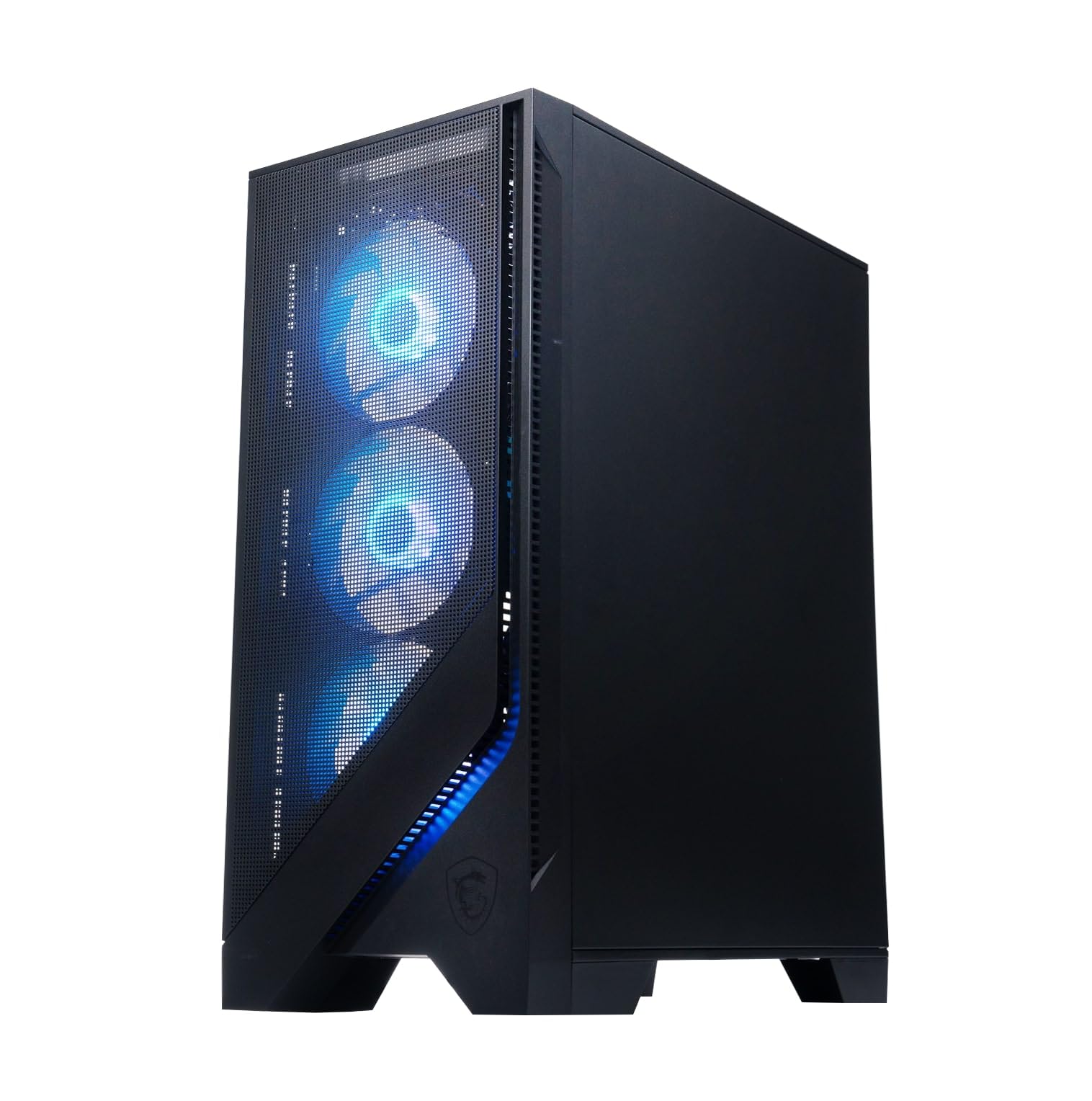
A name-brand tower that runs quiet, with four cooling fans doing the work
Build quality is what earns this one its place. The Intel Core i5-14400F with a hybrid architecture boosts to 4.7GHz, paired with an NVIDIA GeForce RTX 5060 carrying 8GB of graphics memory, 16GB of DDR5, and a 1TB SSD. The cooling is deliberate: an RGB CPU air cooler plus four system fans — three at the front pulling cool air in and one at the rear pushing heat out. MSI Center software controls the RGB lighting, and you can cycle through lighting options with a dedicated button.
What owners notice most is how solid and quiet it runs, with smooth performance across multiple apps and a clean, easy setup. It arrives ready with Windows 11 Home, and the look is restrained for a gaming tower. The 8GB of graphics memory puts it on par with the other RTX 5060 builds for 1080p play.
The catch is that this sits at the very top of the range, and it is a six-core chip, not the eight-core silicon on the OMEN 40L or the 5700X builds — so pure streaming multitasking favors those others. For a quiet, name-brand desktop with a modern card, it is a solid, if not value-leading, finish to the list.
The appeal
- 4.7GHz hybrid Intel i5-14400F with 16GB of DDR5 and a 1TB SSD
- Four well-placed cooling fans plus an RGB CPU air cooler
- Known brand, quiet operation, and easy setup with Windows 11 Home
- RTX 5060 with 8GB of graphics memory for 1080p play
The honest note
- Six cores rather than eight — heavy streaming favors other picks
- Sits at the top of the range for what it offers
The right buyer: someone who values a trusted name, quiet running, and tidy build quality over raw core count.
The wrong buyer: a dedicated streamer who needs eight cores — look to the OMEN 40L instead.
Understanding the Specs
VRAM (graphics card memory)
VRAM is the fast, dedicated memory pool on the graphics card where it keeps textures and lighting data. Think of it as counter space in a kitchen — the more you have, the more you can prepare at once without things stacking up. When a game asks for more than the pool holds, you see stutter or dropped detail. At this range you will meet 4GB, 6GB, and 8GB cards. The 8GB models have the most room to keep newer titles smooth, which is why the 8GB RTX 3050 and 3060 Ti and the 8GB RTX 5060 builds sit above the 4GB and 6GB options.
Boost clock and core count
The base clock is a chip’s resting speed; the boost clock is how fast it climbs when a game needs more. A six-core chip at a 4.2GHz boost is plenty for gaming plus a voice chat and a browser. Eight cores spread heavy work like streaming and recording across more workers, so they help most when you do several demanding things at once. Compare boost figures, not base figures, and pair the core count with how much you intend to run in the background.
SSD storage (NVMe)
An NVMe SSD is a stick-shaped drive that plugs directly into the motherboard, and it is the single biggest factor in how quickly the machine feels. It shortens boot times and loading screens dramatically. Capacity matters just as much: 512GB fills fast once you install a few current big-budget games, while 1TB gives you real breathing room. If a build ships with 500GB, plan on adding a second drive at some point.
Memory (DDR4 vs DDR5)
System RAM is the short-term workspace the whole computer uses. 16GB is the sensible minimum for gaming at this range; 32GB buys headroom for streaming, editing, and many browser tabs. DDR4 is the older standard and DDR5 is the newer one — DDR5 is faster and points toward future upgrades. At 16GB either works for gaming, so choose DDR5 only if you want the newer platform.
FAQ
Is 8GB of VRAM enough for modern games at this range?
Can I upgrade a prebuilt gaming PC later?
Will a gaming PC under $1200 run current AAA games?
Is a Ryzen 5 5500 good enough for gaming and streaming at once?
Do these gaming PCs come with Windows installed?
What is the difference between DDR4 and DDR5 memory?
How much storage do I need for a game library?
Is a bigger power supply worth caring about in a prebuilt?
Can these gaming PCs drive two monitors at once?
Should I pick a newer GDDR7 graphics card or a proven older one?
Final Thoughts: The Verdict
For most people, the gaming pc under $1200 that gets it right is the CyberPowerPC Gamer Xtreme VR — the 8GB RTX 3050 gives it the video memory headroom that budget towers so often cut, and it arrives assembled, quiet, and ready to game. If raw gaming power is the goal, the RTX 3060 Ti build carries the strongest card here. And for streaming or heavy multitasking, the OMEN 40L brings the most cores and memory to the job. Whichever you pick, spend up on the graphics card’s memory before anything else — it is the figure you will feel every session.
How We Picked
We do not accept paid placement. Every pick is matched to a real buyer and a real use-case; we do not hands-on test units.
Sources & Methodology
Specifications: manufacturer listings and product documentation. Review insights: verified customer reviews, as of November 2026. Pricing: not shown on this page (it changes often); check the current price via the retailer link.
As an Amazon Associate, Gadgets Feed earns from qualifying purchases. This does not affect which products we feature.