
Our readers keep the lights on and my morning glass full of iced black tea. As an Amazon Associate, I earn from qualifying purchases.
Specs are compiled from manufacturer listings and verified buyer reviews and can change over time — please confirm the key details on the product page before buying.
If your 3D scanner keeps losing tracking mid-scan, the problem is usually not the scanner — it is the platform underneath it. A good motorized turntable turns your object at one steady, slow speed so the scanner sees the same surface again and again without a jump. Get that right and your scans stitch cleanly on the first pass.
I’m Min — the founder and writer behind Gadgets Feed. This guide is built by comparing the manufacturers’ published specifications and the patterns across verified customer reviews, so you get each pick’s real strengths and trade-offs instead of marketing spin.
Load rating, disc diameter and rotation speed decide almost everything here, because a platform that wobbles or races past the scanner ruins the capture. Below you will find the models that hold a slow, even turn under real weight — a practical shortlist of the 3d scanning turntable options worth your money.
Our Picks at a Glance
How To Choose The Best 3D Scanning Turntable
Buying for scanning is different from buying for display. On a display stand you want a slow, pretty spin. For scanning you want a spin you can dial down and hold steady, because a scanner needs time to fire and read each frame. The four points below cover what actually changes your results.
Speed range beats top speed
Rotation speed is written as seconds per revolution — how long the platform takes to complete one full turn. A range that reaches a slow setting (something in the 60 to 90 second range per revolution) gives your scanner room to capture each angle. A platform that only spins fast will blur past the sensor and force you to rescan. Check the slow end of the range first.
The two load numbers on the box
Most of these turntables quote two capacities, and they are not the same thing. Continuous rotation mode carries the full rated load with no stopping points. Stepped rotation mode — where the platform pauses at set angles like 45° or 90° — carries a lower load. That is because the pause puts extra stress on the gearing. If your scan workflow uses stepped angles, plan around the stepped figure, not the headline one.
Disc diameter versus your object’s footprint
The plate needs to hold your object fully, with margin, or the scanner sees a wobbly overhang instead of a stable base. A 7.9 inch disc suits small parts and miniatures. A 12.6 inch or 16.5 inch plate takes larger items like shoes, small appliances or a statue. Measure the widest point of what you plan to scan, then check the disc diameter in the table below.
Motor type and how quiet it runs
A reduction stepper motor (a geared brushless motor that turns in precise, small steps) is the part that keeps rotation smooth and even. That smoothness is what your scanner depends on. Stepper motors also run quietly, which matters if you scan in a small room or shoot video with sound. Some units still beep on each remote press, so read the fine print if silence matters to you.
Quick Comparison
| Model | Best For | Load Capacity | Disc Diameter | Rotation Speed | Amazon |
|---|---|---|---|---|---|
| ComXim MT200RL20JV3-W★ Best Overall | Everyday small-object scanning | 100 pounds continuous / 40 pounds stepped | 7.9 inches | 20 to 68 sec per revolution | Amazon |
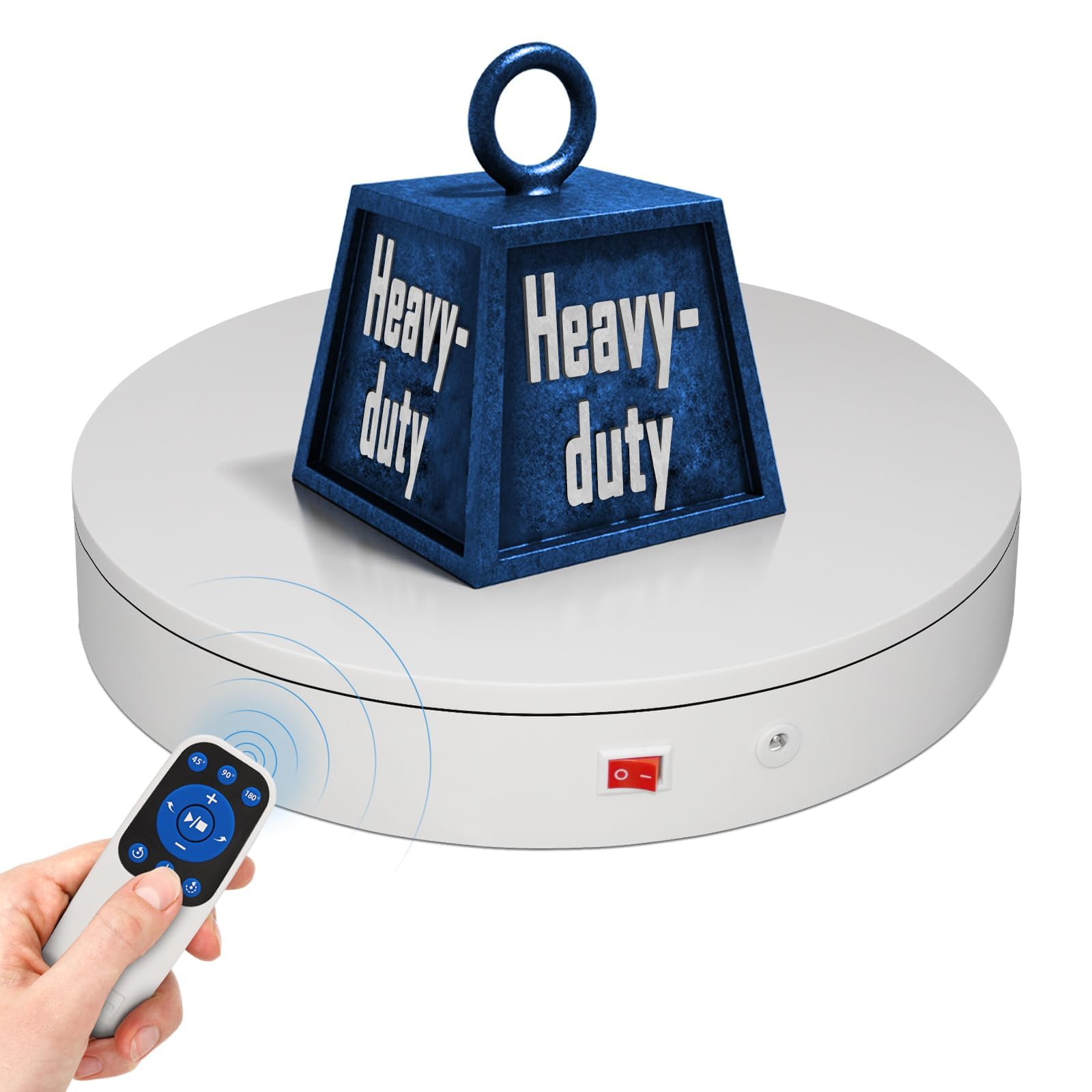
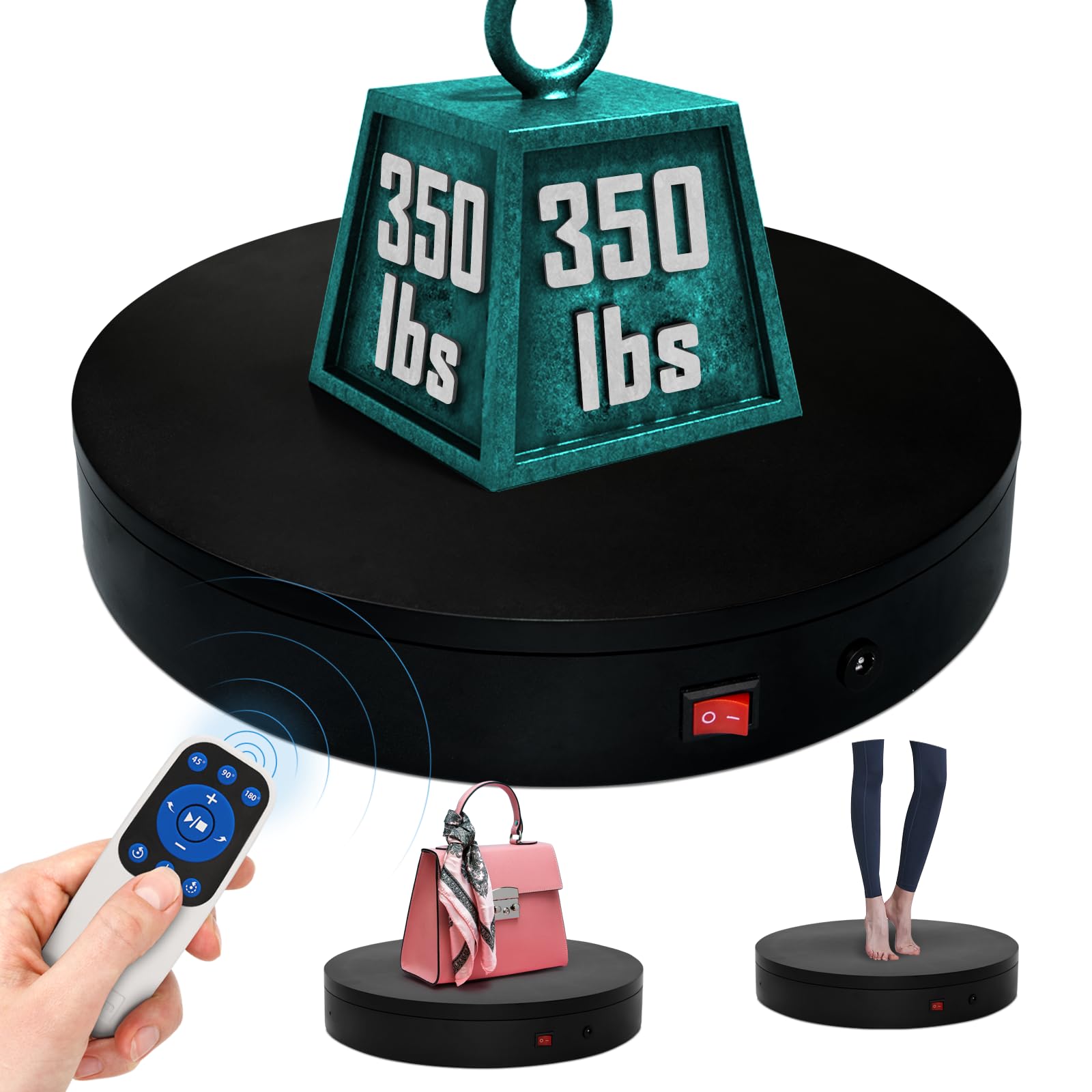
| ComXim 12.6-Inch 350lbsHeavy Load Hero | Heavy or oversized objects | 350 pounds continuous / 88 pounds stepped | 12.6 inches | 27 to 72 sec per revolution | Amazon |
| Flyrivergo 13.7-InchStudio Ready | Photo-and-scan sessions with backdrops | 110 pounds | 13.7 inches | 40 to 90 sec per revolution | Amazon |
| JAYEGT 16.5-Inch | Large objects on a tight budget | 350 pounds | 16.5 inches | Continuous and stepped modes | Amazon |
| ComXim 15.8-Inch 400lbs | Heaviest loads, largest plate | 400 pounds continuous / 132 pounds stepped | 15.8 inches | 28 to 75 sec per revolution | Amazon |
| Revopoint Dual Axis | Purpose-built scanner work | 5 kg | 200 mm | 18 to 90 sec per rotation | Amazon |
| Foldio360 | Phone-based 360 product shots | — | — | — | Amazon |
| ComXim Programmable MTxRUBLProV3 | Developers and automated workflows | 100 pounds continuous / 40 pounds stepped | 7.9 inches | 20 to 68 sec per revolution | Amazon |
In‑Depth Reviews
1. ComXim Remote Motorized Electric Turntable MT200RL20JV3-W
Our pick — 4.5+★ from 100+ verified ratings; the strongest balance of quality and price.
The small-footprint platform that turns slow enough for a scanner to actually keep up.
The headline number here is a 20-to-68-seconds-per-revolution speed range. Sit it near the slow end and your scanner gets a long, even look at each face of the object before the next pass. That slow window is what keeps the mesh from stitching half-finished.
On size, the disc measures 7.9 inches across, which suits miniatures, small parts, figurines and handheld items. Compare that with the 12.6-inch ComXim later in this list — 12.6 inches across versus 7.9 inches here, for the bigger jobs. If your scanning is mostly small, this is the tidier working footprint.
Load is quoted as 100 pounds in continuous rotation and 40 pounds in stepped rotation, so if your workflow pauses at 45°, 90° or 180° angles, plan around the 40-pound figure. A flat thrust bearing inside helps it carry weight evenly, and the reduction stepper motor keeps the turn smooth.
remote motorized control
- Slow-end speed of 68 seconds per revolution gives scanning room to breathe
- Four modes, including stepped angles at 45°, 90° and 180° for multi-angle passes
- Rated to 100 pounds continuous and 40 pounds stepped, with remote control of speed and direction
- Compact 7.9-inch plate stores away easily between sessions
remote only
- Stepped rotation carries a lower load than continuous rotation
- Small plate leaves larger objects overhanging the edge
for remote setups: anyone scanning small-to-medium objects who wants one smooth, slow pass at a fair mid-range tier.
skip if hands-on: if you regularly scan large items or heavy gear that outgrow a 7.9-inch plate.
2. ComXim 12.6-Inch 350lbs Capacity Electric Motorized Turntable
A 350-pound plate that shrugs off the kind of statue most turntables would balk at.
Set this beside the 7.9-inch ComXim above and the difference is plain: 12.6 inches across versus 7.9, and a 350-pound rating versus 100. That is a much bigger working surface for the same family of controls. If you scan boots, small appliances or a bust, the extra plate earns its place on the bench.
Speed is adjustable from 27 to 72 seconds per revolution, so the slow end still gives you a long, steady look per pass. Four modes cover continuous, single-step, repeated-step and pendulum swing, with angles of 45°, 90° and 180°. A metal-nylon hybrid gear reduction box is there to keep noise down during use.
The frosted matte surface is the quiet win for scanning and photography — it cuts light reflection and has better grip, so your object sits where you place it rather than sliding. Owners praise the build quality, though a recurring note flags slight motor noise. Not a dealbreaker, but worth knowing if you scan in a shared room.
350lb capacity: continuous rotation carries the full 350 pounds while stepped rotation is rated to 88 pounds, so a paused-angle scan is a lighter job than a smooth continuous spin.
heavy build: a strong middle-of-the-list pick for people who need real plate area and real capacity without stretching to premium territory.
for heavy loads: your subject is bulky enough that a small plate would leave it hanging over the edge.
skip if light: you need whisper-quiet operation, since a bit of motor hum is the recurring note.
3. Flyrivergo Photography Turntable 13.7-Inch
The slowest spinner here, and the only one that ships with its backdrop plates.
Where most of this list tops out near 72 seconds per revolution, the Flyrivergo stretches to 90 seconds. For a scanner, that extra dwell gives each frame more time to register. It also steps in fine increments — 0.1°, 15°, 45°, 90° and 180° — which is useful when you want a series of matched angles without touching the object.
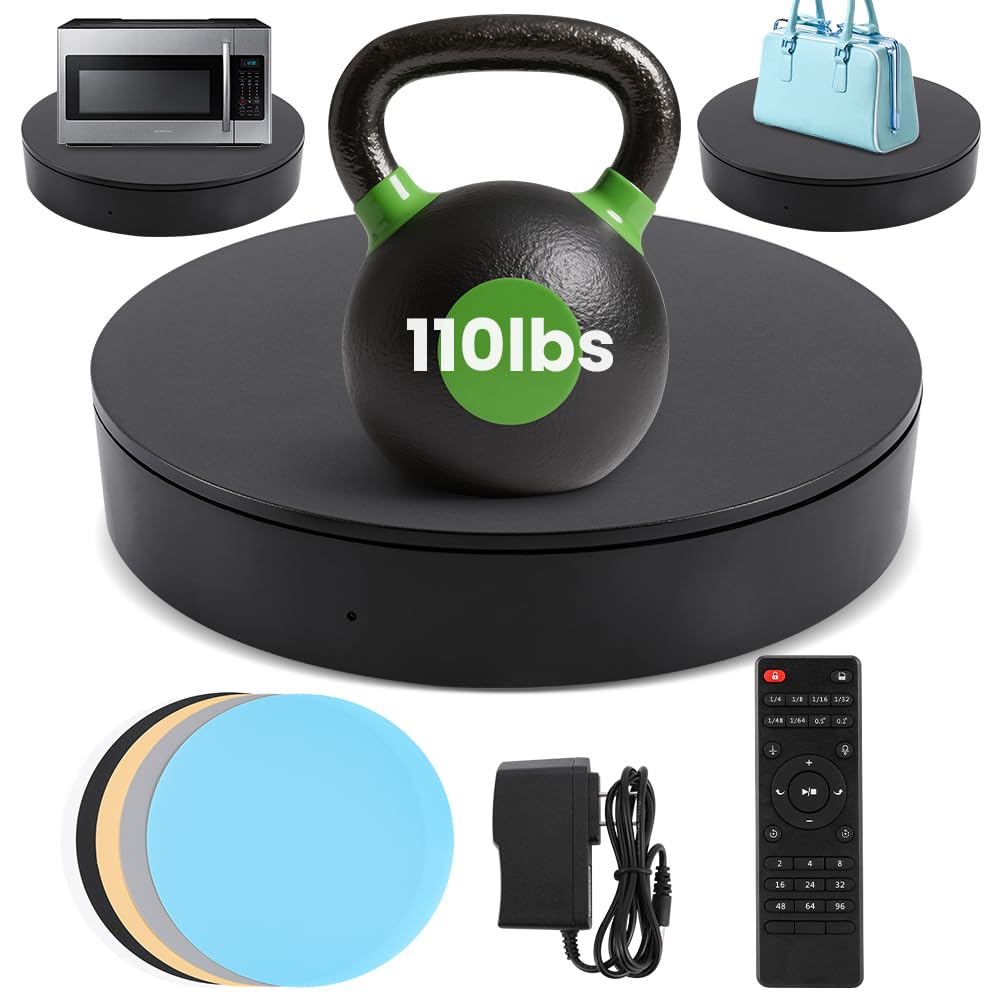
The plate is 13.7 inches across and rated to 110 pounds, so it takes cameras, small appliances and heavier gear that a compact disc would drop. Five double-sided backdrops come in the box, in black, white and colour, with matte and glossy faces. That saves buying separate plates when you shoot as well as scan.
The motor is rated at 50 decibels or under, quiet enough for a two-hour scanning session. Two things are worth knowing before you buy: the turntable beeps each time you press the remote, and the bundled remote batteries are really just for a first test, so plan to swap them. Nothing here breaks the deal, but they are the honest catches.
for scanning rigs: buy it for the 90-second slow spin and the backdrop set together.
skip if heavy: a confirmation beep on every remote press would drive you up the wall in a quiet studio.
4. JAYEGT Motorized Rotating Display Stand 16.5-Inch

A 16.5-inch disc rated to 350 pounds, and it remembers the angles you set.
This is the largest plate in the mid-tier, at 16.5 inches across and rated to 350 pounds. It carries the big jobs — the maker even lists a clothing mannequin and a Christmas tree as fair game. For scanning a tall object or a large prop, that is the difference between a stable base and an overhang your scanner cannot read.
The feature that earns its place for scanning is position memory. You can bank set angles and return to them, alongside continuous and intermittent rotation and 45°, 90° and 180° circulation modes. The plate itself weighs 2 kg, so it moves around the bench without a strain.
Functionality is what wins people over on this one — the broad pattern is that it simply does the job, and buyers report it holding a 227-pound statue for almost three hours. The honest gripes sit around the sound: some report loud beeps when changing settings, and movement that can feel jerky at certain speeds. Worth testing your slow setting early.
large display stand: heavy-load capability and a big plate against a noisy beep and a rotation that is not perfectly smooth for every setting.
for display use: scanning or displaying genuinely large objects where plate area and capacity come first.
skip if precise: you scan small parts at very slow speeds and need a silky, silent turn every time.
5. ComXim 15.8-Inch 400lbs Motorized Turntable
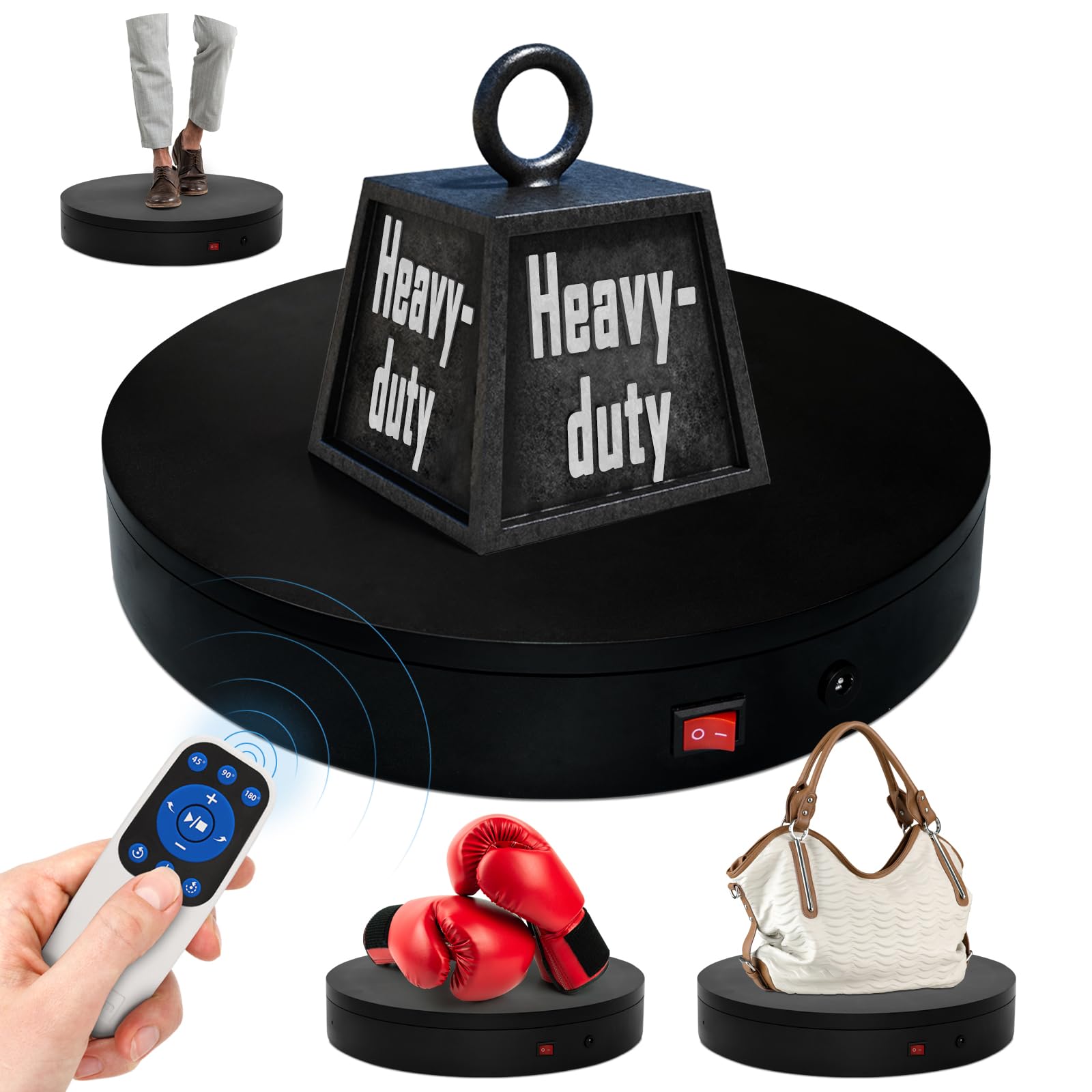
The highest load rating in this lineup, on a plate nearly 16 inches wide.
400 pounds. That is the number that sets this ComXim apart, and it comes with a 15.8-inch plate to match. Compare it with the 16.5-inch JAYEGT — the JAYEGT is fractionally wider, but this one takes the heavier load. If you scan or display something dense enough that capacity is the deciding factor, this is the pick.
Speed runs from 28 to 75 seconds per revolution, with clockwise and counterclockwise direction and the same four modes across the ComXim family: continuous, single-step, repeated-step and pendulum, at 45°, 90° and 180°. A flat thrust bearing and reduction stepper motor do the turning, and both are there to keep the spin stable under load.
The stepped-mode figure drops to 132 pounds against 400 in continuous rotation, as with the other ComXim units, so a paused-angle scanning pass is the lighter job. The plate weighs 7 pounds, so it is a bench fixture rather than a pocket accessory — fine if it stays put, less ideal if you need to carry it between rooms.
for massive items: the weight of your subject is the thing that has been capping your scans.
skip if compact: a 7.9-inch plate would already hold everything you scan, since the size is working against portability here.
6. Revopoint Dual Axis Turntable

The only pick that tilts as well as spins, so the scanner sees the top and bottom too.
Every other turntable here turns on one axis. This one adds a ±30° tilt, which means your scanner can catch the underside and the top of an object without you flipping it by hand. For small and medium objects that is the single biggest quality difference on this list, because those angles are where detail gets missed.
Rotation runs from 18 to 90 seconds per rotation, with adjustable direction and speed. The 200 mm diameter frame supports a max load of 5 kg, and it weighs 771 g. You can drive it from a button on the unit or over Bluetooth through the Revo Scan or Revo Assistant app, which gives deeper control than a fixed remote.
Compatibility is the catch to size up honestly. It is built to work with Revopoint 3D scanners — the POP3, INSPIRE, MINI and RANGE series. That is a real-strength fit, but it also means it is only the obvious buy if you are already in that ecosystem. Pair it with a different brand’s scanner and you lose the app’s deep controls.
dual axis rotation: the dual-axis movement and 18-second-to-90-second range give more scanning coverage than a flat spinner can.
niche use: the 5 kg limit is well below the big ComXim plates, so it is a small-to-medium-object tool.
for 3d scanning: owners of a Revopoint scanner who want tilt and app control in one box.
skip if simple: if you run a different scanner brand or need to carry a load heavier than the 5 kg rating.
7. Foldio360 Smart 360 Photography Turntable

Built for phone-led 360 shots, with lighting that kills the boundary line in frame.
This one is aimed at content creators first: it pairs with your phone over Bluetooth and uses IR sensing, and it ships with an LED light source rated at a colour temperature of 5700 Kelvin and a colour rendering index of 85. In plain terms, that is cool daylight-style light that keeps product colours looking true in the shot. It also helps remove the boundary line that shows up in 360 image series.
The plate is plastic and alloy steel and weighs 998 g. Files come out as JPEG and PNG, and the controls are manual — you set exposure yourself. Setup is what people like about it most, since the whole thing runs from your phone rather than a separate rig.
The honest limit is the app dependency. Controls lean on constant commands from the phone app, and a common note flags rotation speed as too slow for some people’s taste. The build is a mixed bag on the review pages — some find it right, others say it is less accurate than they expected. It is best seen as a 360-product-video tool that can feed a scan, not a dedicated scanning platform.
for automated shots: sellers and creators making 360 product images and short videos with a phone as the camera.
skip if manual: if calm, hands-off scanning speed and precision are the whole reason you are buying.
8. ComXim Programmable Motorized Turntable MTxRUBLProV3
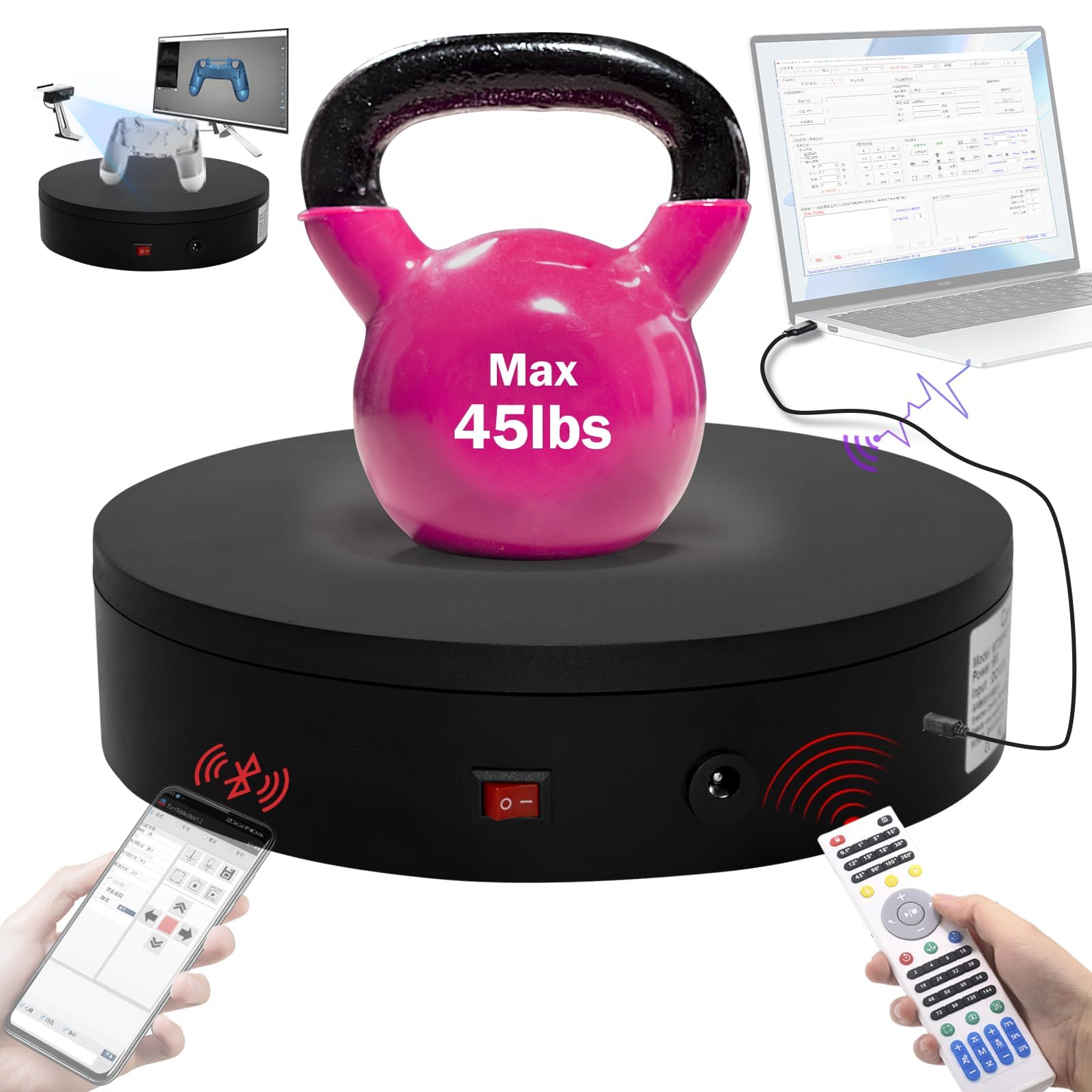
The turntable you script, not just spin — USB or Bluetooth, with commands you write.
This is the pick for people who want to drive a scanning rig from software. You control it over USB or Bluetooth, and over USB the maker provides Windows software for compiling routines. It speaks CT commands, a language-agnostic interface, so you can build automated scanning passes rather than nudging a remote by hand.
The plate measures 7.9 inches, and speed runs from 20 to 68 seconds per revolution, with clockwise and counterclockwise direction. It carries a 100-pound rating in continuous rotation and 40 pounds in stepped rotation, as with the rest of the ComXim family. Five modes are on hand, including a multi-step-within-one-circle mode built for 360-degree multi-angle photography and 3D scanning.
The hands-on remote is a serious one: you can set the current position as the origin point, pair it with a return-to-origin button, and save settings to the turntable’s internal flash. On the developer side, the Bluetooth route offers an Android control app demo and source code for reference, not a finished consumer app. That is the realistic catch — this rewards someone who can code.
for custom cycles: you are scripting a repeatable scan workflow and welcome the 0.1-degree minimum step angle.
skip if simple: you want a ready-made app experience — the Bluetooth side is a demo and source code, not a polished tool.
Understanding the Specs
Rotation Speed (Seconds Per Revolution)
This tells you how long the platform takes to make one full turn, not how fast it feels. A low number means a quick spin; a high number means a slow one. For scanning you want the slow end generous, since a scanner needs each angle held long enough to capture. A range that reaches up toward 90 seconds gives you that room, while a platform that only spins fast will blur the surface. Check the slow end of the range first, then the top end.
Load Capacity in Two Modes
Most turntables here quote two numbers, and they matter differently. Continuous rotation carries the full rated weight with no stopping. Stepped rotation — pausing at 45°, 90° or 180° — carries a lower load, because each pause puts stress on the gearing. Match the figure to your workflow: a smooth continuous scan uses the headline capacity, while a stepped multi-angle scan should be planned around the lower number. Get the mode right and the object sits steadily.
FAQ
Will any motorized turntable work with my 3D scanner?
How slow should a turntable spin for 3D scanning?
What is the difference between continuous and stepped rotation?
How do I know what disc size I need?
Does the Revopoint turntable work with a non-Revopoint scanner?
Why does the turntable beep when I press the remote?
Can I scan something heavier than the stepped-mode rating?
Is the Foldio360 good for 3D scanning or just photography?
Does the programmable ComXim need coding experience?
How quiet are these turntables during long sessions?
Final Thoughts: The Verdict
For most small-to-medium scanning jobs, the 3d scanning turntable winner is the ComXim MT200RL20JV3-W, because its 20-to-68-second speed range and four modes give you a slow, steady spin at a fair tier — and it holds a 4.5+ star rating across a large pool of verified buyers. If you need a bigger plate and more capacity, grab the ComXim 12.6-Inch. And for tilt-and-spin coverage on a Revopoint scanner, the Revopoint Dual Axis is the one to reach for. Whichever you choose, start at the slow end of the speed range — that single setting does more for scan quality than any other.
How We Picked
We do not accept paid placement. Every pick is matched to a real buyer and a real use-case; we do not hands-on test units.
Sources & Methodology
Specifications: manufacturer listings and product documentation. Review insights: verified customer reviews, as of November 2026. Pricing: not shown on this page (it changes often); check the current price via the retailer link.
As an Amazon Associate, Gadgets Feed earns from qualifying purchases. This does not affect which products we feature.