
Our readers keep the lights on and my morning glass full of iced black tea. As an Amazon Associate, I earn from qualifying purchases.
Specs are compiled from manufacturer listings and verified buyer reviews and can change over time — please confirm the key details on the product page before buying.
If your baby screams at every bottle and roots frantically for the breast instead, you don’t need more bottles — you need the right nipple. For a breastfed baby, the teat has to feel close enough to mom for an easy latch, and the flow has to be slow enough that milk doesn’t flood in and trigger a choking-gagging cycle. This guide sorts the options by what actually matters for a breastfed baby, so you can skip the drawer full of rejected bottles.
I’m Min — the founder and writer behind Gadgets Feed. This guide is built by comparing the manufacturers’ published specifications and the patterns across verified customer reviews, so you get each pick’s real strengths and trade-offs instead of marketing spin.
One honest note before you read: this list uses flexible, human-like matching for breastfeeding-compatible, slow-flow nipples, so not every pick is the exact model number you may have searched — the nearest same-type option serves the same purpose. Below you’ll find the real differences that decide whether your baby takes the bottle on the first try, all wrapped into one practical guide to the bottle for breastfed baby that actually gets accepted.
Our Picks at a Glance

How To Choose The Best Bottle For Breastfed Baby
Most parents buy a bottle based on the shape on the box, then wonder why their baby refuses it. The real deciding factors for a breastfed baby are the nipple’s softness and flow speed, the vent that controls air intake, and how easy the thing is to clean at 3 a.m.
Start with the nipple, not the bottle
A breastfed baby is used to milk arriving only when they actively suck. A nipple that drips on its own — a fast or free-flowing teat — can overwhelm that rhythm and cause gulping, coughing and a refusal to go back to the breast. Look for an extra-slow or SS-size nipple rated for 0 months and up, and expect to size up as your baby grows. That is the number one spec to check before anything else.
Air control is the second decision
An anti-colic system is a vent that lets air escape so your baby isn’t swallowing it along with the milk. A base vent, a dual-vent nipple or an internal valve all do the same basic job: keep the air out of the milk and out of your baby’s tummy. If your baby is gassy and fussy after feeds, a vented bottle is worth prioritizing over a plain one.
Then pick the body material
Glass and PPSU both handle heat and repeated sterilizing well. Glass feels heavier and can break if dropped, though a silicone-coated glass bottle adds a soft outer layer for grip and protection. PPSU is a lightweight, drop-resistant plastic that survives the dishwasher and sterilizer. Silicone bodies, like the Comotomo style, are squeezable and won’t shatter — good for a baby who likes to help hold the bottle.
Quick Comparison
| Model | Best For | Capacity | Pack Size | Material | Amazon |
|---|---|---|---|---|---|
| Pigeon Anti-Colic PPSU★ Best Overall | Best Overall | 5 oz / 160 ml | 2-Pack | PPSU | Amazon |
| Nanobebe Breastmilk BottleBest for Preemies | Fast Warming | — | 3-Pack | — | Amazon |
| Comotomo (Gen 2) SiliconeSoftest Feel | Softest Feel | 5 oz | 2-Pack | Silicone | Amazon |
| Munchkin Bond Glass | Glass Safety | 4 oz | 2-Pack | Borosilicate Glass | Amazon |
| Herobility Anti-Colic | Best Value | 5 oz / 140 ml | 4-Pack | Plastic | Amazon |
| Lansinoh Anti-Colic | Newborn Starter | 5 oz | 4-Pack | BPA-Free Plastic | Amazon |
| Thyseed PPSU Anti-Colic | Paced Feeding | 5 oz / 160 ml | 1-Pack | PPSU | Amazon |
| Natural Glass Baby Bottles | Lead-Free Glass | 3 oz + 5 oz | 3-Pack | Borosilicate Glass | Amazon |
| hegen Baby Bottles | One-Hand Use | 5 oz | 2-Pack | PPSU | Amazon |
In‑Depth Reviews
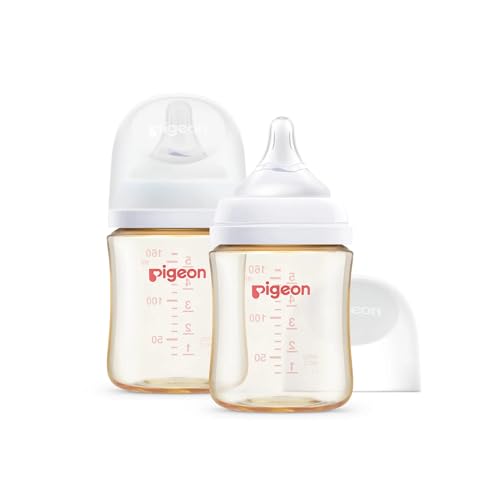
1. Pigeon Anti-Colic PPSU Baby Bottles, Breast-Like, Extra-Slow, 5 oz, 2-Pack
Our pick — 4.5+★ from 950+ verified ratings; the strongest balance of quality and price.
The bottle that quietly became the standard, because the nipple does the convincing.
For a breastfed baby, the Pigeon’s whole case rests on one design choice: the nipple is built around the three natural sucking movements a baby makes at the breast, based on feeding research done in Japan. It’s soft and flexible, which lets your baby’s tongue work the way it already knows how. The latch-on curve is shaped to guide your baby’s mouth into a proper seal, which is exactly the point where most bottle transitions go wrong. The 5 oz / 160 ml body comes with an SS nipple rated for 0 months and up, and Pigeon makes the same teat down to 3L as your baby grows — so you don’t throw the bottle out at month four.
What wins people over is the build quality, followed closely by how well it suits breastfed babies. Reports of babies taking it with no fuss at all are the pattern here, and the wide-neck, streamlined body is easy to hold and genuinely easy to scrape clean. The practical spec is that it’s PPSU, a lightweight plastic that shrugs off repeated sterilizing — so it survives the daily microwave-steam cycle without warping.
The honest catch is cost relative to the pack size. The mid-range price buys you two bottles, and value is the one aspect owners are split on, so it’s not the bottle to fill a whole day’s rotation with in one click. If your baby needs five bottles lined up in the fridge, you’ll feel the sting. Otherwise this is the one to try first — it’s the safest bet on this list for a baby who has refused everything else.
Where it earns its keep
- Nipple engineered around real sucking behavior, not just a shape on a box.
- Wide-neck, streamlined body cleans fast and grips easily one-handed.
- SS nipple for 0m+, with a full size run up to 3L as your baby grows.
- PPSU handles repeated sterilizing without going cloudy.
What to weigh first
- Two bottles for a mid-range outlay — an expensive set to stock up on.
- Value is the one point owners push back on.
Start here: a breastfed newborn who’s already rejected one or two other bottles.
Wait if: you need a full day’s worth of bottles and want the lowest cost per unit.
2. Nanobebe Breastmilk Bottle, Breastfeeding Newborn Breast Like, Anti Colic, Perfect Latch, Preserves Breast Milk nutrients, 3-Pack Grey
Modeled on the breast itself, it warms twice as fast when your baby is already screaming.
A hungry newborn doesn’t patiently wait for a cold bottle to come up to temperature. That’s the spec that sells this one: the Nanobebe warms milk 2x faster than a standard bottle, which means less time with a frantic baby in your arms. The whole design leans on recognition — the bottle is breast-shaped, so your baby instinctively connects with it rather than treating it as some foreign object. For a parent topping up a preemie or trying to protect a breastfeeding routine, that faster warm-up plus the familiar silhouette is the one-two that matters.
It’s a 3-pack at a budget-friendly tier, which makes it the easiest way to test a breast-like bottle without committing to a single pricey unit. Owners find them clean without drama and leak-free in normal use, and they do their job on the colic front for gassy babies. The size is genuinely small, though — that compactness is the trade-off for the easier hold.
Here’s where it gets honest: shape is the big divider. Some parents find the breast-shaped body oddly built and awkward to hold steady during a long feed, and sizing opinions split between “true to size” and “smaller than expected.” Neither is a defect — it’s a fit question. If you want a bottle that looks and warms like the breast, this is a strong, affordable way in. If you want a conventional bottle your whole family can feed with confidently, handle this one in person first.
Takes the edge off the wait: a screaming newborn around 2x faster warming is not a small thing, and the 3-pack price keeps the experiment cheap.
Try before you commit: the ergonomics divide people, so a household with multiple feeders should think about who’s holding it before buying in bulk.
Worth it for: premature or impatient babies, and anyone chasing the breast-like silhouette on a tighter budget.
Think twice if: you want a familiar, upright bottle that every caregiver can read at a glance.
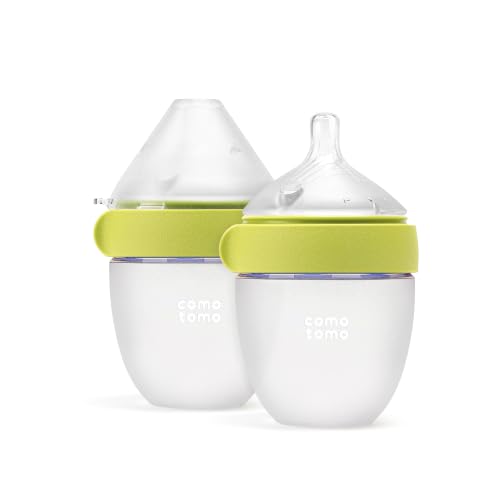
3. Comotomo (Gen 2) Silicone Baby Bottle, Green, 5oz, 2-Pack
The squeezable one that feels less like a bottle and more like what your baby already knows.
If your baby has a strong opinion about texture, this is the bottle to hand them. The entire body is soft, food-contact-grade silicone, and the only thing your milk ever touches is that silicone — never plastic. That matters because it removes the whole microplastic worry from the feeding routine for a breastfed baby who’s used to skin. The nipple is naturally tapered and reinforced against collapsing, so it holds its shape while your baby latches instead of folding under suction.
The Gen 2 design fixed the classic complaints of the original: the base is now 40% wider than version 1, which cuts down on tip-overs, and the outer ring was redesigned so it assembles more securely and resists leaks. Flow is a laser-punctured hole delivering a true slow rate for newborns 0 to 3 months — the kind that supports pacing and an easier breast-to-bottle switch rather than dumping milk down your baby’s throat. The wide neck means no special brush is needed, and the whole thing is dishwasher safe.
Where people get stuck is the lid and general design: some find the collar fiddly to seat correctly and the two-part assembly less intuitive than a simple screw-on cap. Get the ring seated properly and it seals; rush it and you’ll notice. Cleaning is genuinely easy though, which is why the wide neck earns repeat praise. For a baby who loves the soft feel, this is the answer — just mind the assembly ritual.
The soft-touch advantage
- Silicone body and teat — milk never meets plastic.
- Laser-punctured slow-flow nipple tuned for newborns up to 3 months.
- 40% wider base than Gen 1 to help stop tip-overs.
- Truly wide neck; no special brush, dishwasher safe.
The seating ritual
- The ring needs to be seated carefully or it can leak.
- Design and lid draw split opinions among owners.
Best match: a texture-sensitive baby who nuzzles into the soft body and a parent who wants silicone-only milk contact.
Pass on it if: you want a fuss-free screw-on cap you can assemble half-awake.
4. Munchkin Bond Glass Baby Bottles, Anti Colic, 4 oz Silicone Coated BPA Free Slow Flow Bottles for Breastfed Babies, 2 Pack, Mint/Green

Glass, wrapped in a soft-touch skin — the drop protection your nerves were asking for.
Glass gives you the cleanest possible feeding surface, but the fear of a shatter on tile keeps a lot of parents away. The Munchkin Bond answers that with a silicone-coated borosilicate glass body: the glass stays heat resistant and easy to sterilize, while a soft-touch outer layer adds grip and mimics skin-to-skin contact. That outer layer is why it’s a daycare favorite — a caregiver can grip a slippery newborn bottle securely. Two Stage 1 slow-flow nipples come included for 0m+, shaped for a natural feel on a breastfed baby moving toward bottle feeds.
At 4 oz per bottle, you’re looking at a smaller feed size — useful for a newborn’s smaller stomach but less handy once your baby starts draining bigger volumes. What people are drawn to first is the look and feel: the silicone over glass reads as premium and soft in the hand, and buyers appreciate that milk never touches a plastic liner because the glass does the containment. There are no separate sleeves to wrestle off before each wash, which cuts the number of parts in the sink.
The sticking point is sealing consistency. Some bottles lock in without a drip and some spring small leaks — the flip side of a two-layer design that needs the collar seated firmly. It’s also marked with the 2025 Baby Safety Alliance Award of Excellence, which is a nice credential if you care about third-party recognition. For a parent who wants glass purity without raw-glass fragility, this is the pick — just test your first fill over the sink.
Why it belongs here: the silicone-skinned borosilicate body gives you glass hygiene plus a grip that survives a squirming one-handed feed.
The small print: leaks tie directly to how well you seat the collar, and the 4 oz capacity means you’ll be sizing up sooner than a 5 oz owner.
Reach for this if: you want glass without the tile-floor anxiety and are feeding a newborn at smaller volumes.
Look elsewhere if: you need a large-capacity feed or want a sealed neck you never have to re-check.
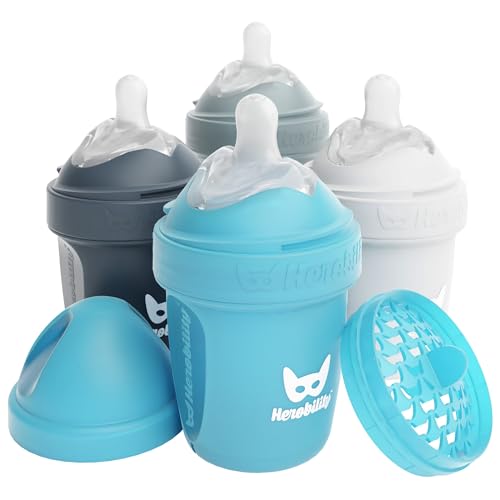
5. Herobility Anti-Colic Baby Bottles 5 oz /140 ml – Pack of 4 Newborn Baby Bottles, Slow Flow, Breast-Shaped Teat
Four bottles for the price of a good single — the value play for a full day’s rotation.
Start with the math that matters: you get four 5 oz / 140 ml bottles in one pack. That’s 25% more capacity per bottle than the 4 oz Munchkin above, and four of them means a full feeding day without washing between feeds. The breast-shaped teat is designed to close the corners of your baby’s mouth so they don’t gulp air around the sides. The ergonomic teat is shaped to close the corners of your baby’s mouth, so they don’t gulp air around the sides. A second set of air valves keeps a vacuum from forming inside the bottle.
This is the double anti-colic system the brand is named for: teat geometry plus valves, working together to keep air out. What wins people over is the overall quality for the money — this is a pack you buy with confidence rather than one bottle you gamble on. It’s comfortable to hold, easy to clean, and the teat suit a breastfed baby well. The Swedish design and the parents-developing-parents story are nice extras, but the real sell is that four-pack practicality.
Now the caveats, sized honestly: some bottles leak milk from the sides of the nipple, and the flow speed is the other dividers — a few find it slower or faster than expected against their baby’s pace. Neither is universal, and most owners are happy, but it’s worth checking your first feed for a snug teat seating before you trust the whole four-pack overnight. For a family that needs bottles in quantity without spending premium money, this is the deal on the list.
The four-bottle case
- 4-pack of 5 oz / 140 ml bottles — a full day without mid-feed washing.
- 25% more capacity per bottle than the 4 oz Munchkin.
- Double anti-colic: teat shape plus air valves.
- Comfortable to hold and easy to clean.
Check at first fill
- Some bottles leak from the sides of the nipple.
- Flow-speed expectations vary from baby to baby.
Smart buy for: a daycare-bound or bottle-heavy routine where four bottles beat one premium unit.
skip it if: you only need one bottle to test the waters — the four-pack is overkill for a bottle-refuser’s experiment.
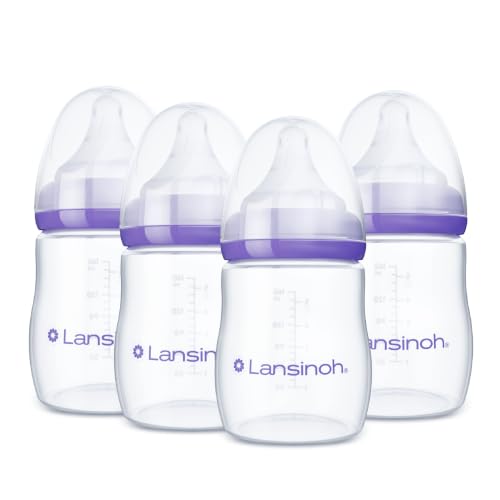
6. Lansinoh Anti-Colic Baby Bottles, 5 Ounces, 4 Count
Four newborn-ready bottles with the slowest nipple in the drawer and three parts to wash.
For a brand-new breastfed baby, the hardest part is the very first bottle. Lansinoh stacks the deck in your favor with an XS extra-slow flow nipple rated for 0 to 1 month, included on all four 5 oz bottles. The nipple is ultra-soft silicone with a wide, gentle slope that molds to your baby’s mouth for a secure latch. The tip is built to stretch with your baby’s sucking motion, which lets them draw milk at their own pace instead of fighting a rigid teat.
What wins people over here is the design itself — a nipple shape that reads very close to the real thing, which is the single most-important quality for protecting a breastfeeding routine from nipple confusion. The anti-colic air ventilation system is aimed at cutting air intake, and it’s a three-piece build (cap excluded) that comes apart without a hidden fifth part to lose. Freezer- and dishwasher-safe, so it handles storage and sterilization without extra fuss.
The trade-off is capacity: 5 oz is a newborn size, and this four-pack won’t scale with a hungry older baby as gracefully as a bottle with a wider flow-size range. But if you’re at the start line, this is a smart, unhurried way to get four bottles that all use the gentlest flow. It fills the “first bottle” slot better than almost anything else at its price tier.
The newborn argument: four bottles all fitted with the XS 0-to-1-month nipple — one clean answer to the very first feed.
What you’re trading: you give up capacity headroom; the 5 oz size is squarely newborn territory, so plan for a second size later.
Made for: the first weeks, when the gentlest flow and an easy three-part wash matter more than volume.
Not ideal if: your baby already takes a larger feed and you want one size to grow into.
7. Thyseed PPSU Anti-Colic Baby Bottle, Breast-Like Extra Slow Flow Nipple for Breastfed Babies (0m+), 5 oz/160 mL, 1 Pack
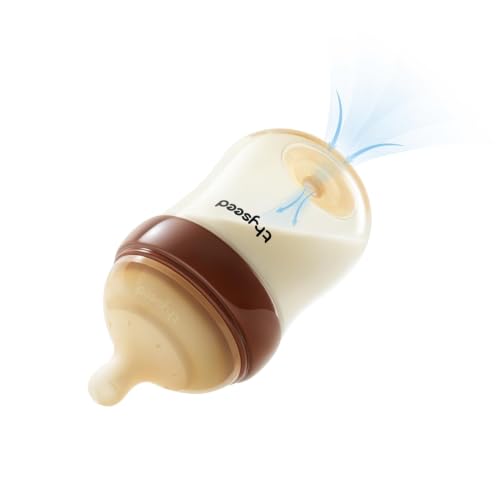
Milk only flows when your baby actively sucks — pacing built into the physics, not the instructions.
The single most important spec for a breastfeeding parent who wants to protect the latch: this nipple releases milk only when your baby actively sucks. That means your little one sets the rhythm instead of the bottle dumping milk at them. The result is paced, baby-led feeding that lets your baby pause and catch a breath, which is the behavior that keeps a breastfed baby comfortable with a bottle. The soft silicone teat is shaped for a natural latch and works well for combo feeding.
Its anti-colic system is a patented base vent that keeps air out of the milk. That design choice pays off in assembly: there’s no neck air valve, so there are fewer potential leak points and the bottle goes together faster. It’s PPSU, so it’s lightweight and drop-resistant, and it comes apart into just four pieces for the dishwasher, freezer or sterilizer, and it’s BPA and BPS free. It even makes a personal endorsement from buyers—one describes it as feeling like “a booby,” which is about the highest compliment a breast-like teat can get.
The honest issue is one that plagues single bottles generally: at one per pack, you’re paying a premium-tier price for a single unit, and value is the split opinion. Some find it worth it, others find it overpriced, and there are mixed experiences with leakage. Buy one to test the latch before committing to a whole set. If your baby takes it, the paced flow is worth the outlay.
Where the design shows through
- Milk releases only on active sucking — paced feeding by default.
- Patented base vent keeps air out of the milk.
- Sealed neck means fewer leak points and faster assembly.
- PPSU, 4 pieces, dishwasher/freezer/sterilizer safe, BPA/BPS free.
The single-bottle gamble
- One bottle per pack at a premium-tier price.
- Leakage and value both draw mixed reports.
Best fit: a parent combo-feeding and determined to keep the breast latch intact.
Hold off if: you need a whole set out of one purchase rather than one premium bottle to trial.
8. Natural Glass Baby Bottles with Gentle & Extra Slow Flow Nipples, Anti-Colic, Includes SS & S Nipples, 3 Pack (3 oz + 5 oz)

Three glass bottles in two sizes, with nipples that guide the latch instead of guessing at it.
A bottle set that grows with your baby’s stomach: one 3 oz bottle and two 5 oz bottles, three total. That’s the practical move for a newborn who starts small and ramps up quickly. The body is borosilicate glass, free of BPA, BPS and phthalates, and heat-resistant enough for sterilizing in a bottle warmer, microwave, sterilizer or boiling water. The branding is laser-engraved rather than ink-printed, so there’s no lead in the marking — the kind of detail parents hunting for clean materials will appreciate.
The nipples carry the same idea as the rest of the list but in a slightly different form: the points on the teat guide an appropriate latch, training your baby toward the correct suction habit they’d use at the breast. You get two nipple sizes, an SS and an S, so the set spans the first months without a separate purchase. The wide, breast-like shape supports a natural latch and an easier transition both ways between breast and bottle.
The real divider with glass is durability — these hold up to heat beautifully, but buyers are split on how they fare against a hard drop, which comes with the territory for glass. If you want a glass set that gives you two useful sizes right out of the gate and no plastic touching the milk, this is a tidy, well-priced way to get there. Just store it where it won’t be knocked off the counter.
The two-size advantage: a 3 oz and two 5 oz bottles means you’re set from the first tiny feeds through the bigger ones, with an SS and S nipple already in the box.
The glass reality: durability opinions split, so handle and store these accordingly.
The right call for: a clean-materials-first household that wants two useful sizes from one pack.
Swap it out if: you need a drop-resistant bottle for a busy kitchen or daycare bag.
9. hegen Baby Bottles – Anti Colic Baby Bottles Wide Neck – Breastfeeding System 5 oz with Slow Flow Teats (2 Pack)

One container from pump to freezer to baby, sealed with one twist of the wrist.
Most bottles force you to pour milk from container to container, losing a little and washing extra parts. The hegen approach is a single system: you express, store and feed in the same 5 oz container, and swap to Hegen storage lids when it goes in the fridge. For a pumping parent trying to protect a breastfeeding supply, that fewer-steps routine is the real value. The big one-handed convenience is the patented press-to-close, twist-to-open lid — you can seal or open the bottle with one hand while holding a baby in the other.
The shape is a deliberate choice: a square-round body that won’t roll off the counter. That’s a small thing until 4 a.m., when a rolling bottle means a spill. It’s built from medical-grade PPSU, BPA and BPS free, and it handles repeated sterilizing and dishwashing without taking on odors or stains the way standard plastic does. The wide neck makes filling and cleaning simple, and the square form stores tighter in the fridge than round bottles.
What you’re trading for that design: the lid. The press-twist mechanism is the whole convenience package, but it’s also the part that draws the mixed feedback — some bottles seal perfectly, others leak, and some find the lid action less intuitive than a plain screw cap at first. Value is also genuinely split. If you pump and want one container to do everything, the system pays off. If you just want a simple baby bottle, the extra mechanism may be more than you need.
For the pumping parent: express, store and feed in the same container, seal and open with one hand, and store it square in a full fridge.
Where to set expectations: the press-twist lid is the star and the risk — leakage reports cluster around it, so check every seal before trusting an overnight bag.
Suits you best if: you’re expressing and want a single container from pump to feed with one-handed lid control.
Choose simpler if: you want a plain cap you never have to double-check for a seal.
Understanding the Specs
Nipple Flow Size (SS, S, M, L)
The letter on the teat is the flow speed, not the nipple’s size in inches. SS and extra-slow are for newborns and breastfed babies who need to set their own pace. S is for the next month or two, and M and L open up as your baby drinks faster. For a breastfed baby, start at the slowest flow your baby will tolerate — a slow teat prevents gulping and the frustration of a bottle that over-feeds. You size up when your baby starts working too hard and fussing at a feed.
Vent Systems (Anti-Colic)
An anti-colic vent is a one-way air channel that lets air escape the bottle so your baby swallows milk, not bubbles. Base vents, dual-vent nipples and internal valves all do the same job in different places. If your baby is gassy, fussy after feeds or spits up often, a vented bottle is worth prioritizing. Fewer parts usually means fewer leak points, so a sealed-neck design with a base vent is a strong balance for a breastfed baby.
PPSU vs Glass vs Silicone Bodies
PPSU is a lightweight, drop-resistant plastic that survives repeated sterilizing and keeps its clarity. Borosilicate glass is heat-resistant and lets nothing but glass touch your milk, but it’s heavier and can break if dropped. Silicone bodies are squeezable and shatterproof, giving a soft, breast-like feel. Pick glass for clean materials and heat tolerance, PPSU for durability and lightness, silicone for texture and grip.
Breast-Like Teat Shape and Latch Line
A “breast-like” teat copies the shape of the real thing so your baby finds the familiar contours. Some designs add a latch-on line or curve that guides the mouth into a proper seal, and a few build in points to train the correct suction. The softness of the silicone matters as much as the shape — a teat that’s too firm won’t stretch with your baby’s sucking, and a teat that’s too soft can collapse. The best teat is the one your baby latches onto without a fight.
FAQ
Will a breastfed baby actually take a slow-flow bottle?
How do I stop my baby getting nipple confusion from a bottle?
Does a glass bottle really need silicone coating?
What does the SS on a baby bottle nipple mean?
Is PPSU better than glass for a breastfed baby?
How many bottles do I need if I’m breastfeeding and pumping?
Can I sterilize a glass bottle in boiling water?
Why does my anti-colic bottle still leak?
When can my baby move up from a slow-flow nipple?
Does a breast-like teat shape actually help a breastfed baby?
Final Thoughts: The Verdict
For most parents of a breastfed baby, the bottle for breastfed baby that earns the first try is the Pigeon Anti-Colic PPSU — its nipple is built around real sucking behavior, the SS teat suits a newborn from day one, and the wide neck keeps cleaning quick. It also holds 4.5+ stars across 900+ ratings, the highest score on this list.
If your priority is protecting the latch long-term, the Lansinoh four-pack puts the gentlest XS flow on every bottle and washes in three parts. For a full day’s rotation without spending premium money, the Herobility four-pack gives you four 5 oz bottles with a double anti-colic system. And if you pump and want one container from expression to feed, the hegen system is the one to reach for.
Whatever you pick, buy one bottle first and test the latch before stocking up — your baby’s acceptance is the only review that counts.
How We Picked
We do not accept paid placement. Every pick is matched to a real buyer and a real use-case; we do not hands-on test units.
Sources & Methodology
Specifications: manufacturer listings and product documentation. Review insights: verified customer reviews. Pricing: not shown on this page (it changes often); check the current price via the retailer link.
As an Amazon Associate, Gadgets Feed earns from qualifying purchases. This does not affect which products we feature.