
Our readers keep the lights on and my morning glass full of iced black tea. As an Amazon Associate, I earn from qualifying purchases.
Specs are compiled from manufacturer listings and verified buyer reviews and can change over time — please confirm the key details on the product page before buying.
If you have ever cut a miter twice and still ended up with a light gap at the corner, you already know why a good angle gauge matters. These pocket-sized tools read a surface’s tilt down to tenths of a degree, so you set the saw or the post once and move on. Below are nine digital finders, levels, and protractors that actually hold their accuracy — from a tiny 2.08-ounce aluminum cube to a 7-inch stainless ruler that reads inside and outside corners.
I’m Min — the founder and writer behind Gadgets Feed. This guide is built by comparing the manufacturers’ published specifications and the patterns across verified customer reviews, so you get each pick’s real strengths and trade-offs instead of marketing spin.
You will see how measurement range, stated accuracy, and the magnetic base separate these picks. Whether you are checking a pipe, cutting crown molding, or hanging a shelf straight, this guide to the angle measurement tool matches the tool to the job.
Our Picks at a Glance


How To Choose The Best Angle Measurement Tool
Most bad angle readings come from the wrong tool for the surface, not from a cheap tool. A cube-shaped gauge that sits flat on a saw table is the wrong shape for a conduit bend. A long protractor arm is overkill when you only need to know if a picture frame is level. Pick the shape first, then check accuracy.
Match the form factor to the surface you touch
Cube and pocket gauges have a flat magnetic base, so they stick to steel studs, saw tables, and blades. Models with V-groove edges (a channel cut into the base) sit steady on round pipe and conduit. Folding-arm protractors reach into inside and outside corners where a cube physically cannot go. If your work crosses several of those, expect to need more than one tool.
Read the accuracy spec, not just the resolution
Resolution is the smallest step the screen can show, such as 0.05° or 0.1°. Accuracy is how close that number is to the true angle. A tool can display 0.05° and still be off by ±0.3°. Accuracy is the number that decides whether your joints close, so weigh it heavier than a fine decimal readout.
Check the battery and the auto-off habit
Every gauge here shuts itself down after a few idle minutes to save power. That is good for battery life but bad if you set the tool down mid-job and lose the reading. A HOLD button that freezes the value is the workaround, and it is worth checking for if you work alone.
Quick Comparison
| Model | Best For | Stated Accuracy | Resolution | Weight | Amazon |
|---|---|---|---|---|---|
| Klein Tools 935DAGL★ Best Overall | Leveling posts, joists, and conduit | 0 to 90° / 0 to 180° ranges | — | 5.92 oz | Amazon |
| VOLCANOES CLUB Mini Angle GaugeBest Value | Miter saw calibration on a budget | ±0.1° at 0° and 90° | 0.05° | 5 oz | Amazon |
| GemRed Digital Angle GaugeLightest Pick | Light everyday checking | 0.2° | 0.1° | 2.08 oz | Amazon |
| S&F STEAD & FAST 7-Inch Finder | Inside and outside corners | ±0.3° | 0.05° | — | Amazon |
| LEXIVON LX-DAF7 | Shop and flooring work | ±0.3° | 0.05° | 0.19 kg | Amazon |
| Klein Tools 935DAA | Jobsites and pipe fitting | — | — | 2.4 oz | Amazon |
| PREXISO 3-in-1 | Home hanging and layout | ±0.1° at 0° and 90° | 0.05° | 6.3 oz | Amazon |
| Johnson 1886-0000 | Verifying roof and cabinet angles | ±0.1° at 0° and 90° | ±0.1° | — | Amazon |
| iGaging Angle Cube Gen 3 | Table saw bevels and machine setup | — | — | 2.7 oz | Amazon |
In‑Depth Reviews
1. Klein Tools 935DAGL Digital Level Angle Finder with Programmable Angles
Our pick — 4.5+★ from 550+ verified ratings; the strongest balance of quality and price.
The one that beeps at you before you cut — so the saw never gets set to a guessed angle.
A digital level lives or dies on whether it tells you anything while you are still adjusting the workpiece. The 935DAGL does that with an audible alarm plus a color-changing LCD that flips when you reach your target angle. You dial in a pitch once and the tool tells you the moment you arrive, instead of forcing you to watch a screen and turn a bolt at the same time. Its built-in ranges cover 0 to 90 degrees, 0 to 180 degrees, and a dual-axis bullseye mode (a circular crosshair readout for reading tilt on both horizontal and vertical axes at once).
What wins people over here is plain build quality, with functionality a close second — the consensus across the review pages is that this thing feels like a real jobsite instrument rather than a plastic toy. Users level posts and joists with it and report it makes that job genuinely quick, and one crew even uses it for leveling mobile cranes. Set a common pitch of 1/8-inch, 1/4-inch, 3/8-inch, or 1/2-inch per foot and the tool stores it for fast repeat angle selection. Housing is ABS plastic over electronic components, and it ships with a soft carrying case and the batteries.
Here is the weight trade-off: at 5.92 ounces, this is the heaviest cube-shaped pick in the list, versus 2.08 ounces for the GemRed below. That bulk is what buys you the alarm, the bullseye mode, and the auto-rotating display that stays readable whether you hold it horizontally or vertically. Responsiveness draws the mixed notes — a few find the alarm’s reaction time not quite instant, which matters if you are nudging a blade in tiny increments. The magnetic base grips genuinely hard, so the flip side is that a strong magnet wants a clean steel surface, not a painted or dirty one.
Where it earns its keep
- Programmable pitch presets for 1/8-inch, 1/4-inch, 3/8-inch, and 1/2-inch per foot mean repeatable cuts without re-entering the angle.
- Audible alarm plus color-changing LCD signals the target angle without you having to stare at numbers.
- Dual axis bullseye orientation reads X and Y alignment for conduit and pipe work.
- Auto-rotating display flips to suit horizontal or vertical holding.
What to weigh first
- At 5.92 ounces it is on the chunky side against the pocket cubes in this list.
- Alarm response is the one thing the review pages treat as mixed rather than settled.
- Specific to the soft carrying case rather than a hard shell — fine for a bag, not for being tossed loose in a truck bed.
Your tool if: you set saws and seat joists all day and want the meter to confirm the angle without a second pair of eyes.
Keep moving if: you only want a tiny cube that disappears into a shirt pocket between jobs.
2. VOLCANOES CLUB Magnetic Digital Angle Finder Protractor Inclinometer
A backlit screen you can actually read from across the bench, with V-grooves that sit on pipe.
The numbers do the talking here. It claims ±0.1° accuracy at 0° and 90°, ±0.2° everywhere else, and a 0.05° resolution — a fine enough step that a miter saw confirmed against it will close the corner. The big, bright LED with backlight and oversized digits means you can read it from a distance or in a dim garage.
Two modes cover more ground than one: absolute mode reads the true tilt of whatever the base sits on, while relative mode (reached with the ZERO button) measures the change from wherever you zeroed it. It also switches between four units — degrees, percent, mm/m, and inches per foot — so roof pitch in inches per foot and a saw blade in degrees come from the same device. And unlike the GemRed’s flat plastic base, this one carries V-groove edges that lock onto curved surfaces like pipe and round stock. The display runs on two pre-installed batteries and switches off automatically after a few idle minutes — the power-saving habit every compact gauge shares.
Owners get the most use out of it helping with miter-saw calibration, and the value read is the pattern that runs through the feedback. A strong magnet and a compact 2.7-inch length make it easy to stick where you need it and leave it. The catches: the package includes a carrying bag rather than a hard case, and the auto shut-off — helpful for battery life — will cut your reading if you set the tool down mid-task. Use the HOLD button to freeze a value before that happens.
Who it is for: a hobbyist or renovator who wants serious accuracy and a big readout without paying for the jobsite-badged version — this one hits the accuracy figures and adds pipe-ready edges.
Mind the shutdown: the automatic power-off is a battery saver, not a fault, but you will want the HOLD button in your workflow.
Strongest match: miter saw calibration and pipe work on a mid-range budget, where backlit readability beats a brand name.
Look past it if: you need a folding arm to reach deep into a corner — a cube shape physically cannot get there.
3. GemRed Digital Angle Gauge (Aluminum-with Hold Function)
The featherweight that rides in a shirt pocket and still reads to a tenth of a degree.
Weight is the whole argument. At 2.08 ounces, this is the lightest gauge on the list — for scale, it weighs 2.08 ounces against 5.92 ounces for the Klein 935DAGL above. It disappears into a pouch and you never think about it until you need it. The frame is aluminum alloy rather than plastic, and the base is built with strong magnets for sticking to metal surfaces. It measures 2 × 180 degrees across a stated 0.2° accuracy and 0.1° resolution, so a degree and a decimal is your working step.
The battery story is unusually practical. You install a single AAA without a screwdriver, and the gauge is rated to run about 50 hours on that one cell, then shuts off automatically after 5 minutes idle. For occasional checking that is months of readiness. A HOLD button freezes the number so you can pull the tool off a surface and read it in better light. GemRed ships it with the battery, a storage pouch, and the manual.
Two things to know before you rely on it. Accuracy of 0.2° is coarser than the ±0.1° claims on the VOLCANOES CLUB and PREXISO picks, so if your work lives on tight miters, that gap can show. And note that it measures in degrees only — no percent, no mm/m — so if you need a roof pitch expressed another way, this is not the one. Owners treat it as a solid, accurate pocket reference; the review pages lean hard on quality and value rather than on any single kill-shot feature. If accuracy at that finer tolerance is what you need, the VOLCANOES CLUB is the closer match.
Weight-first buy: aluminum framing plus a 2.08-ounce body makes this the easiest gauge to keep on you at all times.
The honest limit: a 0.2° accuracy rating and degree-only output narrow it to general checking, not tight-tolerance joinery.
Best for: the toolbox that lives in a car or apron, where a gauge you actually have on you beats the one left on the bench.
Choose the VOLCANOES CLUB instead if: your projects depend on tenth-degree accuracy rather than a pocket-sized alarm.
4. Digital Angle Finder Tool with Case, 7 Inch / 200 mm

Four hundred millimeters of etched stainless arm, sized to catch the corner a cube cannot reach.
This is a folding protractor, not a cube — two stainless arms with a digital readout at the hinge. It measures inside and outside angles and doubles as a straight steel rule for layout and marking. Now the length comparisons, because they matter: it measures 8.46 inches long against 2.7 inches for the VOLCANOES CLUB mini. It also carries 1.38 inches of width versus 1.3 inches on that same mini. The extra reach is the entire point. It is the pick that gets into the inside of a cabinet corner or the outside of a crown molding spring angle, which pocket cubes cannot touch at all.
Where a lot of protractors stop at 200 mm, this one carries a continuous scale across both arms, so you can measure lengths up to 400 mm with the arms open. The display reads decimal degrees or degrees and minutes at 0.05° resolution. Accuracy on the angle measurement is stated at ±0.3° with each unit carrying a unique serial number. Etched scales on stainless mean the markings do not wipe off with wear. A zero button sets a relative reference at any position, and the HOLD button stores a reading when the display is hard to see. It runs on a 3V CR2032 that comes pre-installed. Auto power-off fires after five minutes of inactivity.
Two honest caveats sit in the review history. Some units arrive with the display harder to read than others, and a few report a 90-degree angle showing as 180 — check a known square corner as soon as yours arrives, and swap it if it falls short, since the pivot itself is solid and the zero-backlash action is what most buyers praise. The other caveat is your work style: the wider arm does the fixed, awkward corners at the cost of a longer shell to carry, while the folding action means it is designed for making a measurement as the last step before a cut rather than riding in a pocket alongside a wrench.
What makes it a corner specialist
- Continuous scale across both arms extends length measurement to 400 mm — beyond the 200 mm mark other protractors stop at.
- Measures inside and outside angles, including miter cuts, crown molding, baseboards, and trim.
- Etched stainless scales resist wear and corrosion over time.
- Each unit ships with its own serial number, backed by quality-control testing against a ±0.3° accuracy standard.
What you give up
- A few units arrive with display readability below the rest — check a square corner on arrival.
- The 8.46-inch arm is far longer than the 2.7-inch mini cubes, so it does not fit in a small pocket.
- ±0.3° stated accuracy is coarser than the ±0.1° claims on the finest pocket gauges.
The right pick when: your problem is a corner, a molding, or a length-plus-angle in one pass, where a straight steel rule earns its place in the same breath as the angle readout.
Not the tool for: anyone who wants to check that a single post is plumb and nothing more.
5. LEXIVON Aluminum Digital Angle Finder Gauge, 7-inch/180mm Multi-Purpose Protractor

A shop-grade protractor with a big screen and a lock knob that holds the angle while you cut.
The LEXIVON flips the usual control problem on its head. Instead of a wall of buttons, it gives you four — ZERO, HOLD/FLIP, REV., and ON/OFF — and a physical Angle Lock knob that holds your measured angle rigid so you do not have to memorize the number before the saw spins up. The foldable body is a 7-inch anodized aluminum rule with laser-etched millimeter and inch markings, mounted alongside an XL LCD that reads to 0.05°.
The range is a true 360 degrees, split across inside, outside, and reverse readings — the REV. button flips the readout to the outside angle without a second measurement. It is rated ±0.3° accuracy, and like the S&F tool, each unit carries a serial number and gets individual testing before it ships. That consistency shows in the feedback: the thing that wins people over is accuracy, with quality close behind, and the shop crowd treats it as a daily driver for setting up tools. Portability scores high too — a heavy-duty zippered pouch protects it through woodworking, flooring, and tiling jobs.
Where the LEXIVON sits against the S&F STEAD & FAST protractor is close, and worth naming: both run a 7-inch arm, both read to 0.05°, both claim ±0.3°. The LEXIVON’s edge is the XL screen and the physical angle lock; the S&F’s edge is the longer continuous 400 mm scale across both arms. Pick the LEXIVON if your work is more saw-setup than layout. The catch on this one: it is a shop bench tool, not a pocket gauge — the 7-inch body plus a zippered case takes real space in a bag. Build and adjustability are the two aspects the review pages treat as mixed rather than settled, so expect the pivot knob to want a deliberate hand, not a rushed one.
Bench presence: an XL display, a lock knob, and 0.05° resolution mean you can read the angle and hold it at arm’s length while your saw stays set.
Space and care: the 7-inch frame and the case take up real room, and the pivot wants deliberate handling — this is a bench tool, not a hip-carry one.
Reach for it if: the job is setting up shop tools and you want the angle locked in place while you adjust the blade.
skip it if: you want a pocket-sized gauge to hang a picture and check a shelf in one trip.
6. Klein Tools 935DAA Digital Electronic Level and Angle Gauge, LED Alert

Two-point-four ounces of jobsite gauge that clamps onto conduit and shrugs off dust.
The 935DAA is the smallest and toughest Klein here — 2.4 ounces, priced below its bigger brother, and rated IP54 (resistant to dust and splashing water from any direction) so a dusty shop or a rainy site does not end its day. It drops into a V-groove that seats on any round surface, which is exactly what you want when setting conduit and pipe. The rare-earth magnetic base grabs any magnetic surface hard.
But the feature that changes how you work is the LED alert. Rather than watching a number, you watch LEDs and listen to the audio tone as the unit gets closer to the target angle. That is the trick that makes finding a pitch fast on a site where you have both hands on the workpiece. The reverse-contrast display stays readable on a jobsite, in a shop, or at home, and it auto-rotates so it is upright whatever angle you hold it at. You also get relative angle checks and use as a plain digital level.
The catch on this one is on the display side: compact-size feedback is the one aspect the review pages treat as mixed, and while smallness is the whole draw, it also means fewer digits than the XL-screen protractors. If you are after a big bright number to read from across a bench, this is not that tool. If you want a tough gauge that lets you zero and set angles on pipe all day — for miter cuts, table and commercial benders — it does the job. Built tough, easy to read, and small enough to live in an apron pocket, it is the pick for the person working bent over a pipe rather than sitting at a bench.
Built for the field
- IP54 rating, meaning it is dust- and splash-resistant for jobsite use.
- LED-and-audio alert confirms target angles without you staring at a screen.
- V-groove edges seat on conduit and pipe; rare-earth magnets hold to steel.
- Auto-rotating, reverse-contrast display stays legible at any holding angle.
The small-screen trade-off
- Compact size is the mixed note in the feedback — fewer digits than the XL-screen smart protractors.
- No laser line or V-groove competitor feature like the PREXISO’s three laser lines.
- Not a corner tool — this is a gauge for flat metal and pipe, not cabinet interiors.
Pick it for: pipe, conduit, and jobsite work where a tough gauge that seats on round surfaces and alerts you to angle matters more than a big readout.
Not for: anyone who needs the XL screen and angle-lock knob of the LEXIVON for saw setup.
7. PREXISO 3-in-1 Magnetic Digital Angle Gauge, Digital Level with Laser Level

Three tools wearing one coat: an angle gauge, a level, and a laser line in a single pocket body.
One switch fires three laser lines — one level and two crosshair lines — onto the wall beside the digital readout. That combination is the whole pitch: you hang pictures, mount frames, and level shelves with the same device you use to check the angle of a drain or a pinion. The spec side holds up too. Accuracy is rated ±0.1° at 0° and 90° and ±0.2° at other angles, with 0.05° resolution over a 0 to 360° range broken into four 90° quadrants. A buzzer alerts when you are within ±1° of true horizontal or vertical.
It handles both absolute and relative mode with the ZERO button, and reads in degrees, percent, mm/m, and inches per foot — four units that cover a whole afternoon’s projects. The backlit display auto-rotates when the gauge is upside down, and the base uses strong magnets. A bonus wall-mount base gives you three fixing options — two pins for rough surfaces, ten self-adhesive strips for smooth ones, and pin holes on top — so you can free your hands and mark a line without holding the tool.
The problem-free part: factory-calibrated, but with a self-calibration function you can run yourself for long-term accuracy. Battery life is the one mixed note, and at 6.3 ounces it is the heaviest of the pocket-style gauges here, so it does not float in a light tool belt like the 2.4-ounce Klein. If you only need an angle, the laser and wall mount are extra weight. For the homeowner who levels a shelf and checks a drain angle on the same afternoon, the three-in-one build earns the trade-off. The class II laser (maximum output under 1 mW) keeps it within the safe range for normal home use.
Versatility that pays for itself: three laser lines, four units, and a wall-mount base turn one tool into a level, a line projector, and an angle gauge.
The owner’s caution: it is the heaviest pocket gauge here and battery life is the one mixed note — if you want a pure angle reader, the extras are dead weight.
Fit for: home renovators and DIY hang-anything types who want a straight line and a checked angle from one gadget.
Look elsewhere if: every ounce counts on a tool belt and you never need a laser line.
8. Johnson Level & Tool 1886-0000 Magnetic Digital Angle Locator

The two-button original — backlit, auto-inverting, and happiest stuck to a steel stud.
Two buttons is all this one needs. The 1886-0000 reads in degrees with a working range of four 90-degree quadrants, and its accuracy is stated accurately: ±0.1° at 0° and 90°, ±0.2° elsewhere, resolution 0.1° — the spec that decides whether a cabinet or a counter install closes cleanly. The display is auto-lit and automatically inverts its reading when you flip it overhead, so a ceiling measurement stays readable instead of upside down.
The base is where it lives. Strong rare-earth magnets hold it to ferrous surfaces like steel studs, and the tool is built for verifying and transferring angles on remodeling jobs — cabinets, counters, roof angles, and aligning wood forms for a concrete pour. The working temperature range is 32°F to 122°F (0° to 50°C), so a cold morning pour or a hot roof deck stays within spec. It runs on an included AAA alkaline battery and carries a one-year manufacturer warranty against defects in materials and workmanship.
The trade-off is the shape of the tool. A flat-bottom locator that sticks to steel and reads the tilt is perfect for checking whether a counter is level or a roof pitch is what the plans called for. It is not the tool for reaching into a cabinet corner — the folding-arm protractors do that. It does not do lasers, and it does not do inches per foot or percent. What it does is stick, backlight, and read an angle accurately in two buttons. If you want to verify a surface rather than measure a corner, it earns its spot. The one caveat in the feedback is simply that reliability over years is the reason it is still bought — no one feature jumps out, and that is the point.
Simple is the feature: two-button operation, a backlit auto-inverting display, and ±0.1° accuracy at 0° and 90° with a strong magnetic base.
What it is not: a corner tool or a unit converter — no laser, no percent, no arm to reach inside a cabinet.
For the surface-checker: remodeling work on steel studs, counters, and roof angles where reliable and plain matters more than features.
Ruled out if: you need a folding arm to measure inside a corner or a laser line to mark a wall.
9. iGaging Angle Gage Backlit Digital Electronic Magnetic Level/Protractor/Bevel Gauge Angle Cube Gen 3
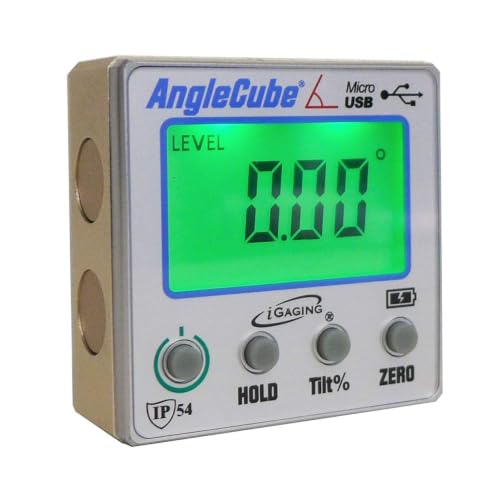
A machined aluminum cube with magnetized sides and a backlit screen that works in a dark shop.
Table saw bevels are where this one shines — the beveled cuts that are easy to eyeball and hard to get right. The Gen 3 reads off a GPS-grade level sensor, and the industrial alloy aluminum body gives the frame reinforcement and a flat face that is what makes a preciseness check trustworthy on a cast-iron table. The backlit LCD stays legible in a dim shop, and the magnetic sides stick to steel so you can let go and turn a knob with both hands. It weighs 2.7 ounces, light enough to toss in a pouch between cuts.
The feedback sums it up around accuracy — it is what people rave about most, with functionality second. It squares bandsaw tables, makes beveled cuts on a table saw simple, and works in the auto shop and machine shop as readily as in the wood shop. The rechargeable USB battery is a notable spec: rather than hunting for AAAs, you plug it in. A carrying pouch with a belt loop comes included.
One honest wrinkle: display readability is the mixed note in the review history, so if a gloved hand is on the tool in full sun, expect a moment to find the angle. It is also a cube, not a protractor — no folding arm, so corners are out of reach. The magnet covers the sides, not the whole body, so it holds well on steel but is not a wall-mount tool. For bench work and machine setup, the aluminum flatness and the rechargeable battery make it a strong daily pick. It ships designed and supported out of California by iGAGING, with live customer support in San Clemente.
Bench and machine strengths
- Industrial alloy aluminum frame keeps the flat faces true for accurate reads on machine tables.
- Rechargeable USB battery removes the AAA scavenger hunt.
- Magnetic sides hold to steel while you work the saw or the knob.
- Backlit LCD stays readable in a dark shop or a poorly lit bay.
Where it asks for care
- Display readability is the mixed aspect in the review history.
- No folding arm — this is a square-set tool, not a corner protractor.
- The magnetic base is on the sides, so it will not mount the way the PREXISO wall base does.
Worth it for: machine shops, cabinet shops, and anyone squaring a bandsaw table or setting a table saw bevel, where an aluminum flat face and a USB charge matter.
Not the pick if: your job needs to reach inside a corner or read at distance from a big screen.
Understanding the Specs
Accuracy vs. Resolution
Accuracy is how far the real reading can sit from the true angle — ±0.1° is tighter than ±0.3°. Resolution is the smallest step the screen displays, like 0.05° or 0.1°. A tool can show a fine 0.05° step and still be a couple tenths off, so weigh accuracy first. When a manufacturer states accuracy as tighter at 0° and 90° than elsewhere, that is normal for these sensors, and the 90° corner is usually where you care most.
Absolute, Relative, and Hold
Absolute mode reads the true tilt of whatever the base sits on. Relative mode, usually reached with a ZERO button, sets your current position as zero and reports the change from there — exactly what you want when the surface is not level but the angle between two pieces is what matters. A HOLD button freezes the current number so you can pull the gauge off a surface and read it somewhere better lit. Every gauge here shuts itself off after a few idle minutes to save power, so HOLD is your safety net.
Magnetic Base and V-Groove Edges
The base decides how steady a reading you get. Flat bottoms with strong magnets stick to steel studs, saw tables, and blades, and rare-earth magnets hold harder on a clean bare surface. V-groove edges are a channel cut into the base that lets the tool sit on round pipe and conduit without rocking. If your work is mostly pipe, look for a V-groove. If it is mostly flat cabinet work, a flat magnetic base does the job.
Display, Units, and Power
A backlit screen with big numerals is what keeps a gauge readable in a dim garage or at distance across a bench. Auto-rotating or auto-inverting displays keep the numbers upright when the tool is upside down or held overhead. On the units side, several tools switch between degrees, percent, mm/m, and inches per foot — with inches per foot being the language roof pitch and some plans are written in. On power, expect AAA or a rechargeable cell plus automatic shut-off after a few idle minutes.
FAQ
Can a digital angle gauge replace a level for hanging shelves?
What is the difference between absolute and relative measurement mode?
Will a magnetic angle gauge stick to aluminum or plastic?
How accurate does an angle gauge need to be for miter cuts?
Why does my angle gauge keep turning off while I work?
Can I measure an inside corner with a cube gauge?
What does the V-groove on an angle finder actually do?
Do these angle gauges need calibration from the start?
Is a folding protractor or a cube gauge better for woodworking?
Can a digital angle gauge read roof pitch in inches per foot?
What battery should I keep spare for these gauges?
Final Thoughts: The Verdict
For most people, the strongest pick is the Klein Tools 935DAGL. Its programmable pitch presets and audible, color-changing angle alarm mean you set the target once and the tool confirms it — no squinting at a number while you turn a bolt. Its alarm and pitch presets turn an angle reading into a closed miter joint without a second pair of eyes.
For the finest accuracy claim without the premium badge, the VOLCANOES CLUB mini angle gauge gives ±0.1° at 0° and 90°, a backlit big-digit screen, and V-grooves that seat on pipe. And for corner work where a cube simply cannot reach, the S&F STEAD & FAST 7-inch angle finder is the one to reach for, with a continuous scale that stretches to 400 mm.
Whichever you choose, do one thing on arrival: check it against a known square corner. That single check tells you more than any spec sheet, because the best angle measurement tool is the one you trust before the saw spins up.
How We Picked
We do not accept paid placement. Every pick is matched to a real buyer and a real use-case; we do not hands-on test units.
Sources & Methodology
Specifications: manufacturer listings and product documentation. Review insights: verified customer reviews, as of November 2026. Pricing: not shown on this page (it changes often); check the current price via the retailer link.
As an Amazon Associate, Gadgets Feed earns from qualifying purchases. This does not affect which products we feature.