
Our readers keep the lights on and my morning glass full of iced black tea. As an Amazon Associate, I earn from qualifying purchases.
Specs are compiled from manufacturer listings and verified buyer reviews and can change over time — please confirm the key details on the product page before buying.
Your main choice when buying a 24 kg kettlebell is simple: do you want a single solid piece of cast iron that stays put on your floor, or a competition-style bell with a thinner handle that lets your hands move freely? Below are three real options, with a plain call on which kind of lifter each one suits.
I’m Min — the founder and writer behind Gadgets Feed. This guide is built by comparing the manufacturers’ published specifications and the patterns across verified customer reviews, so you get each pick’s real strengths and trade-offs instead of marketing spin.
One note before the picks: matching here is flexible, so not every bell is the exact kilogram figure you typed into the search bar — the nearest same-type weight serves the same training purpose. Below you’ll find the honest differences between these 24 kg kettlebell options.
Our Picks at a Glance
How To Choose The Best 24 Kg Kettlebell
A 24 kg bell — about 53 pounds — is usually the point where a lifter stops swinging a toy and starts training seriously. The weight is fixed, so the only things that make one bell better than another are the shape of the handle, how the base sits, and whether the metal is one solid piece.
Solid cast iron versus a hollow competition core
Cast iron bells are poured as one solid piece, with no welds or seams, so there is nothing to rattle or come loose. Competition bells are cast hollow and tuned to an exact weight, which keeps the mass balanced in your hand. Solid iron feels planted during slow lifts, while a hollow competition bell keeps consistent dimensions so your grip doesn’t change as you move up in weight.
The handle is where your hands live
A 24 kg bell pulls hard on your palms during swings and snatches, so handle width is not a small detail. A wider handle like 1.57 inches gives your fingers more room to wrap and spreads the pressure, which suits lifters with larger hands. A narrower 35 mm handle is the competition standard, so if you plan to train alongside other lifters or move up through a set, it keeps your grip mechanics the same bell to bell.
Base and finish decide how it lives in your space
A flat machined base keeps the bell upright on the floor and stops it wobbling between sets. A bell that tips over is a bell that chips. A matte powder coat resists chipping better than a glossy enamel finish, and a slightly textured surface gives your hands something to hold without needing chalk.
Quick Comparison
| Model | Best For | Handle Diameter | Type | Weight | Amazon |
|---|---|---|---|---|---|
| Lifeline Strength Training Kettlebell★ Best Overall | All-round home training on a solid one-piece bell | 1.57 inches | Solid cast iron, void-free | 24 kg / 53 lb | Amazon |
| Titan Fitness Competition Kettlebell | Competition-style training and moving up in weight | 1.378 inches (35mm) | Hollow-core competition bell | — | Amazon |
| Yes4All Powder Coated Kettlebell | High-rep swings without chalk | 1.4 inches | Solid cast iron, powder coated | 24 kg | Amazon |
In‑Depth Reviews
1. Lifeline Strength Training Kettlebell Weight for Home Gym
Our pick — 4.5+★ from 950+ verified ratings; the strongest balance of quality and price.
The one-piece bell with the widest grip here — and the crowd favorite at 4.5+ stars across 900+ ratings.
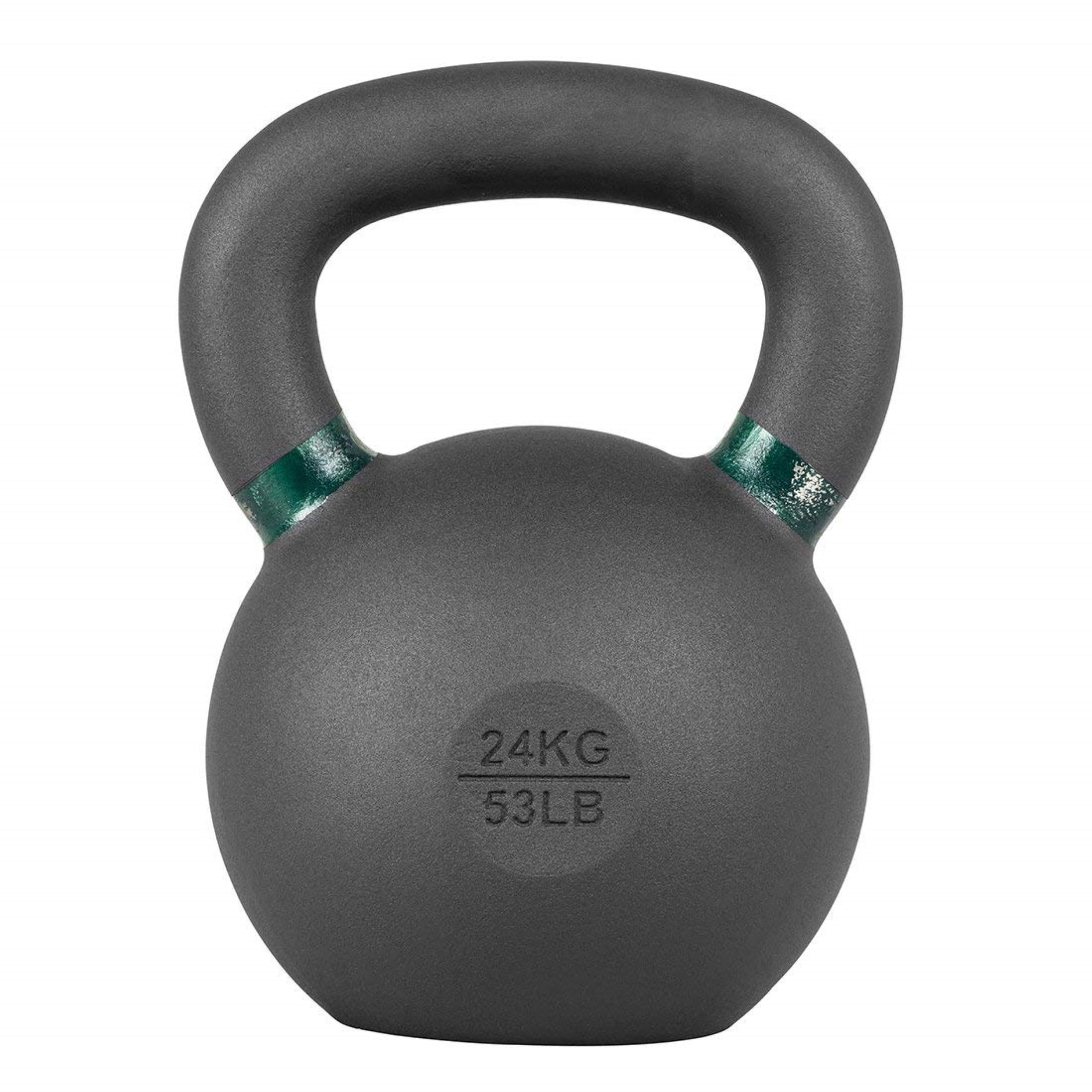
The Lifeline’s standout number is its handle: at 1.57 inches across, it’s the widest of the three, and that extra room gives your fingers more to wrap around during a 53-pound swing. Compared with the Titan Fitness bell’s 1.378-inch handle, you get noticeably more width to press into — genuinely useful if your hands are large or grip fatigue hits early in a session. It’s poured from virgin iron ore as a single solid piece, which means no welded handle, no seams and no rough spots to snag your palm.
What wins people over here is the build itself. The bell is cast void-free and finished in a matte black powder coat that is meant to resist the kind of chipping enamel coatings tend to suffer. It lands on a wide flat machined base that keeps it steady on the floor instead of tipping between sets. Owners describe a professional-looking finish that holds up without scratches or chipped spots where the bell meets the ground.
The trade-off worth knowing is the handle size — it’s a mixed point, with some lifters finding it perfect and others wanting it wider still. If you plan to train competition lifts where a 35 mm handle is the standard, that extra 1.57-inch girth may feel unfamiliar at first. Otherwise it’s the most well-rounded bell of the three, and the one to buy if you want a single solid piece that will sit quietly in the corner of your gym for years.
The case for the Lifeline
- Widest handle here at 1.57 inches — more room for a firm, high-rep grip
- Cast as one solid piece from virgin iron ore, so there are no welds or seams to fail
- Matte powder coat resists the chipping glossy enamel tends to show
- Flat machined base holds the bell upright and wobble-free on the floor
Where it asks you to adapt
- The 1.57-inch handle feels thicker than a standard competition grip
- Handle width divides opinion — some lifters want even more room
Reach for this if: you want one solid, well-finished bell for swings, squats and get-ups at home, and you like a grip with real width to it.
Look elsewhere if: your training follows competition specs and you want the 35 mm handle you’ll use on every bell in the rack.
2. Titan Fitness Competition Kettlebell, Color-Coded, 35mm Handle
A competition bell built to the same shape at every weight, so your hands never relearn the grip.
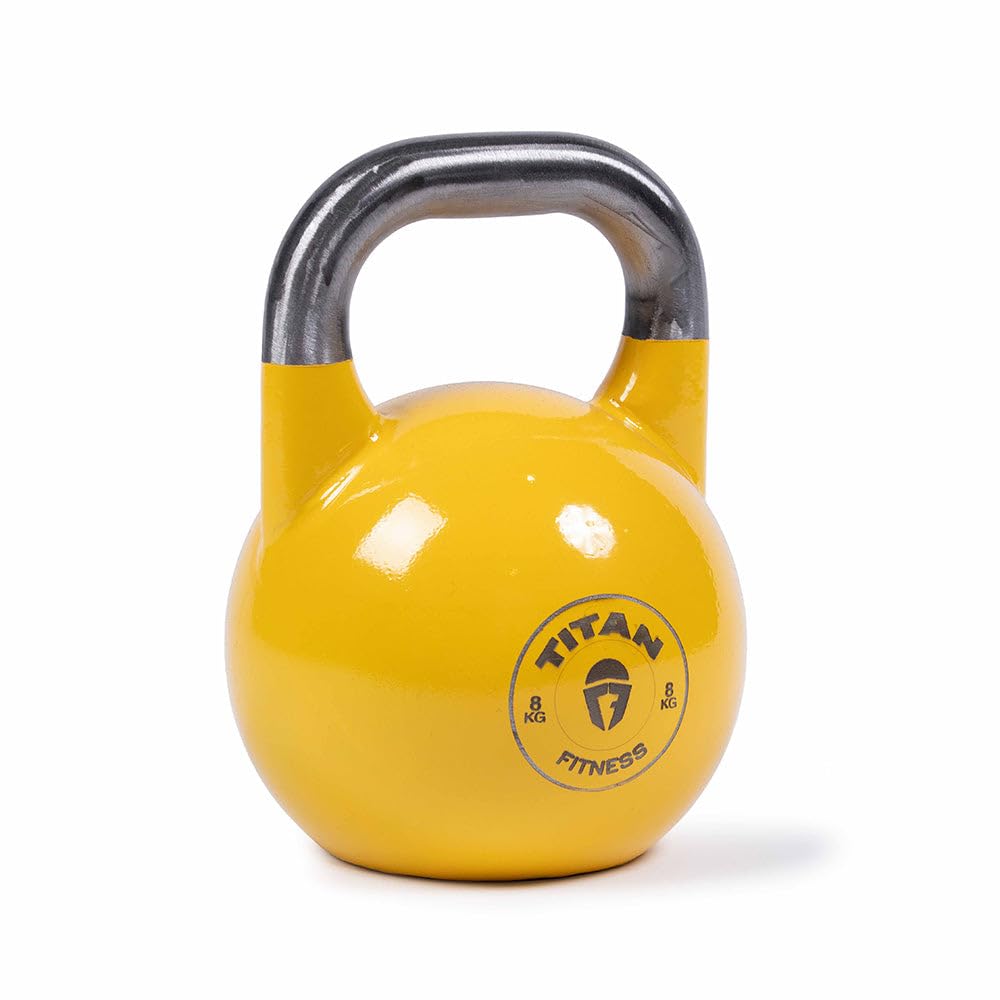
The defining figure on this Titan is 35 mm — the handle width that stays constant across the whole Competition series. That matters because each bell keeps identical dimensions at 8.3 inches in diameter and 11.4 inches in height, so when you graduate from here to a heavier bell, your hands already know where to sit. It’s the opposite philosophy to the Lifeline above: not a wider grip, but the same grip every time. The yellow color coding and laser-etched Titan logo with kilogram markings make it obvious which bell you’ve grabbed, even mid-workout.
Inside, the bell is cast as a hollow core tuned to its exact weight rather than being molded around filler — the maker’s claim, and it’s the construction that gives competition bells their reputation for balance. The finish is textured enough to hold chalk well and still offers grip bare-handed. For swings, deadlifts, squats, get-ups and snatches, it puts the same tool in your hands that competition lifters train with. What earns it praise most is simply the quality of the casting — it feels beautifully made the moment you pick it up.
Here’s the catch: the narrower 35 mm handle is a competition standard, not a comfort feature. If your hands are large or your grip is still developing, the wider Lifeline is the easier bell to hold for long sets. And if you’re not fussed about competition dimensions, you can spend less elsewhere. But for a lifter working toward competition-style technique, this is the most purpose-built of the three.
The honest trade: you’re paying for consistent dimensions and hollow-core balance, not for a roomy grip — the 1.378-inch handle is the narrowest here, which suits trained hands better than big ones.
This one’s for: lifters who train competition lifts and want the same 35 mm grip across every weight in the rack.
Give it a miss if: big hands or early-stage grip strength make a wider handle the safer, kinder choice.
3. Yes4All Powder Coated Kettlebell, 9-88 lb Cast Iron Weights

Solid cast iron with a 1.4-inch handle, textured just enough that you can skip the chalk.
Start with the handle. At 1.4 inches it sits between the wide Lifeline and the narrow Titan — wide enough for a comfortable wrap, trim enough for clean high-rep swings. The surface is smooth but slightly textured, which it’s designed to do so your hands hold firm through a long set without chalk. On a bell this size, that 24 kg iron shape is exactly what you want for swings, deadlifts, squats and snatches.
The other practical win is the labeling. Color-coded rings let you spot the right bell at a glance, and each one is marked in both LB and KG — no mental math before you lift. The flat bottom keeps it steady for renegade rows, mounted pistol squats and handstands where a wobble would ruin the set. It’s solid cast iron with no welds, seams or weak spots, and the powder coating is there to prevent corrosion and give a better grip than a glossy finish. Reviewers praise its versatility most — one bell that covers swings, squats and floor work.
The catch is the finish. Durability and texture draw mixed feedback — some love the smooth-feeling surface, while others find it rough and report powder coating that chips with hard use. Treat the bell with a little care when you set it down and you’ll get years out of it. If you want one bell to cover swings, squats and floor work without fuss, this is the natural first pick.
What you’re really buying: a genuinely versatile solid-iron bell with dual-lb/kg markings and a grip that works bare-handed — the sort of tool you reach for across a whole session.
One thing to watch: the powder coat and surface texture are the mixed notes here, with chipping reported under heavy use, so mind how you drop it.
Pick this if: you swing, row and squat with one bell and want lb-and-kg markings that make the weight obvious.
Think twice if: you drop your bells hard — the powder coat is the part most likely to show wear.
Understanding the Specs
Handle diameter
Handle diameter is the width your fingers wrap around, measured across the thickest part. A wider handle, like 1.57 inches, spreads pressure across your palm, so it suits larger hands or long swing sets. A narrower 35 mm handle is the competition standard, and it keeps your grip mechanics identical as you move up to heavier bells. The right width depends on what your hands are used to.
Solid iron versus hollow core
Solid cast-iron bells are poured as one piece, so there are no welds, seams or weak spots to worry about. A hollow-core competition bell is cast to an exact weight, which keeps the balance precise and the dimensions consistent bell to bell. Both hold 24 kg of mass; the difference is how planted they feel in a slow lift versus how uniform they feel as you climb the rack.
Base and finish
A flat machined base stops the bell wobbling or tipping on the floor between sets, which protects both your floor and the bell’s finish. The coating matters too — a matte powder coat resists chipping better than glossy enamel, and a slightly textured surface gives your hands grip without chalk. If chipping worries you, set the bell down gently rather than dropping it.
Color coding and markings
Color-coded rings and dual lb/kg markings turn a rack of bells into something you can read at a glance. For a single 24 kg bell they’re a small convenience; for anyone building a set, they save a moment of hesitation every time you reach for a weight. Markings in kilograms also line up with competition weight classes.
FAQ
Is 24 kg a good weight to start kettlebell training with?
Why is the handle diameter different between these kettlebells?
What does a hollow-core kettlebell actually mean?
Will a 24 kg kettlebell chip or scratch my floor?
Do I need chalk when swinging a 24 kg kettlebell?
Can I use these kettlebells for snatches and get-ups as well as swings?
Is a solid cast-iron bell better than a competition bell?
How do I know which weight I’m picking up if the markings rub off?
Does a flat base really matter on a kettlebell?
Which handle is easiest on large hands?
Final Thoughts: The Verdict
For most people, the 24 kg kettlebell to buy is the Lifeline Strength Training Kettlebell — its 4.5+ star record across 900+ ratings reflects a one-piece bell with the widest handle here (1.57 inches), a flat machined base and a matte powder coat that’s built to resist chipping. If you train competition lifts and want the same 35 mm grip across every weight, the Titan Fitness Competition Kettlebell is the purpose-built choice. And if you want a versatile cast-iron bell with dual lb/kg markings for swings, squats and floor work, reach for the Yes4All Powder Coated Kettlebell. Whichever you choose, handle width decides whether it feels right: 1.57 inches for large hands, 35 mm for competition-style training.
How We Picked
We do not accept paid placement. Every pick is matched to a real buyer and a real use-case; we do not hands-on test units.
Sources & Methodology
Specifications: manufacturer listings and product documentation. Review insights: verified customer reviews, as of November 2026. Pricing: not shown on this page (it changes often); check the current price via the retailer link.
As an Amazon Associate, Gadgets Feed earns from qualifying purchases. This does not affect which products we feature.