
Our readers keep the lights on and my morning glass full of iced black tea. As an Amazon Associate, I earn from qualifying purchases.
Specs are compiled from manufacturer listings and verified buyer reviews and can change over time — please confirm the key details on the product page before buying.
If you want to turn one thick plank into two bookmatched panels, the saw has to swallow the full height of that board in a single pass. That is the whole ballgame with resawing, and it is the number to check before anything else. This list sticks to the standard 14-inch class, and it uses flexible matching — the nearest same-type wheel size or wattage serves the same purpose — so not every pick is the exact number you searched. Every option here carries a stated resaw capacity, so you are never guessing whether it can actually split a wide slab.
I’m Min — the founder and writer behind Gadgets Feed. This guide is built by comparing the manufacturers’ published specifications and the patterns across verified customer reviews, so you get each pick’s real strengths and trade-offs instead of marketing spin.
Here is the honest breakdown of the 14 inch bandsaw for resawing that earns its floor space.
Our Picks at a Glance

How To Choose The Best 14 Inch Bandsaw For Resawing
Resawing is the one job that separates a real woodworking bandsaw from a curve cutter. You are pushing a tall, wide board through a narrow blade and asking the saw to keep that blade straight under load. Three things decide whether it does: cut height, motor power, and how rigid the frame and wheels are.
Start With Resaw Capacity, Not Horsepower
Resaw capacity is the tallest board the saw can split in one pass, measured under the upper blade guide. On this list it runs from 12″ to 13″, and that figure caps every project you can attempt. A 12″ capacity means a board thicker than that has to be flipped or cut elsewhere. Buy the tallest cut height you can fit and power, because you cannot add height later without a riser block.
Motor Power And What It Actually Feeds
Horsepower and amps tell you how hard the saw can push a wide blade through dense hardwood without bogging. The picks here range from 1-1/2 HP up to 2.5 HP. More power lets you feed faster and hold a straight line in thick stock. Check the voltage too — some saws are prewired for 120V and can be switched to 220V, while others are built around 220V from the start.
Blade Width And Guide Quality
The blade is a consumable, so confirm the length the saw requires and the widest blade it accepts. A 3/4″ blade is the resawing workhorse because it stays stiff in a tall cut. Ceramic or bearing guides hold that blade steady just above and below the table. Better guides mean less drift, which is the wandering cut that ruins a slab.
Quick Comparison
| Model | Best For | Resaw Capacity | Motor | Item Weight | Amazon |
|---|---|---|---|---|---|
| QD-KYOHO 14″ Dual-Speed★ Best Overall | All-round value | 14″ class | 2 HP, 14 A | — | Amazon |
| JET JWBS-14SFXDeep-Cut Pick | Deep-cut resawing | 13″ | 1.75 HP | 272 lb | Amazon |
| Laguna 14|12 | Guide quality | 13″ | 1-3/4 HP | 258 lb | Amazon |
| Powermatic PWBS-14CS | Quiet premium build | — | 1-1/2 HP, 30 A | 178 lb | Amazon |
| Laguna 14BX 220V | Heavy production cuts | 13″ | 2.5 HP | 260 lb | Amazon |
| Grizzly G0555XH | Extreme-series resaw | 12″ | 1.75 HP | — | Amazon |
In‑Depth Reviews
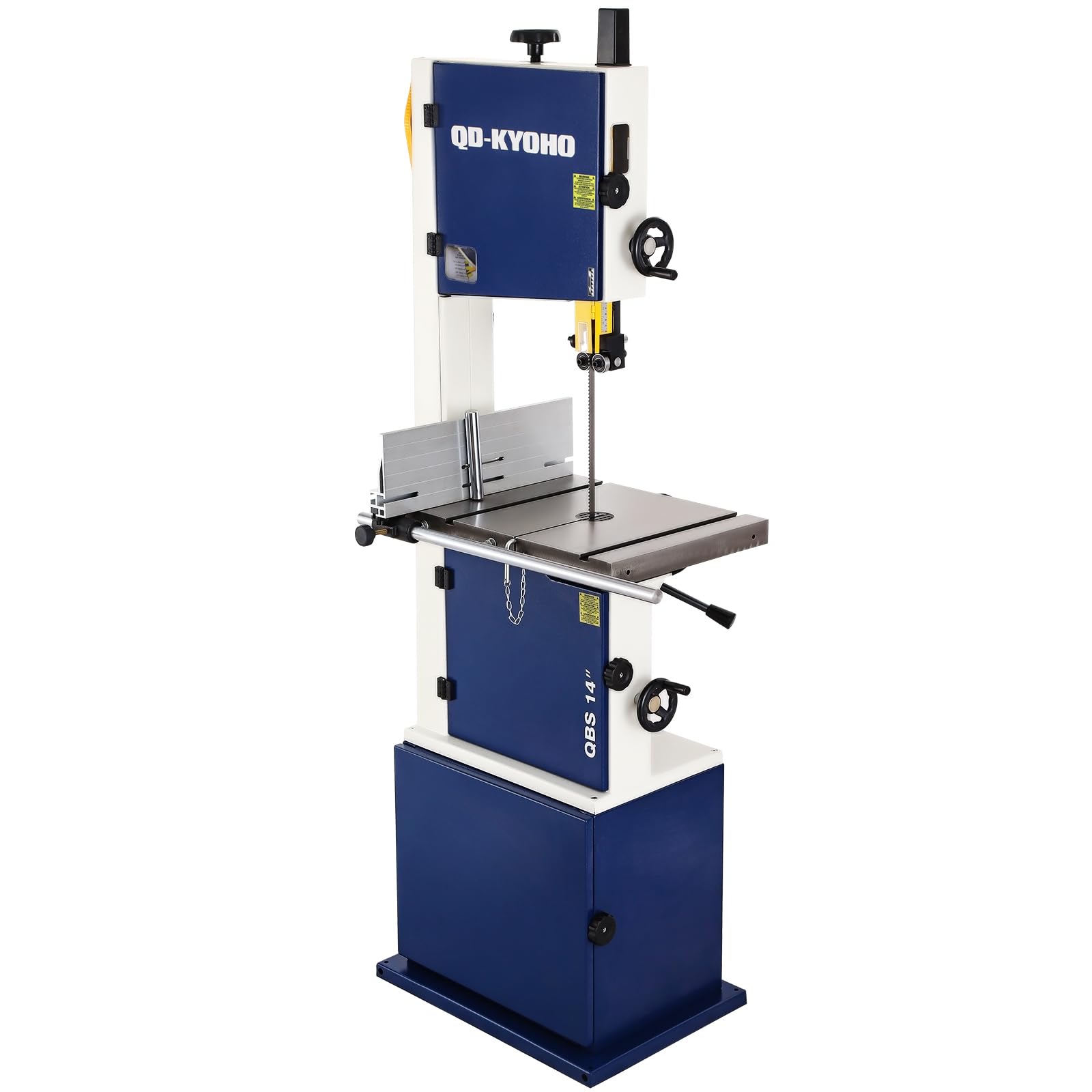
1. QD-KYOHO Band Saw, 14 Inch Dual-Speed
Our pick — 4.5+★ from 100+ verified ratings; the strongest balance of quality and price.
A two-speed 2 HP saw that swaps straight from hardwood slabs to softwood trim without a second machine.
The headline here is the dual-speed setup — two motor speeds in one saw keep you from slowing down on hard maple. Put it on 1445 FPM (feet per minute, the speed the blade travels) for dense hardwood, or switch to 2950 FPM for a smoother finish on softwoods. That 2 HP, 14-amp motor is the engine behind both speeds, and it spins up fast and runs quietly for its size.
Where it earns the top spot is the table and build. The cast iron table measures 21-1/2″ x 15-3/4″, and it tilts 45° right and 5° left so angled and compound cuts stay easy. The frame is welded steel plate with dynamically balanced cast aluminum wheels, which keeps the blade tracking flat and steady while you push a tall board through. A 111″ alloy-steel blade is what this machine runs.
The honest note is the adjustability. Setting up the guides and tuning the blade tension has more back-and-forth than some buyers expect, and a few find the saw vibrates until it is dialed in. Both ease up as the machine settles. Buyers report it works great on wood and soft metals, and assembly is quick with clear instructions.
Where It Wins
- Two blade speeds — 1445 FPM for hardwood, 2950 FPM for smooth softwood cuts
- 2 HP, 14-amp motor starts fast and runs at low noise
- Cast iron table tilts 45° right and 5° left for angled work
- Overload protection guards the motor during long resaw passes
What To Weigh
- Guide and tension setup takes more tuning than some buyers expect
- Vibration can appear until the saw is fully adjusted and broken in
- Blade arrives as a bare tool setup, so confirm what is included
Best for: the woodworker who splits both hard and soft stock and wants one saw to handle both.
Know before you buy: you will spend real time dialing in the guides and tension up front.
2. JET 14″ Woodworking Band Saw, 1.75 HP
Thirteen inches of cut height from a 1.75 HP motor — enough to slice a thick slab into bookmatched panels in one pass.
For resawing, the number that matters is the 13″ resaw capacity, and this JET clears it with a 116″ blade loop. That means you can take a thick slab and split it into two matched panels or thin veneer without dragging in a second machine. The 1.75 HP capacitor-run motor (a motor that keeps its own steady torque) feeds that tall cut without stalling.
The frame is the heavy part, and that is the point. At 272 pounds it is 53% heavier than the Powermatic below at 178 pounds, and that mass is what keeps a tall board from chattering. It runs blades from 1/8″ wide for tight scroll work up to 3/4″ for fast resawing, with a 13-1/2″ throat and independently adjustable ball-bearing guides. The 360 sq. in. ground cast-iron table tilts 0–45° right for bevels.
What wins people over is raw performance — it feeds through thick stock without bogging, and the resaw fence and easy-read scale make repeat cuts simple. Two things to size up honestly: some buyers find the blade drifts out of alignment and needs re-tuning, and this is a two-person lift to position. A 20-amp circuit is recommended, so check your shop power before it arrives. Backed by a 5-year warranty.
The mass advantage: 272 pounds of saw is a chore to place but a gift at the blade — tall resaw cuts stay straight because nothing is moving but the wood.
Power check: the 1.75 HP motor and 20-amp circuit recommendation mean you want a dedicated shop line ready.
Choose it for: bookmatched panels and veneer from thick stock, with a fence and scale that reward repeat work.
skip it if: you want a saw you can lift into place alone or you cannot commit a 20-amp circuit.
3. Laguna Tools MBAND1412-175 14 x 12 Bandsaw
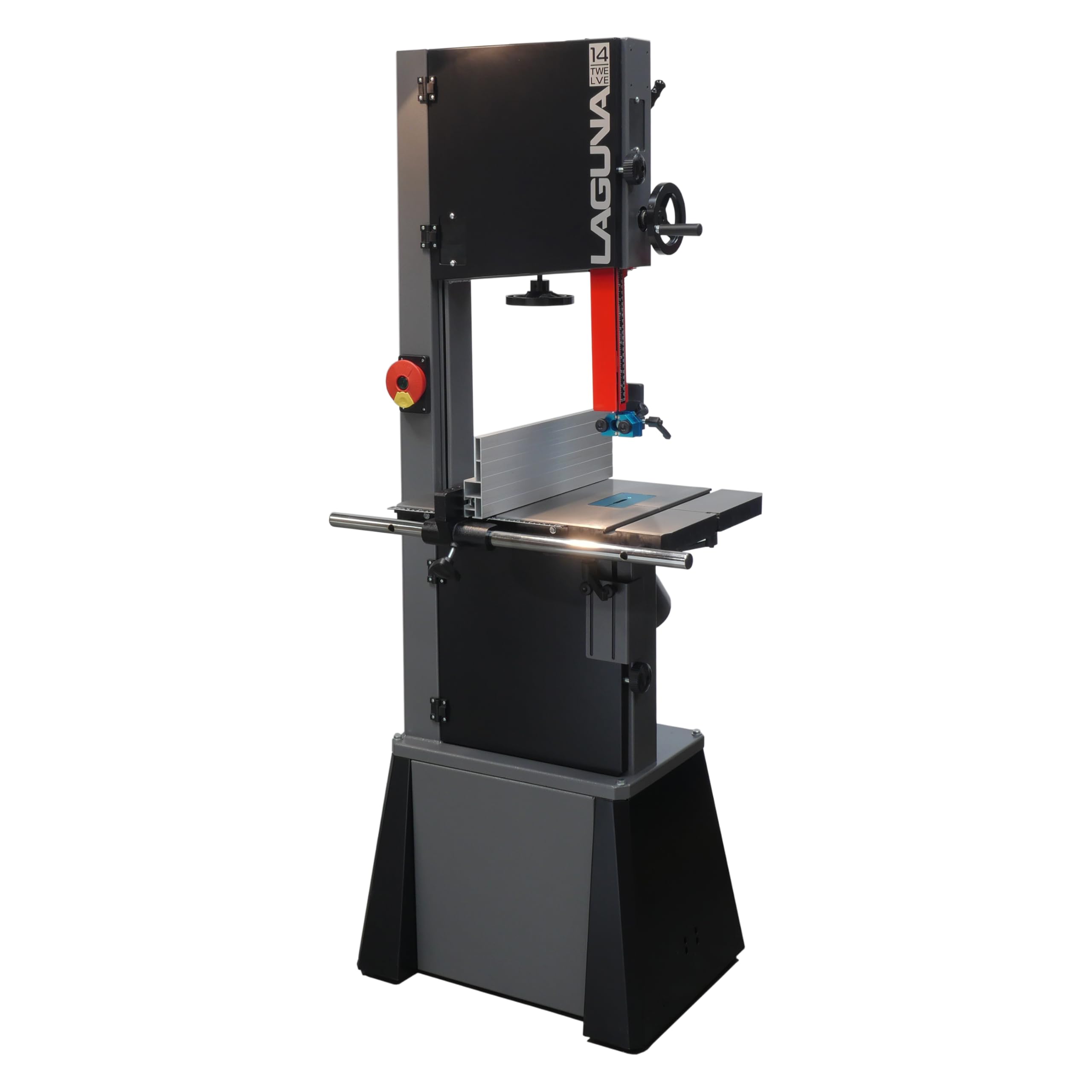
Ceramic guides and balanced cast-iron wheels are the anti-drift package that keeps a wide blade tracking straight.
Start with what keeps a resaw cut honest: the blade. This Laguna runs 13″ of resaw capacity and accepts blades from 1/8″ to 3/4″ wide, so a 3/4″ resaw blade sits where it belongs. Its ceramic Laguna guides and rack-and-pinion upper guide hold the blade steady just above and below the table. The wheels are electronically and dynamically balanced cast iron with one-piece polyurethane tires made to run cooler.
The motor is a 1-3/4 HP dual-voltage TEFC unit — a totally enclosed fan-cooled motor that shrugs off dust — delivered pre-wired for 115V but able to run on 230V. The micro-polished table is 21-1/2″ x 16″ and tilts 45° right and 7° left with a positive stop at 90°. Quick-release tension, a tension indicator, and dual viewing windows let you watch tracking while the saw runs, and at 258 pounds it sits solidly enough that the 90-degree cutting angle stays true.
The honest trade-offs are real but sized: ceramic guide replacements cost more when they wear, and blade adjustment divides buyers. Assembly, by contrast, is reported as intuitive, and the sturdy base stays solid once set. If guide quality is your priority over a bigger motor, this is the saw that puts the money at the blade.
Why It Tracks Straight
- Ceramic guides with rack-and-pinion upper guide for consistent blade control
- Balanced cast-iron wheels with polyurethane tires that run cooler
- Dual tension windows let you monitor tracking while running
- Large 21-1/2″ x 16″ table tilts 45° right, 7° left, positive stop at 90°
The Honest Trade-Offs
- Replacement ceramic guides carry a higher cost than steel
- Blade adjustment is a dividing point for buyers
- Heavy enough that setup is a two-person job
The blade-control play: pick this if drift-free resawing and ceramic guides matter more to you than the largest motor on the list.
Plan for: a two-person lift, some time on blade adjustment, and the cost of ceramic replacements down the road.
4. Powermatic 14-Inch Woodworking Bandsaw PWBS-14CS

Nine-spoke cast-iron wheels and a 60-watt work lamp for buyers who cut in a small shop where noise carries.
The build reads like a small-shop flagship. Precision-balanced nine-spoke cast iron wheels are the vibration story — more spokes and balanced mass mean smoother blade travel on a tall cut. A Carter quick-tension lever speeds blade changes, and its detension setting relaxes the blade between sessions to extend its life. A 60-watt adjustable lamp puts direct light on the blade and workpiece, which matters when you are eyeing a resaw line in dim light.
For clean cuts it runs micro-adjustable dual bearing guides above and below the table, plus a chip blower that keeps the line visible. The resaw side gets a quick-release T-square-style rip fence with a 4″ resaw attachment. It includes a 6″ riser block, which is what lifts resawing range on this class of saw. Power is a 1-1/2 HP motor at 30 A on 115/230V, and the 93.5″ blade loop is the blade size to order.
Quiet operation is the standout — it hums where other saws growl. The friction point is setup: assembly lands in mixed territory, some sail through and some find it needs work, and the printed instructions are the weakest link. At 178 pounds it is the lightest saw on this list, so expect help is not always needed to move it. Budget time for the manual.
The quiet win: a saw that runs softly enough for a basement shop, with a lamp and chip blower that keep your cut line visible.
What to prepare for: the manual is the weak spot, so watch a setup video and give assembly an unhurried afternoon.
Reach for this if: quiet operation, a bright work lamp, and a manageable 178-pound frame fit your shop.
Look elsewhere if: you want a bigger motor for thick slab resawing or you refuse to fight a thin manual.
5. Laguna Tools 220V 2.5 HP Bandsaw, 13″ Resaw

The biggest motor on the list, built to feed a 3/4″ blade through dense hardwood without a stutter.
Here the money goes into muscle: a 2.5 HP motor paired with a solid, one-piece frame and heavier-gauge construction. That combination is built to cut down vibration while you lean into a demanding pass. The resaw capacity is 13″, the maximum blade width is 3/4″, and the ceramic guides make multiple contact points around the blade to hold it steady and cut accurately.
It carries forward Laguna’s habit of putting control at the blade. The 21-1/2″ x 16″ cast iron table tilts 7° left and 45° right. Quick-release blade tension, a magnetic blade guard, an aluminum hi/low fence, and a worm-gear rack-and-pinion adjustment make repositioning fast. Safety gets real attention too: a foot-operated disc brake with a micro-switch stops the blade quickly, and dual 4″ dust ports pull chips out during the cut. This one runs on 220V, so your shop wiring has to be ready.
Owners describe it as a machine that slices 1/8 inch off 10-inch walnut with ease — the test any resaw saw must pass. Quality is what lands highest, and the power backs it up. What to weigh honestly: it needs 220V power, and value-for-money is a dividing point, so decide whether the extra muscle fits how much thick stock you actually cut. At 260 pounds, plan the placement before delivery.
The Muscle And The Control
- 2.5 HP motor on a one-piece frame for less vibration on heavy cuts
- 13″ resaw capacity with a 3/4″ maximum blade width
- Ceramic guides with multiple contact points for accurate cuts
- Foot-operated disc brake with micro-switch and dual 4″ dust ports
What To Plan Around
- Runs on 220V, so shop wiring must be in place first
- 262 pounds to move and position
- Value for money divides buyers, so match it to real resaw volume
Made for: heavy resawing in a shop already wired for 220V, where thick walnut and dense stock are routine.
Think twice if: you are on 120V or cut thin stock — this is more machine than that work needs.
6. Grizzly Industrial G0555XH 14″ Resaw Bandsaw
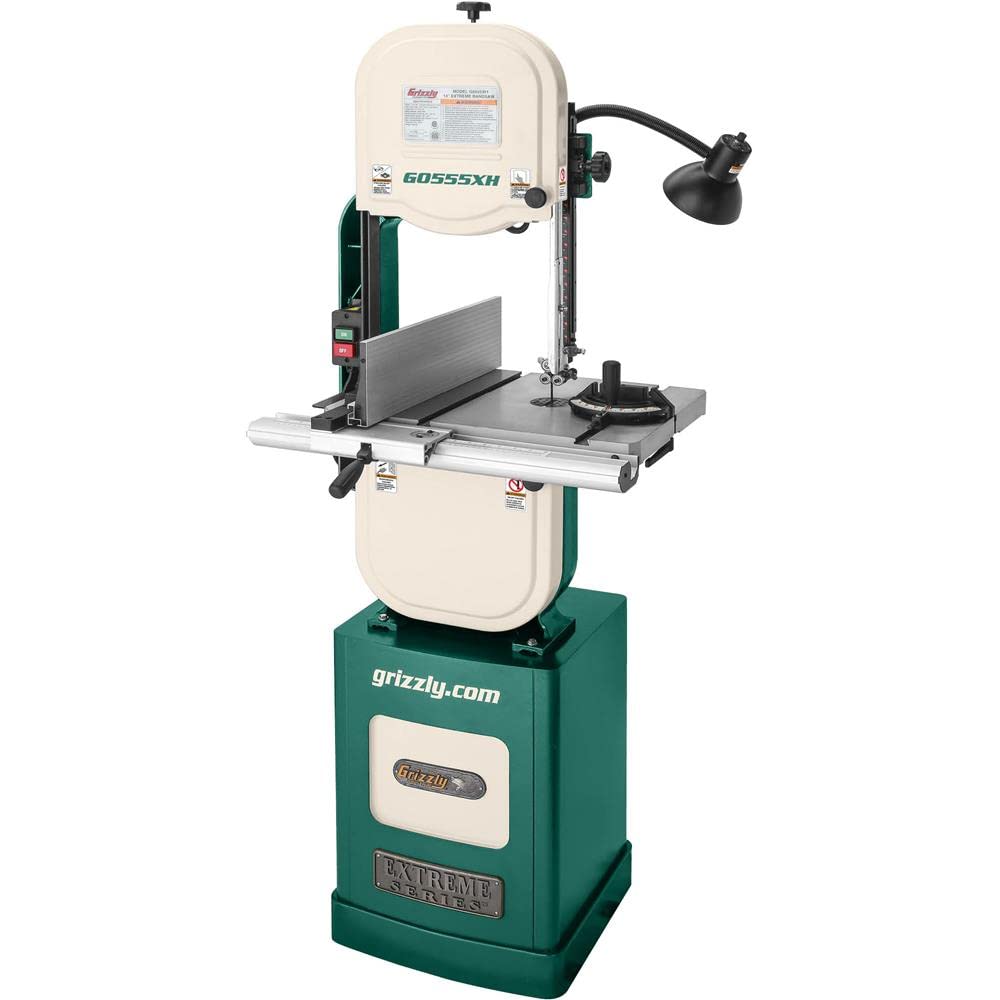
A cast-iron frame and heavy-duty stand built to hold steady under the Extreme Series resaw badge.
Grizzly’s approach is to pour the mass where it counts. This saw uses a cast iron frame and a heavy-duty stand, which is the stiffness that keeps a blade from wandering in a tall cut. The motor is a 1.75 HP unit with 12″ of resawing capacity, so thick boards stay within reach though the cut height sits a touch under the 13″ models here. It comes with an extruded aluminum resaw fence and a miter gauge, so you can start repeat cuts without extra shopping.
Power is flexible: it is a 110V/220V machine prewired for 120V, so it runs on standard shop power and can move to 220V if you later want that setup. It is CSA Certified and built in an ISO 9001 factory, and it cuts at a 45-degree angle for bevel work. The blade material is high speed steel, the kind that holds an edge under heat.
One thing to set expectations on: this is a newer model with a thin review record. This saw is not as widely owned as the JET or the Laguna pick, so the review record is thinner and you are leaning more on the spec sheet than the crowd. If you want a cast-iron-framed 14-inch saw that flexes between 110V and 220V with a resaw fence included, it fits the brief. Just confirm the blade situation before you plan your first cut.
Fits the shop that: wants a cast iron frame, a resaw fence in the box, and the option to run 120V now and 220V later.
Weigh up front: the 12″ cut height is a touch shy of the 13″ saws here, and the ownership record is thin.
Understanding the Specs
Resaw Capacity Explained
Resaw capacity is the tallest board the saw can split in a single pass, measured under the upper blade guide. On this list it runs from 12″ to 13″, and it caps the size of the panels and veneer you can produce. Always match this figure to the thickest stock you plan to cut. If a board is taller than the capacity, you cannot resaw it in one pass no matter how strong the motor is.
Horsepower And Voltage
Horsepower tells you how hard the saw can push a wide blade through dense hardwood without bogging, and on this list it runs from 1-1/2 HP up to 2.5 HP. Voltage decides how the saw connects to your shop: a 115/230V or 110V/220V saw may arrive prewired for the lower voltage, while a dedicated 220V model needs that line ready. Match both to your wiring before you buy.
Blade Length And Width
Blade length is the exact loop size the saw requires, and it varies here from 93.5″ up to 116″, so order the right size or the blade will not fit. Blade width decides the job: 1/8″ handles tight curves while a 3/4″ blade stays stiff for resawing. Confirm the widest blade the saw accepts before you plan a resaw setup.
Frame Mass And Guides
A heavy cast-iron or steel frame with balanced wheels reduces vibration, which is what keeps a tall cut straight. Guides hold the blade steady just above and below the table. Ceramic and bearing guides both keep a wide blade on line, and better guides mean less of the drift that ruins a slab. The heavier the frame, the more help you need to move it.
FAQ
What resaw capacity do I need for bookmatched panels?
Can I run a 14 inch resaw bandsaw on standard household power?
What blade width should I use for resawing?
Is more horsepower better for resawing thick hardwood?
Why do bandsaws drift and how do guides stop it?
How much does a 14 inch resaw bandsaw weigh and how hard is it to move?
Do these bandsaws include a blade and a fence?
Do I need a dust collector with a resaw bandsaw?
Should I choose a 90-degree cut saw over a tilting- table model for resawing?
Final Thoughts: The Verdict
For most woodworkers, the 14 inch bandsaw for resawing winner is the QD-KYOHO 14 Inch Dual-Speed. Its two-speed 2 HP motor cuts both dense hardwood and smooth softwood, so one saw handles your rough and finish boards. The cast iron table tilts 45° (degrees), so you can angle a cut without a jig. Want the deepest one-pass cut and do not mind a heavyweight? Grab the JET 14″ Band Saw: its 13″ resaw capacity (the tallest board it can split in one pass) lets you slice thicker stock, and it carries a 5-year warranty. For heavy production resawing in a shop already wired for 220V (a higher-voltage outlet), reach for the Laguna 14BX 2.5 HP. The QD-KYOHO is the crowd favorite here at 4.5+ stars across 100+ ratings. Match your shop’s voltage and the stock you actually cut, and any of these will split a board cleanly.
How We Picked
We do not accept paid placement. Every pick is matched to a real buyer and a real use-case; we do not hands-on test units.
Sources & Methodology
Specifications: manufacturer listings and product documentation. Review insights: verified customer reviews, as of November 2026. Pricing: not shown on this page (it changes often); check the current price via the retailer link.
As an Amazon Associate, Gadgets Feed earns from qualifying purchases. This does not affect which products we feature.