
Our readers keep the lights on and my morning glass full of iced black tea. As an Amazon Associate, I earn from qualifying purchases.
Specs are compiled from manufacturer listings and verified buyer reviews and can change over time — please confirm the key details on the product page before buying.
If you need a radio that actually reaches someone across a state line, the real answer is cellular push-to-talk — a radio that uses a mobile network instead of a direct handset-to-handset signal. The old-school GMRS pairs here still top out at a manufacturer-rated 36 miles, and that number only happens in wide-open country with both of you standing on high ground. So treat this list the way it is built: a flexible, human-like match for the long-range class around 50 miles, which means not every pick carries that exact number. Some go far past it. The nearest same-type match in power and antenna design does the same job for your trip.
I’m Min — the founder and writer behind Gadgets Feed. This guide is built by comparing the manufacturers’ published specifications and the patterns across verified customer reviews, so you get each pick’s real strengths and trade-offs instead of marketing spin.
Two things decide your purchase here: if you need a licence to press transmit, and whether your campsite has phone signal. Both are answered below. The right 50 Mile Range Walkie Talkie is the one whose network matches your terrain: GMRS where there is no signal, 4G LTE where there is.
Our Picks at a Glance

How To Choose The Best 50 Mile Range Walkie Talkie
Start with the question that changes everything else: does your group stay inside cell coverage? A cellular radio talks for thousands of miles and dies the moment you leave signal. A GMRS radio keeps working in a dead zone but asks you to buy a licence. Know which one you are before you spend.
Pick the radio type that fits your ground
GMRS is a licensed radio service — in the US you need a licence from the FCC to legally transmit on those channels. That includes the Midland pairs on this list. The trade is real durability: those radios run on their own frequency range (462.5500 – 467.7125 MHz, the band the FCC sets aside for this service) and need no tower at all. A cellular push-to-talk radio needs no licence but needs bars on the screen.
Read a mile rating properly
A long-range claim is a best-case figure measured over open terrain. Trees, ridges, and building walls eat distance fast. For hill country and forests, a shorter-rated GMRS radio used by two people on the same ridge will often beat a taller claim used from behind a hill. For split-up teams driving separate highways, only cellular works. Set expectations to your land, not the box.
Weight the battery the way the job does
Battery life is where a cheap pair quietly fails a twelve-hour shift. Look for two separate figures: talk hours and standby days. A radio rated 10 hours of talk is fine for a day hike. A radio rated 72 hours of use with 15 days of standby keeps a dispatcher or a night-shift foreman live without hunting for an outlet.
Work out how many handsets you need
Most pairs ship as two, and that is enough for a hike or a driver and a spotter. If three or four people need to hear the same call — a construction crew, a family convoy, a warehouse floor — buy the pack that matches the headcount. Mixing pack sizes across brands gets awkward because each family of radios groups only with its own models.
Quick Comparison
The table below lines up the three specs that actually decide which radio suits your trip: the technology it runs on, the top range figure the maker publishes, and the battery headroom. Follow the columns straight across and the right fit usually picks itself.
| Model | Best For | Technology | Rated Max Range | Battery | Amazon |
|---|---|---|---|---|---|
| Midland GXT1000VP4★ Best Overall | Camping and outdoor groups | GMRS | Up to 36 mile | 10 hours | Amazon |
| Midland GXT1030VP4Crew Favorite | Job sites and crews | GMRS | Up to 36 mile | 10 hours | Amazon |
| TIDRADIO TD-G100 | Family and logistics teams | 4G LTE | 10000 miles | 72 hours | Amazon |
| XOTODREM G05 | Industrial and factory use | 4G LTE | — | 5000mAh | Amazon |
| Powerlava L1 | Privacy and cross-border teams | 4G LTE | Unlimited | 3000mAh | Amazon |
| KaYoTom M12 | Fleet and highway crews | 4G LTE | 5000 mile | 3000mAh | Amazon |
| Arridioter AD-11 | Lowest-cost nationwide entry | 4G LTE | 5000 mile | 3000mAh | Amazon |
In-Depth Reviews
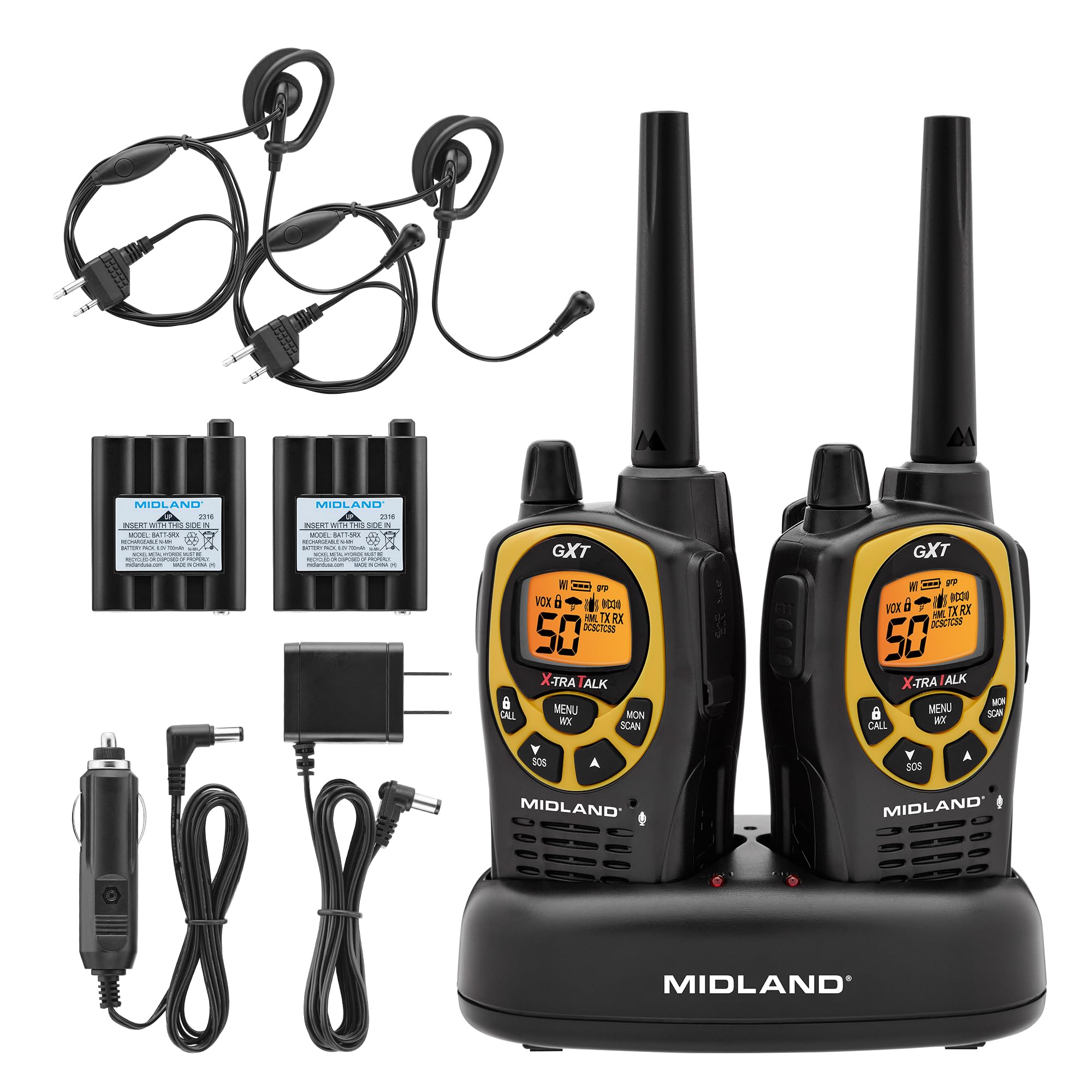
1. Midland GXT1000VP4 GMRS Two-Way Radios with Headsets, 2 Pack
Our pick — 4.0+★ from 13,000+ verified ratings; the strongest balance of quality and price.
The pair that keeps working when the cell tower is three valleys behind you.
You get 50 channels and 142 privacy codes on this pair — the privacy codes are sub-channels that keep other people’s chatter off your line, so a crowded campground does not turn into one long argument. It runs on GMRS, which means you need an FCC licence to transmit legally in the US. In return, it uses no phone network at all, so a dead zone costs you nothing. For camping, skiing, and hunting where signal vanishes, that is the whole point.
Compare it honestly to the Arridioter unit on this list and the scale is stark: that one claims 5000 mile of talking range against the 36 mile rated here. Held up against real use, though, 36 miles is a best-case figure under open sky. Build quality wins people over: the housing and controls feel like a tool, and the keypad lock stops a pocket press from changing your channel. A built-in NOAA scan sounds an alert when severe weather rolls in, and the charger and rechargeable packs come in the box, topped up and ready.
The recurring gripe is battery life. Midland rates it at 10 hours of talk, and heavier users do find it running dry on a long day. The fix is already in the design — dual-power mode lets you drop in AA cells when the pack fades. Range is the other honest limit: walkers behind a ridge drop off sooner than the number suggests. Both are the trade-off for a radio that works with no tower in range.
What the box hands you
- Two radios, rechargeable packs, and a desktop charger, ready from the start
- SOS siren, keypad lock, vibrate mode, and ten call tones for crew use
- EVOX hands-free voice activation keeps your grip on the wheel or gear
- Weather-resistant body rated JIS4, so rain does not end the outing
Where it asks patience
- GMRS transmission in the US requires an FCC licence
- 10 hours of rated talk time runs short for all-day users
- Real-world reach falls well under 36 mile in trees and hills
Reach for this if: your trips run off-grid and your group stays within a few miles of each other.
Look elsewhere if: you need contact across hundreds of miles — that is a cellular job, not this one.
2. Midland GXT1030VP4 GMRS Two-Way Radios with Headsets, Hi-Vis Yellow, 2 Pack
Same radio internals as the top pick, dressed in yellow so it never wanders off a site.
Picture a roofing crew spread over three roofs and a laydown yard. The black-and-yellow housing on this pair is the feature you notice first — bright enough to spot across a warehouse or a festival field, which matters when a radio gets set down next to a chop saw. Underneath it shares the GXT1000’s 50 channels, 142 privacy codes, and up to 36 mile rating. It also comes with rechargeable packs and a charger, plus AA dual-power backup for stretches away from an outlet.
Weight comes in at 4.8 ounces a handset, so a belt clip keeps it out of the way all shift. It earns its place with the GXT line’s solid housing and simple controls, which buyers report surviving daily site use. Owners mention the controls surviving daily site punishment and the sound staying readable over machinery. The NOAA weather scan adds early warning before a storm front reaches an outdoor job, and the keypad lock plus silent mode let a supervisor run a quiet channel without broadcasting tones.
Where every GMRS pair on this list shares a weakness is real-world distance — the type of weather and terrain you work in will shorten the reach, and this one is no exception. Battery figures follow Midland’s own 10-hour talk rating, so long shifts want spare AA cells within reach. It still lands near the top because a hi-vis housing and AA backup suit active job sites.
The case for the yellow: visibility is a genuine safety feature on a busy site, and it costs nothing in performance over the black version.
Go with it when: your team works in daylight among other crews and needs radios that are easy to count at a glance.
Pass when: you want nothing to do with an FCC licence, because this pair still lives on GMRS channels.
3. TIDRADIO TD-G100 4G LTE PoC Radio, 4 Pack

Four handsets, one nationwide channel, and six days of standby before anyone thinks about a charger.
This is the pick for the family convoy or the four-truck delivery team. It runs push-to-talk over a 4G LTE cellular network, so your reach is limited only by where a tower stands — not by ridges or trees. The pack of four each carry a 3000mAh battery rated for 72 hours, which in plain terms means six days or more of standby for a radio sitting in a cup holder. You get a 1.77-inch-comparable control layout through the ODmaster app, where groups are created, bound, and unbound without a call to support.
Compared with the two Midland pairs above, the range story flips completely: this one’s 4G path crosses states, while the GMRS units stop at a rated 36 mile. That gap is why it suits logistics and family road trips. Value is the trait it wears best — a four-pack at this tier spreads the cost across every vehicle. Communication quality holds up too, helped by a 3W speaker and Smaster AI noise reduction that trims background engine and wind noise on a call.
The honest catch is connectivity. A cellular radio needs signal, and when reception is patchy the call stumbles. Sound quality also draws a split reaction — some find it clean, others find the earpiece lacking, so try the included earpieces before relying on hands-free in a loud cab.
Arguments for the four-pack
- 300 channels give room for separate teams on separate calls
- One-click over-the-air updates, no cable needed
- Auto-recording saves chats so a missed instruction can be replayed
- Works alongside TIDRADIO’s TD-M15, TD-M13, TD-G18, and TD-M2 models in one group
The bits to weigh first
- Data service is free for the first year — renewal afterwards is a paid subscription
- Reception-dependent: dead zones end the conversation
- Sound quality gets mixed reactions, and the earpiece divides opinion
Made for: four or more people splitting across vehicles or floors who need one shared channel.
Not for: backcountry routes with no bars — take a GMRS pair there instead.
4. XOTODREM G05 Unlimited Range 4G LTE PoC Radio, 3 Pack

The pack that stays clear in a noisy plant, with a battery built for a full shift and then some.
Industrial buyers should start here. The G05 carries a 5000mAh battery — bigger than any other pack on this list — rated for a full day of talk and seven days of standby. That one figure answers the biggest worry on a factory floor: whether the radio quits before the shift does. Its microphone is tuned to pull your voice forward while cutting an advertised 95% of surrounding noise, which is the difference between a clear instruction and a repeated one in a busy warehouse.
Setup is the part that surprises people. The 4G LTE SIM card comes pre-installed, so there is no activation ritual — power on, press the PTT button, and talk. For crews of any real size, support will link every device into one group once you share the IMEI numbers, or build custom groups to match your structure. It holds 200 channels, and the dust-proof body shrugs off the grit that comes with construction and logistics work.
The trade is the same one every cellular radio makes: a building with no cellular signal gets you nothing. The pack arrives as a three-piece set, which is generous for a three-person team but awkward for a pair. What owners talk about most is reliability and sound quality — the clear-audio promise lands more often than not, and that is what keeps this one near the front.
Worth it if: your radio lives on a noisy site or a warehouse floor and must survive a long shift on one charge.
Think twice if: your routes run through tunnels and basements where no network reaches.
5. Powerlava L1 Lifetime Free 4G LTE PoC Radio, 2 Pack
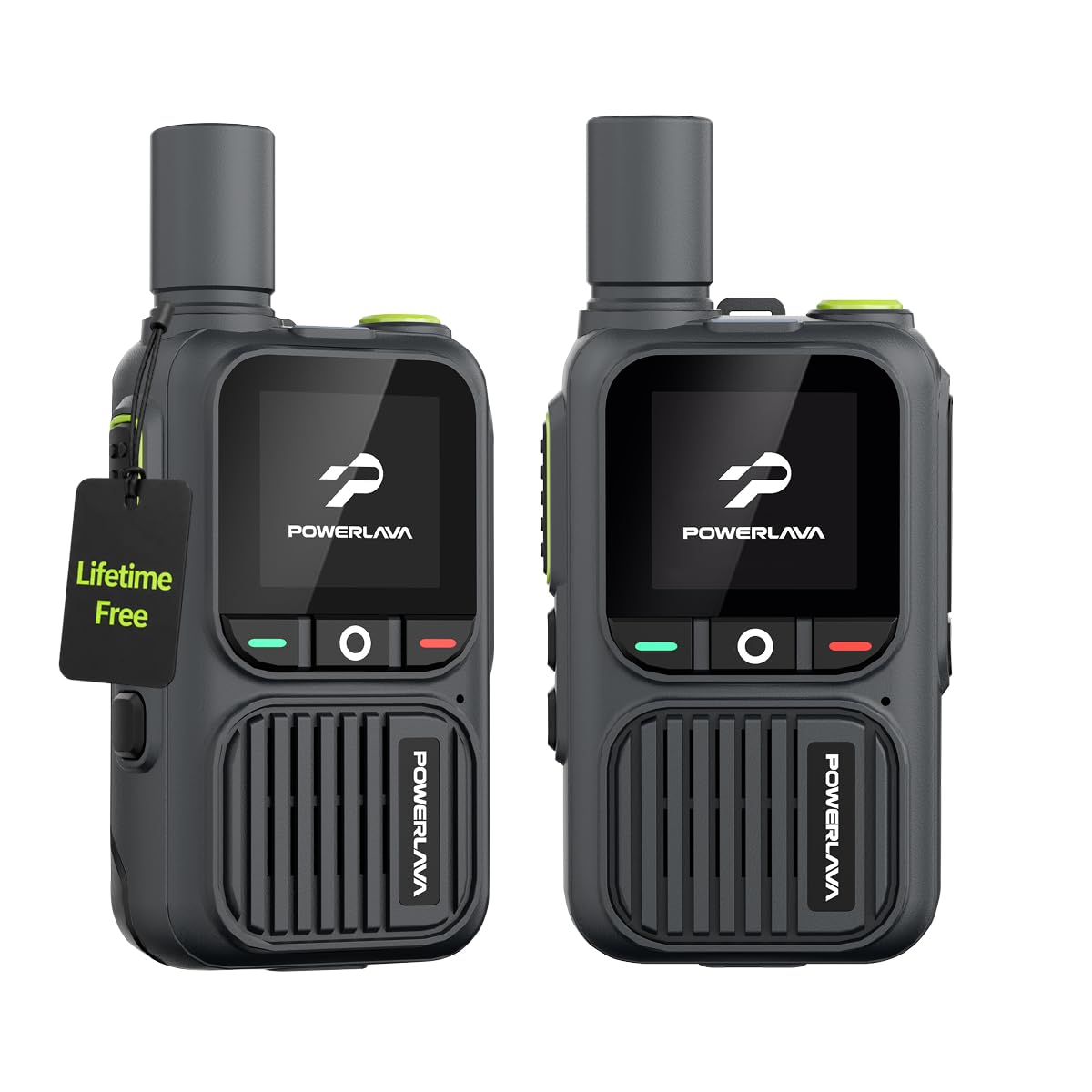
A privacy-first radio that keeps working when your road trip crosses a border.
The number to know is 80: this radio’s pre-installed anonymous SIM carries roaming across 80+ countries and regions. For a driver crossing into Canada or a crew spreading across a border, that is a wider net than most of this list. Every voice transmission runs under end-to-end encryption — a scramble that keeps the conversation to your group alone. The SIM runs off US-based servers, with no annual fee, no monthly subscription, and no hidden charge. You get 16 channels and a 3000mAh battery, water-resistant in the body.
You can run a whole team from one screen. Create a group, share a 6-digit code, and invite members in; the live member list shows green for online in your group, yellow for online elsewhere, and gray for offline, so a dispatcher sees the whole team at a glance. A Temp Call function lets you open a one-on-one private talk with any online member without making a permanent group. Small touches round it out: replay of the last received voice message, over-the-air firmware updates (the radio updates itself over the network, no cable needed), and the device’s IMEI (its unique ID number) shown on screen for asset tracking.
Where it gives ground is in the field. The 16-channel cap is the fewest on this list, so a large operation with many teams will feel boxed in. Like every cellular pick, it needs coverage to talk. Pairing with the Poclink app adds remote group control, and the whole thing is a sensible fit for privacy-minded users who want one clean channel and no monthly bill.
Privacy read: the anonymous SIM plus encryption is a genuine differentiator for sensitive deployments and cross-border work.
Fit caution: a 16-channel limit means the biggest crews should map their team structure before buying.
Pick this for: a two-person team that travels internationally or handles conversations they would rather keep private.
Think twice when: you are running dozens of separate teams — the channel count will feel tight.
6. KaYoTom M12 5000+ Miles 4G LTE PoC Radio, 4 Pack
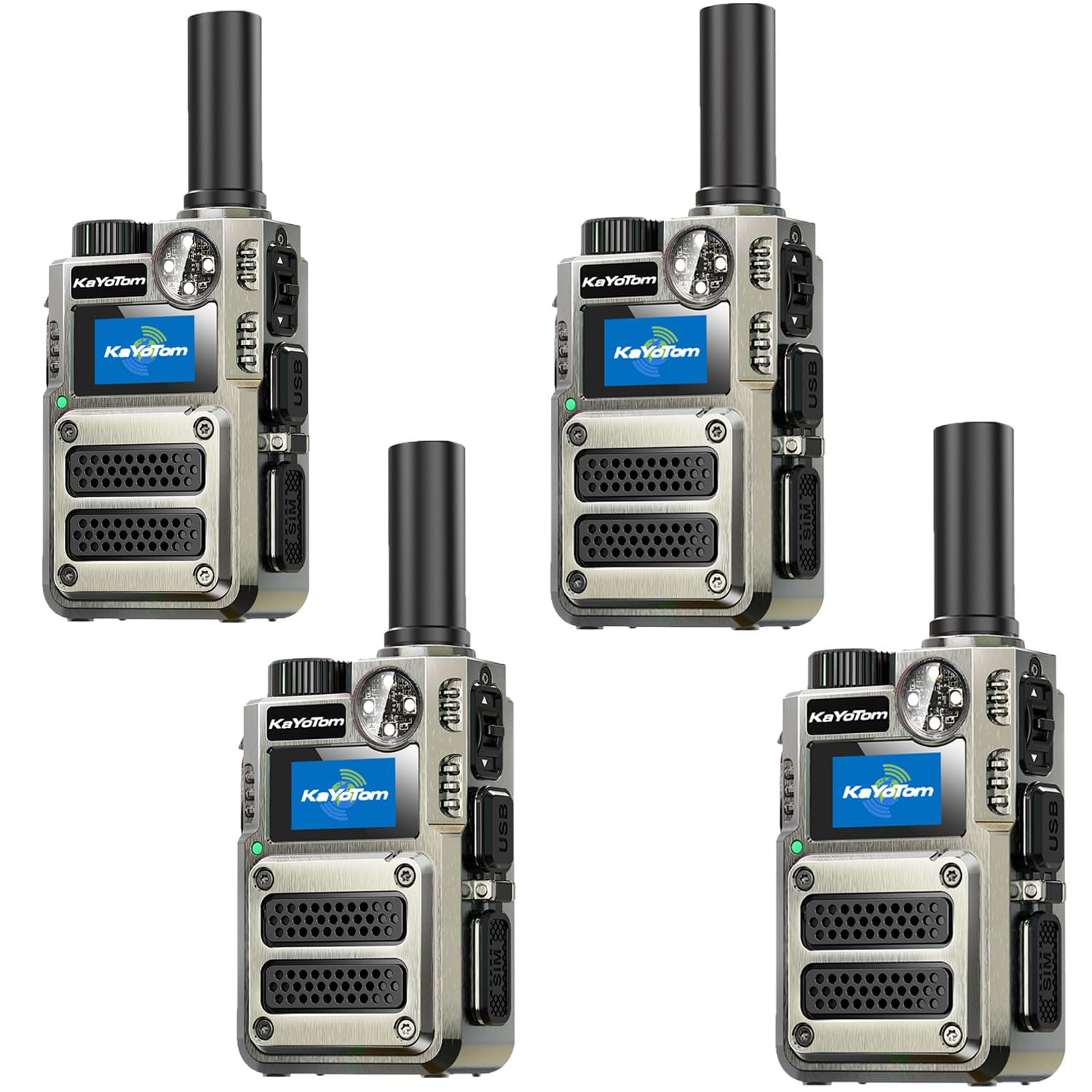
Four radios and a 5000-mile claim, aimed straight at truck fleets and hiking groups.
The headline is reach: with the SIM pre-inserted, this pack claims 5000+ miles of coverage, enough to talk from California to New York through the cellular network without pressing a thing but the PTT button. It wins people over on sound — HD voice carries closer to a phone call than a radio. The pack carries 200 channels and comes as four units, each with a detachable antenna and a 3000mAh Li-ion battery rated for 72h+ of use and 15 days of standby. A USB-C port restores 50% of that charge in 40 minutes, honest convenience for a driver on a short stop.
Set against the Midland GXT1000VP4’s 36 mile rating, the cellular gap is what sellers here charge for. A truck fleet, a construction roll-out, or a family convoy spread over a highway gets range no GMRS pair on this list can match. The SOS alert is a useful extra for a lone hiker or a driver stopped on the shoulder, and group management is a message to support away — they will link every IMEI into one talk group for you.
The footnotes matter. Devices do not link automatically on a repeat purchase — you must send the IMEI numbers from the back label or device settings before they share a group. Body falls into the same package as the others here, so the coverage is only as good as the nearest tower.
Why a fleet would choose it
- 5000+ mile reach across the cellular network
- 72h+ of use and 15 days of standby per unit
- USB-C recharge to 50% in 40 minutes
- Four detachable antennas ready to swap
The fine print
- Multi-device linking takes a manual IMEI hand-off to support
- Needs a cellular network, so remote backcountry routes go dark
- Not water resistant
Best matched to: highway crews and hiking parties who want four radios on one setup and can wait for a support link.
Better avoided if: your group splits into separate groups — the manual linking adds a step.
7. Arridioter AD-11 Lifetime Free 4G LTE PoC Radio, 2 Pack

The cheapest way onto a nationwide channel, packed with a SIM ready to go.
This is the entry point for a family or a small team who want unlimited reach without committing much. It runs PTT over 4G LTE, and the maker advertises a 5000 mile maximum — that is the cellular class in full, so a call from the Americas works as long as a tower stands nearby. The pack includes 200 group channels for slicing teams into separate calls, plus a 1.77-inch color screen and large PTT buttons that a gloved hand can find. The 3000mAh battery recharges over USB-C, with a power bank or car supply as an option.
Setup is genuinely painless: both radios arrive pre-set and both SIM cards are built in, so you unbox, power on, and talk. The SIM covers the US, Canada, and Mexico under one universal card — helpful for a low-cost trio of countries without a trip to a carrier. Functionality is what buyers talk about most, and those who use it note it reaching across the US and into Mexico.
Quality is the split point. Some find the little radios amazing for the outlay; others find them short of the premium packs. The body is not water resistant, so rain-soaked hikes want a dry pocket. At this price, neither issue rules it out for a family testing cellular radio for the first time.
Where the value shows: two handsets, two SIMs, and nationwide talk with no monthly fee — the cheapest path into the cellular class here.
A fit for: a family or pair testing out cellular radio before spending more on a full crew.
Not the one for: wet-weather work or demanding site use — it carries no weather-resistant rating.
Understanding the Specs
GMRS vs 4G LTE
GMRS is a radio service that uses its own frequency range (462.5500 – 467.7125 MHz) and needs a licence to transmit in the US. It works with no towers, so a mountain valley is no problem — but distance is capped by terrain. 4G LTE push-to-talk carries your voice over a phone network, reaching across states and countries, and ends the moment you lose signal. Choose by the ground you stand on.
Rated Max Range
The mile figure a maker prints is a best-case result under open sky and line of sight. Trees, buildings, and ridges cut reach fast. A cellular radio is different — its range is not a distance at all, but anywhere a tower reaches. When you see a figure like 36 mile on a GMRS pair, plan for less in real country and treat the number as a ceiling, not a promise.
Talk Hours and Standby Days
These are two separate specs and both matter. Talk hours measure how long you can hold conversations on one charge. Standby days measure how long it sits idle and still responds. A dispatcher needs long standby; a foreman needs long talk. Look at both before deciding whether a pack survives your shift.
Battery Capacity in mAh
mAh stands for milliamp-hours, the size of the fuel tank inside the battery. A bigger figure usually means more talk time between charges. 3000mAh is common across the cellular radios here, while the XOTODREM pack runs a 5000mAh cell for longer shifts. Match the mAh to your shift length: 3000mAh covers a standard day, while the 5000mAh XOTODREM G05 suits longer shifts.
Privacy Codes and Channels
Channels are the separate lines you can talk on. Privacy codes are sub-channels that keep other groups off yours — they do not scramble your voice, they just filter out strangers on the same channel. More channels means more room to split teams. A pair with 50 channels and 142 privacy codes holds plenty for a family, while a 200-channel cellular radio suits larger operations.
Weather and Water Ratings
A water-resistance rating tells you how much moisture a radio tolerates. The Midland pairs carry JIS4 weather resistance, and the Powerlava L1 is water-resistant — both handle rain. The Arridioter and KaYoTom packs hold no such rating, so wet conditions call for a dry case or a careful pocket. If you work outdoors year-round, weigh this properly.
FAQ
Do I need a licence to use a 50 mile range walkie talkie?
Will a GMRS radio really talk 36 miles?
Can a cellular walkie talkie work without a cell signal?
How many radios do I need for a family or crew?
Do the free SIM cards really cost nothing to run?
How long does the battery last on a full shift?
Can I add more radios to the same group later?
Are these radios water resistant enough for rain?
Can a GMRS radio talk to a cellular walkie talkie?
Which pick is best for hiking versus trucking?
Final Thoughts: The Verdict
If your trips leave cell coverage, the 50 mile range walkie talkie winner is the Midland GXT1000VP4, because it works with no tower, ships ready with charger and packs, and adds NOAA weather alerts (free US government storm and forecast broadcasts) for off-grid days — its 4.0+ stars across 13,000+ owners say most buyers are happy with the trade. If you want nationwide reach across states and cities, the TIDRADIO TD-G100 is the one to reach for, with four handsets and 72-hour batteries. For a privacy-first pair that travels across borders, the Powerlava L1 fits the bill. Decide whether your ground has cell signal first; that single answer narrows the list to GMRS or 4G LTE.
How We Picked
We do not accept paid placement. Every pick is matched to a real buyer and a real use-case; we do not hands-on test units.
Sources & Methodology
Specifications: manufacturer listings and product documentation. Review insights: verified customer reviews, as of November 2026. Pricing: not shown on this page (it changes often); check the current price via the retailer link.
As an Amazon Associate, Gadgets Feed earns from qualifying purchases. This does not affect which products we feature.