
Our readers keep the lights on and my morning glass full of iced black tea. As an Amazon Associate, I earn from qualifying purchases.
Specs are compiled from manufacturer listings and verified buyer reviews and can change over time — please confirm the key details on the product page before buying.
If your dates smear, fade, or rub off before the stock ever leaves the shelf, the fix is matching the printer type to the surface you actually print on. Manual label guns stamp sticky paper labels you peel and press. Handheld inkjet coders spray ink straight onto cartons, glass, and plastic. Mismatch the two and the job stalls: a label gun won’t stick to a wet bottle, and an inkjet is overkill on a flat uncoated carton. Below are seven date printers that each solve a different version of that job.
I’m Min — the founder and writer behind Gadgets Feed. This guide is built by comparing the manufacturers’ published specifications and the patterns across verified customer reviews, so you get each pick’s real strengths and trade-offs instead of marketing spin.
You will see how print height, ink type, and label capacity separate a warehouse workhorse from a pocket coder. The quick comparison table up top gets you to two finalists fast, and the reviews explain exactly where each one fits. My full breakdown of the before date printer market below covers manual label guns and handheld inkjet coders side by side.
Our Picks at a Glance

How To Choose The Best Before Date Printer
Start with one question: are you applying a label, or printing ink directly on the product? That single answer separates the manual label guns from the handheld inkjet coders. A label gun peels and presses a sticker, so it works on almost any clean, dry surface. An inkjet coder sprays a date straight onto the item, so there is no sticker to peel off in a cooler or a wash-down.
Label gun or inkjet coder
A manual label gun suits low-to-medium volume work where the surface is dry and the date needs to be readable at a glance. You pull the trigger, a pre-printed label with your date advances, and you press it on. An inkjet coder suits higher volume and awkward surfaces like curved bottles, pipes, or cartons. It sprays the date on directly, so there is no label stock to buy and no backing paper to peel.
The trade-off is control. A label gun puts the date in exactly the same spot every time. An inkjet coder depends on a steady hand and, on curved surfaces, a positioning plate to keep the print lined up.
Print height and how many lines you need
Print height is the tallest character the machine can produce, expressed in inches or millimeters. A date plus a batch number usually needs two lines, so check the line count along with the height. A coder that prints a single line of large text is fine for a big date stamp but useless if you also need a lot code underneath.
Ink drying speed and surface
Quick-drying ink sets fast so the print does not smear when the item is handled or stacked. Water-based ink is common and works well on porous surfaces like cartons. On glass, metal, or plastic, the surface and the ink type have to agree. Check the manufacturer’s stated material list before you buy, because a coder that prints beautifully on paper may struggle on a glossy bottle.
Labels, cartridges, and running cost
Label guns are sold with a set number of labels, and you buy refills in packs. Inkjet coders use a cartridge measured in milliliters, and you replace it when it runs dry. Ask how many labels come in the kit or how large the starter cartridge is, because that number decides how soon you are buying supplies again.
Quick Comparison
| Model | Best For | Type | Print Height | Ink or Labels Included | Amazon |
|---|---|---|---|---|---|
| Perco Pro 1 Line Date Label Gun Kit★ Best Overall | High-volume label stamping | Manual label gun | — | 10,000 plain white labels + preloaded inker | Amazon |
| Perco X 1 Line Dater GunBest Value | Budget-friendly label dating | Manual label gun | — | 9,000 white blank labels + extra inker | Amazon |
| MS-Z10 Handheld Inkjet Printer Gun | Curved and mixed surfaces | Handheld inkjet | 0.08–0.5 inch | 42ml quick-drying black cartridge | Amazon |
| Phezer PC11 Plus Mini Inkjet Printer | Pocket-sized portability | Handheld inkjet | 2–12.7mm | 42ml quick-drying black cartridge | Amazon |
| Phezer P15 Handheld Inkjet Printer | Standalone printing, no phone needed | Handheld inkjet | 2–12.7mm | 42ml black cartridge | Amazon |
| BESHENG PT3000 Handheld Inkjet Printer Gun | Reliable multi-surface coding | Handheld inkjet | 0.08–1 inch | Fast-drying black cartridge | Amazon |
| BESHENG PT2000SE Portable Inkjet Printer | App-driven label and date printing | Handheld inkjet | 0.118–0.49 inch | Quick-drying black cartridge | Amazon |
In‑Depth Reviews
1. Perco Pro 1 Line Date Label Gun Kit, Includes 8 Digits Date Gun Labeler, 10,000 Plain White Labels, and Preloaded Inker
Our pick — 4.0+★ from 400+ verified ratings; the strongest balance of quality and price.
Ten thousand labels in the box means you stop reloading and get the run finished.
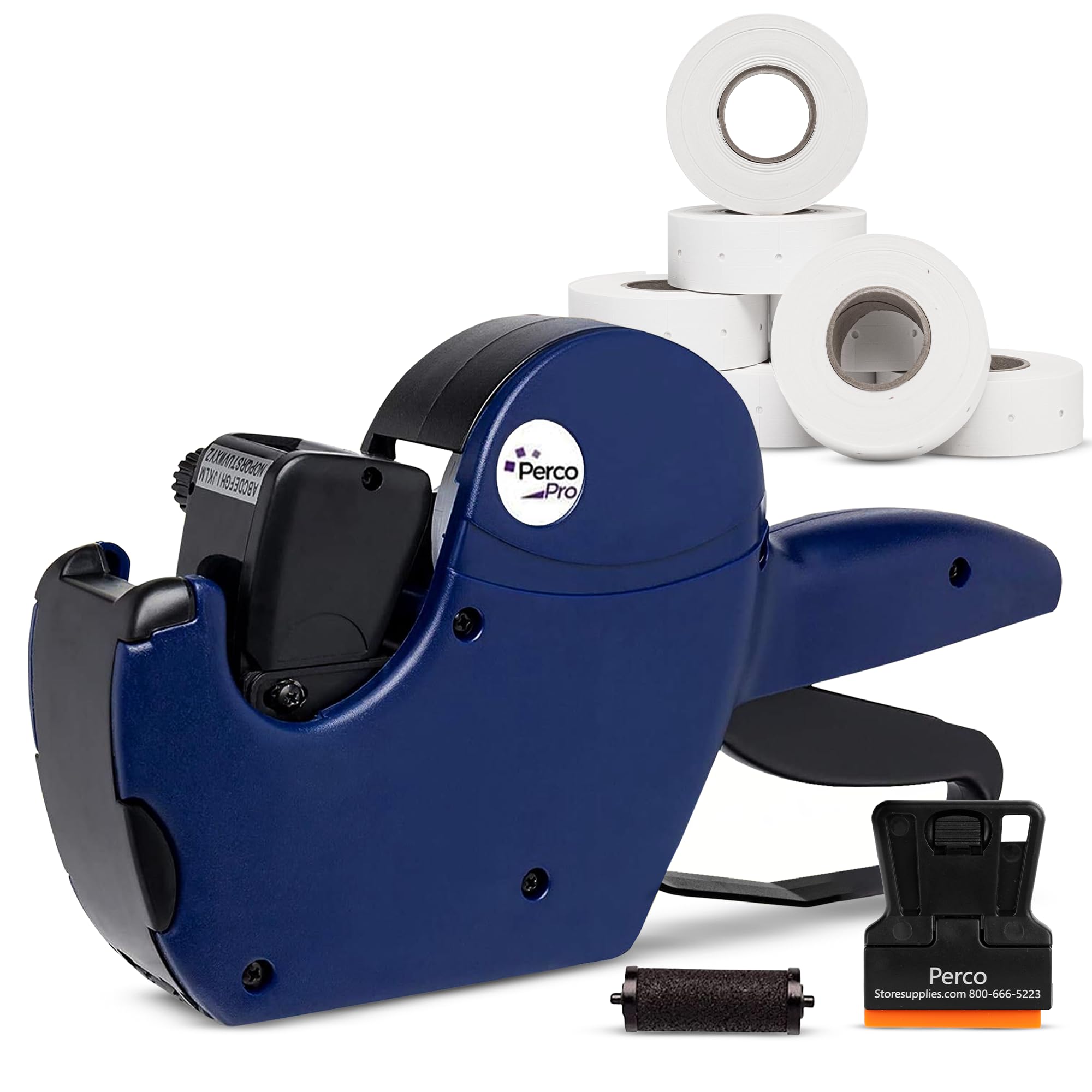
Ten thousand plain white labels is the number that decides this one. That is a stockpile big enough to get a small brewery or a bakery through months of daily date coding before you buy a refill. The gun itself holds 8 digits of interchangeable type, so you set the date once and stamp it the same way on every container. Its dispensing core measures 3 inches, which tells you the label roll is a healthy diameter — fewer roll changes in a shift.
The day-to-day reality of a manual gun like this is speed. You pull the trigger, a label advances, you press it down. No screens, no app, no charging. The 0.9 kg weight (about 2 lbs) sits in your hand comfortably enough for a long run, and the plastic body keeps it from feeling like a brick. Its strongest suit is the 10,000-label kit that keeps a busy kitchen coding for months without a refill.
The honest catch is print clarity. The recurring gripe is that the inked date does not always come out sharp — the print can look light or patchy, so ink your type carefully and test on a spare label before committing to a full run. Weigh that against the sheer volume you get: if you value label count and a manual gun’s simplicity over pin-sharp type, this is the one.
What earns the top spot
- 10,000 plain white labels in the kit means months of coding before a refill
- 8-digit interchangeable type handles full dates
- Fully manual operation — no batteries, no app, no charging
- 3-inch dispensing core keeps roll changes rare
Where it asks for care
- Inked date can print light or patchy — test a spare label first
- Manual gun relies on your hand pressure for an even impression
Pick it if: you run a busy kitchen, bakery, or brewpub and want to date code thousands of items without touching a charger.
Think twice if: you need razor-sharp printed text rather than a stamped ink impression — an inkjet coder is the better tool for that.
2. Perco X 1 Line Dater Gun with Labels Kit – 1 Line Label Gun with 9000 White Blank Labels, and an Extra Inker
A lighter label gun with a smaller roll core — easier to swing, quicker to flip through a run.
Here is where the two Perco guns split in a way that actually matters at the counter. This X model has a dispensing core of 0.75 inches, while the Pro kit above runs a 3-inch core. A smaller core means a more compact roll that takes up less shelf space and, in practice, feels easier to manage in a cramped prep area. The weight backs that up too: at 0.8 kg versus the 0.9 kg Pro, a difference you notice by the end of a long shift.
You still get a serious stock of labels here — 9,000 blank white ones — plus an extra inker in the box, so a dry stamp is not instantly a work-stopping problem. Manual operation keeps it dead simple: pull, advance, press. There is no charging, no app pairing, no firmware to think about.
The lighter-gun argument: if your team swaps the gun between stations all day, the lighter body and compact roll are genuine wins over the heavier Pro kit.
The other side of the coin: a single-line gun stamps one row of type, so a date plus a separate lot code means two impressions or a shorter date format.
Reach for this if: you want the lower-cost Perco for lighter-duty label dating and prefer a smaller, easier-to-handle roll.
Look elsewhere if: you want the maximum label stockpile per kit or a single full-date impression with 8 digits — the Pro kit covers both.
3. Handheld Inkjet Printer Gun MS-Z10 with 42ml Quick-Drying Ink Cartridge Portable Handheld Printer for Text/Barcode/Logo/QRCode/Counter/Batch Number/Date Coder

A gun-shaped coder that handles lettering tall or small, straight onto the carton.
The MS-Z10 packs a 4.3-inch touchscreen, which means you edit the date and lot number right on the device rather than tethering to a phone. Print height runs from 0.08 to 0.5 inch, and it supports 1 to 5 lines of text — enough for a full date, a batch number, and a short note stacked together. Resolution is selectable at 300, 400, or 600 DPI, the measure of how fine the printed characters come out.
What makes this fit awkward jobs is the surface range. The maker lists carton boxes, metal boards, wood, glass, and curved surfaces, with an auxiliary positioning plate to steady the line on a round item. A 42ml quick-drying black cartridge is included, and the quick-dry part matters when you stack items seconds after printing.
Weigh the honest picture: the ease of use draws a solid nod, but ink quality and print results split opinion — some buyers get crisp output, others hit trouble, and a few units arrived with a malfunctioning screen. That is a mixed record, not a dealbreaker, but it is why you should test print on a scrap surface before a live run. This is the pick for someone printing on bottles, pipes, and cartons who wants on-device editing.
Best for awkward shapes: the positioning plate and curved-surface support make this the natural tool for round or uneven items a label gun cannot press flat.
The print-quality gamble: results are mixed across buyers, so a quick test print on your actual surface is worth the minute.
Good match for: a small operation printing dates and batch codes on curved bottles, pipes, or mixed packaging, with on-screen editing.
Not your tool if: you need guaranteed sharp output on the first try — a manual label gun gives more predictable impressions.
4. Phezer Upgraded Mini Inkjet Printer for Flat and Curved Surface PC11 Plus, 25 Languages & Quick-Drying Ink Cartridge

Half a pound of printer that drops in a pocket and codes dates on the go.
A 0.55 lb (0.25 kg) body is the whole personality of the PC11 Plus. It is small enough to carry on a delivery route or between job sites without a bag, and Phezer built it for flat and curved surfaces both. Print height adjusts from 2mm to 12.7mm, and length is not limited — the practical meaning is you can print a long line without the coder choking on it.
Content coverage is broad: text, dates, times, QR codes, barcodes, and logos across paper, board, carton, stone, pipe, cable, metal, glass, plastic, and cloth. It supports 25 languages and 360-degree all-round printing, so orientation is not a fuss. A 42ml black quick-drying cartridge ships in the box.
Where it asks for patience: print quality is the mixed note here — some buyers find it great, others say it falls short of their expectation, and the cartridges are not cheap to replace. Reliability, though, is what draws the steadiest praise, with the machine handling its work consistently. If your job means printing on the move and you accept a learning curve on print setup, this fits; if sharp, repeatable output is everything, weigh it against your test print.
Portability wins: at 0.55 lb with pocket-scale dimensions, it is the easiest coder here to keep on you all day across sites.
Running-cost honesty: replacement cartridges add up, and print quality is a mixed experience rather than a sure thing.
Worth it for: field techs and small business owners who need a genuine pocket coder for dates and codes on the move.
Consider skipping if: you plan high-volume runs where a heavier, stationary coder and cheaper consumables make more sense.
5. Phezer P15 Handheld Inkjet Printer for Flat Surface 0.5 Inch Nozzle for QRCode Barcode Production Date Time Logo Batch Number Print (25 Languages)

It runs standalone — no app, no computer, just a touchscreen and a trigger.
This is the pick for anyone who has been burned by a coder that only works while tethered to a phone. The P15 carries its own upgraded cortex-A9 quad-core CPU and an independent system, so it prints after hours of use without pairing to anything. A 4.3-inch LCD touchscreen lets you type and edit the date and batch number directly on the device. The rechargeable 2000mAh battery is the other big draw — it means the coder goes where the outlet does not.
Produce a wide range of content with it: text, QR codes, barcodes, production dates, times, and logos across paper, board, carton, stone, pipe, cable, metal, glass, plastic, and cloth. Print height runs 2mm to 12.7mm with length unlimited, and it covers 25 languages plus 360-degree all-round printing with positioning plates. A 42ml black quick-drying cartridge comes included.
The fair warning sits with print quality. Ease of use earns steady praise, but print results split buyers — some call it excellent, others are let down. At 1.54 lb it is light enough to hold one-handed, though the pocket model above is 0.55 lb, so this one leans toward counter and bench use. Treat it as a strong standalone coder when portability and phone-free operation matter most.
The straightforward buy: pick the P15 if you want to edit dates on a bright 4.3-inch touchscreen and never depend on a phone app.
Hold off if: print consistency is your top priority and you would rather test-print first — the quality reports are genuinely split.
6. Handheld Inkjet Printer Gun PT3000 Printing Height 0.08-0.5Inch Inkjet Coder with Original Fast-Drying Ink for Text QRCode/Barcode/Batch Number/Label/Image/Date Printer
A taller print height and a machine that keeps its nerve on multi-surface runs.
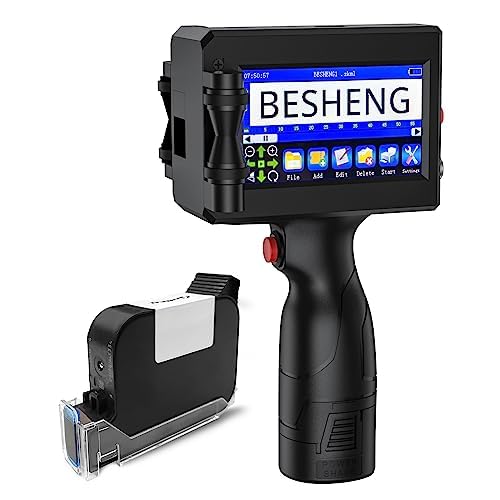
Print height is what sets the PT3000 apart in this group — it reaches from 0.08 inch up to 1 inch, versus a 0.5-inch ceiling on several rivals here. That extra height means bigger, more legible characters on a carton or pipe. It prints 1 to 5 lines at a time, and carries 28 built-in languages including English, Japanese, Spanish, and Portuguese. You edit content right on the 4.3-inch touchscreen, or import text and BMP images from the included USB drive.
Surface coverage runs from paper, carton, and wood to metal, plastic bottles, ceramic, aluminum cans, glass, stone, PVC pipe, and fiber cloth — with a sheet-metal positioner supplied for circular or curved items. The included black fast-drying ink sets quickly, and the maker states it becomes waterproof once dry. That waterproof claim is worth knowing if the coded item will see condensation or a cold-room wipe-down.
Reliability is what wins people over here — it holds up on multiple packaging surfaces without jams, and the recommendation rate is right up there with it. The catch to weigh is price position: it sits at the premium end of this list, so you are paying for the taller print height and the dependable multi-surface run. For a warehouse or packing line that codes cartons and bottles all day, that trade makes sense.
The reliability case: consistency on varied surfaces without jams is the reason this one earns strong word-of-mouth, and the 1-inch height beats most rivals.
The premium trade: it is one of the costlier coders here, so a light-duty user may not need its full capability.
Built for: warehouses and packing lines that code cartons, cans, and bottles in volume and want a coder that keeps pace.
Think smaller if: you only stamp a handful of dates a week — the taller print height is wasted on low output.
7. PT2000SE Portable Inkjet Printer with Quick-Drying Ink Cartridge, Handheld Mobile Inkjet Code Printer for Labels, Production Date/Time, Barcode, QR Code, Logo

Set the date on a phone app, then press it onto anything flat.
The PT2000SE takes a different route to your content. You can type directly on the control-panel keyboard, or download the Seabird Sticker Printer app and drive the printer from an iOS or Android device. That app route opens up 7 languages — English, German, Spanish, French, Italian, Japanese, and Chinese — while the machine itself handles English and Chinese. Print height runs 3mm to 12.5mm across 1 to 4 lines, with a nozzle-to-surface distance of 2mm to 5mm.
The body weighs 440g and uses a matte, non-slip finish, so it sits steady in your hand for longer coding sessions. The black quick-drying cartridge makes clear prints, and it is rated for flat surfaces from wood board and plasterboard to leather, stone, steel, pipe, metal, aluminum foil, cable, carton, and envelope. The listing cites FCC, ROHS, and UL certifications and 12 months of after-sales service.
Quality and value draw solid approval, and most buyers find it easy to use. The mixed notes land on reliability — some units work well, others arrive unusable — and on battery life, where charging trouble comes up. That means checking the charging from the start is the smart first move. For a small shop that wants app control and a matte grip for hand coding, it earns a place; if you need running-voltage certainty, test the battery early.
Why it makes the list
- App control via Seabird Sticker Printer adds 7 languages on iOS and Android
- 440g matte, non-slip body stays comfortable for long coding sessions
- Prints across wood, stone, metal, pipe, cable, carton, and envelope
- 3–12.5mm height and 1 to 4 lines handle full dates plus a code
The honest caveats
- Reliability is a mixed record — some units work, others arrive unusable
- Battery and charging issues surface for some buyers
Fits well if: you want to compose dates and codes on a phone app and print them onto flat packaging, leather, or cartons by hand.
Test first if: you are buying sight-unseen — checking the battery and a sample print on arrival protects you from the mixed reliability.
Understanding the Specs
Print Height (Inches or Millimeters)
Print height is the tallest character a coder can produce, measured in inches or millimeters. It decides whether a single line is a bold readable date or a tiny one. A taller height like 1 inch means a big, standable-off date on a carton. A shorter range like 0.08 to 0.5 inch keeps the lettering small and neat, better for a bottle neck or a small label area. If you need a date plus a batch number, also check line count — many coders print 1 to 5 lines in one pass.
Ink Cartridge Volume and Type
Inkjet coders use a cartridge measured in milliliters, and the number tells you how much printing you get before a refill. A 42ml quick-drying cartridge is common. Quick-drying means the ink sets fast, so the print does not smear when the item is stacked or handled right after coding. Water-based ink works well on porous surfaces like cartons; on glass, metal, or plastic, the surface and ink type have to match, so confirm the material list before buying.
DPI (Dots Per Inch) and Sharpness
DPI, or dots per inch, measures how finely an inkjet coder lays down its characters. Higher resolution means crisper edges on small text and sharper barcodes and QR codes. Selectable settings like 300, 400, or 600 DPI let you trade print speed for detail. For tiny codes that a scanner has to read, the higher resolution setting is worth choosing.
Label Core Diameter and Capacity
On a manual label gun, the dispensing core diameter is the size of the label roll’s center hole, measured in inches. A bigger core, like 3 inches, holds a larger roll so you change label stock less often. Capacity is the number of blank labels in the kit — 9,000 or 10,000 labels means months of coding before a refill. Smaller core guns are more compact, which helps in a tight prep area.
FAQ
Is a label gun or an inkjet coder better for printing a best before date?
Can a handheld inkjet printer print on glass bottles?
How many labels does a manual dater gun kit include?
What print height do I need for a date plus a batch number?
Does quick-drying ink smear when items are stacked?
Do handheld date printers need a phone or computer to work?
How often do I replace the ink cartridge on a date coder?
Can a label gun print dates on plastic or metal containers?
What does DPI mean on a handheld inkjet coder?
Final Thoughts: The Verdict
For most people code-dating in volume, the Perco Pro 1 Line Date Label Gun Kit is the safe call — 10,000 labels in the box and a fully manual, no-charge operation that simply gets the run done. If you need to print onto curved bottles, glass, or pipes, the BESHENG PT3000 is the one to reach for, with its 1-inch print height and dependable multi-surface coding. And if you want to compose dates on a phone app before pressing print, the BESHENG PT2000SE fits a small shop that codes by hand. Match the tool to your surface first; print height and label capacity follow from there.
How We Picked
We do not accept paid placement. Every pick is matched to a real buyer and a real use-case; we do not hands-on test units.
Sources & Methodology
Specifications: manufacturer listings and product documentation. Review insights: verified customer reviews, as of November 2026. Pricing: not shown on this page (it changes often); check the current price via the retailer link.
As an Amazon Associate, Gadgets Feed earns from qualifying purchases. This does not affect which products we feature.