
Our readers keep the lights on and my morning glass full of iced black tea. As an Amazon Associate, I earn from qualifying purchases.
Specs are compiled from manufacturer listings and verified buyer reviews and can change over time — please confirm the key details on the product page before buying.
If your layer cakes keep coming out with one side thicker than the other, you need a leveler that holds its height while you saw. For most kitchens, buy the PME 18-inch Cake Leveler. Its 18-inch serrated blade (a toothed edge that grips the sponge instead of tearing it) spans a full 18 x 7.4-inch frame, so a big celebration cake gets sliced in one steady pass.
I’m Min — the founder and writer behind Gadgets Feed. This guide is built by comparing the manufacturers’ published specifications and the patterns across verified customer reviews, so you get each pick’s real strengths and trade-offs instead of marketing spin.
Below are nine levelers sorted by how they behave in a kitchen, from single-wire cutters to multi-blade frames. The short version: match the frame width to your biggest cake tin, then decide between a wire or a blade. Here is what matters most when you shop for the best Cake Leveler.
Our Picks at a Glance


How To Choose The Best Cake Leveler
Every leveler does the same job — hold a cutting edge at a fixed height so the blade passes through the sponge flat instead of diving. What separates a good one from a frustrating one is how rigid the frame stays when you push, and whether the frame is wide enough to clear your tin.
Wire or serrated blade
A tensioned wire glides through soft sponge with almost no drag, which is why it suits delicate genoise and mousse cakes. A serrated blade (a saw-toothed edge) needs a back-and-forth motion, but it handles denser bakes like fruit cake and brownie without snagging. Neither is better outright — pick the edge to match the crumb you bake most.
Frame width and blade length
This is the number buyers get wrong most often. A narrow frame simply cannot span a wide tier, so you end up cutting in two passes and the second cut never lines up with the first. Measure your largest cake tin across the top before you order, then check the leveler’s stated blade length and item length against it.
How the height adjusts
Most wire levelers use notches along the legs — you press the plastic slider and walk it up or down a step at a time. That gives you repeatable layer heights, which matters when you want three even tiers, but the notched sliders are where fiddly adjustment complaints tend to live. A screw-adjust design moves in finer steps but demands more patience.
Build and cleanup
Stamped metal (pressed from a single sheet) is light and cheap to make; forged builds are heavier and hold their shape under pressure. Check the dishwasher line honestly — a stainless frame marked dishwasher safe is easy to live with, while a thin wire under tension rewards hand washing with a longer straight life.
Quick Comparison
| Model | Best For | Blade Length | Item Length | Item Weight | Amazon |
|---|---|---|---|---|---|
| PME 18-inch Cake Leveler, Silver★ Best Overall | Big celebration tiers | 18 inches | 7.4 inches | 6.4 ounces | Amazon |
| Professional 10-Inch Stainless Steel Cake Leveler & SlicerBudget Champion | Small tins, tight cabinets | 0.35 inches | 11.89 inches | 0.12 kg | Amazon |
| Boao 3 Pieces Kitchen Baking ToolsThree-Piece Set | One order, three tools | 6.3 inches | 6.3 inches | 10.2 ounces | Amazon |
| XL Adjustable Cake Layer Cutter Leveler Slicer | Very wide 16-inch tiers | 16 inches | 20.8 inches | 5.6 ounces | Amazon |
| Cake Leveler with Adjustable Wire, 17 Inch | Lightweight counter storage | — | 17 inches | 3.2 ounces | Amazon |
| Mrs. Anderson’s Baking Multi 7-Layer Cake Slicer and Leveler | Seven layers in one press | — | 11.75 inches | 1.01 pounds | Amazon |
| IBILI 708933 Cake Leveler | Simple stainless build | 33 centimeters | 33 centimeters | 0.1 kg | Amazon |
| Agatige Adjustable Cake Leveler | Three blade changes | 20.5 centimeters | 8.07 inches | — | Amazon |
| Professional Cake Leveler Slicer Cutter 4-Layer | Multi-layer batch work | 3.5 inches | 14 inches | 12.8 ounces | Amazon |
In‑Depth Reviews
1. PME 18-inch Cake Leveler, Silver
Our pick — 4.0+★ from 2,000+ verified ratings; the strongest balance of quality and price.
A full-width saw that clears the biggest tier in one clean pass.
Where this one earns its keep is sheer span. The serrated alloy-steel blade runs 18 inches (a toothed edge that bites into the crumb and keeps the line straight), and that clears a wide tier without you restarting the cut halfway. Blade length is the spec that decides everything here: the Professional 10-Inch tool in this list lists 0.35 inches of blade, so the two are built for entirely different jobs.
The stamped metal frame measures 18 x 7.4 inches and weighs 6.4 ounces, which is light enough to steer with one hand while your other hand steadies the turntable. For big sponge tiers — the sort that get split into three layers and stacked — that lightness plus the wide span is the combination that keeps the cut level from edge to centre.
What wins people over is the stamped metal frame, which stays rigid as the 18-inch blade moves. That is the aspect folks bring up most, and it lines up with the way the adjustable cutting level locks into a height and stays there as the saw moves. Reviewers also praise the even slices it turns out on both large and small layers. The honest catch sits with the adjustment: several bakers find the height slider easy, others find the notched process fiddly to dial in. If your cakes live at one fixed layer thickness, that matters little. If you switch heights constantly, budget a little practice.
What earns its reputation
- 18-inch serrated alloy-steel blade spans a large tier in one motion
- Adjustable cutting level holds a repeatable layer height
- 6.4 ounces keeps it light enough to steer one-handed
- Praised for even cuts on both large and small layers
Where it asks patience
- The notched height adjustment splits opinion — some find it fiddly
- Very wide frame takes real cupboard space between bakes
Buy it for: tiered celebration cakes and anyone splitting a wide sponge into three even layers.
Think twice if: you bake in 6-inch tins and want something that tucks into a drawer.
2. Professional 10-Inch Stainless Steel Cake Leveler & Slicer Baking Tool
A wire cutter sized for everyday tins, not wedding tiers.
This one is built around a wavy cutting wire that mimics a serrated knife’s action, so it slices cleanly and leaves less crumb debris scattered across the top. The scale on the side lets you set a layer thickness and hold it, which turns “roughly even” into genuinely even. It tops out at cakes within 10 inches across and above 2 inches tall, so it suits standard sandwich tins rather than a stacked tier.
The stainless body carries a non-slip plastic handle, and the whole thing is dishwasher safe — sponge residue wipes or rinses off far faster than with a wide frame. The wire moves via notched plastic sliders on the legs: press, then pull up or down a step. That notched action is the toolless way to change height, and it is also the part that rewards a bit of care rather than a hard yank.
Who this fits: home bakers working with a single 8-inch or 10-inch tin, and anyone who wants the cut height repeated batch after batch without eyeballing it.
The honest limit: the 10-inch ceiling is a hard stop. If your tin is wider, this wire simply cannot span it — step up to a wider frame rather than fighting it.
Reach for this if: your cakes live in the 8-to-10-inch range and you want a wire cut with a built-in scale.
Look elsewhere if: you regularly bake tiers wider than 10 inches.
3. Boao 3 Pieces Kitchen Baking Tools, Adjustable Cake Levelers, Double Wire Cake Slicer
One box that outfits a beginner’s whole cake-cutting drawer.
Three separate tools arrive together: a double-wire leveler, an adjustable single-wire leveler with a non-slip handle, and a serrated bread knife. That is the appeal — you get the double wire for slicing a cake into thin parallel layers in one action, the single wire for standard torting, and the knife for trimming domed tops. The levelers measure 11.8 x 6.3 inches and 12.6 x 6.3 inches; the knife runs 16.9 inches long.
Both levelers adjust the same way: press the plastic slider and walk the wire up or down the metal notches. All three pieces are stainless steel and dishwasher safe. Compare the weight: 10.2 ounces for this set against 3.2 ounces for the Cake Leveler with Adjustable Wire on this list. That heft is the trade for having three tools in one order.
The thing to know: Functionality is what people praise here most, and the notched adjustment does its job for basic torting.
Where opinion splits: durability and quality land as mixed feedback — some love the set, others find it less sturdy than hoped. It is best treated as a starter kit for light home baking rather than a workhorse for a busy bakery.
Best suited to: a new baker who wants two levelers plus a serrated knife without buying them separately.
Not the pick for: heavy daily production where a stiffer frame matters more than variety.
4. XL Adjustable Cake Layer Cutter Leveler Slicer for 6-16 Inch Large Layer Cakes

The widest frame here — and the one that needs the steadiest hand.
For a genuine 16-inch tier this frame goes the distance: a 16-inch serrated stainless blade, a full length of 20.8 inches, and a stated working range of 6 to 16 inches. It folds down for storage, which a frame this long badly needs. Set against the Boao set in this list, whose items measure 6.3 inches long, that length is the whole point — you cut a wide tier in one pass instead of restarting mid-cake.
The scale lets you set a layer thickness, and a sawing motion is meant to leave a smoother top with less crumb fall. What the design does not solve is rigidity. Cutting performance draws the most discussion, and it trends negative: the 16-inch blade is described as too flexible, so it can wander off line under pressure. Build-quality feedback lands the same way, with several buyers calling the long frame too flexible to hold a straight line.
Weigh the appeal honestly. At 5.6 ounces it is light for its size, and the fold-flat frame helps if space is tight. But a flexible blade in a long frame is the hardest combination to keep straight, so this suits a patient hand and a light sawing stroke. If you want a 16-inch cake cut reliably, treat this as a budget route with a real learning curve rather than a set-and-go tool.
Worth considering if: you bake genuinely large 16-inch tiers and want a foldable frame that stores flat.
Skip if: you want a blade that stays dead straight with no technique — a stiffer build serves you better.
5. Cake Leveler with Adjustable Wire, 17 Inch
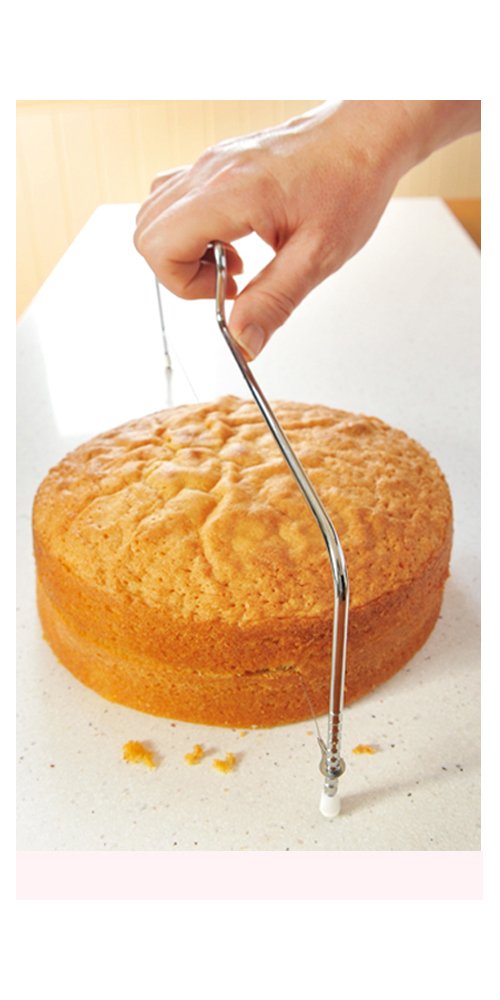
Ten fixed height notches, and barely any weight to carry.
The adjustable wire here clicks into 10 different heights via notches along the legs, so you can level a domed top or slice a thick layer into several thin tortes by stepping down the ladder. The frame measures about 16-3/4 inches wide, and plastic feet at the base steady it on the counter while you draw the wire through.
Weight is the standout number: 3.2 ounces. That makes it the lightest single leveler in this lineup. The Boao set runs 10.2 ounces. So it lifts off the shelf and onto the turntable with no fuss, and it stores flat in a slim drawer gap.
What it does well: the ten-notch height ladder gives you repeatable layer thicknesses without a scale to read, and plastic feet keep the frame planted as you cut.
What to expect: this is a lighter-duty wire frame, and the high wire tension a leveler relies on is helped by careful handling. Wash it by hand and store it flat rather than stacking tins on top.
Pick this one if: you want a featherweight wire leveler with plenty of height steps that slips into a drawer.
Better to pass if: you bake dense, heavy cakes that need a stiff, loaded frame behind the wire.
6. Mrs. Anderson’s Baking Multi 7-Layer Cake Slicer and Leveler
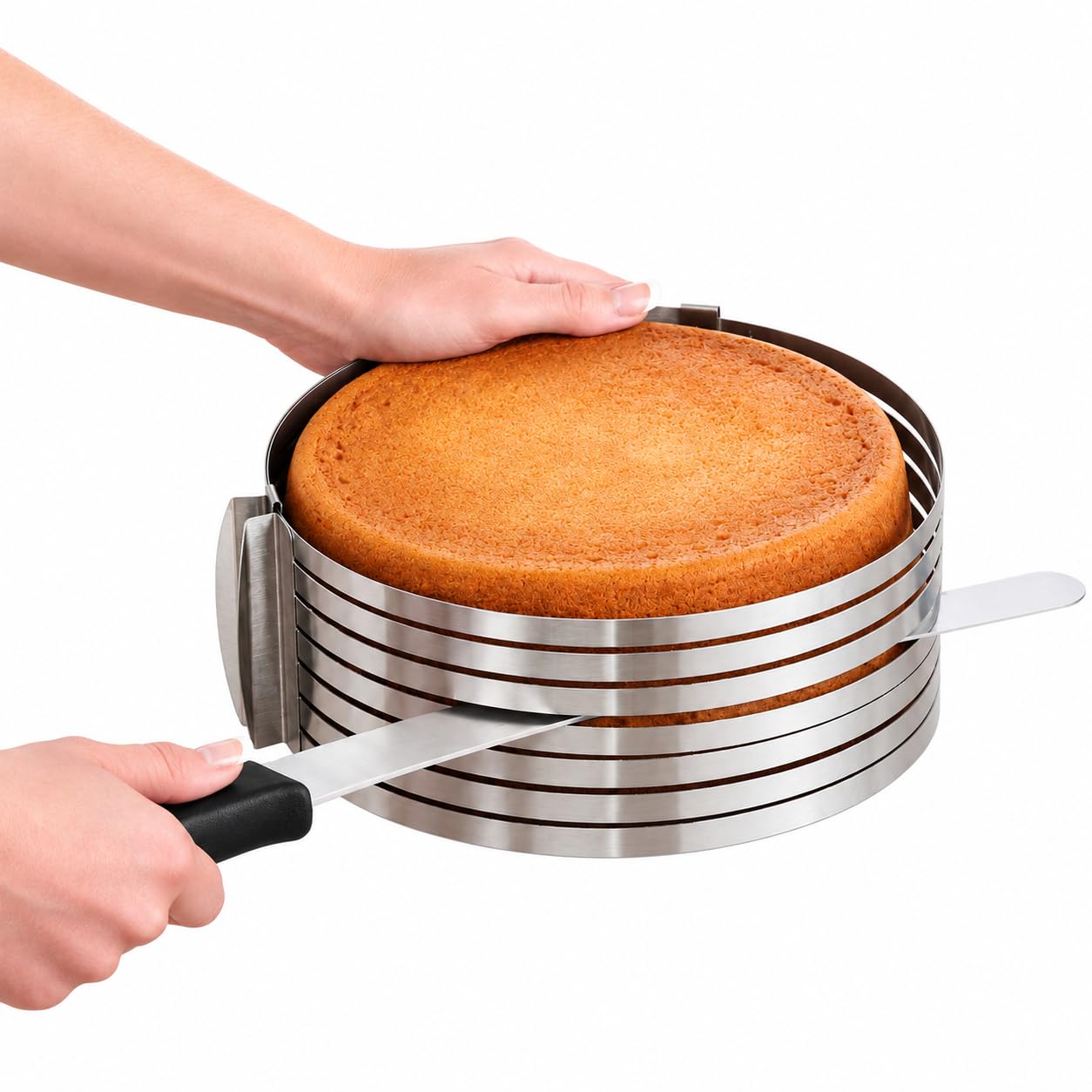
A slotted frame that turns one sponge into up to seven even tiers.
Instead of a single moving wire, this is a stainless frame with multiple slots. Slice through every slot for 7 thin layers, cut every other slot for 3 thicker ones, or mix and match. It is made from stainless steel 0.5-millimetres thick and expands to fit cakes from 9 to 12 inches across, with a solid centre section supporting the sponge so it slices without crumbling.
When closed it measures 9.25 x 3.3 inches and opens fully to 11.75 x 3.3 inches. Here is where the size maths gets interesting: this frame measures 3.3 inches of height against the 0.5 inches of the Cake Leveler with Adjustable Wire. So give it a little more cupboard headroom. It weighs 1.01 pounds and is dishwasher safe.
Best when you batch-build: a multi-layer torte cake, where pressing one frame over the sponge and cutting all the slots at once gives you uniform cake-to-filling distribution in a single go.
One thing to note: it trims domed tops off single layers happily, but the frame’s job is quantity of layers, not fine-tuning a single custom height.
The right tool for: bakers chasing a tall, multi-layer torte and the even distribution that comes with it.
Wrong tool for: anyone who wants to set any arbitrary layer thickness on the fly.
7. IBILI 708933 Cake Leveler

Single-piece stainless, built simply and meant to be lived with.
Clean construction is the story here. The blade and frame come as one-piece stainless steel with a plastic-composite handle, and the whole leveler measures 33 centimeters in length and lists a 33-centimeter blade. There is no fussy mechanism to master: it is a fixed, solid tool with a single-piece forged body that holds its shape rather than flexing as you cut.
It is dishwasher safe, which for a stainless frame means cleanup is a quick rinse-and-stack rather than a hand-polish. At 0.1 kg it is light for a stainless build. Against the widest tools on this list — the XL frame reaches 20.8 inches of item length — this 33-centimeter length is built for standard home tins and everyday torting, not oversized tiers.
The value read: you pay for the material and the simplicity, not for a ladder of adjustability. Choose it if a solid stainless leveler that stays put is all you need.
Be clear on the trade: this is not a multi-height adjustable cutter. If you switch layer thicknesses often, a notched adjustable wire serves you better.
Go for it when: you want one sturdy stainless leveler, easy to wash, for straightforward single-height torting.
Keep looking if: flexible layer thickness is a core part of how you bake.
8. Agatige Adjustable Cake Leveler with 3 Stainless Steel Blades

Swap between three blades and cut bread as well as cake.
Three stainless blades ship with this leveler, and the cutting-wire height adjusts so you can dial the slice thickness to your bake. It is pitched wide: layer cakes, bread, loaf and toast all fall within its brief, which suits a kitchen where the same tool has to earn its drawer space across more than just dessert. The ergonomic handle is shaped to cut down on effort over a long session, and the body is a forged stainless build.
Its blade runs 20.5 centimeters and the unit measures 8.07 inches long, so it is a compact tool that works on standard tins rather than broad tiers. The plain stainless edge carries through the cutting action the same way a kitchen knife does, and the adjustable height is what turns one tool into many layer thicknesses.
Where it stands out: the three-blade setup means a worn or dulled edge gets swapped rather than ending the tool’s life — a practical durability play you rarely see at this tier.
What to weigh: the compact 8.07-inch length is the giveaway that it is sized for home loaves and standard cakes, not an oversized celebration tier.
An easy yes for: bakers who want one tool that cuts cake layers and quick breads, with spare blades in the box.
A no if: your tins run wide and you need the cutting edge to span a large diameter.
9. Professional Cake Leveler Slicer Cutter 4-Layer Stainless Cutter

Screw-adjusted blades for building two, three, or four even tiers.
This cutter sets its slice thickness by rotating an upper screw, with an adjustable range of 1-9CM, and you can pull out one or two blades to switch between 2, 3, or 4 layer cakes. That is the difference from a single-wire frame: instead of one moving wire, multiple blades hold their spacing so a multi-layer stack comes out with consistent thickness through the whole cut.
The blade carries a serrated design on stainless steel, and the shaft is aluminium alloy to keep the weight down at 12.8 ounces. The handle is thick PP plastic with a matte, anti-slip finish for grip on a long batch. Its blade length is listed at 3.5 inches and the unit runs 14 inches long, so it is proportioned for typical home cakes rather than vast tiers.
Build quality is what people rave about — the stainless body reads as sturdy and commercial-grade in the hand. Cutting performance, though, is genuinely split: some find it slices beautifully, others report uneven cuts and find the screw-and-blade setup hard to control. So go in expecting a learning curve on the screw adjustment, and dial it in on a test cake before a special one.
Fits you if: you build multi-layer cakes and want several blades working at a set spacing in one pass.
Heads up if: you want zero-fuss setup — the screw and removable-blade adjustment rewards a patient first run.
Understanding the Specs
Blade Length and Frame Width
Blade length decides how big a cake you can cut in a single pass — a short blade on a wide tier forces a second cut that never quite matches the first. Match the stated blade length and frame width to the widest tin you own before buying. A leveler rated for cakes within a set diameter cannot physically span past that limit.
The Cutting Edge: Wire vs Serrated
A tensioned wire glides through soft sponge with little drag, while a serrated blade saws through denser bakes. Each cuts cleanly in the right application, so pick the edge style to suit the crumb you bake most often.
Height Adjustment
Notched sliders give repeatable, stepped layer heights; a scale or screw lets you dial finer thicknesses. More steps mean more flexibility but more to manage, so weigh adjustability against how often you actually change layer depth.
Build, Weight, and Cleanup
Forged or stainless builds hold their shape under pressure better than thin flexible ones, and a stiffer frame keeps the cut straight. Check whether it is dishwasher safe. Lighter levelers are easier to steer; heavier ones sit steadier on the counter.
FAQ
Will a 10-inch cake leveler work on a 12-inch tier?
How do I set the layer thickness on a wire cake leveler?
Why does my cake leveler cut unevenly?
Do cake levelers work on bread and loaf too?
Are cake levelers dishwasher safe?
Can I make a two-layer cake into four layers with one leveler?
What size should I buy for a 6-inch tin and a 16-inch tier?
Should I buy a wire leveler or a serrated blade leveler?
Is a stainless steel cake leveler worth choosing over plastic?
Can I level a domed cake top without splitting it into layers?
Final Thoughts: The Verdict
For most kitchens, the cake leveler winner is the PME 18-inch Cake Leveler because its 18-inch serrated blade spans a large tier in one steady pass, while the adjustable level holds a repeatable layer height. If you want a wire cut with a built-in scale for standard tins, grab the Professional 10-Inch Stainless Steel leveler. And for building a tall seven-layer torte with even distribution, the Mrs. Anderson’s Multi 7-Layer Slicer is the one to reach for. The PME earns its top spot on its 18-inch serrated blade and adjustable cutting level, so make it your first stop for wide tiered cakes.
How We Picked
We do not accept paid placement. Every pick is matched to a real buyer and a real use-case; we do not hands-on test units.
Sources & Methodology
Specifications: manufacturer listings and product documentation. Review insights: verified customer reviews, as of November 2026. Pricing: not shown on this page (it changes often); check the current price via the retailer link.
As an Amazon Associate, Gadgets Feed earns from qualifying purchases. This does not affect which products we feature.