
Our readers keep the lights on and my morning glass full of iced black tea. As an Amazon Associate, I earn from qualifying purchases.
Specs are compiled from manufacturer listings and verified buyer reviews and can change over time — please confirm the key details on the product page before buying.
If you want one answer: the Samsung Odyssey G7 G75F is the strongest all-round 40-inch-class curved monitor here, because it pairs a 5120 x 2160 panel with a 180Hz refresh rate that nothing else in this group matches. It is also the only pick with a 3000:1 contrast ratio. Just be clear on one thing before you read on — hardly any monitor is sold as exactly 42 inches, so this list uses flexible, human-like matching for that size. The nearest large curved models sold — 37.5, 40, and 40 inches — do the same job from your desk. That size-matching caveat applies to every pick below.
I’m Min — the founder and writer behind Gadgets Feed. This guide is built by comparing the manufacturers’ published specifications and the patterns across verified customer reviews, so you get each pick’s real strengths and trade-offs instead of marketing spin.
Curved ultrawide panels at this size are a multi-year desk decision, and the specs that matter are resolution, refresh rate, panel type, and curve depth. Every model below is a real curved screen near the 42-inch mark, so the only hard part left is matching one to how you actually work and play. Use this breakdown of the 42 inch curved monitor category to pick the panel your desk will thank you for.
Our Picks at a Glance
How To Choose The Best 42 Inch Curved Monitor
A curved monitor this wide is really one big panel doing the work of two screens. The trick is matching ultrawide width and resolution to how you actually work. Four specs decide whether a curved ultrawide earns its desk space.
Start with resolution, not inches
Screen size tells you nothing about sharpness. Resolution does. A 21:9 ultrawide panel gives you extra width instead of extra height, so two documents, a timeline, and a chat window can all sit side by side. A 5120 x 2160 panel packs in the most detail of the three here. A 3840 x 1600 panel is a step down but still far roomier than a standard 1080p screen. Decide how much you value dense text before anything else.
Refresh rate is the gaming-tell
Refresh rate is how many times per second the screen redraws, measured in hertz (Hz). The higher the number, the smoother fast motion looks — a racing game or a flick scroll gets crisper. If you mostly write, read, and watch, a 75Hz panel is plenty. If you play games with quick movement, a 180Hz panel gives you noticeably more frames per second than a 75Hz one.
VA or IPS — the panel decides the look
VA panels are known for deeper blacks and higher contrast, which helps dark scenes look rich. IPS panels are known for consistent color from wide angles, which suits design and photo work. VA wins on contrast, IPS wins on off-angle color. Pick VA for dark-scene gaming, IPS for color-accurate design work.
The curve number and your desk
Curve depth is written as an “R” number, like 1000R or 2500R. A smaller number means a tighter wrap. A 1000R curve bends more around your eyeline; a 2500R curve is gentler and better for a wider desk where you sit farther back. Either way, check the stand’s height and tilt adjustment so the top edge sits at eye level.
Quick Comparison
| Model | Best For | Resolution | Refresh Rate | Panel Type | Amazon |
|---|---|---|---|---|---|
| Samsung 40” Odyssey G7 (G75F)★ Best Overall | All-round gaming and work | 5120 x 2160 | 180Hz | VA | Amazon |
| Gawfolk 37.5 Inch Gaming Curved Monitor | Budget-friendly gaming | 3840 x 1600 | 144Hz | VA | Amazon |
| Deco Gear 40″ Ultrawide Curved Monitor | Creative work and multitasking | 5120 x 2160 | 75Hz | IPS | Amazon |
In‑Depth Reviews
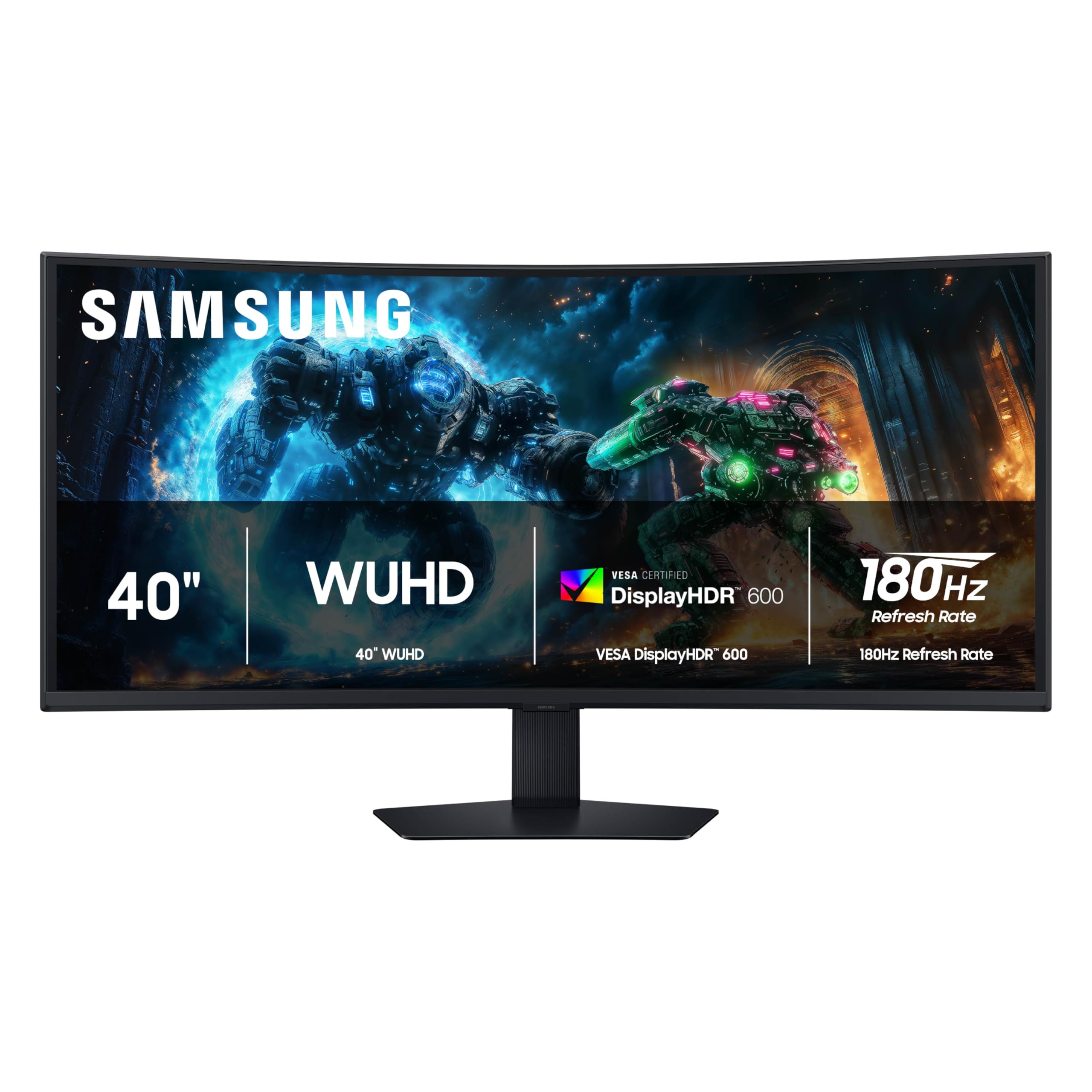
1. Samsung 40” Odyssey G7 (G75F) Series WUHD Curved Gaming Monitor
Our pick — 4.5+★ from 150+ verified ratings; the strongest balance of quality and price.
A 40-inch panel that hits 180Hz and wraps your eyeline in a 1000R curve.
Games and work both get the same rich panel here. The 180Hz refresh rate redraws the screen 180 times a second, so fast camera turns and quick flicks land smoothly instead of smearing. Its 1ms response time (GtG — the grey-to-grey measure of how fast a pixel changes colour) keeps trailing ghosts off fast-moving objects. That is the standout number of the group: the Deco Gear runs at 75Hz, so this Samsung is the fast one of the two by a wide margin.
Contrast is the other headline. At 3000:1, the Samsung pulls far deeper blacks than the Gawfolk at 1000:1, so night scenes and dark backgrounds look richer rather than washed grey. The 1000R curve bends tightly around your field of view — a snug wrap on a single desk rather than a gentle bow. Ultrawide 5120 x 2160 resolution (21:9) gives you room for two or three windows side by side, and the brightness rating of 350 cd/m2 is enough for a normally lit room. FreeSync Premium Pro smooths games against screen tearing, and HDMI plus DisplayPort inputs cover a console and a PC together.
What buyers rave about most is simply how it looks in use — picture quality and sharp, legible text come up again and again. Value gets plenty of nods too, since it lands under the big-name LG and Dell alternates. The honest catch is reliability talk: a slice of buyers report a unit that stopped working within the first month, even as most say it runs exactly as expected. Buy it for the panel and the speed, and keep your receipt close in the early weeks.
Where It Dominates
- 180Hz refresh with a 1ms response time keeps fast motion clean
- 3000:1 contrast gives noticeably deeper blacks than the 1000:1 Gawfolk
- 5120 x 2160 ultrawide resolution fits several windows at once
- 1000R curve wraps the screen tightly around your view
What To Weigh
- Some units have failed within the first month of use
- Tight 1000R bend suits a single desk more than a wide seating spread
Made for: gamers and mixed-use buyers who want the sharpest, fastest 40-inch-class curved panel on this list.
Think twice if: you need a screen you will never have to think about again — this is the pick to watch closely in the first month.
2. Gawfolk 37.5 Inch Gaming Curved Monitor 3840×1600p 144Hz PC Monitor
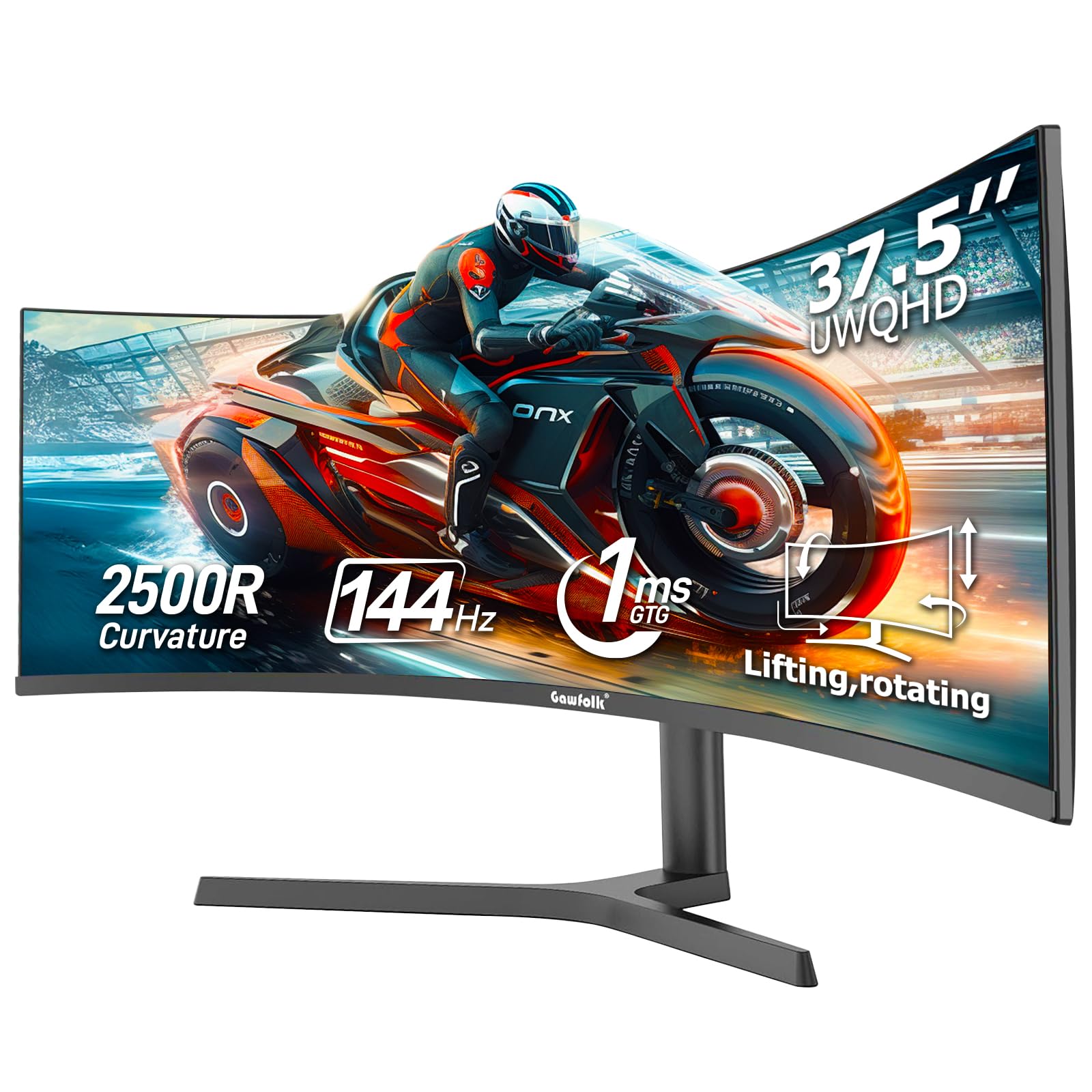
The value pick that still brings a genuine 144Hz gaming panel.
Gamers on a tighter budget get the real thing here, not a compromise panel. The 144Hz refresh rate is high enough that fast motion stays fluid, well above a standard office screen. The 37.5-inch 21:9 panel runs at 3840 x 1600 (UWQHD+ — an ultrawide resolution wider than standard 1080p), giving you a roomy desktop for gaming and multitasking. Its 2500R curve is a gentle bend rather than a tight wrap, which suits sitting back a bit from the glass.
Color is where it puts in extra effort. The 10-bit color depth (8bit + A-FRC — a way of expanding colour output from a base panel) reaches 1.07 billion colors, which smooths gradients and reduces colour banding in skies and shadows. Contrast is 1000:1, the lower of the group — noticeably short of the Samsung’s 3000:1, so dark scenes are less deep. Connectivity is generous for the tier: two HDMI 2.0 ports plus two DisplayPort inputs, and the maker recommends the DisplayPort inputs for full 3840 x 1600, since HDMI 2.0 caps at 75Hz at this resolution. Built-in ambient backlight adds atmosphere, and both a DP and an HDMI cable are in the box.
The games side is well covered with G-Sync and FreeSync support to cut tearing, plus an on-screen crosshair and a black equalizer that lifts dark areas without washing out the whole image. The stand lets you adjust height and tilt from 5° to 15°, and a 100 x 100mm VESA mount means you can wall it. If you want 144Hz gaming without premium-tier money and can live with 1000:1 contrast, this is the value pick.
Frames on a budget: you get 144Hz and dual sync support at a price tier below the premium picks, so gamers win here.
The weaker spot: 1000:1 contrast means dark scenes look flatter next to the Samsung’s 3000:1 panel.
Reach for this if: you want high-refresh gaming without paying premium-tier money.
Look elsewhere if: deep blacks and rich dark-scene contrast matter more to you than frame rate.
3. Deco Gear 40″ Ultrawide Curved Monitor, 5120×2160, 5K2K, 21:9 75Hz 1ms MPRT
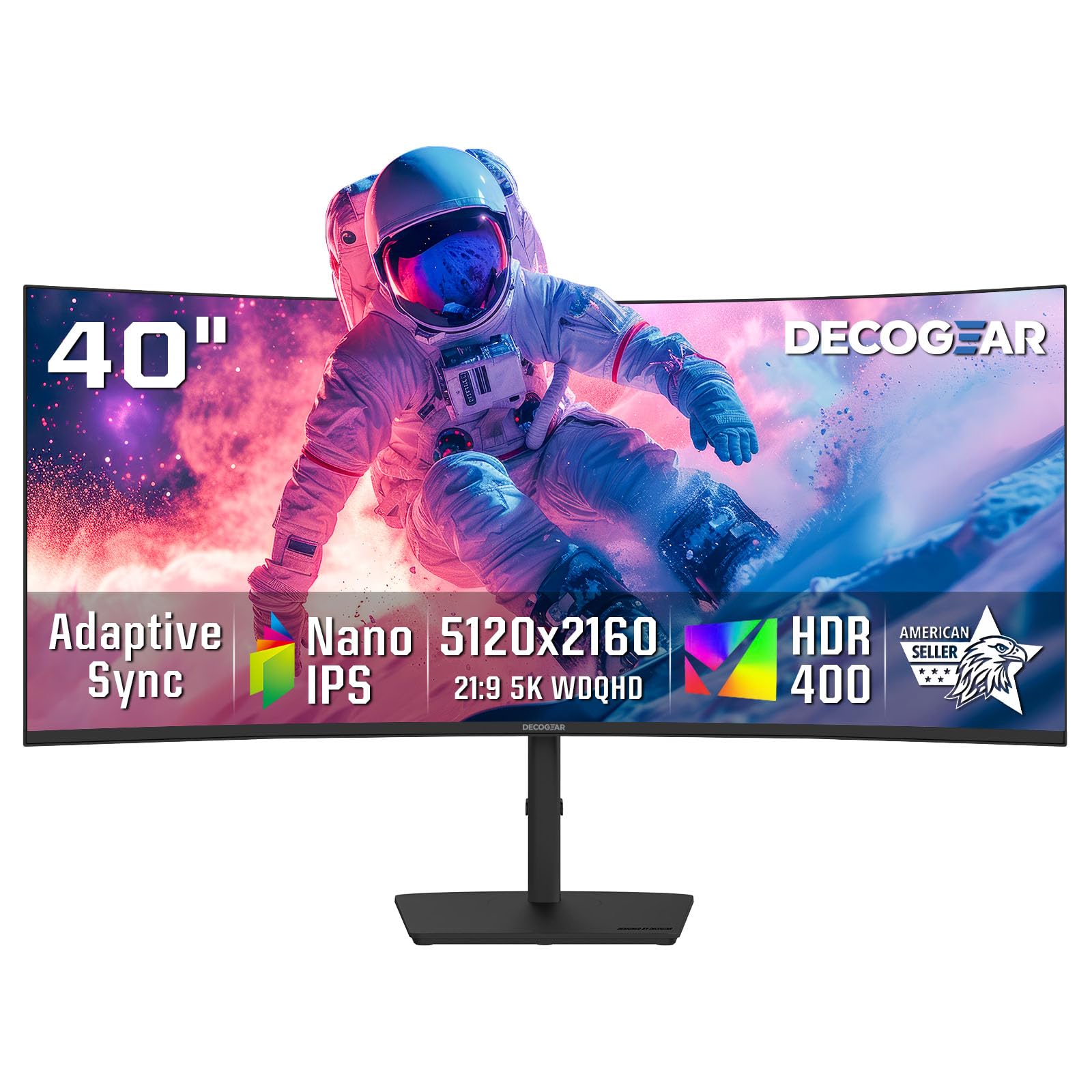
Built for the desk that runs on color, cables, and one laptop.
Designers, editors, and programmers get the most workstation-minded screen of the three. The 5120 x 2160 WDQHD panel offers a wide 21:9 canvas for timelines, spreadsheets, and code on one uninterrupted surface. Colour coverage is where it makes its case: 100% sRGB, 96% DCI-P3, and 95% NTSC mean photos, video, and printed layouts should read accurately. A 178° viewing angle keeps the image stable even when you lean off to the side.
The connection game is the real differentiator. A single USB-C cable carries high-resolution video, data, and up to 90W of power to a compatible laptop — enough to charge it over the same lead, so you are not hunting for a second charger. A built-in KVM lets one keyboard and mouse control two connected computers, and PIP/PBP modes show two sources side by side for research and editing. Behind that sit HDMI 2.0, DisplayPort 1.4, USB-B 2.0, two USB-A 2.0 ports, audio out, and built-in speakers. The 40-inch size edges the Gawfolk’s 37.5-inch panel wider, giving you slightly more desk real estate for tools.
It is the slower screen of the three at 75Hz, paired with 1ms MPRT (moving-picture response time — a blur-reduction metric) and Adaptive Sync to keep motion clean for casual gaming and video. The stand tilts from -5° to 15°, swivels ±45°, and rises 130mm, or you can hang it on a 100 x 100mm VESA mount. Owners love the size and see strong value here, but the recurring honest gripe is resolution expectation — a few find the sharpness short of what they hoped, and rare units have shown a screen going dark. For color-accurate creative work with occasional gaming, this is the pick.
Built for the creative desk: 100% sRGB coverage, 90W USB-C charging, and a KVM switch make it a one-cable workstation hub.
Skip for competitive gaming: 75Hz sits below the 180Hz Samsung, so high-frame shooters are not its job.
Understanding the Specs
Resolution and Aspect Ratio
Resolution is the number of pixels wide by tall, and it decides sharpness — more pixels means crisper text and finer detail. A 21:9 aspect ratio means the screen is much wider than it is tall, a shape that suits side-by-side windows on one panel. The Samsung and Deco Gear both hit 5120 x 2160, while the Gawfolk runs 3840 x 1600 — still far more room than a standard 1080p screen, but a step down in pixel density. If you read dense documents all day, higher resolution keeps small text clean.
Refresh Rate and Response Time
Refresh rate is how often per second the panel redraws, in hertz. The Samsung runs 180Hz, the Gawfolk 144Hz, and the Deco Gear 75Hz — so the Samsung shows the smoothest fast motion. Response time, in milliseconds, can mean pixel switching speed (GtG) or moving-picture blur (MPRT); the Samsung’s 1ms GtG and the Deco Gear’s 1ms MPRT both reduce blur. Pair a high refresh rate with a low response time and fast action stays clean. If you mostly scroll and type, 75Hz looks perfectly smooth already.
FAQ
Is a 40-inch curved monitor basically the same as a 42-inch one?
Will a 5120 x 2160 ultrawide work with my laptop?
What does the “R” number on a curved monitor mean?
Is VA or IPS better for a curved ultrawide?
Do I need 144Hz or 180Hz if I mostly work?
Can I wall-mount these curved monitors?
Will a curved ultrawide fit on a normal desk?
What is a KVM switch and do I need one?
Do these monitors have built-in speakers?
Final Thoughts: The Verdict
The strongest all-round pick in the 42 inch curved monitor group is the Samsung Odyssey G7 G75F, because its 180Hz refresh rate and 3000:1 contrast lead the field for both games and general work. If frames on a tighter spend are the goal, the Gawfolk brings 144Hz at the value tier. And for a color-accurate, one-cable creative desk, the Deco Gear with 100% sRGB, 90W USB-C, and a KVM is the one to reach for.
How We Picked
We do not accept paid placement. Every pick is matched to a real buyer and a real use-case; we do not hands-on test units.
Sources & Methodology
Specifications: manufacturer listings and product documentation. Review insights: verified customer reviews, as of November 2026. Pricing: not shown on this page (it changes often); check the current price via the retailer link.
As an Amazon Associate, Gadgets Feed earns from qualifying purchases. This does not affect which products we feature.