
Our readers keep the lights on and my morning glass full of iced black tea. As an Amazon Associate, I earn from qualifying purchases.
Specs are compiled from manufacturer listings and verified buyer reviews and can change over time — please confirm the key details on the product page before buying.
You grab a 1200 grit disc to do the delicate stuff — knocking the dust nibs off a fresh clear coat, bringing a headlight back to life, smoothing a tabletop before the final coat. It is not the grit that decides whether you get a mirror finish or a cloudy mess. The backing material, the hole pattern, and how the grit is bonded decide that. Below are nine discs and sheets that actually hold together at that grade, ranked so you can find the right one in a couple of minutes.
I’m Min — the founder and writer behind Gadgets Feed. This guide is built by comparing the manufacturers’ published specifications and the patterns across verified customer reviews, so you get each pick’s real strengths and trade-offs instead of marketing spin.
Some of these are film-backed discs meant for a random orbital sander, some are plain sheets you cut yourself, and one is an 11-yard roll for people who sand constantly. At this grade, clogging is what separates a usable disc from a frustrating one — 1200 grit removes so little material that a loaded disc stops cutting — which is why several picks here, including the Dura-Gold film-backed discs, are built specifically to resist loading and clogging. The right 1200 grit sandpaper stays sharp long enough to finish a panel without loading up or shedding grit mid-pass.
Our Picks at a Glance

How To Choose The Best 1200 Grit Sandpaper
At 1200 grit you are not shaping anything. You are refining. That means the failure mode is different from a coarse grit: instead of tearing through material too fast, a bad 1200 disc smears dust across the surface or glazes over and stops cutting. These are the four things that actually matter when you pick one.
Backing material: film vs. paper
A film-backed disc uses a thin polyester sheet under the abrasive instead of paper. That is what makes a disc nearly impossible to tear when you are wet sanding against a panel edge. Paper-backed sheets are cheaper and fine for hand sanding, but they soften and tear if you work them wet for a long stretch. If you are running a random orbital sander, film backing is the more forgiving choice.
Grit material and how it breaks down
Silicon carbide is the common choice at this grade because the grains self-fracture as they dull, exposing fresh sharp edges. Zirconia alumina is tougher and tends to last longer under heat, which is why some discs fuse the two. Either works on clear coat and paint; the difference shows up in how quickly the disc loads up when you are dry sanding.
Hole pattern and dust extraction
Pre-punched holes let your sander pull dust through the disc instead of grinding it back into the surface. An 8-hole disc on a sander with 8 matching holes clears dust far better than a solid sheet. If your backing pad has 5 holes, buy a 5-hole disc — mismatched holes mean dust stays trapped and the disc clogs early.
Disc diameter and sander fit
Five-inch and six-inch discs are the two standard sizes, and they are not interchangeable. A 5-inch disc will not seat on a 6-inch backing pad, and a 6-inch disc overhangs a 5-inch pad and flaps. Measure your pad before ordering, and check that the hook-and-loop backing matches too.
Quick Comparison
| Model | Best For | Diameter | Quantity | Grit Material | Amazon |
|---|---|---|---|---|---|
| 5-Inch 8-Hole Wet Dry Sanding Discs, 50-Pack★ Best Overall | All-round clear coat and paint work | 5 inches | 50 discs | Zirconia alumina | Amazon |
| VIBRATITE 30PCS 6 Inch Hook & Loop DiscsSix-Inch Specialist | Six-inch orbital sanders | 6 inches | 30 discs | Silicon carbide | Amazon |
| AutKerige 6 Inch Hook and Loop DiscsScratch Remover | Scratch removal on car paint | 6 inches | 25 discs | Silicon carbide | Amazon |
| POTUINOM 50PCS Mixed Grit Discs | Building a full grit progression | 5 inches | 50 discs | Silicon carbide | Amazon |
| HZXBGF 1200 Grit Sandpaper Roll | Long continuous sanding sessions | 3-2/3 inches wide | 11 yards | Silicon carbide | Amazon |
| 3M Wetordry Sandpaper Sheets | Hand sanding auto body panels | 9 x 11 inches | 5 sheets | Silicon carbide | Amazon |
| BMOTL Wet Dry Sandpaper Sheets | Headlight restoration and detailing | 9 x 11 inches | 24 sheets | Silicon carbide | Amazon |
| Dura-Gold 5″ Green Film Discs, 5 Hole | Dustless work on 5-hole pads | 5 inches | 50 discs | Aluminum oxide + zirconia alumina | Amazon |
| Dura-Gold 5″ Green Film Discs, Solid | Finishing and color sanding | 5 inches | 50 discs | Aluminum oxide | Amazon |
In‑Depth Reviews
1. 5-Inch 8-Hole Wet Dry Sanding Discs 1200 Grit Sandpaper, 50-Pack
Our pick — 4.5+★ from 450+ verified ratings; the strongest balance of quality and price.
A film-backed 5-inch disc that shrugs off tearing and clears its own dust.
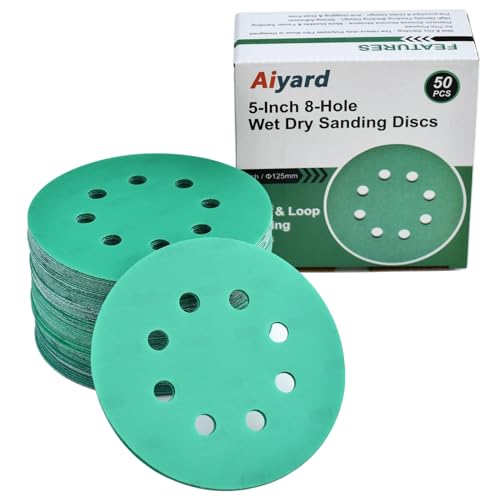
Fifty discs, 5 inches across, pre-punched with 8 holes for dust extraction — the Aiyard pack is the one to reach for if you want to stop thinking about your sandpaper and start finishing panels. The backing is polyester film sandwiched between the hook-and-loop layer and the zirconia alumina coating, so the disc resists tearing instead of shredding at the edge like a paper disc will.
Zirconia alumina is the tougher of the common grit materials, and the resin bond plus calcium carbonate coating are there to keep it cutting under heat. What wins people over is the quality of the disc itself; it is the most-discussed strength in the feedback, and durability trails close behind. Buying a 50-pack of discs that hold their edge means fewer changes mid-panel. Buyers report each disc lasts around 15-20 minutes of active sanding before it loads up.
Compare it to the 5-inch mixed-grit POTUINOM set and the 50-count match is a straight tie — but unlike that set, every one of these discs is 1200 grit, so you are not paying for a grit ladder you may never use. The 8-hole pattern matches 8-hole backing pads, so check your sander before you buy. As with any ultra-fine disc, the sanding performance itself draws some mixed feedback — at this grade you are refining a surface, not removing material, so expect slow, patient passes rather than fast correction.
Why it earns the top spot
- Polyester film backing resists tearing during wet sanding against panel edges
- Zirconia alumina grit and resin bond hold up under heat
- 8 pre-punched holes pull dust through instead of grinding it back in
- 50 discs of a single grit means no wasted mixed-grit stock
What to know before you commit
- The 8-hole pattern only lines up with an 8-hole backing pad
- Only fits 5-inch random orbital sanders, not 6-inch machines
- Ultra-fine cutting action is slow by nature at this grade
Reach for this if: you run a 5-inch random orbital sander with an 8-hole pad and want a single-grit box that covers clear coat, paint, and wood finishing without running out.
Pass if: your backing pad has 5 holes or your sander is 6 inches — the disc simply will not line up.
2. VIBRATITE 30PCS 1200 Grit 6 Inch Hook & Loop Sanding Discs
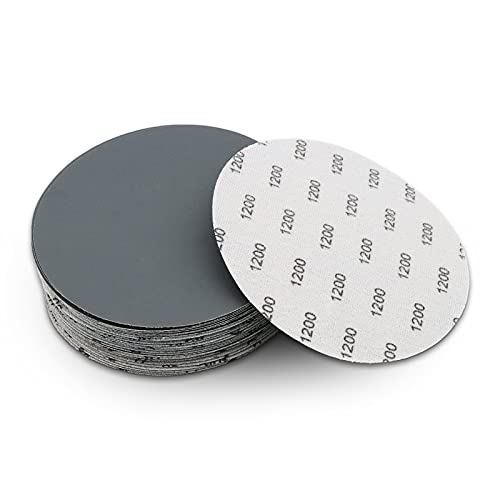
Thirty discs, each 6 inches across, with the grit printed right on the back, so you never grab the wrong grade.
If your sander takes 6-inch discs, your options narrow fast at this grade — and VIBRATITE fills that gap with 30 discs of electro-coated silicon carbide. The coating spreads the abrasive grains evenly across the disc, which is what gives you a consistent scratch pattern instead of a patchy one. Silicon carbide is also a sensible pick for wet sanding, where water carries away dust before it can clog the surface.
Each disc carries its grit number printed on the back. That matters once you own three unmarked stacks and cannot tell 1200 from 800 by touch. The hook-and-loop backing holds the disc in place during use, and the design lets you peel and swap discs without scraping at the pad.
Compare it directly to the AutKerige 6-inch set and the two are matched on diameter at 6 inches, but VIBRATITE gives you 30 discs where AutKerige gives 25, at roughly the same working size. No hole pattern here at all, so this is a solid disc; if you want dust extraction you need a hole-punched disc instead. It covers wood, metal, plastic, stone, and lacquer, which makes it the versatile choice for mixed materials.
Plain and effective: Electro-coated silicon carbide, 6 inches, grit number on the back of every disc, and enough stock to work through a project without rationing.
The trade-off: No dust holes, so dry sanding will throw dust rather than extract it — plan on wet sanding or an external dust setup.
Best matched to: anyone with a 6-inch orbital sander who sands multiple material types and wants the grade printed where they can see it.
Look elsewhere if: your sander relies on a hole pattern for dust collection.
3. 6 Inch 1200 Grit Wet Dry Sandpaper,25 PCS Hook and Loop Sanding Discs
Built for the specific job of lifting scratches out of a car’s clear coat.
The AutKerige pack of 25 six-inch discs leans hard into automotive work. The premium silicon carbide is waterproof, so you can wet sand a clear coat without the disc breaking down, and the flexible backing lets it follow slight curves in a panel. Water is the lubricant here — it floats the dust away rather than letting it load the grit.
Like the VIBRATITE set above it is a 6-inch disc, and both are solid (no dust holes), so your material choice is really about quantity and backing. AutKerige gives 25 discs; VIBRATITE gives 30. Where AutKerige pulls ahead is the anti-static treatment and the stated focus on removing scratches from clear coat and polishing mirror surfaces — it is a disc built for the finish side of the job rather than general sanding.
The hook-and-loop backing sticks firmly to the sander and the grit number is printed on the back of each pad, so you can sort a mixed stack without guessing. It handles ceramic, rubber, leather, and metal alongside paint work. If you want dust extraction, this is not the disc for you — there are no holes punched in it.
Where it shines: Wet sanding car clear coat and polishing — that is the job in the product’s own description, and 25 flexible discs give you enough to work a full panel.
Honest limit: No dust holes means dry sanding gets messy, and at 25 discs it is the smaller of the two 6-inch boxes here.
The right pick for: car owners and detailers chasing light scratches out of clear coat who plan to wet sand.
Not your disc if: you need dust extraction for dry work or you want the larger disc count.
4. 50PCS 5 inch Wet Dry Sanding Discs 1000 1200 2000 3000 5000 Grit Sandpaper
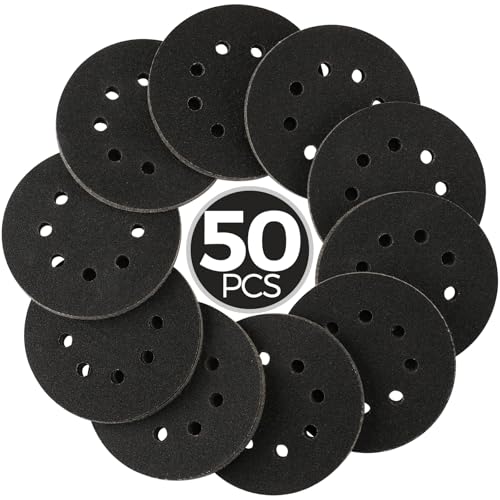
Fifty discs, but only ten of them are the 1200 you came for.
This POTUINOM set is the smart buy if you are working through a whole finishing sequence rather than just touching up. You get 50 discs split evenly across five grades — 1000, 1200, 2000, 3000, and 5000 — so ten discs of each. That means you can step from a 1000 grit cut through the 1200 refine and right into 2000, 3000, and 5000 polishing without buying five separate boxes.
The discs are silicon carbide, electro-coated, and pre-punched with 8 holes for dust extraction, and they are made for wet or dry use on waterproof backing. The backing carries a special coating to reduce temperature and a thick fleece cloth for better pad adhesion — useful when you are running long sequences that heat the disc up.
Compare it to the Aiyard 50-pack and the count is identical at 50 discs — but the Aiyard gives you all 1200 grit while this gives you ten. If 1200 is a small step in your process, that spread is a bargain. If 1200 is the whole job, you will burn through ten discs fast. The listed sander compatibility covers common machines including the BOSCH ROS20VSC and DEWALT DWE6423. Functionality is the strongest point in its feedback, though sanding performance itself gets split reviews — a reminder that a multi-grade set asks a lot of one abrasive.
Value play: Five grits, ten discs each, 8-hole dust extraction — the cheapest route to a full finishing sequence from a single box.
Count the trade: Only 1200 grit discs among the 50 are the ones you specifically came here for, so heavy 1200 work drains the set unevenly.
Buy it when: you want to step all the way from 1000 grit to a 5000 polish and would rather buy one assortment than five boxes.
Think twice if: 1200 grit is your end goal — ten discs will not carry a large project.
5. 1200 Grit Sandpaper Roll, 3-2/3″ Wide 11 Yards Long Wet Dry Sanding Sheet
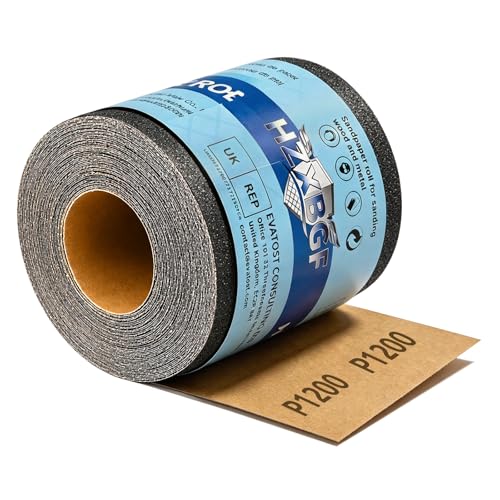
Eleven yards on a single roll — for people who sand often enough to be annoyed by running out.
Every other pick here is a disc or a cut sheet. This HZXBGF roll is 3-2/3 inches wide and 11 yards long, which is the right format if you hand sand, wrap paper around a block, or feed a handheld sander that takes a strip. You cut exactly what you need and nothing goes to waste on a shape that does not fit your tool.
The abrasive is silicon carbide with a waterproof paper base, so wet sanding on stone, ceramics, glass, automotive paint, and metal all work. The longer roll is the real feature — continuous work without stopping to change rolls, which is what the product description pushes. The width suits most handheld sanders and common workpiece surfaces.
Compare the format rather than the count: a 3-2/3-inch-wide roll is narrower than the 5-inch and 6-inch discs here, so it will not cover a full random orbital pad. That is the trade-off. This is a hand-sanding and strip-sander format, not a pad-covering disc. If you want to press a hook-and-loop disc onto a machine, buy a disc; if you want a long supply to tear off at will, this is it.
Format winner: 11 yards of continuous 1200 grit with a waterproof base gives you the longest uninterrupted working supply in this lineup.
The catch: At 3-2/3 inches wide it is narrower than a 5- or 6-inch pad and does not have a hook-and-loop backing, so it is a hand-sanding roll.
Suits you if: you sand by hand or with a strip-fed sander and want a supply you cut to fit instead of pre-punched discs.
skip it if: your workflow is a random orbital sander with a hook-and-loop pad.
6. 3M Wetordry Sandpaper, 1200 Grit, 9 in x 11 in, 5 Sheets

Five full 9 x 11 sheets of the sandpaper body shops have been reaching for.
Sheets are the format that gives you the most control, because you can cut a 9 x 11 sheet down to fit a block, a detail sander, or your fingertips. 3M’s Wetordry line is the reference point for auto body finishing, and the 1200 grade here is aimed squarely at removing dust nibs and paint runs from a clear coat and smoothing paint texture.
The silicon carbide abrasive self-fractures as it dulls, which is 3M’s explanation for why the paper keeps cutting instead of glazing over — that is what the “longer lasting” claim rests on. You can use it wet or dry without switching paper, and 3M states it delivers a 10% smoother finish than its conventional sandpaper.
Compare this to the BMOTL sheets and both are 9 x 11 inches, but the quantity gap is what matters: 5 sheets here against 24 from BMOTL. If you finish panels regularly, the 3M pack runs out fast — but for one repair job and the confidence of a known brand on a delicate clear coat, five sheets can be enough. Performance and durability are both solid in the feedback, and owners mention it preps paint surfaces evenly for both wet and dry work.
Where 3M earns its place
- Self-fracturing silicon carbide keeps cutting longer before it glazes
- Wet or dry use on the same sheet, no switching
- 9 x 11 sheets cut down to any block or detail sander shape
- Waterproof backing holds up through wet sanding
The honest math
- Five sheets is a short supply for anyone finishing more than one panel
- No hook-and-loop backing, so it is hand or block work only
- Sheet format asks you to cut it to size yourself
Chosen by: anyone doing a one-off clear coat repair who wants a trusted abrasive and does not need a bulk supply.
Better elsewhere if: you finish panels on a regular basis — you will want the larger sheet count of the BMOTL pack.
7. Wet Dry Sandpaper Sheets: 1200 Grit
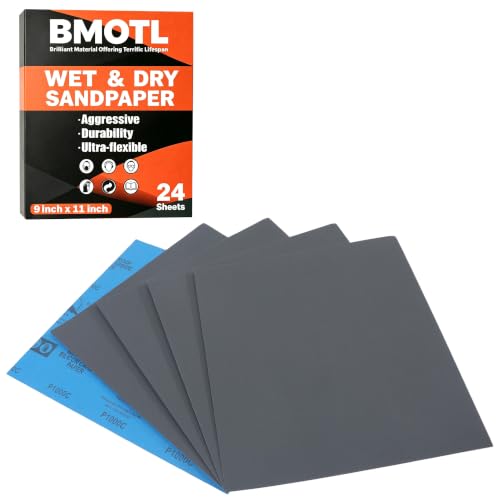
Twenty-four big sheets for headlight restoration and the final pass before buffing.
This BMOTL pack puts 24 sheets of 9 x 11 inch 1200 grit paper in your hands — against 5 sheets in the 3M pack at the same sheet size. That matters if you restore headlights, refinish furniture, or work through projects where you cut a fresh sheet often. You stop rationing sheets and cut a fresh one whenever the old one loads up.
The abrasive is high-purity silicon carbide applied with an electrostatic coating process for a consistent, sharp cut, and the C-weight paper backing is built to resist tearing and folding. C-weight is the middle of the paper-weight range — thick enough to hold together by hand, light enough to flex. The 9 x 11 size lets you cut any shape your project needs.
Compare it to the 3M sheets and the story is quantity: 24 sheets against 5, at the same 9 x 11 inch dimension. What you trade for that is brand certainty — 3M is a known name in auto body, BMOTL is not. Its listed uses cover automotive detailing, headlight restoration, wood, metal, plastic, and painted surfaces, so it is a generalist sheet rather than a specialist one. It weighs 250 g per pack, so shipping a full box is not a problem.
Best value in sheet form: 24 sheets of 9 x 11 silicon carbide is the largest hand-sanding supply here, which is what makes it the pick for repeated projects.
Fair caveat: Sheet paper needs cutting to fit blocks and sanders, and it is not a known auto-body brand like the 3M option.
Go with it if: you restore headlights or refinish furniture and go through paper steadily — the 24-sheet count keeps you working.
Look instead at: the 3M sheets if you want a recognized auto-body name for a single delicate repair.
8. Dura-Gold 5″ Green Film Sandpaper Discs, 1200 Grit, 5 Hole Pattern 50 Discs
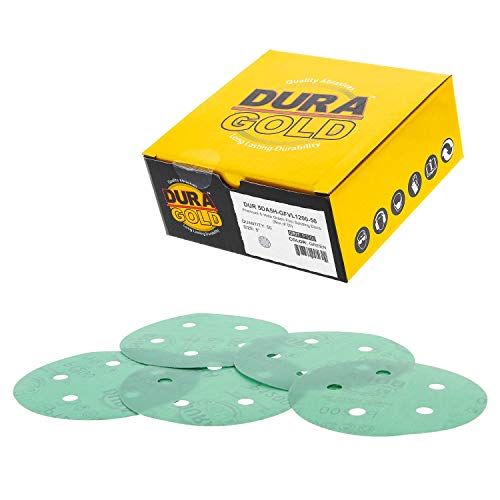
A 5-hole disc built for sanders that pull dust instead of throwing it.
If your backing pad has 5 holes rather than 8, this is the Dura-Gold disc that lines up. Fifty discs, 5 inches, with a 5-hole pattern that lets the sander pull dust through for dustless sanding. The backing is extra-tough polyester film, and the abrasive is aluminum oxide corundum fused with zirconia alumina — a combination that keeps a consistent scratch pattern and resists clogging.
That anti-clogging resistance is the real draw at 1200 grit. A loaded disc stops cutting, and at this fine a grade a glazed disc can put fine scratches back into a finish you were trying to polish out. The fused alumina-zirconia grain resists loading, so you spend less time swapping discs.
Compare it to the solid Dura-Gold disc below and the two are the same 50-count, same 5-inch size, same film backing — the only meaningful difference is the 5-hole pattern. Buy this one if your pad is drilled for 5 holes, and buy the solid one if it is not. Using a 5-hole disc on a pad with different holes traps the dust, which defeats the whole point.
What makes it work
- 5-hole pattern matches 5-hole backing pads for dustless sanding
- Polyester film backing resists tearing and folding
- Aluminum oxide fused with zirconia alumina resists clogging and loading
- 50 discs at a consistent ultra-fine cut for paint and wood finishing
The compatibility catch
- Only right for a 5-hole pad — mismatched holes defeat the dust extraction
- 5-inch only, so it will not fit a 6-inch sander
Right for you when: your sander’s backing pad is drilled for 5 holes and you want the dust pulled out during dry or wet work.
Wrong if: your pad is an 8-hole pattern — the dust channels will not line up.
9. Dura-Gold 5″ Green Film Sanding Discs, 1200 Grit, Box of 50, Hook & Loop
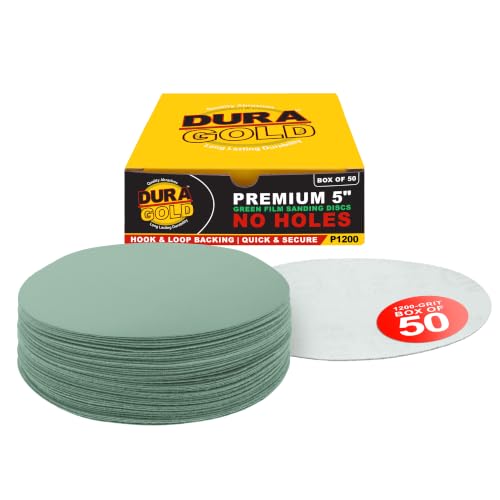
The solid-disc twin: fifty Dura-Gold discs with no holes, for color sanding and fine scratch removal.
Same green film, same 50-count box, same 5-inch diameter as the 5-hole version above — the difference is that this one is a plain solid disc. That makes it the right pick if your backing pad is not drilled, or if you prefer the extra abrasive surface that comes with skipping the holes. Fifty discs of ultra-fine-cut aluminum oxide abrasive are plenty for a full color-sanding job.
The abrasive is a super-coated aluminum oxide corundum, and the extra-tough polyester film backing keeps the disc flat and rigid against the pad. Dura-Gold positions these for auto body, paint and detailing shops — fine color sanding of paint finishes, very light scratch removal, and extra fine finish sanding on wood. That is exactly the work a 1200 grit disc does best.
Against the 5-hole Dura-Gold above, this one has more abrasive surface per disc because there are no holes cut out of it — useful when you are hand-guided or working a small area where dust management is less of a concern. The cost of that is no dust extraction, so dry sanding a full panel will leave you cleaning up afterwards.
For finish work: 50 solid film-backed discs give you the most usable abrasive per disc and enough stock for a full color-sanding sequence.
Size it honestly: No dust holes means dry work gets messy, and these are not for a 6-inch sander.
Pick it if: you want 50 film-backed discs for color sanding a car or finishing wood and do not need a dust pattern.
Choose the other one if: your pad has 5 holes — the drilled version will keep your work area cleaner.
Understanding the Specs
Grit grade and what 1200 means
Grit is a count of abrasive particles per unit area — higher means finer. 1200 lands in the extra-fine to super-fine range, which is the grade you reach for after you have cut and leveled a surface and now want to refine it. At 1200 grit you remove haze, micro-scratches, and dust nibs rather than shaping material. Film-backed discs and paper sheets both work at this grade; the film holds up better when you wet sand against an edge.
Silicon carbide vs. zirconia alumina
Silicon carbide is the common abrasive for fine finishing. It is hard and self-fractures as it dulls, exposing fresh edges, which keeps the cut going longer. Zirconia alumina is tougher and handles heat better, and some discs fuse the two for a longer-lasting cut. Neither is universally better — silicon carbide is the standard for wet sanding paint, while fused alumina-zirconia discs resist clogging during longer dry sessions.
Hook-and-loop vs. plain sheets
Hook-and-loop backing lets you press a disc onto a sander pad and peel it off cleanly, which is what makes disc changes fast mid-project. Small loops on the disc grab small hooks on the pad. Plain sheets and rolls have no backing — you cut them to size and hold them by hand or wrap them around a block. If you run a random orbital sander you want hook-and-loop; if you sand by hand or with a strip sander, a roll or sheet is more efficient.
Hole patterns and dust control
Pre-punched holes let the sander’s dust port pull dust through the disc while you work. Match your disc’s hole count to your backing pad’s hole count — an 8-hole disc on an 8-hole pad, a 5-hole disc on a 5-hole pad. A mismatched pattern or a solid disc means the dust stays on the surface, and dry dust is what clogs a fine-grit disc. Wet sanding achieves the same thing with water as the carrier, which is why so many 1200 grit jobs are done wet.
FAQ
Will 1200 grit remove scratches from car clear coat?
Should I wet sand or dry sand at 1200 grit?
How do I know if my sander takes 5-inch or 6-inch discs?
What is the difference between 8-hole and 5-hole sanding discs?
How long does a 1200 grit disc actually last?
Is silicon carbide better than aluminum oxide for 1200 grit?
Can I use 1200 grit sandpaper on wood furniture?
Do I need a sanding block or can I use sheets by hand?
How many discs do I need for one car panel?
Will 1200 grit sandpaper clog when sanding paint?
Final Thoughts: The Verdict
For most people doing clear coat, paint, or wood finishing, the Aiyard 5-Inch 8-Hole 50-Pack is the one to buy — film backing that resists tearing, zirconia alumina grit that keeps cutting, and 8-hole dust extraction all in a box of 50 at the same single grade. If you want a trusted name on a single delicate repair, the 3M Wetordry sheets are the safe pair of hands for clear coat work. And if you go through paper fast, the BMOTL 24-sheet pack keeps you stocked for headlight restoration and furniture refinishing. Match your hole pattern and disc diameter to your sander first — that single check decides which of these nine actually fits your tool.
How We Picked
We do not accept paid placement. Every pick is matched to a real buyer and a real use-case; we do not hands-on test units.
Sources & Methodology
Specifications: manufacturer listings and product documentation. Review insights: verified customer reviews, as of November 2026. Pricing: not shown on this page (it changes often); check the current price via the retailer link.
As an Amazon Associate, Gadgets Feed earns from qualifying purchases. This does not affect which products we feature.