
Our readers keep the lights on and my morning glass full of iced black tea. As an Amazon Associate, I earn from qualifying purchases.
Specs are compiled from manufacturer listings and verified buyer reviews and can change over time — please confirm the key details on the product page before buying.
Want the short answer? Start with the VMAX SLR125 two-pack. It is the strongest overall pick here, and buyers report each 125Ah unit running a fridge, freezer, Wi-Fi and satellite radio for over six hours on a single charge. Below, you will see which absorbed glass mat deep cycle battery fits your boat, RV, trolling motor or off-grid cabin. You will also see which one is quietly the wrong shape or capacity for your project.
I’m Min — the founder and writer behind Gadgets Feed. This guide is built by comparing the manufacturers’ published specifications and the patterns across verified customer reviews, so you get each pick’s real strengths and trade-offs instead of marketing spin.
You will see how amp-hours, group size and terminal type change what a battery can actually run, and where each design earns its keep. The goal is a shortlist you can trust before you spend on an AGM deep cycle battery.
Our Picks at a Glance


How To Choose The Best Absorbed Glass Mat Deep Cycle Batteries
An absorbed glass mat battery (AGM) holds its acid in a fiberglass mat instead of a pool of liquid, so it is sealed, spill-proof and needs no water top-ups. That sealed, spill-proof build is the whole appeal for a boat that heels over or a camper that bounces down a dirt road. The trick is matching amp-hours, group size and terminal type to what you are actually powering.
Start with amp-hours, not with the label
Amp-hours (Ah) is the fuel-tank size — a 100Ah battery can deliver roughly 100 amps for one hour, or 5 amps for about 20 hours. If you run a trolling motor all day, you want the 100Ah to 125Ah end of this list. If you are powering a mobility scooter for short trips, the compact 40Ah VEVOR can be the smarter fit.
Measure your tray before anything else
Group size is the industry code for a battery’s physical footprint, and it is the single most common reason a perfectly good battery will not fit. A Group 27 case and a Group U1R case are very different animals. Write down the length, width and height of your existing tray, then compare it to the listed dimensions on each pick here.
Match the discharge current to the load
Discharge current is how many amps the battery can push out in a short burst — the muscle for a motor startup or an inverter kicking on. A 1400A surge rating tells you the battery can feed heavy motor loads. A lower 400A figure is fine for light-duty scooters and e-bikes, so do not pay for muscle you will never use.
Check the terminals and the warranty
Terminal type is the connector that bolts your cable to the battery. Marine terminals take a ring or clamp, insert terminals use a bolt-through post, and T16 terminals have their own shape. Get this wrong and you are buying terminal adapters. Warranty length is the other quiet decision-maker: one year and two-year coverage both appear in this lineup.
Quick Comparison
| Model | Best For | Capacity | Amperage | Weight | Amazon |
|---|---|---|---|---|---|
| Qty2: VMAX SLR125 12V 125Ah★ Best Overall | Whole-cabin solar backup | 125Ah | — | — | Amazon |
| Renogy 12V 100Ah Deep Cycle AGMPremium Pick | RV and solar systems | 100Ah | 50 A | 63.9 pounds | Amazon |
| Mighty Max ML100-12 12V 100AHBest Value | Budget solar setups | 100Ah | 100 A | — | Amazon |
| XS Power XP950 | Car audio and accessory power | 35Ah | 950 A | 24.5 pounds | Amazon |
| VMAX MR127 12V 100Ah | Trolling motor days | 100Ah | — | 68 pounds | Amazon |
| Go Power GP-AGM-100-12 | Off-grid inverter systems | 100Ah | 100 A | 67.5 pounds | Amazon |
| Interstate DCM0100 12V 110Ah | Wheelchairs and scooters | 110Ah | — | 71.5 pounds | Amazon |
| NPP 12V 200Ah AGM | Large off-grid reserve | 200Ah | 200 A | 137.8 pounds | Amazon |
| VEVOR 12V 40AH AGM | Mobility scooters and e-bikes | 40Ah | 400 A | 24.7 pounds | Amazon |
In‑Depth Reviews
1. Qty2: VMAX SLR125 AGM Sealed Deep Cycle 12V 125Ah Batteries
Our pick — 4.5+★ from 150+ verified ratings; the strongest balance of quality and price.
Two 125Ah tanks that keep the fridge humming long after the sun goes down.
This is the pick for the person building a real off-grid power bank — a solar cabin, a camper, a boat with an inverter — rather than topping up a single accessory. Each battery is a 12V 125Ah AGM sealed unit, and the listing ships two of them, so you are buying a matched pair from the start. For a small solar array feeding an inverter, that pair is a deep reserve instead of a short buffer.
Tank size aside, the number that wins people over is the service life: VMAX rates the float service life at 8 to 10 years. The construction leans on a 99% recombination design, which is the closed-loop chemistry that stops dangerous fumes or gases escaping into a cabin. That is why this one suits a living space where you sleep near the battery bank, not just a garage shelf.
The chemistry is sealed lead-acid AGM across 6 cells, and it is built for boat, camper and RV duty. Marine terminals mean ring or clamp connections rather than a bolt-through post. Owners mention these 125Ah batteries lasting almost 8 years with no issues, and powering a fridge, freezer, Wi-Fi and satellite radio for over 6 hours on one charge. Long-term owners also praise them for solar panel work, which is exactly the job this two-pack is aimed at. The pairing with VMAX’s own smart charger is worth knowing about if you do not already own a suitable AGM charger.
What earns the top spot
- 125Ah per battery across a matched two-pack — real reserve for an inverter-fed cabin
- 8 to 10 year float service life rating from the maker
- 99% recombination design keeps fumes and gases contained
- Marine terminals suit boat and RV wiring
What to plan around
- Covered by a 1 year warranty only
- Needs a compatible AGM charger — the maker points to its own smart charger model
- Two full-size batteries take real space and are heavy to move
Reach for this if: you are wiring a solar cabin, camper or boat bank and want a matched pair of high-capacity AGM batteries with a long rated service life.
Look elsewhere if: you only need to run one small scooter — 125Ah per unit is far more tank than that job needs.
2. Renogy 12 Volt 100Ah Deep Cycle AGM Battery
The RV workhorse that shrugs off a 140°F afternoon and still starts your inverter.
Compare this to the compact XS Power below and the capacity gap is stark: this Renogy holds 100 amp-hours versus 35 amp-hours, nearly three times the tank. That surplus is why it can feed a fridge, microwave, CPAP or coffee maker instead of just a light bar. It is the pick for someone living out of an RV or running a cabin off solar, where runtime matters more than saving shelf space.
This battery keeps working in hot and cold places, thanks to its upgraded electrolyte formula (the fluid mix inside that carries the charge). Renogy lists discharge performance from -4 to 140°F (-20 to 60°C). So an unheated cabin or a desert summer does not quietly drain your usable power. The 1100A (5-second) max discharge current is the burst of power you need to start an inverter under load. And the self-discharge rate (how fast it loses charge while sitting) stays below 3% per month at 77°F. That means a stored battery is not dead when you come back to it.
The sealed design spares you the internal troubleshooting that lithium packs can demand, and Renogy says you can run series with no limit and parallel up to 4P. One honest note on fit: it is a substantial unit, so measure your tray and plan for a two-person lift. Battery quality and performance are the themes that carry the review pages, though a share of owners flag battery life and value as a split verdict — treat this as a fit decision, not a sure thing. If you want the most polished all-round RV battery in this lineup, this is it.
Where it shines: The temperature window and the sub-3% monthly self-discharge make it a genuinely low-maintenance battery to leave in an RV through the shoulder seasons.
The honest trade-off: It carries a premium-tier sticker for a 100Ah pack, and its split reputation on long-term life means you should size your loads with a little headroom rather than running it flat.
Best fit: RV owners and off-grid cabin setups who want a proven 100Ah AGM with serious surge current and wide temperature tolerance.
Think twice if: you are on a tight budget and only need light-duty power for a scooter.
3. Mighty Max Battery 12V 100AH Deep Cycle VRLA
A full 100Ah Group 27 case for the price of an entry-level pack.
Here is the budget-friendly route into a genuine 100Ah solar battery. It is a Group 27 sealed lead-acid AGM that Mighty Max says is UL Certified, and it mounts in any position, which is handy when your battery box is under a bench or tucked on its side. If you are assembling a first solar setup and the premium names feel like overkill, this is where many people start.
For a 100Ah pack it is rated at 100 A, and the spill-proof AGM build gives you a high discharge rate and wide operating temperatures. It resists shocks and vibration too, which is the spec that matters in a bouncing trailer or a shed-mounted array. It arrives as the battery and screws only, so budget for your own wiring harness and mounting hardware.
Owners run real loads on it, with fridge, fan and lights mentioned alongside powering a full shed of LED lighting, and the value angle is what keeps coming up. A caution worth stating plainly: battery life is a split question in the reviews, so treat it as a solid budget workhorse rather than an untouched-upon lifetime purchase. Backed by a full one-year warranty.
Why budget buyers go here
- A full 100Ah Group 27 capacity without a premium-tier outlay
- UL Certified and mounts in any position
- Handles shocks and vibration in trailers and shed setups
- Full one year warranty
Fine print to read first
- Ships as the battery and screws only — bring your own wiring harness and mount
- Battery life draws mixed feedback, so size your loads carefully
Pick this if: you want maximum amp-hours per dollar for a first solar or shed setup and already own the wiring.
skip it if: you need the battery to arrive with mounting accessories included.
4. XS Power XP950 950 Amp AGM Secondary Battery

A small, light battery built to throw a huge burst of amps at a stereo or winch.
Where the Renogy is a long-haul reservoir, this XS Power is a sprinter. It holds 35 amp-hours versus the Renogy’s 100, so it will not run a cabin for hours. What it does is deliver 950 max amps and 950 secondary watts, and it weighs 24.5 pounds versus the Renogy’s 63.9 — far easier to lift into an engine bay or under a seat. This is a secondary battery for powering heavy accessories, not your main house bank.
It is a Group U1R case, sealed and leak-proof with M6 terminal hardware in the box, so installation is straightforward in powersports and vehicle applications. XS Power lists 50 minutes of reserve capacity and backs it with a 2-year warranty. For a car audio system, light bar, winch or power inverter that needs a punch of current, that high-amperage output is the whole point.
The design goal: A compact secondary that dumps a large burst of current into accessories without the weight of a full-capacity deep cycle unit.
The catch: 35Ah is a short tank, so do not expect this to carry long-duration loads.
Made for: car audio builds, winches, light bars and powersports owners who need a small, light, high-surge secondary battery.
Not the one for: anyone expecting a whole-cabin deep cycle reserve.
5. VMAX MR127 12 Volt 100Ah AGM Deep Cycle Battery

The trolling-motor battery that runs the lake all day and still has reserve.
VMAX built this one specifically for the water — a Group 27 marine deep cycle at 12V 100Ah, aimed at boats and trolling motors in the 40 to 100lb thrust range. It has marine terminals and comes with carrying handles, which matters because this is a heavy 68-pound unit. If your weekend is a bass boat and an electric motor, this is a direct-fit candidate.
The construction detail worth knowing is the electrolyte suspension system: a high-porosity AGM mat that fully absorbs the electrolyte, with no silica gels or other contaminants added. The heavy-duty lead tin alloy grids are the part meant to hold up after repeated over-discharges — the exact abuse a trolling motor dishes out when you run it flat at the end of the day.
What buyers rave about is the runtime and the raw power: it runs the motor all day with reserve to spare, and lasts long enough that people compare it favorably to cheaper big-box options. The recurring gripe is the handles, which some find less sturdy than the battery itself — so use them carefully when hauling it in and out of the boat. Covered by a 1-year warranty.
Solid on the water
- 100Ah Group 27 built for trolling motors in the 40-100lb class
- Marine terminals and included carrying handles
- High-porosity AGM mat and lead tin alloy grids for repeated deep discharges
Boat-owner notes
- 68 pounds — expect a real lift
- Handles are the recurring weak point; carry it by the body when you can
Right call for: trolling-motor boaters who want an all-day 100Ah marine battery with proper marine terminals.
Consider another pick if: you need a battery you can move light and single-handedly.
6. Go Power GP-AGM-100-12 SunCycle Deep Cycle 12V AGM Solar Battery

Purpose-built for solar-and-inverter setups, with handles to help you shift 67.5 pounds.
Go Power aimed this 100Ah AGM at one job: solar, inverter and off-grid power systems in RVs, boats and fleet applications. It is a sealed, spill-proof and leak-proof design that removes the need for water top-ups. The 100 A rating and the stated support for heavy loads suit running appliances, tools and onboard electronics from an inverter.
At 67.5 pounds it is heavy, which is why the integrated carrying handles are a genuine design choice rather than a footnote — you can lift and reposition it without fighting the case. If your setup is a mid-size solar array feeding an inverter for an RV or a small off-grid cabin, this is squarely the intended use.
It is a smaller-volume pick in this lineup, so there is less owner chatter to study, and the honest read is that you are buying a focused solar battery rather than a do-everything one. The straightforward verdict: strong fit for inverter-driven off-grid, less so if you need a compact pack for a scooter.
Well matched to: solar and inverter systems in RVs, boats and small off-grid builds where sealed, no-top-up operation is the priority.
Not the fit for: mobility or light-vehicle replacements that want a compact, lighter case.
7. Interstate Batteries 12V 110 AH SLA/AGM Deep Cycle Battery

A wheelchair-and-scooter battery with a serious 110Ah reserve behind it.
Interstate developed the DCM0100 for mobility duty — wheelchairs and electric scooters — and it is a 12V 110Ah AGM with insert terminals that take a bolt-through connection. At 71.5 pounds it is one of the heavier packs here, which makes sense for the deep-discharge endurance a powered chair needs. If you are replacing the battery in a mobility device, this is the target-use pick.
The AGM and VRLA (valve-regulated) design is what makes it maintenance-free and spill-proof — the valve controls internal pressure so it does not leak or vent in normal use. Interstate states it is not a replacement for a golf cart battery, so do not try to use it there. Beyond mobility, it is also listed for solar, wind and RV use, plus medical equipment, oil and gas flow meters and injection pumps.
On the review pages, top quality is the recurring theme, though reliability is a split story — a working-by-the-book battery for many, yet not every unit holds up over the long haul. That is the honest caveat to weigh when you buy. Covered by a 1-year manufacturer performance warranty.
Where it earns its place: The 110Ah capacity in a purpose-built mobility case, with sealed VRLA construction that suits a device kept indoors.
The thing to weigh: Reliability is not a unanimous verdict, so keep your charging routine disciplined and use the one-year warranty if something slips.
Strongest pick for: wheelchair and electric scooter owners who need a 110Ah AGM replacement built for repeated deep discharges.
Wrong choice if: you are shopping for a golf cart — Interstate says this is not that battery.
8. NPP 12V 200Ah AGM Deep Cycle Battery
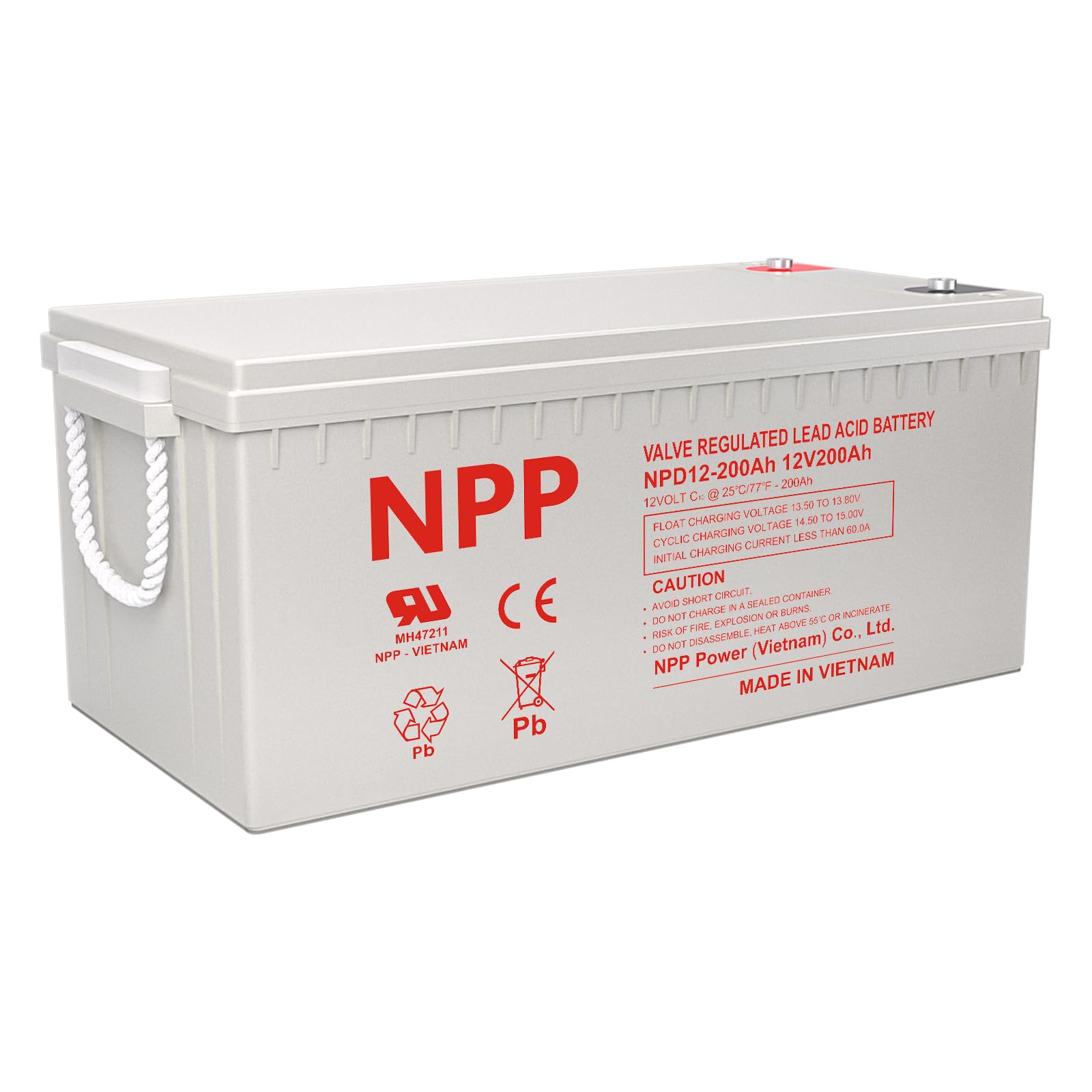
Twice the tank of the 100Ah packs, for when you refuse to recharge every day.
When the job is a large off-grid reserve — think a cabin, an UPS bank or a big inverter system — 200Ah changes the math. That is double the 100Ah packs in this lineup, so you are not recharging constantly. The trade is size and weight: 137.8 pounds is the heaviest battery here, so plan for a two-person install and a sturdy, well-ventilated spot.
You get long runtime, and the numbers back it up. NPP lists up to 1200+ cycles at 30% depth of discharge (how far you drain it each cycle). It also lists around 91% capacity remaining after 3 months at 25°C, thanks to low self-discharge. That is good news for a standby bank that sits between uses. Internal resistance of about 3mΩ (a measure of how freely power flows inside) and up to 1400A surge (5 seconds) suit inverter, generator-backup and motor-startup loads.
Temperature performance runs from 5°F to 122°F, holding about 85% capacity at 32°F — useful for a trailer or cabin that gets cold. It uses T16 terminals and supports series and parallel connections for 24V-48V systems when configured right. The maker points to UL, CE and IEC certification. One honest note: this is best suited to controlled loads, and real performance depends on your inverter capacity and system setup, so size the rest of the system to match.
What the big reserve delivers
- 200Ah — twice the capacity of the 100Ah picks, for fewer recharge cycles
- Up to 1200+ cycles at 30% depth of discharge
- ~91% retained capacity after 3 months at 25°C
- 1400A surge suits inverter and motor loads
Plan before buying
- 137.8 pounds requires a two-person install and a strong mount
- Best for controlled loads — match it to your inverter’s capacity
Built for: large off-grid, cabin, UPS and inverter banks that need a big 200Ah reserve with cold-weather tolerance.
Think again if: you need something light, small, or easy to move often.
9. VEVOR Deep Cycle Battery 12V 40AH AGM

The entry-level pack for scooters, wheelchairs and e-bikes that don’t need a huge tank.
Not everyone is powering a cabin. If your load is a mobility scooter, an electric wheelchair, a go-kart or an e-bike, 40Ah is a sensible match and this is the lowest-cost route in. It is a 12V 40Ah AGM with a 400A maximum discharge current delivered in 5 seconds — enough to start light electric devices without paying for capacity you will never use.
The absorbent glass mat design needs no maintenance and no liquid top-up, unlike old flooded lead-acid cells. VEVOR states it minimizes self-discharge and handles high temperatures, and it is compact at 24.7 pounds with dimensions of 6.5 x 6.7 x 7.8 inches. One thing to note from the listing: it calls for professional charging equipment during use, so make sure your charger is up to the job.
Buyers rate the quality and build highly, and value for money comes up again and again. Customers note it runs a Vevor diesel heater well. The honest split is on battery life: some say it holds a charge very well, others say theirs would not hold charge at all. So buy it for the light-duty job it is built for, and charge it properly. It is the affordable way in, not a long-run cabin battery.
The value case
- Low entry price for a 12V 40Ah AGM deep cycle
- 400A max discharge in 5 seconds handles light-device startup
- Compact and 24.7 pounds, easy to fit in a scooter or go-kart
Where to set expectations
- Battery life is a split story — some units do not hold charge
- Needs proper charging equipment to perform as intended
Best budget entry for: scooter, wheelchair, go-kart and e-bike owners who need a compact 40Ah AGM at the lowest outlay.
Not aimed at: anyone running long-duration cabin or inverter loads that demand 100Ah or more.
Understanding the Specs
Amp-Hours (Ah)
Amp-hours is the size of the battery’s fuel tank — a 100Ah pack delivers about 100 amps for an hour, or 5 amps for roughly 20 hours. The bigger the number, the longer you can run a fridge, trolling motor or inverter before recharging. Match it to your load: a scooter is happy at 40Ah, while a cabin bank wants 100Ah or 200Ah. Do not buy more capacity than your space and charging setup can support.
Group Size
Group size is the industry code for the battery’s physical footprint, and it decides whether the thing drops into your existing tray. A Group 27 case and a Group U1R case are very different shapes. Measure your tray’s length, width and height before you order, then compare against the listed dimensions. Getting this wrong is the most common reason a technically perfect battery gets returned.
Discharge Current (Amps)
Discharge current is the burst of amps the battery can push out in a short window — the muscle for starting a motor or letting an inverter kick on. A 1400A surge rating means it can feed heavy loads in a five-second burst. A 400A figure is plenty for light electric devices. Buy the surge level your equipment actually draws, and no more.
AGM and VRLA Construction
AGM means the acid is held in a fiberglass mat, so the battery is sealed, spill-proof and maintenance-free. VRLA (valve-regulated lead acid) adds a pressure valve that keeps it from leaking or overpressurizing in normal use. Together they let you mount the battery in more positions and skip water top-ups — the reason these suit boats, RVs and indoor mobility devices.
FAQ
Will a 100Ah AGM battery run my RV fridge overnight?
How long does an AGM deep cycle battery last before replacement?
Can I mount an AGM battery on its side or upside down?
Do I need a special charger for an AGM battery?
What is the difference between AGM and a regular flooded lead-acid battery?
Can I connect two of these batteries in series or parallel?
How heavy are these batteries to move?
Should I choose a 100Ah or a 200Ah battery for off-grid solar?
Is an AGM battery safe to keep inside a camper or cabin?
Final Thoughts: The Verdict
For most people building a real power bank, the absorbed glass mat deep cycle batteries winner is the VMAX SLR125 two-pack. Two 125Ah sealed units with an 8 to 10 year rated float service life give you genuine reserve for a solar cabin, camper or boat. Want the most polished all-round RV battery? Grab the Renogy 100Ah AGM with its wide temperature window and 1100A surge. And for a trolling motor that needs to run all day, reach for the VMAX MR127.
How We Picked
We do not accept paid placement. Every pick is matched to a real buyer and a real use-case; we do not hands-on test units.
Sources & Methodology
Specifications: manufacturer listings and product documentation. Review insights: verified customer reviews, as of November 2026. Pricing: not shown on this page (it changes often); check the current price via the retailer link.
As an Amazon Associate, Gadgets Feed earns from qualifying purchases. This does not affect which products we feature.