
Our readers keep the lights on and my morning glass full of iced black tea. As an Amazon Associate, I earn from qualifying purchases.
Specs are compiled from manufacturer listings and verified buyer reviews and can change over time — please confirm the key details on the product page before buying.
If you want short, hard sets that leave your muscles burning rather than a slow jog, this list is for you. The shortlist below covers home machines built for resistance work — the kind where you push, pull or press against a set load until the muscle gives out. The MERACH Ab Machine takes the top spot because it holds up to 440 pounds, folds away between sessions and gives you a readable rep count on a small screen. Every pick here is a home machine built for resistance work, and each one does a specific job well.
I’m Min — the founder and writer behind Gadgets Feed. This guide is built by comparing the manufacturers’ published specifications and the patterns across verified customer reviews, so you get each pick’s real strengths and trade-offs instead of marketing spin.
You will see where each machine fits, what it actually measures, and where it falls short before you commit floor space to it. Here is the honest breakdown of the anaerobic exercise equipment worth your floor space.
Our Picks at a Glance

How To Choose The Best Anaerobic Exercise Equipment
Anaerobic training means short, intense efforts — a set of presses, a hard minute on a rope, a controlled ab crunch — where your muscles work against a load rather than cruising on steady oxygen. The machine you pick sets your resistance ceiling, its floor footprint, and whether you will actually use it on a Tuesday night.
Start with the load, not the label
The number that decides how long a machine stays useful is its resistance load. A weight stack rated to 152 pounds, a band system that tops out at 400 pounds, or a digital motor pushing 220 pounds — each one caps how strong you can get before you outgrow it. Match that ceiling to your current strength plus a healthy margin, because a machine you max out in month two becomes a clothes rack.
Measure your actual floor
Footprint decides whether a home machine gets used or becomes storage. A full functional trainer with two stacks takes up a real corner of a room, while a folding ab track or a strap kit slides under a bed or into a backpack. Measure the square footage you can give up permanently, not the space you could clear on a good day.
Decide between steel stacks and digital resistance
You get two ways to add resistance. A steel weight stack gives you a physical plate you can see and hear moving. A digital resistance motor spins to create smooth, adjustable load and can change weight mid-set. The stack is simpler and needs no power. The motor is quieter, more adjustable, and usually comes with guided coaching on a screen. Pick based on if you want zero electronics or you want the guided experience.
Check the cable and strap range
Cable and strap anchor points decide whether a machine trains your whole body or just your arms. Count the cable positions and the included handles, bars and straps. More anchor points mean you can hit a low row, a high pulldown and a chest press on the same frame without dragging in extra gear.
Quick Comparison
Every row below lists resistance, unit weight and footprint in the same columns, so you can compare them side by side.
| Model | Best For | Max Resistance | Unit Weight | Footprint / Form | Amazon |
|---|---|---|---|---|---|
| MERACH Ab Machine★ Best Overall | Foldable core training | 440 lb user max | 24 lb | Foldable track | Amazon |
| Bullworker ISO-FLOBest for Travel | Travel and small spaces | Self-resistance | 2 lb | Strap kit with carry bag | Amazon |
| EVO GymMost Portable | Backpack portability | 400 lb tension | — | Base plus 10 bands | Amazon |
| Wonder Core Pro Max | Four modes in one frame | 242 lb user max | 28.7 lb | Foldable, closet-friendly | Amazon |
| Mikolo Home Gym | Full-body stack training | 152 lb stack | 300 lb | 75″D x 36.3″W x 80″H | Amazon |
| Q-Rope Trainer | Rope conditioning | 132 lb adjustable | — | Cordless, carry bag | Amazon |
| Body-Solid Powerline | Dual-stack cable work | Two 160 lb stacks | 476 lb | 42.3″D x 62.6″W x 83″H | Amazon |
| Speediance Gym Monster 2 | Smart digital resistance | 220 lb digital | 125 kg | Folds to 0.25 m² | Amazon |
| Speediance Gym Monster 3 | Precision digital home gym | 260 lb digital | 82 kg | Under 10.8 sq. ft. | Amazon |
In‑Depth Reviews
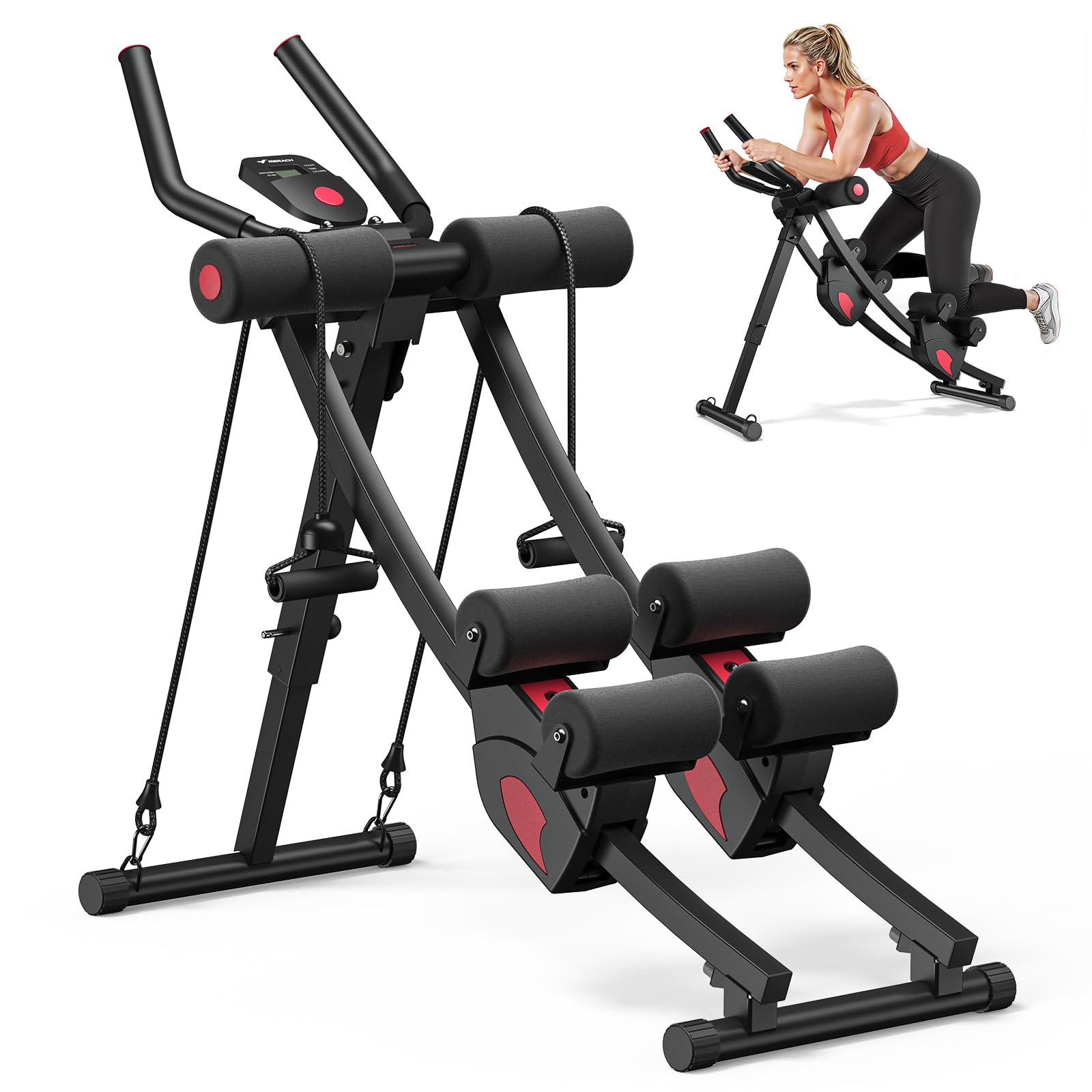
1. MERACH Ab Machine, Adjustable Ab Trainer Machine, AB Workout Equipment
Our pick — 4.5+★ from 650+ verified ratings; the strongest balance of quality and price.
A folding track that puts your core under your own bodyweight and still holds 440 pounds.
You can load your abs without giving up a permanent spot. If you have a spare bedroom, an unused corner, or a garage that doubles as a gym, this machine folds away. The frame carries up to 440 pounds, so it will hold almost any adult comfortably. It weighs 24 pounds, which makes it the heavier of the two foldable picks here — the Bullworker strap kit weighs 2 pounds, about a twelfth as much — but that mass is what gives the track its stability.
What wins people over is how quickly it comes together. Assembly and build quality are the two things buyers call out most often, and the recurring theme is that the machine feels sturdier than the price would suggest. The split-track design lets you alternate sides on a mountain-climber motion, which mimics the unilateral drive you get from a heavy carry or a hard set of crunches. You get four height settings, so a beginner and a seasoned lifter can both find a level that works.
The 110° curved track is the piece that earns its keep. It follows the natural arc of your spine when you crunch, and the track is 50% longer than the earlier version, so you get a deeper range before the abs give out. A small LCD screen tracks reps, time and calories, which sounds basic until you realize you can watch your rep count without a notebook. The recurring gripe is the durability of a few components — treat the folding hinge sensibly and it holds up; yank it around and you may be disappointed. The safe working load is 440 pounds, but that is the frame rating, not a measure of how much resistance you feel.
What earns the top spot
- 440-pound frame capacity means almost any adult can use it without worrying about the rail bowing.
- Folds flat for storage, so it slides behind a door or under a bed.
- Four height settings let you increase the difficulty as your core gets stronger.
- LCD shows reps, time and calories without a separate fitness tracker.
What to weigh before buying
- At 24 pounds it is not a one-handed carry — you will want to store it near where you train.
- A few buyers report durability questions on the folding mechanism over time.
Reach for this if: you want a dedicated core machine that folds away and will handle a heavy user without complaint.
Look elsewhere if: you need a full-body station or a machine that works your back and legs as hard as your abs.
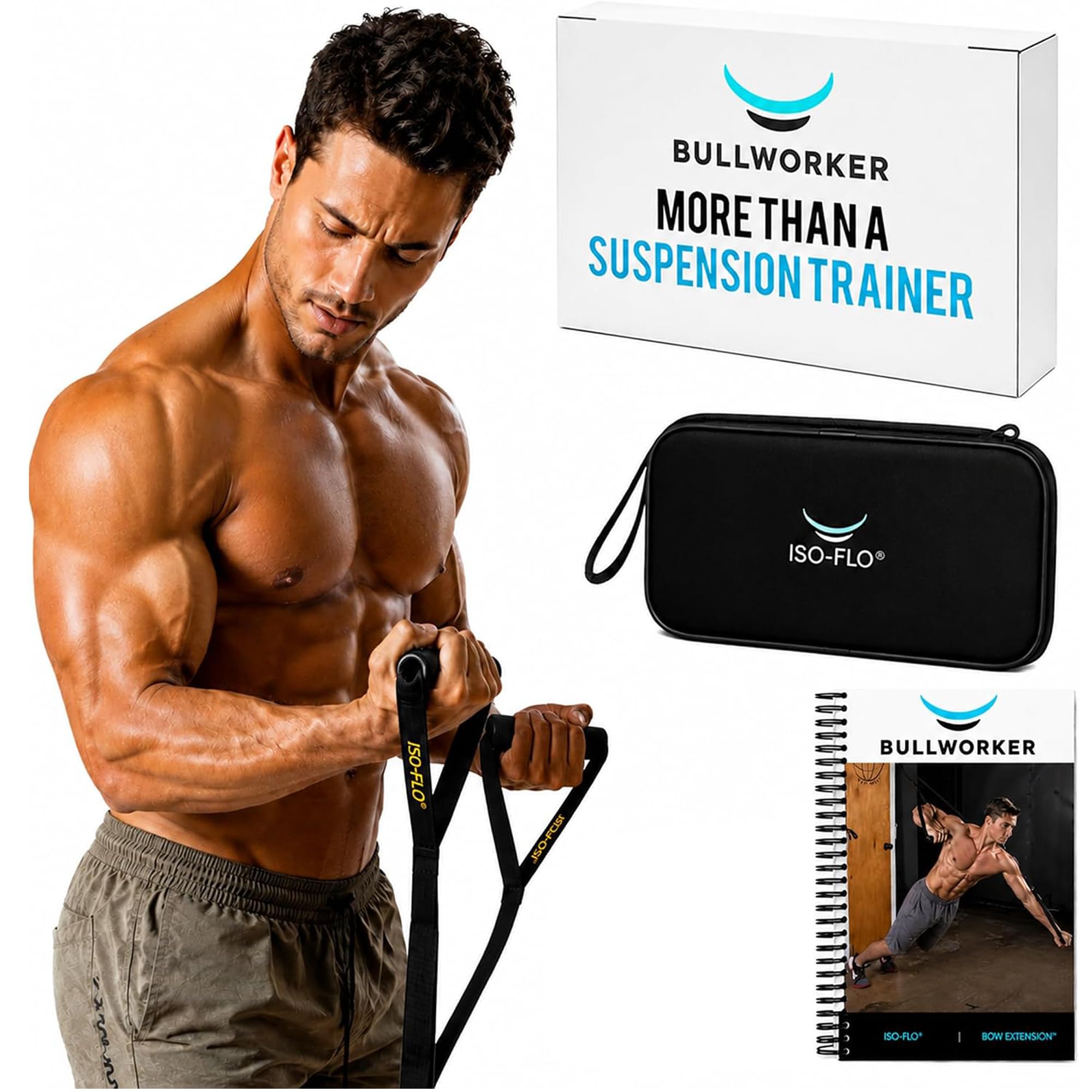
2. Bullworker ISO-FLO Isometric Exercise Equipment
Two pounds of nylon straps that turn any doorway into a resistance station.
Two pounds. That is the entire carry weight of the ISO-FLO system, and it is the number that decides where this thing lives. It goes in a carry bag, in a suitcase, or in a backpack for a hotel room, and it sets up without tools. The straps are nylon and one resistance level is built in — this is not a machine that adds plates, it is a strap system you load with your own bodyweight and angle.
The workout performance is where this pick earns its place. Users report it works for full-body sessions and for targeted movements, which means you can string together a hard circuit of presses, rows and core work without a single weight plate. The mind-to-muscle control that isometric training demands means every rep is a deliberate push against your own resistance, so a ten-minute session can leave your arms and shoulders genuinely spent. That low-impact, user-controlled nature is what makes it usable for someone coming back from a layoff or training in a small apartment.
The honest limit: it is a strap system, not a cable machine. If your goal is progressive overload on a heavy bench press, you will outgrow the ceiling here. It is also one resistance level, so the variety comes from your body position and leverage rather than from adding weight. For travel, small spaces and portability, though, it is hard to argue with a two-pound kit that fits in a carry-on.
Where it shines: the compact kit goes anywhere, the nylon straps are durable, and the isometric approach gives you a real burn without a single plate.
The trade-off: no stack, no cable, no incremental load — your strength progression comes from leverage and control, not from adding weight.
Pick this when: you train on the road, in a shared room, or in a space too small for a frame.
Pass on it when: you need measurable load increases to track strength gains.
3. EVO Gym – Portable Home Gym Strength Training Equipment
A backpack gym that loads up to 400 pounds of tension without a wobble.
Here is a direct comparison that matters: the EVO Gym maxes out at 400 pounds of tension, and the MERACH ab machine above carries a 440-pound user rating. Those numbers mean different things — the EVO is a band-loaded station, the MERACH is a bodyweight track — so read the spec as a ceiling on how hard you can pull, not how heavy a person can sit on it. The base is aircraft-grade aluminum with a polycarbonate body, so it holds steady when you load all ten bands.
Buyers rave about the build quality, and the resistance range comes second. The set comes with 10 bands — two at 10 pounds, two at 20, two at 30 and four at 50 — plus an extra pair of 50-pound bands that let you stack up to 400 pounds of tension. The included steel workout bar, two handles, ankle straps, door anchor and hook mean you can do squats, deadlifts and presses from the same base. Owners note you can switch between exercises in under a minute, which keeps a circuit moving instead of turning into a fumble with clips.
Portability is the whole premise, and it delivers: everything packs into the base and fits in a carry-on or a large purse. The trade-off is that band tension is not the same feel as a steel stack — the resistance builds as the band stretches, so the top of the rep is harder than the bottom. That suits some lifters and frustrates others. A few owners also raise durability questions on the bands over the long haul, so inspect them for wear if you train hard daily.
Why it travels well
- Loads to 400 pounds of tension with the included bands.
- Packs into the base and fits in a carry-on.
- Includes bar, handles, ankle straps, door anchor and hook for a full-body circuit.
The honest caveats
- Band resistance gets heavier as you stretch, unlike a constant-weight stack.
- A few owners flag band durability as something to watch over years of hard use.
Worth it if: you want a real full-body session from a kit that fits under an airplane seat.
skip it if: you need the constant, measurable feel of a steel weight stack.
4. Wonder Core Pro Max – Ab Machine for Stomach Workout, 4-in-1 Exercise Equipment
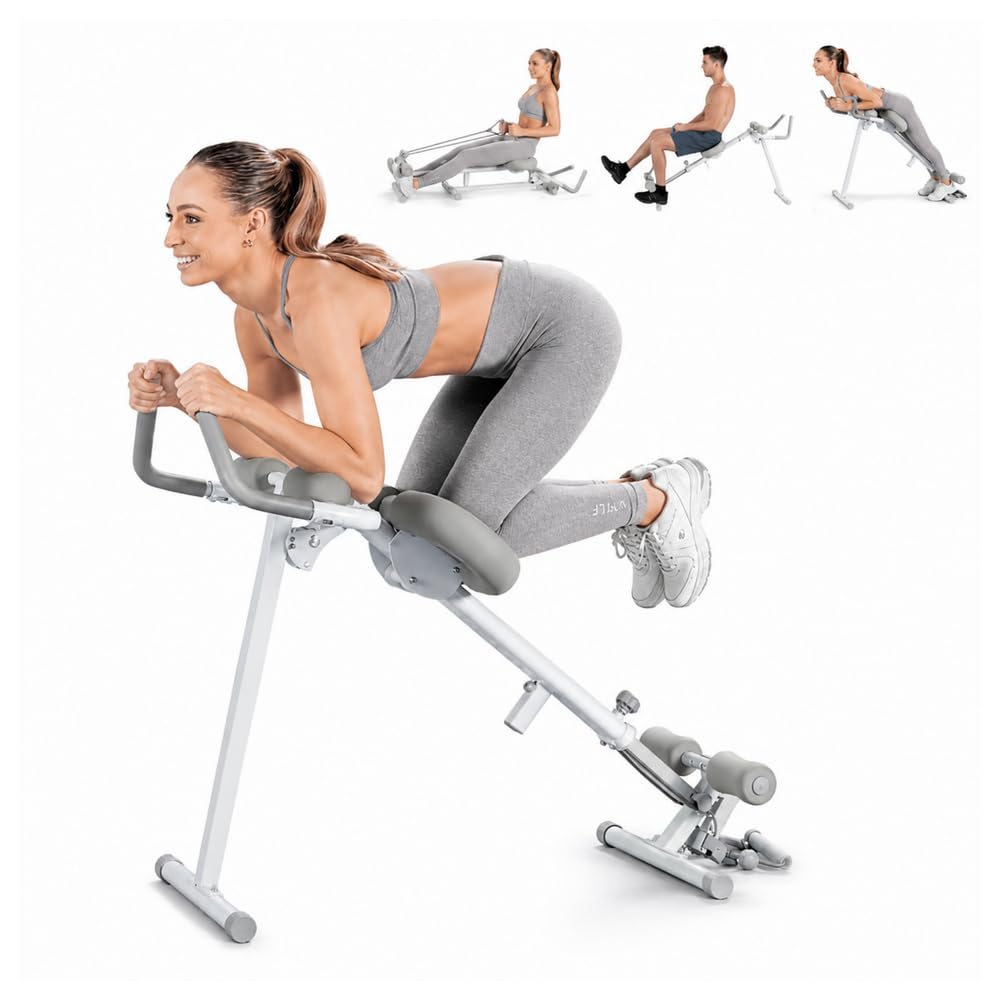
Switch from ab glider to rower to leg press in seconds on one folding steel frame.
The pitch here is variety: four modes on one machine, so you can hit your core, your glutes, your legs and your back without buying four separate pieces. The frame is alloy steel with a 242-pound maximum user weight, and it folds down to slide into a closet or under a bed between sessions. At 28.7 pounds it is heavier than the MERACH, which makes sense given the extra modes and the rowing arm.
Performance is what keeps people coming back. The rowing mode performs well according to owner feedback, and the machine is sturdy enough that it does not feel like a toy when you pull hard. Ease of use is the second most-praised trait — the mode changes are quick, and the included dumbbell-friendly design means you can add your own kettlebells or dumbbells as the bodyweight work stops being enough. The free Wonder Core app adds guided tutorials for all four modes if you want instruction rather than guesswork.
Assembly is straightforward with the included tools, and the manual is intuitive enough to get you training the same day. What to know before you buy: the 242-pound maximum weight recommendation is lower than the MERACH’s 440-pound rating, and the adjustability of some settings draws mixed feedback. If you are a heavier lifter or you want one machine that maxes out resistance, this is not that. If you want four training styles in a foldable footprint for a spare room, it is a strong fit.
The value case: four modes, foldable steel frame, an included app, and a rowing action that holds up under real effort — all from one machine that hides in a closet.
Worth knowing: the 242-pound user ceiling and the mixed feedback on some adjustment points mean this suits average-to-moderate training better than heavy strength work.
The right buyer: someone who wants variety and a compact footprint more than maximum load.
The wrong buyer: a heavy lifter who needs a 400-pound-plus ceiling and dead-simple adjustment.
5. Mikolo Home Gym, Workout Station with 152LBS Weight Stack
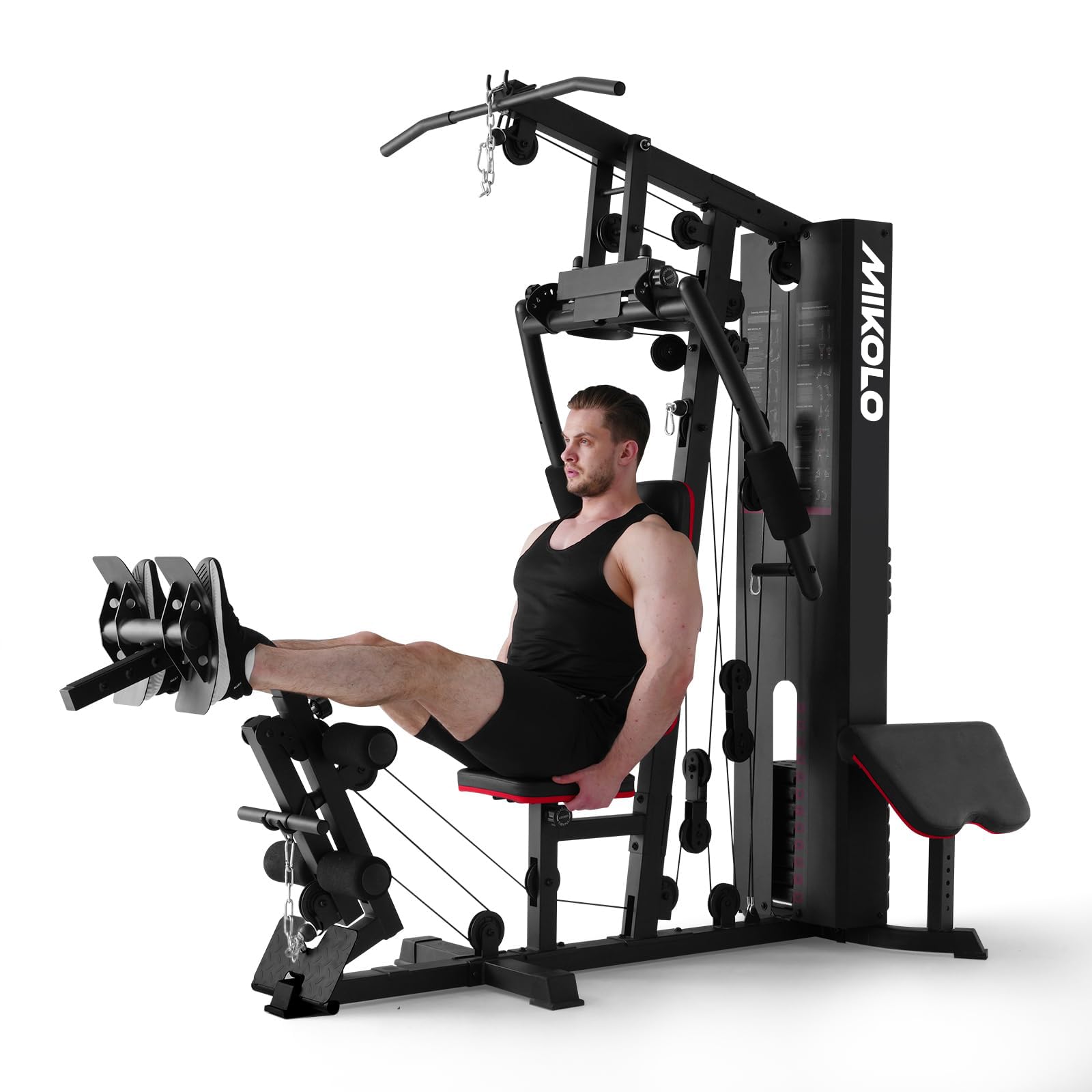
A single station that replaces a wall of cable machines with one 152-pound stack.
If you want one machine that covers the whole body and you have a permanent corner to give it, this is the pick. The 14-gauge steel frame with a sheet-protected counterweight block supports over 90 exercises, from pec fly and lat pulldown to leg press and preacher curl. The 152-pound weight stack means no plates to load and unload between sets — you find the right pin position and start pulling.
What buyers appreciate most is the quality of the build and the sheer range of movements. The high, mid and low pulley system plus chest press, chest fly and back extension in one frame means you can run a full session without moving stations. The included D-handles, short cable bar, lat pulldown bar, tricep rope and chain attachment give you plenty of grip options, and the preacher curl pad and leg press accessories are removable when you do not need them. A professional bearing on the cable bar reduces wrist stress during pulling movements.
Two things to plan for. First, it is 300 pounds and measures 75 inches deep by 80 inches high, so it needs real floor space and a spot where the ceiling height suits a standing pulldown. Second, assembly feedback is mixed — some find it simple, others find it a project. Budget a weekend and a second set of hands. The 300-pound maximum weight recommendation covers most users, but if you plan to lift near that ceiling regularly, check the frame rating against your goals.
What makes it a full gym
- 152-pound stack replaces loose plates entirely.
- Over 90 exercises from one frame, including pulldowns, rows, presses and leg work.
- 14-gauge steel construction with a steel-sheet-protected counterweight block.
What it demands of you
- 300 pounds of machine and an 80-inch height requirement — it needs a dedicated corner.
- Assembly is a mixed experience; some buyers find it a longer project than expected.
For you if: you want a permanent full-body cable station and have the room for it.
Not for you if: you rent, move often, or cannot spare a walk-in closet’s worth of floor.
6. Q-Rope Patented Endless Rope Trainer Machine
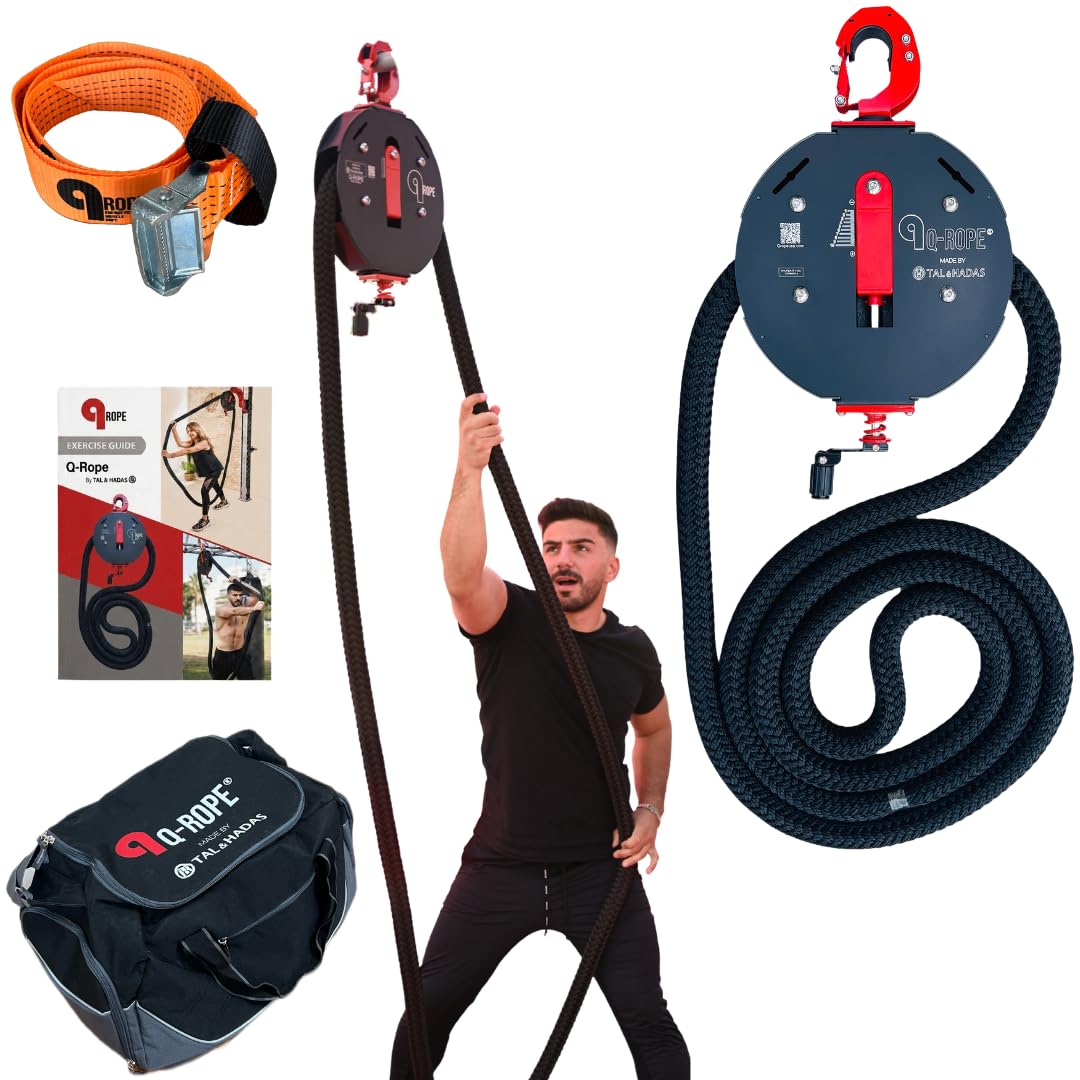
A hand-over-hand rope pull that hits your forearms and lungs harder than it looks.
If the word “anaerobic” means hard, short bursts that leave you gasping, this is the most literal match on the list. You pull a continuous rope hand over hand with no end and no reset, and the resistance dial goes up to 132 pounds. That is a load you can turn down to almost nothing for rehab or senior training and wind up to strongman territory — same machine, same dial.
What buyers value is the quality of the build and the range of movements. The frame is aircraft-grade aluminum and stainless steel with nothing that rusts, and the rope splice is built to run smooth and silent through your hands rotation after rotation. It ships with an anchor strap, an illustrated exercise guide and a carry bag, so it lives in a closet and sets up in a doorway or around a post. The same pull trains arms, shoulders, back, core and legs — strength one session, cardio the next.
The honest caveat is the value question. This is a premium-priced piece of equipment and some owners feel the price sits high for a single machine. It is also a single-motion tool — if you want presses, squats and rows from one frame, look at the Mikolo or the Speediance picks instead. What you get here is a conditioning tool that never runs out of rope, and for interval work that is exactly the point.
The standout: 132 pounds of adjustable resistance on one dial, an endless rope that never needs resetting, and a build using aircraft-grade aluminum and stainless steel.
The catch: premium pricing and a single pulling motion — it is a conditioning tool, not a full cable station.
Ideal for: interval training, grip and forearm strength, and anyone who wants a hard two-minute effort.
Think twice if: you want one machine that covers pressing, squatting and pulling together.
7. Body-Solid Powerline Cable Crossover Exercise Machine

Two independent 160-pound stacks that let each arm pull on its own terms.
The defining numbers here are the two 160-pound weight stacks and the 1/2:1 weight ratio, which means each pulley delivers a controlled feel rather than a jerky one. Independent stacks give you true isolateral movement — each arm pulls its own cable, so your stronger side cannot cheat for your weaker one. That is a real training advantage for anyone working back from an imbalance or chasing a symmetrical press.
The build is what keeps this machine in the conversation. An extra-wide mainframe and an electrostatically applied powder coat give it a sturdy, commercial-gym feel, and the pulleys run smoother than the price tier suggests. Owners praise the quality and the value most, and the smooth gliding motion is a recurring theme. The exercise range is broad: cable crossovers, shoulder presses, pull-ups and leg kickbacks are all on the table, along with rows, crunches, tricep press-downs and glute kickbacks.
Be realistic about the footprint. The frame measures 42.3 inches deep, 62.6 inches wide and 83 inches high, and it weighs 476 pounds — this is a permanent install, not a weekend shuffle. The 210-pound maximum weight recommendation is a user rating, not a resistance cap. Instructions draw mixed feedback, with several buyers finding them not entirely clear, so allow extra time for assembly. The 10-year frame warranty and 1-year parts coverage soften that.
What the dual stack gives you
- Two 160-pound stacks with isolateral movement so each arm trains independently.
- Smooth pulleys and a sturdy extra-wide mainframe.
- Covers crossovers, presses, rows, pulldowns and leg work from one frame.
The reality check
- 476 pounds and a 62.6-inch width — it owns the room it sits in.
- Instructions are not fully clear, so budget assembly time.
Buy this if: you want commercial-style cable work at home and have a permanent space for it.
Leave it if: you need something that moves, folds or fits a small apartment.
8. Speediance Gym Monster 2 Smart Home Gym
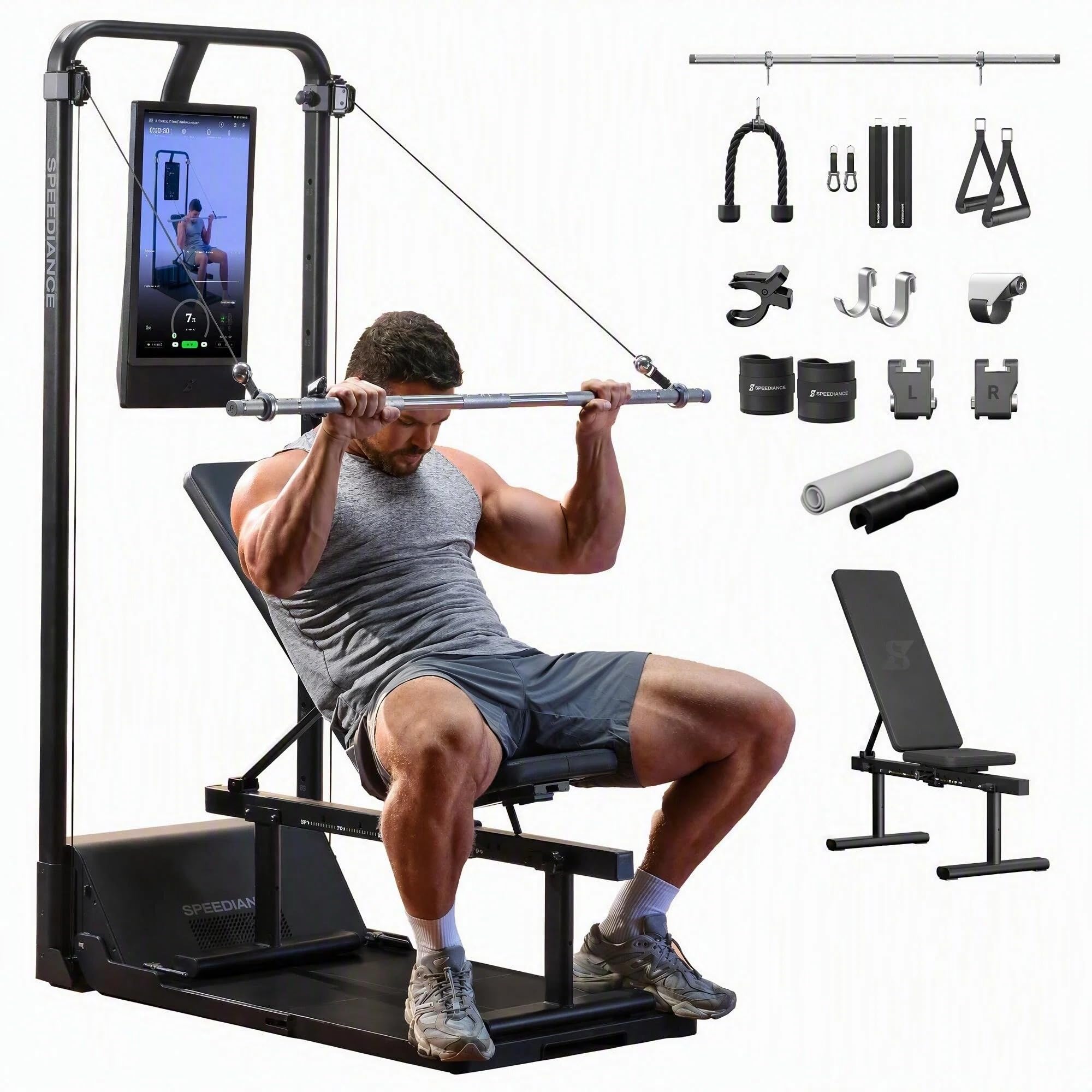
A power cage, Smith machine and cable tower folded into one slim digital frame.
This machine replaces a power cage, a Smith machine, a squat rack, a bench rack, a cable machine and a pulley system with one folding unit. Dual 800W PMSM motors generate up to 220 pounds of digital resistance, adjusted in controlled increments for progressive overload. The slim frame folds down to 0.25 m² — roughly 2.69 square feet — so it disappears against a wall between sessions, which is the whole reason it works in an apartment.
The AI coaching is the feature that separates it from a plain stack. The system tracks performance in real time and suggests weight adjustments after each set, which removes the guesswork for anyone who has never programmed their own progression. Quality is the most-praised trait across the review base, and versatility and workout experience follow close behind — the machine ships with an adjustable bench, barbell, handles, tricep rope, ankle straps, Bluetooth ring and mat, so you have a full setup in one box.
What to weigh: digital resistance feels different from a steel stack. The motor can go lighter and heavier than plates and can change mid-set, but some lifters miss the clank and inertia of real iron. It also weighs 125 kg, so moving it is a two-person job despite the folding footprint. The 2-year main-unit and 1-year accessory coverage is a fair safety net for a motorized machine. If you want guided programming and a small footprint, this is the strongest fit on the list for that brief.
Where it wins: 220 pounds of motor-driven resistance, folding storage at 0.25 m², AI weight suggestions, and a full accessory bundle including bench and barbell.
Where it diverges: digital resistance has a smoother, motor-driven feel that is not the same as a steel stack, and 125 kg means you will not move it alone.
The match for: apartment lifters who want guided strength work and a machine that vanishes when the session ends.
Not the match for: purists who want the physical feel of loaded plates.
9. Speediance Gym Monster 3, All-in-One Smart Home Gym
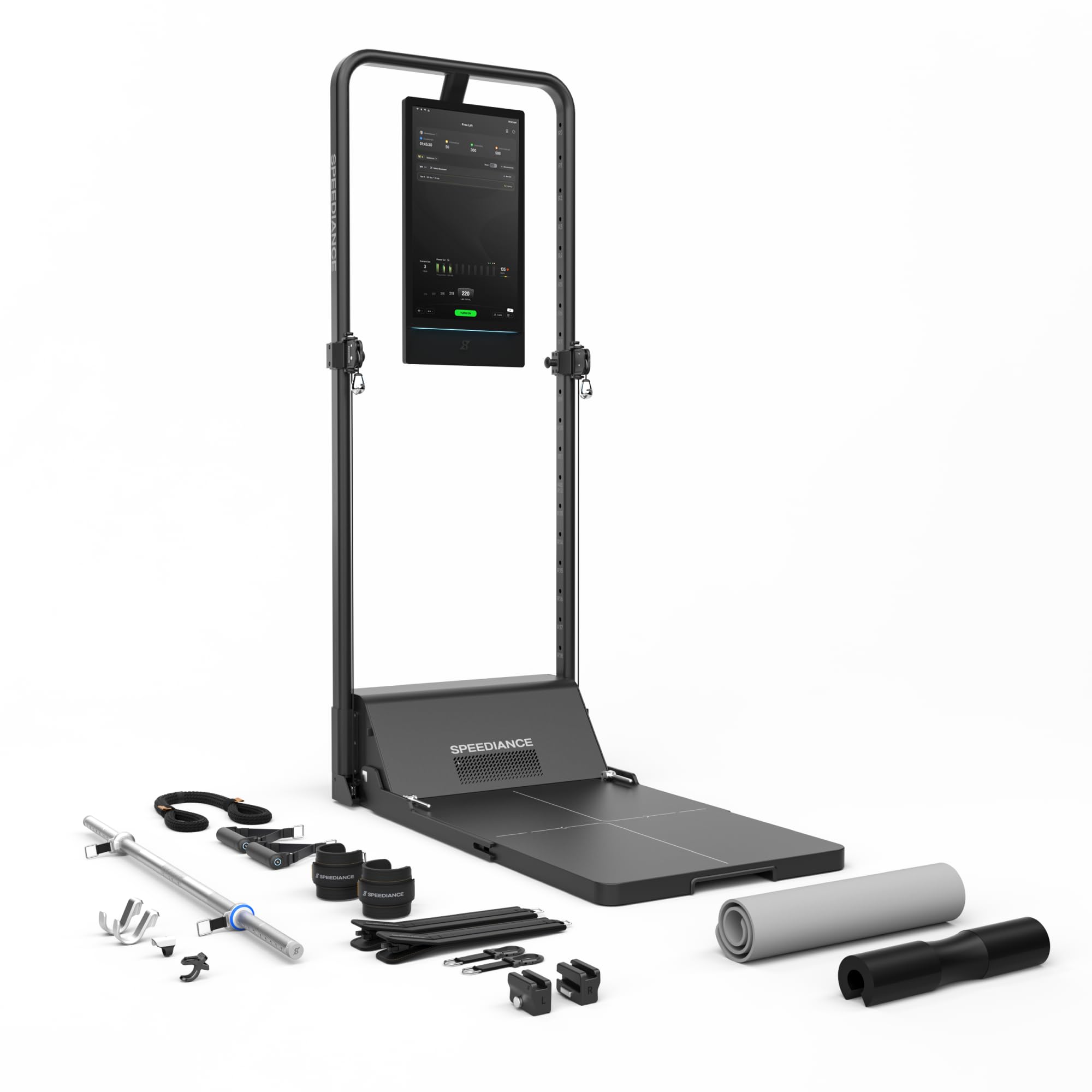
A 260-pound digital trainer with a 23.8-inch screen and 19 cable positions.
The step up here is measurable. The Gym Monster 3 delivers up to 260 pounds of digitally controlled resistance with 1-pound adjustments, against the 220 pounds on the Gym Monster 2. The next-generation brushless motor makes the resistance responsive enough for squats, presses, rows and pulls from the same frame. Nineteen cable positions give you the high, low and mid angles you would otherwise need a full crossover for.
Functionality is what earns this machine its keep — it combines strength training, cardio, Pilates, mobility and functional work in one unit. The 23.8-inch HD display, 20W 2.1 stereo sound and ambient lighting turn a session into something closer to a class than a grind, and hands-free voice control lets you adjust settings without breaking your set. It requires no drilling or wall mounting and takes up less than 10.8 square feet. At 82 kg it is lighter than the Gym Monster 2’s 125 kg, which makes repositioning realistic.
What to weigh is honest: adjustability draws mixed feedback and some owners flag durability as a longer-term question, which is worth knowing on a motorized machine this complex. The 2-year main-unit and 1-year accessory coverage is the safety net. Selected AI features may arrive through future software updates, so the coaching gets better over time rather than being fixed at launch. If you want the biggest screen, the most cable positions and 1-pound resistance steps, this is the top of the range.
The case for it: 260 pounds of digital resistance with 1-pound steps, 19 cable positions, a 23.8-inch HD display and voice control — the most adjustable smart gym here.
The caveat: some adjustment points draw mixed feedback and durability is a longer-term question on a complex motorized machine.
Right for: a buyer who wants the widest resistance range and the most rich screen-led training.
Wrong for: anyone who wants a simple machine they never have to think about or update.
Understanding the Specs
Resistance Load
Resistance load is the maximum force a machine can push back against you, measured in pounds. A 152-pound stack, a 400-pound band tension ceiling or a 260-pound digital motor all describe the same idea: the cap on how hard you can train before you run out of machine. Read it alongside the maximum weight recommendation, which is the heaviest user a frame is rated to hold — those are two different numbers and they are often confused. A frame rated to 440 pounds can hold a heavy user; a stack rated to 152 pounds is the resistance you actually move.
Digital vs Steel Resistance
A steel weight stack is a visible plate you pin and lift, and the resistance stays constant through the range of motion. A digital resistance system uses a motor to generate load, which lets you change weight mid-set and step in small increments — the Gym Monster 3 adjusts in 1-pound steps. The trade-off is feel: a motor is smooth and quiet, while a stack gives the clank and inertia some lifters prefer. Neither is better in general; the stack suits purists and the motor suits guided, adjustable training.
FAQ
Is an ab machine actually anaerobic exercise?
How much floor space do I need for a home gym station?
Can I build real muscle with resistance bands instead of weights?
What does maximum weight recommendation mean on these machines?
Is digital resistance as good as lifting real weights?
How heavy is each machine to move around?
Do I need to assemble these machines myself?
Which machine works the most muscle groups at once?
Can I use these machines in an apartment without disturbing neighbors?
How long should a resistance training session be on one of these?
Final Thoughts: The Verdict
For most people setting up a home training space, the anaerobic exercise equipment that makes the most sense is the MERACH Ab Machine. It holds a 440-pound user rating, folds flat, and gives you a readable rep count for core work — a lot of utility from one small frame. If you have a permanent corner and want full-body cable work, reach for the Mikolo Home Gym and its 152-pound stack. And if short, brutal conditioning is the goal, the Q-Rope Trainer with its 132-pound dial is the tool that will leave you flat on the floor in two minutes.
How We Picked
We do not accept paid placement. Every pick is matched to a real buyer and a real use-case; we do not hands-on test units.
Sources & Methodology
Specifications: manufacturer listings and product documentation. Review insights: verified customer reviews, as of November 2026. Pricing: not shown on this page (it changes often); check the current price via the retailer link.
As an Amazon Associate, Gadgets Feed earns from qualifying purchases. This does not affect which products we feature.