
The shift from traditional LCD technology to a 4K OLED gaming monitor is not incremental — it is a complete sensory overhaul. You trade the dull gray of IPS glow for absolute, pixel-level blacks and a contrast ratio that makes shadows feel tangible. The burn-in fear, the sub-pixel text quirks, and the aggressive auto-dimming are the real trade-offs serious buyers must evaluate before committing to this panel class.
I’m Min — the co-founder and writer behind Gadgets Feed. I’ve spent months dissecting the technical specifications, customer-reported failure modes, and real-world performance deltas across every meaningful 4K OLED gaming monitor on the market right now to build a reference-grade buying guide.
Whether you prioritize blistering 240Hz refresh rates or the color volume of a QD-OLED panel, this guide benchmarks every critical spec to help you choose the best 4k oled gaming monitor for your rig and budget.
How To Choose The Best 4K OLED Gaming Monitor
Selecting a 4K OLED gaming monitor means balancing pixel response, peak brightness, panel longevity, and connectivity bandwidth. Every spec interacts: a high refresh rate is meaningless if the GtG response is slow, and a bright panel without proper burn-in mitigation will degrade fast. Focus on the hierarchy of specs below.
Panel Technology: QD-OLED vs. WOLED
Quantum Dot OLED panels (QD-OLED) produce wider color volume and higher peak brightness in HDR highlights, making single-player titles like Cyberpunk 2077 visually richer. White OLED panels (WOLED) with Micro Lens Array+ tend to deliver slightly better near-black uniformity and lower color shift at off-angles. QD-OLED panels also exhibit a purple tint under direct bright light, while WOLED handles ambient lighting more gracefully. Your choice depends on whether you prioritize peak color saturation or consistent black levels in a bright room.
Refresh Rate & Dual-Mode Capability
Native 240Hz is the sweet spot for 4K OLED panels because pixel response time (0.03ms GtG) ensures each frame resolves before the next arrives, eliminating ghosting entirely. Some monitors now offer dual-mode switching — toggling between 4K@240Hz and FHD@480Hz — useful for competitive shooters where higher frame rates reduce input lag. DisplayPort 2.1 bandwidth is required to sustain 4K@240Hz with 10-bit color and HDR without Display Stream Compression artifacts.
HDR Performance & Peak Brightness
VESA DisplayHDR True Black 400 is the baseline for OLED HDR, but peak brightness varies widely. A monitor rated for 1000 nits in a 3% window (like the Alienware AW2725DF) will produce specular highlights that genuinely pop, while a 250-nit panel will look flat in HDR mode. Pay attention to the ABL (Auto Brightness Limiter) aggressiveness — some panels dim quickly on sustained bright scenes, which ruins immersion.
Quick Comparison
On smaller screens, swipe sideways to see the full table.
| Model | Category | Best For | Key Spec | Amazon |
|---|---|---|---|---|
| ASUS ROG Swift PG32UCDP | WOLED Dual-Mode | Versatile 4K & FHD gaming | 4K@240Hz / FHD@480Hz Dual Mode | Amazon |
| ASUS ROG Swift PG27AQWP-W | Glossy Tandem OLED | Competitive 540Hz play | QHD@540Hz, DisplayPort 2.1 | Amazon |
| LG 32GX870A-B | MLA+ WOLED | Bright-room 4K with audio | 4K@240Hz / FHD@480Hz, 1300 nits peak | Amazon |
| LG 27GX790B-B | 4th Gen WOLED | Ultra-high refresh rate | QHD@540Hz, DisplayPort 2.1 | Amazon |
| Samsung Odyssey G8 G81SF | QD-OLED | Glare-free 4K immersion | 4K@240Hz, 0.03ms GtG | Amazon |
| Alienware AW2725Q | QD-OLED 4K | Compact 27″ 4K clarity | 4K@240Hz, 1,500,000:1 contrast | Amazon |
| MSI MPG 321URXW | White QD-OLED | Productivity + Gaming | 4K@240Hz, 90W USB-C PD | Amazon |
| ASUS ROG Swift PG32UCDM | QD-OLED | Color-accurate 4K HDR | 4K@240Hz, Graphene heatsink | Amazon |
| MSI MPG 321URX QD-OLED | QD-OLED | Balanced 4K gaming value | 4K@240Hz, DisplayHDR True Black 400 | Amazon |
| Acer Predator X32 | Curved QD-OLED | Immersive curved 4K | 4K@240Hz, 1700R curve | Amazon |
| INNOCN GA27M1Q | QD-OLED 500Hz | Budget competitive speed | 1440p@500Hz, 0.03ms | Amazon |
| Alienware AW2725DF | QD-OLED 360Hz | Entry-level OLED value | 1440p@360Hz, 0.03ms | Amazon |
| Samsung Odyssey G7 G75F | VA Curved | Console and productivity | 4K@165Hz, 1000R curve | Amazon |
In‑Depth Reviews
1. ASUS ROG Swift 32” 4K OLED Gaming Monitor (PG32UCDP)

The PG32UCDP uses a 32-inch WOLED panel with Micro Lens Array+ technology that delivers a measured peak brightness of over 1300 nits in a 3% window, making it one of the brightest OLED gaming monitors available. The dual-mode toggle lets you switch from native 4K@240Hz to FHD@480Hz, which gives you the flexibility to drop into ultra-fast competitive shooters without losing response time. ROG-exclusive OLED Anti-Flicker technology stabilizes the luminance during VRR fluctuations, solving a common pain point on WOLED panels.
Color accuracy is exceptional out of the box with 99% DCI-P3 coverage and Delta E < 2, which means this monitor doubles as a credible HDR reference display. The custom heatsink design eliminates the need for active cooling, and the three-year burn-in warranty provides peace of mind for daily mixed use. The built-in AI Assistant functions — dynamic crosshair and sniper modes — are niche but useful for specific game genres.
The matte anti-glare coating handles bright room lighting well without crushing blacks, though some users report subtle graininess on solid white backgrounds. The OSD joystick is responsive, and the USB-C port delivers 90W Power Delivery for single-cable laptop setups. Connectivity includes DisplayPort 1.4a and dual HDMI 2.1 ports, though you will need DisplayPort 2.1 for uncompressed 4K@240Hz on future GPUs.
Why it’s great
- True 4K@240Hz and FHD@480Hz dual-mode flexibility
- 1300-nit peak brightness with excellent HDR pop
- Three-year burn-in warranty included
Good to know
- DisplayPort 2.1 not included — limited to DP 1.4a
- Aggressive ABL can dim large static white areas
- Matte coating may look slightly grainy on bright screens
2. ASUS ROG Swift 27″ OLED Gaming Monitor (PG27AQWP-W)
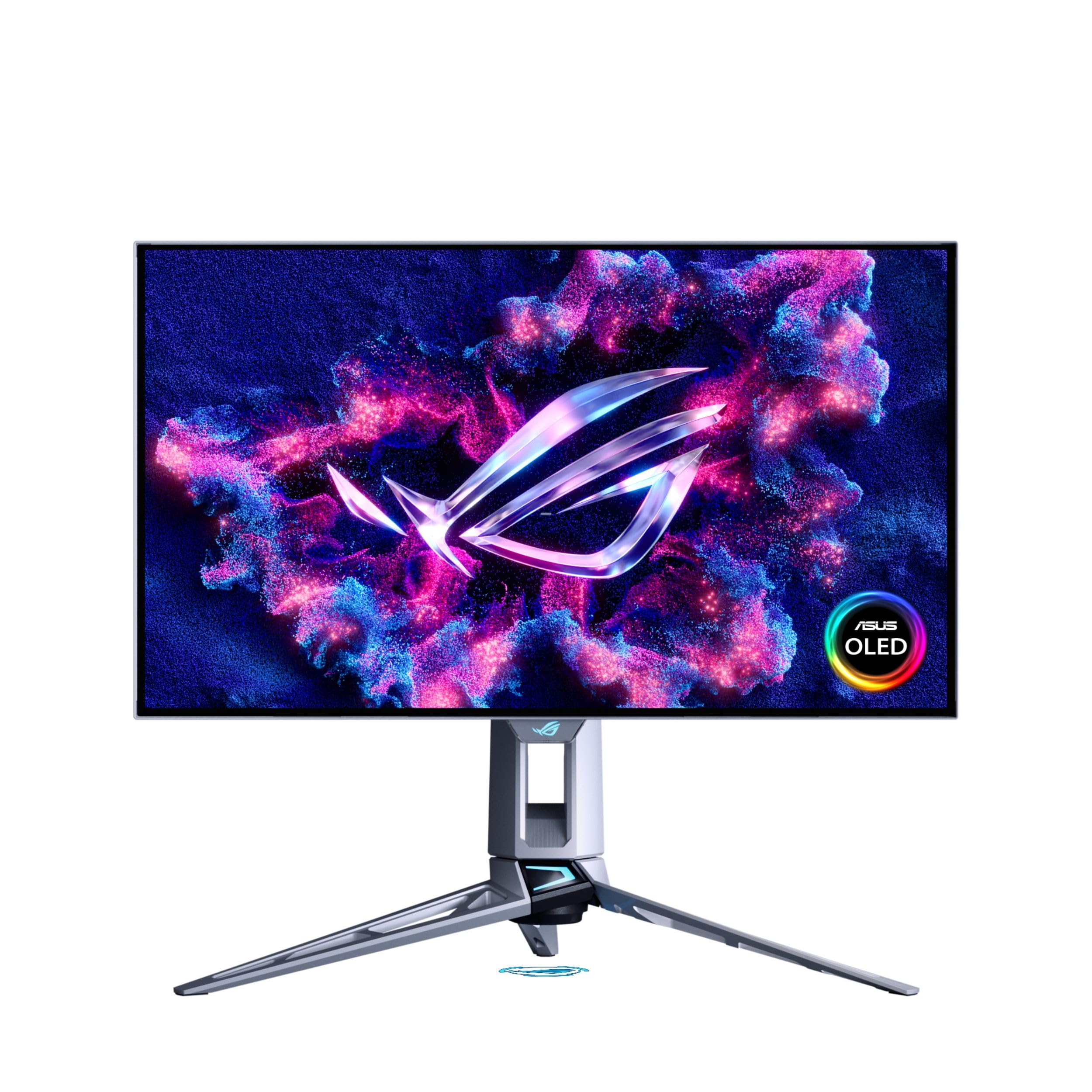
The PG27AQWP-W introduces ASUS’s new Tandem OLED technology, which stacks two OLED layers to achieve 15% higher peak brightness and 60% longer panel lifespan compared to previous WOLED generations. The TrueBlack Glossy surface delivers zero haze and exceptionally sharp text, directly addressing the sub-pixel clarity complaints that plague QD-OLED alternatives. At 540Hz in QHD mode, the motion clarity is frankly absurd — even at 240Hz you can see the individual frames resolve with no ghosting trail.
The Neo Proximity Sensor is a standout OLED care feature: it detects when you walk away and automatically blanks the screen, reducing burn-in risk without requiring manual intervention. DisplayPort 2.1 UHBR20 with full 80Gbps bandwidth means you can run QHD@540Hz with 10-bit color and HDR without any compression artifacts. The three-year burn-in warranty covers the panel, which is essential given the premium price point.
Grey banding has been reported on some units, particularly in dark gradients, and the built-in speakers are noticeably quieter than competing LG models. The white chassis and RGB lighting make this a statement piece for white-themed builds, but the glossy panel requires careful lighting placement to avoid reflections. At 27 inches, the 1440p resolution provides a pixel density of 109 PPI, which is sharp enough for desktop work without scaling headaches.
Why it’s great
- DisplayPort 2.1 UHBR20 with 80Gbps bandwidth
- Neo Proximity Sensor for automatic burn-in prevention
- Glossy panel delivers exceptional text clarity
Good to know
- Occasional grey banding reported on some units
- Speakers are quieter than competing monitors
- Glossy finish requires careful ambient light management
3. LG 32GX870A-B 32-inch Ultragear 4K OLED Gaming Monitor
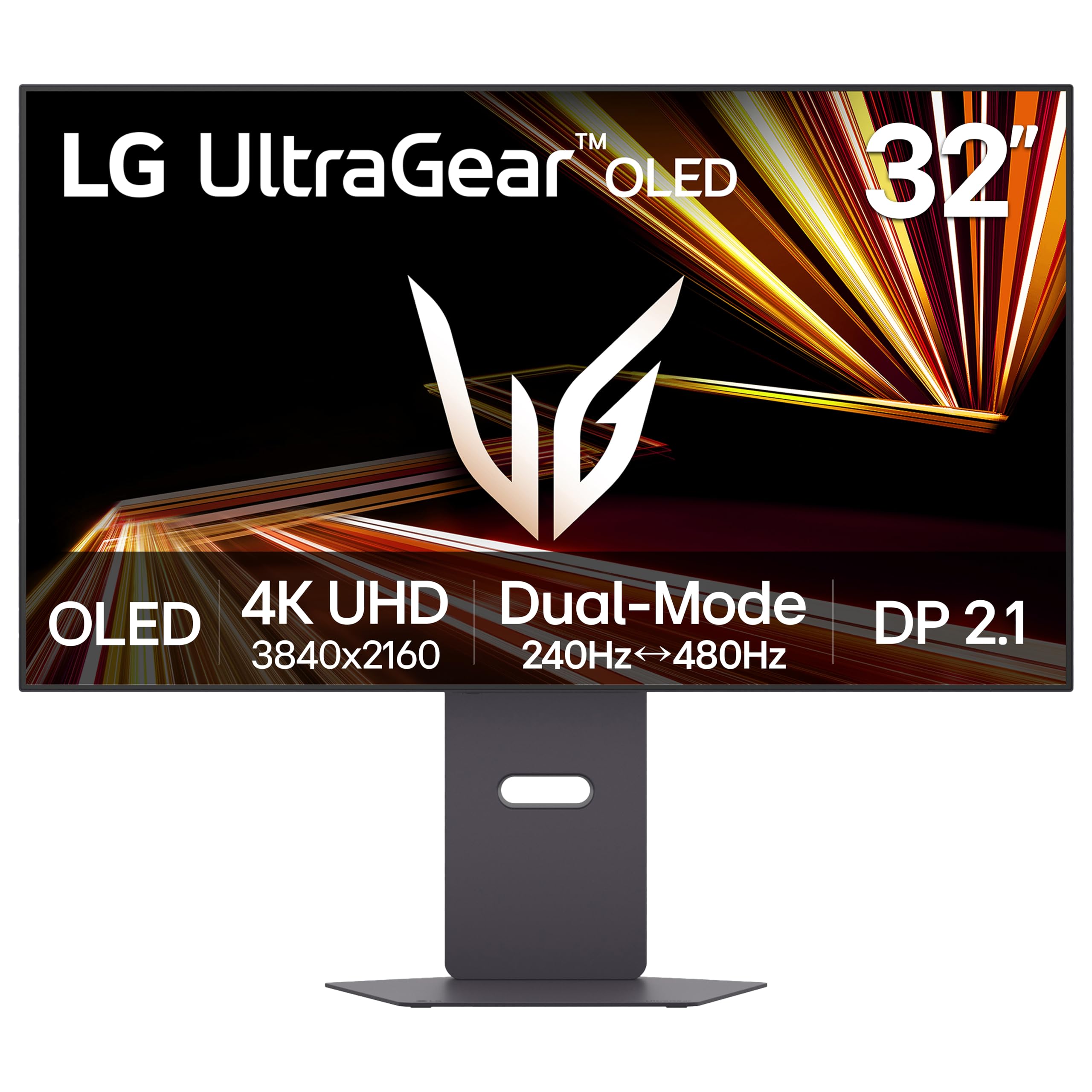
The LG 32GX870A-B leverages Micro Lens Array+ technology to push peak brightness to 1300 nits in small highlight windows, making it the brightest OLED gaming monitor in this lineup. The dual-mode toggle between 4K@240Hz and FHD@480Hz is VESA-certified and works seamlessly via a single hotkey, giving you native 480Hz for esports titles without sacrificing 4K clarity for AAA games. The anti-glare low-reflection coating effectively eliminates distracting reflections while maintaining deep black levels in moderately lit rooms.
Built-in speakers are surprisingly capable with bass-driven sound and DTS Headphone:X support for 3D audio, which reduces the need for external desktop speakers in tight setups. The Switch app allows screen customization with up to six split sections and integrates webOS streaming directly into the monitor, turning it into a productivity hub when the PC is idle. OLED Care tools including pixel cleaning and a two-year limited warranty on the panel provide reasonable protection.
Initial vertical banding is common on WOLED panels but typically resolves after several pixel refresh cycles. Text clarity at 4K native resolution is excellent, though disabling ClearType may be needed for users sensitive to sub-pixel rendering artifacts. The global dimming on large bright areas is more noticeable than on QD-OLED alternatives, which can make full-screen white applications look dimmer than expected.
Why it’s great
- 1300-nit peak brightness for exceptional HDR highlights
- VESA-certified dual-mode 4K@240Hz / FHD@480Hz
- Built-in speakers with DTS Headphone:X support
Good to know
- Initial vertical banding may require pixel refresh cycles
- Global dimming noticeable on large bright areas
- Two-year warranty is shorter than some competitors
4. LG 27GX790B-B 27” Ultragear QHD OLED Gaming Monitor
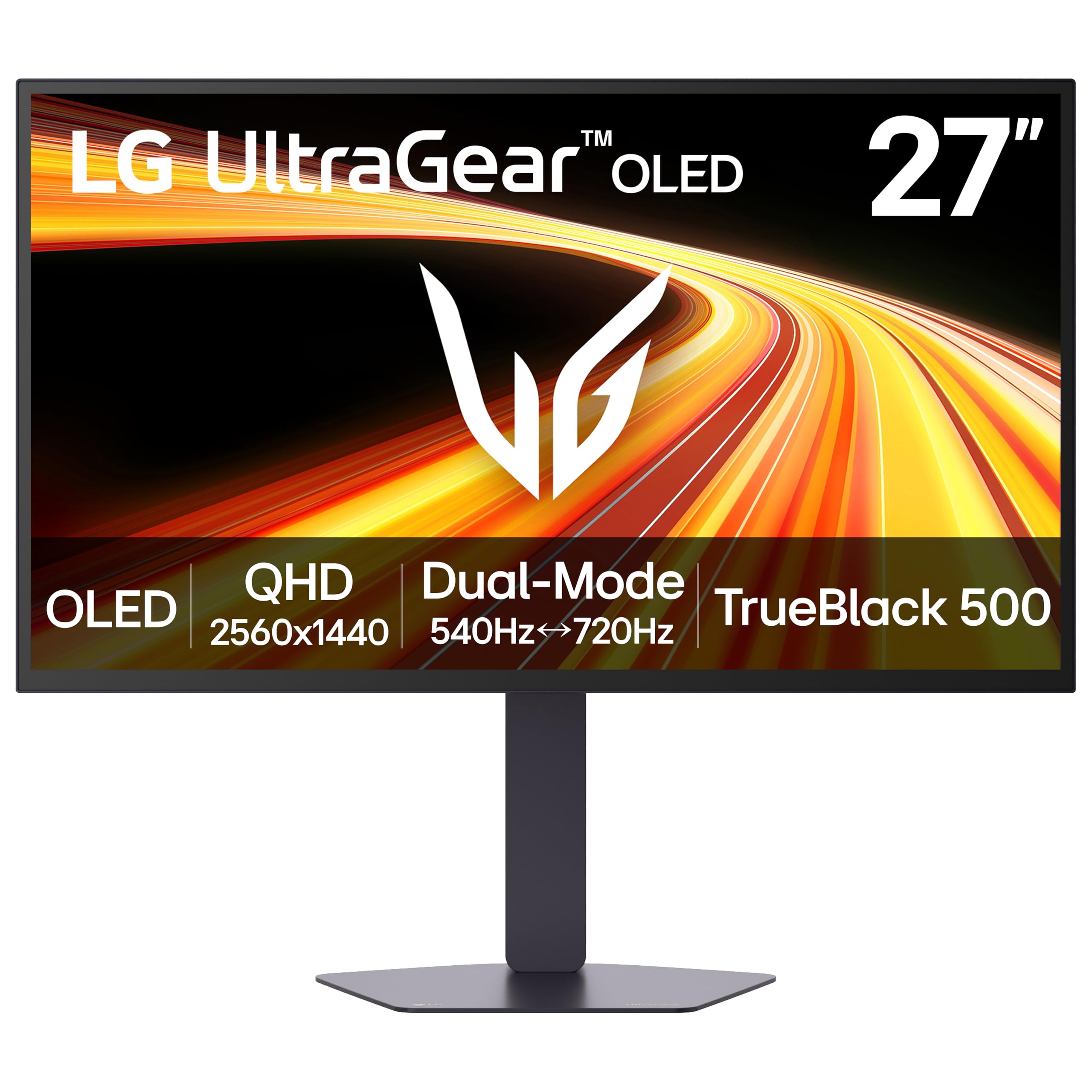
The 27GX790B-B uses LG’s 4th Gen Primary RGB Tandem OLED structure, which delivers 335 nits typical brightness — the brightest standard luminance of any OLED in this guide — while consuming less power than previous generations. The dual-mode capability is staggering: QHD at 540Hz or HD at 720Hz, both supported natively via DisplayPort 2.1. The 0.02ms GtG response time is the fastest on paper among these monitors, translating to zero visible ghosting even at 720fps.
UL-verified Perfect Reproduction certification ensures that dark scenes retain intended color and detail, which is critical for competitive players who rely on visibility in shadows. The 1.5 million:1 contrast ratio combined with DisplayHDR True Black 500 gives this monitor deeper black expression than the True Black 400 standard. The matte finish works well in bright rooms, and the 99.5% DCI-P3 gamut with Delta E ≤ 2 makes it viable for color-critical creative work.
The large bottom bezel has been criticized for its unfinished look — there is no plastic trim to conceal the panel edge, which may trigger visual discomfort for sensitive users. The proprietary power cable is also a minor annoyance if you prefer standard C13 connectors. At 27 inches with QHD resolution, the 109 PPI pixel density is sharp but not as crisp as a true 4K panel for productivity text.
Why it’s great
- World-class 540Hz/720Hz dual-mode refresh rates
- 335 nits typical brightness — brightest in class
- DisplayPort 2.1 with uncompressed bandwidth
Good to know
- Unfinished bottom bezel detracts from premium feel
- Proprietary power cable limits replacement options
- QHD resolution less sharp than native 4K for productivity
5. Samsung 32” Odyssey QD-OLED G8 (G81SF)
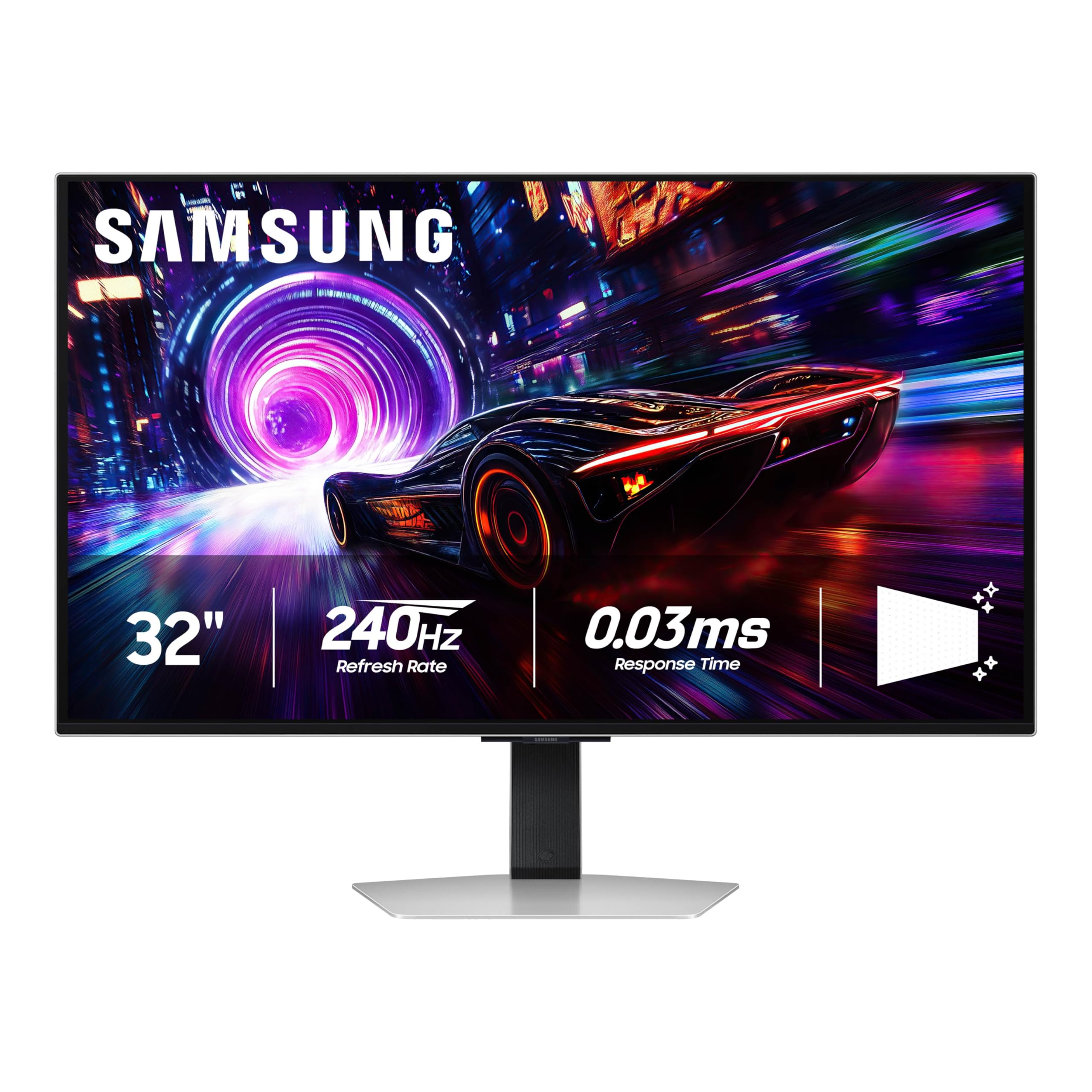
Samsung’s Glare Free technology reduces the screen’s reflectivity by 54% compared to conventional anti-reflection film, making the G81SF the best choice for brightly lit rooms without needing a hood. The 32-inch QD-OLED panel delivers 4K at 240Hz with a 0.03ms GtG response time and full G-Sync Compatibility alongside FreeSync Premium Pro. The Dynamic Cooling System uses a Pulsating Heat Pipe that dissipates heat five times faster than graphite, reducing core temperature and preventing burn-in without a fan.
The Thermal Modulation System automatically adjusts brightness based on temperature to prevent overheating, while Logo and Taskbar Detection reduces luminance on static elements to further mitigate burn-in. CoreSync and CoreLighting+ project on-screen colors onto your desk via 16.7 million colors, creating an immersive ambient lighting effect that syncs with gameplay. The ergonomic stand offers full height, tilt, and swivel adjustment with a premium metal build.
Some units have reported dead pixel clusters appearing after two months of use, and the warranty paperwork has caused confusion — some customers received documentation showing a one-year term despite the advertised three-year coverage. The mini joystick OSD controller is finicky, and the 260 cd/m2 typical brightness is notably lower than competitors, requiring HDR mode for punchy highlights.
Why it’s great
- Industry-best Glare Free coating for bright rooms
- Pulsating Heat Pipe fanless cooling system
- Dynamic burn-in prevention with taskbar detection
Good to know
- Some units develop dead pixels within months
- 260 nits typical brightness — dimmer than competition
- Finicky mini joystick for OSD navigation
6. Alienware AW2725Q 27″ 4K QD-OLED Monitor

The AW2725Q packs a 27-inch 4K QD-OLED panel with a 1,500,000:1 contrast ratio and VESA DisplayHDR True Black 400 certification, delivering the same pixel-dense clarity as larger 32-inch 4K monitors but in a compact footprint that fits smaller desks. The fourth-generation QD-OLED panel provides noticeably improved text clarity over earlier QD-OLED iterations, with reduced fringing around white-on-black text. The 240Hz refresh rate and 0.03ms GtG response time are perfectly matched for fast-paced gaming.
Dell’s three-year warranty includes advanced replacement with next-day shipping, which is significantly better than the standard mail-in service many competitors offer. Dolby Vision support works correctly on Xbox, PS5, and PC, giving this monitor a genuine HDR format advantage for streaming and console gaming. The monitor runs warm but includes an active cooler fan that is nearly silent in operation.
The out-of-box HDR mode is slightly dark and requires manual calibration to reach its potential — you will need to adjust the peak brightness setting in the OSD. There is no DisplayPort 2.1 support, so 4K@240Hz runs over DisplayPort 1.4a with Display Stream Compression, which is visually lossless but worth noting for future-proofing. The built-in stand is fully adjustable with height, tilt, swivel, and pivot, but the included accessories bundle is minimal.
Why it’s great
- Compact 27-inch 4K QD-OLED with improved sub-pixel layout
- Three-year warranty with next-day advanced replacement
- Dolby Vision support for consoles and PC streaming
Good to know
- HDR mode requires manual brightness calibration
- No DisplayPort 2.1 — uses DSC for 4K@240Hz
- Active cooling fan may be audible in quiet rooms
7. MSI MPG 321URXW QD-OLED 31.5″ 4K Gaming Monitor

The white variant of the MPG 321URX shares the same QD-OLED panel as its black sibling but adds 90W USB-C Power Delivery, making it ideal for MacBook users who want a single-cable desk setup. The 31.5-inch 4K Quantum Dot OLED panel covers 99% DCI-P3 with Delta E ≤ 2 accuracy and reaches up to 1000 nits peak brightness in a 3% window. The fanless graphene heatsink eliminates mechanical noise entirely, which is a meaningful advantage for quiet gaming environments.
MSI Gaming Intelligence software includes OLED Care 2.0 for burn-in prevention, Smart Crosshair AI support, and Console Mode that correctly handles 4K@120Hz from PS5 and Xbox Series X. The KVM 1.0 functionality with PiP/PbP modes lets you control two systems with a single keyboard and mouse, which is genuinely useful for streamers or dual-PC setups. The four-way adjustable stand with RGB lighting completes a premium visual package.
The white chassis may yellow over time if exposed to direct sunlight, and the lack of DisplayPort 2.1 means 4K@240Hz requires DSC. The built-in speakers are absent, which is a disappointment at this price point compared to the LG 32GX870A-B. Some users report that the OSD menu layout is less intuitive than competitors, requiring several button presses to reach common adjustments.
Why it’s great
- 90W USB-C Power Delivery for single-cable laptops
- Fanless graphene heatsink — completely silent
- KVM and PiP/PbP for dual-system workflows
Good to know
- White chassis may discolor in direct sunlight
- No built-in speakers
- OSD menu navigation less intuitive than competitors
8. ASUS ROG Swift 32” 4K OLED Gaming Monitor (PG32UCDM)

The PG32UCDM uses a custom heatsink combined with graphene film and advanced airflow design to reduce burn-in risk without a fan, achieving a completely silent thermal solution. The QD-OLED panel delivers 99% DCI-P3 coverage with true 10-bit color and Delta E < 2 accuracy, making this one of the most color-accurate 4K gaming monitors available. The optional Uniform Brightness setting maintains consistent luminance across the screen, which is critical for desktop productivity work where ABL interference is problematic.
VESA DisplayHDR True Black 400 compliance ensures deep black levels, and the 1000-nit peak brightness in small highlights provides convincing specular pop in games and HDR movies. DisplayWidget Center software lets you adjust OLED Care functions and monitor settings using a mouse, which is more pleasant than hunting through OSD menus. The three-year warranty includes burn-in coverage, matching the industry’s best protection policies.
Peak brightness varies due to color pre-calibration, meaning different units may show slightly different luminance levels out of the box. The matte coating reduces reflections effectively but softens highlight detail compared to glossy panels. The single DisplayPort 1.4a port means you cannot run 4K@240Hz with 10-bit color without DSC, which may matter for users sensitive to compression artifacts.
Why it’s great
- Custom heatsink and graphene film for silent burn-in protection
- Delta E < 2 color accuracy out of the box
- Uniform brightness setting eliminates ABL flicker
Good to know
- Lacks DisplayPort 2.1 — relies on DSC for high refresh
- Unit-to-unit peak brightness variation from pre-calibration
- Matte coating slightly reduces highlight punch
9. MSI MPG 321URX QD-OLED, 32″ 4K Gaming Monitor

The MPG 321URX delivers the same Samsung QD-OLED panel found in the more expensive ASUS PG32UCDM at a lower price point, making it the clear value champion for 32-inch 4K OLED gaming. The 31.5-inch UHD panel runs at 240Hz with a 0.03ms GtG response time and offers VESA DisplayHDR True Black 400 certification for deep black levels. The 1.07 billion colors from 10-bit processing with 99% DCI-P3 coverage produce vibrant, accurate visuals without calibration.
OLED Care 2.0 includes pixel shift, static screen detection, and multi-logo brightness reduction to mitigate burn-in. MSI Gaming Intelligence AI adds Smart Crosshair and Console Mode, which properly maps 4K@120Hz HDR from PlayStation 5 and Xbox. The KVM function with PiP/PbP works well for users who need to monitor two inputs simultaneously. The four-way adjustable stand is sturdy and supports VESA 100mm mounting.
The 250 nits typical brightness is lower than some competitors, meaning HDR content relies on the panel’s 1000-nit peak window rather than sustained luminance. The monitor lacks USB-C Power Delivery, so laptop users will need a separate charging cable. The sub-pixel layout on QD-OLED panels still shows minor text fringing at close viewing distances, though it is less pronounced than earlier generations.
Why it’s great
- Same QD-OLED panel as premium competitors at lower price
- KVM with PiP/PbP for dual-input productivity
- Comprehensive OLED Care 2.0 burn-in prevention
Good to know
- 250 nits typical brightness — dimmer than some rivals
- No USB-C Power Delivery for laptops
- Minor text fringing from QD-OLED sub-pixel layout
10. Acer Predator X32 Curved QD-OLED Gaming Monitor
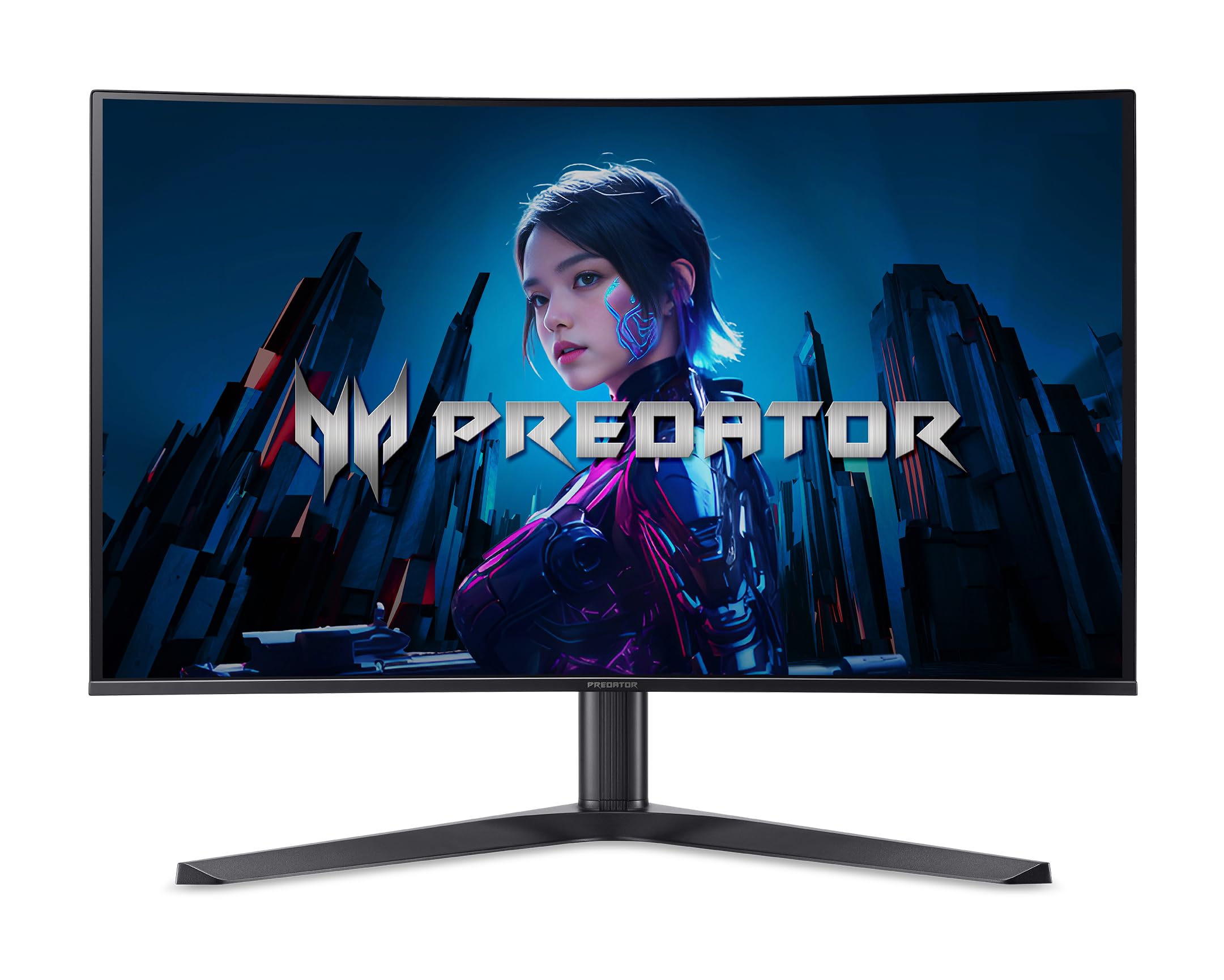
The Acer Predator X32 is the only curved 4K OLED gaming monitor in this roundup, using a 1700R curvature that wraps the 31.5-inch QD-OLED panel around your peripheral vision for a genuinely immersive experience. The 4K UHD resolution at 240Hz with 0.03ms GtG response time matches the flat panel competitors in raw performance, while the 99% DCI-P3 coverage and VESA DisplayHDR True Black 400 certification deliver excellent color and contrast. The true 10-bit panel avoids the banding artifacts seen on 8-bit+FRC monitors.
Image retention refresh technology periodically clears any latent image data to prevent burn-in, and the built-in speakers provide functional audio without external speakers. The ergonomic stand offers height, tilt, and swivel adjustment with a sturdy metal base. Connectivity includes two HDMI 2.1 ports, two DisplayPort 1.4 ports, and a USB-C port with data passthrough, giving you ample input options for multi-platform setups.
The monitor requires periodic user acknowledgment of on-screen prompts, which becomes annoying during extended sessions. Some units have been reported as significantly dimmer than the advertised 1000 nits, with white backgrounds appearing beige before calibration. The V-shaped stand base extends deep onto the desk, requiring a 25-inch minimum depth for comfortable placement.
Why it’s great
- 1700R curvature enhances peripheral immersion
- True 10-bit panel eliminates gradient banding
- Dual HDMI 2.1 and DP connections for multi-platform
Good to know
- Intrusive on-screen prompts interrupt gameplay
- Unit-to-unit brightness variance reported
- Large V-shaped stand requires deep desk space
11. INNOCN 27″ OLED 2K QHD 500Hz Gaming Monitor (GA27M1Q)
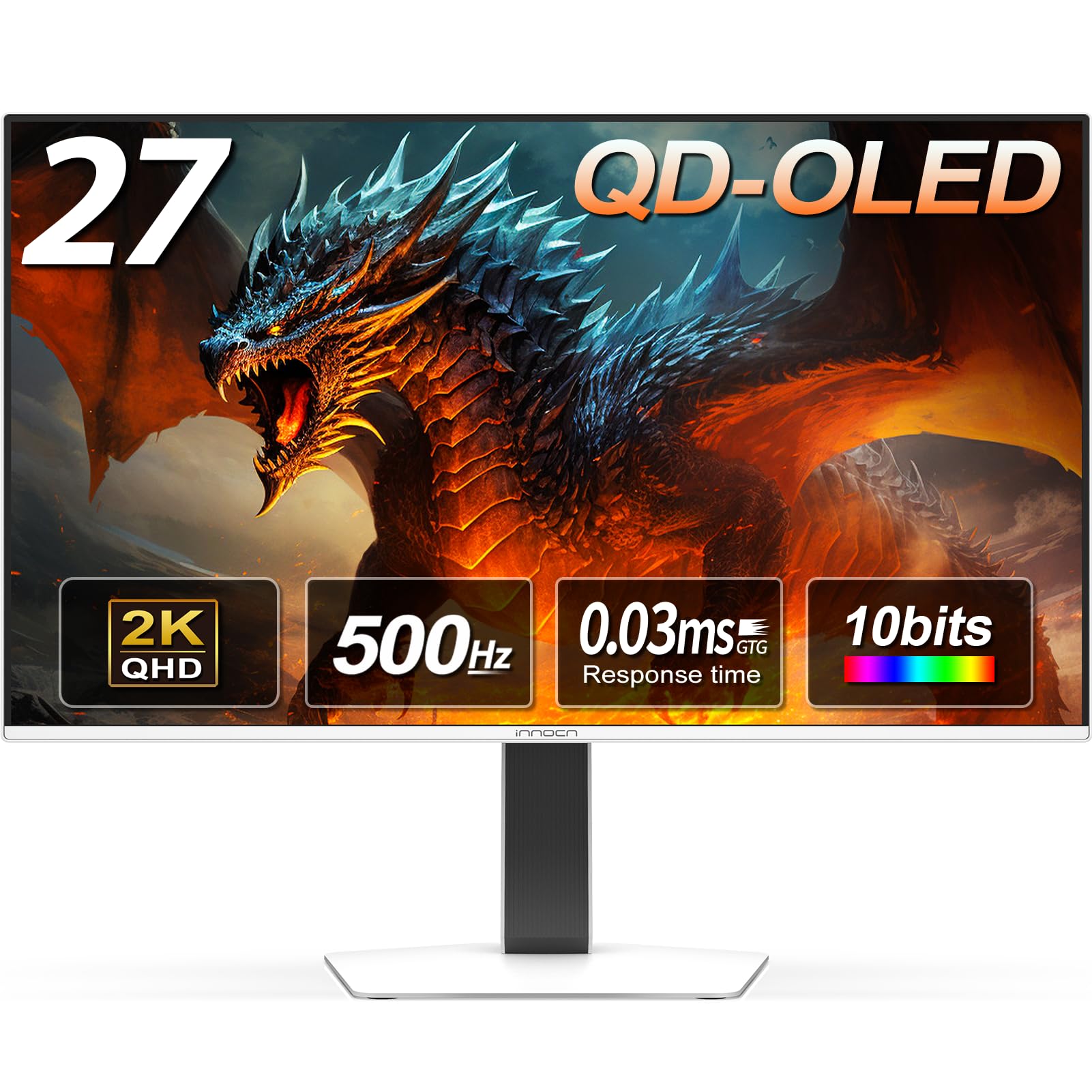
The GA27M1Q delivers a rare 500Hz refresh rate on a QD-OLED panel at a price point that undercuts every other high-refresh OLED monitor in this guide, making it the ultimate value pick for competitive gamers. The 27-inch 1440p QD-OLED panel covers 99% DCI-P3 with 1.07 billion colors and a 1,500,000:1 contrast ratio, providing the same OLED benefits of infinite black and vibrant color at a fraction of the cost of 4K alternatives. The 0.03ms GtG response time ensures each of those 500 frames resolves without ghosting.
G-Sync compatibility eliminates screen tearing across the 48Hz to 500Hz VRR range, and the monitor includes dedicated MAC-VIEW modes that optimize color matching for Mac users. The three-sided ultra-narrow bezel design with LED atmosphere lights adds a premium aesthetic to the white chassis. The fully adjustable stand with height, tilt, swivel, and pivot support makes finding the perfect viewing angle simple, and VESA 100mm compatibility allows for monitor arm mounting.
The 1440p resolution means this is not a true 4K gaming monitor — it is included specifically for buyers who prioritize frame rate over pixel density. The built-in speakers are adequate but lack bass response, and the HDR500 certification is less impactful than True Black 400, as peak brightness is lower. The white finish may show grime over time if you eat or drink at your desk.
Why it’s great
- 500Hz QD-OLED at a budget-friendly entry price
- G-Sync compatible with full 48-500Hz VRR range
- MAC-VIEW modes for color-accurate Apple workflows
Good to know
- 1440p resolution — not native 4K
- HDR500 has lower impact than True Black certification
- White chassis requires frequent cleaning
12. Alienware AW2725DF OLED Gaming Monitor

The AW2725DF is the most affordable entry point into genuine OLED gaming, offering a 26.7-inch QD-OLED panel with 360Hz refresh rate and 0.03ms GtG response time at a price that rivals high-end IPS monitors. The QHD resolution (2560×1440) delivers 109 PPI pixel density, which is sharp enough for immersive gaming without the GPU penalty of native 4K. The infinite contrast ratio and VESA DisplayHDR True Black 400 certification produce the same deep black levels and vibrant highlights as flagship monitors.
DCI-P3 99.3% color coverage with Delta E < 2 accuracy makes this monitor viable for content consumption and light creative work. AMD FreeSync Premium Pro with VESA AdaptiveSync provides tear-free gameplay across the full refresh range. Dell’s three-year burn-in warranty is the gold standard in the industry, giving buyers confidence in long-term ownership. The fully adjustable stand supports height, tilt, swivel, and pivot.
Minor text clarity issues persist on QD-OLED panels due to the triangular sub-pixel layout, with a slight purple tint visible on white backgrounds in bright rooms. The monitor is a fingerprint magnet and requires periodic pixel refresh cycles to maintain uniformity. At 1440p, this monitor is best paired with a mid-range GPU rather than a flagship card, making it a sensible upgrade for gamers who prioritize smooth motion over absolute resolution.
Why it’s great
- Lowest-cost entry into genuine QD-OLED gaming
- 360Hz refresh rate with 0.03ms response
- Three-year burn-in warranty from Dell
Good to know
- 1440p resolution — not 4K
- Text clarity fringing and purple tint in bright rooms
- Requires periodic pixel refresh maintenance
13. Samsung 37” Odyssey G7 (G75F) Curved 4K Monitor
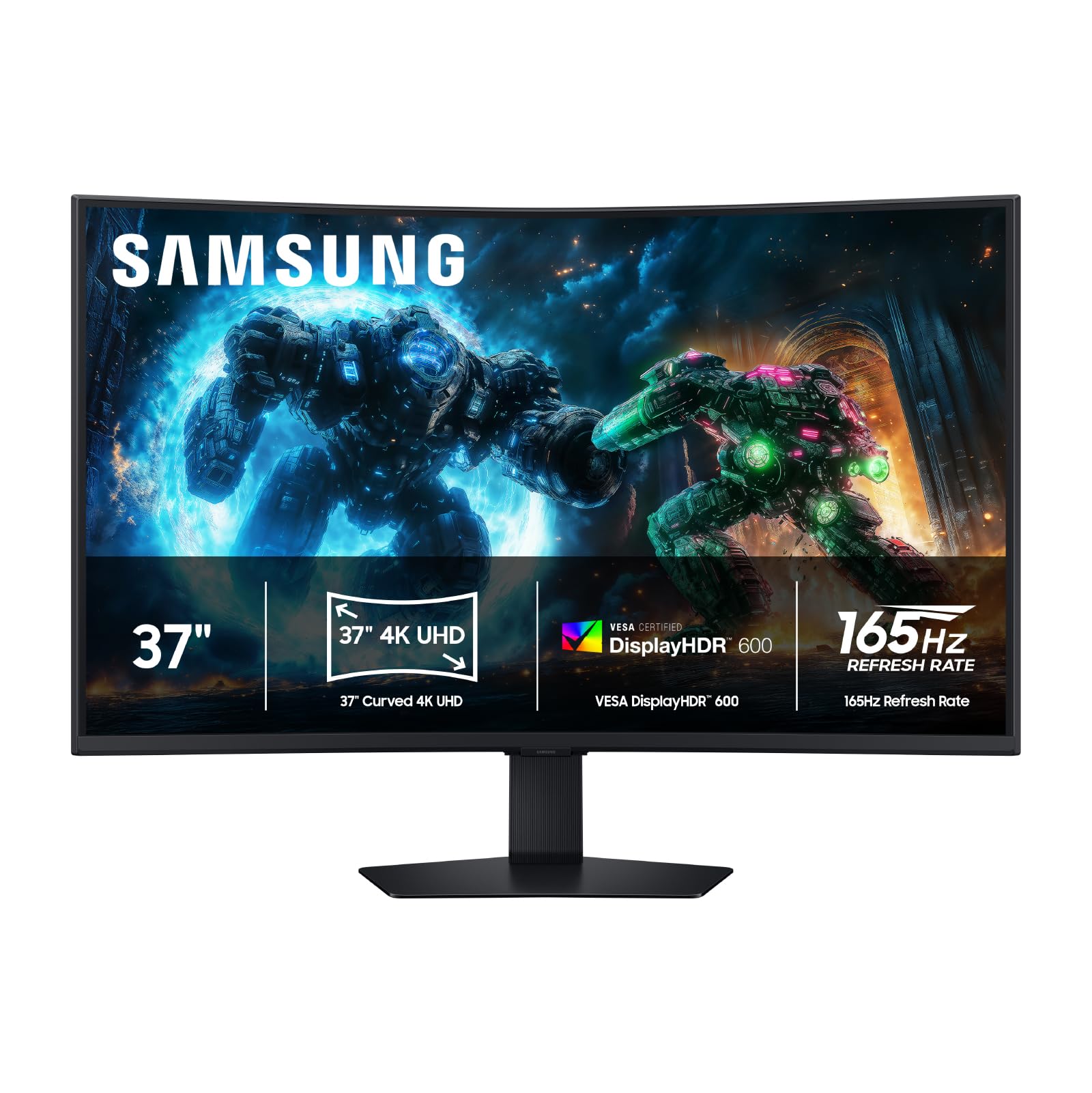
The Odyssey G7 G75F is a 37-inch 4K VA panel with a 1000R curvature, making it the largest and most aggressively curved monitor in this guide. The VA panel delivers a 3000:1 native contrast ratio that approaches OLED territory for black depth without the same burn-in concerns, and VESA DisplayHDR 600 certification provides brighter highlights than most OLED panels in sustained scenes. The 165Hz refresh rate with 1ms GtG response time is respectable, though not competitive with the 240Hz OLED alternatives.
FreeSync Premium Pro ensures tear-free gameplay with AMD GPUs, and the sheer 37-inch size provides a cinematic experience unmatched by smaller panels. For productivity, the 4K resolution combined with the 1000R curve allows you to tile four windows comfortably without needing a multi-monitor setup. The aggressive curve is particularly praised by software engineers who prefer a single large display over ultrawide options.
This is not an OLED monitor — it uses a VA panel, which means pixel response times are slower than OLED and there is noticeable black smearing in dark scenes. The 1000R curve is polarizing: some users find it deeply immersive, while others cannot tolerate the distortion on straight lines. The 350 cd/m2 typical brightness is modest, and the 165Hz refresh rate may feel limiting for users coming from a 240Hz OLED.
Why it’s great
- 37-inch 4K at 1000R curve — most immersive size
- 3000:1 contrast ratio approaches OLED black depth
- VESA DisplayHDR 600 for brighter sustained highlights
Good to know
- VA panel — not OLED — with slower pixel response
- Aggressive 1000R curve is not for everyone
- 165Hz refresh rate lags behind OLED competitors
FAQ
What is the real risk of burn-in on a 4K OLED gaming monitor?
Can I use a 4K OLED gaming monitor for productivity and text work?
Do I need a GPU that supports DisplayPort 2.1 for 4K at 240Hz?
Why do some OLED monitors have a matte coating while others are glossy?
Final Thoughts: The Verdict
For most users, the 4k oled gaming monitor winner is the ASUS ROG Swift PG32UCDP because it combines the brightest WOLED panel in the class with flexible dual-mode switching and a three-year warranty. If you want uncompromised color volume and peak highlight impact, grab the MSI MPG 321URX. And for competitive gamers who prioritize frame rate over everything, nothing beats the LG 27GX790B-B and its 720Hz ceiling.