
A dead battery in the middle of a camping trip, a roadside emergency with a dying phone, or a sudden power outage that kills your Wi-Fi router — these aren’t inconveniences; they are modern crises. The difference between a powerless night and a productive one comes down to the backup you keep in your bag. A portable battery-powered charging station is no longer a luxury; it is the core of your go-bag, your travel kit, and your home emergency plan.
I’m Min — the co-founder and writer behind Gadgets Feed. I’ve spent countless hours cross-referencing capacity ratings, AC outlet wattage claims, battery chemistries, and real-user testing feedback to map out exactly where these portable power stations actually deliver and where they fall short. This guide cuts through the spec-sheet noise to find the gear that earns its place in your pack.
After comparing over a dozen models across price tiers from compact USB-C banks to high-capacity solar generators, I’ve built this to land on the single best battery powered charging station for every real-world use case you actually face.
How To Choose The Best Battery Powered Charging Station
Every portable power station lives and dies by three things: how much energy it holds (watt-hours), how fast it can dish that energy out (wattage), and the battery chemistry that determines how many times you can trust it. Before you swipe your card, these are the specs that actually separate a useful tool from a paperweight.
Watt-Hours (Wh) and Pure Sine Wave Output
Watt-hours tell you the total energy capacity — a 299Wh station can run a 60W laptop for roughly 5 hours straight. The critical spec you must check on the AC outlet is whether it outputs pure sine wave power. Pure sine wave is necessary for sensitive electronics like laptops, CPAP machines, and portable fridges. Modified sine wave inverters can cause buzzing, overheating, or outright failure in these devices. Every station in this guide uses a pure sine wave inverter for reliable AC power.
Battery Chemistry and Cycle Life
Lithium-ion (NCM) cells are energy-dense and cheap, but they degrade after roughly 500 full charge cycles. Lithium Iron Phosphate (LiFePO₄/LFP) cells last 3,000 to 3,500 cycles before dropping to 80% of original capacity — a decade or more of regular use. For a station you intend to keep in your car or emergency kit, LiFePO₄ is the only chemistry worth your money. The premium models in this review all use LFP cells.
Port Selection and Pass-Through Charging
Count your ports carefully. A USB-C PD 60W port is great for modern laptops, but if you need to power a 12V car fridge and charge three phones simultaneously, you need a station with dedicated DC barrel ports and multiple high-speed USB-A outputs. Pass-through charging — the ability to charge the station itself while simultaneously powering devices — is an underrated feature for home backup and RV setups where you never want the battery to fully drain.
Quick Comparison
On smaller screens, swipe sideways to see the full table.
| Model | Category | Best For | Key Spec | Amazon |
|---|---|---|---|---|
| Anker SOLIX C200 DC | Premium | Ultra-compact 192Wh power with 140W PD | 60,000 mAh / 192Wh LiFePO₄ | Amazon |
| EF ECOFLOW RIVER 3 | Premium | UPS alternative with 20ms switchover | 245Wh LiFePO₄ / 300W AC (600W surge) | Amazon |
| VTOMAN Jump 600X | Mid-Range | Car jump starter and 9-device charging hub | 299Wh LiFePO₄ / 600W AC (1200W surge) | Amazon |
| HOWEASY H120 MAX | Mid-Range | Airline-safe 98Wh with 65W PD fast charge | 98Wh Lithium / 135W AC (270W surge) | Amazon |
| DARAN 89.6Wh | Mid-Range | Pocketable LiFePO₄ with 1.5hr fast charge | 89.6Wh LiFePO₄ / 100W AC (200W surge) | Amazon |
| Powkey 24000mAh | Value | Budget 65W AC outlet for small electronics | 24,000 mAh / 88.8Wh Lithium Ion | Amazon |
| Belkin 3-in-1 Qi2 | Style | Foldable MagSafe wireless charging stand | 15W Qi2 / 5W AirPods pad / 36W power supply | Amazon |
In‑Depth Reviews
1. Anker SOLIX C200 DC Power Bank Station

The Anker SOLIX C200 DC packs 192Wh (60,000 mAh) of LiFePO₄ energy into a chassis that is 39% smaller than comparable stations — 3.9 x 7.3 x 4.3 inches and only 2.6 pounds. The headline feature is a two-way USB-C PD 3.1 port that delivers up to 140W output and accepts 140W input, meaning you can recharge the station itself to 80% in just 1.3 hours using a compatible laptop charger. This is the only station in its size class that offers true 100W+ single-port laptop charging on the go.
With five ports total — two USB-C (140W and 100W), two USB-A (12W each), and a third USB-C 15W port — the C200 DC is optimized for modern USB-C ecosystems. It also accepts up to 100W solar input, making it viable for multi-day off-grid trips. The integrated flashlight is lower-tier, but the real draw is the high-efficiency GaN charging circuitry that minimizes heat and wasted energy during conversion.
The trade-off is the lack of an AC wall outlet inside the box — you must supply your own 18W or higher USB-C wall charger, which adds to the upfront cost. Additionally, the C200 DC only outputs DC power (no built-in 110V AC inverter), so it cannot run small appliances like mini-fridges or CPAP machines that require a standard wall plug. For laptop-and-phone users who prioritize compactness and pure USB-C performance, this is the cleanest option.
Why it’s great
- Ultra-compact 192Wh in a 2.6 lb package with 140W PD 3.1 port.
- LiFePO₄ chemistry delivers 3,000+ cycles for long-term reliability.
- Fast self-recharge to 80% in 1.3 hours via USB-C.
Good to know
- No AC wall charger included — requires separate 18W+ USB-C charger.
- No standard 110V AC outlet, limiting appliance compatibility.
- Flashlight is basic, not a primary work light.
2. EF ECOFLOW RIVER 3

The EF ECOFLOW RIVER 3 brings 245Wh of LiFePO₄ capacity with a 300W pure sine wave AC inverter (600W surge via X-Boost) in a chassis that is 30% smaller than the industry average for its capacity class — 8.3 x 4.4 x 10 inches and 7.8 pounds. The standout feature is GaN technology, which enables whisper-quiet operation below 30 dB at a distance of 1.5 feet — far quieter than the typical fan-cooled power station. For home backup, this station doubles the runtime for any appliance under 100W compared to traditional models.
The RIVER 3’s <20ms auto-switching UPS function is its killer feature for networking gear. When the grid fails, the station switches from AC passthrough to battery output in under 20 milliseconds — imperceptible to routers, modems, and security cameras. Users report running an entire Wi-Fi network and a small computer station for days without interruption. X-Stream AC fast charging refills the battery from 0 to 100% in one hour, and solar input up to 110W tops it off in 2.6 hours.
The main limitation is the price point — you are paying a premium for GaN efficiency, the 1-hour recharge speed, and the silent operation. There is no wireless charging pad built in, and the 300W AC output means heavy-duty appliances like space heaters or large refrigerators are out of reach without X-Boost engagement. However, for a UPS replacement in your home office or a quiet camping power source, the RIVER 3 is difficult to beat.
Why it’s great
- Silent GaN operation below 30 dB — ideal for indoor and bedroom use.
- True <20ms UPS switchover protects networking and computer equipment during outages.
- Quick 0–100% recharge in 1 hour via AC wall outlet.
Good to know
- Premium pricing for GaN technology and fast charging feature set.
- 300W AC output limits appliance compatibility without X-Boost mode.
- No wireless charging pad on the unit itself.
3. VTOMAN Jump 600X

The VTOMAN Jump 600X is a rare 2-in-1 device: a 299Wh LiFePO₄ power station paired with a dedicated car jump-start port for 12V vehicles. At 10.2 x 8.7 x 8.6 inches and 14.6 pounds, it is larger than the compact USB-C-centric models, but it compensates with a genuine 600W continuous AC inverter that can surge to 1200W. The constant-power feature means that if you plug in a device exceeding 600W (like a 700W space heater), the station continues delivering 600W rather than shutting off entirely — a real-world advantage over stations that just hit an error state.
The port selection is the broadest in this comparison: two 110V AC outlets, three USB-A ports (one QC 3.0 at 18W), one 60W USB-C PD port, two DC5521 12V/10A outputs, and a dedicated 12V/10A car port. All DC outputs are regulated, which means they maintain 12V even as the battery drains — crucial for running CPAP machines, car fridges, and tire inflators that demand stable voltage. Capacity can be expanded to a massive 939Wh with an optional external battery pack (sold separately).
The trade-off is weight and recharge speed — the included AC adapter charges the unit to full in about 3 hours, and solar input is limited to 100W via a DC 5521 port, taking 5-6 hours. The build is utilitarian rather than sleek, and the LED light with five modes is functional but not as bright as dedicated camping lanterns. For anyone who drives and needs emergency jump-start capability plus full AC power for tools or appliances, this is the most versatile mid-range option.
Why it’s great
- Built-in car jump starter eliminates the need for a separate booster pack.
- 600W constant-power AC inverter can handle resistive loads that exceed rating.
- Expandable to 939Wh with optional VTOMAN extra battery.
Good to know
- Heavier (14.6 lb) and bulkier than pure USB-C competitors.
- Recharge takes ~3 hours via AC adapter; solar input is limited to 100W.
- Build quality is functional but not premium — utilitarian design.
4. HOWEASY H120 MAX
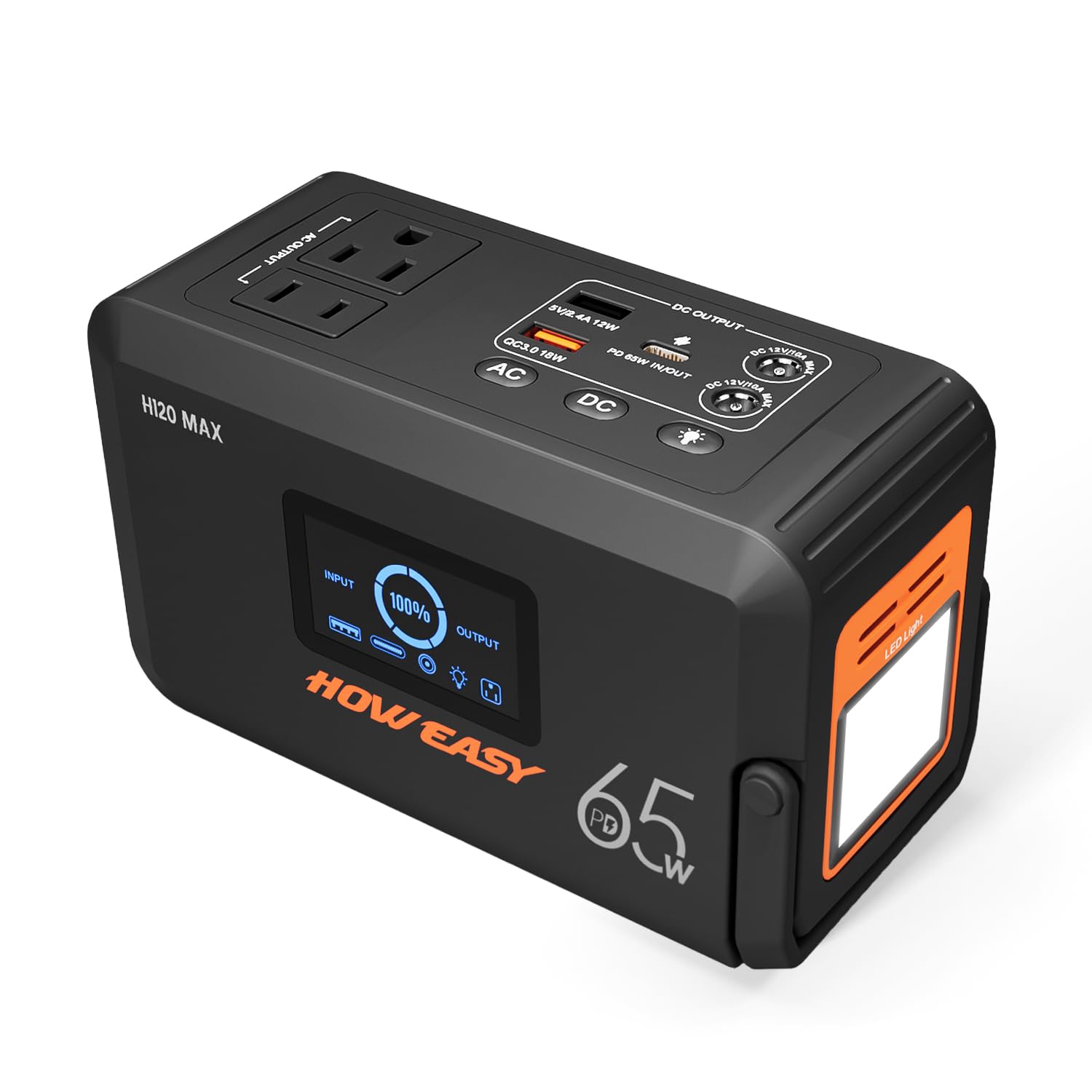
The HOWEASY H120 MAX hits the critical 99Wh threshold, making it FAA-compliant for carry-on airline travel. At 2.3 pounds and 6.6 x 3 x 4 inches, it is one of the most portable pure AC-output stations available. Its 135W inverter (270W surge) powers two AC outlets, while the dedicated 65W USB-C PD port can charge a modern laptop to 80% in about an hour. The built-in 4-mode LED flashlight (low, medium, high, SOS) is a genuine emergency tool rather than an afterthought.
The station features seven output ports total: two AC, one 65W PD, one QC3.0, one 5V/2.4A, and two DC ports. It supports pass-through charging and can be recharged via 65W PD input (80% in one hour), solar panels (15V-24V), or a car 12V adapter. The BMS system offers six protection layers covering overvoltage, overload, overcurrent, overheating, short circuits, and overcharging. The metal chassis and weather-resistant build add durability for outdoor environments.
The loud cooling fan is a known compromise — it works well for camping and travel but may be disruptive in a bedroom or office setting. Some users have reported USB port reliability issues after extended use, so this is not a station for daily high-cycle use as a permanent home backup. For its price range, the HOWEASY H120 MAX delivers the best capacity-to-weight ratio for flyers who need real AC power on the go.
Why it’s great
- FAA-compliant 98Wh capacity allows carry-on airline travel with AC outlet.
- 65W USB-C PD fast charge — laptop reaches 80% in one hour.
- Lightweight at 2.3 pounds with metal chassis and weather-resistant build.
Good to know
- Cooling fan is louder than premium competitors, not ideal for quiet indoor use.
- Some user reports of USB port failures after extended daily use.
- AC inverter limited to 135W (270W surge) — not enough for larger appliances.
5. DARAN 89.6Wh LiFePO₄ Power Station
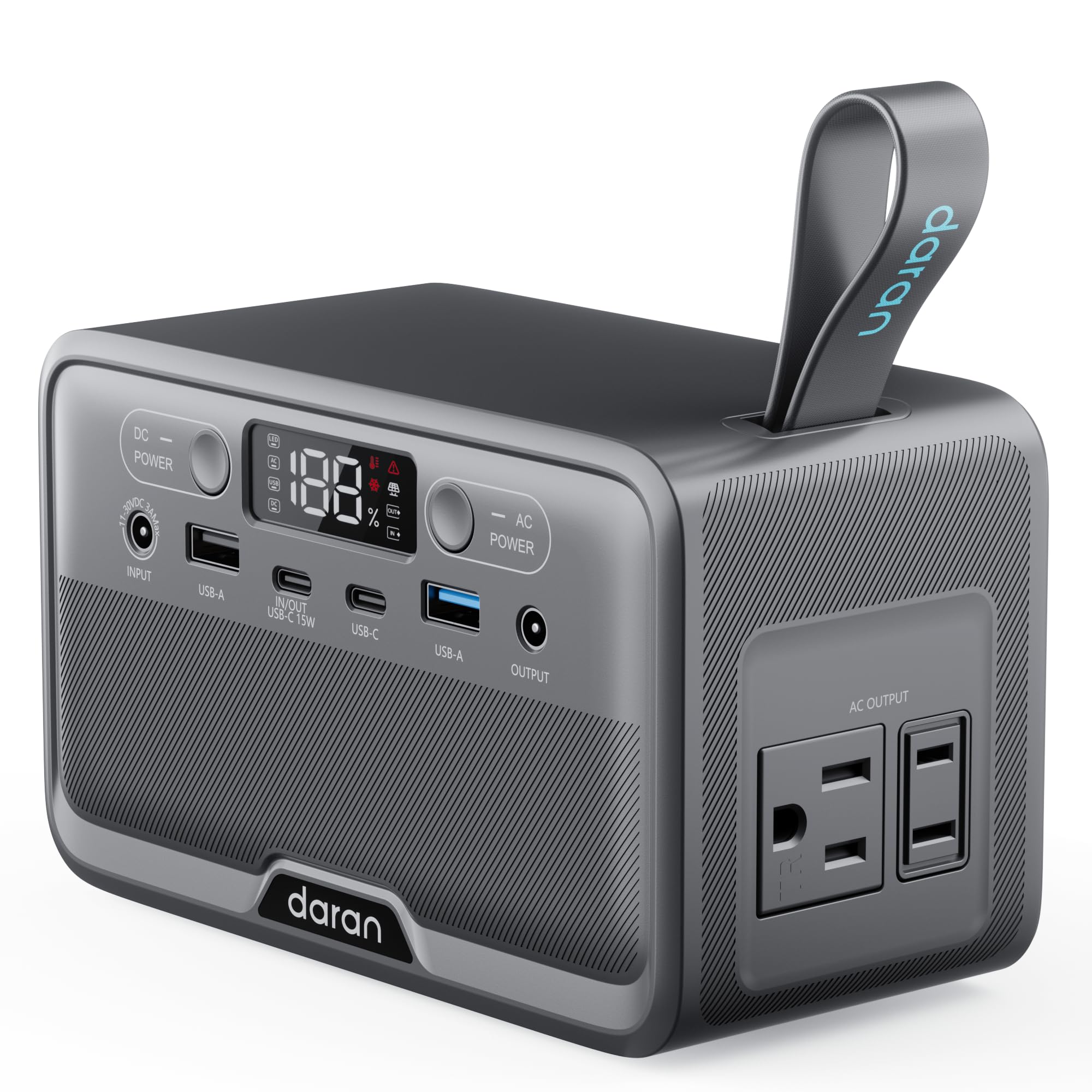
The DARAN 89.6Wh station is the smallest LiFePO₄-based AC power station in this roundup — roughly the size of a water bottle at 3.3 x 6.5 x 4 inches and weighing 2.54 pounds. It packs a 100W pure sine wave inverter (200W peak) across two AC outlets, supported by two USB-C ports (45W and 15W), two USB-A ports (18W and 15W), and a DC5521 barrel port. The 89.6Wh capacity is compliant with the FAA 100Wh limit for carry-on bags, making this one of the safest travel chemistry options available.
The headline number is the recharge speed: DARAN claims 0 to 80% in 1.5 hours using the included AC fast charger, which bypasses the need for an external brick. Four charging methods — AC wall socket, USB-C PD (two-way, so the same port charges in and out), car 12V, and solar panels — provide flexibility for any scenario. The built-in 4-level LED flashlight with steady and SOS modes is a practical addition, and the fanless design keeps operation silent during low-power loads.
The USB-C ports top out at 45W and 15W, so users with high-power laptops (16-inch MacBook Pro, gaming notebooks) will not get full-speed charging. The AC inverter at 100W continuous is limited to phones, tablets, cameras, drones, and small fans — a mini fridge or CPAP machine exceeds this limit. For ultralight backpackers, commuters, and desk workers who need a silent LiFePO₄ backup that slides into a bag, this is the most compact option with safe LFP chemistry.
Why it’s great
- Smallest LiFePO₄ AC power station — water-bottle sized at 2.54 lb.
- Fast 0-80% charge in 1.5 hours with included AC adapter.
- Fanless operation ensures silent use for sleep or work environments.
Good to know
- USB-C PD limited to 45W (not enough for full-speed high-power laptop charging).
- 100W AC inverter cannot handle mini-fridges or CPAP machines.
- LCD screen is basic — no detailed power draw or time-remaining data.
6. Powkey 24000mAh Portable Power Station

The Powkey 24000mAh station is the entry-level value pick that makes an AC wall outlet accessible at the lowest cost. With 88.8Wh capacity and a 65W / 110V pure sine wave inverter, this station is designed specifically for small electronics: smartphones, tablets, laptops under 65W, and USB LED lights. It weighs just 1.3 pounds and measures 6.9 x 3.9 x 1.9 inches — truly pocket-sized compared to the other AC stations in this guide. The bright green color makes it easy to find in a dark tent or car trunk.
The port selection includes one AC outlet, two USB-A outputs (one QC3.0 at 9V/2A), and a DC 9~12.6V/10A output. Three recharging methods — AC wall charger, car 12V cigarette lighter, and solar panel (13V-16V input) — provide baseline flexibility. The LED display shows remaining battery level in bars, and the station includes a carrying pouch and car charger cable in the box. For the price, this is the cheapest way to get a genuine 110V AC socket in your backpack.
The battery is standard lithium-ion (not LiFePO₄), which means the cycle life is roughly 300-500 full charges before noticeable degradation. Multiple user reviews report the unit failing after a handful of uses, so reliability is a concern for anything beyond occasional weekend use. The 4-hour charge time via the included 30W adapter is slow compared to modern PD standards. This station is best viewed as an expendable backup for short trips where losing it would not be a crisis.
Why it’s great
- Lowest price point for a portable station with a genuine 110V AC outlet.
- Ultra-lightweight at 1.3 pounds and compact footprint for bag carry.
- Includes car charger and wall adapter in the box for immediate use.
Good to know
- Standard lithium-ion battery with limited cycle life (300-500 cycles).
- Inconsistent reliability — some units fail after limited use based on user reports.
- Slow 4-hour recharge time via the included 30W input charger.
7. Belkin 3-in-1 MagSafe-Compatible Charger

The Belkin 3-in-1 is an entirely different category of battery-powered charging station — it does not contain a battery at all. Instead, this is a foldable Qi2-certified MagSafe charging stand that simultaneously powers your iPhone (up to 15W), Apple Watch, and AirPods from a single 36-watt power supply. The key spec here is Qi2 certification, which ensures the same magnetic alignment and fast wireless charging speed as Apple’s own MagSafe standard, but at a lower price point than first-party alternatives.
The foldable design uses liquid silicone rubber for a soft-touch finish and features a non-slip base. When folded, it collapses flat for travel, making it the most portable dedicated multi-device charging solution for Apple users. The StandBy mode support turns your iPhone into a clock, calendar, or photo frame while charging in landscape orientation. The included 5-foot USB-C to USB-C cable and 36W power supply mean you are ready out of the box without additional purchases.
The limitation is obvious: without a built-in battery, this station requires a wall outlet to function. It cannot serve as backup power during an outage or charge devices away from the grid. Additionally, the dedicated 5W AirPods pad means standard wireless earbuds charge slowly compared to a wired connection. For travelers who always have access to a wall plug and want the cleanest cable-free desk or nightstand setup, the Belkin 3-in-1 is the top wireless option.
Why it’s great
- Qi2-certified 15W fast wireless charging for iPhones with MagSafe magnetic alignment.
- Foldable design collapses flat for easy packing in a carry-on or laptop bag.
- Single USB-C cable powers iPhone, Apple Watch, and AirPods simultaneously.
Good to know
- No built-in battery — requires a wall outlet, cannot serve as backup power.
- AirPods pad charges at only 5W, which is slower than wired charging.
- Some users report reliability failures after 4-6 months of daily use.
FAQ
Can a portable power station run a CPAP machine all night?
Are LiFePO4 batteries worth the extra money over standard lithium-ion?
What does the mAh rating on a power station actually mean for AC devices?
Final Thoughts: The Verdict
For most users, the battery powered charging station winner is the Anker SOLIX C200 DC because it combines 192Wh of LiFePO₄ battery safety with a 140W USB-C PD 3.1 port in the most compact 2.6-pound package available — making it the perfect daily driver for laptop-and-phone users who value portability over raw AC power. If you need silent UPS-grade home backup with sub-20ms switchover for your networking gear, grab the EF ECOFLOW RIVER 3. And for the ultimate versatile mid-range station that jump-starts your car and powers tools for hours, nothing beats the VTOMAN Jump 600X.