
Our readers keep the lights on and my morning glass full of iced black tea. As an Amazon Associate, I earn from qualifying purchases.
Specs are compiled from manufacturer listings and verified buyer reviews and can change over time — please confirm the key details on the product page before buying.
Bonding a glass pane to a wood frame is one of the few jobs where the wrong glue fails silently — the glass looks fine, then separates months later. What you want is a clear adhesive that grips non-porous glass on one side and absorbs wood’s natural movement on the other, so the joint stays invisible and stays put. This guide covers nine adhesives that genuinely do that job on glass-to-wood work.
I’m Min — the founder and writer behind Gadgets Feed. This guide is built by comparing the manufacturers’ published specifications and the patterns across verified customer reviews, so you get each pick’s real strengths and trade-offs instead of marketing spin.
One thing to know before the list: these picks use flexible matching for glues that bond glass to wood. So not every entry is the exact bottle you typed into the search bar — the nearest same-type formula does the same job. Below are the clearest, strongest adhesive for glass to wood choices.
Our Picks at a Glance

How To Choose The Best Adhesive For Glass To Wood
Two different materials, two different problems. Glass gives a glue nothing to soak into. Wood expands and shrinks with the seasons. A joint that survives both has to hang on mechanically to the glass and flex slightly with the wood.
Match the chemistry to the pair
Epoxy cures hard and is the go-to for a permanent, load-bearing glass-on-wood joint — it fills small gaps and grips the glass surface. Construction adhesive stays slightly flexible, which suits a glass panel sitting against a wood frame. Polyurethane offers strength with some give. PVA-style glue is the gentlest and cleans up with water, but it cures by drying out, so it wants at least one absorbent surface. For glass to wood, PVA can work on the wood side only if you clamp and let it cure fully.
Read the “working time” before the “cure time”
These are two different clocks. Working time is how long you have to slide the pieces into position before the glue grabs — around 5 minutes on fast epoxies, up to 20 minutes on the slower kits. Cure time is when the joint reaches full strength, which can be 15 minutes on a quick epoxy or 24 hours on most construction adhesives. If your glass needs careful alignment, a longer working time saves you from a crooked joint.
The honest part: clean and slightly rough wins
No glue listed here beats a clean surface. Wipe glass with an oil-free cleaner and lightly etch or scuff the bond area so the adhesive has something to bite. Skip this and even the strongest formula can let go around the edges.
Quick Comparison
| Model | Best For | Adhesive Type | Working/Set Time | Full Cure | Amazon |
|---|---|---|---|---|---|
| Bob Smith Industries BSI-201 Quik-Cure Epoxy★ Best Overall | Fast repairs and small glass-on-wood fixes | 2-part epoxy, 1:1 mix | 5-minute working time | 15 minutes | Amazon |
| Loctite Power Grab Ultimate crispBest for Panels | Glass panels against wood frames and trims | Construction adhesive | Quick initial tack | 24 hours | Amazon |
| Gorilla Max Strength Construction Adhesive, ClearBest for Wet Jobs | Wet or outdoor glass-to-wood jobs | Hybrid construction adhesive | Up to 30 minutes | 24 hours | Amazon |
| Brampton Extra Strength Epoxy | Large or vertical glass-and-wood projects | 2-part epoxy, 1:1 mix | 20-minute work life | 15 hours | Amazon |
| GDDP 5 Minute Epoxy Glue, 8.45 fl oz | Heat-exposed glass on wood, all-in-one kit | 2-part epoxy, 1:1 mix | About 5 minutes | 24 hours | Amazon |
| Gorilla Clear Glue, All Purpose, 2-Pack | Craft and household glass-to-wood fixes | Polyurethane | Non-foaming, water resistant | 24 hours | Amazon |
| Starbond 5 Minute Epoxy Pro Kit, 8 oz | Repairs that need flex, not brittleness | 2-part epoxy, 1:1 mix | About 5 minutes | 24 hours | Amazon |
| FastCap 2P-10 CA Super Glue & Activator | Instant tack without clamps | Cyanoacrylate (CA) super glue | 2–4 seconds with activator | 30 seconds | Amazon |
| Weldbond Glue, 3L / 101 oz | Big mosaic and craft batches, low fumes | PVA (polyvinyl acetate) | 20-minute fast set | 30 minutes | Amazon |
In‑Depth Reviews
1. Bob Smith Industries BSI-201 Quik-Cure Epoxy
Our pick — 4.5+★ from 5,000+ verified ratings; the strongest balance of quality and price.
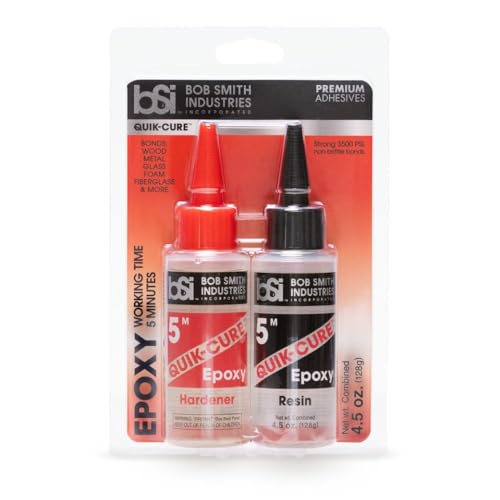
A clear 1:1 epoxy that cures hard in 15 minutes, so a small glass-on-wood fix is ready to handle in one sitting.
Fifteen minutes. That is the full cure time on this clear two-part epoxy, which means a small glass-and-wood fix can go from bare surfaces to a joint you can pick up in a quarter of an hour. You get a 5-minute working time to line everything up first, then it locks. For a chipped glass shelf against a wood bracket or a small pane in a frame, that speed is the whole appeal.
Mix it 1:1, which is the easy ratio most people can eyeball with two squeeze lines on a scrap of card. The cured finish stays clear, so a visible joint does not turn into an ugly amber streak. It bonds wood, metal, glass, ceramics, fiberglass, and most plastics, so the same bottle covers the rest of your repair list. It is a 4.5-ounce combined kit — resin and hardener — with the two bottles included as one pack.
It takes the top slot on buyer confidence: it is the most reviewed pick here at 4.5+ stars across 5,000+ ratings. What wins people over is the speed — buyers consistently report it sets as advertised. The one honest catch: it cures hard and rigid, so it suits a joint that does not need to flex. If your glass sits in a wood frame that swells and shrinks through the year, a slightly flexible construction adhesive is the safer partner. On a crack, a coaster, or a fixed bracket, this is the one.
What Earns It The Top Slot
- Full cure in 15 minutes — a joint you can handle the same session.
- Clear, hard, impact-resistant cured bond for visible glass repairs.
- 1:1 mix ratio that is easy to measure by eye.
- Bonds glass, wood, ceramic, metal, fiberglass, and most plastics.
Where It Gives Ground
- Rigid cure — not the choice for a joint that must flex with wood movement.
- Fewer buyers report success on unusual pairs like foam to metal.
- Fast grab leaves little time to reposition a large glass panel.
Reach for this if: you want a small glass-to-wood repair done and handled in one sitting, with a clean clear finish.
Look elsewhere if: you are bonding a big pane into a frame that moves with the weather — the extra working time of a slower adhesive serves you better.
2. Loctite Power Grab Ultimate crisp Construction Adhesive
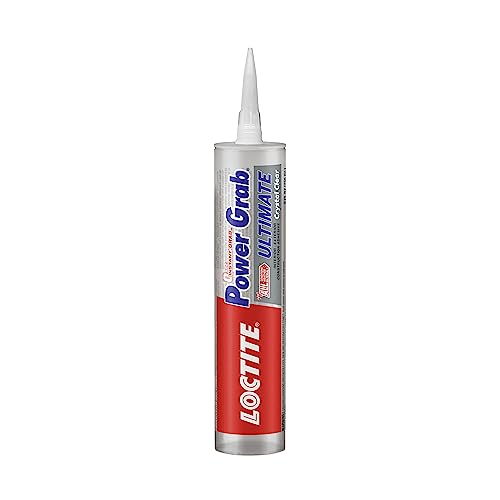
A crisp construction adhesive for laying a flat glass panel against a wood frame or trim.
This is a cartridge adhesive, not a mixing epoxy, and that changes the job it suits. Where an epoxy is for a small hard-set repair, this is for laying a pane or glass panel against a wood surface and letting it grab. The crisp formula stays clear both while you apply it and after it cures, so a joint behind a glass edge does not telegraph as a grey smear.
It is rated for 0°F to 140°F, which covers most exterior glass-and-wood work — a cold workshop or a hot garden window frame both fall inside that. It can bond two non-porous surfaces, which is exactly the glass-on-glass or glass-on-coated-wood situation where ordinary glue struggles. It works on wet surfaces too, so a slightly damp frame is not a disaster.
Here is the fair warning up front: the clarity is what buyers praise most, but durability gets more discussion than any other topic on this bottle, and the verdict there is split. Some buyers find it holds beautifully for years; others find it softer or less powerful than a structural epoxy. Read it as a job-fit question, not a defect — this is a panel-and-trim adhesive, and it prefers a surface with some grip to it. If you are hanging a glass sheet onto a clean wood frame and want no bracing, this will do it after a full 24-hour cure.
Where It Fits: a glass panel against a wood frame, a mirror onto a wood backer, or a trim strip where you want hold without nails. The quick initial tack cuts how much bracing you need while it sets.
The Recurring Note: application difficulty comes up as a mixed point. Squeeze it on and press cleanly, rather than trying to spread it like a thin glue, and the cure behaves better.
Made for: anyone fixing a flat glass panel to wood and willing to wait 24 hours for the full cure.
Not the pick for: a tiny crack repair where you need a hard, immediate bond in minutes — reach for the quick epoxy instead.
3. Gorilla Max Strength Construction Adhesive, Clear
A 100% waterproof hybrid adhesive that bonds glass to wood even on wet surfaces and under water.
Most glues treat moisture as the enemy. This one is built the opposite way: it is 100% waterproof and bonds on wet surfaces, even under water. For a glass-to-wood joint near a shower, a tub surround, a garden window, or an outdoor worktop, that single trait is what separates it from a standard epoxy that wants dry, prepared surfaces. It is a 7-ounce clear tube with a hybrid formula.
You get up to 30 minutes of working time to reposition, which is generous for sliding a glass panel onto a wood frame and nudging it true. The gap-filling coverage means the two surfaces do not have to be perfectly flush. It dries crisp and non-foaming, plus it is paintable in 2 hours and sandable once fully cured, so if your glass edge is masked you can paint right over the wood seam. And where does it sit speed-wise? Its 24-hour full cure is the long game compared to the Brampton epoxy’s 15 hours — a faster finished joint, but the Brampton trades away the waterproof and wet-surface advantage to get there.
The big review data backs up the strength story: it is the most-reviewed construction adhesive here at 4.5+ stars across 13,000+ ratings, and quality followed by strength are the things buyers single out most. The honest flip side is that adhesion and drying time both get genuinely mixed feedback — some buyers find it bites fast and hard while others see a slow, reluctant grab. The reliable move is to prep the glass clean and oil-free first, and give it the full 24-hour cure before loading the joint.
The Case For It
- 100% waterproof and bonds on wet surfaces — ideal for bathrooms and exteriors.
- Up to 30 minutes working time for adjusting a glass panel into place.
- Gap-filling coverage and a non-foaming clear finish.
- Paintable in 2 hours and sandable once cured.
- Bonds wood, metal, ceramic, tile, stone, glass, mirrors, and concrete.
The Trade-Off
- Adhesion and drying time both split review opinion — surface prep makes or breaks it.
- 24-hour full cure is slower than a fast epoxy’s finished joint.
- Needs the full cure before it carries any real load.
If your glass meets wood near water: this is the one to grab — nothing else here bonds under water and stays clear.
Skip the wait if: you need the joint done today — a quick epoxy finishes sooner.
4. Brampton Extra Strength Epoxy

A 20-minute work life that lets you align a large or vertical glass-and-wood layout before the epoxy grabs.
If you have ever squeezed a fast epoxy onto a big pane and watched it grab halfway through alignment, this is the fix. The Brampton gives you a 20-minute work life — four times the 5-minute window of the quick epoxies here — with a 5-hour set time before it cures fully in 15 hours. A large mosaic, a long glass strip onto a wood rail, or a vertical glass panel that needs two hands and careful placement all fit inside that window.
It is 100% waterproof and no-drip, which matters on a vertical glass surface — you do not want runny epoxy sliding off before it grabs. The shock-resistant compounds suit a joint that will feel an occasional knock, like a picture frame, a mirror back, or a workshop fixture. It becomes sandable and paintable after 20 hours, so you can refinish around the joint. Mix parts 1:1 by volume and apply.
Where it wins the review pages is raw effectiveness — that is the quality buyers praise most, followed by bonding performance, and it applies without fuss. The catch to plan around is time: the same split shows up on drying, and the small print says it can take a couple of days to reach maximum cure. If you are a patient builder laying up a big glass-and-wood project, that is a fair trade. If you want it done in minutes, it is not the one.
The Standout: a 20-minute work life at 100% waterproof and no-drip is the combination no other epoxy here offers. It is built for careful, controlled placement rather than speed.
Order it when: your job is big, vertical, or fussy, and you would rather take your time than rush the alignment.
Keep looking when: you need a one-sitting fix — 15 hours to full cure is not a quick-repair formula.
5. GDDP 5 Minute Epoxy Glue, 8.45 fl oz
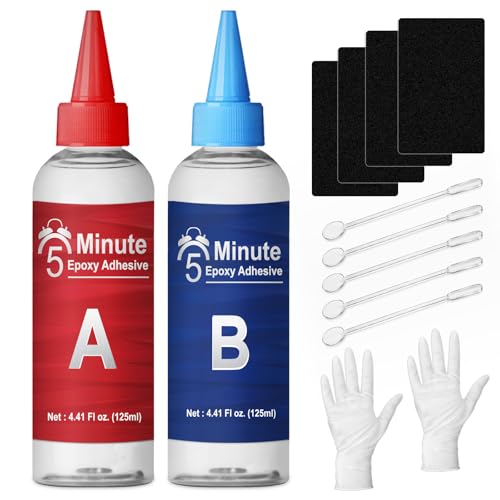
A 300°F-rated epoxy kit that ships with mixing trays, gloves, and wooden sticks.
A glass-and-wood joint near a heat source — a fireplace surround, a warm workshop, a glass panel behind a radiator — wants an adhesive that does not soften. This clear two-part epoxy is rated to withstand temperatures up to about 300 degrees Fahrenheit (about 149 Celsius), which is well beyond anything a household joint will see. You get about 5 minutes of working time, functional curing in one hour, and full cure in 24 hours.
The kit is where it earns its place among the pricier picks. It arrives as a complete set: two resin bottles, five small wooden sticks, two gloves, and four mixing trays. The two bottle caps are different colors so you do not cross-mix resin and hardener by accident — a small thing that quietly saves a botched batch. It bonds metal, glass, wood, concrete, tile, ceramic, porcelain, 3D printed parts, fiberglass, fabrics, and most plastics, so it covers the whole hobby shelf.
Because it is a fresh listing, there is not a deep well of buyer history to lean on the way there is with the industry staples here. Treat it as the newcomer with the best package and the most heat headroom. The higher the temperature and humidity, the shorter your working time gets, so if you are gluing in a hot garage, plan the mix-and-place fast. At 4.5+ stars it lands at the top of the score range, which is a decent signal the formula does its job.
What You Actually Get: epoxy, trays, sticks, and gloves in one box — no separate shopping trip for mixing gear. For a first-time glass-to-wood project, that removes most of the setup friction.
Plan Around This: high heat or humidity trims the 5-minute working window. Set up in the cool of the morning if you are bonding anywhere warm.
Ideal if: you want one box that has everything and a formula that shrugs off heat.
Think twice if: you want a long proven track record — this is a newer listing with less buyer history behind it.
6. Gorilla Clear Glue, All Purpose, 2-Pack

A clear polyurethane glue that cures without foaming, so decorative glass-on-wood pieces stay bubble-free.
Two 3.75-ounce bottles of clear polyurethane glue, and the headline trait is that it does not foam as it cures. That matters for glass-to-wood work specifically: a foaming glue can push amber bubbles out of the joint where they set hard and show. This one stays liquid-clear, so a decorative glass-and-wood panel keeps its clean look. It is water resistant too, rated for indoor and outdoor use, “rain or shine.”
It bonds wood, stone, metal, ceramic, foam, and glass, and cures fully in 24 hours. Polyurethane is the middle ground between a hard epoxy and a flexible construction adhesive — it grabs with real strength but is a touch more forgiving on a wood surface that shifts. Two bottles mean one for the workshop and one for the kitchen drawer, which is often the real reason people buy the pack.
The honest read from the review pages: versatility and clarity are the two things people praise most, and that is exactly the craft-and-household niche this fills. What is mixed is the hold and the drying time — some buyers find a strong, clean bond, others find it slow to grab or reluctant on certain surfaces. That is the classic polyurethane patience curve: it wants a clean surface, a little moisture on one side, and pressure while it cures. On a glass-to-wood craft piece where looks matter, it delivers. On a load-bearing structural joint, choose the epoxy.
Why Crafters Like It
- crisp, non-foaming cure — no amber bubbles spoiling a visible joint.
- Water resistant for indoor and outdoor craft and repair work.
- Bonds wood, stone, metal, ceramic, foam, and glass.
- Two bottles in the pack, one for each workspace.
Honest Watch-Outs
- Hold and drying time split opinion — prep and clamping matter.
- Polyurethane needs patience, not a quick grab.
- Not the pick for a structural load-bearing glass joint.
Right for: decorative glass-on-wood pieces where a clean, invisible finish is the goal.
Wrong for: a joint that will carry weight — that is an epoxy job.
7. Starbond 5 Minute Epoxy Pro Kit, 8 oz

A toughened, flexible epoxy built to absorb vibration and wood movement instead of cracking at the glass seam.
Here is the design detail that matters most for glass to wood: this formula is toughened to flex. It is engineered to absorb vibration and stress without the brittle cracking that a hard epoxy can suffer when a wood substrate swells or shrinks against rigid glass. That makes it the more forgiving partner for a glass panel set into a wood frame that lives through seasonal humidity changes. It reaches handling strength in about 5 minutes and full cure in 24 hours.
The pro-kit packaging is smarter than most: screw-cap bottles, reusable mixing trays, and tools for controlled application. No leaky syringes, less waste, and better shelf life between jobs. It mixes 1:1 by volume and cures clear, so a visible glass-and-wood seam stays tidy. It bonds wood, metal, glass, ceramic, and plastics like ABS and PVC.
Quality leads the feedback on this kit, followed by how easy it is to use — and the reusable mixing pallets get a specific nod for cutting waste. Where it gets honest is bonding strength and drying time, which both come in mixed: some buyers find it strong and fast, others hit adhesion trouble. The fix is prep — clean the glass, scuff the bond area, and mix precisely. Do that and the flexible cured bond is the most crack-resistant choice here for a joint that moves.
The Defining Trait: a flexible, toughened cure is rarer than it sounds in a 5-minute epoxy. For glass on movable wood, that flexibility is the whole reason to buy it over a rigid formula.
Pick it for: a glass-to-wood joint on a surface that flexes, vibrates, or shifts with the seasons.
Leave it for later if: you want maximum hardness and rigidity — this formula is deliberately the softer one.
8. FastCap 2P-10 CA Super Glue & Activator
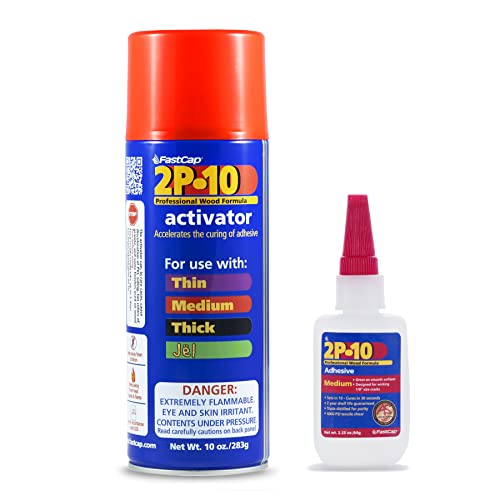
A CA glue and activator pair that sets a glass-to-wood joint in 2 to 4 seconds without clamps.
This sits at the opposite end of the speed scale from a 24-hour construction adhesive. Apply the CA (cyanoacrylate, the family super glue belongs to) to one surface, spray the activator on the other, then join them. You get 2 to 4 seconds for alignment, 10 seconds to set, and a 30-second full cure. Used without the activator, it sets in 10 to 20 seconds and cures in 5 minutes. For a small glass-to-wood repair where clamping is impossible, that instant grab is the point.
The viscosity is 100 to 120 centipoises, which the maker compares to motor-oil thickness. That medium body suits filling small cracks and getting into a glass-to-wood seam rather than running off the surface. It dries clear and works with or without the activator, and it is sandable within 60 seconds when you use the activator. The activator also has a 2-year shelf-life guarantee and a non-clogging pin-cap. It bonds glass, metal, stone, tile, wood, MDF, chipboard, and ceramic.
Do read the exclusions: it is not ideal for polyethylene or polypropylene plastics, so a plastic frame or a poly-coated surface is the wrong partner. And it wants clean, oil-free, slightly etched surfaces — CA glue is unforgiving about surface prep in a way polyurethane is not. Buyers who respect that get a genuinely instant joint. At 4.0+ stars it is the lowest score here, consistent with CA’s higher skill ceiling, but nothing else on the list cures in seconds without a clamp.
Where It Shines: small, awkward glass-to-wood fixes where you cannot hold the piece still for 5 minutes. The activator makes clamping unnecessary.
The Fine Print: skip it for polyethylene or polypropylene, and always degrease and lightly scuff first.
Choose it when: you need a glass-to-wood gap filled and locked in seconds with no clamps.
Pass if: your surfaces are plastic-grade or you would rather have minutes, not seconds, to position the piece.
9. Weldbond Glue, 3L / 101 oz
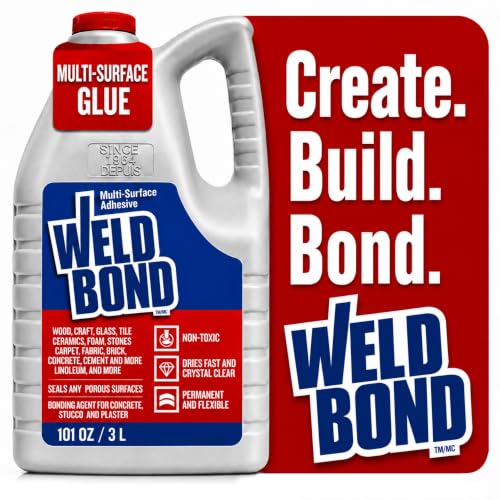
A three-liter jug of fume-free PVA for the glass-and-wood project that never ends.
This is a 3-liter, 101-ounce bottle of PVA (polyvinyl acetate — the white glue family) — a volume built for mosaic artists, classrooms, and anyone bonding a lot of small glass or tile onto wood. It sets in just 20 minutes with no clamping required, dries crisp, and cleans up with water. For a glass-and-wood mosaic or a glass-tile panel on a wood backer, that combination of clear finish and easy cleanup is hard to arrange anywhere else.
It is non-toxic, odorless, and non-flammable, which is why it shows up in craft and kids’ settings, and it works across glass, ceramics, porcelain, pottery, stone, marble, granite, clay, cork, slate, and wood. It is sandable and paintable, so a wood surface sealed with it can be refinished. The container is a jug — with that much glue, the bulk buy is the value argument.
Effectiveness is what the review pages praise most, followed by drying speed, and this glue’s home turf is exactly mosaics and clear-finish glass work. Adhesion and strength, though, come in mixed: some buyers find it strong, others note it is softer than a dedicated wood glue like TiteBond. That is the nature of PVA — it does its best work on porous or absorbent surfaces and thinner seams, and less well as a heavy structural glass-to-wood bond. Think of it as the volume craft choice, not the structural repair choice.
What It Brings
- Large 3-liter jug for big mosaic and craft batches.
- Non-toxic, odorless, non-flammable, cleans up with water.
- Fast 20-minute set, no clamping required.
- Dries clear across glass, tile, stone, ceramic, and wood.
Where It Is Softer
- Adhesion and strength are mixed — softer than a dedicated wood glue.
- Best on porous surfaces and thin seams, not heavy structural joints.
- PVA cures by drying, so it needs air and an absorbent side.
The right buy for: mosaic artists and crafters sealing lots of small glass onto wood, where fume-free cleanup wins.
Look past it if: you need a strong structural glass-to-wood bond — a flexible epoxy is the sturdier answer.
Understanding the Specs
Working Time vs Full Cure
Working time is the window to slide the joint into place before the glue grabs — 5 minutes on a fast epoxy, up to 30 minutes on Gorilla’s construction tube, 20 on Brampton. Full cure is when the joint reaches final strength, which ranges from 15 minutes on Quik-Cure to 24 hours on most construction adhesives. A quick set is not always a quick finish — plan your handling around the full-cure number, not the working number.
Why “Dries Clear” Matters So Much
Glass is see-through, so any adhesive behind it is on display. A clear, non-foaming cure keeps a glass-to-wood seam invisible, while an amber or foaming glue leaves a visible line. That is why the crisp formulas here earn repeated praise for looks. If your joint sits behind frosted glass or is fully hidden, this trait matters less.
Non-Porous Glass vs Porous Wood
Glass gives glue no surface pores to soak into, so it needs a formula that grips mechanically or bonds on contact — epoxy and construction adhesive do this. Wood is absorbent, so it can pull moisture out of a PVA-style glue and speed its cure. A glass-to-wood joint is really two bonding problems, which is why a flex-and-grip formula like a toughened epoxy often wins.
1:1 Mix Ratio
Two-part epoxies here mix 1:1 by volume — equal parts resin and hardener. That is the easy ratio to eyeball, and getting it right is what lets the epoxy cure clear and hard. Off-ratio mixing is where most epoxy problems start, so use the included trays and sticks to measure evenly.
FAQ
Can you glue glass directly to wood with epoxy?
Which adhesive works best if the glass and wood will get wet?
How long should I clamp a glass-to-wood joint?
Does the glue need to dry clear for a visible glass joint?
Is super glue strong enough to hold glass to wood?
Can I use PVA craft glue for glass on wood?
Why does my epoxy bond fail between glass and wood?
What is the difference between a 5-minute and a 20-minute epoxy?
Can I paint or sand over a glass-to-wood joint?
Will heat affect the glass-to-wood bond?
Final Thoughts: The Verdict
For most glass-to-wood repairs, the speed of the Bob Smith Industries BSI-201 Quik-Cure Epoxy is the winning trait. It gives a clear, hard bond that cures in 15 minutes, and its 1:1 mix is easy for anyone to get right. It also carries the strongest review comfort of the nine. If the joint lives near water, the waterproof Gorilla Max Strength Construction Adhesive is the smarter partner. And when the glass sits on wood that flexes and shifts, reach for the flexible Starbond 5 Minute Epoxy Pro Kit so the seam bends instead of cracking.
How We Picked
We do not accept paid placement. Every pick is matched to a real buyer and a real use-case; we do not hands-on test units.
Sources & Methodology
Specifications: manufacturer listings and product documentation. Review insights: verified customer reviews, as of November 2026. Pricing: not shown on this page (it changes often); check the current price via the retailer link.
As an Amazon Associate, Gadgets Feed earns from qualifying purchases. This does not affect which products we feature.