
Our readers keep the lights on and my morning glass full of iced black tea. As an Amazon Associate, I earn from qualifying purchases.
Specs are compiled from manufacturer listings and verified buyer reviews and can change over time — please confirm the key details on the product page before buying.
A car signal booster cannot create reception out of nothing — it needs at least a bar or two of signal outside the vehicle to work with. That single fact decides most buying mistakes before you even compare models. This guide sorts nine in-vehicle boosters by what they actually amplify, which carriers and bands they cover, and how much installation work they demand, so you can match one to the roads you really drive.
I’m Min — the founder and writer behind Gadgets Feed. This guide is built by comparing the manufacturers’ published specifications and the patterns across verified customer reviews, so you get each pick’s real strengths and trade-offs instead of marketing spin.
Band support is the spec that quietly makes or breaks a vehicle booster, because a unit tuned for the wrong frequencies will amplify nothing on your network. A quick scan of band lists, gain figures and antenna hardware is usually all it takes to separate a booster that will earn its roof space from one that just adds cables, and that logic runs through this breakdown of the automobile cell phone signal booster options worth a closer look.
Our Picks at a Glance
How To Choose The Best Automobile Cell Phone Signal Booster
Everything about a vehicle booster comes back to one number: how strong the signal is where you park the car. If you can hold a call on the driveway with one or two bars showing, a booster has something to amplify. If the map shows nothing for miles, no amplifier will invent a tower. Start by checking your real-world bars, then work down this list.
Match the bands to your carrier first
Every model here lists the frequency bands it amplifies, because a booster only helps on the slices of radio spectrum your carrier actually uses. AT&T and Verizon lean heavily on Band 12/17 and Band 13 (both in the 700 MHz range, which carries far and punches through rural gaps). T-Mobile relies more on Band 2, Band 4 and Band 66. A booster with a wider band list is the safer buy if you travel with multiple people on different networks.
Gain and how it behaves in motion
Gain is measured in dB — think of it as how much louder the booster turns up the whisper coming off the tower. A 65dB unit is working with more headroom than a 50dB one. That headroom matters most on the highway, where towers slide past fast and the amplifier has to re-tune constantly. Look for automatic gain control, which lets the booster dial itself down when it senses interference rather than feeding back into the network.
Where the outside antenna goes
The outside antenna is the whole game. It needs clear sky above it and distance from the inside antenna, otherwise the two talk to each other and the booster fights itself. Magnet mounts grab the roof and stay put at speed; suction cups are fussier but easier to move between vehicles. Whatever the mount, never let the outdoor antenna sit on a metal surface inside the cabin — that kills the reception it is meant to collect.
Quick Comparison
| Model | Best For | Stated Gain | Bands Supported | Warranty | Amazon |
|---|---|---|---|---|---|
| FREEQUEEN LOVE LIFE HF50★ Best Overall | Long road trips, campers and SUVs | 65dB | 2/4/5/12/13/17/25/66 | 2 years | Amazon |
| JACOOL Vehicle BoosterBest for Off-Road | Trucks and off-road rigs needing a secure roof mount | — | 2/4/5/12/13/17/25/66 | 3 years | Amazon |
| GAGBK Upgarde Car BoosterMost Reviewed | Mixed-carrier households and multi-passenger rides | 65dB | 2/4/5/12/13/17/25/66 | 3 years | Amazon |
| subroad Truck & RV Booster | Off-road vehicles and semi-trailers | — | — | 2 years | Amazon |
| Metarepeater MT1 LCD Booster | RVers who want to see real-time gain readouts | — | 4/12/13/17/5/2/25 | 3 years | Amazon |
| weBoost Drive X OTR | Big-rig drivers with a CB antenna mount | Up to 50dB | 12/17, 13, 5, 4, 25/2 | — | Amazon |
| Rover Duo OTR 2-in-1 | Owners who move between a car and a semi | 50dB max | 2, 4, 5, 12/17, 13 | 2 years | Amazon |
| HiBoost Car 3.0 | Daily highway commuters in weak-signal zones | — | 12/17, 13, 5, 4, 25/2 | 3 years | Amazon |
| SureCall Fusion2Go Ultra | Rural drivers chasing distant towers | Up to 50dB | 12/17/13/5/2/25/4 | 3 years | Amazon |
In‑Depth Reviews
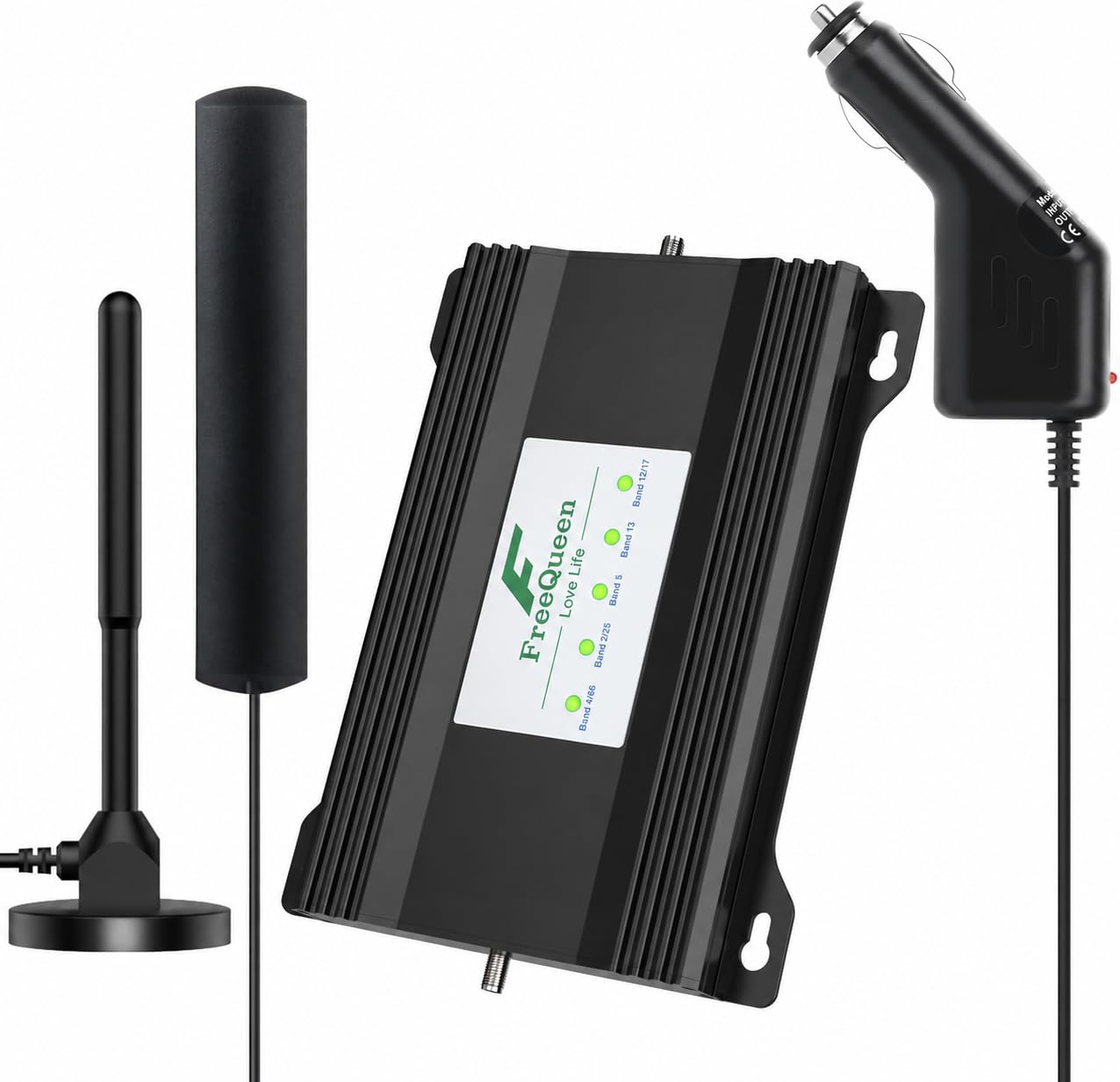
1. FREEQUEEN LOVE LIFE HF50 RV Cell Phone Signal Booster
Our pick — 4.5+★ from 750+ verified ratings; the strongest balance of quality and price.
The camper’s booster: 65dB of gain across eight carrier bands that follows you from the driveway to the trailhead.
Start with the raw numbers, because they do the explaining. The HF50 is rated at 65dB of gain and covers eight distinct bands — Band 2, 4, 5, 12, 13, 17, 25 and 66. That spread means one box serves a Verizon phone, an AT&T phone and a T-Mobile hotspot in the same cabin without anyone juggling SIMs. Gain is the amount of extra pull the amplifier applies to a weak tower signal. Sixty-five decibels of it is real headroom for a vehicle moving between towers on open highway.
What comes in the box deserves a look too, because installation is where most vehicle boosters go wrong. You get a 12V 3A power adapter, a magnet-mount outdoor antenna on a 16-foot cable, and an indoor patch antenna on a 10-foot cable. That cable length is the practical detail: sixteen feet lets you run the wire from the roof down past the doors and into the cabin without the antenna sitting where it shouldn’t. The kit is designed to cover RVs, cars, trucks, vans, SUVs, travel trailers and boats.
The honest part: an outdoor antenna on a cable still needs a sensible route into the cab, and the 5–8 mile communication range quoted for this series assumes a usable tower signal outdoors to begin with. It is a booster, not a satellite link. For a family that spends weekends moving between campgrounds with one-bar coverage, that trade is exactly the right one.
What earns the top spot
- 65dB gain paired with Band 2/4/5/12/13/17/25/66 — one unit that spans all the major U.S. carrier bands.
- 16-foot outdoor cable and 10-foot indoor cable give you real routing room on a long vehicle.
- Automatic gain control, inactivity mode and oscillation elimination let it re-tune as signal conditions shift.
- Works with iPhone, Samsung, HTC, tablets and Windows Phone systems.
Where it asks more of you
- The 5–8 mile reach is a best-case figure that assumes a live tower signal outside the vehicle.
- Install is plug-and-play, but routing the outdoor cable cleanly takes a bit of planning.
- No on-unit display, so you will not see gain readouts while driving.
Settle here: if you travel with more than one carrier in the car, the band spread alone justifies this pick.
Look past it: if you want to watch gain numbers change on a screen as you drive.
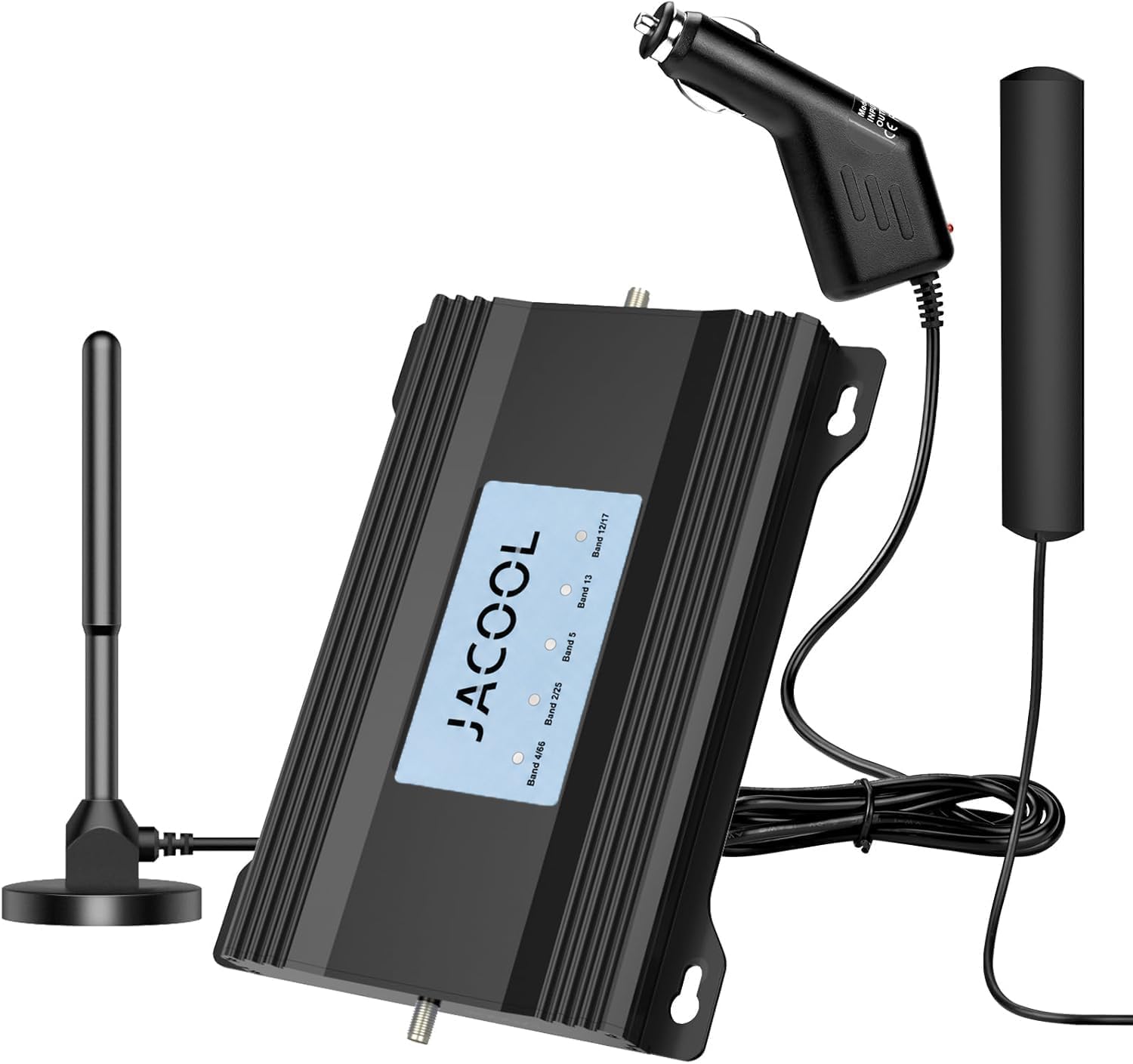
2. JACOOL Vehicle Cell Phone Booster for Car Truck RV
Built for the rig that leaves pavement behind: an omnidirectional antenna that grabs signal from any angle.
Most vehicle antennas want you to aim them at a tower. The JACOOL unit sidesteps that ritual with a high-gain omnidirectional design — it collects signal from any direction, so a truck swinging through switchbacks on a forest road never has to be pointed the “right” way. The mount is a suction cup rather than a magnet, and the kit includes the patch interior antenna, the exterior suction antenna, the booster itself and a vehicle power supply.
Band coverage runs 2, 4, 5, 12, 13, 17, 25 and 66, with a stated quad-band frequency class and a listed frequency span of 700/850/1700/1900/2100MHz. That covers 5G and 4G LTE voice and data across Verizon, AT&T, T-Mobile and other U.S. networks. It also supports multiple phones at once. The maker is explicit about one thing worth repeating: this amplifies carrier-deployed 5G that rides inside LTE bands, and it does not carry WiFi signals.
Two details set the JACOOL apart from the HF50 above. First, the warranty: three years against the HF50’s two. Second, the build ethos — it is pitched at trucks, RVs, campers, SUVs and off-road vehicles on long-distance runs. There is a mounting caution the manufacturer flags that buyers ignore at their peril: do not stick the patch antenna on metal inside the cab, or you throttle the very reception you paid for.
The install reality: FCC certified with automatic gain control, and it needs at least 1–2 bars of outdoor signal to do its job. Zero-coverage ground stays zero-coverage.
Suction vs magnet: a suction mount is easy to reposition between vehicles but demands a clean, flat surface; a magnet mount is more set-and-stay. Neither is wrong — just decide which you value.
Go this way: for a truck or off-roader that changes vehicles often and wants antennas that aim themselves.
Think twice: if you want a set-and-forget mount that never needs a surface wiped clean first.
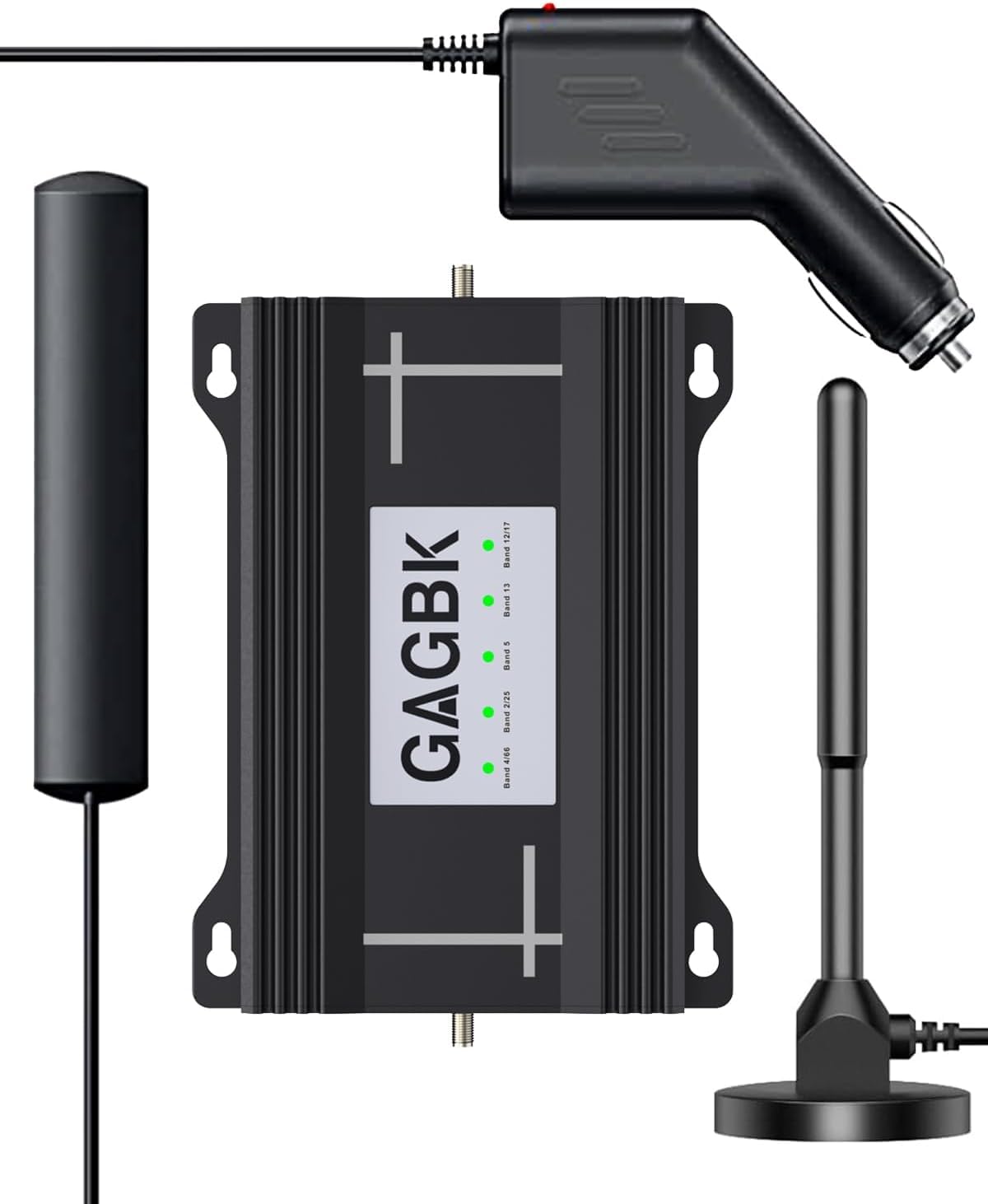
3. GAGBK Upgarde Cell Booster for Car, Truck
The family-crossover answer: 65dB of gain that keeps four phones and a tablet talking on the same stretch of interstate.
Here is a booster that wins on spread rather than on any single headline. It carries the same 65dB high-gain figure as the HF50 and the same eight-band list — 2/4/5/12/13/17/25/66 — which means nothing in your car gets left on a dead band. Verizon, AT&T, T-Mobile, Straight Talk, Cricket and U.S. Cellular all get covered, and so do iPhones, Samsungs, tablets and Windows Phone systems.
The package mirrors the HF50 closely: a 12V 3A power adapter, a 10-foot indoor patch antenna cable and a 16-foot magnet antenna cable. The routine stuff is handled well — automatic gain control, an inactivity mode and oscillation elimination, so it re-tunes itself when signal wobbles. One difference worth knowing: the listed manufacturer warranty is three years, then a line elsewhere describes a 2-year manufacturer term, so confirm the coverage that applies to your order before you rely on it.
The GAGBK earns a spot because it is the multi-carrier pick that does not ask you to compromise on band reach. What it does not do is show you anything. No screen, no readout — it just sits there amplifying. For a household where any given phone might be on Verizon one week and AT&T the next, that silence is fine.
The strong hand
- 65dB gain spans Band 2/4/5/12/13/17/25/66 in one compact unit.
- Serves multiple users and devices simultaneously — good for a packed SUV.
- Self-tuning gain control and oscillation elimination mean less fuss after install.
- Backed by a stated 30-day money-back and 90-day replacement policy.
The fine print
- Warranty wording is inconsistent between the 3-year and 2-year references — verify before purchase.
- No display or gain readout on the unit.
- Like every model here, it needs an existing outdoor signal to amplify.
Best call: for a car full of people on different networks who all need bars at once.
Keep looking: if you want visual confirmation of gain while driving.
4. subroad Cell Phone Signal Booster for Truck & RV

The 20-minute job: an omnidirectional antenna that scoops signal from every direction and a build you can fit yourself.
The pitch here is speed to working signal. subroad ships an omnidirectional high-gain outdoor antenna that receives from all directions, so there is no tower-hunting and no aiming ritual. The manufacturer puts DIY install at roughly 20 minutes, which is the kind of claim that matters to someone standing in a driveway with a drill and a Saturday.
It handles 5G and 4G LTE for Verizon, AT&T, T-Mobile and more, with a listed quad-band frequency class. The applications it names span RVs, campers, trucks, vans, SUVs, semi-trailers, off-road vehicles and boats — a wide net that suits people who swap vehicles. Multiple devices are supported, so passengers can stay connected in one cabin.
Where it stands in this lineup: it is built for off-road vehicles and semi-trailers specifically, which is a more targeted mission than the multi-carrier units above. It is FCC certified and comes with a stated 1-month free replacement plus a 3-year manufacturer’s warranty. What the spec sheet does not give you is a stated gain figure, so if raw dB headroom is your deciding metric, the HF50 and GAGBK make that comparison easier.
Practical read: the fast-install angle and FCC certification make this a sensible entry point for a truck owner who has never mounted a booster.
The gap to know: no published gain number means you are trusting the omni design and the brand’s install promise rather than a dB figure you can cross-shop.
Worth grabbing: if you want a straightforward DIY booster for an off-road rig or semi.
Skip past: if you insist on comparing published gain figures before you buy.
5. Metarepeater MT1 Cell Phone Booster for RV Truck with LCD

The one that shows its work: a full-color LCD that reports the gain on five frequency bands in real time.
Every other booster on this list asks you to trust it. This one tells you. A large color LCD displays working status and, more usefully, the gain on five frequency bands simultaneously. For an RVer tuning antenna placement, that readout turns a guessing game into a visible dial — you move the antenna, watch the number respond, and keep the spot that scores best.
Under the screen it covers Band 12/17, Band 13, Band 5, Band 2/25 and Band 4, handling 4G LTE and 5G for multiple users at once. The outdoor antenna is a 360° omnidirectional design on a spring-mounted base — the spring absorbs vibration and shock on rough roads, and the housing is built to resist dust, oil and water. The maker states a 5–8 mile range and up to 100x weak-signal enhancement.
The kit is thorough: three 3D-FB cables, an AC/DC power adapter, the omni antenna, a mounting kit and the booster itself. It is FCC certified (FCC ID 2BR4W-TY70M5) and backed by a 3-year warranty. The one caution the maker repeats is worth heeding: test your own frequency band before buying to confirm your carrier sits inside the bands this unit supports.
Reach for it: if you install once and want to dial gain by eye, or you run bumpy back roads in an RV.
Pass on it: if you would rather skip the screen and the band-matching homework entirely.
6. weBoost Drive X OTR Cell Phone Signal Booster for Trucks
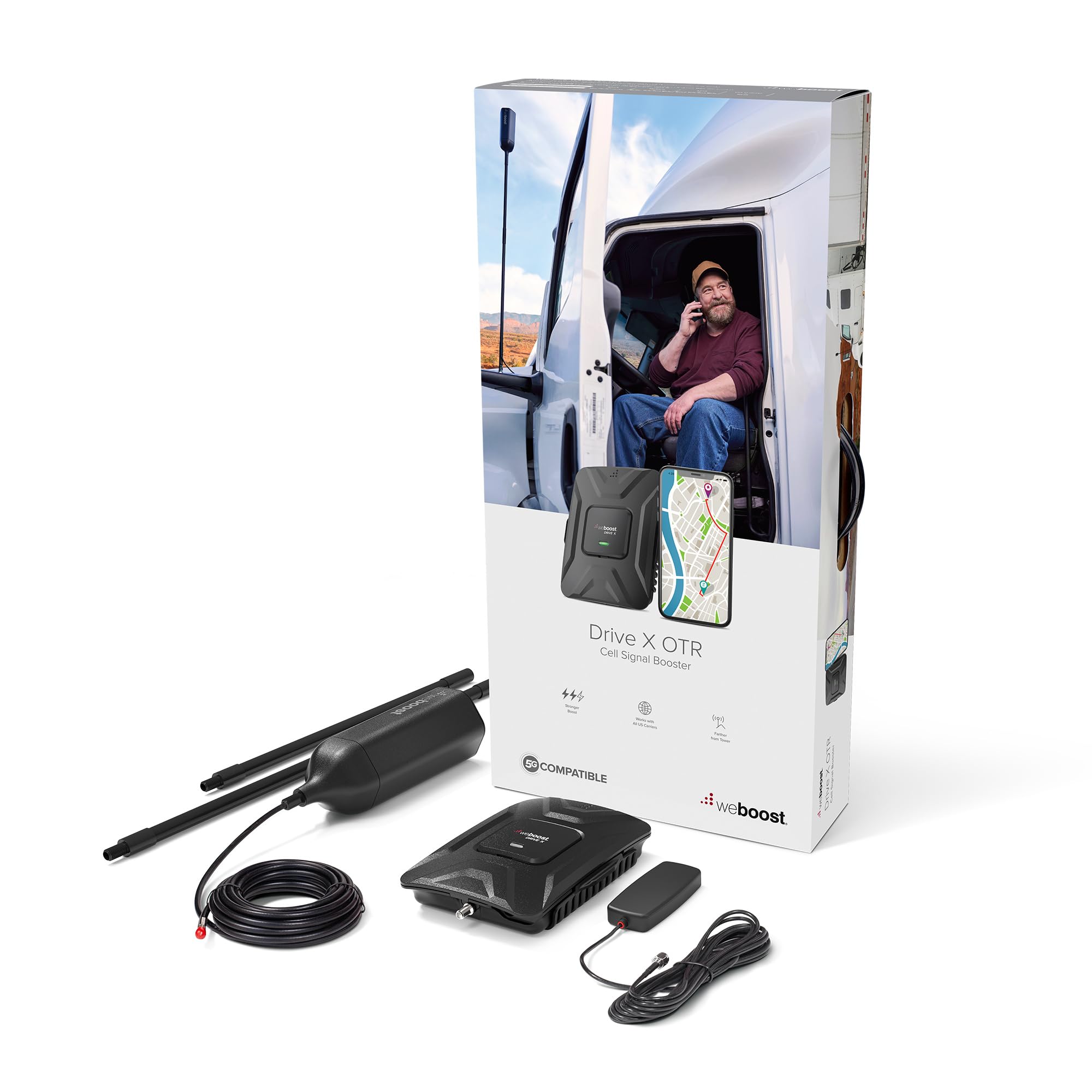
A highway lifer’s kit: a 17-inch weather-resistant antenna and a 3-way CB mount built for the long haul.
If you drive a big rig, the antenna is where a booster earns its keep, and this one is purpose-built. The Drive X OTR ships a 17-inch omnidirectional, weather-resistant antenna along with a 3-way CB antenna mount, a mast extension and a side exit adapter. Those extras are truck-specific hardware — the kind of fitment a highway driver already has a home for, and a sedan owner does not.
The spec sheet says up to 50dB gain, with a listed frequency span covering Band 12/17 at 700MHz, Band 13 at 700MHz, Band 5 at 850MHz, Band 4 at 1700/2100MHz and Band 25/2 at 1900MHz. It handles all U.S. networks and carriers — Verizon, AT&T, Sprint, T-Mobile, U.S. Cellular and more — with multi-user support so every passenger benefits. The listed data transfer rate is 1 gigabit per second, and the pack weighs 5 pounds.
The maker also claims the stronger service draws less battery, quoted as up to 2 hours of additional talk time. That is a manufacturer figure, not a lab result you can verify at home. And here is the honest trade — a large share of owner discussion centers on whether it works in a given spot, which is true of every booster: the weaker the outdoor signal, the less dramatic the gain.
Why truckers lean on it: the 17-inch antenna and 3-way CB mount are genuine fitment for a semi, plus FCC coverage for all the major carriers.
The catch to size: those truck-specific mounts are overkill in a daily-driver sedan, and at 5 pounds it is not a throw-in-the-glovebox unit.
Pick it: if you already run a CB mount on a truck and want a booster that bolts straight on.
Don’t bother: if your vehicle is a compact car with no mast hardware to attach to.
7. Rover Duo OTR 2-in-1 Car-to-Truck Vehicle Signal Booster

One kit, two cabs: move the booster between your car and your truck with the antennas already accounted for.
Most boosters are tied to one vehicle by cable routing. The Rover Duo OTR is the exception — it comes with all the antennas and accessories needed to shift between a car and a truck, including an outside OTR antenna, an outside vehicle antenna, two inside antennas, cables, adapters and two 12V DC power supplies. If you own both a daily driver and a work truck, that second power supply and second inside antenna are the difference between a permanent install and a shared one.
On the technical side it runs 50dB max gain and is FCC approved (ID PWO460061). Band support covers 4G LTE and 5G across bands 2, 4, 5, 12/17 and 13, works on all U.S. carrier networks and supports multiple users at once. It is designed and assembled in the USA, backed by U.S.-based customer service and a 2-year warranty, with a maker-listed 74-mile range. Note that this is a 3.5+ star product with a small base of reviews, so the track record is thinner than the heavily reviewed picks above.
Where the Rover Duo makes sense is a two-vehicle garage. Where it asks more of you is that band list, which omits Band 25 and Band 66 that several rivals here support — check your carrier’s bands before committing, because a T-Mobile customer relying on those higher bands is the wrong fit for this one.
Made for you: if you swap between a car and a semi and want one kit that carries all the hardware.
Second-guess it: if your carrier depends on Band 25 or 66 that this unit does not list.
8. HiBoost Car 3.0 Cell Phone Signal Booster
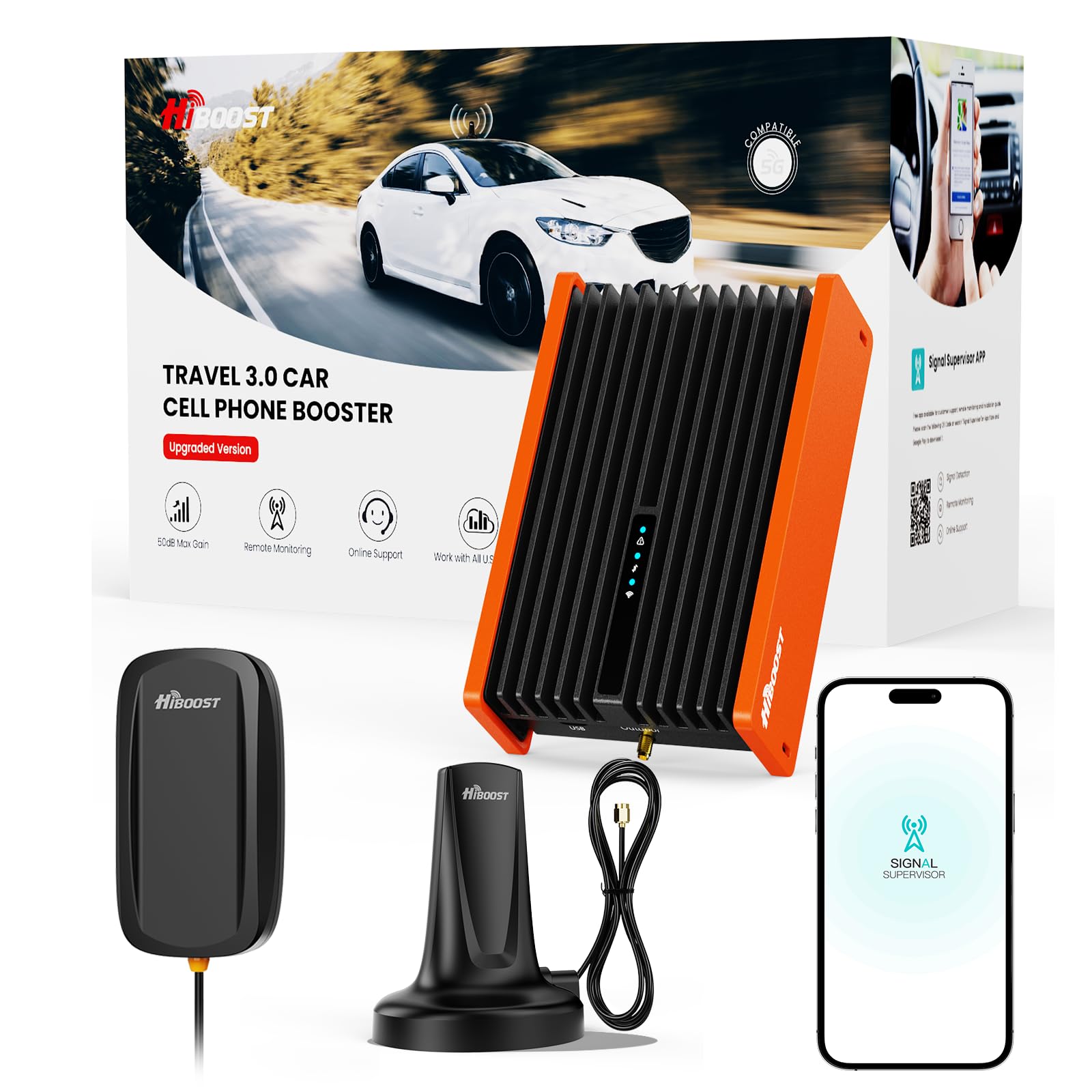
A highway commuter that slaps on the roof and goes to work: magnetic antenna, rugged metal booster, no drama.
For the daily-driver crowd, mount simplicity matters more than gain bragging rights. HiBoost uses a magnetic outdoor antenna that drops onto the roof and grabs signal in seconds, with the interior antenna on a 9.84-foot cable and the exterior on a 13.12-foot cable. The booster itself is a rugged metal shell wrapped in a protective silicone cover to shrug off bumps, scratches and the outdoors.
Coverage leans on the main carrier bands — Band 12/17 at 700MHz, Band 13 at 700MHz, Band 5 at 850MHz, Band 4 at 1700/2100MHz and Band 25/2 at 1900MHz — for both 4G LTE and 5G on AT&T, Verizon and T-Mobile. What wins here is signal strength, the strongest recurring theme among owners, followed by the value people feel they got for the money. It also folds in an app for signal detection and installation guidance, plus 3 years of support — the standout advantage over the weBoost OTR above, which lists no warranty on its spec sheet at all.
Nothing here is a dealbreaker; it is simply a dialed-in commuter unit. Durability draws some mixed notes, which on a permanently mounted roof antenna is at least worth tracking — silicone covers help, but weather has its own timeline.
Where it shines
- Magnetic roof antenna installs in seconds and stays put at speed.
- Rugged metal body with a silicone cover for bumps, scratches and outdoor use.
- An app for signal detection and install guidance — genuinely useful when tuning an antenna.
- 3 years of support and an FCC-approved design.
Worth knowing
- Durability draws some mixed notes over time on the roof-mounted antenna.
- Band list skips Band 66, so check T-Mobile coverage in your area.
- The metal-and-silicone body is not a pocket-sized accessory — it lives in the car.
Your fit: for a daily highway commute through patchy coverage, with a roof that takes a magnet.
Not your fit: if you need Band 66 support on a T-Mobile setup or want a fully portable unit.
9. SureCall Fusion2Go Ultra Vehicle Cell Booster
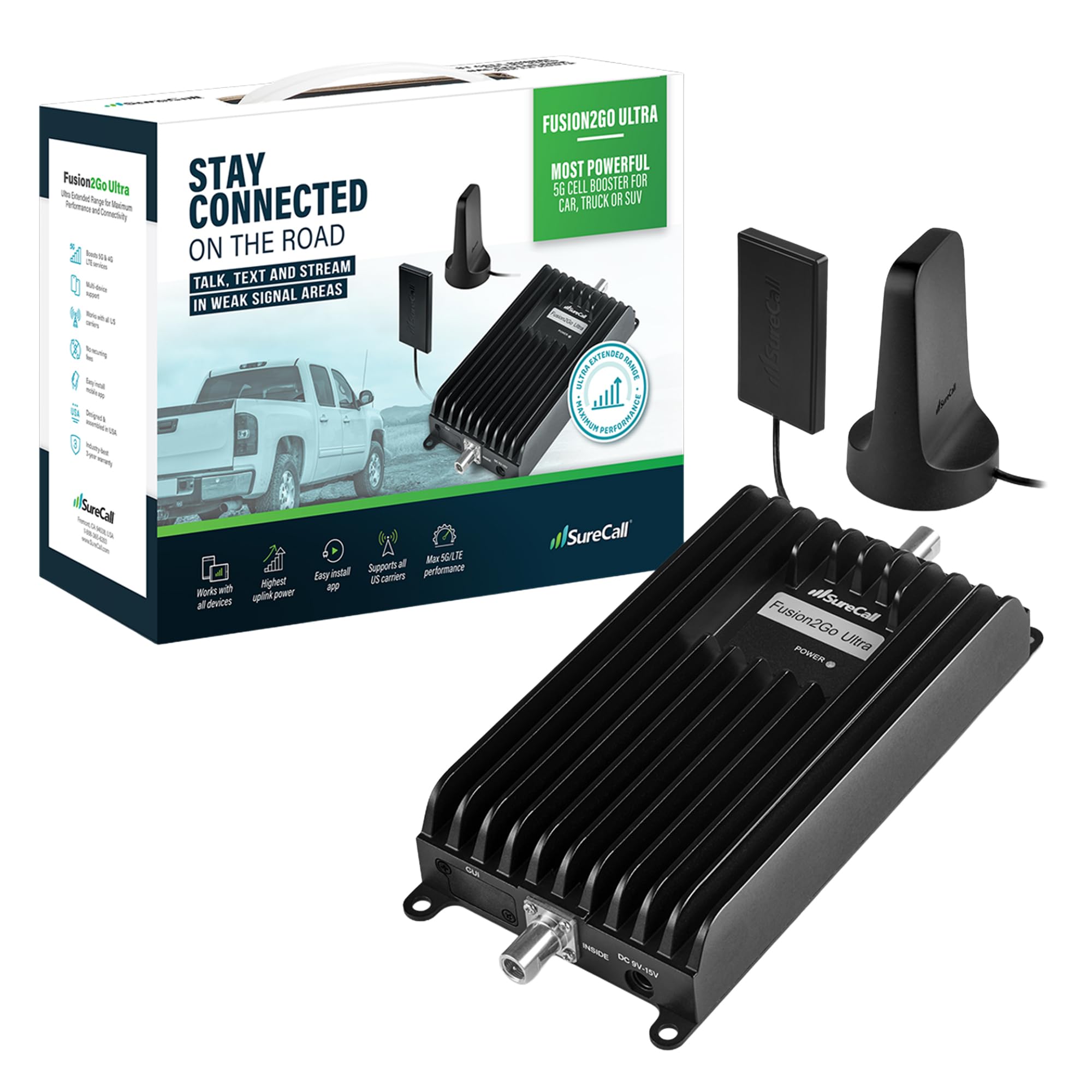
Built to shout at far towers: the highest listed uplink power here, aimed at rural drivers chasing a distant signal.
The headline is uplink. Uplink is the path your phone takes back to the tower, and it is what usually dies first far from coverage. SureCall quotes up to 50dB gain and up to 30 dBi uplink power, which the maker calls the highest on the market. On a rural road where the tower is miles out, more uplink reach is what keeps a call from being dropped in the first place.
The kit is complete and self-contained: the Fusion2Go Ultra amplifier, a magnet-mount exterior antenna with an attached low-loss cable, an interior patch antenna, a power supply and a quick start guide. There is no subscription and no WiFi dependency — it is a one-time hardware purchase. It covers all U.S. carriers including AT&T, T-Mobile, Verizon, US Cellular, Google Fi, Mint Mobile and Boost Mobile, and supports phones, tablets and hotspots at the same time.
A free iOS/Android app helps you find the best antenna placement, which is precisely where a magnetic exterior antenna and a 50dB amplifier need guidance. It is designed, assembled and tested in the USA, FCC certified (RSN-F2GULTRA), carries a 3-year warranty and weighs 4 pounds. Compare that to the weBoost OTR’s 5 pounds and no listed warranty — different missions, but the SureCall gives you more coverage commitment on paper.
The rural advantage: the 30 dBi uplink figure is the highest in this set, and uplink reach is what distant-tower driving demands.
The honest read: 50dB gain is less headroom than the 65dB units above, so in dense city interference it has less room to work — its strength is reach, not brute strength.
Grab it: if you drive rural routes where the tower is always the far dot on the horizon.
Leave it: if you mostly drive urban cores and want maximum gain headroom instead.
Understanding the Specs
Gain in dB (and why 65dB and 50dB differ)
Gain is the amount the booster turns up a weak tower signal, measured in decibels. A 65dB unit has more headroom than a 50dB unit, which often translates to a stronger pull in a moving vehicle. More gain is not automatically better in every spot — in a strong-signal city, the amplifier can run into interference. That is why automatic gain control matters: it lets the booster self-adjust rather than fight the network.
Band numbers and your carrier
Bands are slices of radio spectrum, each identified by a number. Lower bands like 12/17 and 13 sit at 700MHz and travel farthest, which makes them the rural workhorses. Higher bands like 2, 4, 25 and 66 carry more data but fade faster. A booster is only useful where its band list overlaps your carrier’s. That single check prevents most disappointing purchases — and it is why the widest band lists are the safest bets for mixed-carrier households.
Indoor and outdoor antenna placement
Two antennas, one job: the outside unit collects signal, the inside unit re-broadcasts it in the cabin. They need separation. Put the outdoor antenna on the roof or a mast with clear sky, run its cable into the cab, and keep the indoor patch away from metal. Several makers warn that a patch antenna stuck to interior metal will lose performance, because the metal fights the antenna’s field.
Warranty and FCC certification
FCC certification means the amplifier meets regulations and will not harm carrier networks — look for the certification on any vehicle booster. Warranty length varies widely across this set, from a 2-year to a 3-year term, and one premium unit lists none on its spec sheet. If you plan to mount an antenna permanently and leave it through winters, the longer warranty terms are the calmer choice.
FAQ
Will a vehicle signal booster work if I have no bars at all?
Do these boosters work with 5G as well as 4G LTE?
How do I know which bands my carrier uses?
Can I move one booster between my car and my truck?
Where should the outside antenna go on a vehicle?
Is a 65dB booster better than a 50dB booster?
Do these boosters kill my phone battery faster?
Do I need a subscription or WiFi for a vehicle booster to work?
What does FCC certification mean on a signal booster?
Will a booster improve my data speed or just my calls?
Final Thoughts: The Verdict
For most drivers, the winner is the FREEQUEEN LOVE LIFE HF50, because its 65dB gain and eight-band coverage handle a cabin full of different carriers without you having to check anyone’s network first. If you swap between a car and a semi, the Rover Duo OTR ships the second antenna and power supply you will need. And for rural routes where the tower is always faint, the SureCall Fusion2Go Ultra leans on its 30 dBi uplink to reach farther.
One honest nudge: whichever you choose, confirm two things before checkout — that your carrier’s bands sit inside the unit’s list, and that your usual parking spot shows at least a bar or two outdoors. Those two checks decide whether a booster earns its place on yourroof. Get those right and any of these nine will do exactly what you paid for: turn a barely-there signal into a call that stays connected.
How We Picked
We do not accept paid placement. Every pick is matched to a real buyer and a real use-case; we do not hands-on test units.
Sources & Methodology
Specifications: manufacturer listings and product documentation. Review insights: verified customer reviews, as of November 2026. Pricing: not shown on this page (it changes often); check the current price via the retailer link.
As an Amazon Associate, Gadgets Feed earns from qualifying purchases. This does not affect which products we feature.