
Our readers keep the lights on and my morning glass full of iced black tea. As an Amazon Associate, I earn from qualifying purchases.
Specs are compiled from manufacturer listings and verified buyer reviews and can change over time — please confirm the key details on the product page before buying.
Your spray gun needs one thing above everything else: a steady, uninterrupted supply of air at the pressure it was designed to run. Pick the wrong compressor and you get spitting, uneven fan patterns, and a finish that looks like sandpaper. Get the CFM at 90 PSI and the tank buffer right and your gun lays down an even coat without spitting.
I’m Min — the founder and writer behind Gadgets Feed. This guide is built by comparing the manufacturers’ published specifications and the patterns across verified customer reviews, so you get each pick’s real strengths and trade-offs instead of marketing spin.
You’ll see the quiet machines that let you shoot inside a garage without a neighbour complaint, and the high-pressure tanks that keep a gun fed through a whole panel. The short answer: match your gun’s CFM demand to the compressor’s delivered airflow at 90 PSI, then decide how much noise and weight you’ll tolerate. Below you’ll find the strongest options for every one of those needs, laid out in plain language so you can pick a air compressor for spray gun without guessing.
Our Picks at a Glance


How To Choose The Best Air Compressor For Spray Gun Work
A spray gun is a picky tool. It asks for a specific volume of air at a specific pressure, all the time, without stalling. The quiet motor, the wheels and the accessory kit only matter once that airflow figure is covered.
Start with your gun’s CFM number, not the tank
Every spray gun lists an air consumption figure, usually in CFM (cubic feet per minute — the volume of air the gun gulps down while it is spraying). Your compressor’s delivered CFM at 90 PSI has to cover that figure with a little headroom. A compressor that delivers 2.2 CFM at 90 PSI feeding a gun that wants more will cycle constantly and starve the finish. Look at the airflow number at 90 PSI, not the max airflow quoted at a lower pressure.
Decibels decide where you can paint
Noise rating matters more for spray work than most tools, because a spray job runs for minutes at a stretch, not seconds. A unit rated around 60 to 70 decibels is the sort you can run in a basement or attached garage without shouting. A 95 dB pancake is fine outdoors or in a detached shop, but it will dominate a small enclosed space.
Tank size and recovery time smooth out the pulses
The tank acts as a buffer so the gun sees steady air while the pump catches its breath. Bigger tanks and short recovery times mean fewer pressure dips mid-panel. A small tank with slow refill lets pressure dip mid-panel, which shows up as a visible seam in the finish.
Why oil-free matters for a paint finish
An oil-free pump removes any chance of oil vapour reaching the air stream. That is why oil-free units dominate this list — a finish is unforgiving of contamination. Add a moisture trap regardless, because condensation is the other enemy of a clean coat.
Quick Comparison
| Model | Best For | Airflow @ 90 PSI | Max Pressure | Tank | Amazon |
|---|---|---|---|---|---|
| California Air Tools 8010★ Best Overall | Quiet indoor spraying | 2.20 CFM | 120 PSI | 8 gal | Amazon |
| FORNAX 6 Gallon PancakeCompact Pick | Two-tool jobs | 2.6 CFM | 150 PSI | 6 gal | Amazon |
| ECOMAX Pancake 150 PSIBest Value | Value run-and-gun | 2.6 CFM | 150 PSI | 6 gal | Amazon |
| CRAFTSMAN CMXECXA02106410 | Home shop all-rounder | 2.6 SCFM | 150 PSI | 6 gal | Amazon |
| FORNAX 8 Gallon | Quiet spraying on a budget | 2.2 CFM | 125 PSI | 8 gal | Amazon |
| VEVOR 6.3 Gallon | Fast refill on a tight budget | 3.35 CFM | 116 PSI | 6.3 gal | Amazon |
| Limodot Quiet 5 Gallon | Kit-in-a-box spraying | 2.8 CFM | 120 PSI | 5 gal | Amazon |
| ECOMAX 6 Gallon Kit | Accessory-rich starter setup | — | 150 PSI | 6 gal | Amazon |
| DEWALT DWFP55130 | High-pressure trim work | 3.0 SCFM | 200 PSI | 2.5 gal | Amazon |
| Klutch 20-Gallon | Big-job shop spraying | 4.2 SCFM | 175 PSI | 20 gal | Amazon |
In‑Depth Reviews
1. California Air Tools 8010 1.0 HP Ultra Quiet and Oil-Free Air Compressor
Our pick — 4.5+★ from 2,000+ verified ratings; the strongest balance of quality and price.
Sixty decibels of compressor that lets you spray in a basement without a neighbour knocking.
The number that decides this one is 60 decibels — the sound level of a normal conversation, so you can stand beside it while your gun is running and still hear yourself think. It is also the crowd favourite here, holding 4.5+ stars across 2,400+ ratings, and quiet operation is what owners rave about above everything else. In an attached garage or basement workshop, that 60 dB rating is what makes spraying indoors possible at all.
Inside sits a dual-piston oil-free pump rated to run over 3000 hours before wear, driven by a 1.0 HP motor that turns at only 1680 RPM — the low speed is part of why it stays so hushed. It delivers 3.10 CFM at 40 PSI and 2.20 CFM at 90 PSI, which covers the slow, steady demand of an HVLP detail gun rather than a full-panel production gun. The 8-gallon steel tank fills from empty in 165 seconds and recovers from 90 PSI back to 120 PSI in 60 seconds. Buyers report “The airflow speed receives positive feedback, taking just 2 minutes to fill the tank from empty.”
Honest catch: it is heavy to move around. With the wheel kit attached it weighs 48 pounds, versus 27.6 pounds for the ECOMAX pancake on this list. It also takes up real floor space, because the 26-inch length will crowd a tight bay. Also worth knowing, a minority of owners find the delivered airflow falls short of expectations for heavier tools. So this is a detail-and-trim sprayer, not a panel-and-production unit.
What owners rave about
- 60 dB operation makes indoor and garage spraying genuinely practical
- 8-gallon tank plus a 60-second 90-to-120 PSI recovery keeps the air steady
- Oil-free dual-piston pump rated past 3000 hours before wear
Where it asks for patience
- 48 pounds and a 26-inch footprint — plan a permanent corner for it
- 2.20 CFM at 90 PSI suits detail guns more than high-demand spray work
Buy it for: the quietest realistic way to spray inside a home workshop, with tank volume that keeps a detail gun fed.
Think twice if: your gun demands big airflow at 90 PSI — the 2.20 CFM ceiling will feel tight.
2. FORNAX Pancake Air Compressor with Two Couplers, 6 Gallon
Two couplers on a 28.8-pound pancake — run your spray gun and blow gun at once.
The feature that earns this one its place is the pair of couplers. You can keep a spray gun on one and a blow gun or nailer on the other, switching without swapping fittings — genuinely useful when you are cleaning a gun between coats. At 28.8 pounds it is light enough to lift onto a bench one-handed, which is a different experience from wrestling an 8-gallon tank into position.
Specs put it at 150 PSI max, spinning at 3550 RPM, with 2.6 CFM at 90 PSI and 3.4 CFM at 40 PSI. Quality is the trait buyers single out most, and it lands at 4.0+ stars overall. That 2.6 CFM at 90 PSI is a real step up from the California Air Tools figure of 2.20 CFM, so a slightly hungrier gun stays fed.
The trade-off you should weigh before buying: the noise rating is 95 dB(A), which is loud — that is power-tool-loud, not conversation-loud, so this is a garage-door-open or outdoor compressor. A handful of owners also note pressure holding issues, so check fittings and tape the threads properly on day one. If quiet is your priority, this is not the pick.
Where it shines: two couplers plus 28.8 pounds of portability make it the practical run-around-the-shop unit for mixed tasks.
What you accept: 95 dB(A) noise and a mixed record on holding pressure — fine for a detached shop, awkward in a shared space.
Reach for this if: you want two tools hooked up at once and move the compressor between jobs.
Look elsewhere if: you spray indoors or inside an attached garage — 95 dB(A) will be heard.
3. ECOMAX Pancake Air Compressor MAX 150 PSI, 2.6 CFM @ 90 PSI
A 27.6-pound pancake that asks for very little and delivers 2.6 CFM at 90 PSI.
For a first spray setup, this is the sensible starting point. It delivers 2.6 SCFM (cubic feet of air per minute, the airflow that actually drives your gun) at 90 PSI (pounds per square inch, the pressure pushing that air) and 3.6 SCFM at 40 PSI, with a 150 PSI ceiling. That is more delivered airflow at 90 PSI than the California Air Tools above, so a detail gun stays fed. The trade is noise: it runs far louder, at pancake-compressor volume rather than whisper level.
The body is Q235B alloy metal with rubber handle and feet, and it weighs 27.6 pounds, versus 48 pounds for the California Air Tools unit. That matters when you are carrying it out to the yard for an outdoor paint job and back in afterwards. What wins buyers over most here is straightforward performance — it does the job without drama — and the value angle lands too.
The honest limit is noise: the review pages split on it, with some calling it low-noise and others finding it very noisy. That tells you it depends heavily on what you are comparing against and how enclosed your space is. The oil-free UMC motor does help it start in cold weather, a nice detail for an unheated garage.
The real story: 2.6 SCFM at 90 PSI in a 27.6-pound package is genuine value for a hobby spray gun.
The catch: noise is the dividing line — fine outdoors, less so in a small enclosed shop.
Go with this if: you want solid spray-gun airflow at entry level and move it around a lot.
Check yourself first: if your work happens in a basement, the noise will wear on you.
4. CRAFTSMAN 6 Gallon 150 PSI Oil-Free Pancake Air Compressor CMXECXA02106410
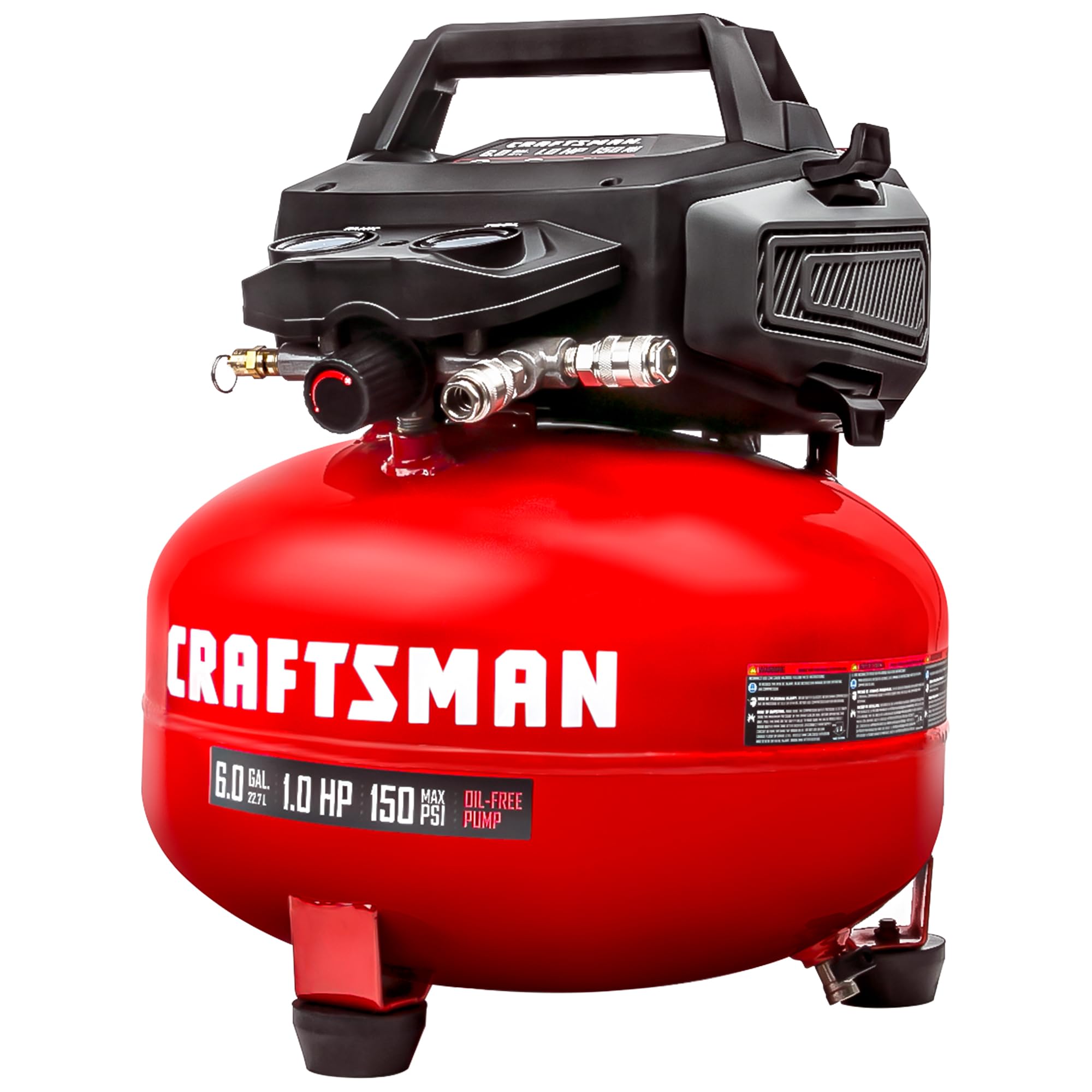
The compact CRAFTSMAN that hits 150 PSI and stays out of your way at 15.8 inches long.
Put this beside the California Air Tools and the size difference is stark: 15.8 inches long versus 26 inches. In a cramped garage, that shorter body is the reason to pick it over the California unit. It also reaches 150 PSI against the California unit’s 120 PSI, with 2.6 SCFM at 90 PSI from a 120V 1.0 HP motor.
What buyers notice most is the raw performance — 46 separate mentions across the reviews, well ahead of any other trait — with the pressure build described as fast. Owners mention “The compressor builds up pressure quickly, with one customer noting it’s powerful enough to run a single framing nailer non-stop, and another mentioning it holds pressure for weeks.” The dual quick couplers (two push-fit outlets) let you keep two tools live, so you can switch from spray gun to nailer without unplugging. And the 30.8-pound iron body with carry handle moves without effort.
One real caveat sits in the durability notes: a few customers note the handle breaking immediately, so treat the carry handle as a lift aid rather than a swing handle. Otherwise this is a sturdy little unit backed by a 1-Year warranty.
What earns the spot
- 150 PSI ceiling with 2.6 SCFM at 90 PSI covers paint spraying and nailing
- Compact 15.8-inch footprint for cramped shops
- Dual couplers keep two tools connected at once
The fine print
- Handle durability is the weak point — lift it carefully
- 30.8 pounds is heavier than the lightest pancakes here
The match: a home shop that wants one compressor to spray, nail and inflate without owning the floor.
The mismatch: if you plan to drag it around by the handle daily, choose a lighter unit.
5. FORNAX 8 Gallon Air Compressor, 1HP 2.2 CFM, Max 125 PSI

Eight gallons and 70 dB — the quiet, big-tank option that keeps the neighbours off your back.
Here is the interesting trade against the other FORNAX on this list. This 8-gallon model the company states is 8 gallons against the pancake’s 6, yet it runs at a claimed 70 dB against the pancake’s 95 dB(A) — the quiet one wins on both count and calm. The 8-gallon tank holds more air to absorb the pump’s cycling while your gun runs.
It is oil-free, 1HP, turning at 1730 RPM, delivering 2.2 CFM at 90 PSI to a 125 PSI ceiling, and it ships with a handle and wheels. At 45 pounds it is manageable for a wheeled unit. The induction motor is the reason it stays smooth and quiet, and the company lists spray guns among its supported tools alongside nail guns and impact wrenches.
Set expectations honestly: 2.2 CFM at 90 PSI is the same airflow class as the California unit, so it suits detail and trim spraying rather than a full automotive panel. Owners rate it as steady for light-duty work with quiet operation a close second, and this is a newer model with a smaller review base than the veterans here — plenty of happy users, but less history.
The draw: 70 dB plus 8 gallons is a rare pairing at the bottom of the price range.
The limit: 2.2 CFM at 90 PSI keeps it in detail-gun territory.
Made for: the home woodworker who wants tank buffer and low noise in one wheeled package.
Not for: production spraying where airflow demand pushes past 2.2 CFM at 90 PSI.
6. VEVOR 6.3 Gallon 2 HP Air Compressor, Max 116 PSI
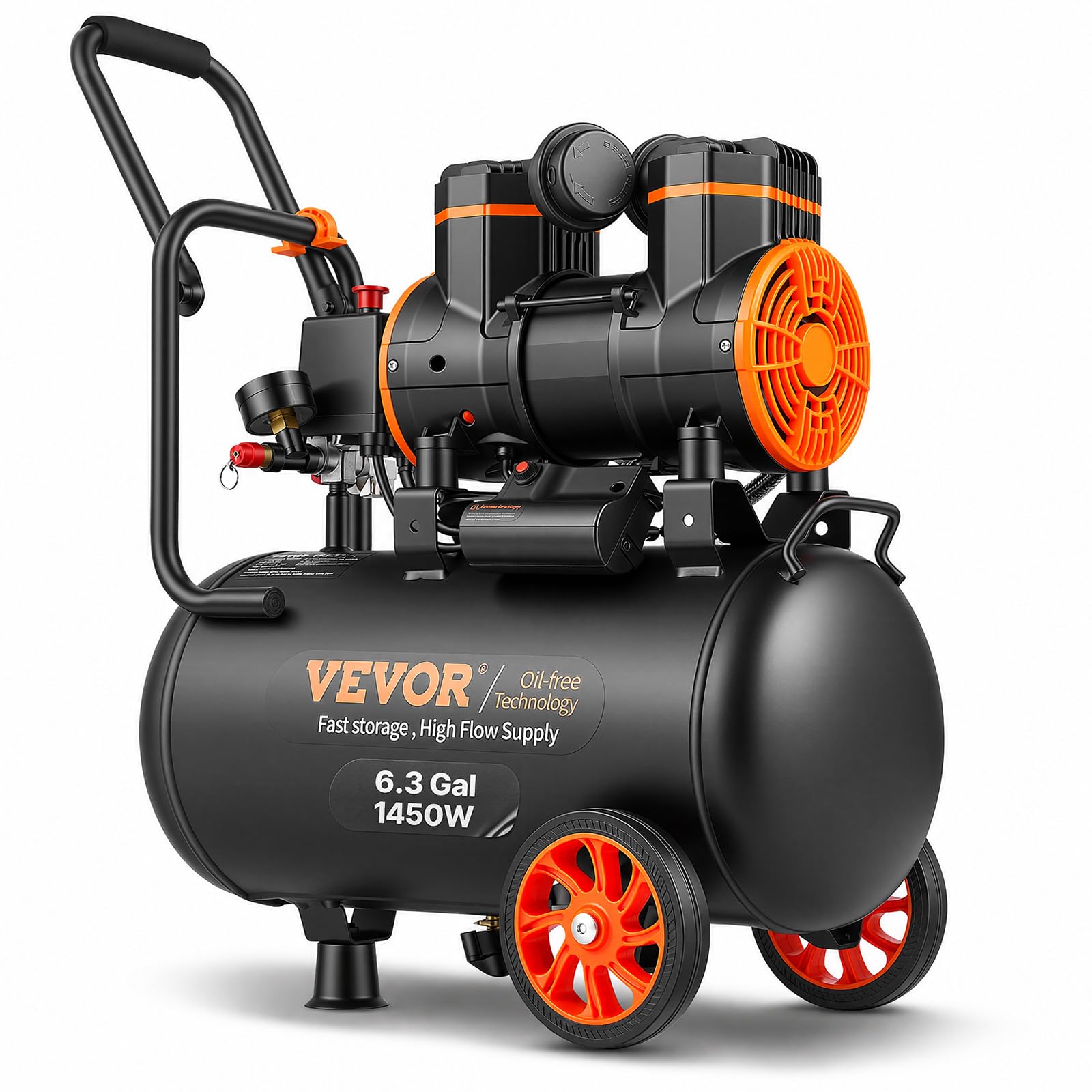
The budget pick that pushes 3.35 CFM at 90 PSI out of a 6.3-gallon tank.
On paper this is the airflow bargain of the budget tier. Its oil-free motor drives 3.35 CFM at 90 PSI, a strong number for the money, and it names spray painting among its best uses. If your gun is a hungry one, this delivers the volume without the premium price tag.
What owners praise most is how quiet it runs and how much they feel they got for the spend, with fast refill speed close behind — 87 mentions on noise and 57 on value. The build is a three-layer process with rust and wear resistance, a 392°F heat-resistant silicone intake pipe, two silencers, and Q235B structural steel, plus automatic overheating protection and pressure-relief safeguards.
The part you need to know: performance and pressure output are the most-discussed themes and the record is genuinely mixed, with durability drawing critical reports in a slice of cases. So this is a buy-it-knowing pick — great airflow value, but treat it as a light-to-medium duty unit and keep the warranty handy. The 43-pound weight with casters makes moving it a two-second job.
The bargain side
- 3.35 CFM at 90 PSI is a lot of airflow for the budget tier
- Quiet running is the trait owners praise most
- Casters and 43 pounds make it easy to reposition
The risk side
- Performance and pressure output feedback is mixed
- Durability draws critical reports from a segment of buyers
Worth it when: airflow per dollar is your main driver and the workload is moderate.
Walk on by if: you need a unit to run hard, all day, every day.
7. Limodot Quiet Oil-Free Air Compressor, 68 dB, 2.8 CFM @ 90 PSI, 5 Gallon

Sixty-eight decibels, 2.8 CFM at 90 PSI, and a hose kit in the box on day one.
The complete-kit angle is what makes this the smoothest first spray setup on the list. You get a 25-foot PVC air hose, a 13-piece air tool accessory kit, wheels, and a 1/4-inch quick-connect fitting — the bits you would otherwise shop for separately before your gun ever fires. And it explicitly lists an HVLP spray gun among the tools it drives, at 2.8 CFM at 90 PSI and 4 CFM at 40 PSI from a 1.2 HP motor to a 120 PSI ceiling.
Noise sits at 68 dB (decibels, a measure of loudness) thanks to an induction motor turning at only 3400 RPM (revolutions per minute). Owners describe it as “merely purring while running,” so you can spray without shouting over it. Refill is quick, with the recovery time called out as 25 seconds and a full fill from empty listed at 80 seconds. It holds pressure between sessions too, which matters if you only spray on weekends. It holds a strong 4.5+ star record with 900+ ratings behind it.
The one thing to plan around: the 5-gallon tank is the smallest on the quiet side of this list, so you will get slightly more pump cycling than an 8-gallon unit during a long spray session. For a detail gun and short passes it never becomes a problem, but a full panel will make the motor work more.
Why it earns a slot: 68 dB, 2.8 CFM at 90 PSI and a hose-and-tool kit together — nothing else here hands you a complete spray-ready bundle.
One thing to note: the 5-gallon tank means more cycling than the bigger quiet tanks.
Perfect for: a first spray kit where you want quiet operation and everything in the box.
Better options exist if: you spray large panels continuously and want a bigger buffer tank.
8. ECOMAX Air Compressor 6 Gallon 150 PSI Pancake with 10-Piece Accessory Kit
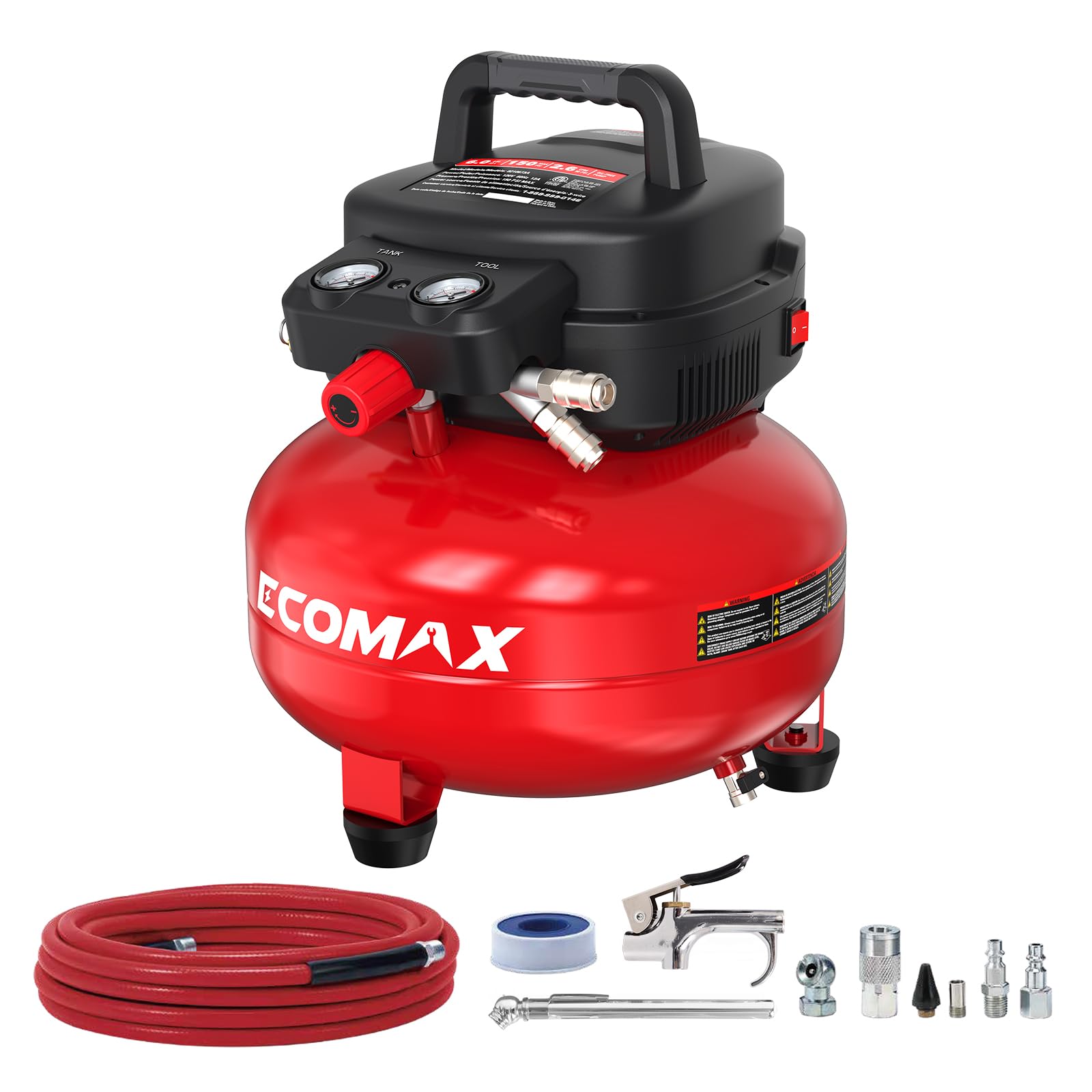
A 6-gallon, 150 PSI pancake that arrives with ten accessories so you can spray the same day.
The differentiator here is the box contents. Alongside the 6-gallon, 150 PSI, 1.5HP pancake you get a 25-foot PVC air hose, thread seal tape, a ball foot air chuck, quick-connect plugs and coupler, a tire pressure gauge, a nozzle, a blow gun, and a sleeve. For someone starting from zero, that closes the gap between unboxing and first coat.
What buyers value most is exactly that — value for money leads the praise, with pressure control and the accessory bundle close behind. Dual gauges give precise pressure readings, dual quick couplers let two tools connect, and the oil-free pump trims maintenance. At 34.17 pounds it is a carry-able pancake, and the reviews note it handles impact guns and suits RV use for those who travel with tools. It lands at 4.5+ stars across 300+ ratings.
Be clear-eyed on noise: the review record calls it very loud in several places, so this is an outdoor or detached-garage compressor, not a basement unit. The flip-up handle makes storage tidy, which partly offsets the volume issue for small spaces.
What buyers like
- Ten-piece accessory kit gets you spraying immediately
- Dual gauges and dual couplers for precise, two-tool control
- 1.5HP motor hitting 150 PSI in a 34.17-pound body
What to weigh
- Noise is called out as very loud
- A pancake tank means frequent cycling during long spray passes
The pick for: buyers who want the accessories included and a strong warranty-backed pancake.
Reconsider if: quiet operation is your number one requirement.
9. DEWALT Air Compressor for Trim, 200-PSI Max, Quiet Operation (DWFP55130)
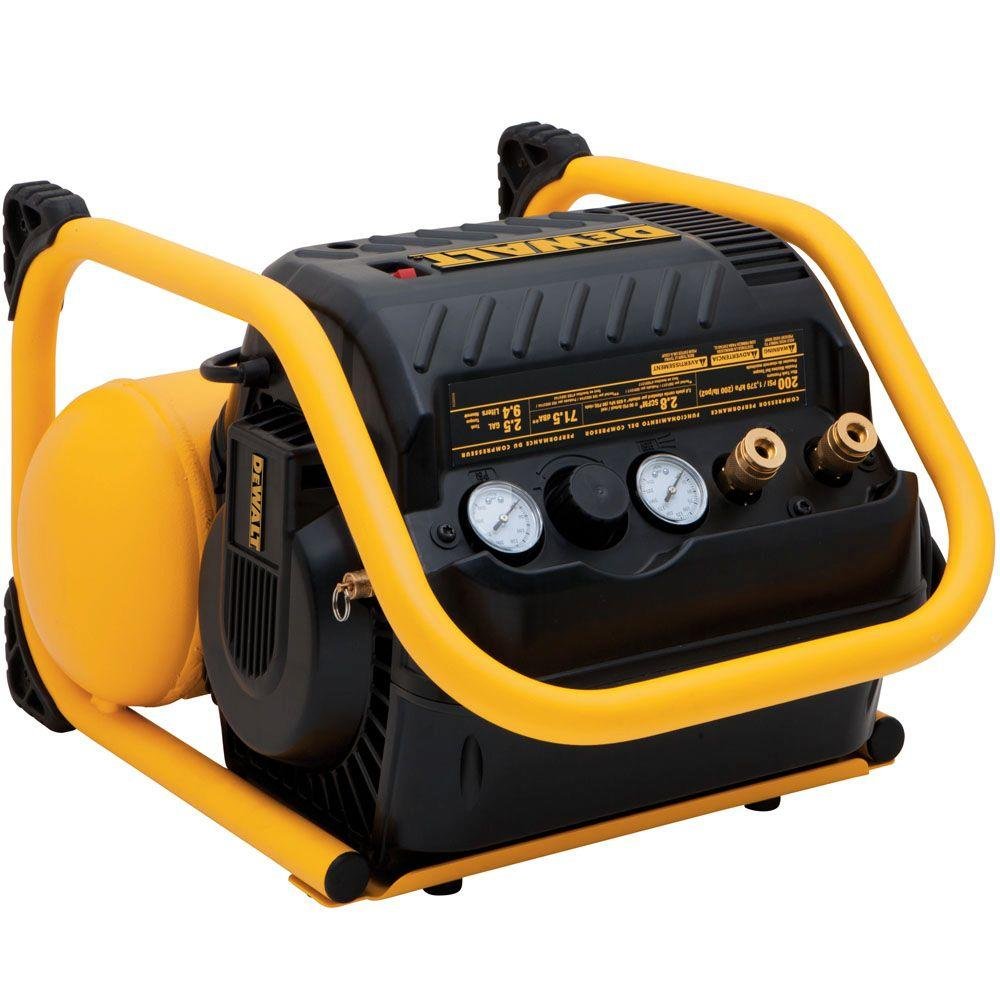
Two hundred PSI from a slim, carry-anywhere trim compressor that runs at 71.5 dBA.
Where this one wins is delivered airflow in a very small shell. It serves up 3.0 SCFM (cubic feet of air per minute) at 90 PSI (pounds per square inch), with a 200 PSI ceiling — more pressure than the CRAFTSMAN’s 150 PSI. And it does it from a 2.5-gallon tank that is only 12.5 inches thin and 36 pounds. That combination suits a trim gun and a small detail spray gun well, so you get steady coverage on small panels. It stores vertically or horizontally to fit wherever you have room.
The 71.5 dBA run means you can work beside it without ear defenders on an extended job. Owners love the quiet and the low weight, both called out far more than any other trait, and the low 12-amp draw reduces breaker tripping — handy in older garages. A roll cage and control panel protect the key parts, dual couplers hold two nailers, and the ball-valve drain makes flushing the tank quick.
The complaint that recurs is reliability: a portion of the review record mentions units failing to maintain pressure, and durability carries critical notes. That does not describe most units, but it is enough that you should keep the warranty paperwork handy and note the 2.5-gallon tank is small for long spray runs. Pressured air with a small tank needs a short recovery — the pump delivers on that.
The upside: 3.0 SCFM at 90 PSI and a 200 PSI ceiling in a 36-pound, 12.5-inch body is genuinely compact capability.
The trade: reliability is mixed enough that warranty coverage matters, and 2.5 gallons runs short on long sprays.
The ideal buyer: a trim carpenter or detail sprayer who wants high pressure and quiet in a portable frame.
Think about it if: you need a large tank for full-panel painting — the 2.5 gallons will cycle a lot.
10. Klutch 20-Gallon Air Compressor, 2 HP, 120V

Twenty gallons and 4.2 SCFM at 90 PSI — the shop-grade tank that keeps a gun fed for a full panel.
If your spray work is panels rather than touch-ups, this is the volume answer. A 2.0 HP series motor delivers 4.2 SCFM at 90 PSI with a 175 PSI ceiling, and the 20-gallon tank means the pump cycles far less while you keep the gun moving. It is a 90-pound, wheeled, shop-grade unit built to sit in one place and work.
What buyers prize most here is performance, then quiet running — a pleasant surprise for a compressor this big. It runs at 14 amps, has thermal overload protection to stop overheating on long runs, rubber foot stabilizers to cut vibration, an oil-free pump that cuts maintenance, and a 2-year warranty. Large rubber wheels and an ergonomic handle move it around the shop without drama.
The caveat is the size and the mixed signals on pressure retention and air leakage in the review record. Check the fittings and tank seals on arrival, before you trust it on a full panel. This is a stationary shop compressor, not something you carry to a job. But for an at-home paint bay, the volume is class-leading here.
The headline: 20 gallons and 4.2 SCFM at 90 PSI keep a spray gun fed through a full panel without pulsing.
The reality check: 90 pounds and a footprint that wants a dedicated corner — plus a check for tank and fitting leaks on arrival.
The right room: a garage or shop with space for a fixed compressor and real spray volume.
Not the right tool: if you need to lift and carry your compressor between sites.
Understanding the Specs
CFM at 90 PSI
CFM (cubic feet per minute) is the volume of air the pump pushes out — the fuel your spray gun burns. The important figure is the CFM quoted at 90 PSI, because that is roughly the pressure a gun runs at. A compressor’s max CFM at lower pressure looks impressive on a sticker but tells you little. Match delivered CFM at 90 PSI to your gun’s listed air consumption with a little headroom.
Decibel Rating (dB)
Decibels measure how loud the compressor runs. Around 60 dB is conversational, 70 dB is a vacuum-cleaner level background hum, and 95 dB is louder than a busy street and needs ear protection nearby. For spray work that runs for minutes at a stretch, lower is meaningfully better. A quiet unit keeps home and garage work comfortable.
Tank Size and Recovery Time
The tank stores air so the gun sees steady pressure while the pump cycles on and off. Bigger tanks and short recovery times (the seconds it takes to refill from the working pressure back up) combine to keep a spray pattern even. A small tank with slow refill lets pressure dip mid-panel, which shows up as a visible seam in the coat.
Oil-Free Pump
An oil-free pump has no lubricating oil that can escape into the air stream. Since paint finishes are easily spoiled by contamination, most spray-focused buyers stick to oil-free. It also means fewer fluid changes and reliable cold-weather starts, though oil-free pumps usually run louder than oil-lubricated ones.
FAQ
What CFM do I need to run an HVLP spray gun?
Can a 6-gallon pancake compressor run a spray gun?
Is an oil-free compressor better for spray painting?
How quiet does an air compressor for spray work need to be?
Do I need a moisture trap for spray painting?
What is the difference between SCFM and CFM?
How big a tank do I need for painting a whole panel?
Can I use the same compressor for nailing, tires and spray painting?
What size breaker does a 120V air compressor need?
Will a pancake compressor hold enough air for a full spray session?
Final Thoughts: The Verdict
For most home spray work, the air compressor for spray gun winner is the California Air Tools 8010. Its 60 dB (decibel) operation lets you spray inside a garage without bothering a soul, and its 8-gallon tank plus 60-second recovery keeps a detail gun fed. If you want the accessory bundle and a hose in the box on day one, grab the Limodot Quiet 5 Gallon. And for full-panel spraying where airflow volume is the whole point, the Klutch 20-Gallon is the one to reach for.
Match that delivered CFM at 90 PSI to your gun first, then pick your noise and tank trade-offs. Get those two numbers right and the California unit’s 60 dB motor lets you spray indoors without a neighbour complaint.
How We Picked
We do not accept paid placement. Every pick is matched to a real buyer and a real use-case; we do not hands-on test units.
Sources & Methodology
Specifications: manufacturer listings and product documentation. Review insights: verified customer reviews, as of November 2026. Pricing: not shown on this page (it changes often); check the current price via the retailer link.
As an Amazon Associate, Gadgets Feed earns from qualifying purchases. This does not affect which products we feature.