
Our readers keep the lights on and my morning glass full of iced black tea. As an Amazon Associate, I earn from qualifying purchases.
Specs are compiled from manufacturer listings and verified buyer reviews and can change over time — please confirm the key details on the product page before buying.
If your house has one room that bakes in July and freezes in January, the fix is not a bigger window unit — it is a heat pump that both cools and heats from the same wall cassette. A mini-split heat pump moves heat instead of burning fuel to make it, so the same box handles summer and winter. The catch most people miss is tonnage: buy too small and the unit runs nonstop, buy too big and it short-cycles and never wrings the humidity out of the air. This page walks through eleven systems that genuinely do both jobs, sorted by what each one is actually good at.
I’m Min — the founder and writer behind Gadgets Feed. This guide is built by comparing the manufacturers’ published specifications and the patterns across verified customer reviews, so you get each pick’s real strengths and trade-offs instead of marketing spin.
You will see SEER2 ratings, BTU capacities, and HSPF2 numbers explained in plain terms, plus honest notes on installation realities and the WiFi quirks that keep surfacing. By the end, ac heat pump units become a decision you can make, not a spec sheet to decode.
Our Picks at a Glance

How To Choose The Best AC Heat Pump Units
Start with square footage, not brand loyalty. Every unit here lists a floor area it is built for, and going under that number is the most common reason people end up disappointed. A heat pump that is too small for the room runs at full tilt constantly, which wears the compressor and never quite reaches the set temperature on a 100°F afternoon.
Match the tonnage to the room, then round down for open plans
A ton is shorthand for heat-moving capacity, and one ton lines up with roughly 12,000 BTU. A 1.5-ton unit moves 18,000 BTU, a 2-ton moves 24,000, and a 3-ton moves 36,000. For a single bedroom or a converted garage, a 1.5-ton system is usually plenty. For an open living area with high ceilings, the 2-ton systems make more sense because they can push more air without straining. If your space is chopped into separate rooms you want closed off from each other, the multi-zone systems with two indoor air handlers solve that problem in one purchase instead of two.
Read the heating number as closely as the cooling number
This is the part buyers skip. A heat pump’s heating capacity is listed separately from its cooling capacity, and the two do not always match. Some units here heat down to 5°F, one is rated for reliable heating to -4°F, and the cold-climate inverter systems push to -22°F. If you live somewhere with genuine winter, that lower temperature limit matters more than any other spec on the page. HSPF2 is the heating efficiency score — the higher it reads, the less electricity the unit uses per unit of warmth.
Plan for the install before you plan for the price
Nearly every system on this list requires professional installation, and that cost sits outside the equipment itself. What helps is that several units arrive pre-charged with refrigerant for a set line-set length, which means the installer is not adding gas on site. The Daikin Entra ships with a 15-foot line set, the ROVSUN and Senville multi-zone kits include 25-foot and 16-foot runs respectively, and the ACiQ Essentials includes 16 feet. Confirm the line-set length against where your outdoor condenser will actually sit — a short run that needs extending costs more than a system that already includes the right footage.
Quick Comparison
| Model | Best For | Capacity | Efficiency | Coverage | Amazon |
|---|---|---|---|---|---|
| Senville 2 Zone 18000 BTU★ Best Overall | Two rooms, one condenser | 1.5 tons / 18,000 BTU | High efficiency, 4 Star BEE | Multi-zone residential | Amazon |
| Temprium 18000 BTU 20 SEER2Best Value | Bedrooms needing near-silence | 1.5 tons / 18,000 BTU | 20 SEER2 | 1250 sq. ft. | Amazon |
| ZAFRO 24000 BTU 19 SEER2Best for Large Rooms | Big open living spaces | 2 tons / 24,000 BTU | 19 SEER2 | 1500 sq. ft. | Amazon |
| ROVSUN 2 Zone 20000 BTU | Two rooms on a tighter budget | 1.67 tons / 20,000 BTU | 23 SEER2 | Multi-zone | Amazon |
| DELLA Vita 24000 BTU | Cold winters, 1500 sq. ft. | 2 tons / 24,000 BTU | 20 SEER2, Energy Star | 1500 sq. ft. | Amazon |
| Daikin 18,000 BTU Entra R32 | Brand-name reliability | 1.5 tons / 18,000 BTU | 18 SEER2, 9 HSPF2 | 1000 sq. ft. | Amazon |
| MRCOOL 18000 BTU Easy Pro | Workshops and converted buildings | 1.5 tons / 18,000 BTU | 2 Star BEE | 800 sq. ft. | Amazon |
| ACiQ Essentials 36000 BTU | Whole-floor coverage | 3 tons / 36,000 BTU | 20 SEER2 | 1500–2000 sq. ft. | Amazon |
| MrCool Easy Pro 24k BTU 5th Gen | DIY-friendly install | 2 tons / 24,000 BTU | 18.9 SEER2, 11.2 HSPF2 | 1200 sq. ft. | Amazon |
| Senville Central 4 Ton | Replacing central air | 4 tons / 48,000 BTU | Cold Climate Energy Star | 2,000 sq. ft. | Amazon |
| Goodman 3 TON 15 SEER2 | Full system replacement | 3 tons / 36,000 BTU | 15 SEER2 | — | Amazon |
In‑Depth Reviews
1. Senville Mini Split AC/Heating System, 2 Zone, 18000 BTU
Our pick — 4.5+★ from 450+ verified ratings; the strongest balance of quality and price.
Two rooms, two thermostats, one outdoor box — this is the zoning shortcut done properly.
Senville’s 2 Zone system splits 1.5 tons of capacity across two indoor air handlers fed by a single condenser. That means the spare bedroom can sit at 66°F while the living room runs warmer, and each room gets its own remote. For a house with two problem rooms and no ductwork between them, this is the arrangement that actually solves the problem instead of averaging it. Capacity sits at 1.5 tons.
The scale comparison matters here. Against the ZAFRO 24000 BTU unit, this Senville is the lighter-duty system at 1.5 tons versus 2 tons, and 18,000 BTU of cooling versus 24,000 BTU. If both rooms together total more than 1,000 square feet, the ZAFRO single-zone makes more raw cooling sense. If you want those rooms on separate schedules, the Senville’s second air handler is the whole point.
What wins people over is raw performance — it is the thing buyers bring up more than anything else, and the theme is a system that simply delivers the set temperature without drama. The quieter notes land too: owners describe operation that fades into the background. Alexa and the companion app add scheduling and a built-in 24-hour timer, so you can let the house drift while you are out and pull it back before you walk in. The honest catch is the WiFi layer — it is the one part buyers describe with mixed feelings, with some hitting bumps pairing it to Google Home and Assistant. Treat voice control as a bonus and the remote as the dependable way to change settings.
What earns this the top spot
- Two indoor handlers and one condenser deliver independent temperatures per room
- Remote plus app plus Alexa covers every way you would want to change a setting
- Rated 4 Star on the BEE scale with high efficiency noted in the spec sheet
- Handles residential and light commercial spaces, from bedrooms to restaurants
Where it needs a fair warning
- Professional installation is required and not included with the hardware
- Google Home and Assistant pairing is the uneven part of the smart-control story
- 1.5 tons of shared capacity will not carry two large rooms at once in a heat wave
Reach for this if: you have two rooms that need different temperatures and no ductwork to link them.
Look elsewhere if: your two spaces are big enough that 1.5 tons total will feel thin in peak summer.
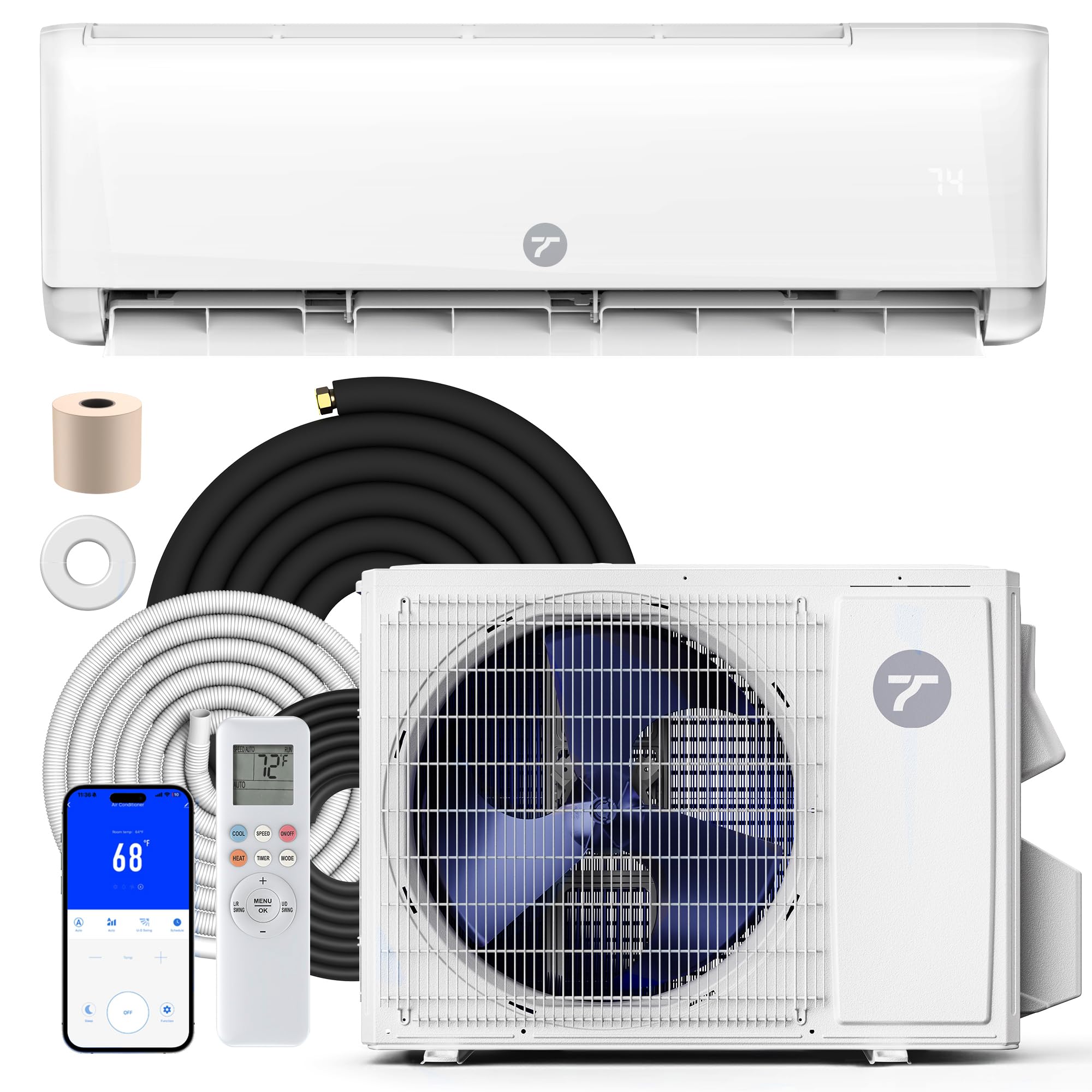
2. 18000 BTU Mini Split Air Conditioner, 230V 20 SEER2 AC & Heat Pump
A nursery-grade whisper at 28 dB, wrapped around a 1,250-square-foot workhorse.
Temprium’s offering is the value play of the group, and the number that sells it is 28 dB. That is the indoor unit in its quietest mode — quieter than a whisper, which is the difference between a bedroom unit you forget about and one that hums you awake. It covers 1250 square feet with 1.5 tons and 18,000 BTU, and it keeps working at the extremes: rapid cooling even at 120°F outside, reliable heating down to 5°F.
Against the ZAFRO 24000 BTU above, this is the smaller footprint system — 1250 square feet of coverage versus 1500, and 18,000 BTU versus 24,000. For a typical primary bedroom plus adjoining bath, the Temprium is right-sized. For a vaulted open-plan great room, step up in capacity instead.
You get a lot of controls for the money, and buyers report the install goes smoothly. The feature set is unusually complete: seven operating modes including Dry, Fan, and ECO, seven fan speeds, 4D auto swing, Turbo, and a Follow-Me sensor (a remote that reads the temperature where you sit, not at the wall unit) so the cooling tracks wherever you are. A 133°F self-cleaning cycle dries the indoor coil, and a washable filter traps dust. ETL (a safety certification) and AHRI (a performance certification) round out the paperwork. You can control it through WiFi, app, Alexa, or Google Assistant — but owners mention the WiFi link is uneven, so plan on the backlit remote as your daily driver.
Best feature nobody advertises: the Follow-Me sensor. It quietly fixes the classic mini-split complaint where the unit cools the wall it is mounted on rather than the sofa you are sitting on.
The short version: the smartest value in this lineup for a bedroom or home office up to 1250 square feet.
Know before you buy: expect to lean on the remote rather than voice commands while the app settles in.
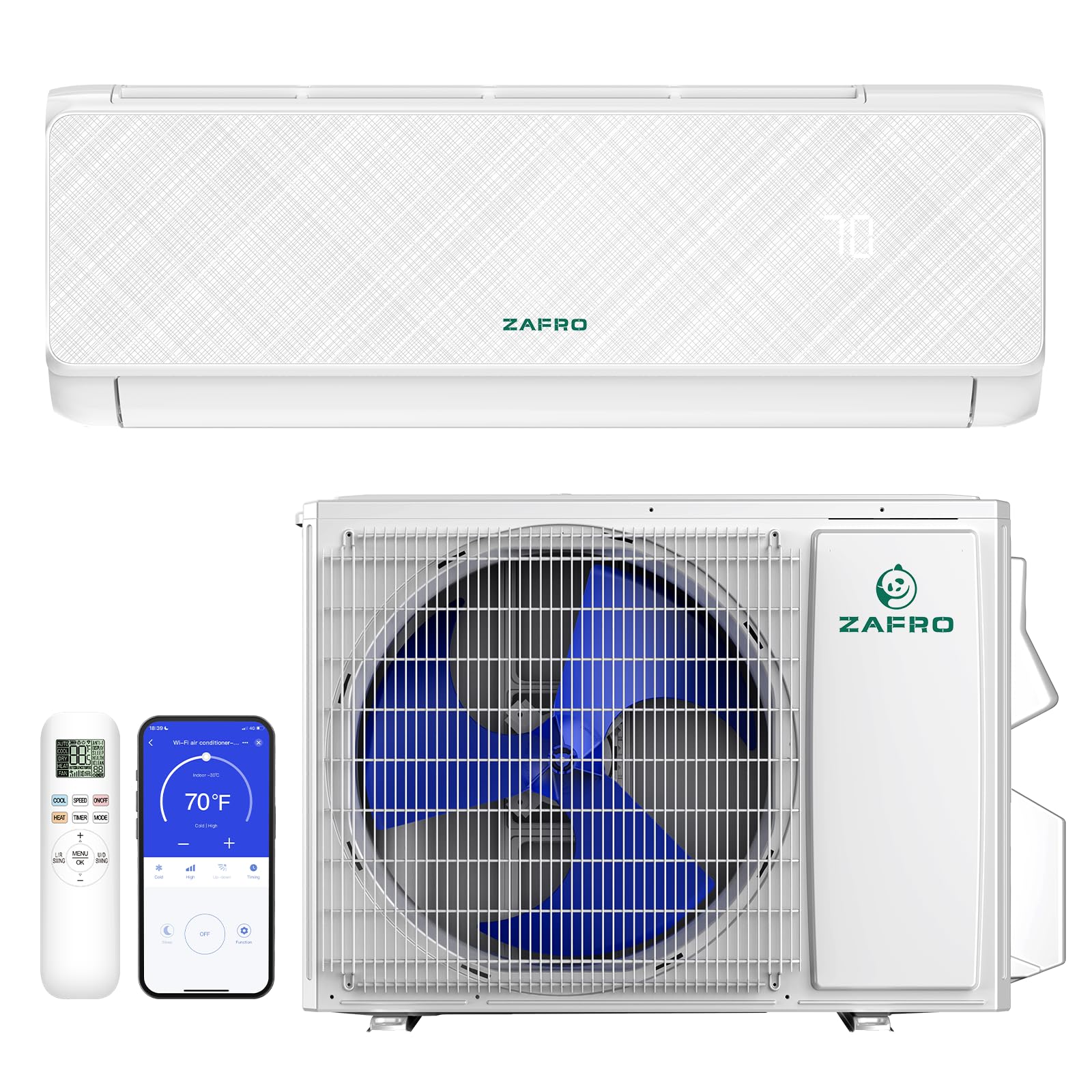
3. ZAFRO 24000BTU Mini Split AC&Heating System, 19 SEER2 230V, Heat Pump
Two full tons and 1,500 square feet of coverage, for the room where everyone actually gathers.
The coverage gap between this ZAFRO and the Temprium above is the whole argument for stepping up: 1500 square feet versus 1250, and 24,000 BTU versus 18,000. When your living space is one big open run rather than separate rooms, that extra reach is what keeps the far corner from feeling like a different climate. Inverter technology paired with a 19 SEER2 rating keeps the running cost down while it does it.
Installation is the aspect that gets talked about most with this unit, and it is encouraging talk — buyers describe a process that went as expected rather than a fight. Cooling performance follows right behind in the conversation, alongside consistent praise for how quiet it runs. The Sleep Mode drops the indoor unit to 30 dB and dims the display to dark, which is the detail light sleepers will notice first.
You can leave the settings alone all year: five modes — Cool, Heat, Dry, Fan, and Auto — cover every season. Vertical auto-swing louvers push air from top to bottom, so one corner is not getting blasted while another sits still. The self-cleaning function dries the coil after each run to head off that damp smell. The unit carries ETL safety certification and AHRI performance certification. Annual energy consumption is listed at 1516 kilowatt hours per year (kWh, the unit your power bill uses), so check that figure against your current bill. One wrinkle: the spec sheet lists app control among the controller types, but the shipping package is built around the remote, so confirm your control expectations before install day.
Why the big room crowd picks it
- 2 tons and 24,000 BTU push real air into an open 1500-square-foot space
- 30 dB sleep mode with a display that blacks out for light sleepers
- Auto-swing louvers distribute air vertically instead of blasting one spot
- ETL and AHRI certified, with self-cleaning to keep the coil fresh
Worth knowing up front
- The remote, not the app, is the control path spelled out in the included parts
- Large-capacity 230V systems need a professional install and a dedicated circuit
Pick this one: when your main living area is one big open space and you want it uniformly cool.
Think twice: if you were counting on app control as your primary interface rather than the included remote.
4. ROVSUN 2 Zone 20000 BTU (12K/12K) Mini Split AC/Heating System, 23 SEER2
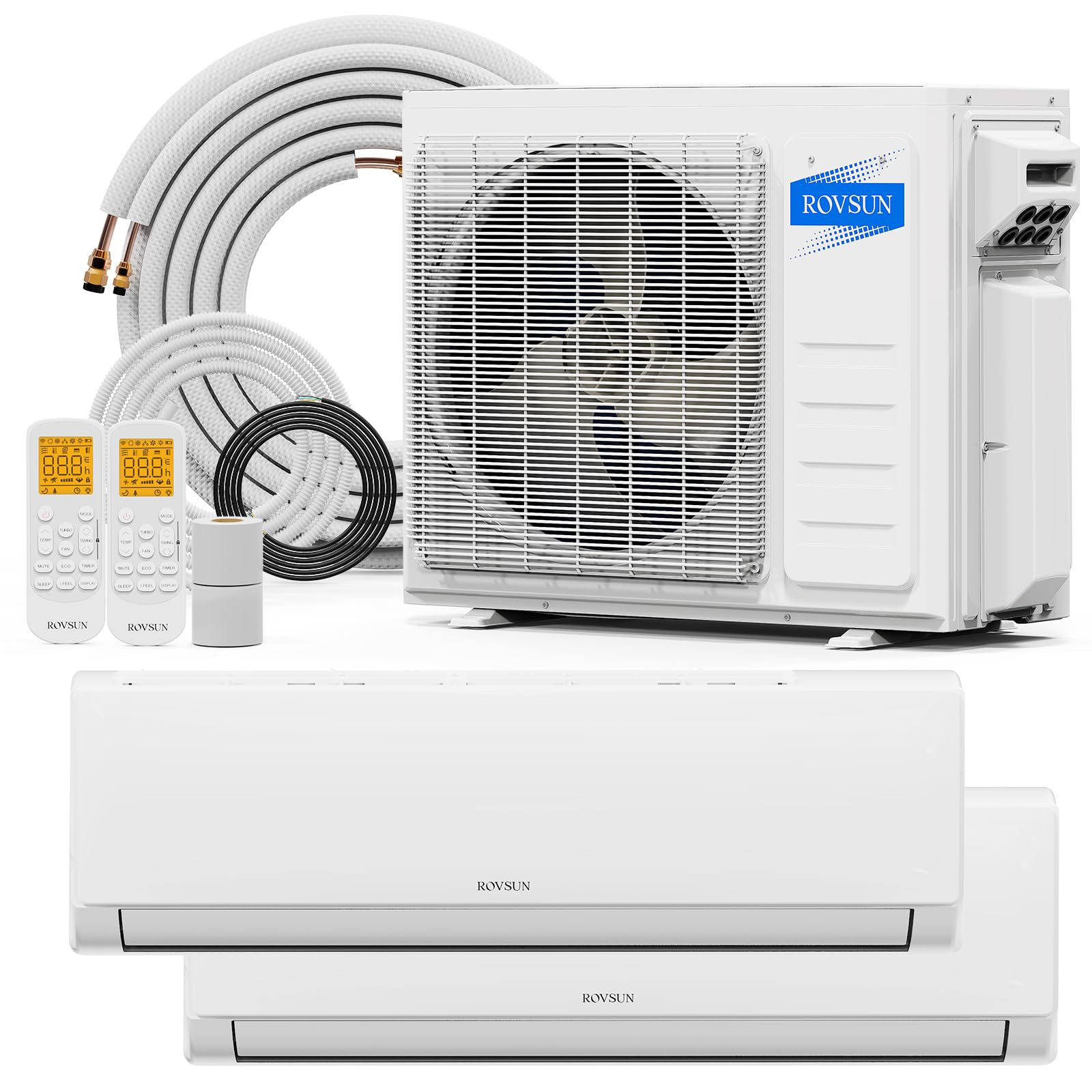
Two 12K heads on a single condenser, rated at the highest efficiency number in this lineup.
Of the two multi-zone systems here, the ROVSUN carries the sharper efficiency rating: 23 SEER2 against the Senville 2 Zone’s high-efficiency rating with no SEER2 figure printed. If you want two independently controlled rooms and you care about the running cost more than brand familiarity, this is the one that leads on paper. The 20,000 BTU total splits into two 12,000 BTU heads, so each room gets a dedicated indoor unit and its own remote.
The temperature envelope is wide, spanning -4°F to 122°F ambient, which is what makes this a genuine four-season system rather than a summer appliance. Automatic defrosting, self-diagnosis, self-cleaning, iFEEL mode, a 24-hour timer, four-way swing, sleep mode, and mute mode all ship included. Noise sits between 28 and 45 dBa depending on the mode and fan speed. Both the condenser and the line sets are pre-charged to 25 feet, and the kit arrives with two 25-foot lines and two remotes.
Effectiveness is the quality buyers single out most, with installation close behind — a system that does the job and goes in without drama. Be clear-eyed about the flip side, though: reliability is the one area where the feedback splits, with some owners reporting units that did not fire up correctly, and temperature behavior on restart drew a mixed response. Most units land fine, but this is the pick that rewards a careful installer relationship and a proper post-install test before the installer leaves the driveway.
The efficiency headline: 23 SEER2 is the top number in this comparison, and that is what you feel when the summer bill arrives.
Ideal match: a two-room setup where both spaces want separate schedules and the lowest running cost available.
Be prepared: to commission it thoroughly on day one — get the installer to verify both heads before signing off.
5. DELLA Vita 24000 BTU Mini Split Air Conditioner, Energy Star, 20 SEER2 230V

Twenty-four thousand BTU that keeps heating when the outside temperature drops to -4°F.
Here is where the winter question gets answered properly. The DELLA Vita carries a 20 SEER2 rating and a heating range down to -4°F, which puts it in genuine cold-climate territory rather than the 5°F floor most single-zone units here list. It moves 24,000 BTU across 1500 square feet. If your heating season has real teeth, this is the spec that should drive your decision.
The running-cost story leans on DC inverter technology — the compressor modulates speed instead of slamming on and off, so the room holds a steady temperature and the unit avoids the efficiency cliff that comes with constant cycling. DELLA claims up to 40% lower electricity use, and the Energy Star rating supports that. Annual energy consumption is listed at 1827.97 kilowatt hours per year.
The room feels right because of the I Feel sensor (a remote that reads the temperature where you sit). It reads temperature at the remote instead of at the indoor unit, so the system cools according to where you are sitting rather than the wall behind the unit — that single design choice kills the hottest complaint about mini-splits. Noise drops to 34 dB at the low end (about the level of a quiet conversation), so it will not drown out the TV. 4D airflow with multiple fan speeds, Turbo, Sleep, and a 24-hour timer fill out the controls. Alexa, Google Assistant, and the DELLA app all connect. The install kit includes a 16-foot copper line set and a 78.7-inch drain pipe, and the system is pre-charged with R-32 (the refrigerant gas already inside). Maximum fuse size is 30A (amps, the breaker rating) — a detail your electrician will want before the unit arrives.
What makes it the cold-weather pick
- Heating rated down to -4°F, well below the 5°F floor of most units here
- 20 SEER2 inverter compressor that modulates instead of cycling
- I Feel sensor tracks temperature at the remote for consistent comfort
- Energy Star rated with a 16-foot line set and R-32 pre-charge included
The practical requirements
- 30A maximum fuse size means a dedicated circuit and a licensed install
- At 1827.97 kilowatt hours per year, this is built to run hard through winter
- App and voice control add layers on top of the core remote operation
Built for: homes with a real winter where the unit has to heat, not just cool, for months on end.
Not the pick if: you only ever need cooling — the cold-climate capability is wasted on a summer-only climate.
6. Daikin 18,000 BTU 18 SEER2 Entra R32 Series Heat Pump Mini Split A/C

The one with the full spec sheet: 9 HSPF2, 10.5 EER2, and a 3.30 COP spelled out in black and white.
Daikin publishes the numbers other brands leave off. Cooling capacity runs 18,100 BTU with a modulation range from 6,900 up to 20,000 BTU, heating capacity is 18,000 BTU spanning 5,800 to 22,500 BTU, and it covers up to 1,000 square feet. The efficiency detail goes beyond the 18 SEER2 headline: 9 HSPF2 for heating, 10.5 EER2, and a 3.30 COP. If you want to know exactly what you are buying rather than guess, that transparency is worth something.
The operating window is deliberately narrow and honest: cooling from 50°F to 115°F, heating from 5°F to 65°F. That is a fine fit for mild-to-temperate climates and a poor fit for a Minnesota January, which is where the DELLA Vita’s -4°F rating and this unit’s 5°F floor separate cleanly. On efficiency, Daikin’s 18 SEER2 sits a step behind the DELLA Vita’s 20 SEER2 and the ROVSUN’s 23 SEER2 — you are buying the engineering pedigree and the documented performance over the highest rating on the page.
The comforts are well considered. Cold Draft Prevention stops the unit blowing chilly air on startup before the coil warms, ECO+ trims consumption, Powerful Operation gets a room to temperature fast, and a Titanium Apatite Photocatalytic air purifying filter joins the standard filtration. Self-diagnostics report through a digital display. The kit arrives with a 15-foot Maxwell refrigerant line set including interconnecting cables, a wall mounting bracket, and a condenser pre-charged with R-32. Cooling performance is what buyers comment on most, and the theme is steady — a unit that holds a consistent temperature rather than swinging around it.
The engineering case: a fully documented efficiency profile — 9 HSPF2, 10.5 EER2, 3.30 COP — for buyers who would rather read the test data than a tagline.
The trade-off to accept: 1,000 square feet of coverage is the smallest in this comparison outside the MRCOOL, and its 5°F heating floor rules out hard winters.
Strongest for: a sunroom, basement, or attic conversion in a mild climate where documented efficiency beats headline ratings.
Rule it out if: winter temperatures in your area routinely plunge below 5°F.
7. MRCOOL 18000 BTU 230V Ductless Inverter Mini Split Air Conditioner & Heat Pump System, Easy Pro Series
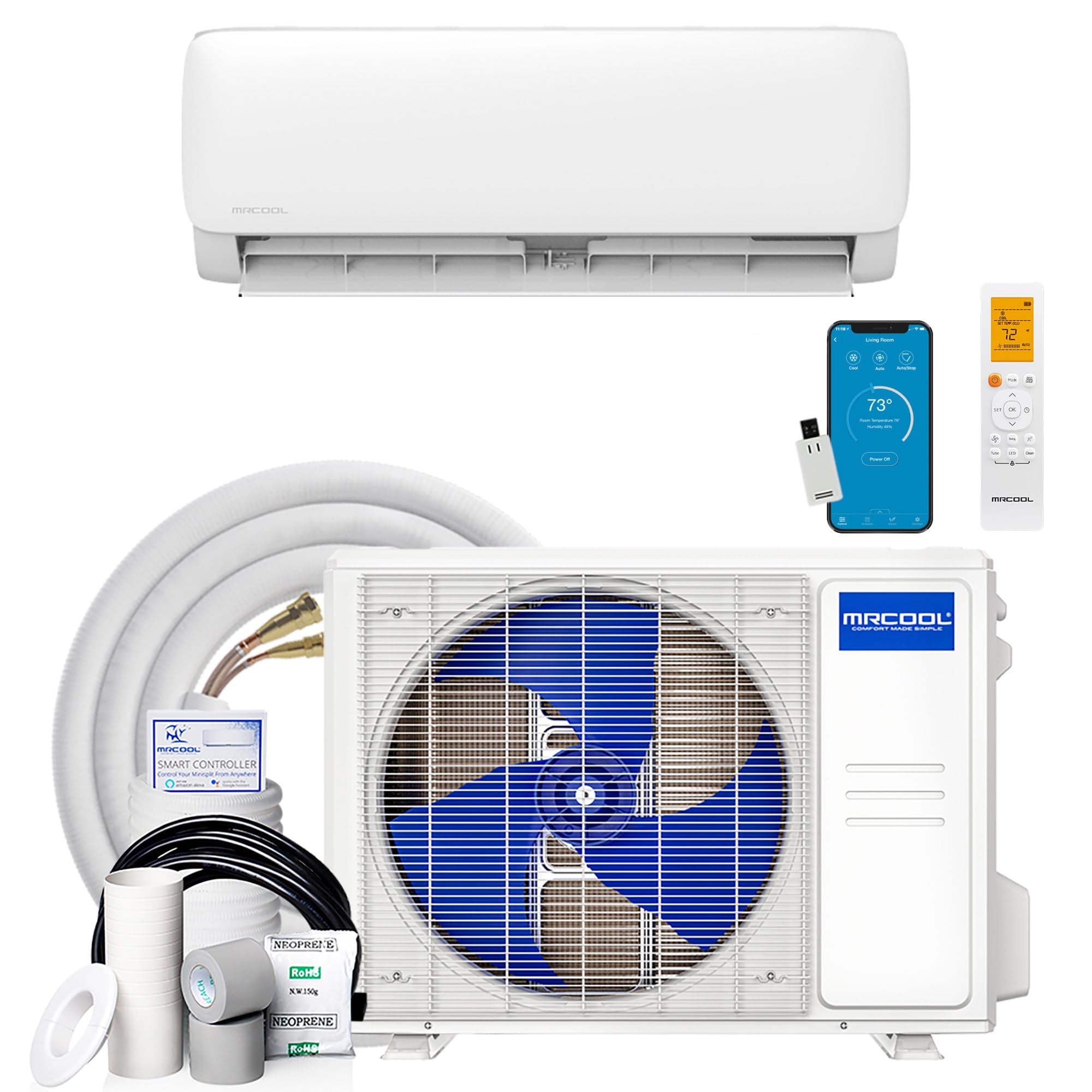
Eight hundred square feet of shop, office, or commercial space — cooled and heated by one wall unit.
MRCOOL aims this one at the space that central HVAC forgot: the converted garage, the back office, the small retail floor. It moves 18,000 BTU across up to 800 square feet, which is the tightest coverage number in this comparison — and that is a feature, not a flaw, if your room is genuinely that size. Putting a 24,000 BTU unit into an 800-square-foot box would short-cycle it and leave the air clammy. Matching capacity to the room is what this pick gets right.
Installation is the strongest suit and the most-praised quality of the two things buyers talk about with this unit. MRCOOL builds the Easy Pro around a streamlined setup that produces less mess and lower installation cost than a traditional split. Beyond that, the cooling performance draws consistent praise, including a building of 12 by 40 feet brought to temperature without trouble. Quiet operation shows up too — the indoor unit described as inaudible from a few feet away. Value rounds out the picture, which tracks for a system that keeps a small commercial space comfortable without a second condenser.
You give up efficiency headroom. The BEE rating is 2 Star (a government energy star scale), the lowest on this list, so the running cost per hour of cooling will not rival the 23 SEER2 ROVSUN or the 20 SEER2 DELLA (SEER2 is the cooling efficiency score — higher means cheaper to run). The spec sheet also lists capacity as 0.46 cubic feet, which is clearly a listing quirk rather than the real HVAC figure — judge this one by the 18,000 BTU cooling power (British thermal units, the standard cooling measure) and 800-square-foot coverage that match up cleanly.
Go with it when: you are fitting out a workshop, garage office, or small storefront of roughly 800 square feet.
Keep looking if: the space runs all day every day and efficiency ratings drive your operating budget.
8. Essentials 36000 BTU 230V 20 SEER2 Mini Split AC/Heating System, White
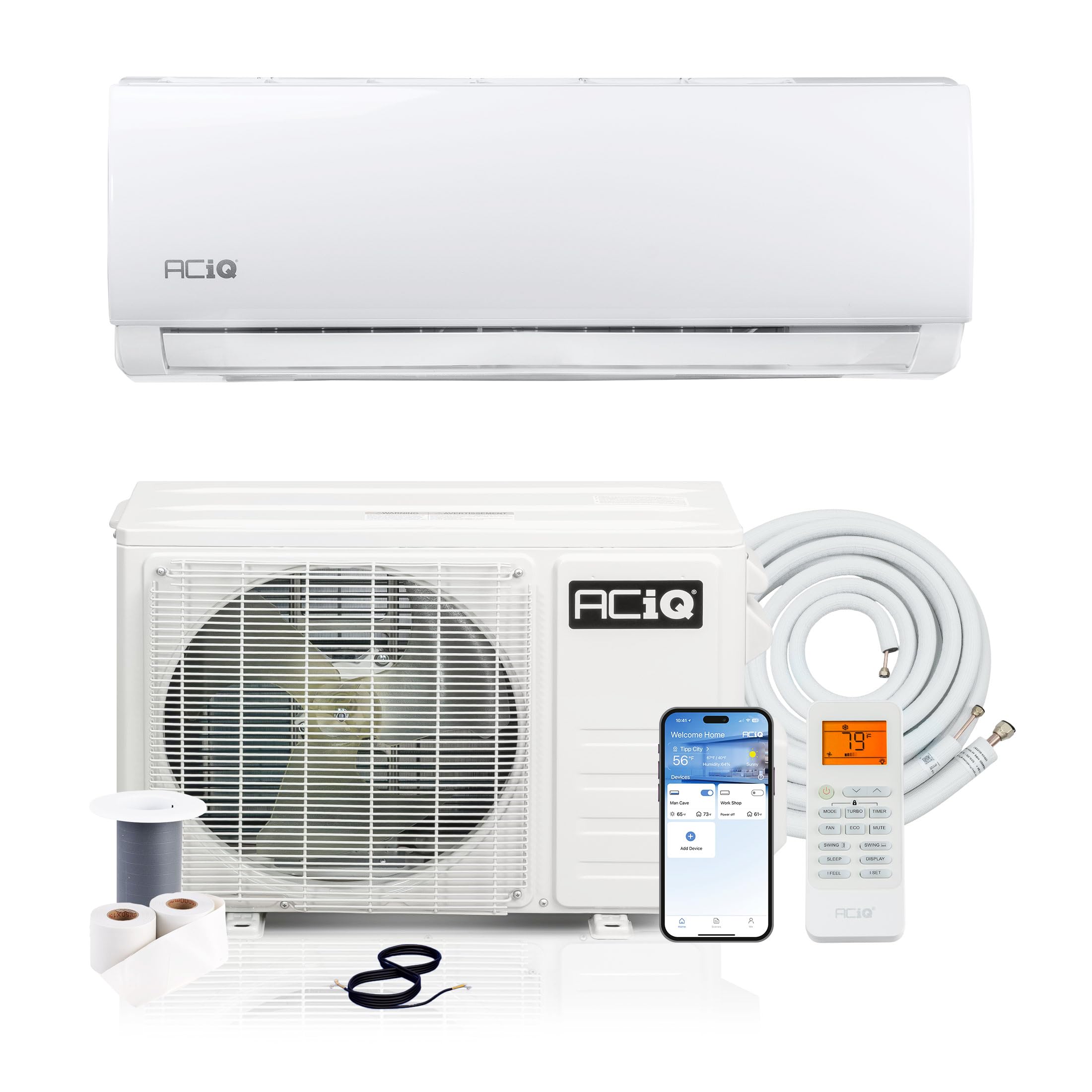
Three tons, 20 SEER2, and two thousand square feet from a single wall cassette.
When one unit has to carry an entire floor, the ACiQ Essentials is built for it. The 36,000 BTU rating covers 1500 to 2000 square feet, and the temperature envelope is unusually broad in both directions — cooling from 5°F to 127°F outside, heating from -4°F to 75°F. That dual range is what makes this a year-round system rather than a summer convenience. A rotary DC inverter compressor paired with the 20 SEER2 rating keeps consumption in check while it works.
The supply side earns its keep too. The installation kit is genuinely complete: a 16-foot line set, remote with mount and batteries, power cable, indoor mounting plate, outdoor rubber feet, wall cap, drain elbow and line, plasticene, and screws with anchors. Buyers consistently note the copper finish looks good enough to leave on display, which is a small thing until you have lived with an ugly box bolted to your living room wall. Quiet operation draws steady praise alongside the appearance and the value.
The warranty is the detail that separates this from the pack: 4 years on parts and 6 years on the compressor, provided a technician installs it and you register it online with the manufacturer at no charge. That is a meaningful safety net on a system this large — provided you follow the registration step, which is easy to forget after the installer leaves. Performance is what carries the reputation most, which is exactly what you want to hear about a unit sized to cool a whole floor.
The case for the big ACiQ
- 36,000 BTU and 20 SEER2 covers 1500 to 2000 square feet from one indoor unit
- Cooling to 127°F and heating to -4°F outside covers both seasons properly
- 4-year parts and 6-year compressor warranty with free online registration
- A fully stocked install kit means fewer trips to the hardware store
Before you commit
- The warranty requires professional installation and online registration
- A 3-ton system needs a substantial electrical supply, so plan the circuit work early
Right answer for: an open floor plan or a large finished basement that needs one machine to handle everything.
Look past it if: your rooms are separated by walls — you would be paying for capacity that cannot reach around corners.
9. MrCool Easy Pro 24k BTU 18.9 SEER2 Ductless Heat Pump Split System 5th Generation
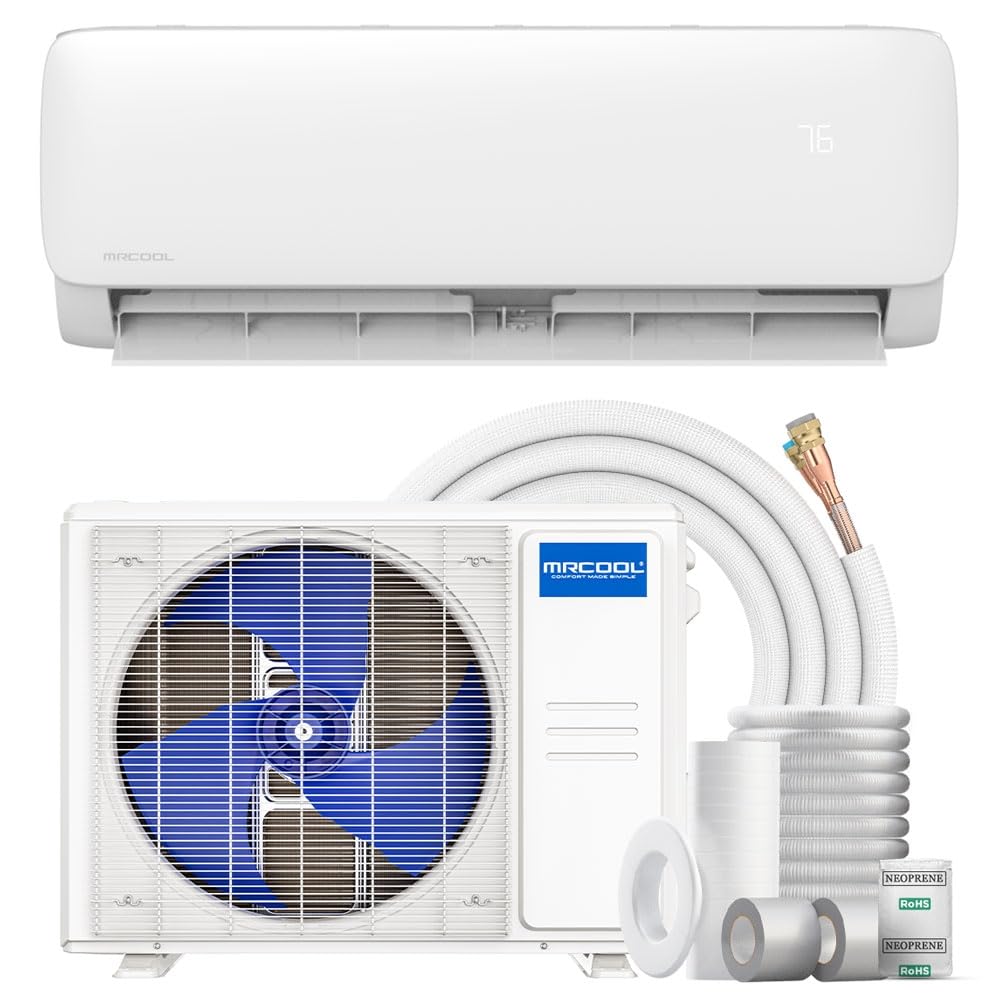
An 11.2 HSPF2 heating score — the winter-efficiency number that rarely gets top billing.
Most shoppers read SEER2 and stop there. The 11.2 HSPF2 rating on this 5th-generation MrCool is the more interesting figure, because HSPF2 is the heating efficiency score (how cheaply it heats in winter) and heating is where heat pumps earn their name. Combined with an 18.9 SEER2 rating (the cooling efficiency score) and a 24,000 BTU capacity, this system handles up to 1200 square feet — game rooms, garages, and sunrooms according to the spec sheet. That is exactly the sort of space where a ducted system was never going to fit.
Against the Daikin’s 9 HSPF2, the MrCool’s 11.2 HSPF2 gives it the edge on heating efficiency per unit of electricity. Against the ROVSUN’s 23 SEER2, it gives ground on summer efficiency. Which number wins depends entirely on whether your climate hurts more in January or August.
The Gold Fin condenser coating protects the outdoor coil from corrosion and rust. That coating resists corrosion and rust on the outdoor coil while keeping heat transfer intact — so a coastal or humid install does not chew through the condenser as fast. Variable-speed compressor operation (the compressor ramps up and down instead of switching on and off) smooths out the temperature swings. This is a newer listing with a thinner review history than the established picks above, so treat it as one to consider when the specs fit your space rather than one with a long track record behind it.
The spec worth circling: 11.2 HSPF2. If you heat more months than you cool, this is the efficiency number that actually moves your bill.
Worth considering when: heating dominates your year and the space is a garage, game room, or sunroom under 1200 square feet.
Hold off if: you want a long, well-documented ownership history before committing — this one is still building one.
10. Senville Central Air Conditioning System, Heat Pump, 4 Ton, 10kW Aux
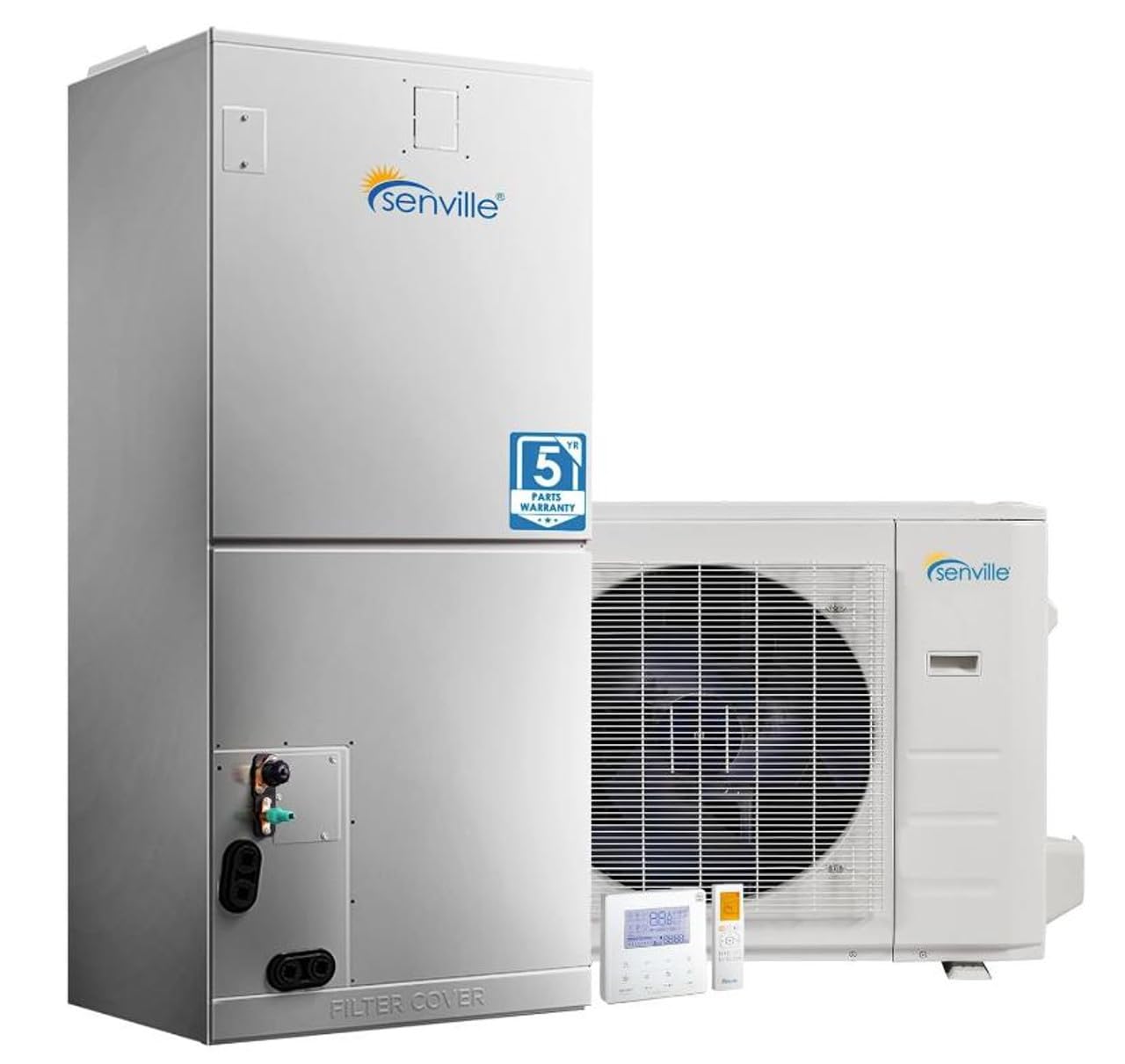
Four tons and a 10kW backup heater that keeps pushing warmth to -22°F.
This is the replacement for a dying central air system, not an add-on for a spare room. Senville’s central unit delivers 48,000 BTU across 2,000 square feet, driven by a variable-speed inverter compressor (a compressor that ramps up and down instead of switching on and off). The figure that separates it is the heating floor: -22°F / -30°C with the 10kW auxiliary heat (a backup electric heater) backing the inverter heat pump. That is cold-climate hardware, and it is paired with a Cold Climate Energy Star designation rather than a standard one.
The kit reflects the job it is meant to do. You get the indoor air handler, the outdoor condenser, the 10kW auxiliary heat element, a thermostat, and a 16-foot installation kit in one box. The compressor carries a 10-year warranty and the parts carry 5 years. Annual energy consumption is listed at 5173 KW (kilowatts, the unit your power bill uses), which is the honest number to weigh for a system this size — 48,000 BTU of capacity does not run on air, and knowing the annual figure before you commit beats discovering it on a February bill.
Cooling performance is the aspect that gets praised, with hot-climate service specifically called out — the kind of heat that bakes a house from morning to night. Build quality earns its own share of the conversation. It is worth being clear that 4 tons is a serious commitment: this is for a large house that already has the ductwork or the central infrastructure in place. If your home is 1,200 square feet with no ducts, the ductless mini-splits on this list are the better match and cost far less to install.
Where it stands out
- Reliable heating down to -22°F with the 10kW auxiliary heat element
- 10-year compressor warranty and 5-year parts warranty
- Cold Climate Energy Star designation rather than standard
- Thermostat and 16-foot install kit included with the system
What to prepare for
- 5173 KW annual consumption reflects a system built to run large spaces hard
- 4 tons of central capacity assumes existing ductwork and a proper electrical supply
Suits you if: you are replacing a central air system in a large home and want heat pump efficiency with a real winter backup.
Not for you if: you are outfitting a single room — this is whole-house equipment from the ground up.
11. Goodman 3 TON 15 SEER2 Multi-Position R-32 Heat Pump System with Air Handler
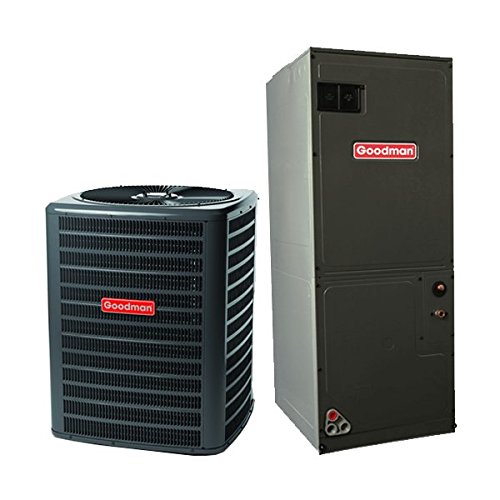
A matched condenser-and-air-handler pair, sold as one box for a full system swap.
Goodman packages this as a complete unit: a GLZS4BA3610 heat pump paired with an AMST36CU1300 air handler. Three tons of cooling power at 36,000 BTU, running on R-32 refrigerant, and rated 15 SEER2. It is not a wall cassette — it is the equipment that sits in place of an old central system, and the air handler is the part that pushes conditioned air through the ducts already in your house.
Here is where the budget math turns. Accessories are sold separately — line sets, thermostats, and LP conversion kits do not come in the box. That means the true installed cost sits above the equipment list, and you should price the extras before committing. The system also takes the HKSC/HKSX series of heat kits specifically, not the HKR series. Ordering the wrong heat kit is the kind of mistake that stalls an install by a week, so hand that detail to your installer rather than assuming.
Fifteen SEER2 is the lowest efficiency rating among the larger systems here, sitting well behind the 20 SEER2 DELLA Vita and the 23 SEER2 ROVSUN. For a homeowner replacing a decades-old unit, 15 SEER2 is still a step forward, and the matched heat pump plus air handler pairing removes the guesswork of mixing brands. This is the pick for someone who wants a named, matched system from a known manufacturer and is prepared to let a technician handle the accessory list.
The practical read: a matched heat pump and air handler from one brand means no compatibility gamble — but the line set, thermostat, and heat kit all sit outside the box.
The efficiency note: 15 SEER2 is the floor of this comparison, so this is a budget-replacement play rather than an efficiency upgrade.
Choose this if: you need a matched condenser and air handler to drop into existing ductwork and you want one manufacturer standing behind both halves.
Go another way if: you want the highest efficiency available or you are not prepared to source accessories separately.
Understanding the Specs
BTU and Tons
BTU is a measure of how much heat a unit can move in an hour, and a ton is simply a shorthand for 12,000 BTU. That means a 1.5-ton unit is the same thing as an 18,000 BTU unit, and a 3-ton unit is a 36,000 BTU unit. You will see both figures used across these listings, which is why the same system can look like two different products. Match the number to your square footage first, because an undersized heat pump runs nonstop trying to catch up and an oversized one cycles on and off without pulling moisture out of the air.
SEER2 and HSPF2
SEER2 is the cooling efficiency score and HSPF2 is the heating efficiency score — think of them as miles per gallon, one for summer and one for winter. A higher SEER2 means less electricity per unit of cooling, and a higher HSPF2 means less electricity per unit of heat. This is why the MrCool Easy Pro’s 11.2 HSPF2 matters as much as its 18.9 SEER2, and why the ROVSUN’s 23 SEER2 is the summer standout. If you heat more than you cool, weight the HSPF2 number more heavily when you compare.
Inverter Compressors
A standard compressor is either fully on or fully off, which is why older air conditioners feel like they are blasting and then going silent. An inverter compressor varies its speed instead, so it can hold a steady temperature by running gently rather than slamming on and off. The payoff is a room that holds its set temperature instead of swinging around it, with less compressor wear over time. Look for the word inverter in the specs — most of the systems here carry one.
Refrigerant and Line Sets
R-32 is the refrigerant (the gas that moves heat) used in the newer systems here, and it arrives pre-charged in the condenser for a specific line-set length — 15 feet on the Daikin, 16 feet on the ACiQ Essentials and the MrCool, 25 feet on the ROVSUN. If your outdoor unit needs to sit farther from the indoor unit than the included length allows, the installer has to add refrigerant and possibly a longer line. Confirming that distance before you buy saves a surprise on install day, and a pre-charged system with the right length included is the smoother path.
FAQ
What is the difference between an AC and a heat pump mini split?
How many square feet will a 18000 BTU mini split heat pump cover?
Will a mini split heat pump work in freezing weather?
Can I install a mini split heat pump myself?
What does SEER2 actually mean on a heat pump unit?
How long does a heat pump mini split system last?
Is a two zone mini split better than two separate units?
Does a mini split heat pump work with Alexa or Google Home?
Why do some heat pump units list 230V and others 208-230V?
What is R-32 refrigerant and why does it matter?
Final Thoughts: The Verdict
Start with the ac heat pump units pick that solves this category’s most common problem: the Senville 2 Zone 18000 BTU, which gives two rooms separate temperatures with no ducts between them. Two air handlers, one condenser, and a 4.5+ star crowd of owners behind it. If your living space is one big open run, the ZAFRO 24000 BTU gives you 2 tons and 1500 square feet of coverage from a single wall unit. For cold-climate duty where the unit has to heat as hard as it cools, the DELLA Vita 24000 BTU is the one that keeps working down to -4°F. And if you are replacing a whole central system rather than adding a room, the ACiQ Essentials 36000 BTU covers a full floor with a 6-year compressor warranty behind it. Measure the room, pick your tonnage, then let the efficiency ratings settle the last decision.
How We Picked
We do not accept paid placement. Every pick is matched to a real buyer and a real use-case; we do not hands-on test units.
Sources & Methodology
Specifications: manufacturer listings and product documentation. Review insights: verified customer reviews, as of November 2026. Pricing: not shown on this page (it changes often); check the current price via the retailer link.
As an Amazon Associate, Gadgets Feed earns from qualifying purchases. This does not affect which products we feature.