
Our readers keep the lights on and my morning glass full of iced black tea. As an Amazon Associate, I earn from qualifying purchases.
Specs are compiled from manufacturer listings and verified buyer reviews and can change over time — please confirm the key details on the product page before buying.
An automatic biscuit dispenser fixes one specific problem: your cat screaming at 5 a.m. because the bowl is empty and you are still asleep. The right unit drops a measured portion of dry kibble on a schedule you set once, so breakfast happens whether you are in bed, at work, or away for the weekend. The wrong unit jams, overfeeds, or loses its schedule in a power cut. This guide separates the two.
I’m Min — the founder and writer behind Gadgets Feed. This guide is built by comparing the manufacturers’ published specifications and the patterns across verified customer reviews, so you get each pick’s real strengths and trade-offs instead of marketing spin.
What separates a dependable unit from a frustrating one is boring: how well the rotor handles your kibble size, whether the lid actually stays shut, and whether the schedule survives a power cut. Below you will find the picks that get those basics right, plus the honest trade-off on each one. Every option here earns its place as an automatic cat biscuit dispenser worth putting in your kitchen.
Our Picks at a Glance

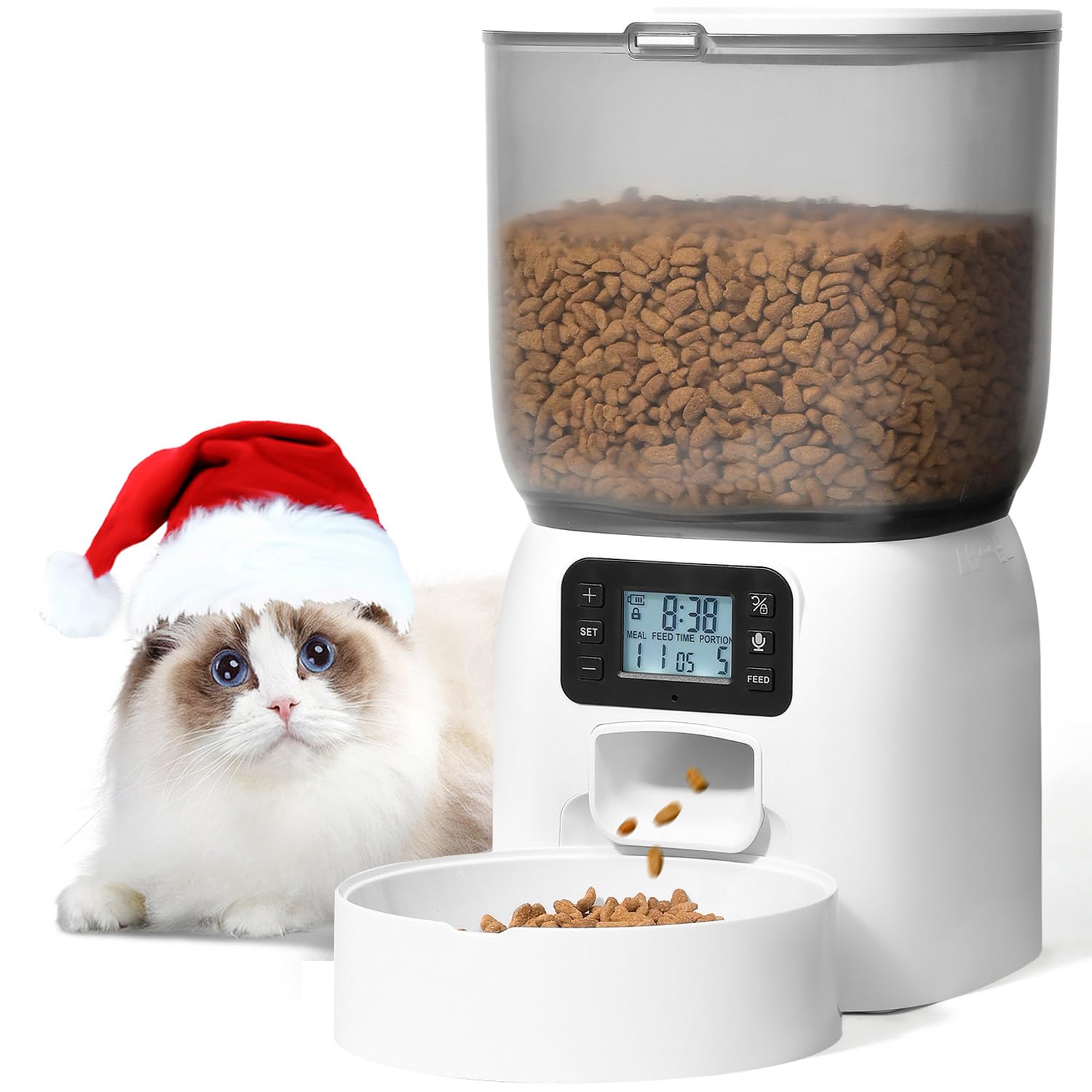

How To Choose The Best Automatic Cat Biscuit Dispenser
Start with your cat’s food, not the feeder’s feature list. A dispenser that jams on your kibble is useless no matter how many meals it can schedule. Work through these four checks in order and the shortlist narrows itself.
Match the rotor to your kibble size
The dispensing mechanism is a rotating rotor — a spinning wheel with pockets that scoop kibble and drop it into the chute. If a biscuit is bigger than the pocket or the outlet, it wedges. Some units publish a kibble range in millimeters or inches; treat that number as a hard ceiling. If your cat eats wide dental biscuits rather than small round kibble, buy a feeder rated for the bigger size rather than hoping it will cope.
Decide if you want buttons or an app
Button-and-screen feeders set everything on the unit itself with no Wi-Fi at all. They cannot drop a connection because there is no connection to drop. App feeders let you change a schedule from anywhere and see a feeding history, but they depend on your home network staying friendly. If you are often away and want to check in remotely, an app earns its keep. If you just want breakfast handled, buttons are the calmer choice.
Understand what a “portion” actually weighs
Portion is not a standard unit. One feeder’s portion may be a small handful of grams and another’s may be nearly double that. Two feeders can both say “up to 20 portions” and deliver wildly different amounts of food. Before you commit to a schedule, weigh out a portion on a kitchen scale and compare it to what your vet or your cat’s current bowl suggests.
Check the battery backup story
Most of these units run from a plug-in adapter and take batteries as a fallback for outages. The batteries are almost always sold separately, so budget for them and fit them on day one rather than discovering the gap on the night of a storm. Sealed lids and desiccant compartments matter too — dry food left open goes soft and clumps, and a soft biscuit clogs a rotor faster than a hard one.
Quick Comparison
| Model | Best For | Capacity | Meals / Portions | Power | Amazon |
|---|---|---|---|---|---|
| VOLUAS 4L Timed Dispenser★ Best Overall | Most households | 4 liters | 1–4 meals / 0–40 portions | USB adapter or 3 D-cell batteries | Amazon |
| ANDOLL HOME Timed DispenserBudget Champion | Fast eaters | 3 liters | Timed schedule | 5V DC adapter or 3 AA batteries | Amazon |
| Miaosical Clear 4.2LNo-App Simplicity | No-app simplicity | 4.2 liters | Up to 6 meals / 1–12 portions | AC adapter or 3 D-size batteries | Amazon |
| IMIPAW 3L Programmable | Frequent small feeds | 3 liters | 1–6 meals / up to 20 servings | Plug-in or 3 D-size batteries | Amazon |
| DUDUPET 5L / 21 Cup | Multi-pet homes | 5 liters | 1–6 meals / 1–20 portions | 5V DC adapter or 3 D-cell batteries | Amazon |
| PAPIFEED Wi-Fi 3L | Remote scheduling | 3 liters | 1–10 meals / max 6 portions | 5V DC adapter or 4 AA batteries | Amazon |
| oneisall Large Kibble | Big biscuits and treats | 12 cups / 3 liters | Up to 6 meals / up to 12 portions | USB power | Amazon |
| Nityers 5L Sealed | Long trips away | 5 liters | Up to 6 meals per day | Type-C adapter or 3 D-cell batteries | Amazon |
| IMIPAW Wi-Fi 3L | Phone-first feeding | 3 liters | Up to 10 meals / 1–20 servings | AC power or battery backup | Amazon |
In‑Depth Reviews
1. VOLUAS Automatic Cat Feeder, 4L Timed Dry Food Dispenser
Our pick — 4.0+★ from 12,500+ verified ratings; the strongest balance of quality and price.
The default choice for a reason: a 4-liter hopper, forty portion steps, and a voice call at mealtime.
This is the one to buy if you want the schedule handled and nothing else to think about. The hopper holds 4 liters — roughly 16.9 cups of dry food by the maker’s own measure — so you fill it and forget it for days rather than topping up nightly. You set between 1 and 4 meals a day, and each meal can run from 0 to 40 portions, which gives you fine control over exactly how much hits the bowl.
Each portion drops about 6-7 grams, roughly a tablespoon of biscuit. That fine granularity is what makes it work for weight management: you can nudge a cat’s intake down by a portion or two without changing the whole routine. The voice recording runs up to 10 seconds, and it plays at mealtime so your cat hears you call before the food lands. It is a small thing that genuinely helps a nervous cat relax around a machine.
The trade-off is portion size itself — some owners find the individual portions come out on the small side and end up stacking several per meal to hit a satisfying amount. Plan your schedule around stacking portions rather than expecting one to equal a full serving. Power runs from a 5V USB adapter, with 3 D-cell batteries (not included) carrying the schedule through an outage. As owners put it, the battery backup is the feature that makes the whole thing trustworthy.
What it handles well
- 4 liters of storage keeps a cat fed across a long weekend without a refill.
- 1–4 meals with 0–40 portion steps lets you dial in a precise daily intake.
- USB adapter plus 3 D-cell battery backup keeps the schedule running in an outage.
- Intuitive LCD screen and removable washable parts make setup and cleaning quick.
Where it asks for patience
- Individual portions are about 6-7 grams, so a full serving usually means multiple portions.
- D-cell batteries are not included, so fit them before the first storm.
Reach for this if: you want a set-and-leave schedule with granular portion steps and a backup battery already built into the design.
Look elsewhere if: you expect one push of a button to deliver a big pile of food in a single portion.
2. ANDOLL HOME Automatic Cat Feeder, Timed Cat & Dog Dry Food Dispenser
Built around one job: getting food out of the chute without you shaking the machine like a maraca.
Most feeder complaints start the same way — kibble bridges over the outlet and nothing drops. This unit attacks that head-on with a swinging device inside the hopper that keeps food moving toward the bowl, plus an 8-degree tilted bowl so your cat eats at a more natural angle instead of crouching flat. Compared with the VOLUAS, its 3-liter hopper is the smaller of the two, and its 12″L x 7″W x 13″H body stands taller and wider on the counter.
It is also the cheapest of the group, so it makes sense as your first feeder if you are not yet sure your cat will accept a machine at all. The lid has a finger-press opening device on top — a design that makes it hard for a determined paw to pry up — and a desiccant box inside (a small compartment that absorbs moisture) keeps biscuits crisp instead of chewy. Power comes from a 5V DC adapter (a standard plug-in power supply), with 3 AA batteries (not included) as the backup when the power fails.
The voice feature is unusually generous for the tier: a 10-second recording that replays three times at mealtime, which is enough to get a cat moving from another room. What wins people over most is simply that it performs reliably, and the raccoon-resistant lid gets a genuine following — one owner’s cat stopped throwing up from eating too fast once meals were split into smaller scheduled drops.
Where the value sits: a smooth-feed rotor, sealed desiccant compartment, and triple-play voice call at the lowest outlay here — a strong first-machine pick.
The honest catch: at 3 liters it needs refilling more often than the 4- and 5-liter units on this list, so it suits one cat better than a multi-pet kitchen.
Smart first buy: a single-cat household testing whether timed feeding works for them at all.
Size up instead if: you have two cats or travel often enough that refilling every few days is a chore.
3. Miaosical Automated Cat Feeder, Clear 4.2L Dry Food Dispenser
A see-through hopper that tells you at a glance whether your cat is running low.
You can see when a refill is due from across the kitchen, because the 4.2-liter container is clear — no lifting the lid on a white box to check. On capacity it beats the ANDOLL HOME’s 3 liters by a clear margin. It also takes up less floor space: the Miaosical sits in a 6.9″L x 6.9″W x 8.3″H frame, against the ANDOLL HOME’s 12″L x 7″W x 13″H body, so it tucks into a tighter corner.
Scheduling runs to 6 meals a day with 1–12 portions each, at roughly 5g±2g per portion. The ±2g tolerance is worth understanding: it means portions are approximate, not laboratory-exact, so weigh a few drops before you build a strict diet plan. The reverse-rotation mechanism — the rotor briefly spins backward to clear a stuck biscuit — is the anti-jam trick, and it handles dry food from 2–15mm. There is no app and no Wi-Fi; buttons only.
What earns this feeder its following is dependability in the plain sense: it shows up and drops food on schedule without drama. The recurring snag is programming — the menu logic trips up some buyers, so allow a calm ten minutes with the manual rather than rushing setup at 11 p.m. Parts that touch food, including the tray, lift out for washing, though the main body must stay dry to protect the electronics.
Best match for: the buyer who wants no cloud account, no pairing, and a hopper they can eyeball from the doorway.
Think twice if: you want to change meals from your phone at work — this one lives entirely on its own buttons.
4. IMIPAW PET Automatic Cat Feeder, 3L Programmable

For the cat that eats six tiny meals instead of two big ones.
Some cats do far better on frequent small feeds than on one loaded bowl, and this IMIPAW is built for that pattern. You can schedule 1–6 meals a day with up to 20 servings per meal at about 8 grams a serving, so you can spread a day’s food across six drops and stop a greedy eater from inhaling the lot in ninety seconds. It weighs 2.5 pounds, light enough to shift around the kitchen one-handed.
The dispensing hardware is a double rubber rotor with an angled outlet, which the maker rates for dry food under 0.4 inches in size. If your biscuits run bigger than that, this is not the feeder for you — check the kibble bag before ordering. A desiccant pack ships inside to hold freshness, and the food tank lifts off for washing while the base stays dry. Power is plug-in with 3 D-size batteries (not included) as backup.
Reliability is the thing buyers talk about most with this unit, and it is the right thing to care about: a feeder that misses a meal defeats the entire purchase. The honest caveat is build longevity — a share of units are reported sturdy, while others have failed inside six months, so treat the one-year horizon as the moment to check the rotor is still turning freely. The lid is the other weak point worth watching, since it can sit loosely if not clicked fully home.
Why it suits grazers
- Up to 20 servings per meal at about 8 grams each gives genuinely fine portion steps.
- Double rubber rotor with angled outlet keeps dry food under 0.4 inches moving.
- 2.5 pounds and a lift-off tank make refilling and washing straightforward.
Worth knowing before you buy
- Rated only for kibble under 0.4 inches, so large biscuits are out.
- Durability is uneven across units; check the rotor runs free well before the year mark.
- The lid needs a firm push to seat properly or it sits loose.
Pick this for: a cat on a weight-management plan who needs many small drops rather than two heavy ones.
Pass if: your biscuits are chunky dental kibble that will not clear the 0.4-inch limit.
5. DUDUPET 5L / 21 Cup Automatic Cat Feeder

Twenty-one cups of storage, so refill day is a rare event rather than a routine.
If the reason you want a feeder is a long weekend away, capacity is the number that matters. This tank holds 5 liters — the maker puts it at 1.3 gallons or 21 cups — which comfortably outlasts the 3- and 4-liter units here on a single fill. It takes dry kibble from 0.07 to 0.55 inches, and around 0.35–0.39 inch kibble a single portion lands near 0.62 oz, which is roughly 3 tablespoons of food.
Scheduling covers 1–6 meals a day with 1–20 portions each, and there is an LCD screen for setup plus a neat trick: press the plus and minus buttons together and one portion drops immediately, without breaking the schedule. Cleaning is easier than most — the food tank and bowl both detach and go in the wash. A lockable lid, sealed container and built-in desiccant box work together to keep biscuits crisp rather than soft.
Two things to plan around. First, portions confuse people — several find the portion math hard to translate into a real serving, so weigh your first few drops against a measuring cup. Second, the machine wants its rotor aligned exactly during assembly; the maker is explicit that the slots must line up and the blade rotate until it locks, otherwise food fails to dispense. Get that right once and it runs quietly for days.
What it gets right: the largest capacity here combined with dual power — a 5V DC adapter plus 3 D-cell batteries (not included) — for uninterrupted feeding through an outage.
Be ready to: spend a few minutes matching the rotor slots on assembly and weighing a portion or two, because the portion labels alone will not tell you how much your cat is getting.
Go here for: multi-pet homes and travel-heavy schedules that need days of food in the tank.
Choose simpler if: you dislike weighing portions and want a machine that assigns a straightforward serving size for you.
6. PAPIFEED Automatic Cat Feeder with App, Wi-Fi 3L

Trickles food out one portion a minute, which is the whole point for a fast eater.
The slow-feed mode is what separates this feeder from the pack. Instead of dumping a meal in one go, it releases a portion per minute, so a cat prone to gulping and immediately bringing it back up gets food at a pace it can handle. That is a different feature from portion control — you can set 1–10 meals a day with max 6 portions each, and the slow release changes how those portions arrive, not how many.
The 3-liter bucket holds plenty for a small household, and everything that touches food lifts out — the tank and a food-grade stainless steel bowl — and both are dishwasher safe. A stainless bowl is also easier to keep truly clean than plastic, which matters for a cat prone to a grubby chin. Scheduling runs through the app over 2.4GHz Wi-Fi, so you can adjust meals from anywhere.
The app is also the weak spot. Connection is the most-discussed issue with this feeder, and it is the one buyers should weigh honestly: if your router sits far from the kitchen or your network is fussy about 2.4GHz, setup can turn into a fight. Portion accuracy draws mixed reports too, with some finding it over-delivers.
Suits you if: you need remote control and your cat needs food delivered slowly rather than all at once.
Walk away if: your home Wi-Fi is unreliable — this feeder leans on it for every schedule change.
7. oneisall Automatic Cat Feeder for Large Kibble and Snacks

The rare feeder rated for big biscuits and freeze-dried treats, not just tiny round kibble.
Most of the machines on this list choke on anything chunky. This one is rated for dry cat food and freeze-dried treats up to 0.7 inches, which puts it in a class of its own for owners of cats on large-biscuit diets. Note the limit clearly: dog food is not supported, so it stays a cat feeder despite the capacity. It holds 12 cups — 3 liters — and schedules up to 6 meals a day at up to 12 portions per meal.
Setup is refreshingly plain. A single knob handles every function, replacing the cluster of buttons and tiny screens that trip people up on other units. The body is low-profile with a weighted base and anti-skid pads, so a cat that likes to shove the feeder around for entertainment will find it stays put. Multi-layer sealing and built-in desiccants keep biscuits crunchy rather than softening overnight.
It is quiet in operation, which matters more than buyers expect — a feeder that whirs loudly at 5 a.m. wakes the whole flat. What most owners notice is simply that it works: effective timed delivery and easy portion control in a compact body. On value and pet safety, opinion splits — some find it effective at preventing overeating, others question whether it is the right machine for their cat. That split is the honest caveat; for a good proportion of homes it does the job, but it is not a universal fit.
The arguments in its favor
- Rated for dry food and freeze-dried treats up to 0.7 inches — far larger than most feeders handle.
- One knob runs every setting, so no menu diving at setup.
- Weighted base and anti-skid pads resist a cat that shoves the machine.
Before you commit
- Dog food is not supported, whatever the capacity suggests.
- Value and safety reviews split, so it is a fit question rather than an obvious yes.
Right answer for: cats on large dental biscuits or freeze-dried treats that jam ordinary feeders.
Not for you if: you also want to feed a dog from the same machine.
8. Nityers Automatic Cat Feeder, 5L Anti-Clog Dispenser
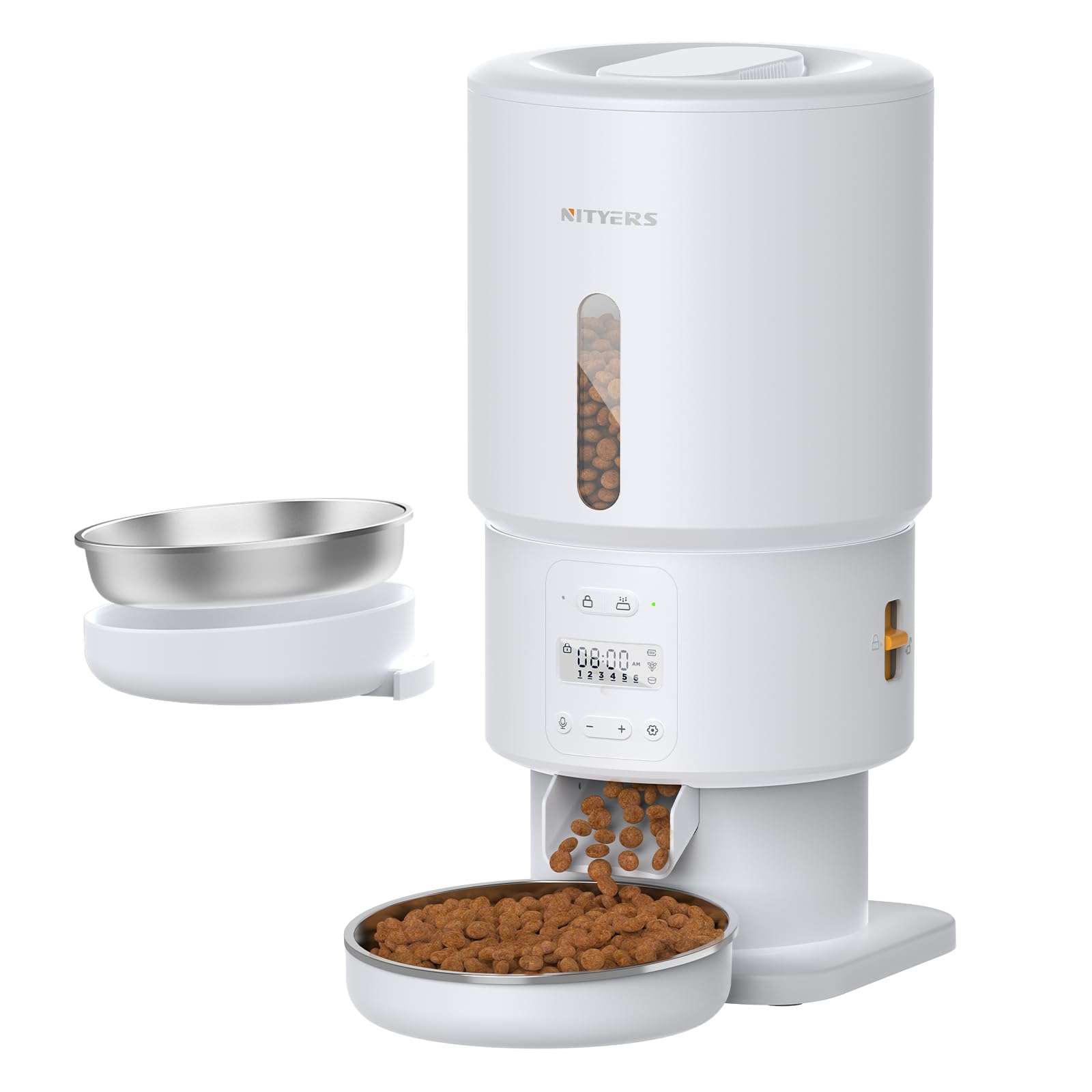
A twist-lock lid and silicone seal that treat kibble like it needs protecting from the weather.
Biscuits stay crunchy here because the lid twists and locks with a silicone seal ring, and there is a dedicated desiccant compartment (a slot for a moisture-absorbing pack). A silicone rotor with a transparent cover seals the outlet between meals, so air and ants stay out. The stainless steel bowl is curved to keep whiskers clear of the sides and lifts out for cleaning — a detail plastic bowls often miss.
Capacity is 5 liters, which the maker puts at up to 21 cups — enough to cover a good stretch for cats and a shorter run for small dogs. Portions run from 1/16 cup up to a full cup per serving, with up to 6 meals a day, so the spread of what you can dial in is wider than most. It handles kibble from 0.08 to 0.6 inches, including bigger dental pieces.
A power cut is a nuisance, not a disaster, because the backup from 3 D-cell batteries is rated at up to 180 days thanks to low power draw. Day to day it runs from a Type-C adapter (a common USB-style plug). A sliding safety lock ties the hopper (the food storage bin) to the body, and a bottom-mounted hopper means a cat shaking the machine cannot spill kibble out of the chute. One oddity: the listing mentions camera quality in its reviews, which does not match a feeder — set that aside.
what separates it: the twist-lock lid, sealed rotor cover and 180-day battery rating together make it the most outage-proof feeder in this group.
The trade-off: set-up is easy and quality is strong, but all that sealing adds parts — expect to re-seat the lid properly each refill or the twist lock will not bite.
Made for: owners who leave for a week-plus and want the food fresh at the end of it, with the schedule held through any outage.
Consider a simpler model if: you refill daily and would rather not manage a multi-part sealed lid.
9. IMIPAW Automatic Cat Feeder, 5G Wi-Fi with App Remote Control
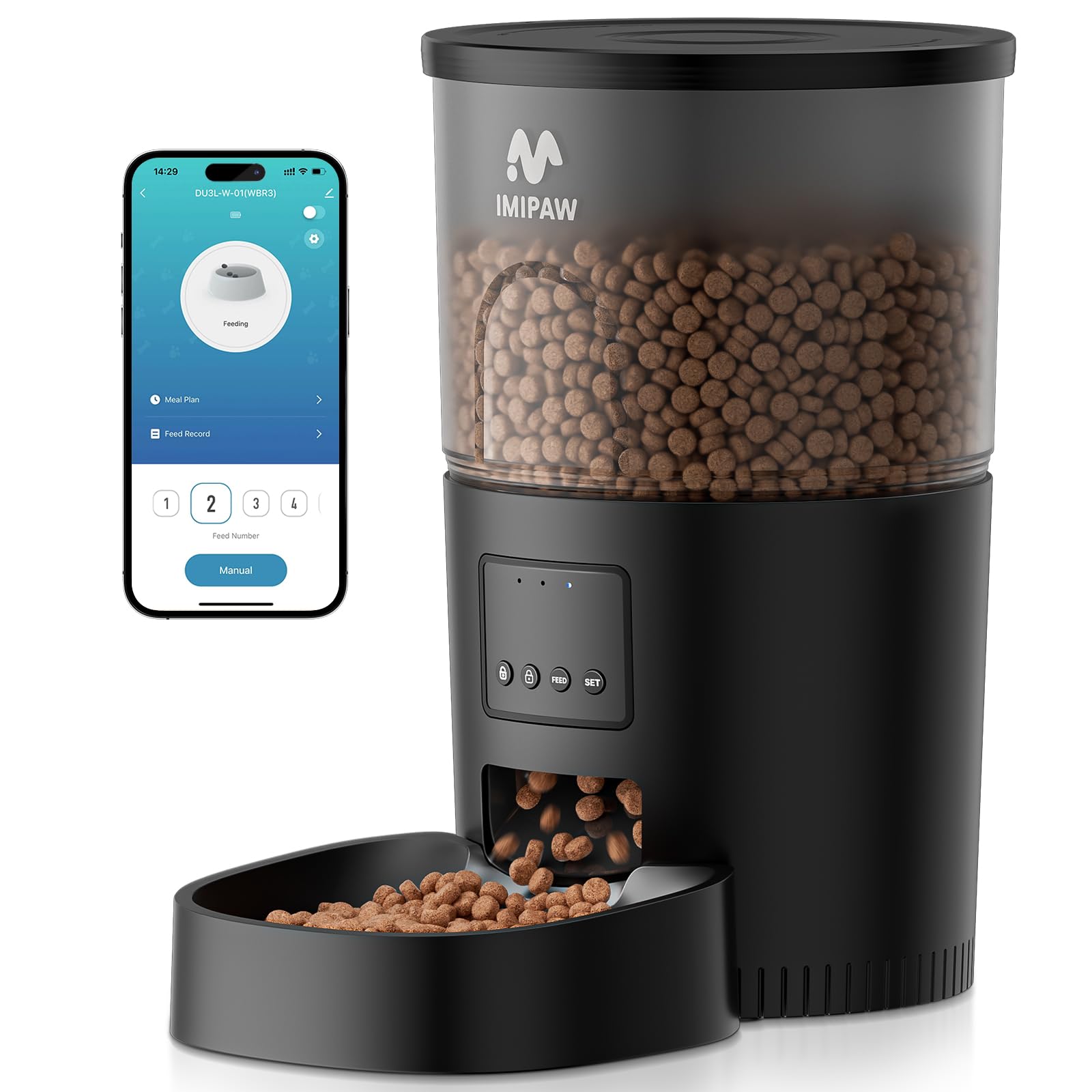
Ten meals a day, set from your phone, with a locked lid that defeats a determined cat.
If you want to run a cat’s whole day from an app, this is the front-runner. It pairs with the PetTech app and schedules up to 10 meals a day with 1–20 servings each — the most meal slots on this list. You can view the feeding history to confirm your cat actually ate, and multiple family members can control it from their own phones, so a partner or housesitter can step in.
Inside, a dual rotor structure with a six-compartment wheel keeps portions even, and the tilt of the internal chute helps food slide rather than sit. The lid has a safety lock that clamps the storage bin shut, so a cat that knocks things over cannot get the top off — a specific fix for the classic problem. A desiccant bag handles freshness, and you can still feed manually without disturbing the schedule.
Quality and reliability are the two things buyers bring up most, and both are positive — the machine feels solid and does not miss its slot. Connectivity splits opinion, which is the honest caveat for any Wi-Fi feeder: when it pairs cleanly it is excellent, and when it does not, setup gets tiresome. Check that your router lets a 2.4GHz-style device connect before you count on remote control being there when you need it on a trip.
Choose this when: you travel and want a full feeding log you can check from the road.
skip it if: you are happy walking over and pressing a button — the app adds complexity you would rather not have.
Understanding the Specs
Capacity (liters and cups)
Capacity tells you how long you can leave food in the tank before refilling. It is quoted in liters, or in cups, or both. On this list the range runs from 3 liters up to 5 liters, and the biggest tank is rated around 21 cups. Bigger is not automatically better — more food sitting in a hopper for weeks can go stale if the seal is poor. Match capacity to how often you refill: a single cat at home daily can live with 3 liters, while a multi-cat kitchen or a frequent traveler wants 4 to 5. Always cross-check the kibble size rating separately, because a huge tank that jams on your biscuits is no help.
Portions per meal and portion weight
Two feeders can both offer “up to 20 portions” and deliver completely different amounts of food. The number of portions is granularity; the weight per portion is what actually matters. Some list it in grams, some in cups, some in ounces — and they are not the same measure. The way to compare honestly is to weigh a portion on a kitchen scale before you build a diet plan. If the portion feels too small, stack two or three per meal rather than forcing a schedule that leaves your cat hungry. Precision matters most for weight-management cats.
Dual power supply and battery backup
Your cat still gets fed during a storm, because dual power runs the feeder on a plug-in adapter for everyday use and switches to batteries when the power fails. That is the most reassuring feature on a timed feeder, since a schedule that dies mid-storm is worse than a manual bowl. Battery figures vary by unit and by battery size — some take AA cells, others bigger D cells — and almost none ship with batteries. Fit them on day one. A longer-rated battery life on a sealed, low-draw feeder is the confidence you are paying for.
Anti-clog dispensing and kibble size
The rotor is the spinning wheel inside the hopper that scoops food into the outlet. Clogs happen when a biscuit is too big for the gap, or when soft, clumped food bridges over the hole. Makers fight this two ways: a swinging arm or reverse rotation that clears a jam, and a published kibble size range. Respect that range — typically a small-kibble feeder will refuse chunky dental biscuits. If your cat eats big pieces or freeze-dried treats, look specifically for a feeder rated for the larger size rather than assuming it will cope.
FAQ
Will an automatic feeder work with big dental biscuits?
What happens to the schedule if the power goes out?
Can my cat open the lid and steal food between meals?
Is a Wi-Fi app feeder better than a button-and-screen feeder?
How do I stop my cat eating too fast and being sick?
Do these feeders work with wet food?
How much food is in one portion?
Do I need a feeder that holds enough for a week away?
How difficult is programming an automatic feeder?
Final Thoughts: The Verdict
Most households should buy the VOLUAS 4L Timed Dispenser, because it gets the boring essentials right: 4 liters of storage, 1–4 meals with 0–40 portion steps, a 10-second voice call, and battery backup that keeps the schedule alive in an outage. Nothing here is a weak pick — the right choice depends on your cat’s kibble and your schedule. If your biscuits are chunky, the oneisall is rated for food up to 0.7 inches and stands apart for that alone. If you leave for long stretches, the Nityers 5L seals the food and holds its schedule on a battery backup rated at up to 180 days. And if you want to run everything from your phone, the IMIPAW Wi-Fi feeder gives you up to 10 meals a day and a feeding history to check. The plainest advice is this: weigh one portion before you trust any schedule, fit the backup batteries on day one, and confirm your kibble size against the feeder’s stated limit before it ships.
How We Picked
We do not accept paid placement. Every pick is matched to a real buyer and a real use-case; we do not hands-on test units.
Sources & Methodology
Specifications: manufacturer listings and product documentation. Review insights: verified customer reviews, as of November 2026. Pricing: not shown on this page (it changes often); check the current price via the retailer link.
As an Amazon Associate, Gadgets Feed earns from qualifying purchases. This does not affect which products we feature.