
Our readers keep the lights on and my morning glass full of iced black tea. As an Amazon Associate, I earn from qualifying purchases.
Specs are compiled from manufacturer listings and verified buyer reviews and can change over time — please confirm the key details on the product page before buying.
You want a 255/70R22.5 tire that carries your load without wandering at highway speed. Two things decide that: how much weight the sidewall is built to carry, and whether the tread stays calm once you are loaded up. Every pick below carries a 140 load index (a code for how much weight each tire can support). So the real difference depends on the load range letter, the ply count, and how the tread behaves when the trailer is full.
I’m Min — the founder and writer behind Gadgets Feed. This guide is built by comparing the manufacturers’ published specifications and the patterns across verified customer reviews, so you get each pick’s real strengths and trade-offs instead of marketing spin.
Commercial rubber is not cheap, so match the load range and tread to the axle and the route. Below are four options sorted by what they are actually built for. Here is what to know before you commit to 255/70R22.5 tires.
Our Picks at a Glance

How To Choose The Best 255/70R22.5 Tires
Every tire in this size is physically interchangeable on the rim, so a 255/70R22.5 from four different brands will all bolt on. The choice is about what happens after that: how much weight the carcass tolerates, how the grooves shed water, and how the sidewall behaves at highway speed with a full trailer.
Start with the load index and load range
The load index is a number code that maps to a maximum weight each tire can carry. A 140 load index is the common heavy-duty figure in this size, so most buyers start there. The load range is the letter that tells you the ply rating and sidewall strength — a G range is a lower ply count than an H range. Match the letter to the axle and the trailer weight your work actually involves, and go up rather than down if you are close.
Look at how the tread moves water
Wet-road grip in a commercial tire comes from grooves and sipes (the thin cuts across the tread blocks). Wide straight grooves push standing water out from under the contact patch. Zig-zag or wavy grooves interrupt the flow and add bite. Stone ejectors are small raised platforms in the groove bottoms that stop gravel drilling into the belts — worth knowing if you run unpaved shoulders.
Decide where the tire actually works
A highway tire and a mixed-service tire are built for different days. If your routes are mostly paved interstate, a highway all-season tread runs quieter and wears more evenly. If your truck regularly pulls onto gravel lots or construction sites, stone protection and curb guards on the sidewall matter more than a smooth ride. Match the tread to the route before you pick.
Quick Comparison
| Model | Best For | Load Range / Ply | Load Index | Item Weight | Amazon |
|---|---|---|---|---|---|
| Ironman GEN2 I-19A★ Best Overall | Highway hauling with stone protection | H / 16 Ply | 140 | 102 pounds | Amazon |
| Hercules Strong Guard HRA | All-position semi-truck use | H / 16 Ply | 140 | 102 pounds | Amazon |
| Sumitomo ST719 | Load capacity on a lighter carcass | H / 16 Ply | 140 | 58.7 pounds | Amazon |
| Michelin XZE | Long-haul highway confidence | G | — | 58.7 pounds | Amazon |
In‑Depth Reviews
1. Ironman GEN2 I-19A 255/70R22.5 140/137M H Commercial Tire
A highway tire that guards its own sidewall when the route turns rough.
This tire earns its spot on the H load range (a heavier-duty rating than a G) built on a 16-ply radial carcass (16 layers of cord inside the tire). That extra ply count is what you want when the trailer is full and the route is mostly paved. It carries a 140 load index, so the weight rating sits in the heavy-duty band that semi and box-truck work expects. For a highway all-season tire, that is the right foundation.
The tread is where Ironman earns its keep. Enhanced siping channels water out of the footprint (the flat area where rubber meets road), which helps wet braking and resists the uneven wear that eats into tire life. Stone ejector platforms sit in the groove bottoms to keep gravel from drilling into the belts — a small thing until you are pulling off a gravel shoulder twice a day. Curb guards along the sidewall add a layer of protection against kerbs and loading-dock scuffs.
What owners respond to is the combination of a solid highway ride and that sidewall protection. It is rated 4.5+ stars across 10+ ratings, a small sample but a strong one. The honest trade-off is weight: at 102 pounds this is a heavy tire to mount, and the same figure appears on the Hercules below. Compared with the Sumitomo ST719 at 58.7 pounds, you are giving up easy handling for a beefier build.
Where it earns the top spot
- H load range with a 16-ply radial carcass for loaded highway work
- Stone ejectors protect the belts on gravel shoulders
- Curb guards shield the sidewall from dock and kerb impacts
- Enhanced siping helps wet braking and fights irregular wear
What you should know first
- At 102 pounds it is a two-person job to mount
- Small review sample, so long-term wear is not yet widely reported
Steer here: highway and regional haulers who want an H-rated 16-ply tire with real sidewall and stone protection.
Keep looking: if you swap tires yourself — the 102-pound weight is a genuine wrestling match.
2. Hercules Strong Guard HRA 255/70R22.5 140/137L G Commercial Tire
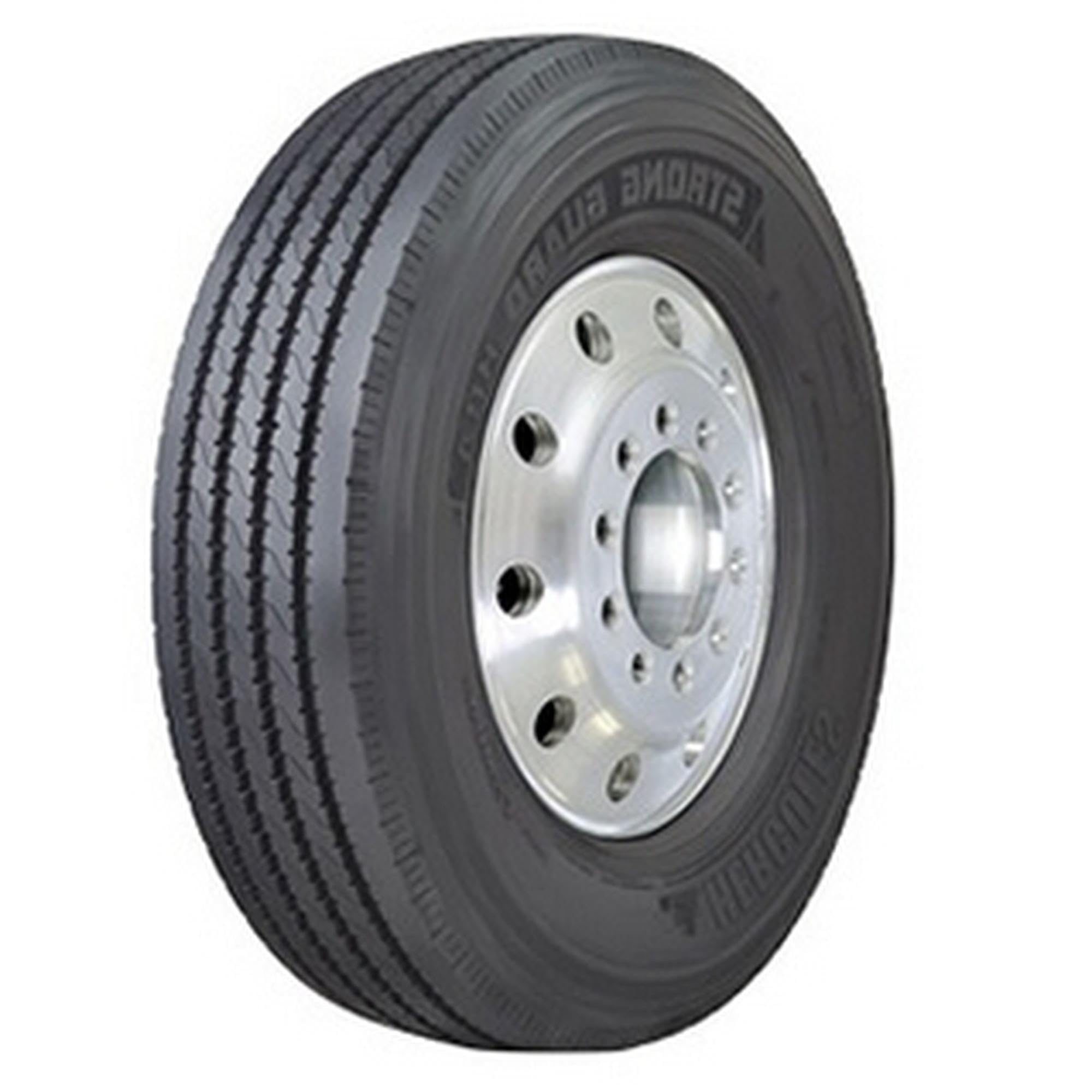
Built to run on any axle of a semi, with water channels wide enough to matter.
Hercules designs this one for all positions on a semi-truck, which is the practical draw if you rotate tires between steer and drive axles instead of buying two different treads. A wide solid shoulder increases lateral stability and promotes even wear — sideways steadiness under a tall load, and a tread that does not cup on one edge. Four wide grooves funnel water out of the footprint to reduce hydroplaning risk, and multi-point edged grooves with wavy lateral sipes add bite on wet pavement.
The G load range is the catch worth understanding. That is a lower ply rating than the H-rated Ironman above, so if your work sits near the top of the weight envelope, the H tire is the safer call. Where the Hercules holds its own is the tread design: zig-zag grooves for handling and that four-groove water evacuation layout are genuinely useful on wet interstate.
Owner feedback is where you need to read carefully. The recurring theme in the reviews is a split verdict — plenty of drivers get on well with the tire, while others describe a rough ride and shaking at speed. Ride quality comes up repeatedly as a point of contention rather than a settled strength. Treat a careful balancing and alignment job as part of the purchase, and go in expecting to sort out any vibration early rather than living with it. Its 4.0+ star rating reflects that mixed picture honestly.
Positioning play: the all-position design is the real reason to pick this over the Ironman — one tread that works on steer and drive axles instead of two.
Ride caveat: the mixed reports on smoothness mean you should budget for a proper road-force balance on day one, not after the shake shows up.
Worth it when: you want one all-position tire across the truck and your loads sit comfortably inside a G rating.
Think twice: if you are running near maximum weight or you are sensitive to highway vibration.
3. Sumitomo ST719 255/70R22.5 H/16PLY

The lightweight of the group, and still rated to carry a serious load.
Two figures tell this tire’s story. It carries a 5510-pound load capacity, the same headline number as the Michelin XZE, so the weight rating is not where you compromise. And at 58.7 pounds it is far easier to handle than the 102-pound Ironman and Hercules options — a real difference on the day you are rolling a spare into place by hand.
The H/16PLY build and 140 load index put it in heavy-duty territory, and a maximum pressure of 120 psi gives you headroom when you are tuning inflation for load. It is built in Japan, mounts as a vehicle-specific fit, and comes as tire only. The 39-inch diameter makes it a touch taller than the Michelin’s 36.7-inch figure, which is worth confirming against your wheel well and axle spacing before you order.
Here is the honest part: it comes with no manufacturer warranty listed, so you are buying on build quality and trust in the brand rather than a written guarantee. It also carries a 4.5+ star rating across a very small sample of 7 ratings — encouraging, but not enough volume to call it proven over a hundred thousand miles. If you want the lightest handling of the bunch without giving up load capacity, this is your tire.
Why it stands out
- 5510-pound load capacity in a 58.7-pound tire
- H load range with a 16-ply radial construction
- 120 psi maximum pressure for load-tuned inflation
Before you order
- No manufacturer warranty is listed
- Only a handful of ratings, so long-term wear is unproven
Reach for this: if you want maximum load capacity without wrestling a 100-pound tire onto the hub.
Look elsewhere: if a written warranty matters to you — there isn’t one listed here.
4. Michelin XZE Commercial Truck Tire – 255/70-22.5
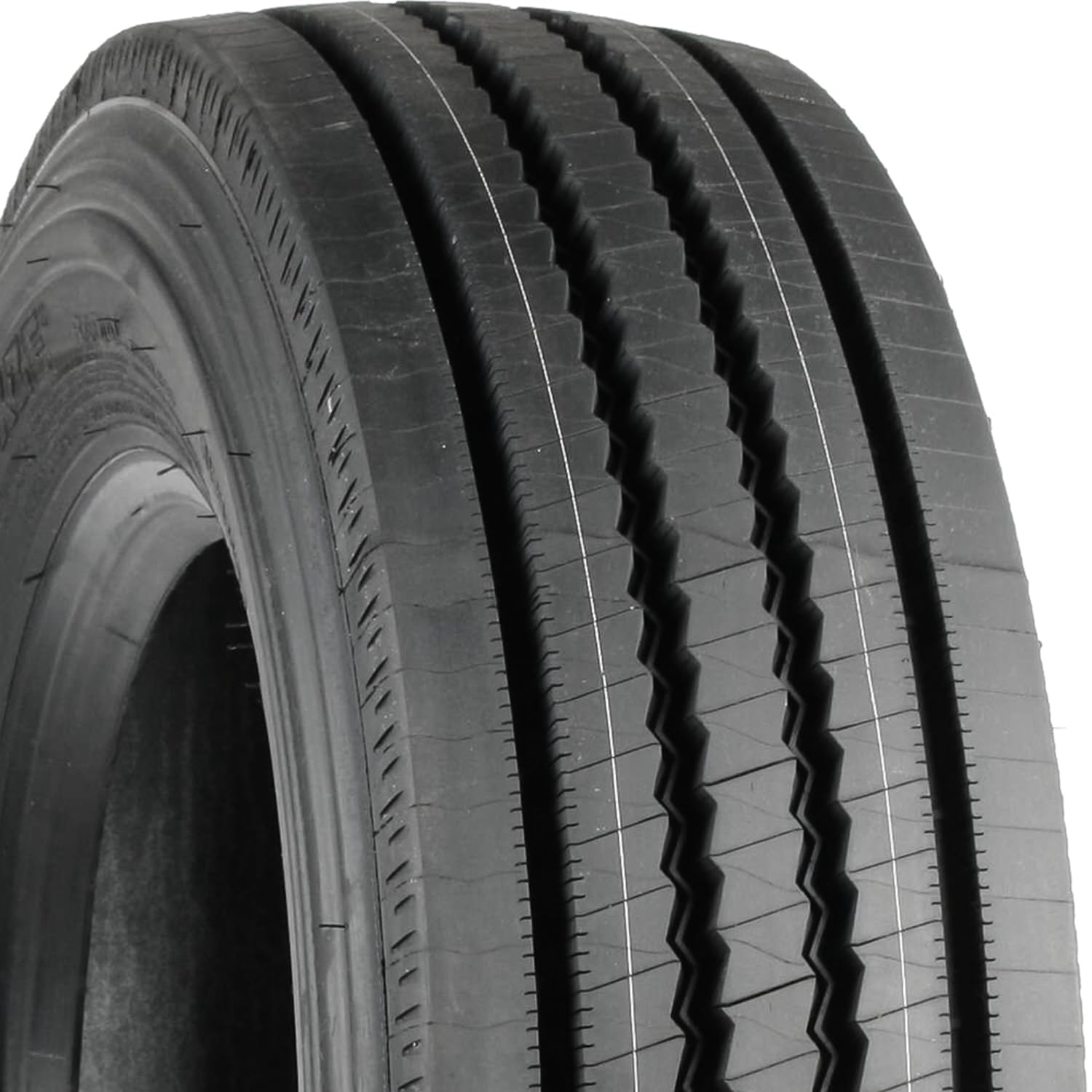
The brand name you pay a premium for, in a G-rated highway casing.
Michelin’s XZE brings the same 5510-pound load capacity as the Sumitomo ST719, in a 58.7-pound tire built in the United States. The 36.7-inch diameter makes it the more compact of the two, sitting smaller than the Sumitomo’s 39-inch figure — worth measuring if clearance is tight on your truck. It is a G load range, so the ply rating sits one step below the H-rated Ironman and Sumitomo options.
Where the Michelin makes its case is the brand’s highway reputation and a vehicle-specific fit that lines up cleanly with the axle it was designed for. If a fleet manager has run Michelin highway tires before and trusts the wear pattern, that continuity has real value over a tire bought on spec sheet alone. The 4.0+ star rating across 6 ratings is a small but positive signal.
The trade-off is straightforward: you are paying a premium-tier amount for a G-rated tire with no manufacturer warranty listed. That is a genuine gap compared with the H-rated, 16-ply build of the Ironman and the Sumitomo — if maximum ply and sidewall strength are your priority, the Michelin falls short of both on paper. Where it earns its place is for the buyer who values the Michelin name and highway confidence over the highest ply count.
The value question: you are paying for the Michelin badge and a US-built casing, not for the highest load range in this group — the G rating is the honest limitation.
Fit note: the 36.7-inch diameter is the smallest here, so it suits tighter wheel wells better than the taller Sumitomo.
Pick it if: you want Michelin highway tires with a US-built casing and a compact 36.7-inch diameter.
skip it if: you need an H-rated 16-ply carcass — this one is G-rated with no warranty listed.
Understanding the Specs
Load Index and Load Range
The load index is a number code for how much weight a single tire can support — a 140 index sits in the heavy-duty band for commercial trucks and semi-trailers. The load range is the letter that tells you the ply rating, so G is a lower ply count than H. Go up a letter rather than down if your trailer weight sits near the ceiling. In this group, the Ironman, Hercules, and Sumitomo all carry a 140 load index, while the Michelin lists a G load range without a stated load index.
Ply Rating and Sidewall Strength
The ply rating in a commercial tire is a measure of how many layers of reinforcing cord the carcass is built with — a 16-ply build is a heavier construction than a lower count. More plies generally mean a stiffer, stronger sidewall that holds up better under load. That stiffness is also why heavy tires ride firmer and weigh more. Weigh that against the routes you actually drive: a stiff sidewall is an asset on loaded highway work and a liability if you want a soft ride.
Tread Grooves and Sipes
Grooves are the deep channels running around the tire that push standing water out from under the tread. Sipes are the thin cuts across the tread blocks that open up on wet pavement to add edge grip. A four-groove layout, like the Hercules, evacuates water from the contact patch efficiently. Enhanced siping, like the Ironman’s, helps braking and resists irregular wear. Both matter more the wetter your climate.
Stone Ejectors and Curb Guards
Stone ejectors are raised platforms in the groove bottoms that stop gravel from drilling into the tire’s belts — useful on unpaved shoulders and construction lots. Curb guards are extra rubber along the sidewall that absorbs impacts from kerbs and loading docks. Neither shows up on a spec sheet as a number, but both extend tire life on routes that mix pavement with rough ground.
FAQ
Will a 255/70R22.5 tire fit my truck’s rim?
What does the 140 load index actually mean?
Is an H load range better than a G load range?
Do stone ejectors and curb guards really matter on a highway tire?
How long does a 255/70R22.5 commercial tire last?
Which tire is best for a semi-truck that runs all positions?
Why do some commercial tires weigh so much more than others?
Should I run a G-rated or H-rated tire on my trailer?
Do these tires come with a warranty?
Final Thoughts: The Verdict
For most drivers shopping 255/70r22.5 tires, the Ironman GEN2 I-19A is the smart pick — an H-rated 16-ply carcass with stone ejectors and curb guards for real highway durability. If you rotate across steer and drive axles, the Hercules Strong Guard HRA gives you an all-position tread with four wide water grooves. Want maximum load capacity in a lighter tire? The Sumitomo ST719 carries 5510 pounds at 58.7 pounds. And if the Michelin name and a compact 36.7-inch diameter matter more than ply count, the Michelin XZE is your premium choice — just go in knowing it is G-rated.
How We Picked
We do not accept paid placement. Every pick is matched to a real buyer and a real use-case; we do not hands-on test units.
Sources & Methodology
Specifications: manufacturer listings and product documentation. Review insights: verified customer reviews, as of November 2026. Pricing: not shown on this page (it changes often); check the current price via the retailer link.
As an Amazon Associate, Gadgets Feed earns from qualifying purchases. This does not affect which products we feature.