
Our readers keep the lights on and my morning glass full of iced black tea. As an Amazon Associate, I earn from qualifying purchases.
Specs are compiled from manufacturer listings and verified buyer reviews and can change over time — please confirm the key details on the product page before buying.
You want a wool pad that stays put under the bars, spreads the rider’s weight across the back, and doesn’t bunch up halfway through a trail ride. The short answer: buy for thickness and fit first, brand second. A 30×30 pad that matches your saddle’s skirt length and your horse’s back shape will do more for you than any badge on the spine. Everything below is sized to that exact 30-inch-by-30-inch footprint, so you can compare like for like.
I’m Min — the founder and writer behind Gadgets Feed. This guide is built by comparing the manufacturers’ published specifications and the patterns across verified customer reviews, so you get each pick’s real strengths and trade-offs instead of marketing spin.
The pads here split into three honest groups: wool-blend workhorses you can use daily, premium all-wool pads for sensitive or high-withered backs, and saddle-fit problem solvers. The real job is matching one of them to your horse’s withers and your saddle’s bar spread — which is exactly what the reviews below unpack in plain language for a 30×30 wool saddle pad.
Our Picks at a Glance


How To Choose The Best 30×30 Wool Saddle Pad
Start with your saddle, not the pad. A 30×30 pad is a square footprint — 30 inches long and 30 inches wide — so it suits most stock and gaited builds under a variety of western saddle types. If your skirt hangs past 30 inches, the pad’s corners will show and the leather will sit on wool rather than on the pad’s center. Measure the skirt first, then choose thickness, then choose wool content.
Thickness: the 3/4-inch versus 1-inch decision
A 3/4-inch pad gives you a padded base without lifting you high off the horse, so your leg stays close to the barrel. A 1-inch pad adds more cushioning and fills a saddle that sits a touch low. Thicker is not automatically better — it changes how your saddle sits and how much cinch you need. Pick thickness to suit your saddle fit, riding style and climate, and remember a 1-inch pad under a well-fitting saddle can make the fit tighter than it was.
Why contoured beats flat for most horses
A contoured pad is cut to follow the curve of the back, with a split panel or shaped spine that lets the pad move with the horse instead of bunching under the saddle bars. Flat square pads are simpler and cheaper, but they rely on the saddle to hold them in place. If saddle roll has ever annoyed you on a downhill stretch, contoured construction is the feature to hunt for. Precise cutouts under the wear leathers are the giveaway that a pad was actually shaped rather than just trimmed to size.
Wool felt versus wool blend
Wool felt is dense and pressed, so it absorbs shock and spreads pressure across the back without packing down into a thin sheet. Wool also wicks sweat and helps regulate temperature, which matters on long trail days. A wool blend mixes in other fibers, usually to keep the cost down while holding most of the cushioning. Neither is a trick — just know that a 100% wool pad and a wool-blend pad at a similar thickness will feel different under the hand and behave differently after a wet ride.
Quick Comparison
| Model | Best For | Dimensions | Thickness | Material | Amazon |
|---|---|---|---|---|---|
| Weaver Equine Wool Blend Felt Western Saddle Pad★ Best Overall | Daily training and trail work | 30″ x 30″ | 3/4″ | Wool felt blend | Amazon |
| Weaver Equine 33″ x 32″ Contoured Wool Blend Felt PadMost Versatile | Bigger-built horses needing a roomier cut | 33″ x 32″ | 1″ | Wool | Amazon |
| HILASON Western Wool Felt Horse Saddle Pad | Split-panel flatness on long rides | 30″ x 30″ | 1″ | Wool felt with leather border | Amazon |
| The Montana Extra Fine Wool Saddle Pad | All-wool authenticity, made in the USA | 30″ x 16″ package footprint | 3/4″ or 1″ | 100% extra-fine wool | Amazon |
| Jeffers WoolLuxe 100% Wool Felt Saddle Pad | Color-matched tack setups | 30″ x 30″ | 3/4″ or 1″ | 100% pressed wool | Amazon |
| OrthoRide Premium All Wool Build Up Saddle Pad | High withers and young horses | 30″ x 30″ | — | All wool | Amazon |
| 5 Star Equine Contoured All Around Saddle Pad | Barrel racing and roping | 30″ x 30″ | 3/4″ | 100% virgin wool | Amazon |
In‑Depth Reviews
1. Weaver Equine Wool Blend Felt Western Saddle Pad
Our pick — 4.5+★ from 400+ verified ratings; the strongest balance of quality and price.
A 3/4-inch wool-blend pad that cushions, wicks sweat, resists roll and holds its shape season after season.
Here is the pad most riders should start with. It’s a 30-inch by 30-inch square cut, built from a wool felt blend at 3/4-inch thick, so it adds cushioning without lifting you high off the horse. The wool blend is there for a reason: it absorbs shock, spreads the rider’s weight, and wicks sweat so the back stays cooler than it would under a synthetic pad. Reinforced at the spine with top-grain wear leathers, the edges that take the worst of the rubbing are the edges that were built to survive it.
What wins people over is the craftsmanship — quality is far and away the thing this pad gets praised for, more than any other single trait, and it shows in how the pad holds its shape. Fit is the runner-up strength, and that matters because a pad that shapes to the back is a pad that stops rolling. The contoured build is designed to reduce saddle roll and lock in place, with cutouts under the wear leathers so you keep feel through the seat. For daily training and trail work, that combination is what you actually want.
At 5.2 pounds it’s a genuinely manageable pad to sling over the saddle horn one-handed. Compare that with the HILASON below at 8 pounds and you have a noticeable weight difference on and off the horse every single day. The one thing worth knowing: this is a wool blend, not 100% wool, so if your horse runs hot and sweaty under a full wool pad, the Montana further down is the more natural-fiber route.
What riders keep coming back for
- 3/4-inch wool felt blend cushions without changing your saddle fit much
- Contoured shape with a reinforced spine helps cut saddle roll
- Wool blend wicks sweat and helps regulate temperature on long days
- 5.2 pounds — noticeably lighter to handle than an 8-pound felt pad
Where it draws the line
- It’s a blend, not 100% wool — the all-wool route is a step up in fiber purity
- The square 30×30 cut is the standard footprint, so very long skirts will hang past it
Buy this one: if you ride several times a week and want a pad that handles cushioning, sweat and stability without fuss.
Step up instead: if your horse has high withers or a saddle that already rubs, the OrthoRide’s build-up design targets that problem directly.
2. Weaver Equine 33″ x 32″ Contoured Wool Blend Felt Saddle Pad
A full inch of wool felt in a 33″ x 32″ cut, for horses that need more cushioning under the bars.
Most pads in this size bracket give you 3/4-inch of felt. This one goes thicker — a full 1 inch — and stretches the footprint to 33 inches by 32 inches. That extra inch of padding is the difference you feel when a saddle sits a touch low or a horse has less muscle over the loin. The wool blend underneath does the same job as its stablemate: shock absorption, moisture wicking, and even weight distribution across the back.
Owners describe it as well-made, and the quality is exactly what shows up first in the feedback — it’s the trait this pad is praised for above everything else, with fit and value close behind. It conforms to the back and withers rather than sitting like a plank, which is what you want from a contoured pad. The reinforced spine and top-grain wear leathers protect the parts that wear first. Functionality gets consistent approval too, which for a saddle pad means one thing: it does its job under the saddle without you thinking about it.
Now the honest part. The thickness gets mixed reactions — some buyers find it exactly as plump as described, others say it isn’t quite what they pictured. Sizing is the other catch: this is a 33×32 pad, not the 30×30 standard, so it’s bigger than the headline size of this guide. If your saddle skirt is built for a true 30×30, this one will sit slightly proud at the edges.
Worth noting: The 1-inch felt is the thickest in this comparison, so it suits horses that benefit from more built-in cushioning under a western saddle.
Check before buying: The 33 x 32 inch footprint runs larger than the rest of this list — measure your skirt before you commit.
Reach for this if: your horse needs more cushioning and your saddle has room for a slightly larger pad.
Look elsewhere if: you need a strict 30×30 to keep corners tucked under the skirt.
3. HILASON Western Wool Felt Horse Saddle Pad 30X30 in
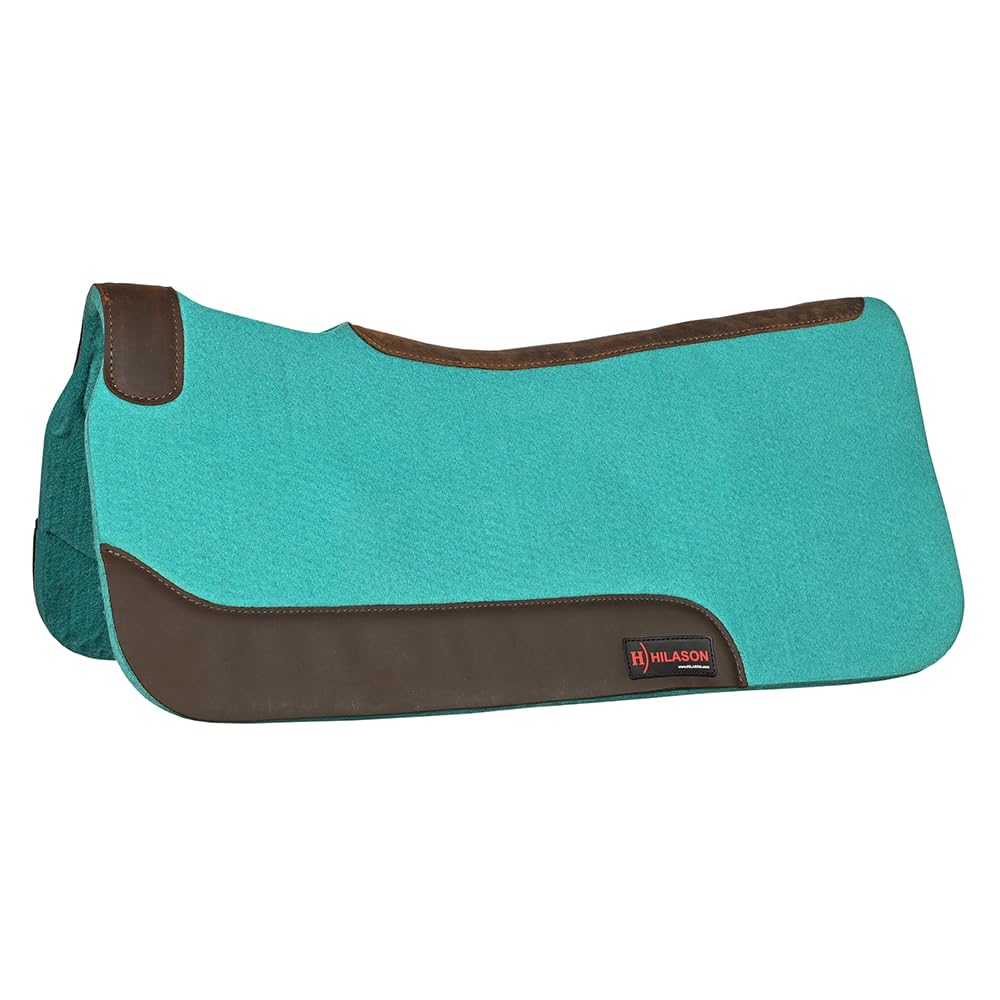
A split-panel 1-inch felt pad that flexes with a gaited back instead of bunching under the bars.
Split-panel construction is the design choice that makes this pad interesting. Instead of one rigid slab, the panel is divided so it can flex with the horse’s back rather than bunching under the bars. That keeps the pad flat through long rides, which is precisely where flat pads start to bunch. The 30-inch by 30-inch footprint at 1 inch thick is a standard western size that fits most stock and gaited builds.
The body is high-grade wool felt with a distressed top-grain leather border — the leather reinforcing the edges that rub hardest every single day. Wool felt here does double duty: it absorbs shock and spreads pressure across the back, and it wicks sweat to help regulate temperature on trail riding, ranch work and roping practice. Cleanup is the pleasant surprise for a felt pad: rinse with mild soap and water, and the dense felt air dries quickly and resists odor buildup.
Here is the weight catch. This pad runs 8 pounds, and the Weaver Best Overall above runs 5.2 pounds, so you’re adding real heft when you lift it onto the saddle. That heft comes from the dense 1-inch felt and the leather edging, but it’s a hands-on difference you’ll notice daily. It also carries a 30-day warranty against manufacturer defects, which is worth knowing since this is a newer model on the market.
The standout: A contoured split panel plus a leather-edged border is a combination aimed squarely at riders who hate a pad that wrinkles under the bars mid-ride.
The trade-off: At 8 pounds it’s the heaviest pad in the comparison — noticeably more to lift than the 5.2-pound Weaver.
Ideal for: gaited and stock horses worked hard across trails, ranch chores and roping practice.
Think twice if: you want a featherweight pad to throw on and off all day.
4. The Montana 100% Extra Fine Wool Made in the USA Saddle Pad

100% extra-fine wool, made in the USA, with a choice of 3/4-inch or 1-inch thickness at checkout.
If wool purity is the whole point for you, this is the pad that takes it seriously. It’s 100% extra-fine wool, crafted in the USA, and it’s designed to conform precisely to the shape of your horse’s back rather than working against the musculature. Extra-fine wool is the softer grade, which is why this pad feels different in the hand from a coarser felt. The fiber also naturally regulates temperature and wicks sweat during hard work.
You get to choose your thickness here — 3/4-inch or 1-inch — depending on saddle fit, riding style, climate and how much cushioning you prefer. The 1-inch version also includes premium leather wear leathers that develop a patina over time. Fit and value come through strongest in the feedback: it conforms to the back, and owners consider it worth the price. Appearance and comfort round out the approval.
The honest caveats are worth hearing. Stability gets mixed reactions — for many it stays in place, but side-to-side movement does come up. Material quality is also a mixed point, which is a surprise on a 100% wool pad and may come down to how each buyer reads the wool by hand. Neither issue is a reason to write it off; both are reasons to check your saddle’s fit before you blame the pad.
Why it earns its place
- 100% extra-fine wool, made in the USA
- Choose 3/4-inch or 1-inch thickness to match your saddle and climate
- Conforms to the horse’s back shape rather than fighting it
- The 1-inch version includes premium leather wear leathers that age with use
Before you commit
- Stability feedback is mixed — some riders report side-to-side movement
- Material quality reads differently from buyer to buyer on the same wool pad
The right fit: riders who want genuine all-wool construction and a thickness choice as part of the purchase.
Be realistic about: a pad whose stability depends on the saddle sitting well underneath it.
5. Jeffers WoolLuxe 100% Wool Felt Saddle Pad

All-wool cushioning in eight colors, for the rider who wants the pad to match the tack.
Coordinating tack is part of the fun, and this pad takes it further than anything else on the list. You can order it in pink, turquoise, blue, cream, red, purple, emerald green or black, so it can line up with your saddle, bridle, breast collar, blanket and leg wraps. Underneath the color, it’s 100% pressed wool with a compression-resistant build designed to hold its shape ride after ride. The 30-inch by 30-inch footprint is the standard square cut you’re shopping for.
The wool is naturally breathable and moisture wicking, which helps air circulate and move heat away during longer rides. Choose between 3/4-inch and 1-inch thickness to suit your saddle fit and riding style. It’s pitched at trail riding, arena work, daily training, barrel racing, roping and general western riding, so it isn’t a single-discipline pad. The cushioned design sits between saddle and back to help distribute pressure and support back comfort.
This is a newer listing, so the long-term wear picture is thinner than the pads with years of feedback behind them. That’s the honest trade-off, not a knock — the construction described (pressed wool, compression resistance) is the right foundation for a pad that keeps its loft. The color range is also the reason many buyers land here in the first place.
Where it shines: 100% pressed wool in eight color options is a combination no other pad here matches.
Honest limit: A newer model, so there’s less long-term ownership history to lean on than the established picks.
Choose it for: a color-coordinated all-wool pad for mixed western work.
Skip it for: a proven track record — the older pads here have more years behind them.
6. OrthoRide Premium All Wool Build Up Saddle Pad

Built to rescue the horse whose withers take the hit before the saddle does.
This is the pad you buy when the problem isn’t the saddle as a whole — it’s the wither area. The build-up design is aimed at high-withered horses where the saddle rubs on the wither, and at young horses that haven’t developed their shoulder muscles yet. It’s all wool, made in the USA, and it’s sized in a 30-inch by 30-inch cut. A contoured shape lets it bend over the back instead of sitting on it, and that’s the detail owners keep praising.
A PORON-RXD foam layer under the bars is designed to absorb up to 90% of shock. That’s the kind of cushioning that matters under the horn in fast work — team roping, barrel racing, and anything where the stops are sudden. The stability feedback is positive, and fit comes through clearly, particularly for off-track Thoroughbreds under western saddles. Quality is the most-praised trait overall, and there’s a straight comparison to classic Equine Biofit pads in the feedback that runs in this pad’s favor.
The realistic expectation is that a build-up pad changes how your saddle sits — that’s the point of it — so you’ll likely re-check your cinch and girth after you switch. It also isn’t trying to be a color-matched fashion pad; it’s a problem-solver for a specific back shape. If your horse is wide, flat-withered and already comfortable under a standard pad, this is more pad than you need.
What it solves: Wither rubbing on high-withered horses and under-muscled young horses, with a build-up cut and all-wool body.
What it costs you: A build-up pad changes saddle fit by design, so plan to re-check your girth after switching.
Ideal for: high-withered or young horses where the saddle rubs on the wither.
Unnecessary if: your horse already fits its saddle cleanly and doesn’t need extra build-up.
7. 5 Star Equine 3/4″ Thick Western Contoured All Around Saddle Pad

The contoured square skirt that promises less cinching and less slipping on speed runs.
Less cinching required and reduced slippage — that’s the pitch here, and it’s the one most riders care about once the basics are covered. The pad is a 3/4-inch thick contoured build in 100% virgin wool, sized 30 inches wide by 30 inches long in a square skirt. Contoured construction is made to fit both you and your horse comfortably, which in practice means the pad follows the back instead of bridging over it. Virgin wool is the fresh-fiber version, used for cushioning that doesn’t break down quickly.
The discipline list is broad: barrel racing, trail riding and roping are all named. That fits a pad with a 3/4-inch profile — enough cushioning for fast work without pushing you out of the saddle. The square skirt keeps the pad’s coverage even under the bars, and the contouring is what produces the reduced slippage the maker points to. If you’ve ever had to over-cinch a stiff pad to keep it from creeping, that’s the annoyance this design is aimed at.
It’s the priciest pad on this list, and it’s a newer listing with a smaller ownership base, so its wear record is less documented than the Weaver or the Montana. That’s a fair trade for 100% virgin wool in a purpose-built contoured cut. If you’re chasing barrels or roping regularly and you want the pad to stay put without cranking the cinch, this is the use case it was cut for.
What it’s built to do
- 100% virgin wool in a contoured 30″ x 30″ square skirt
- Reduced slippage means you don’t have to over-cinch
- 3/4-inch thickness keeps you close to the barrel for fast work
- Pitched at barrel racing, trail riding and roping
What to weigh up
- The highest cost in this comparison
- A smaller ownership base, so less long-term wear reporting
Built for: barrel racers and ropers who want a contoured all-wool pad that resists slipping.
Consider cheaper first: if you mostly trail ride at a walk, the Weaver above covers the same basics.
Understanding the Specs
Thickness (3/4-inch vs 1-inch)
Thickness is how much padding sits between the saddle bars and the horse’s back. A 3/4-inch pad keeps you close to the horse and changes saddle fit very little. A 1-inch pad adds cushioning and fills a saddle that sits low, but it can make a snug saddle tighter. Choose thickness to match your saddle’s current fit, your riding style and your climate rather than assuming thicker is always better.
Wool Felt and Wool Blend
Wool felt is dense, pressed wool that absorbs shock, spreads pressure and wicks sweat. A wool blend mixes in other fibers, usually to control cost, while keeping most of the cushioning and moisture behavior. 100% wool pads tend to feel different in the hand and behave differently after a wet ride, so the fiber content is worth checking before you buy.
Contoured Construction
A contoured pad is shaped to follow the curve of the horse’s back, often with a split panel or a shaped spine. The shaping lets the pad move with the horse rather than bunch under the bars, and it’s the main reason a contoured pad resists saddle roll on downhill stretches. Precise cutouts under the wear leathers are the sign a pad was genuinely shaped rather than simply trimmed.
The 30×30 Footprint
30 inches by 30 inches is a square footprint that suits most stock and gaited builds under western saddles. The length needs to line up with your saddle’s skirt — if the skirt runs longer, the pad’s corners will show at the edges. Measure your skirt before you buy, because a pad that’s even one size off changes how the whole rig looks and sits.
FAQ
Will a 30×30 pad fit under my western saddle?
Is 1-inch thick better than 3/4-inch for a saddle pad?
Does a wool saddle pad actually wick sweat?
How do I stop my saddle pad from rolling or slipping?
Can a build-up pad help a high-withered horse with saddle rubbing?
How much does a wool felt saddle pad weigh and does it matter?
How do I clean and care for a wool felt saddle pad?
Is 100% wool worth it over a wool blend pad?
Will a thicker pad change how my saddle fits?
What is the difference between a contoured pad and a flat square pad?
Final Thoughts: The Verdict
If you only buy one 30×30 wool saddle pad this season, start with the Weaver Equine Wool Blend Felt Western Saddle Pad. It earns that spot by balancing three things: a 3/4-inch wool felt blend (real wool mixed with synthetic felt), a contoured spine (a curved channel along the top) that cuts saddle roll, and a 5.2-pound weight you can sling on one-handed. It also holds 4.5+ stars across 400+ ratings. Want genuine all-wool construction with a thickness choice? Reach for the Montana. And if your horse has high withers (a tall ridge at the shoulder) or is young and the saddle rubs, the OrthoRide targets that exact problem. Its PORON-RXD foam layer under the bars is designed to absorb up to 90% of shock, per the maker.
How We Picked
We do not accept paid placement. Every pick is matched to a real buyer and a real use-case; we do not hands-on test units.
Sources & Methodology
Specifications: manufacturer listings and product documentation. Review insights: verified customer reviews, as of November 2026. Pricing: not shown on this page (it changes often); check the current price via the retailer link.
As an Amazon Associate, Gadgets Feed earns from qualifying purchases. This does not affect which products we feature.