
Our readers keep the lights on and my morning glass full of iced black tea. As an Amazon Associate, I earn from qualifying purchases.
Specs are compiled from manufacturer listings and verified buyer reviews and can change over time — please confirm the key details on the product page before buying.
You want a converter that turns wall power into steady 12-volt DC without overheating, beeping, or dying on you in a month — and the honest answer is that peak ratings lie. Most cheap listings quote a peak amp number you should never run continuously, so the real figure to shop is the recommended continuous output. Match that to what your gear actually draws, add a safety margin for motors, and you are done. The seven picks below cover everything from a 10-amp LED-strip adapter to a 1500-watt monster for a car audio build.
I’m Min — the founder and writer behind Gadgets Feed. This guide is built by comparing the manufacturers’ published specifications and the patterns across verified customer reviews, so you get each pick’s real strengths and trade-offs instead of marketing spin.
Some AC/DC DC converters run quietly for years on a radio bench. Others look great on paper but run hot and loud. The difference usually depends on cooling, wiring quality, and whether the maker quotes peak amps (the highest burst a unit can handle) or continuous amps (the steady load it can carry all day). This AC/DC DC Converter breakdown sorts out those three things for you.
Our Picks at a Glance


How To Choose The Best AC/DC DC Converter
The most common mistake in this category is buying on peak amps. A converter listed as a 50A unit often carries a recommended continuous limit of 40A, and running it flat out invites early failure. Size to the continuous amps your gear draws, then add headroom above it.
Peak Versus Continuous Amps
A peak rating is a short burst the unit can survive, not a working load. Look for the maker’s own recommended equipment ceiling — many high-output supplies suggest staying at or below a lower continuous figure. For anything with a motor inside, like a pump or air compressor, the start-up draw spikes well above the running amp number, so a supply with headroom is the safe pick.
Matching The Connector To Your Gear
Screw terminals take bare wire and hold it tight, which suits permanent bench setups and radio gear. A cigarette-lighter socket is the easy route for car accessories like a tire inflator or cooler. Barrel tips in the 5.5mm size fit LED strips and small electronics. Buy the converter whose connector matches your device, or budget for an adapter.
Quick Comparison
| Model | Best For | Output | Max Power | Connector | Amazon |
|---|---|---|---|---|---|
| BTECH RPS-30M★ Best Overall | Radio bench supply | 13.8V | 30 A | Screw terminals + cigarette plug | Amazon |
| SHNITPWR 12V 10A 120WBest Value | LED strips and small devices | 12V | 120W | 5.5×2.5mm barrel tip | Amazon |
| GESD 30A 360W | Workshop and DIY projects | 12V | 360W | Screw terminals | Amazon |
| ALITOVE 15A 180W Pro Max | Car accessories indoors | 12V | 180W | Cigarette lighter socket | Amazon |
| Yaheeda 12V 600W 50A | RV and pump duty | 12V | 600W | Clips and copper wire | Amazon |
| IMAYCC 12V 50A 600W | High-draw permanent install | 12V | 600W | Wire, terminal block | Amazon |
| NUOWEIDE 125A 1500W | Car audio and heavy loads | 12V | 1500W | Nickel-plated copper terminals | Amazon |
In‑Depth Reviews
1. BTECH RPS-30M 30 Amp Compact Regulated Bench Power Supply
Our pick — 4.5+★ from 300+ verified ratings; the strongest balance of quality and price.
The bench supply that radio operators stop thinking about because it just keeps working.
Here is a converter built around one job: feeding 13.8-volt gear from a 110-volt wall outlet at up to 30 amps. That 13.8V output is the standard voltage ham, GMRS, and CB radios expect, so you are not stretching a 12V supply to cover a radio that wants slightly more. The unit runs two outlets, with screw terminals for bare wire and a cigarette plug for accessories — meaning you can wire a radio permanently and still plug in a handheld or a light.
What wins people over is how it behaves under load. It stays cool and quiet instead of humming at you through a long operating session. Forums and review pages fill up with the same story in different words — this thing happily runs a 100-watt HF radio without complaint. The trade-off is physical: at 2.3 pounds and 7.5 inches wide, this is a desk-top box, not something you toss in a go-bag.
Where it falls short of the cheaper high-watt units is raw output. The Yaheeda and IMAYCC both quote 600W peaks against this unit’s 30-amp ceiling, so if you are powering a winch or a large amplifier, go bigger. For everything a radio bench needs, this holds the higher score at 4.5+ stars while the budget pick carries more reviews — 700+ against 300+ here — but this one is the calmer, cooler operator.
Why Radio Users Keep It
- 13.8V output matches ham, GMRS, and CB radio expectations directly
- Screw terminals plus a cigarette plug on one unit — two ways to connect
- Stays cool and quiet during long operating sessions
- Overheat, short circuit, and amperage surge protection built in
Where It Caps Out
- 30-amp ceiling is well below the 50A and 100A supplies on this list
- At 2.3 pounds it is a desktop unit, not portable
Reach for this if: you run radios, scanners, or any fixed 13.8V device at a desk and want one supply that simply works.
Look elsewhere if: your load climbs past 30 amps — the bigger supplies below cover that ground.
2. SHNITPWR 12V 10A 120W DC Power Supply Adapter
A brick-sized adapter that quietly powers an entire LED strip run or a 3D printer.
You get a steady 12V DC at a max 10 amps and 120 watts — enough to run small DC gear like 5050 and 3528 LED strips, security cameras, a 3D printer, or a router. The adapter accepts 100 to 240 volts at the wall, so it works on a North American outlet or overseas without a step-down transformer (a device that lowers voltage). The output tip is 5.5mm by 2.5mm, and it also fits 5.5mm by 2.1mm sockets, so most barrel-input devices plug straight in.
The smart part is the honesty in the listing. It self-limits: if your device draws 7A, it delivers 7A. If it pulls more than 10A, the supply caps at 10A and will not survive long, which is why the maker flatly says never overload. You also get automatic overload, over-voltage, thermal, and short-circuit cutoffs, plus a 2.3m (7.6ft) cable that reaches across a workbench.
One thing to be clear about: this is an adapter, not a charger. It cannot charge anything with a battery inside, laptops included, and the maker warns it may damage them. Use it to run a wall-powered device under 10A, and you have a reliable low-noise supply for small jobs.
The overload rule: aim to power devices at or below 80% of the 120W maximum and this adapter runs cool and stable for years.
Not a charger: anything with an internal battery needs a charger, not this — that is the one boundary the maker draws hard.
Suits you when: an LED strip, camera, or 3D printer needs a simple plug-in 12V feed at under 10A.
Pass it by for: charging a laptop or any battery-powered device — this is a power supply, not a charger.
3. GESD 30A 360W Universal Regulated Switching Power Supply

A metal-cased workhorse that gives you a dial on the side and 30 amps to play with.
This is the supply for the person with a bench, a soldering iron, and a to-do list of LED runs and CCTV cameras. It puts out a regulated 12V DC up to 30 amps (360W max), and a ±10% adjustable voltage range lets you trim the output to suit finicky gear. The side-mounted switch selects 110V/115V or 220V/230V input before you power on, and it arrives preset to 110V for U.S. use.
Owners lean on the metal heat-dissipation enclosure to keep things cool through a long session, and the EMI/RFI filter keeps the output low-noise for sensitive electronics. On pure functionality, this unit earns a lot of goodwill — it powers a 400-watt amp without fussing, and the workshop crowd treats it as a dependable bench staple. The 4.5+ star standing across 700+ ratings backs that reputation.
Here is the honest catch: a few units die young — under two months, or within minutes in a rare case — and buyer opinions split between “great deal” and “you get what you pay for.” Nothing on this list is defect-free, so test this one thoroughly when it arrives. Do that, and you have a versatile 360W bench supply (a power unit for testing gear on a workbench).
What it does best: adjustable output, dual input voltage, and a metal case for long workshop sessions on LED, CCTV, and 3D-printer work.
Test it on arrival: reliability is the recurring note across owners, so run it under load within the return window.
Solid choice for: a project bench that wants a dialable 30-amp supply for electronics and lighting.
Think twice if: you need guaranteed multi-year service with no inspection — test first, every time.
4. ALITOVE 110V to 12V 15A 180W Pro Max Car Cigarette Lighter Adapter
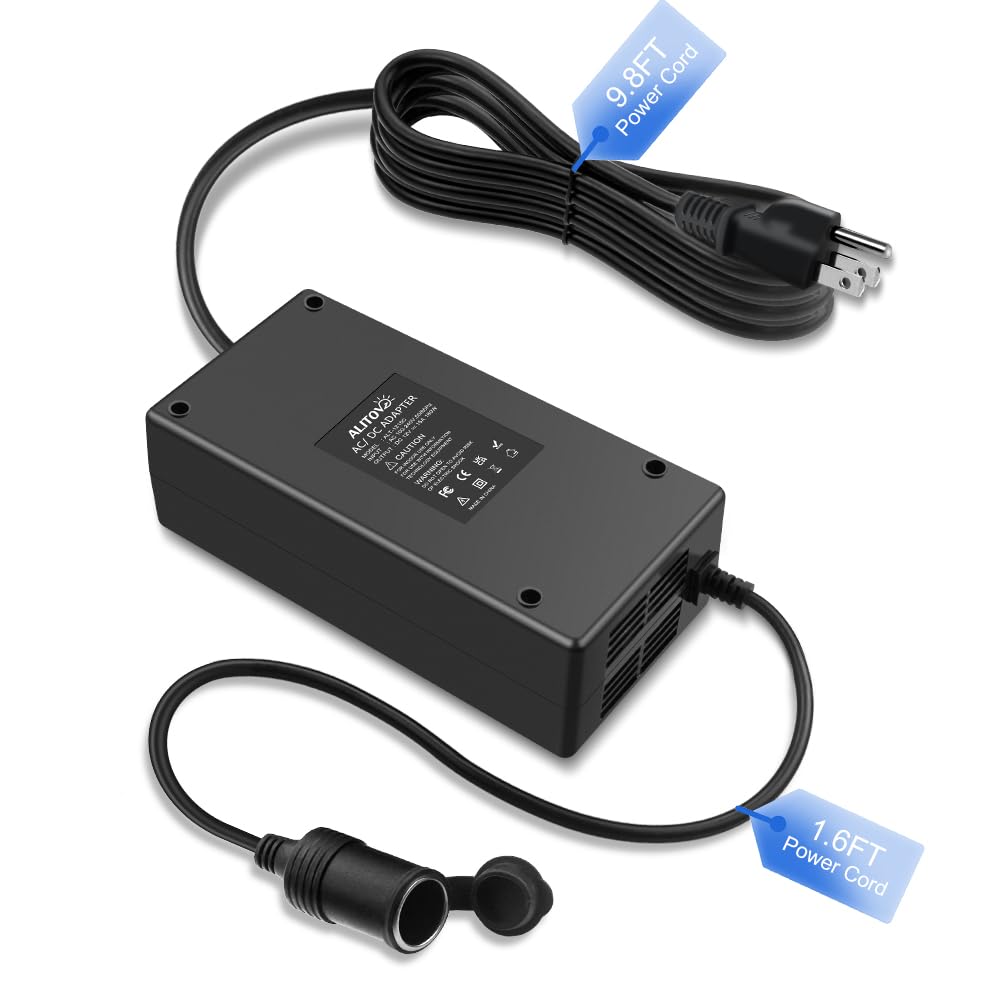
Turns any wall outlet into a car socket so your 12V accessories work indoors.
Plug this into the wall, and you have a cigarette lighter socket in your garage, workshop, or driveway. It takes 100-240V at the inlet and delivers 12V DC at a max 15 amps and 180 watts — enough for a tire inflator, a vacuum cleaner, a cooler, an air pump, or a dash cam. The 11.5-foot power cord is the star for anyone who has ever dragged a car vacuum to the limit of its reach.
Safety is handled with layers: over-voltage, over-current, over-temperature, and short-circuit protection, plus a smart silent cooling fan that only spins up once current hits 6 amps or more. That keeps it quiet during light loads and cool under heavier ones. Buyers report it happily running a ham radio and handling up to 15A of current, and off-road truck owners single out its usefulness for outdoor gear.
The boundary you need to respect is the wattage ceiling. Push past 220W for long and the unit beeps and stops; past 660W, the built-in fuse blows and it is done for good. That makes it a fit for accessories under 180W, not for a compressor that spikes high on start-up.
What Earns Its Place
- Real car socket output indoors for inflators, coolers, and dash cams
- 11.5ft cord reaches across a garage without an extension
- Fan only spins up at 6A and up, so light loads stay silent
- Four-way protection with a fuse as a hard backstop
The Limits To Respect
- Over 220W it beeps and cuts out; over 660W the fuse blows permanently
- Cigarette socket only, so barrel-input or bare-wire gear needs an adapter
Buy it for: running car accessories from a wall outlet at home or in the shop.
Skip it for: gear that spikes past 180W on start-up — that needs a bigger supply with real headroom.
5. Yaheeda New Version 110V AC to 12V DC Converter 600W 50A

One box that runs a diesel heater, a pump, and a stereo without swapping supplies.
If your 12V loads are a mixed bag, this is the one-key answer. It accepts 110V or 220V input and delivers up to a 50A peak with a 600W peak ceiling, though the maker recommends keeping equipment below 40A / 480W for daily running. For a motor, the supply wants more than twice the motor’s power in peak rating to cover start-up surge. Two power connection methods plus included clamps and copper wire make it plug-and-play for RV and garage duty.
What reviews hone in on is versatility — diesel heaters in garages and RVs are the perennial use case, and it handles them cleanly. The imported aluminum alloy shell, built-in EMI filter, and 100% full-load burn-in testing are real construction points, and a red on/off button makes shutting down safer than yanking a cord. A 4.5+ star standing across 750+ ratings reflects that broad satisfaction.
The one thing to watch is longevity. Some units run for years; a rare few quit inside a month, and the dual-input design means a wrong gear setting can cause trouble. Check the voltage selector before your first power-up. Used correctly, this is the most flexible high-watt supply here.
The flexibility play: 50A peak and 600W with two connection methods makes it a jack-of-all-trades for RV, pump, and stereo duty.
The check to make: confirm the input gear position and test under load early — a small share of units do not last.
Best fit for: RV and garage setups juggling several 12V devices of different sizes.
Hold off on: running it at full 50A continuous — stay under the recommended 40A / 480W and it behaves.
6. IMAYCC AC to DC Converter 110V to 12V 50A 600W

Built like a small tower with a dust net, so it survives long industrial-style shifts.
This one is aimed at the permanent install — the kind of unit screwed down and forgotten about. It supports AC 110V-120V and 220V-240V input and adjusts automatically, then delivers 12V DC from 1A up to a 50A max at 600W. Copper nickel-plated terminals carry the current cleanly, and dual connection methods let you clamp or wire it as your setup demands.
The cooling design is the real differentiator. An aluminum alloy shell with heat-dissipation holes, a built-in fan, and a dust-proof net work together to keep the circuit board from cooking — dust is what kills these supplies over time, and the net blocks it. Anti-skid pads underneath add stability. The UL, CE, and RoHS-certified cord and plug round out the safety story alongside overload, overvoltage, leakage, and short-circuit protection.
It cost the same makers nothing to be quiet about the trade-off: the mixed notes on fan noise mean it is not silent, and the 12.5-inch width makes it a fixed-position box. Set it where the fan hum will not bother you, and this becomes a dependable base for car electronics or a small 12V station.
Reason to Trust It
- Dust-proof net plus fan fights the long-term killer for these supplies
- Auto-switching 110V/220V input with a 50A / 600W ceiling
- UL, CE, and RoHS certified cord and plug
- Copper nickel-plated terminals for clean current transfer
Adjust To This
- Fan noise is not silent — plan for a fixed spot away from a quiet room
- At 12.5 inches wide it wants real bench space
Pick it when: you are mounting a supply for the long haul and dust or heat is a concern.
Not for you if: the unit must sit in a bedroom or quiet studio — the fan is audible.
7. NUOWEIDE 110V AC to 12V DC Converter 125A 1500W
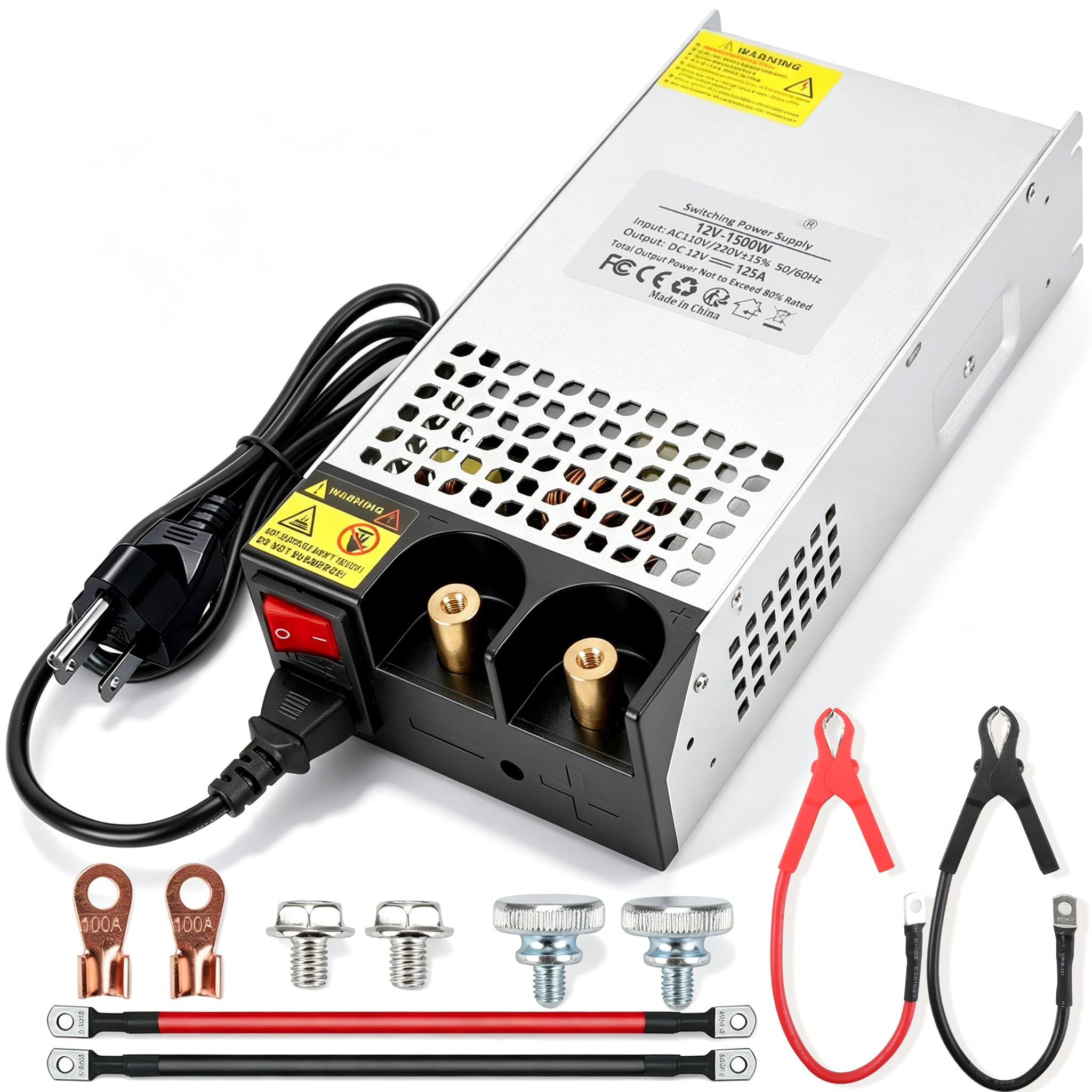
The big-league unit for car audio fans who refuse to let their amps sag.
This is the supply for the person who owns a subwoofer box and a pair of tweeters and wants them loud without the voltage dipping. Peak figures run to 125A current (the listing heading says 150A) and 1500W, with the maker recommending loads below 100A / 1200W. That is headroom you will not find on the smaller supplies here, and it is enough to drive serious gear.
Frosted aluminum and alloy housing with four anti-slip bracket pads means it bolts down flat and disperses heat, and the built-in fan plus porous metal casing keep it cool through heavy use. Two nickel-plated copper terminals with clips handle the wiring. Owners mention it handles 80 amps with no hiccups, and one build ran a 1200-watt amp with subs, tweeters, and a 6-inch sub with no voltage sag even at 100 amps.
The trade-off is size and weight — a 8.6 by 4.4 by 2-inch chunk of metal that wants its own shelf. For a bass-heavy audio install, though, few things match a 1500W peak that stays steady under the deepest notes.
Where it shines: a 1500W peak that keeps car audio loud without the voltage sag that flattens weaker supplies.
Plan for the bulk: it is a big metal box with a fan — give it a shelf and airflow, not a tight corner.
Choose it if: your car audio system, pump, or 12V project draws near 100A and needs a supply that will not sag.
Overkill for: LED strips and small cameras — the lower-watt picks cover those with less bulk.
Understanding the Specs
Amperage (A) and Watts (W)
Amperage is how much current the supply can push; watts are amps multiplied by voltage. A 12V supply rated at 10A gives you 120W of usable power. Buy a supply whose continuous amps exceed your device’s peak draw, not just match it.
Peak Versus Continuous
Peak current is a short surge, not a working load. A supply quoting a 50A peak often recommends equipment below 40A continuous. For motors, choose a supply whose peak rating is well above the motor’s running draw to cover the start-up spike.
Input Voltage Switching
Many larger supplies accept both 110V and 220V input through a selector switch. Set it to match your wall outlet before powering on. The U.S. standard is 110V; a few units ship preset to that layout.
Connectors and Terminals
Screw terminals and bare wire suit permanent installs. A cigarette-lighter socket fits car accessories. Barrel tips in 5.5mm size fit LED strips and small electronics. Match the connector type to your device before buying.
FAQ
Can a converter power a device that draws more than its rated amps?
Do I need to flip a voltage switch before plugging in?
Will a 12V supply charge a laptop or phone?
How much headroom should I leave for a motor like a pump or compressor?
Can I use a cigarette-lighter converter for a tire inflator?
Why do some supplies beep or shut off under load?
Do these supplies get hot while running?
Can I run several 12V devices off one supply at once?
What is the difference between 12V and 13.8V output?
Will a 600W supply run a small 3D printer?
Final Thoughts: The Verdict
For most people, the right AC/DC DC Converter is the BTECH RPS-30M. It puts out the 13.8V that radio and fixed 12V gear wants, stays cool and quiet through long sessions, and gives you both screw terminals and a cigarette plug in one unit. If your load is a car accessory under 180W, the ALITOVE turns a wall outlet into a car socket with an 11.5ft cord. And for a bass-heavy car audio build that needs a 1500W peak with no voltage sag (a dip in output when demand spikes), reach for the NUOWEIDE.
How We Picked
We do not accept paid placement. Every pick is matched to a real buyer and a real use-case; we do not hands-on test units.
Sources & Methodology
Specifications: manufacturer listings and product documentation. Review insights: verified customer reviews, as of November 2026. Pricing: not shown on this page (it changes often); check the current price via the retailer link.
As an Amazon Associate, Gadgets Feed earns from qualifying purchases. This does not affect which products we feature.