
Our readers keep the lights on and my morning glass full of iced black tea. As an Amazon Associate, I earn from qualifying purchases.
Specs are compiled from manufacturer listings and verified buyer reviews and can change over time — please confirm the key details on the product page before buying.
You want to clip a charger on and forget it until spring, without frying the battery. That is what an automatic battery charger does: it reads your battery’s voltage on its own and steps the charge down as the battery fills, so months of connection stay safe. For most people with a car, motorcycle, or mower parked through winter, the Battery Tender Plus is the one to start with. If you need one unit to handle both lead-acid and LiFePO4 (a lithium iron phosphate battery), the NEXPEAK NC202 and the NOCO GENIUS5 are the serious contenders. Every pick below is judged on what the charger actually does, not on its marketing labels.
I’m Min — the founder and writer behind Gadgets Feed. This guide is built by comparing the manufacturers’ published specifications and the patterns across verified customer reviews, so you get each pick’s real strengths and trade-offs instead of marketing spin.
You will see amp ratings, stage counts, and battery chemistries explained in plain words throughout. The goal is to land you on the right automatic battery charger on the first try, without paying for amp headroom you will never use.
Our Picks at a Glance


How To Choose The Best Automatic Battery Charger
The word “automatic” gets stretched hard in this category. What it should mean is a charger that senses your battery’s voltage by itself, picks the charge stage, and drops into float mode once the battery is full, so an overnight connection does not turn into an overcharge. Any unit that makes you set the amperage by hand is a different animal. Every pick here runs that sensing cycle on its own.
Match the amp rating to the battery size you actually own
A 1.25 amp charger is a maintainer first — it is built to hold a healthy battery at full charge, not to revive a flat one quickly. A 10 amp charger pushes harder and suits a car, truck, or deep-cycle bank. If you only ever top off a motorcycle battery through winter, the low-amp route is easier on the battery. If you face a dead car battery every spring, a 10 or 12 amp unit will refill it far faster.
Check the battery chemistry list before you buy
Lead-acid comes in several flavours — flooded, AGM, GEL, and deep-cycle — and most automatic chargers handle all of them. Lithium LiFePO4 is a different charging profile, and a lead-acid-only charger should not be pointed at it. If you run a lithium pack in a boat or a camper, buy a unit whose listing names LiFePO4 outright.
Decide if you want desulfation and repair modes
Sulfation is the crust that builds on battery plates when a battery sits discharged, and it is the usual reason a stored battery will not hold charge. A desulfator sends pulses meant to break that layer down over several hours. It cannot wake a battery that reads zero volts, so treat it as recovery for a neglected battery, not a resurrection trick.
Cable length and connectors decide how easy it is to live with
Alligator clips are fine for a quick hook-up. Ring terminals bolt onto the battery posts permanently, so you can plug in through a quick-disconnect harness without opening the bonnet each time. If the charger will live in a garage and reach a car parked nose-in, a long AC cord and long DC cable matter more than any spec on the box.
Quick Comparison
| Model | Best For | Charge Rate | Battery Types | Charging Stages | Amazon |
|---|---|---|---|---|---|
| Battery Tender Plus 12V 1.25 AMP★ Best Overall | Long-term winter maintenance | 1.25 A | 12V lead-acid | 4-step | Amazon |
| Mroinge 5A 6V/12VBudget All-Rounder | Mixed fleet on a budget | 5 A | 6V/12V lead-acid, 12V LiFePO4 | 7-stage | Amazon |
| NEXPEAK NC201 10AFastest Recovery | Fast recovery on 12V and 24V | 12V 10 A / 24V 5 A | 12V/24V lead-acid | 7-stage | Amazon |
| NEXPEAK NC202 10-Amp | Mixed lead-acid and LiFePO4 fleets | 12V 10 A / 24V 5 A | 12V/24V lead-acid and LiFePO4 | 8-stage | Amazon |
| CRAFTSMAN 12A CMXCESM258 | Garage all-rounder with test mode | 12 A | 6V/12V lead-acid, 12V LiFePO4 | Multi-stage | Amazon |
| NOCO GENIUS5 5A | Dead-battery recovery and permanent mounting | 5 A | 6V/12V lead-acid, LiFePO4 | Multi-stage with repair | Amazon |
| ECO-WORTHY 12V 10A | Quick top-ups on 12V packs | 10 A | 12V lead-acid and LiFePO4 | Fully automatic | Amazon |
| Clore Automotive PL2310 | Shops wanting adjustable charge rates | 2 / 6 / 10 A | 6V/12V lead-acid | Multi-phase | Amazon |
| CTEK CT5 12V | Powersports batteries in storage | 1.1 A | 12V lead-acid and LiFePO4 | Automatic with Recond mode | Amazon |
In‑Depth Reviews
1. Battery Tender Plus 12V 1.25 AMP Car & Motorcycle Battery Charger and Maintainer
Our pick — 4.5+★ from 21,500+ verified ratings; the strongest balance of quality and price.
The slow, patient charger that keeps a stored battery alive without ever cooking it.
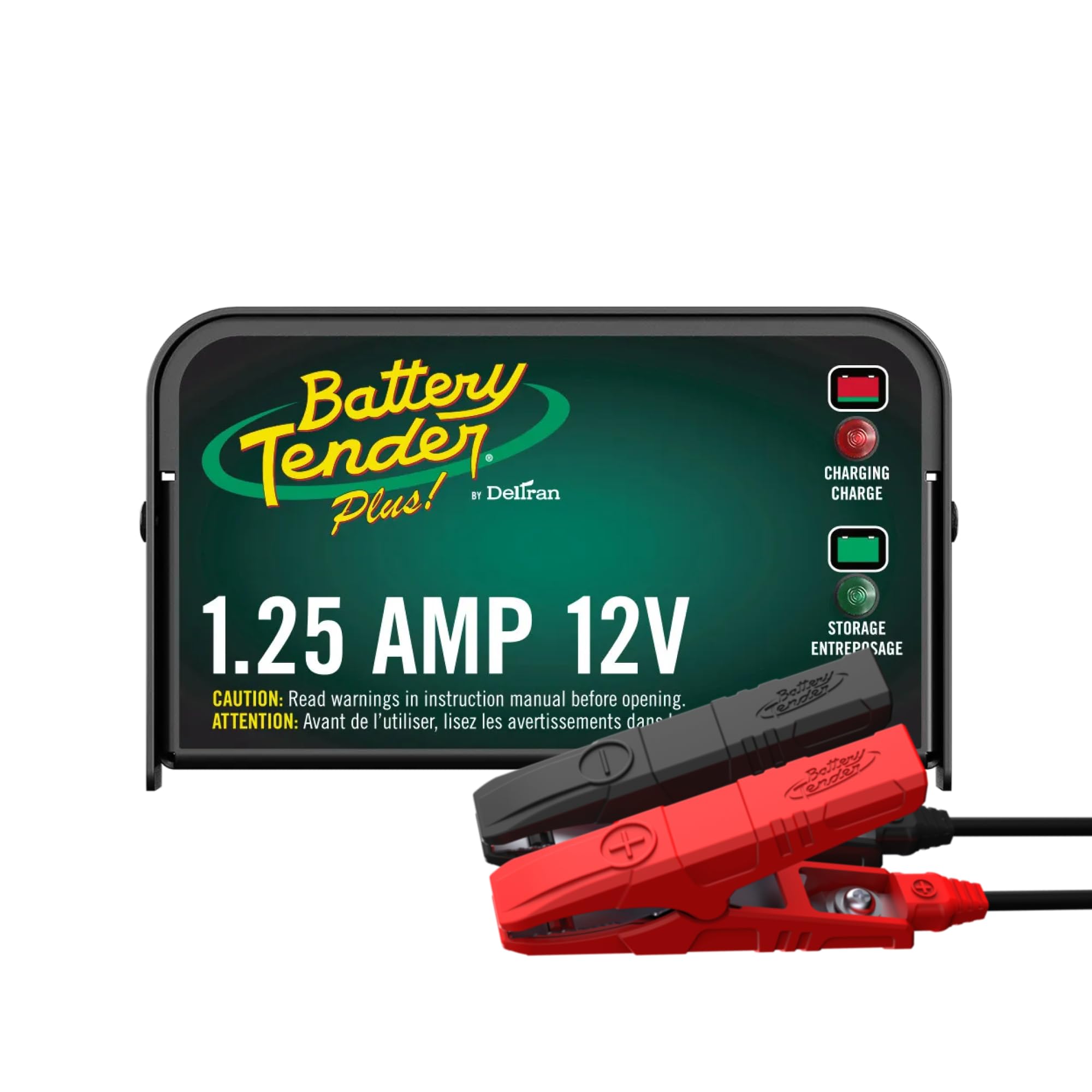
This is the pick for anyone whose real problem is a motorcycle, mower, or ATV that sits for months and then refuses to start. Its output is 1.25 amps, which means it charges gently rather than quickly — exactly what you want when the charger is clipped on for a whole winter. The 4-step program (a staged charge and hold sequence, not one flat blast of current) walks the battery up and then holds it at float so nothing gets overcharged.
Where it pulls ahead of bigger, faster units is day-to-day living. It measures 2.9 inches deep by 2.15 inches wide by 4.4 inches tall and weighs 1.5 pounds, so it tucks onto a shelf or hangs out of the way. Compare that to the NEXPEAK NC202 at 12 by 16 by 5 inches, and you see the difference in footprint plainly. The quick disconnect harness is the part that wins people over — bolt the ring terminal to the battery posts once, then unplug and replug without wrestling with clamps in the dark.
The honest trade-off is speed. At 1.25 amps (a gentle trickle of current), it will not refill a car battery that is flat on Monday morning and needed by noon. It also runs a shorter charging program than the 8-stage NEXPEAK or the 7-stage Mroinge, so it does less repair work on a badly sulfated battery (one crusted with hardened lead sulfate). Buyers who understand that distinction tend to keep it on the shelf for years and report reliable starts every spring. A solid-state two-color LED tells you at a glance whether it is charging or the battery has dropped under load.
battery tender staple
- The 4-step program holds a battery at float instead of overcharging it
- Compact 1.5-pound body fits a shelf or a corner of a garage
- Quick disconnect harness means no clamp-fumbling after the first install
- Two-color LED shows charge state and picks back up if voltage sags
small amp output
- At 1.25 amps it is a maintainer, not a fast rescue charger
- No LiFePO4 profile — it is a 12V lead-acid tool
- The short stage count does less desulfation work on neglected batteries
trickle maintainer: you want to clip something on in autumn and trust it through spring for a bike, mower, or ATV.
fast charging: you need a flat car battery ready for a same-day drive.
2. Smart Battery Charger, Mroinge 5A 6V/12V Automatic Charger / Maintainer / Desulfator
A 7-stage charger that covers 6V and 12V lead-acid plus LiFePO4 for entry-level money.
If you own a mix of battery types — a 6V classic, a 12V AGM in the daily driver, and a lithium pack in a camper — this is the one that saves you buying three chargers. It handles 6V and 12V lead-acid, including wet, gel, AGM, standard, deep-cycle, and maintenance-free, plus 12V LiFePO4 packs up to 160Ah. The 5A output sits in the middle ground: faster than a trickle unit, gentler than the 10A machines.
The 7-stage sequence runs battery test, desulfation, soft start, bulk, absorption, analysis, and float — a complete cycle run by an MCU controller (a small onboard chip that runs the whole charging recipe). The LCD reads out charging status, battery voltage, battery capacity, and a fault code when something is wrong, so troubleshooting does not involve guesswork. It also carries six safety layers: spark-proofing, reverse polarity protection, short-circuit protection, overcharge protection, overheat protection, and a bad-battery identify function.
What earns it shelf space is the 7-stage cycle that protects long-term battery life. The clear expectation to set is pace: this is a 5A machine, so it charges steadily rather than dramatically, and reviewers are split on exactly that. Think of it as a set-and-leave charger for keeping vehicles topped off during storage rather than a jump-start rescue tool.
budget automatic: households with several battery chemistries and no appetite for buying a charger per vehicle.
premium brand: the 5A pace — it maintains and refills, it does not hammer a dead battery back fast.
3. NEXPEAK NC201 10A Car Battery Charger Automotive Trickle Charger 12V 24V Maintainer
Ten amps on 12V, five on 24V, and a screen that shows you the whole charging story.
The practical case for this one is speed plus reach. It delivers 12V at 10 amps and 24V at 5 amps through a 7-stage program, and it covers the lead-acid family — AGM, GEL, SLA, and flooded — in cars, trucks, SUVs, motorcycles, lawn mowers, and boats. If your fleet includes a 24V machine, this is one of the few picks here that speaks that voltage.
You get real numbers instead of a blinking light, thanks to the large LCD. It shows charge voltage and current, inside temperature, charge percentage, and both a summer and winter mode. Pulse repair mode detects sulfation and acid stratification (a chemical layering inside the battery) and works to restore some of the performance a neglected battery has lost. The aim is longer battery cycle life, not an instant revival.
Temperature compensation is the quiet spec worth noticing. It adjusts the charge for hot and cold climates, so a summer garage and a cold winter bay both get treated appropriately. The one hard limit to know going in: it cannot activate or charge a battery that reads zero volts. If your battery is completely flat, look at the NOCO GENIUS5 with Force Mode instead.
quick top ups: you want fast 10-amp top-ups and also run 24V equipment.
delicate batteries: a totally dead 0V battery is beyond its reach.
4. NEXPEAK NC202 10-Amp Battery Charger, 12V 24V LiFePO4 Lead Acid Portable Car Battery Charger

An 8-stage charger with the longer cable and the LiFePO4 profile the NC201 leaves out.
Step up from the NC201 above and you gain two things that matter: a lithium LiFePO4 profile alongside lead-acid, and an 8-stage process instead of 7. Output holds at 12V 10 amps and 24V 5 amps, and the extra stage adds a more careful ramp toward the float that holds a stored battery topped up for months. The compatible list is broad — LiFePO4 or lead-acid, AGM, GEL, SLA, and flooded across cars, trucks, SUVs, motorcycles, lawn mowers, and boats.
The screen and cable are the practical wins here. Extra large LCD, readable under sunlight, showing charge voltage and current, inside temperature, charge percentage, and summer and winter mode. The charge cable runs 10 feet, which makes reaching a battery in a boat or at the far end of a garage far less annoying. There is also a caution baked into the listing worth repeating: charging current above 15A can overcharge a battery and damage its internal chemistry, so a 10A unit is matched to normal car batteries rather than overkill.
You get more charging stages and more cable length than the Battery Tender Plus in position one, but you pay for it in space. This is a 12 by 16 by 5 inch body against the Battery Tender’s 2.9 by 2.15 by 4.4 inch one, so it is a bench machine, not a pocket one. Pulse repair again goes after sulfation and acid stratification, and the same limit as its sibling applies: dead batteries at zero volts will not come back.
lithium lifepo4 ready
- 8-stage charging, the most steps of the NEXPEAK pair
- Handles both LiFePO4 and lead-acid chemistries
- 10-foot charge cable reaches awkward battery locations
- Sunlight-readable LCD with percentage and temperature
menu takes learning
- Larger 12 by 16 by 5 inch body needs bench or shelf space
- Won’t activate or charge a completely dead battery at 0V
- 10 amps exceeds what a small powersport battery wants
lithium owners: a garage running both lead-acid and LiFePO4 packs that wants fast, monitored 10-amp charging.
simple lead acid: you only maintain a small motorcycle battery and want the smallest body possible.
5. CRAFTSMAN 12A Car Battery Charger & Maintainer, 6V/12V – CMXCESM258
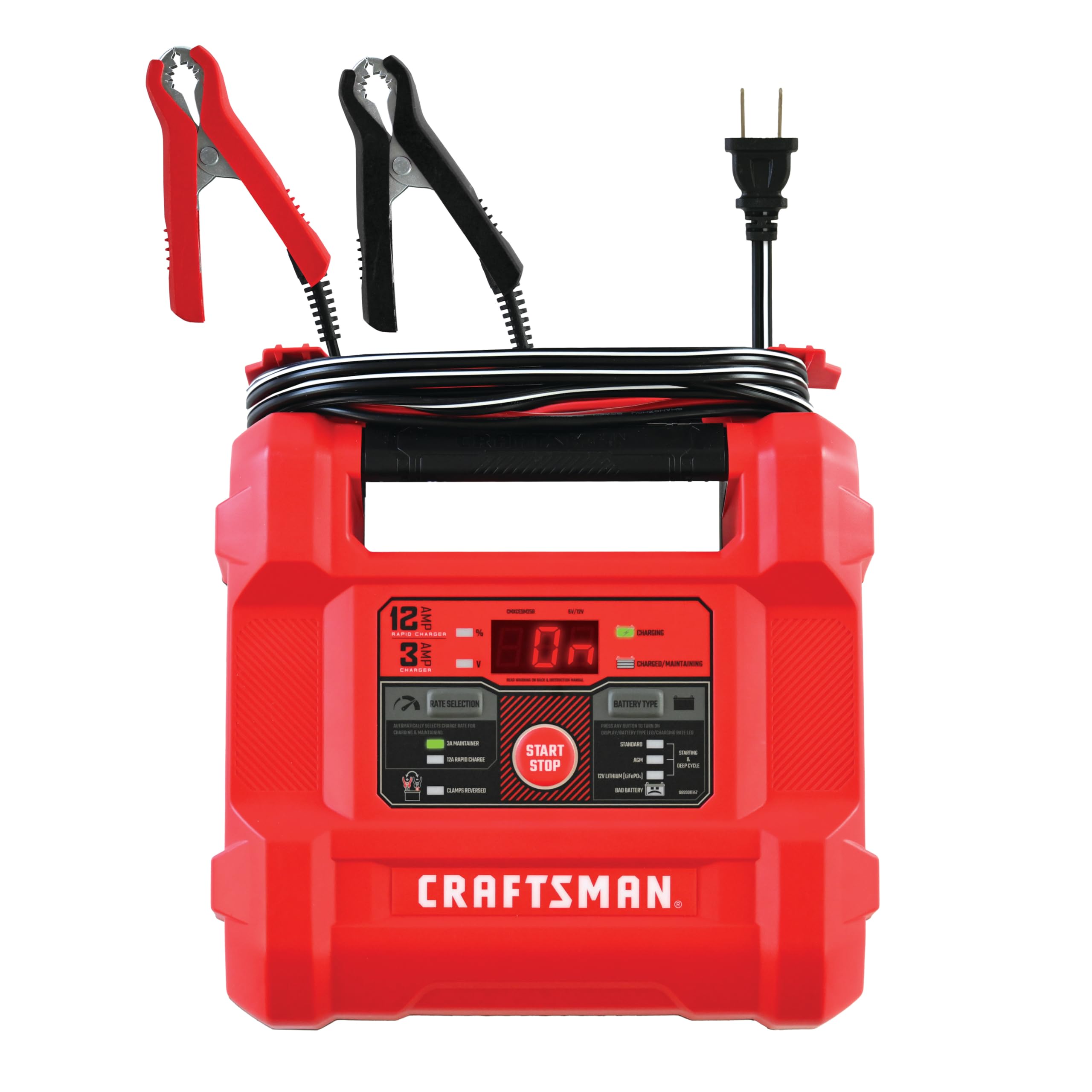
A 12-amp garage machine that charges, maintains, tests, and restores in one box.
The standout here is the 12A output — the highest charge rate on this list — paired with a 4-in-1 job description. It charges, maintains, tests, and restores batteries for cars, motorcycles, ATVs, trucks, SUVs, and boats. It covers standard, AGM, deep-cycle, and 12V lithium LiFePO4 packs. Auto voltage detection sorts 6V from 12V by itself, and reverse hook-up protection means a wrong clamp connection does not fry the unit.
Reach is a real advantage. A 6-foot AC cord plus 6-foot battery cables give 12 feet of total run, which is enough to reach a car parked a bay away from the socket. The digital display and microprocessor control keep the charge sequence running on its own, with a smart trickle stage at the end so a stored battery stays healthy. A desulfation mode goes after build-up on batteries that have been sitting.
The fair caveat is build feel. Reviewers are largely happy with the quality of the charge it delivers, but opinion splits on how solid the housing itself feels, and a handful report a battery that stayed flat after use. That is a small slice of a large pool rather than a pattern. If a heavy, shop-grade casing is what you want in hand, look to the Clore or CTEK below.
craftsman build quality: the 12-amp charge and the 12 feet of reach make it the easiest unit here to live with in a garage.
bulky housing: the housing feels lighter-duty than the specs suggest, so treat the case kindly.
garage workhorse: a home garage wanting maximum amp output plus a test function in one device.
travel use: you want a heavy-duty shop-grade casing above all else.
6. NOCO GENIUS5 5A 6/12V Smart Battery Charger, Trickle Charger & Maintainer

The one that revives batteries the others refuse — all the way down to zero volts.
Most chargers draw a line at a battery that reads nothing. The GENIUS5 crosses it. It can charge batteries from as low as 1 volt, and Force Mode lets you manually push charge into a completely dead battery down to zero volts. If you have ever pulled a neglected battery out of a shed and watched it refuse, that feature is the whole reason to buy this unit.
The rest of the package is built for leaving it connected. An integrated thermal sensor (a built-in temperature probe) adjusts the charge to ambient conditions, so it avoids overcharging in summer heat and undercharging in winter cold. It handles 6V and 12V lead-acid — AGM, gel, SLA, VRLA, flooded, maintenance-free, deep-cycle, marine, and powersport — plus lithium LiFePO4. NOCO also states it is 34% smaller and delivers over 65% more power than the brand’s own G3500. Precision pulse charging goes after sulfation and acid stratification.
The detailed spec to check against your routine: the mounted package includes a 72-inch AC cable and an 80-inch DC cable with clamps and integrated eyelet terminals, plus a mounting bracket and screws. That bracket means it can live permanently under a bonnet or on a garage wall. The honest friction is the user guide — setup instructions draw the most criticism of anything on this unit, so plan to work out the modes yourself or find a walkthrough online.
set and forget: your batteries sit neglected and you want the best shot at bringing them back to life.
large banks: thin printed instructions — the charger is smarter than the leaflet explains.
7. ECO-WORTHY 12V 10A Battery Charger for Lead-Acid and LiFePO4 Battery

A 10-amp 12V charger that puts its speed front and centre and stays simple to hook up.
This is a single-voltage machine, and that focus works in its favour. Output is fixed at 12V 10 amps, with two battery-type options — 12V lead-acid and 12V lithium LiFePO4. A stated 3-hour charge time makes it one of the quicker 12V units here. Owners consistently single out how fast it fills a battery compared to what they expected, and it hits that speed without the 6V or 24V modes the NEXPEAK units add.
Connection is deliberately low-fuss. The included battery clip and O-ring terminal cable run through a 10A fuse, and the SAE connector (a standard two-pin plug found on many vehicle wiring harnesses) lets you disconnect in one motion. Intelligent detection prompts you to repair and charge when it reads low voltage, sulfation, or lost capacity — and it will tell you outright when a battery has lost its value rather than pretending to fix it.
The thing to know before you plug in: it warms up noticeably in use, and that heat is the most-discussed downside. It is normal for a 10-amp charger to run warm, but give it airflow rather than burying it under a rag. Reviewers are split on how well batteries hold charge afterward — for some it maintains beautifully, for others less so.
eco worthy value: 12V 10A with a stated 3-hour charge time puts it ahead of the 5A machines here on raw pace.
runs warm: it runs warm through a charge cycle, so sit it somewhere it can breathe.
lead acid packs: you want a fast, simple 12V-only charger for car and camper batteries.
continuous loads: your fleet includes 6V or 24V batteries the fixed 12V output cannot serve.
8. Clore Automotive PL2310 10-Amp Fully-Automatic Smart Charger, 6V and 12V

Three selectable charge rates and a power supply mode make this the tinkerer’s pick.
The differentiator here is choice. You can pick 2, 6, or 10 amps depending on the job — 2 amps for a slow overnight top-up on a small battery, 10 amps when you want to push. The charging process itself is multi-phase and fully automatic, so once you select the rate the unit runs the cycle on its own across 6V and 12V batteries.
Power supply mode is what separates it from every other charger here. Instead of charging, it holds a stable system voltage, which is useful when you are doing electrical work and want the vehicle’s systems kept live. That is a garage-utility trick the strictly-charging units do not offer. The charger is solidly built at 3.9 pounds, and owners note it holds its own against the well-known premium chargers and shows battery percentage as it charges.
Two honest notes. The instruction sheet draws the most complaints of anything on this pick, so expect to work out the modes from the display rather than the paperwork. And while the charge quality is well regarded, there is some split on battery life afterward — for many it maintains happily, for a few it did not lift a tired battery back.
hands off charging: someone who wants to pick a gentle 2A trickle one day and a 10A push the next.
display lovers: the sparse instructions and 3.9-pound body suit a permanent garage spot.
9. CTEK CT5 12V Automotive Battery Charger for Auto, Motorcycle, ATV, Snowmobile

A slim 1.1-amp maintainer with a Recond mode for battery packs that have been deeply drained.
This is the smallest-footprint machine on the list and the one aimed squarely at powersports. It handles motorcycles, ATVs, JetSkis, and snowmobiles, with 12V lead-acid including AGM and 12V lithium LiFePO4 support. At 1.1 amps it is a maintainer first — built to hold a healthy battery at full charge over a winter, not to throw amps at a flat one.
The feature that gives it a niche is Recond mode, which reconditions deeply discharged batteries. Normal mode runs tune for all lead-acid batteries. It ships as a complete kit — alligator clamps, quarter-inch eyelets, and a storage drawstring bag — with a 5-year limited warranty behind it. The eyelet terminals mean you can leave a permanent connection on a bike and plug in without opening anything.
The rating on this page sits at the very top of the list, and the consistency of the build is the reason. The honest limitation is the amp rating. If your problem is a car battery that dies flat, 1.1 amps will take a long time to fill it, and there is no 10-amp mode to switch to. That narrow focus is exactly what makes it ideal for a stored motorbike and less ideal as a single charger for everything.
ctek swedish design: a slim build with a Recond mode and a 5-year limited warranty, sized for storage rather than speed.
higher price: 1.1 amps means it maintains small batteries, not revives a flat car battery quickly.
long term care: you garage a bike, ATV, or snowmobile and want a permanent eyelet connection through the off-season.
tight budgets: you need one charger that will also fast-fill a flat car battery.
Understanding the Specs
Amperage — the amp figure on the box
How hard a charger pushes current depends on its amp rating (amps measure current flow). A 1.1 or 1.25 amp unit is a maintainer: it holds a healthy battery full and is gentle over long storage. A 5 amp unit sits in the middle for general top-ups. A 10 or 12 amp unit is the fast-recovery tool for a car or deep-cycle battery. Buy the amp figure to match the battery you actually own. A 10 amp charger on a tiny powersport battery is more current than that battery wants, while a 1.25 amp charger will take a very long time to refill a flat car battery.
Charging stages — the recipe the charger runs
A stage is one phase of the charging process. A test stage reads the battery, desulfation works on build-up, soft start eases in, bulk and absorption push the main charge, analysis checks the result, and float holds it topped up. More stages usually means a more careful climb and a safer long-term hold. The 4-step program on the Battery Tender Plus is a concise version of the same idea, while the 8-stage NEXPEAK NC202 and the 7-stage Mroinge break the process into finer steps.
Battery chemistry — lead-acid versus LiFePO4
Flooded, AGM, GEL, and deep-cycle are all lead-acid variants, and most automatic chargers here cover the whole family. Lithium LiFePO4 needs a different charge profile, so a lead-acid-only charger should not be pointed at it. If you own a lithium pack, buy a unit whose listing names LiFePO4 outright, like the NEXPEAK NC202, CRAFTSMAN, NOCO GENIUS5, ECO-WORTHY, or CTEK CT5.
Desulfation and repair modes
Sulfation is the hard layer that forms on battery plates as a battery sits discharged. A desulfation mode sends pulses intended to break it down over a repair cycle, which is how a neglected battery recovers usable performance. It is not a fix for a battery reading zero volts — several chargers on this list, including the NEXPEAK units, state that limit plainly. Treat repair mode as care for a tired battery, not a reset button for a dead one.
FAQ
Can an automatic battery charger be left connected for months through winter?
Will a 10 amp charger damage a small motorcycle battery?
Does an automatic battery charger work on a completely dead battery?
What is the difference between a trickle charger and a maintainer?
Can I use a lead-acid charger on a LiFePO4 battery?
How long does a 10 amp charger take to fill a car battery?
Do I need to disconnect the battery from the car to charge it?
Why does my charger get hot during charging?
How should I store a battery in the off-season?
What does desulfation mode actually do?
Final Thoughts: The Verdict
For most people’s real routine, the automatic battery charger to buy is the Battery Tender Plus 12V 1.25 AMP. Its 4-step program and float hold let you clip it on through a whole winter and simply trust the battery will be ready. If you run a mixed fleet with a lithium pack alongside lead-acid, the NEXPEAK NC202 covers both chemistries with the most charge stages of its family. And for a neglected battery you thought was gone, reach for the NOCO GENIUS5: Force Mode lets it push charge into a battery down to zero volts that every other unit here will refuse.
How We Picked
We do not accept paid placement. Every pick is matched to a real buyer and a real use-case; we do not hands-on test units.
Sources & Methodology
Specifications: manufacturer listings and product documentation. Review insights: verified customer reviews, as of November 2026. Pricing: not shown on this page (it changes often); check the current price via the retailer link.
As an Amazon Associate, Gadgets Feed earns from qualifying purchases. This does not affect which products we feature.