
Our readers keep the lights on and my morning glass full of iced black tea. As an Amazon Associate, I earn from qualifying purchases.
Specs are compiled from manufacturer listings and verified buyer reviews and can change over time — please confirm the key details on the product page before buying.
You want real photographs — not phone shots that fall apart the moment you zoom. The trick with a bargain camera is knowing which corners a maker can cut safely (filters, packaging, brand badge) and which ones wreck your pictures (autofocus that hunts, a sensor too small to hold detail). This guide sorts the nine point-and-shoots and DSLR kits that actually hold up, so you spend less and still get sharp files.
I’m Min — the founder and writer behind Gadgets Feed. This guide is built by comparing the manufacturers’ published specifications and the patterns across verified customer reviews, so you get each pick’s real strengths and trade-offs instead of marketing spin.
Every camera below is judged on the numbers that show up in your photos and your camera bag, not the badge on the front. Start with the zoom range you truly need, then check the sensor and screen — that order is what separates a smart purchase from a shelf ornament, and it is exactly how this list of the bargain camera options was ranked from top pick to last.
Our Picks at a Glance
How To Choose The Best Bargain Camera
A bargain camera is not a worse camera — it is a camera where the money went into the lens and the sensor instead of the badge. Get three things right and almost everything else sorts itself out.
Optical zoom versus digital zoom
Optical zoom is the lens physically moving to magnify a distant subject, so every pixel you capture is real detail. Digital zoom simply crops the frame and blows it up, which is why digital-zoom shots look soft and blocky. The KODAK PIXPRO FZ55 gives you 5x optical zoom in a pocket body — enough to pull a stage performer or a seagull closer without mush. A camera listing 18X or 16X digital zoom is working a different, softer kind of magic, so read which word sits in front of the number.
Megapixels tell you less than you think
Megapixels count the dots in a photo, and past a certain point they stop helping. The KODAK PIXPRO FZ55 packs a 16MP sensor, while the 8K Digital Camera with the 4.0″ touchscreen advertises 90MP — and its own listing admits those 90MP photos are interpolated, meaning software inserts extra pixels. A modest, honest sensor usually beats a big inflated number, especially indoors where light is scarce.
Screen, stabilization, and what sits in the box
A flip screen lets you frame yourself for vlogs and selfies, so check the hinge direction if you plan to talk to the lens. Image stabilization — a system that nudges the lens or sensor to cancel your hand shake — matters most at long zoom, which is why the KODAK PIXPRO AZ528 pairs its 52x reach with built-in stabilization. Finally, count the extras: cards, spare batteries, and a bag can add real cost later, so a kit that includes them is doing you a favor.
Quick Comparison
| Model | Best For | Sensor / Stills | Zoom | Screen | Amazon |
|---|---|---|---|---|---|
| KODAK PIXPRO FZ55 Bundle★ Best Overall | All-round bargain travel camera | 16MP | 5x optical | 2.7″ LCD | Amazon |
| 5K Digital Camera 80MP VloggingBest for Vloggers | Vloggers who want flip-screen video | 80MP | — | 3.0″ IPS 270° flip | Amazon |
| 8K Digital Camera 88MP AutofocusBest Starter Kit | Beginners wanting a full starter kit | 88MP | 18X digital | 3″ 180° flip | Amazon |
| 6K WiFi Flip Screen Camera | Content creators on a tight budget | 64MP | 16X zoom | Flip screen LCD | Amazon |
| 8K Digital Camera 90MP Touchscreen | Touchscreen control and lens swaps | 90MP (interpolated) | 16X digital | 4.0″ touch | Amazon |
| Canon PowerShot SX420 is (Renewed) | Long optical reach in a small body | 20.0MP | 42x optical | 3.0″ LCD | Amazon |
| Canon EOS Rebel T3 Kit (Renewed) | Upgrade path into DSLR lenses | 12.2MP APS-C CMOS | 18-55mm kit lens | 2.7″ LCD | Amazon |
| KODAK PIXPRO AZ528 | Wildlife and sports at long range | 16MP BSI CMOS | 52x optical | 3″ LCD | Amazon |
| Nikon D3100 DSLR Kit (Renewed) | Learning real photography cheaply | 14.2MP CMOS | 18-55mm VR lens | 3″ LCD | Amazon |
In‑Depth Reviews
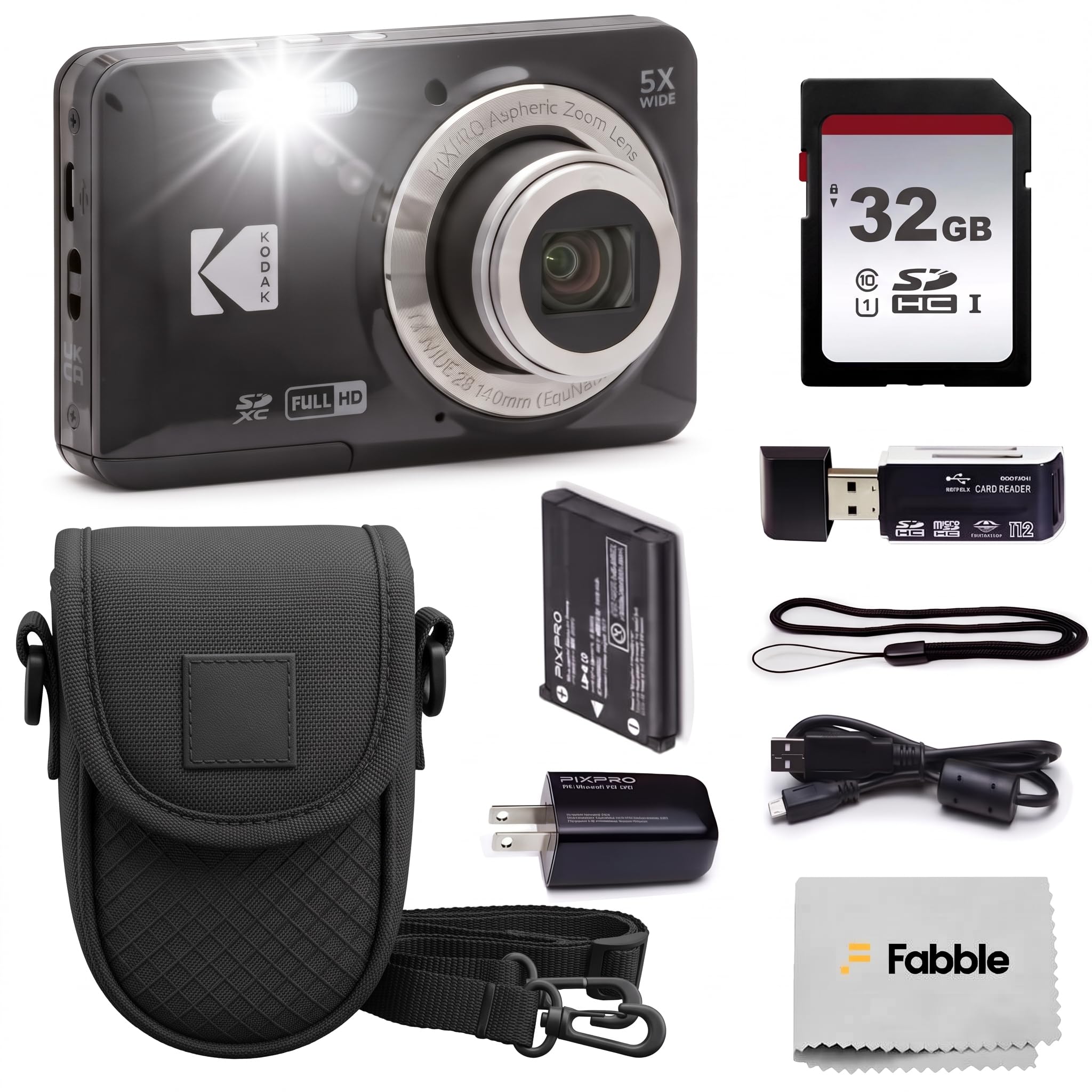
1. KODAK PIXPRO FZ55 Compact Zoom Digital Camera Bundle
Our pick — 4.5+★ from 300+ verified ratings; the strongest balance of quality and price.
A pocket 5x zoom that shoots sharp stills without a menu tree to learn.
Here is the camera that proves a bargain does not mean a compromise — 4.5+ stars across 300+ owners, and the most-praised thing by far is what you get for the money. Its 16MP sensor captures photos with genuinely fine detail, which is why picture quality sits right behind value as the thing buyers talk about. Zoom in with the 5x optical lens, a true lens move rather than a software crop, and a face across a park still lands sharp.
That 28mm wide-angle lens (a wider-than-average view that fits a full group or a whole room) means you are not backing into a wall to get everyone in. And the 2.7″ LCD screen on the back lets you frame and review shots without squinting. It weighs about as much as a paperback, so it disappears into a jacket pocket — the kind of camera you actually bring along.
Compare it to the 8K Digital Camera at the premium end and the numbers tell a story: this one holds 16MP against a 90MP rating, yet its 4.0″ vs 2.7″ screen gap runs the other way — the big-screen model is wider, this one is more compact to carry. Where this KODAK wins is honesty: it records real 1080P Full HD video (the standard sharpness for YouTube and family clips) with no inflated megapixel math. The one thing to know: some owners find the recording controls a touch fiddly at first, so plan a short practice session before your trip.
What buyers keep coming back to
- 16MP sensor delivers detailed stills for the tier
- 5x optical zoom plus a 28mm wide-angle lens covers both close-ups and group shots
- Compact and light enough to live in a pocket
- 1080P Full HD video for everyday clips
Where you will notice the trade-offs
- The 2.7″ LCD is the smallest screen on this list
- Recording controls take a little practice to learn
Reach for this if: you want one small camera for travel, family, and everyday photos that is simple to run.
Look elsewhere if: you need a flip screen for vlogging or a long battery-busting shooting day.
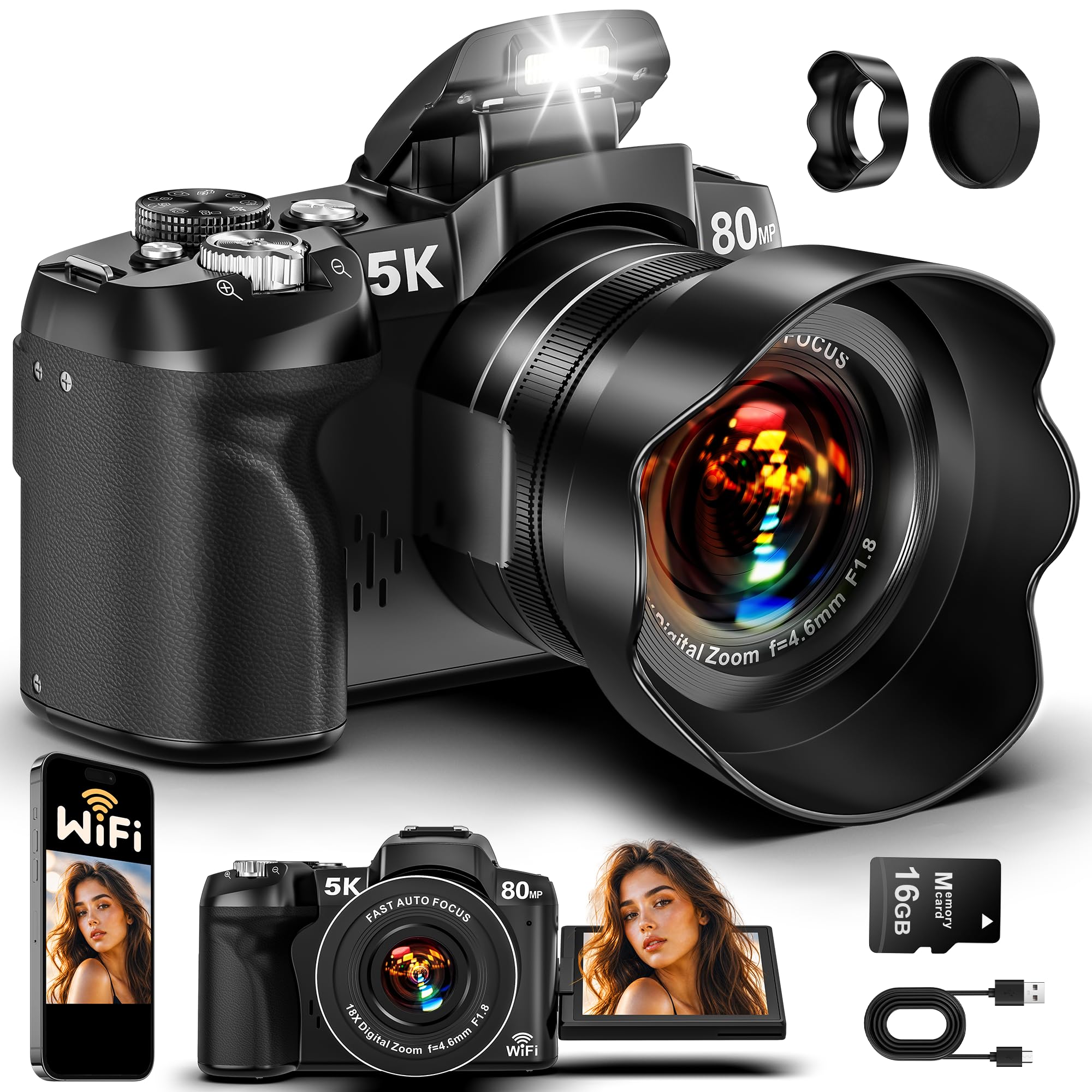
2. 5K Digital Camera 80MP UHD Vlogging Camera with Autofocus and WiFi
A 270° flip screen for self-framing, with 5K video and 80MP stills.
For anyone building a channel, the 3.0″ IPS screen that swivels a full 270° is the reason to start here. It lets you see yourself while you talk, and the IPS panel (a screen type that keeps colors steady when you view it off-angle) means the preview does not wash out at arm’s length. Video tops out at 5K Ultra HD, while photos run to 80MP stills — high-resolution specs that make both your thumbnails and your prints look crisp.
The fast autofocus locks onto a subject quickly, and the listed focus range runs from 3.93 inches to 6.56 feet, so close-up detail work is within reach. A lithium-ion battery keeps recording for over 120 minutes, and the package includes a memory card, battery, lens cap, and strap — ready to shoot rather than ready to shop. There are 30 built-in filters and a rotatable mode dial for time-lapse and loop recording.
One number stands out against the field: Its 120-minute recording run compares with the 8K Digital Camera’s 90-minute battery. Picture quality is the aspect that wins the most fans here, with ease of use close behind. The fair caveat is the control layout — a beginner-friendly camera will always ask for a little time with the manual before the menus feel second nature.
Why it edges ahead: a 270° flip screen, 5K video, and a 120-minute battery make this a genuine vlogging setup rather than a point-and-shoot with a wide name.
The honest note: 80MP stills and 5K video are large files, so budget for a bigger memory card than the included one.
Suits: vloggers, students, and anyone who wants to see themselves on screen while recording.
Think twice if: you shoot mostly distant subjects — this is a wide-view camera built for faces, not far-away action.
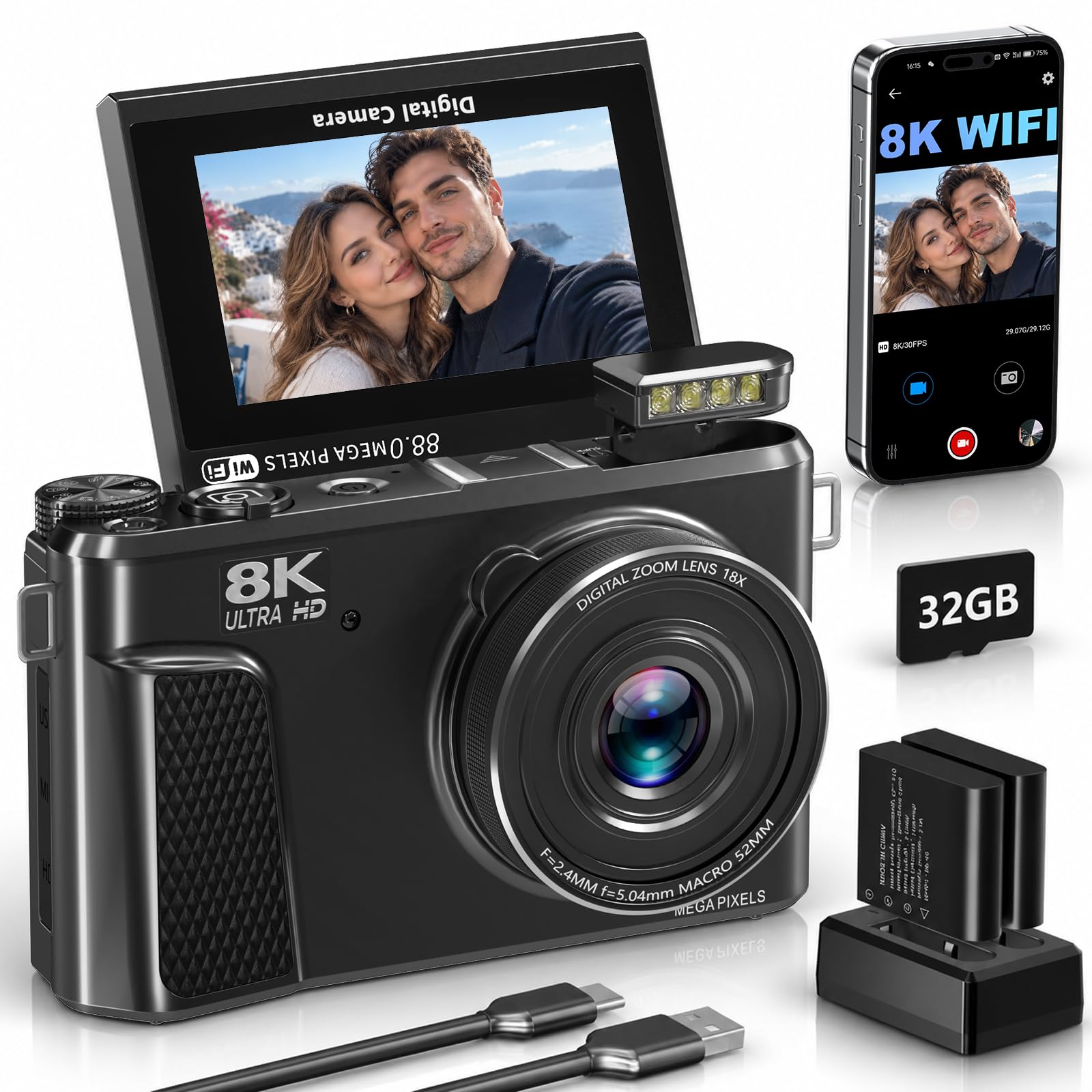
3. 8K Digital Camera, 88MP Autofocus Camera for Beginners
Two batteries, a 32GB card, and a bag in one box — a first camera ready on day one.
Most beginner cameras make you buy the basics separately. This one hands you a 32GB memory card, 2×1500mAh batteries, a dual charger, and a camera bag in the same box — the whole kit is ready for a trip on day one. Photos shoot up to 88MP and video up to 8K, and the 3″ screen flips a full 180° so you can frame selfies and vlog shots without guessing.
Autofocus uses phase detection (a focusing method that locks the subject faster than the contrast-based system on the KODAK FZ55) and pairs with anti-shake to fight blur from shaky hands. An 18X digital zoom stretches the frame further, though digital zoom enlarges pixels rather than resolving new detail. Continuous shooting runs at 5 frames per second, and built-in flash helps at evening gatherings and indoors.
WiFi transfer sends photos straight to your phone for quick sharing, and there are creative modes for time-lapse, slow motion, and filtering. The trade-off worth knowing: the battery is rated up to 90 minutes, which is why a second cell in the box matters — swap it mid-day rather than cutting your outing short.
In the box on arrival
- Two 1500mAh batteries plus a dual charger
- 32GB memory card, camera bag, and accessories included
- 180° flip screen for selfies and vlogs
- Built-in WiFi for phone transfers
The honest limits
- Rated battery life tops out at 90 minutes, so carry the spare
- 18X is digital zoom, not optical reach
Pick this for: a gift or first camera where everything needs to be in one box.
Skip the swap if: you already own cards and batteries and would rather put that money into optical zoom.
4. 6K WiFi Flip Screen Digital Camera with Mic and Fill Light

A wide-plus-macro two-lens kit with a microphone and fill light in one bag.
This 6K WiFi camera carries two lenses: a wide-angle for landscapes and a macro lens for close-ups, plus 16X zoom for stretching the frame. Photos shoot up to 64MP, and the flip screen makes self-framing easy for travel and family use. The unusual part is what comes with it — a microphone for clear audio, a bi-color fill light for warm or cool tones, and a lens hood to cut glare.
Quality is the aspect buyers mention most often, and the camera handles both stills and 6K Ultra HD video. The 500+ ratings on this one make it one of the most-reviewed products here, and it is easy to see why: the 64GB card, two batteries with a charging stand, mic, light, and hood add up to an all-in-one creator pack. USB-C also lets you run it as a webcam for live streaming.
It is also the pick with the most honest split — the overall rating sits at 4.0+, which tells you a chunk of buyers find it good but not flawless. The dual-lens design is genuinely useful for switching between landscapes and macro detail without swapping glass.
The creator’s shortlist: mic, fill light, 64GB card, and two batteries in the box — this is the most complete starter package here for talking-head video and TikTok-style clips.
Size the caveat: the 4.0+ rating against 500+ buyers means most are content, but a share find it merely fine — buy it for the accessory value, not the badge.
Best matched to: new YouTubers and TikTok creators who want lighting and audio handled in one purchase.
Look past it if: you care most about a top score — higher-rated picks sit above this one.
5. 8K Digital Camera, 90MP Camera Fotografica with 4.0″ Touchscreen

The list’s biggest screen at 4.0″, plus a 52mm mount that accepts add-on lenses.
Tap-to-focus on a 4.0-inch capacitive touchscreen is the headline here, and it is a real upgrade for anyone tired of pecking at buttons. That 4.0″ display sits next to the KODAK FZ55’s 2.7″ screen, so reviewing shots and framing selfies is easier on the eyes. Video records at 8K (7680×4032 at 15FPS), and stills top out at 90MP — a figure the listing itself calls interpolated, meaning the camera scales up the pixel count in software.
A 52mm standard lens mount is the quiet win: it accepts external UV, wide-angle, and telephoto lenses (sold separately), so this body can grow as your skills do. The 3000mAh battery supports charging while you record, which solves the mid-shoot drain problem. Built-in WiFi sends previews and clips to your phone, and 11 filters plus slow-motion and time-lapse modes save you post-editing time.
The kit includes a 64GB micro SD card, HDMI and USB cables, a wrist strap, a lens hood, and a cloth. Compare its 90MP against the KODAK FZ55’s 16MP and the gap is dramatic on paper — but remember that a software-upscaled 90MP is not the same as a native 90MP, so expect big files without a huge jump in low-light detail. There is no built-in flash on this model, so plan for decent room light or add your own.
For you if: a big touchscreen and the option to add glass later are worth more than a flash.
One caveat to accept: no built-in flash means low-light shots need steady hands or extra light.
6. Canon PowerShot SX420 is 42x Optical Zoom (Renewed)

42x optical zoom with image stabilization in a body that still fits one hand.
Real lens reach is the reason to consider this Canon: 42x optical zoom with an optical image stabilizer, which physically counters hand shake so long shots stay usable. A 20.0MP sensor with Canon’s DIGIC 4+ image processor handles detail, and a 3.0-inch LCD with a wide viewing angle makes framing and sharing simple. Built-in Wi-Fi and NFC push photos to your phone without a cable.
That 42x optical figure dwarfs the 5x optical on the KODAK FZ55 — if birds on a far branch are the goal, this is a different league of reach. Aspect ratios cover 16:9, 3:2, 4:3, and 1:1. It is a renewed unit, meaning refurbished rather than factory-fresh, so inspect the lens and battery on arrival.
Here is the honest part: this is the lowest-scoring camera on the list, and the mix of feedback points to inconsistent quality across renewed units. Some buyers get a great shooter; others feel the performance did not match the sub-brand promise. Read it as a fit question — if a long stabilized zoom is what you need and you are willing to verify a renewed unit, it delivers reach you will not find elsewhere at this tier.
Why the zoom is the story
- 42x optical zoom with optical image stabilization
- 20.0MP sensor and DIGIC 4+ processor
- Built-in Wi-Fi and NFC for phone transfer
Read this before you buy
- Renewed unit, so condition varies
- Lowest rating on this list — quality feedback is split
A fit for: anyone who needs 42x stabilized reach and will check a renewed unit carefully.
Better to pass if: you want a guaranteed-fresh camera with a top score.
7. Canon EOS Rebel T3 Digital SLR Camera 12.2MP Lens Kit (Renewed)

A real DSLR body with a real lens — the cheapest honest door into interchangeable glass.
Most cameras here have a fixed lens you will never change. This Rebel T3 does not: an APS-C CMOS sensor (a sensor noticeably larger than the tiny chips inside point-and-shoots) sits behind an EF-S mount that accepts the kit’s 18-55mm f/3.5-5.6 lens and any later glass you add. At 12.2MP the pixel count looks modest next to the 90MP claims above, but a larger sensor gathers more light per pixel — the physical reason serious shooters still reach for DSLRs.
Continuous shooting runs at up to 3 frames per second, and a 9-point autofocus system tracks subjects across the frame. ISO (light sensitivity) spans 100-6400, and video records at 720p HD. The 2.7-inch LCD carries 230,000 dots, and the Basic+ control menu keeps settings reachable for newcomers.
This is a renewed kit, so check shutter count and lens glass the day it lands. The upside is enormous: an actual DSLR body with the lens included, which sets you up to upgrade lenses far more cheaply than replacing camera bodies every couple of years. For a learner who wants to understand aperture and shutter speed rather than trust auto mode, this is the smart buy.
The upgrade-path pick: an EF-S mount and included 18-55mm lens mean you can grow into better glass later — something no fixed-lens camera on this list allows.
The catch to know: 12.2MP and 720p video are modest by modern numbers, so buy it for learning and lens flexibility, not for big prints or 4K video.
Choose this if: you want to learn manual photography and add lenses over time.
Leave it if: you want a light carry-everywhere camera — a DSLR body and lens add heft a pocket zoom never will.
8. KODAK PIXPRO AZ528 16MP Digital Camera, 52x Optical Zoom, Wi-Fi

Fifty-two times zoom with the stabilization to keep a far branch steady.
A bird on the far bank is exactly what this camera was built to answer. The 52x optical zoom reaches distant subjects through a 24mm wide-angle lens and a genuine lens magnification — no digital crop cheating. Built-in optical image stabilization (OIS) counters hand movement even at full 52x reach, which is the difference between a crisp frame and a smear. A 16MP BSI CMOS sensor, a back-side-lit chip type that helps in dim light, keeps the detail intact.
Burst mode fires at 6 frames per second, so you can catch a sprinter or a scoop of fast-moving birds and keep the sharpest shot. Video records at 1080p Full HD. Wi-Fi pushes images straight to your phone from the field or flips the phone into a live remote viewfinder. The rechargeable Li-ion battery powers extended sessions, and the card slot accepts Class 10 SD, SDHC, or SDXC cards up to 1.5TB.
Zoom is the draw, but the honest note is that picture quality and zoom both land in mixed territory for some buyers — a few find long shots softer than hoped, and autofocus earns occasional gripes. Quality is still the aspect mentioned most often in praise, and value runs second. Treat it as a bird-and-sports specialist that shines in good light and asks patience in low light.
The reach champion: 52x optical zoom with OIS puts far-away detail in frame without a tripod — more optical reach than the Canon PowerShot’s 42x.
Set expectations: autofocus and picture quality draw some mixed notes, especially at the long end — lean on the 6fps burst to keep the sharp frame.
Made for: wildlife, sports, and anyone who shoots across distance in daylight.
Not for: low-light indoor shooting, where the sensor has to work harder.
9. Nikon D3100 14.2MP DSLR Camera with 18-55mm VR Lens (Renewed)

A 14.2MP sensor and a vibration-reduction lens for real low-light DSLR work.
Low-light shooting is where the D3100 earns its place: standard ISO runs up to 3200, with an extended Hi 2 setting reaching ISO 12800-equivalent, so evening and indoor scenes stay usable. A 14.2MP CMOS sensor feeds Nikon’s EXPEED 2 image processor, which suppresses noise and holds colors true. The included 18-55mm VR lens adds vibration reduction — Nikon’s version of stabilization — to counter your hand shake.
Continuous shooting hits 3 frames per second, and an 11-point autofocus system tracks your subject. Video records in 1080p Full HD with D-Movie and full-time servo AF (autofocus that keeps adjusting during recording). A 3-inch, 230,000-dot LCD with diopter adjustment rounds out the viewfinder-friendly layout. The lens kit alone is note in a bargain camera — it is real glass, not a plastic placeholder.
Compare it to the Rebel T3 above: this Nikon has 14.2MP against 12.2MP, and it reaches 1080p video where the Canon stops at 720p — both meaningful jumps for a starter DSLR. This is a renewed, discontinued model, so check the shutter mechanism and glass on arrival. For a learner chasing wide ISO range and stabilization, it is a sensible place to land.
Where it works hard for you
- ISO up to 3200, extended to ISO 12800-equivalent
- EXPEED 2 processor suppresses noise
- 18-55mm VR lens includes vibration reduction
- 1080p Full HD movie recording
What to plan around
- Renewed, discontinued model — verify condition on arrival
- Older DSLR body, so expect more weight than any pocket camera here
The right call for: beginners who want a stabilized lens and real ISO headroom for indoor and evening photos.
Consider the alternative if: you prefer a factory-fresh unit — this one is renewed and longstanding.
Understanding the Specs
Sensor and megapixels: quality versus quantity
A sensor is the light-catching chip at the heart of any camera, and its physical size often matters more than the megapixel count printed on the box. Megapixels measure how many pixels make up the photo — more of them means more cropping room and bigger prints, but a small chip stuffed with pixels can gather less light per pixel. That is why the KODAK PIXPRO FZ55’s 16MP sensor competes with 90MP claims that the listing itself calls interpolated. Look for “BSI” or “APS-C” in the spec to judge how much light the chip can take in; the 8K 90MP model and the big-zoom point-and-shoots sit in different leagues from the Nikon D3100’s APS-C-class CMOS sensor.
Optical zoom, digital zoom, and stabilization
Optical zoom means the lens physically magnifies the scene, so every pixel is real detail — the 5x on the KODAK FZ55 and the 52x on the KODAK AZ528 both work this way. Digital zoom simply crops and enlarges pixels, which is what the 16X and 18X figures on the budget point-and-shoots describe. Pair long zoom with stabilization: the AZ528 uses built-in OIS, while the Nikon D3100’s lens uses vibration reduction, and both counter hand shake at reach. A 4.0″ touchscreen like the one on the 90MP model makes framing easier, and WiFi lets you push shots straight to your phone.
FAQ
Is optical zoom really better than digital zoom on a bargain camera?
Do I need 90 megapixels if most of the list has 16MP?
Will a renewed Canon or Nikon DSLR still work reliably?
How much battery life should I expect from these cameras?
What is the difference between a flip screen and a touchscreen?
Can these cameras connect to my phone?
Do I need image stabilization for a long-zoom camera?
Can I add lenses to a bargain camera later?
Are these cameras good for beginners who have only used a phone?
What memory card do these cameras need?
Final Thoughts: The Verdict
For most people hunting the best bargain camera, the KODAK PIXPRO FZ55 is the pick to beat — 4.5+ stars across 300+ owners, a 16MP sensor, 5x optical zoom, and 1080P video in a body you can slip into a jacket. If you are building a channel, the 5K vlogging camera’s 270° flip screen and 120-minute battery suit you better. And if you want to learn real photography with a lens you can upgrade, the Nikon D3100’s ISO range and vibration-reduction lens make it the smarter long-term buy. That small, unassuming FZ55 is the crowd favorite for a reason — start there and you rarely regret it.
How We Picked
We do not accept paid placement. Every pick is matched to a real buyer and a real use-case; we do not hands-on test units.
Sources & Methodology
Specifications: manufacturer listings and product documentation. Review insights: verified customer reviews, as of November 2026. Pricing: not shown on this page (it changes often); check the current price via the retailer link.
As an Amazon Associate, Gadgets Feed earns from qualifying purchases. This does not affect which products we feature.